Wrapper Classes
10/02/13 RENAISSANCE SOFTLABS (P) LTD. 2
Problem with Primitives
 Java is an object-oriented language. Means, everything in
Java is an object
 But, how about primitives?
 Primitives cannot participate in the object activities, such as
 Returned from a method as an object
 Adding to a Collection of objects
 As a solution to this problem, Java allows you to include the
primitives in the family of objects by using Wrapper classes
10/02/13 RENAISSANCE SOFTLABS (P) LTD. 3
Creating Wrapper Classes
 For to each primitive data type in Java there is
corresponding wrapper class
 This class encapsulates a single value for the primitive
data type
 The wrapper object of a wrapper class can be created
in one of two ways:
 By instantiating the wrapper class with the new operator
 By invoking a static method on the wrapper class
10/02/13 RENAISSANCE SOFTLABS (P) LTD. 4
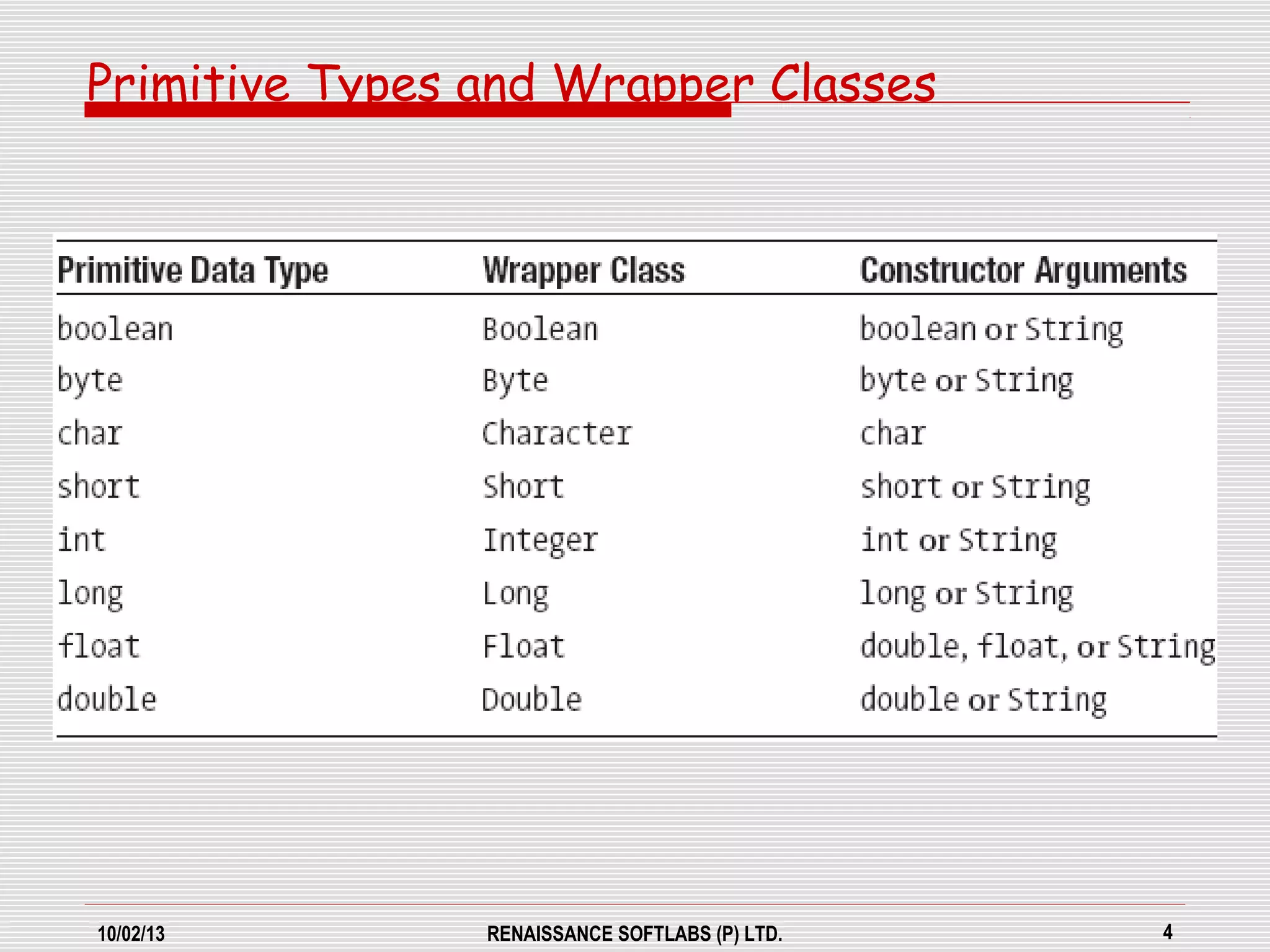
Primitive Types and Wrapper Classes
10/02/13 RENAISSANCE SOFTLABS (P) LTD. 5
Creating Wrapper Classes with new Operator
 Obviously, you can always pass the corresponding primitive data
type as an argument to a wrapper class constructor
 You can also pass a String as an argument to any wrapper class
constructor except Character
 The Character constructor only takes the obvious argument: char
 You can pass double as an argument to the Float constructor but
not vice versa
 All the wrapper classes except Boolean and Character are
subclasses of an abstract class called Number
 Boolean and Character are derived directly from the Object class
10/02/13 RENAISSANCE SOFTLABS (P) LTD. 6
Another way of Creating Wrappers
 The wrapped value in a wrapper class cannot be modified
 To wrap another value, you need to create another object
 Wrappers are immutable
 There will be situations in your program when you really don’t
need a new instance of the wrapper class
 but you still want to wrap a primitive
 In this case, use the static method valueOf()
10/02/13 RENAISSANCE SOFTLABS (P) LTD. 7
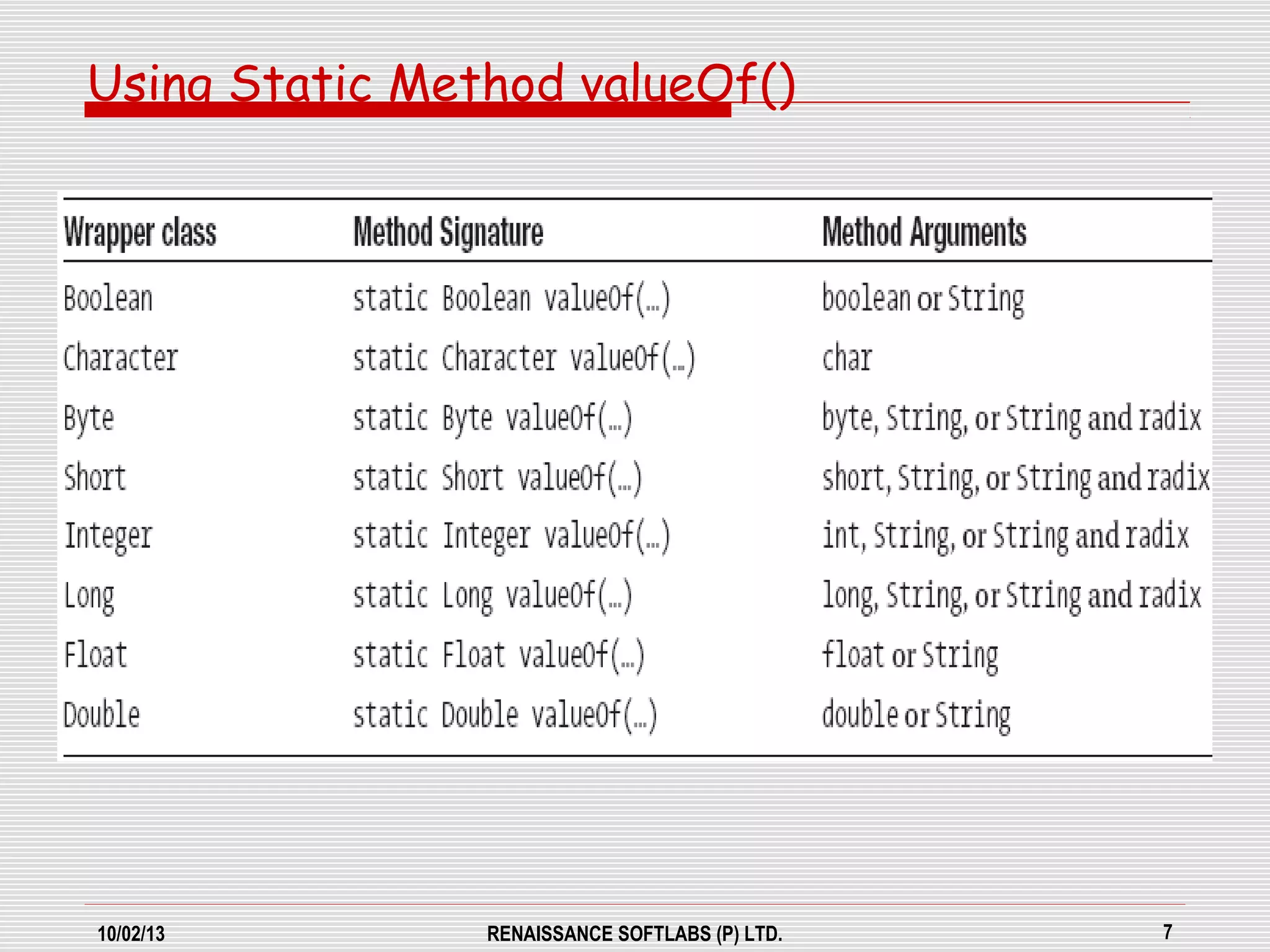
Using Static Method valueOf()
10/02/13 RENAISSANCE SOFTLABS (P) LTD. 8
 The valueOf() method in the Character class accepts only
char as an argument
 Any other wrapper class will accept either the corresponding
primitive type or String as an argument
 The valueOf() method in the integer number wrapper classes
(Byte, Short, Integer, and Long) also accepts two arguments
together:
 A String
 A radix, where radix is the base
 For example, a decimal is radix 10 and a binary is radix 2
Using Static Method valueOf()
10/02/13 RENAISSANCE SOFTLABS (P) LTD. 9
 A storage capability without the retrieval capability is not of much use
 Once we store a primitive in a wrapper object, often you will want to
retrieve the stored primitive at a later time
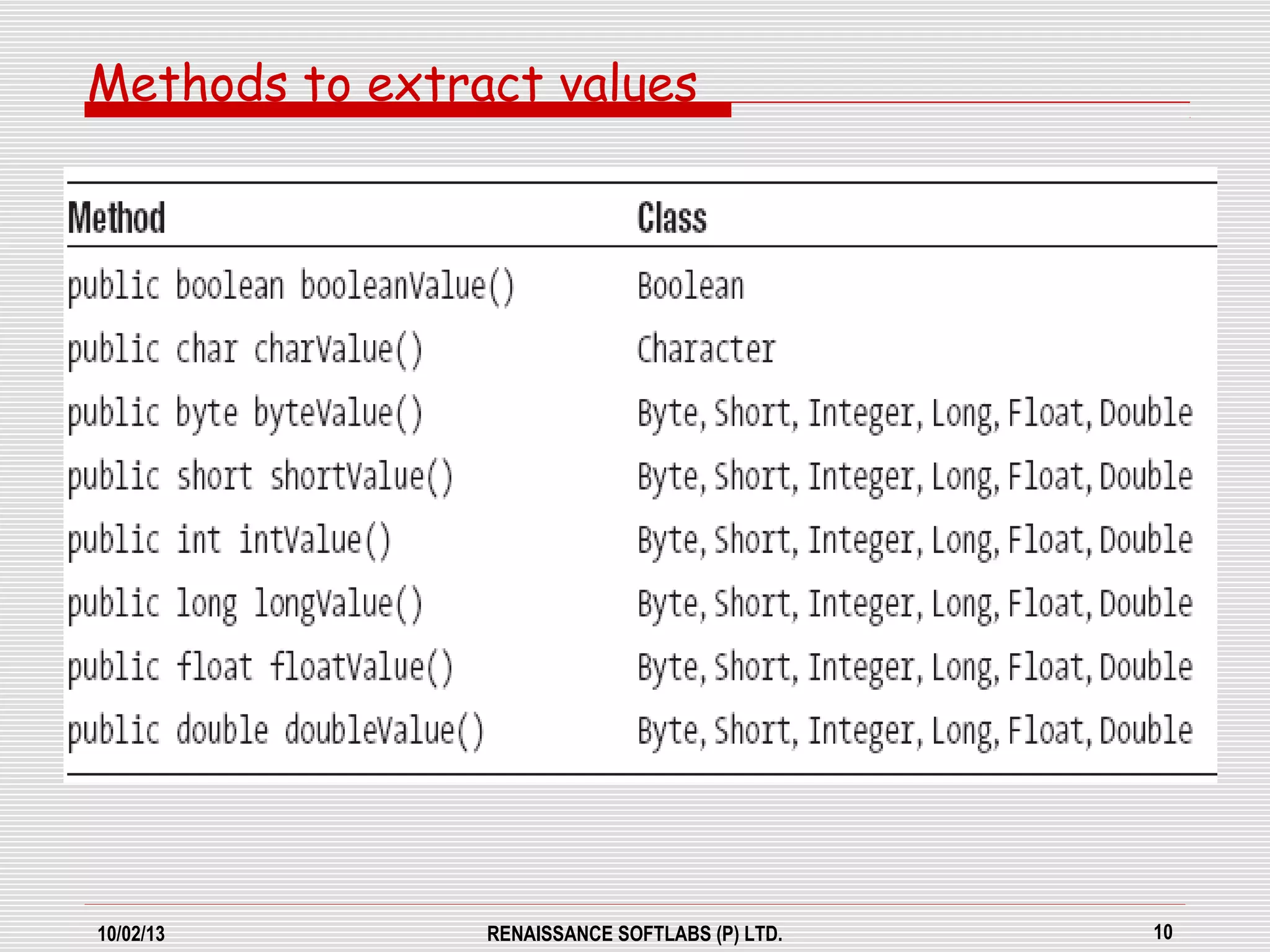
 All the number wrapper classes (Byte, Short, Integer, Long, Float, and
Double) have the which can retrieve byte, short, int, long, float, or
double
 This is because all of these classes are subclasses of the Number
class
 It means you can store one primitive type in a wrapper and retrieve
another one
 So you can use the wrappers as a conversion machine
Extracting Wrapped Values
10/02/13 RENAISSANCE SOFTLABS (P) LTD. 10
Methods to extract values
10/02/13 RENAISSANCE SOFTLABS (P) LTD. 11
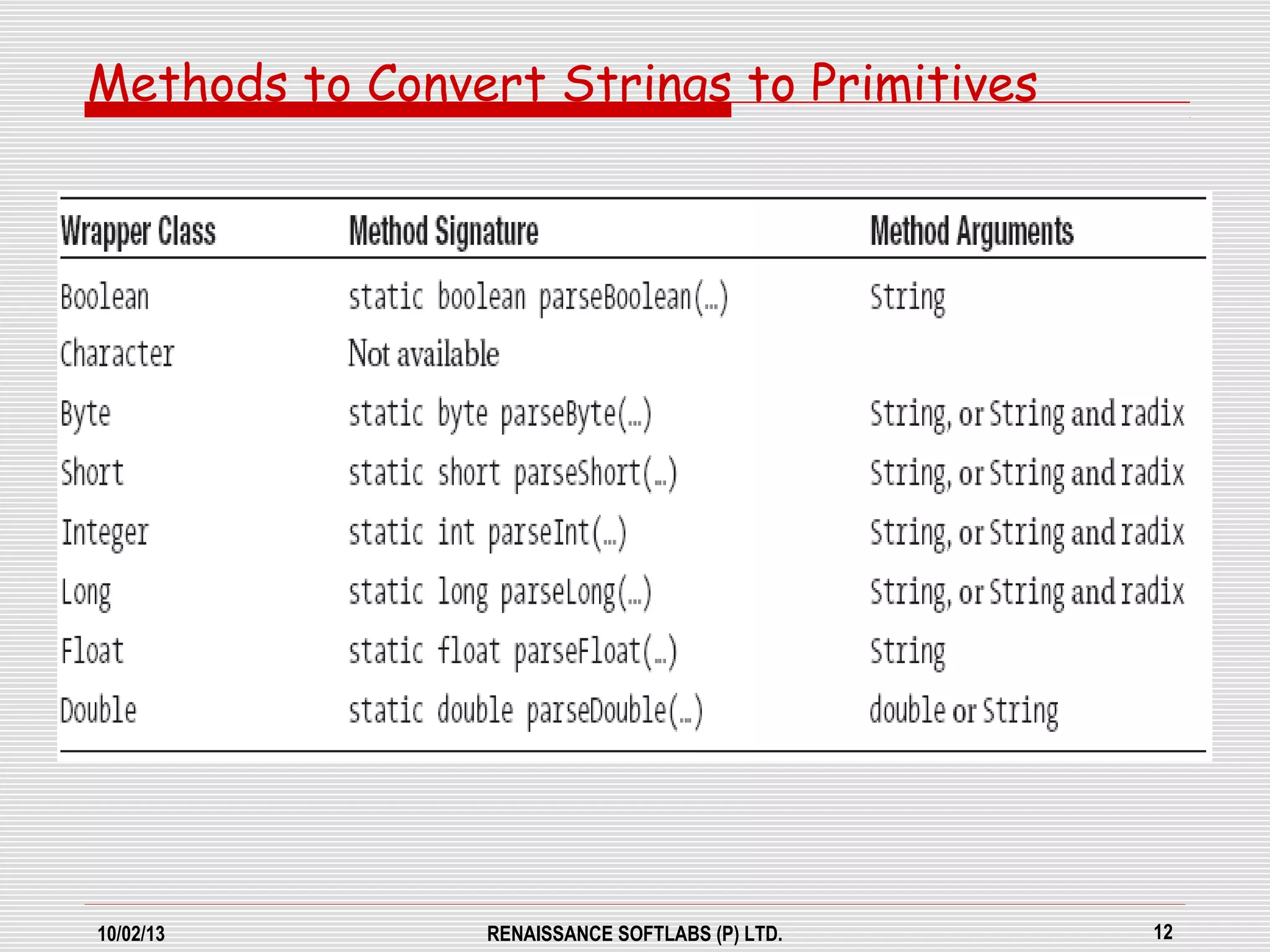
 We can use Wrappers for converting the type without
creating the Wrapper
 There is an appropriate static method in every wrapper class
 For example, all the wrapper classes except Character offer
a static method that has the following signature:
static <type> parse<Type>(String s)
 Ex: static int parseInt (String s)
 Each of these methods parses the string passed in as a
parameter and returns the corresponding primitive type
Instant use of Wrapper Classes
10/02/13 RENAISSANCE SOFTLABS (P) LTD. 12
Methods to Convert Strings to Primitives
10/02/13 RENAISSANCE SOFTLABS (P) LTD. 13
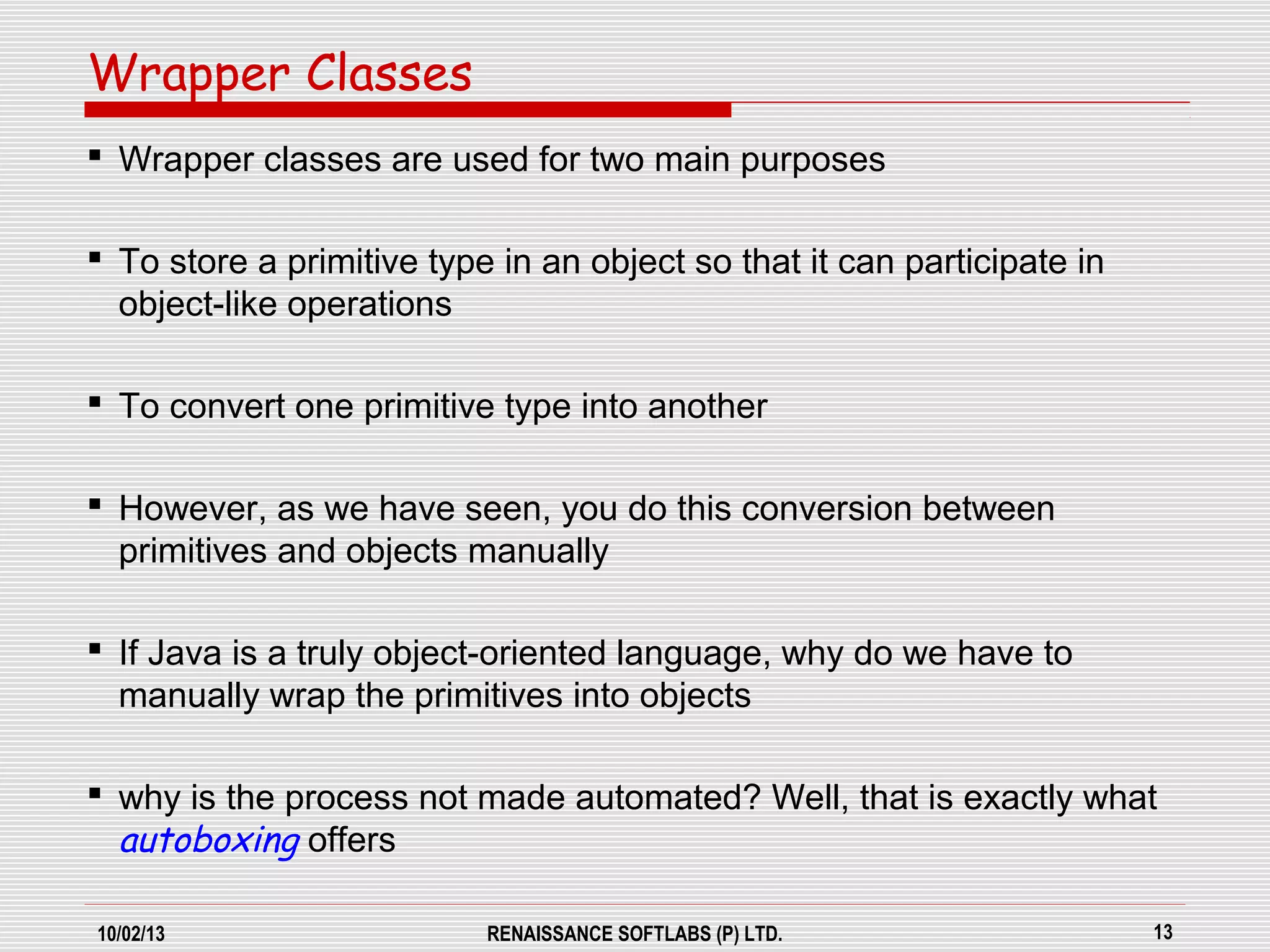
 Wrapper classes are used for two main purposes
 To store a primitive type in an object so that it can participate in
object-like operations
 To convert one primitive type into another
 However, as we have seen, you do this conversion between
primitives and objects manually
 If Java is a truly object-oriented language, why do we have to
manually wrap the primitives into objects
 why is the process not made automated? Well, that is exactly what
autoboxing offers
Wrapper Classes
10/02/13 RENAISSANCE SOFTLABS (P) LTD. 14
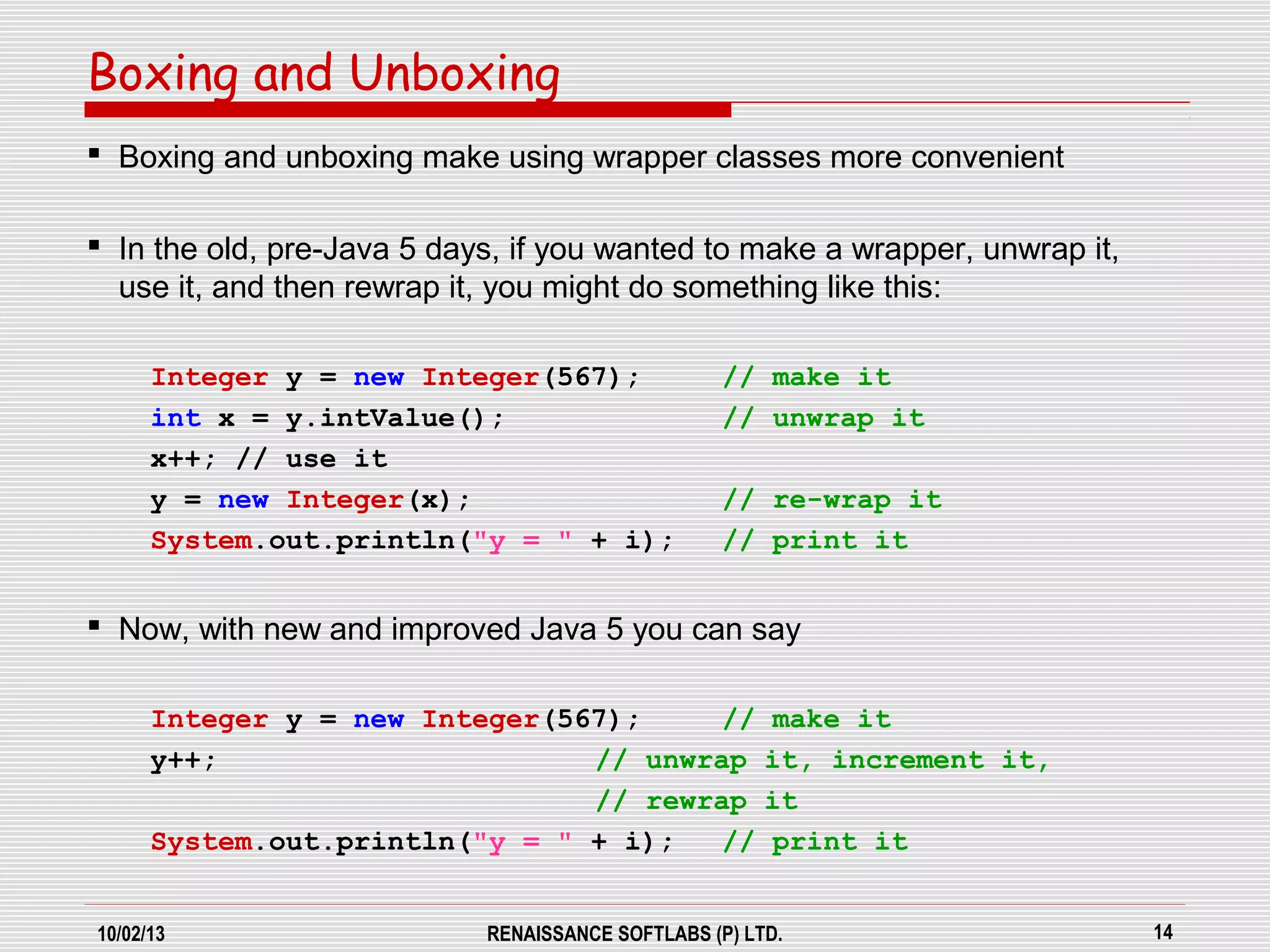
 Boxing and unboxing make using wrapper classes more convenient
 In the old, pre-Java 5 days, if you wanted to make a wrapper, unwrap it,
use it, and then rewrap it, you might do something like this:
Integer y = new Integer(567); // make it
int x = y.intValue(); // unwrap it
x++; // use it
y = new Integer(x); // re-wrap it
System.out.println("y = " + i); // print it
 Now, with new and improved Java 5 you can say
Integer y = new Integer(567); // make it
y++; // unwrap it, increment it,
// rewrap it
System.out.println("y = " + i); // print it
Boxing and Unboxing
10/02/13 RENAISSANCE SOFTLABS (P) LTD. 15
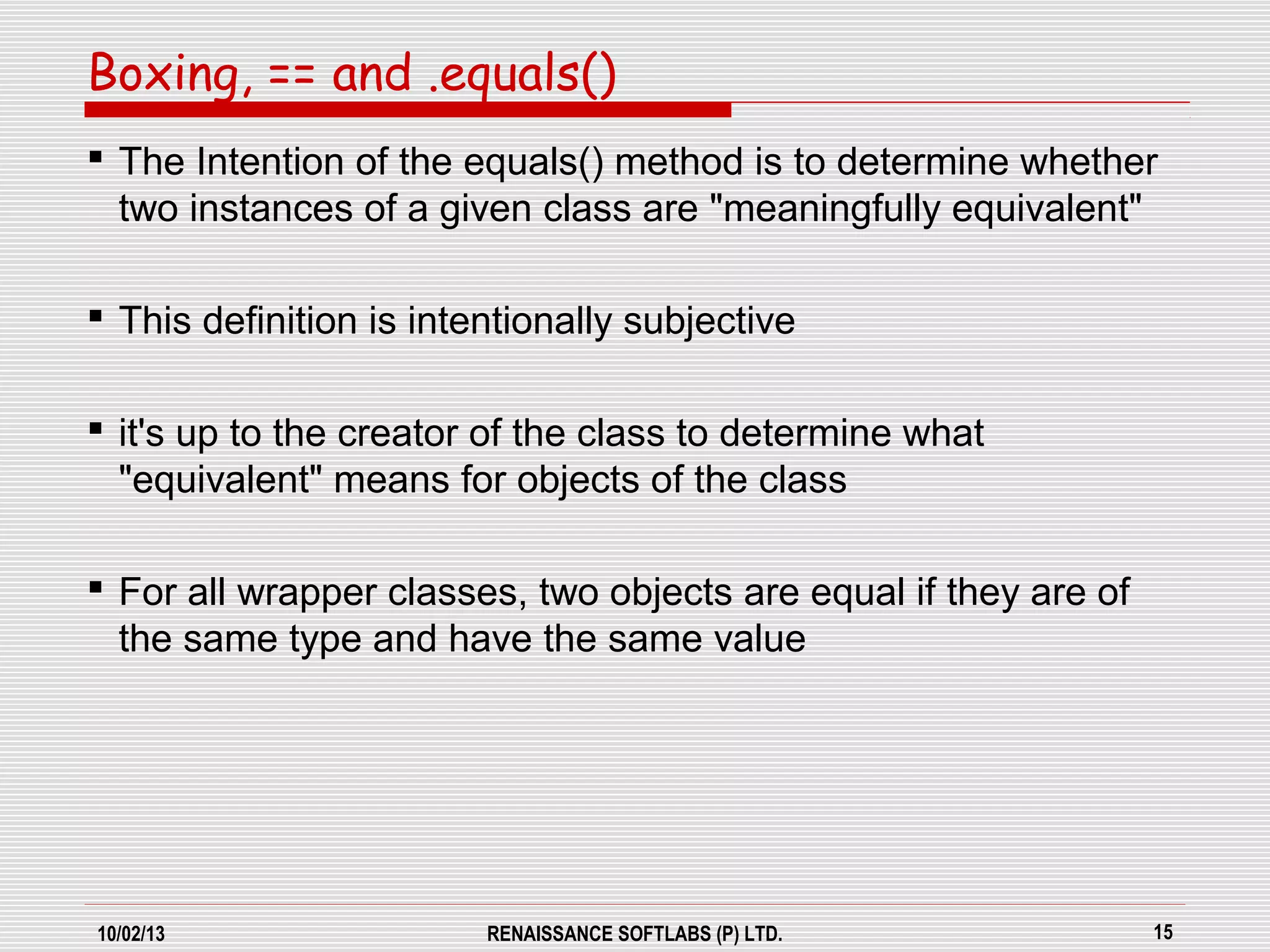
 The Intention of the equals() method is to determine whether
two instances of a given class are "meaningfully equivalent"
 This definition is intentionally subjective
 it's up to the creator of the class to determine what
"equivalent" means for objects of the class
 For all wrapper classes, two objects are equal if they are of
the same type and have the same value
Boxing, == and .equals()
10/02/13 RENAISSANCE SOFTLABS (P) LTD. 16
 Widening, Var-Args and Auto-Boxing make method overloadig a
little tricky
 When a class has overloaded methods, the compiler's jobs is to
determine which method to use whenever it finds an invocation for
the overloaded method
Auto-Boxing and Overloading
10/02/13 RENAISSANCE SOFTLABS (P) LTD. 17
class AddBoxing
{
static void go(Integer x)
{
System.out.println("Integer");
}
static void go(long x)
{
System.out.println("long");
}
public static void main(String [] args)
{
int i = 5;
go(i); // which go() will be invoked?
}
}
Overloading with Boxing and Widening
10/02/13 RENAISSANCE SOFTLABS (P) LTD. 18
class AddVarargs
{
static void go(int x, int y)
{
System.out.println("int,int");
}
static void go(byte... x)
{
System.out.println("byte... ");
}
public static void main(String[] args)
{
byte b = 5;
go(b,b); // which go() will be invoked?
}
}
Overloading with Var-Args and Widening
10/02/13 RENAISSANCE SOFTLABS (P) LTD. 19
 Even though each invocation will require some sort of
conversion, the compiler will choose the older style
before it chooses the newer style
 This keeps the existing code more robust.
 So far we've seen that
 Widening beats boxing
 Widening beats var-args
 Does does boxing beat var-args?
Reason
10/02/13 RENAISSANCE SOFTLABS (P) LTD. 20
class BoxOrVararg
{
static void go(Byte x, Byte y)
{
System.out.println("Byte, Byte");
}
static void go(byte... x)
{
System.out.println("byte... ");
}
public static void main(String [] args)
{
byte b = 5;
go(b,b); // which go() will be invoked?
}
}
Overloading with Var-Args and Boxing

wrapper classes

  • 1.
  • 2.
    10/02/13 RENAISSANCE SOFTLABS(P) LTD. 2 Problem with Primitives  Java is an object-oriented language. Means, everything in Java is an object  But, how about primitives?  Primitives cannot participate in the object activities, such as  Returned from a method as an object  Adding to a Collection of objects  As a solution to this problem, Java allows you to include the primitives in the family of objects by using Wrapper classes
  • 3.
    10/02/13 RENAISSANCE SOFTLABS(P) LTD. 3 Creating Wrapper Classes  For to each primitive data type in Java there is corresponding wrapper class  This class encapsulates a single value for the primitive data type  The wrapper object of a wrapper class can be created in one of two ways:  By instantiating the wrapper class with the new operator  By invoking a static method on the wrapper class
  • 4.
    10/02/13 RENAISSANCE SOFTLABS(P) LTD. 4 Primitive Types and Wrapper Classes
  • 5.
    10/02/13 RENAISSANCE SOFTLABS(P) LTD. 5 Creating Wrapper Classes with new Operator  Obviously, you can always pass the corresponding primitive data type as an argument to a wrapper class constructor  You can also pass a String as an argument to any wrapper class constructor except Character  The Character constructor only takes the obvious argument: char  You can pass double as an argument to the Float constructor but not vice versa  All the wrapper classes except Boolean and Character are subclasses of an abstract class called Number  Boolean and Character are derived directly from the Object class
  • 6.
    10/02/13 RENAISSANCE SOFTLABS(P) LTD. 6 Another way of Creating Wrappers  The wrapped value in a wrapper class cannot be modified  To wrap another value, you need to create another object  Wrappers are immutable  There will be situations in your program when you really don’t need a new instance of the wrapper class  but you still want to wrap a primitive  In this case, use the static method valueOf()
  • 7.
    10/02/13 RENAISSANCE SOFTLABS(P) LTD. 7 Using Static Method valueOf()
  • 8.
    10/02/13 RENAISSANCE SOFTLABS(P) LTD. 8  The valueOf() method in the Character class accepts only char as an argument  Any other wrapper class will accept either the corresponding primitive type or String as an argument  The valueOf() method in the integer number wrapper classes (Byte, Short, Integer, and Long) also accepts two arguments together:  A String  A radix, where radix is the base  For example, a decimal is radix 10 and a binary is radix 2 Using Static Method valueOf()
  • 9.
    10/02/13 RENAISSANCE SOFTLABS(P) LTD. 9  A storage capability without the retrieval capability is not of much use  Once we store a primitive in a wrapper object, often you will want to retrieve the stored primitive at a later time  All the number wrapper classes (Byte, Short, Integer, Long, Float, and Double) have the which can retrieve byte, short, int, long, float, or double  This is because all of these classes are subclasses of the Number class  It means you can store one primitive type in a wrapper and retrieve another one  So you can use the wrappers as a conversion machine Extracting Wrapped Values
  • 10.
    10/02/13 RENAISSANCE SOFTLABS(P) LTD. 10 Methods to extract values
  • 11.
    10/02/13 RENAISSANCE SOFTLABS(P) LTD. 11  We can use Wrappers for converting the type without creating the Wrapper  There is an appropriate static method in every wrapper class  For example, all the wrapper classes except Character offer a static method that has the following signature: static <type> parse<Type>(String s)  Ex: static int parseInt (String s)  Each of these methods parses the string passed in as a parameter and returns the corresponding primitive type Instant use of Wrapper Classes
  • 12.
    10/02/13 RENAISSANCE SOFTLABS(P) LTD. 12 Methods to Convert Strings to Primitives
  • 13.
    10/02/13 RENAISSANCE SOFTLABS(P) LTD. 13  Wrapper classes are used for two main purposes  To store a primitive type in an object so that it can participate in object-like operations  To convert one primitive type into another  However, as we have seen, you do this conversion between primitives and objects manually  If Java is a truly object-oriented language, why do we have to manually wrap the primitives into objects  why is the process not made automated? Well, that is exactly what autoboxing offers Wrapper Classes
  • 14.
    10/02/13 RENAISSANCE SOFTLABS(P) LTD. 14  Boxing and unboxing make using wrapper classes more convenient  In the old, pre-Java 5 days, if you wanted to make a wrapper, unwrap it, use it, and then rewrap it, you might do something like this: Integer y = new Integer(567); // make it int x = y.intValue(); // unwrap it x++; // use it y = new Integer(x); // re-wrap it System.out.println("y = " + i); // print it  Now, with new and improved Java 5 you can say Integer y = new Integer(567); // make it y++; // unwrap it, increment it, // rewrap it System.out.println("y = " + i); // print it Boxing and Unboxing
  • 15.
    10/02/13 RENAISSANCE SOFTLABS(P) LTD. 15  The Intention of the equals() method is to determine whether two instances of a given class are "meaningfully equivalent"  This definition is intentionally subjective  it's up to the creator of the class to determine what "equivalent" means for objects of the class  For all wrapper classes, two objects are equal if they are of the same type and have the same value Boxing, == and .equals()
  • 16.
    10/02/13 RENAISSANCE SOFTLABS(P) LTD. 16  Widening, Var-Args and Auto-Boxing make method overloadig a little tricky  When a class has overloaded methods, the compiler's jobs is to determine which method to use whenever it finds an invocation for the overloaded method Auto-Boxing and Overloading
  • 17.
    10/02/13 RENAISSANCE SOFTLABS(P) LTD. 17 class AddBoxing { static void go(Integer x) { System.out.println("Integer"); } static void go(long x) { System.out.println("long"); } public static void main(String [] args) { int i = 5; go(i); // which go() will be invoked? } } Overloading with Boxing and Widening
  • 18.
    10/02/13 RENAISSANCE SOFTLABS(P) LTD. 18 class AddVarargs { static void go(int x, int y) { System.out.println("int,int"); } static void go(byte... x) { System.out.println("byte... "); } public static void main(String[] args) { byte b = 5; go(b,b); // which go() will be invoked? } } Overloading with Var-Args and Widening
  • 19.
    10/02/13 RENAISSANCE SOFTLABS(P) LTD. 19  Even though each invocation will require some sort of conversion, the compiler will choose the older style before it chooses the newer style  This keeps the existing code more robust.  So far we've seen that  Widening beats boxing  Widening beats var-args  Does does boxing beat var-args? Reason
  • 20.
    10/02/13 RENAISSANCE SOFTLABS(P) LTD. 20 class BoxOrVararg { static void go(Byte x, Byte y) { System.out.println("Byte, Byte"); } static void go(byte... x) { System.out.println("byte... "); } public static void main(String [] args) { byte b = 5; go(b,b); // which go() will be invoked? } } Overloading with Var-Args and Boxing