TRAINING REPORT ON:
MICROWAVE TELECOMMUNICATION &
SIGNALING AT RAILWAYS
SITE OF TRAINING :
MICROWAVE CENTRE AND SIGNAL
WORKSHOP,
ZONAL HEAD QUARTER,
N.E. RAILWAY,GORAKHPUR
SUBMITTED BY:-
shashikant
mechanical engineering
MICROWAVE
TELECOMMUNICATION &SIGNALING
WORK IN INDIAN RAILWAYS
SUBMITTED TO
NEERAJ KUMAR
 Indian Railway is a department owned and controlled by
the Govt.of India,via the Ministry of Railways
 Indian railway is divided into zones,which are further
divided into divisions.
 Gorakhpur is the zonal headquarter of the North Eastern
Railway zone
 The formal inauguration ceremony of IR was
performed on 16th April 1853 with the first
passenger train steamed out of Howrah station
destined for Hooghly, a distance of 36 km .
 It runs 12000 trains every day
 It is fuel efficient system
 Railways has 7500 engines,38000 coaches & about
2.5 lakh of wagons
 7000 stations & about 500 computerized
passenger reservation centers
 1 lakh km of track
 17 lakh employee(10 lakh in Group C) including
10000 officers
CONT…..
PRACTICAL TRAINING UNDER NER
 We have received the scheduled Summer Practical
Training as a part of our curriculum, from 22ndJune,
2011to 19th July, 2011 under Divisional Railway Manager
North Eastern Railway, Gorakhpur
 Ms.Sunita Verma is the General manager, North Eastern
Railway and Mr.Vinod Yadav is the DRM of Gorakhpur
Division presently.
 We've studied about the following operational
technologies in the IR–
Module 1:Railway signaling & Signal workshop
Module 2:Microwave communication in Railway
PRINCIPLES OF TRAIN WORKING
AND NEED FOR SIGNALING
 All over the world Railway transportation isi
ncreasingly used, as this mode of transport is
more energy efficient and environmentally friendly
than road transportation
 Trains move on steel rail tracks and wheels of The
railway vehicle are also flanged Steel wheels.
Hence least friction occurs at the point of contact
between the track & wheels
 Therefore trains carry more loads resulting in
higher traffic capacity since trains move on
specific tracks called rails, their path is to be fully
guided and there is no arrangement of steering.
CONT….
 Clear of obstruction as available with road
transportation, so there is a need to provide control
On the movement of trains in the form of Railway
signals which indicate to the drivers to stop or move
and also the speed at which they can pass a signal
 Since the load carried by the trains and the speed
which the trains can attain are high, they need more
braking distance before coming to the stop from full
speed. Without signal to be available on the route
to constantly guide the driver accidents will take
place due to collisions
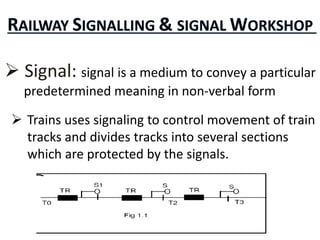
 Signal: signal is a medium to convey a particular
predetermined meaning in non-verbal form
 Trains uses signaling to control movement of train
tracks and divides tracks into several sections
which are protected by the signals.
CONT…………….
In case of a failurelike a broken wire, rail fracture,
power supply failure, failure of the source the
detector will lose the signal and conclude the
section is occupied by a train. This will allow the
detection to maintain safety even under failure
condition and satisfy requirments of fail safety
 Multiple Aspect Color Light Signal
(MACLS)Multiple means more than 2 indications.
They may have 3 or 4 different aspects or
indications to be given to the driver. These signals
have longer range of visibility and Improved reliability.
 In the signal workshop of N.E.Railway, Gorakhpur
following machine are manufactured which are
used as a part of signaling system-:
1.Electric point machine.
2.Relays
 Points are provided to divert the running trains
one track to another. The points have
movable switches which can be operated
electrically by a point machine.
 Solid State Interlocking is a data-driven signal
control system designed for use throughout the
British railway system
 SSI is a replacement for electromechanical
interlockings which are based on highly reliable
relay technology
 SSI is a multicomputer system with two panel
processors, a diagnostic processor, and three
central interlocking processors which operate in
repairable triple modular redundancy
MICROWAVECOMMUNICATION
 The international telecommunications system relies
on microwave and satellite links for long-distance
international calls
 Microwaves are electromagnetic waves whose
frequencies range from 1 GHz to 1000 GHz.
 There are large number of bands in microwave
Region
CONT…..
 Before the advent of fiber optics, these
microwaves formed the heart of the long distance
telephone transmission system.
 In its simplest form the microwave link can be one
hop.
 A single hop is typically 30 to 60 km in relatively flat
regions for frequencies in the 2 to 8 GHz bands.
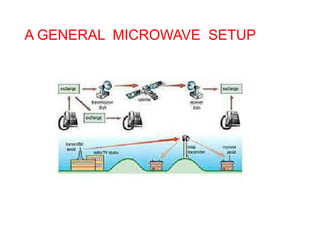
A GENERAL MICROWAVE SETUP
MICROWAVE TRANSMITTER AND RECEIVER -:
 The voice, video, or data channels are combined by
a technique known as multiplexing to produce a BB
signal.
 This signal is frequency modulated to an IF and
then up converted (heterodyned) to the RF for
transmission through the atmosphere.
 The reverse process occurs at the receiver. The
microwave transmission frequencies are within the
approximate range 2 to 24 GHz.
ROLE OF MICROWAVES IN PASSENGER
RESERVATION SYSTEM -:
 In PRS,the Gorakhpur Zone is connected to the
main server through communication lines and there
is the need of non stop working of PRS in Indian
Railways otherwise there will be big loss to Indian
Railways.
 to increase the reliability of PRS, the main server is
also connected to the zones through microwave
links.In case if there is a failure in the physical
mediathen the PRS can be operated by microwave.
APPLICATIONOF MICROWAVE IN INDIAN
RAILWAYS -:
 controlling of trains.
 to give correct running and stopping information of
the trains.
 It help the railway staff to communicate for this
purpose.
 Stations on average of 40 km can communicate
with each other by microwave.
Railway shashikant training report on

Railway shashikant training report on

  • 1.
    TRAINING REPORT ON: MICROWAVETELECOMMUNICATION & SIGNALING AT RAILWAYS SITE OF TRAINING : MICROWAVE CENTRE AND SIGNAL WORKSHOP, ZONAL HEAD QUARTER, N.E. RAILWAY,GORAKHPUR
  • 2.
    SUBMITTED BY:- shashikant mechanical engineering MICROWAVE TELECOMMUNICATION&SIGNALING WORK IN INDIAN RAILWAYS SUBMITTED TO NEERAJ KUMAR
  • 3.
     Indian Railwayis a department owned and controlled by the Govt.of India,via the Ministry of Railways  Indian railway is divided into zones,which are further divided into divisions.  Gorakhpur is the zonal headquarter of the North Eastern Railway zone  The formal inauguration ceremony of IR was performed on 16th April 1853 with the first passenger train steamed out of Howrah station destined for Hooghly, a distance of 36 km .
  • 4.
     It runs12000 trains every day  It is fuel efficient system  Railways has 7500 engines,38000 coaches & about 2.5 lakh of wagons  7000 stations & about 500 computerized passenger reservation centers  1 lakh km of track  17 lakh employee(10 lakh in Group C) including 10000 officers CONT…..
  • 5.
    PRACTICAL TRAINING UNDERNER  We have received the scheduled Summer Practical Training as a part of our curriculum, from 22ndJune, 2011to 19th July, 2011 under Divisional Railway Manager North Eastern Railway, Gorakhpur  Ms.Sunita Verma is the General manager, North Eastern Railway and Mr.Vinod Yadav is the DRM of Gorakhpur Division presently.  We've studied about the following operational technologies in the IR– Module 1:Railway signaling & Signal workshop Module 2:Microwave communication in Railway
  • 6.
    PRINCIPLES OF TRAINWORKING AND NEED FOR SIGNALING  All over the world Railway transportation isi ncreasingly used, as this mode of transport is more energy efficient and environmentally friendly than road transportation  Trains move on steel rail tracks and wheels of The railway vehicle are also flanged Steel wheels. Hence least friction occurs at the point of contact between the track & wheels  Therefore trains carry more loads resulting in higher traffic capacity since trains move on specific tracks called rails, their path is to be fully guided and there is no arrangement of steering.
  • 7.
    CONT….  Clear ofobstruction as available with road transportation, so there is a need to provide control On the movement of trains in the form of Railway signals which indicate to the drivers to stop or move and also the speed at which they can pass a signal  Since the load carried by the trains and the speed which the trains can attain are high, they need more braking distance before coming to the stop from full speed. Without signal to be available on the route to constantly guide the driver accidents will take place due to collisions
  • 8.
     Signal: signalis a medium to convey a particular predetermined meaning in non-verbal form  Trains uses signaling to control movement of train tracks and divides tracks into several sections which are protected by the signals.
  • 9.
    CONT……………. In case ofa failurelike a broken wire, rail fracture, power supply failure, failure of the source the detector will lose the signal and conclude the section is occupied by a train. This will allow the detection to maintain safety even under failure condition and satisfy requirments of fail safety  Multiple Aspect Color Light Signal (MACLS)Multiple means more than 2 indications. They may have 3 or 4 different aspects or indications to be given to the driver. These signals have longer range of visibility and Improved reliability.
  • 10.
     In thesignal workshop of N.E.Railway, Gorakhpur following machine are manufactured which are used as a part of signaling system-: 1.Electric point machine. 2.Relays  Points are provided to divert the running trains one track to another. The points have movable switches which can be operated electrically by a point machine.
  • 11.
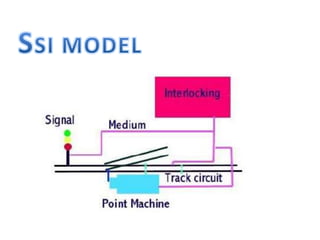
     Solid StateInterlocking is a data-driven signal control system designed for use throughout the British railway system  SSI is a replacement for electromechanical interlockings which are based on highly reliable relay technology  SSI is a multicomputer system with two panel processors, a diagnostic processor, and three central interlocking processors which operate in repairable triple modular redundancy
  • 13.
    MICROWAVECOMMUNICATION  The internationaltelecommunications system relies on microwave and satellite links for long-distance international calls  Microwaves are electromagnetic waves whose frequencies range from 1 GHz to 1000 GHz.  There are large number of bands in microwave Region
  • 14.
    CONT…..  Before theadvent of fiber optics, these microwaves formed the heart of the long distance telephone transmission system.  In its simplest form the microwave link can be one hop.  A single hop is typically 30 to 60 km in relatively flat regions for frequencies in the 2 to 8 GHz bands.
  • 15.
  • 16.
    MICROWAVE TRANSMITTER ANDRECEIVER -:  The voice, video, or data channels are combined by a technique known as multiplexing to produce a BB signal.  This signal is frequency modulated to an IF and then up converted (heterodyned) to the RF for transmission through the atmosphere.  The reverse process occurs at the receiver. The microwave transmission frequencies are within the approximate range 2 to 24 GHz.
  • 17.
    ROLE OF MICROWAVESIN PASSENGER RESERVATION SYSTEM -:  In PRS,the Gorakhpur Zone is connected to the main server through communication lines and there is the need of non stop working of PRS in Indian Railways otherwise there will be big loss to Indian Railways.  to increase the reliability of PRS, the main server is also connected to the zones through microwave links.In case if there is a failure in the physical mediathen the PRS can be operated by microwave.
  • 18.
    APPLICATIONOF MICROWAVE ININDIAN RAILWAYS -:  controlling of trains.  to give correct running and stopping information of the trains.  It help the railway staff to communicate for this purpose.  Stations on average of 40 km can communicate with each other by microwave.