



AN
INDUSTRIAL
PRESENTATION
ON
Technologies
in
“INDIAN RAILWAY”
SUBMITTED TO:
Mr. TARUN MISHRA
Mr. VIJENDRA KUMAR PATEL
(DEPARTMENT OF ELECTRONICS &
COMMUNICATION)
SUBMITTED BY:
KUMUD KHANDELWAL
PCE/EC/12/050
 Introduction to INDIAN RAILWAY
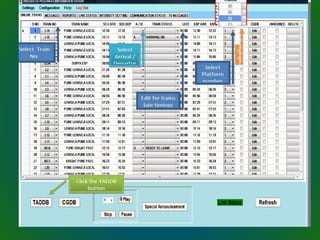
 Integrated Passenger Information System (IPIS)
 Railnet
 Communication system
 Microwave Communication
 Optical Fiber
 Railway Signaling
 Passenger Reservation System (PRS)
 Some Interesting Facts About Railway
CONTENTS : INTRODUCTION
 1853 First railway train journeyed distance of 22
miles between Bombay to Thana.
 It runs 12000 trains every day.
 It carry 1.4 crore passengers & 16 lakh tones of
goods every day.
 Daily earnings Rs120 crore.
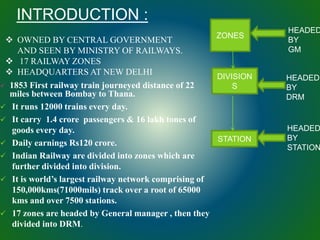
 Indian Railway are divided into zones which are
further divided into division.
 It is world’s largest railway network comprising of
150,000kms(71000mils) track over a root of 65000
kms and over 7500 stations.
 17 zones are headed by General manager , then they
divided into DRM.
 OWNED BY CENTRAL GOVERNMENT
AND SEEN BY MINISTRY OF RAILWAYS.
 17 RAILWAY ZONES
 HEADQUARTERS AT NEW DELHI
HEADED
BY
GM
HEADED
BY
DRM
HEADED
BY
STATION
DIVISION
S
STATION
ZONES
INTRODUCTION :
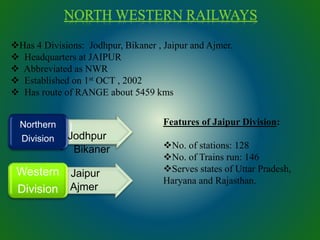
Has 4 Divisions: Jodhpur, Bikaner , Jaipur and Ajmer.
 Headquarters at JAIPUR
 Abbreviated as NWR
 Established on 1st OCT , 2002
 Has route of RANGE about 5459 kms
NORTH WESTERN RAILWAYS
•
Jodhpur
• Bikaner
Northern
Division
• Jaipur
• Ajmer
Western
Division
Features of Jaipur Division:
No. of stations: 128
No. of Trains run: 146
Serves states of Uttar Pradesh,
Haryana and Rajasthan.
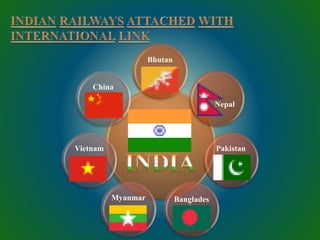
Bhutan
Nepal
Pakistan
Banglades
h
Myanmar
Vietnam
China
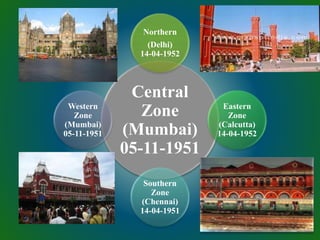
Central
Zone
(Mumbai)
05-11-1951
Northern
(Delhi)
14-04-1952
Eastern
Zone
(Calcutta)
14-04-1952
Southern
Zone
(Chennai)
14-04-1951
Western
Zone
(Mumbai)
05-11-1951
INTEGRATED PASSENGER INFORMATION
SYSTEM (IPIS):
 passenger information systems are the key communications
link between transportation operators and the travelling public.
 This system to provide accurate, current information on arrival
and departure times and Platform information.
 Integrated Passenger Information System is a single system
control, providing audio and visual information to passengers.
 It is related to Train Indication, Coach Guidance and PC
Based Announcement System.
 provides a single control system and data entry system for
different types display boards available on entire railway
station.
The Integrated Passenger Information System Consists Of
Following:
Two control consoles in redundant mode
loaded with software
Data Communication Hub (MDCH & PDCH)
Display boards
CCTV
PC based Announcement system
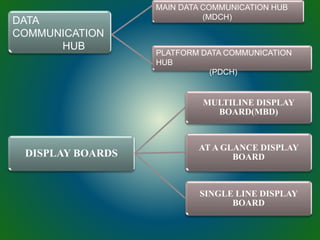
DATA
COMMUNICATION
HUB
MAIN DATA COMMUNICATION HUB
(MDCH)
PLATFORM DATA COMMUNICATION
HUB
(PDCH)
DISPLAY BOARDS
MULTILINE DISPLAY
BOARD(MBD)
AT A GLANCE DISPLAY
BOARD
SINGLE LINE DISPLAY
BOARD
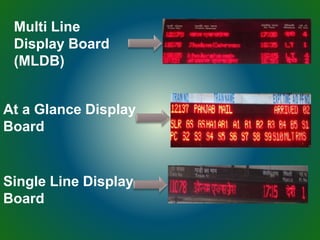
At a Glance Display
Board
Single Line Display
Board
Multi Line
Display Board
(MLDB)
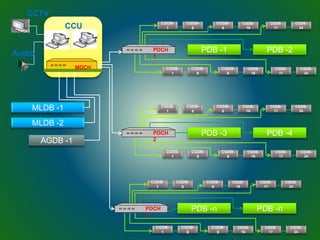
MLDB -1
MLDB -2
AGDB -1
MDCH
PDCH
1
PDB -1
CGDB-
1
CGDB-
8
CGDB-
9
CGDB-
16
CGDB-
17
CGDB-
24
PDB -2
CGDB-
1
CGDB-
8
CGDB-
9
CGDB-
16
CGDB-
17
CGDB-
24
PDCH
2
PDB -3
CGDB-
1
CGDB-
8
CGDB-
9
CGDB-
16
CGDB-
17
CGDB-
24
PDB -4
CGDB-
1
CGDB-
8
CGDB-
9
CGDB-
16
CGDB-
17
CGDB-
24
PDCH
n
PDB -n
CGDB-
1
CGDB-
8
CGDB-
9
CGDB-
16
CGDB-
17
CGDB-
24
PDB -n
CGDB-
1
CGDB-
8
CGDB-
9
CGDB-
16
CGDB-
17
CGDB-
24
CCU
CCTV
Audio
RAILNET:
Rail net is an internet for railways.
Railnet is the name of the Corporate Wide
Information System (CWIS) of Indian Railways.
It is aimed to provide computer connectivity
between Railway Board, Zonal Railways,
Production units.
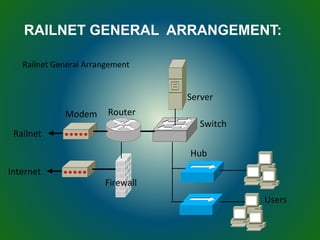
This unit consists of main switch ,web server ,
switch, hub, router, modem, LAN and WAN
extenders and pc’s.
OBJECTIVES OF RAILNET:
Eliminate the need to move paper
documents between different documents
and
Change from “Periodic Reporting” to
“Information on Demand.”
RAILNET GENERAL ARRANGEMENT:
Modem Router
Firewall
Switch
Hub
Users
Server
Internet
Railnet
Railnet General Arrangement
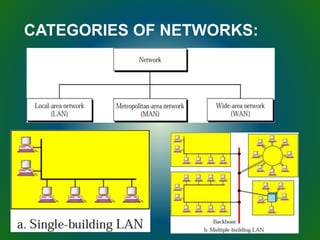
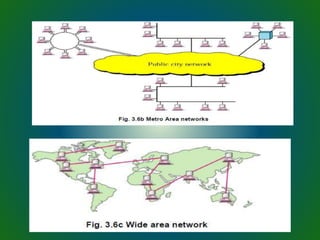
CATEGORIES OF NETWORKS:
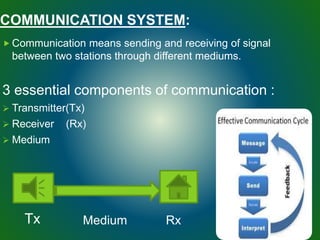
COMMUNICATION SYSTEM:
 Communication means sending and receiving of signal
between two stations through different mediums.
3 essential components of communication :
 Transmitter(Tx)
 Receiver (Rx)
 Medium
Tx Medium Rx
TYPES OF COMMUNICATION
Overhead communication
Underground communication
Microwave communication
Optical Fiber communication
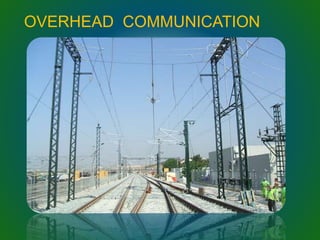
OVERHEAD COMMUNICATION
MICROWAVE COMMUNICATION:
 Communication refers to the sending , receiving and
processing of information by electronic means.
 MW are radio waves with wavelengths ranging from as
long as one meter to as short as one mm.
 MW frequency ranges between 300 MHz (0.3 GHz) and
300 GHz.
 The microwave propagation takes place through space
waves in troposphere.
MICROWAVE PROPAGATION
MODES
There are mainly 3 modes of MW propagation:-
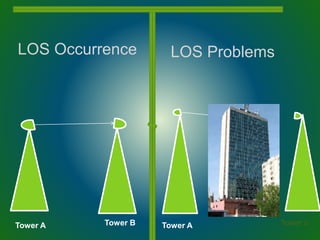
Line of sight (LOS)
 Skywave Propagation
 Ground wave Propagation
LOS ProblemsLOS Occurrence
Tower ATower BTower A Tower b
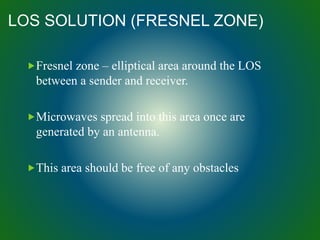
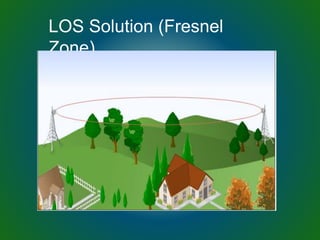
LOS SOLUTION (FRESNEL ZONE)
Fresnel zone – elliptical area around the LOS
between a sender and receiver.
Microwaves spread into this area once are
generated by an antenna.
This area should be free of any obstacles
LOS Solution (Fresnel
Zone)
ADVANTAGES MICROWAVE COMMUNICATION
Large bandwidth is possible. Hence, more
information can be transmitted as hundreds of
channel is possible(approx 960).
Better quality of service due to negligible voice.
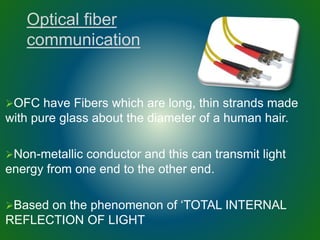
Optical fiber
communication
OFC have Fibers which are long, thin strands made
with pure glass about the diameter of a human hair.
Non-metallic conductor and this can transmit light
energy from one end to the other end.
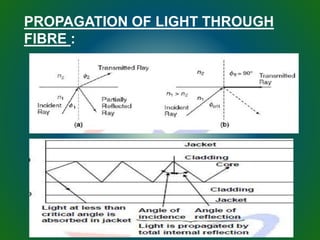
Based on the phenomenon of ‘TOTAL INTERNAL
REFLECTION OF LIGHT
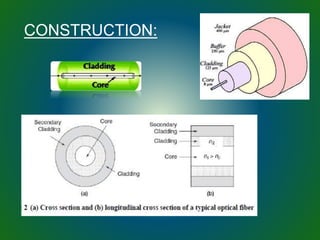
CONSTRUCTION:
OPTICAL FIBER MODES:
 An optical fiber guides light waves in distinct patterns
called modes.
 Mode describes the distribution of light energy across
the fiber.
PROPAGATION OF LIGHT THROUGH
FIBRE :
ADVANTAGE OF OFC COMMUNICATION:
 More information carrying capacity.
 Low transmission loss.
 Dielectric waveguide
 Signal security
 Small size and weight
 Use of WDM – Switching / routing at Optical signal
level
 Safety
 Signal security
 No cross talk
 High resistance to chemical effects and temperature
variations.
 Long haul circuits for administrative branch and data
transmission circuits.
 Short -haul circuits for linking of telephone exchanges.
 Control communication & Signaling application for fail
safe transmission.
 Electronic interlocking systems installations.
Application in Signal and Telecommunications
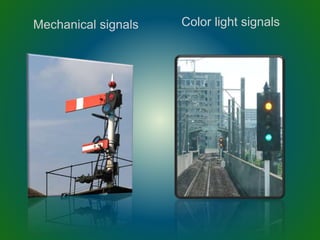
RAILWAY SIGNALLING:
 Railway signaling is a system used to control railway traffic
safely, essentially to prevent trains from colliding.
 Fixed signals
 Route signal
 speed signal
Types of signals
1. Mechanical signals
2. Color light signals
Mechanical signals Color light signals
PASSENGER RESERVATION SYSTEM
(PRS) :
Computerized reservation system to find the
information of any train from anywhere in country.
System works both on the optical fiber cable and
the microwave communication at the data rate of
4.8 kbps or 9.6 kbps.
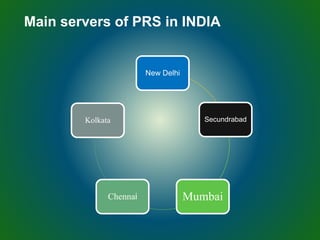
Main servers of PRS in INDIA
New Delhi
Secundrabad
MumbaiChennai
Kolkata
EQUIPMENTS USED IN PRS
Modem
 Multiplexing Equipment
End terminal
 Indian railways, the largest rail network in Asia and the
world's second largest under one management are
also credited with having a multi gauge and multi
traction system.
 The passenger traffic has risen from leaps and bounds
from 1284 million in 1950-51 to 35112 million in 2013-
2014.
 Darjeeling Himalayan Railways, running from New
Jalpaiguri to Darjeeling, a hill station at an elevation of
2134 meters has attained the World Heritage Status
from UNESCO.
 'Palace on Wheels' gives you the experience of a
royalty. The train passes through following
INTERESTING FACTS ABOUT
INDIAN RAILWAY:
CONT……
 Longest station name: Venkatanarasimharajuvariapeta
section of the Southern Railway.
 Longest run (time): The Himsagar Express running between
Jammu Tawi and Kanyakumari, It covers its route of 3751km in
74 hours and 55 minutes.
 Longest run for daily train: The Kerala Express has daily
service and covers 3054 km in its run (in 42.5 hours).
 Stations straddling state lines: Navapur is a station that is
half in Maharashtra and half in Gujarat .
 Bhawani Mandi station, on the Shamgarh-Kota section of the
Bombay-Delhi line is half in Madhya Pradesh and half in
Rajasthan.
 Station with all the three gauges: Siliguri station.
REFERENCES:
 http://www.slideshare.net/TempusTelcosys/training-on-microwave-
communication
 http://www.indianrail.gov.in/concert_Team.html
 Data provided by the indian railway,jaipur.
 http://www.iriset.ac.in
 www.autherstream.com
 www.wikipedia.com
Summer training from Indian Railway ppt (2)

Summer training from Indian Railway ppt (2)

  • 1.
    AN INDUSTRIAL PRESENTATION ON Technologies in “INDIAN RAILWAY” SUBMITTED TO: Mr.TARUN MISHRA Mr. VIJENDRA KUMAR PATEL (DEPARTMENT OF ELECTRONICS & COMMUNICATION) SUBMITTED BY: KUMUD KHANDELWAL PCE/EC/12/050
  • 3.
     Introduction toINDIAN RAILWAY  Integrated Passenger Information System (IPIS)  Railnet  Communication system  Microwave Communication  Optical Fiber  Railway Signaling  Passenger Reservation System (PRS)  Some Interesting Facts About Railway CONTENTS : INTRODUCTION
  • 4.
     1853 Firstrailway train journeyed distance of 22 miles between Bombay to Thana.  It runs 12000 trains every day.  It carry 1.4 crore passengers & 16 lakh tones of goods every day.  Daily earnings Rs120 crore.  Indian Railway are divided into zones which are further divided into division.  It is world’s largest railway network comprising of 150,000kms(71000mils) track over a root of 65000 kms and over 7500 stations.  17 zones are headed by General manager , then they divided into DRM.  OWNED BY CENTRAL GOVERNMENT AND SEEN BY MINISTRY OF RAILWAYS.  17 RAILWAY ZONES  HEADQUARTERS AT NEW DELHI HEADED BY GM HEADED BY DRM HEADED BY STATION DIVISION S STATION ZONES INTRODUCTION :
  • 5.
    Has 4 Divisions:Jodhpur, Bikaner , Jaipur and Ajmer.  Headquarters at JAIPUR  Abbreviated as NWR  Established on 1st OCT , 2002  Has route of RANGE about 5459 kms NORTH WESTERN RAILWAYS • Jodhpur • Bikaner Northern Division • Jaipur • Ajmer Western Division Features of Jaipur Division: No. of stations: 128 No. of Trains run: 146 Serves states of Uttar Pradesh, Haryana and Rajasthan.
  • 6.
  • 7.
  • 8.
    INTEGRATED PASSENGER INFORMATION SYSTEM(IPIS):  passenger information systems are the key communications link between transportation operators and the travelling public.  This system to provide accurate, current information on arrival and departure times and Platform information.  Integrated Passenger Information System is a single system control, providing audio and visual information to passengers.  It is related to Train Indication, Coach Guidance and PC Based Announcement System.  provides a single control system and data entry system for different types display boards available on entire railway station.
  • 9.
    The Integrated PassengerInformation System Consists Of Following: Two control consoles in redundant mode loaded with software Data Communication Hub (MDCH & PDCH) Display boards CCTV PC based Announcement system
  • 10.
    DATA COMMUNICATION HUB MAIN DATA COMMUNICATIONHUB (MDCH) PLATFORM DATA COMMUNICATION HUB (PDCH) DISPLAY BOARDS MULTILINE DISPLAY BOARD(MBD) AT A GLANCE DISPLAY BOARD SINGLE LINE DISPLAY BOARD
  • 11.
    At a GlanceDisplay Board Single Line Display Board Multi Line Display Board (MLDB)
  • 12.
    MLDB -1 MLDB -2 AGDB-1 MDCH PDCH 1 PDB -1 CGDB- 1 CGDB- 8 CGDB- 9 CGDB- 16 CGDB- 17 CGDB- 24 PDB -2 CGDB- 1 CGDB- 8 CGDB- 9 CGDB- 16 CGDB- 17 CGDB- 24 PDCH 2 PDB -3 CGDB- 1 CGDB- 8 CGDB- 9 CGDB- 16 CGDB- 17 CGDB- 24 PDB -4 CGDB- 1 CGDB- 8 CGDB- 9 CGDB- 16 CGDB- 17 CGDB- 24 PDCH n PDB -n CGDB- 1 CGDB- 8 CGDB- 9 CGDB- 16 CGDB- 17 CGDB- 24 PDB -n CGDB- 1 CGDB- 8 CGDB- 9 CGDB- 16 CGDB- 17 CGDB- 24 CCU CCTV Audio
  • 14.
    RAILNET: Rail net isan internet for railways. Railnet is the name of the Corporate Wide Information System (CWIS) of Indian Railways. It is aimed to provide computer connectivity between Railway Board, Zonal Railways, Production units. This unit consists of main switch ,web server , switch, hub, router, modem, LAN and WAN extenders and pc’s.
  • 15.
    OBJECTIVES OF RAILNET: Eliminatethe need to move paper documents between different documents and Change from “Periodic Reporting” to “Information on Demand.”
  • 16.
    RAILNET GENERAL ARRANGEMENT: ModemRouter Firewall Switch Hub Users Server Internet Railnet Railnet General Arrangement
  • 17.
  • 19.
    COMMUNICATION SYSTEM:  Communicationmeans sending and receiving of signal between two stations through different mediums. 3 essential components of communication :  Transmitter(Tx)  Receiver (Rx)  Medium Tx Medium Rx
  • 20.
    TYPES OF COMMUNICATION Overheadcommunication Underground communication Microwave communication Optical Fiber communication
  • 21.
  • 22.
    MICROWAVE COMMUNICATION:  Communicationrefers to the sending , receiving and processing of information by electronic means.  MW are radio waves with wavelengths ranging from as long as one meter to as short as one mm.  MW frequency ranges between 300 MHz (0.3 GHz) and 300 GHz.  The microwave propagation takes place through space waves in troposphere.
  • 23.
    MICROWAVE PROPAGATION MODES There aremainly 3 modes of MW propagation:- Line of sight (LOS)  Skywave Propagation  Ground wave Propagation
  • 24.
    LOS ProblemsLOS Occurrence TowerATower BTower A Tower b
  • 25.
    LOS SOLUTION (FRESNELZONE) Fresnel zone – elliptical area around the LOS between a sender and receiver. Microwaves spread into this area once are generated by an antenna. This area should be free of any obstacles
  • 26.
  • 27.
    ADVANTAGES MICROWAVE COMMUNICATION Largebandwidth is possible. Hence, more information can be transmitted as hundreds of channel is possible(approx 960). Better quality of service due to negligible voice.
  • 28.
    Optical fiber communication OFC haveFibers which are long, thin strands made with pure glass about the diameter of a human hair. Non-metallic conductor and this can transmit light energy from one end to the other end. Based on the phenomenon of ‘TOTAL INTERNAL REFLECTION OF LIGHT
  • 29.
  • 30.
    OPTICAL FIBER MODES: An optical fiber guides light waves in distinct patterns called modes.  Mode describes the distribution of light energy across the fiber.
  • 31.
    PROPAGATION OF LIGHTTHROUGH FIBRE :
  • 32.
    ADVANTAGE OF OFCCOMMUNICATION:  More information carrying capacity.  Low transmission loss.  Dielectric waveguide  Signal security  Small size and weight  Use of WDM – Switching / routing at Optical signal level  Safety  Signal security  No cross talk  High resistance to chemical effects and temperature variations.
  • 33.
     Long haulcircuits for administrative branch and data transmission circuits.  Short -haul circuits for linking of telephone exchanges.  Control communication & Signaling application for fail safe transmission.  Electronic interlocking systems installations. Application in Signal and Telecommunications
  • 34.
    RAILWAY SIGNALLING:  Railwaysignaling is a system used to control railway traffic safely, essentially to prevent trains from colliding.  Fixed signals  Route signal  speed signal Types of signals 1. Mechanical signals 2. Color light signals
  • 35.
  • 36.
    PASSENGER RESERVATION SYSTEM (PRS): Computerized reservation system to find the information of any train from anywhere in country. System works both on the optical fiber cable and the microwave communication at the data rate of 4.8 kbps or 9.6 kbps.
  • 37.
    Main servers ofPRS in INDIA New Delhi Secundrabad MumbaiChennai Kolkata
  • 38.
    EQUIPMENTS USED INPRS Modem  Multiplexing Equipment End terminal
  • 39.
     Indian railways,the largest rail network in Asia and the world's second largest under one management are also credited with having a multi gauge and multi traction system.  The passenger traffic has risen from leaps and bounds from 1284 million in 1950-51 to 35112 million in 2013- 2014.  Darjeeling Himalayan Railways, running from New Jalpaiguri to Darjeeling, a hill station at an elevation of 2134 meters has attained the World Heritage Status from UNESCO.  'Palace on Wheels' gives you the experience of a royalty. The train passes through following INTERESTING FACTS ABOUT INDIAN RAILWAY:
  • 40.
    CONT……  Longest stationname: Venkatanarasimharajuvariapeta section of the Southern Railway.  Longest run (time): The Himsagar Express running between Jammu Tawi and Kanyakumari, It covers its route of 3751km in 74 hours and 55 minutes.  Longest run for daily train: The Kerala Express has daily service and covers 3054 km in its run (in 42.5 hours).  Stations straddling state lines: Navapur is a station that is half in Maharashtra and half in Gujarat .  Bhawani Mandi station, on the Shamgarh-Kota section of the Bombay-Delhi line is half in Madhya Pradesh and half in Rajasthan.  Station with all the three gauges: Siliguri station.
  • 41.
    REFERENCES:  http://www.slideshare.net/TempusTelcosys/training-on-microwave- communication  http://www.indianrail.gov.in/concert_Team.html Data provided by the indian railway,jaipur.  http://www.iriset.ac.in  www.autherstream.com  www.wikipedia.com