Debnarayan Dutta, MD
Head, Radiation Oncology
Amrita Institute of Medical Science, Kochi
duttadeb07@gmail.com
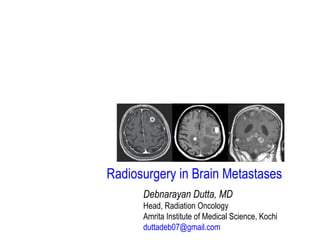
Radiosurgery in Brain Metastases
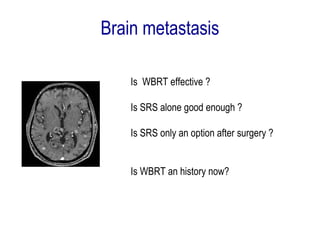
Is WBRT effective ?
Is SRS alone good enough ?
Is SRS only an option after surgery ?
Is WBRT an history now?
Brain metastasis
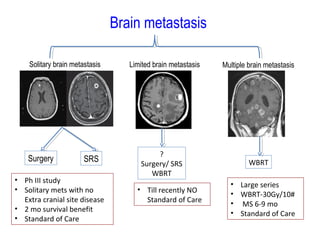
Solitary brain metastasis Multiple brain metastasisLimited brain metastasis
Brain metastasis
Surgery SRS WBRT
?
Surgery/ SRS
WBRT
• Ph III study
• Solitary mets with no
Extra cranial site disease
• 2 mo survival benefit
• Standard of Care
• Large series
• WBRT-30Gy/10#
• MS 6-9 mo
• Standard of Care
• Till recently NO
Standard of Care
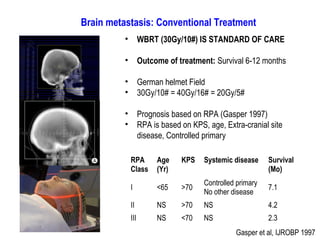
Brain metastasis: Conventional Treatment
• WBRT (30Gy/10#) IS STANDARD OF CARE
• Outcome of treatment: Survival 6-12 months
• German helmet Field
• 30Gy/10# = 40Gy/16# = 20Gy/5#
• Prognosis based on RPA (Gasper 1997)
• RPA is based on KPS, age, Extra-cranial site
disease, Controlled primary
RPA
Class
Age
(Yr)
KPS Systemic disease Survival
(Mo)
I <65 >70
Controlled primary
No other disease
7.1
II NS >70 NS 4.2
III NS <70 NS 2.3
Gasper et al, IJROBP 1997
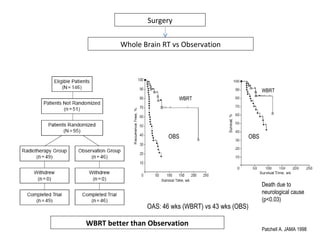
Surgery
Whole Brain RT vs Observation
WBRT
OBS
OAS: 46 wks (WBRT) vs 43 wks (OBS)
WBRT
OBS
Death due to
neurological cause
(p<0.03)
WBRT better than Observation
Patchell A. JAMA 1998
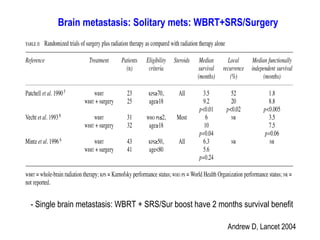
Brain metastasis: Solitary mets: WBRT+SRS/Surgery
- Single brain metastasis: WBRT + SRS/Sur boost have 2 months survival benefit
Andrew D, Lancet 2004
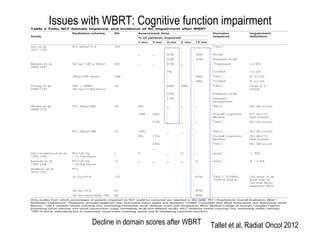
Tallet et al, Radiat Oncol 2012
Issues with WBRT: Cognitive function impairment
Decline in domain scores after WBRT
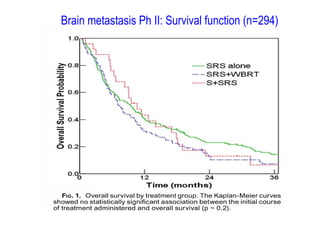
Brain metastasis Ph II: Survival function (n=294)
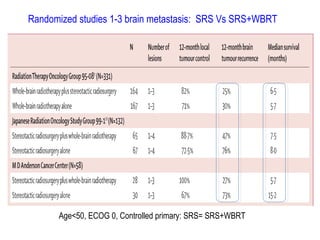
Randomized studies 1-3 brain metastasis: SRS Vs SRS+WBRT
Age<50, ECOG 0, Controlled primary: SRS= SRS+WBRT
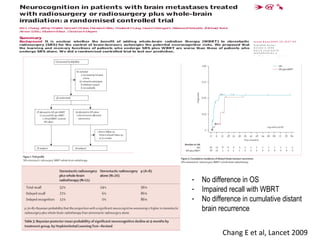
w w w .t h e l a n c e t .c o m / o n c o l o g y V o l 1 0 N o v e m b e r 2 0 0 9 1037
Neurocognition in patients with brain metastases treated
with radiosurgery or radiosurgery plus whole-brain
irradiation: a randomised controlled trial
EricLChang,JeffreySWefel,KennethRHess,PamelaKAllen, FrederickFLang,DavidGKornguth,RebeccaBArbuckle,JMichael Swint,
AlmonSShiu,MosheHMaor, ChristinaAMeyers
Summary
Background It is unclear whether the benefit of adding whole-brain radiation therapy (WBRT) to stereotactic
radiosurgery (SRS) for the control of brain-tumours outweighs the potential neurocognitive risks. We proposed that
the learning and memory functions of patients who undergo SRS plus WBRT are worse than those of patients who
undergo SRS alone. We did a randomised controlled trial to test our prediction.
Methods Patients with one to three newly diagnosed brain metastases were randomly assigned using a standard
permutated block algorithm with random block sizes to SRS plus WBRT or SRS alone from Jan 2, 2001, to Sept 14,
2007. Patients were stratified by recursive partitioning analysis class, number of brain metastases, and radioresistant
histology. The randomisation sequence was masked until assignation, at which point both clinicians and patients were
made aware of the treatment allocation. The primary endpoint was neurocognitive function: objectively measured as a
significant deterioration (5-point drop compared with baseline) in Hopkins Verbal Learning Test–Revised (H VLT-R)
total recall at 4 months. An independent data monitoring committee monitored the trial using Bayesian statistical
methods. Analysis was by intention-to-treat. This trial is registered at www .ClinicalTrials.gov, number NCT00548756.
Findings After 58 patients were recruited (n=30 in the SRS alone group, n=28 in the SRS plus WBRT group), the trial
was stopped by the data monitoring committee according to early stopping rules on the basis that there was a high
probability (96%) that patients randomly assigned to receive SRS plus WBRT were significantly more likely to show a
decline in learning and memory function (mean posterior probability of decline 52%) at 4 months than patients
assigned to receive SRS alone (mean posterior probability of decline 24%). At 4 months there were four deaths (13%)
in the group that received SRS alone, and eight deaths (29%) in the group that received SRS plus WBRT. 73% of
patients in the SRS plus WBRT group were free from CNS recurrence at 1 year, compared with 27% of patients who
received SRS alone (p=0· 0003). In the SRS plus WBRT group, one case of grade 3 toxicity (seizures, motor neuropathy,
depressed level of consciousness) was attributed to radiation treatment. In the group that received SRS, one case of
grade 3 toxicity (aphasia) was attributed to radiation treatment. Two cases of grade 4 toxicity in the group that received
SRS alone were diagnosed as radiation necrosis.
Interpretation Patients treated with SRS plus WBRT were at a greater risk of a significant decline in learning and
memory function by 4 months compared with the group that received SRS alone. Initial treatment with a combination
of SRS and close clinical monitoring is recommended as the preferred treatment strategy to better preserve learning
and memory in patients with newly diagnosed brain metastases.
Funding No external funding was received.
Introduction
About 170000 new brain metastases are diagnosed in the
USA each year.1
For over 50 years, wholebrain radiotherapy
(WBRT) has served as the standard palliative treatment
for brain metastases. More recently, randomised trials
have established the added survival benefi t of either
surgery or stereotactic radiosurgery (SRS) combined with
WBRT over WBRT alone for patients with single brain
metastases,2–4
raising questions about the role of WBRT
and its possible effect on neurocognitive function.
A strategy to preserve neurocognition in patients with
one to three newly diagnosed brain metastases is to use
SRS alone with clinical monitoring to defer or completely
avoid WBRT.5
However, SRS plus WBRT is frequently
given to maximise disease control, since the omission of
WBRT increases the risk of recurrent brain metastases.6–10
We did a randomised controlled trial to help clarify
whether elective WBRT should be given with SRS, or
deferred. We proposed that patients treated with SRS plus
WBRT would have inferior neurocognitive function based
on the Hopkins Verbal Learning Test–Revised (H VLT–R)
compared with patients treated with SRS alone.
Methods
Patients
Eligible patients who presented at the Departments of
Radiation Oncology, and Neurosurgery, and at the Brain
and Spine Center, MD Anderson Cancer Center, Houston,
L a n c e t O n c o l 2 0 0 9 ; 1 0 : 1 0 3 7 – 4 4
P u b l i s h e d O n li n e
O c t o b e r 5 , 2 0 0 9
D O I:1 0 .1 0 1 6 / S 1 4 7 0 -
2 0 4 5 ( 0 9 ) 7 0 2 6 3 - 3
S e e R e fl e c t i o n a n d R e a c t i o n
p a g e 1 0 2 4
D e p a r t m e n t o f R a d i a t i o n
O n c o l o g y ( E L C h a n g M D ,
P K A l l e n P h D , D G K o r n g u t h M D ,
P r o f M H M a o r M D ) ,
N e u r o p s y c h o l o g y S e c t i o n ,
D e p a r t m e n t o f
N e u r o - O n c o l o g y ( J S W e f e l P h D ,
P r o f C A M e y e r s P h D ) ,
D e p a r t m e n t o f N e u r o s u r g e r y
( P r o f F F L a n g M D ) , D e p a r t m e n t
o f B i o s t a t is t i c s
( P r o f K R H e s s P h D ) ,
D e p a r t m e n t o f
P h a r m a c o e c o n o m i c s
( R B A r b u c k l e M S ) , a n d t h e
D e p a r t m e n t o f R a d i a t i o n
P h y s i c s ( P r o f A S S h i u P h D ) ,
T h e U n i v e r s i t y o f T e x a s ,
M D A n d e r s o n C a n c e r C e n t e r ,
H o u s t o n , T X , U S A ; a n d
U n i v e r s i t y o f T e x a s S c h o o l o f
P u b li c H e a l t h a n d T h e C e n t e r
f o r C l in i c a l R e s e a r c h a n d
E v i d e n c e - B a s e d M e d i c i n e ,
U n i v e r s i t y o f T e x a s – H o u s t o n
M e d i c a l S c h o o l, H o u s t o n , T X ,
U S A ( P r o f J M S w i n t P h D )
C o r r e s p o n d e n c e t o :
D r E r i c L C h a n g , D e p a r t m e n t o f
R a d i a t i o n O n c o l o g y , U T M D
A n d e r s o n C a n c e r C e n t e r ,
1 5 1 5 H o l c o m b e B o u le v a r d ,
U n i t 9 7 , H o u s t o n , T X 7 7 0 3 0 , U S A
e c h a n g @ m d a n d e r s o n . o r g
Chang E et al, Lancet 2009
- No difference in OS
- Impaired recall with WBRT
- No difference in cumulative distant
brain recurrence
Analysis 1.1. Comparison 1 Whole-Brain Radiotherapy versus Observation, Outcome 1 Overall Survival.
Review: Surgery or radiosurgery plus whole brain radiotherapy versus surgery or radiosurgery alone for brain metastases
Comparison: 1 Whole-Brain Radiotherapy versus Observation
Outcome: 1 Overall Survival
Study or subgroup
Whole-Brain
Radiotherapy Observation log [Hazard Ratio] Hazard Ratio Weight Hazard Ratio
N N (SE) IV,Random,95% CI IV,Random,95% CI
Patchell 1998 49 46 -0.09 (0.22) 21.5 % 0.91 [ 0.59, 1.41 ]
Aoyama 2006 65 67 0 (0.19) 24.6 % 1.00 [ 0.69, 1.45 ]
Roos 2006 10 9 0.01 (0.52) 6.6 % 1.01 [ 0.36, 2.80 ]
Chang 2009 28 30 0.9 (0.31) 14.5 % 2.46 [ 1.34, 4.52 ]
Kocher 2011 180 179 -0.02 (0.12) 32.7 % 0.98 [ 0.77, 1.24 ]
Total (95% CI) 332 331 100.0 % 1.11 [ 0.83, 1.48 ]
Heterogeneity: Tau2 = 0.05; Chi2 = 8.34, df = 4 (P = 0.08); I2 =52%
Test for overall effect: Z = 0.72 (P = 0.47)
Test for subgroup differences: Not applicable
0.5 0.7 1 1.5 2
Favours WBRT Favours Observation
Soon et al, Cochrene metaanalysis, 2014
Brain metastasis: Cochrane meta-analysis 2014
Surgery/SRS+ WBRT Vs SRS/Surgery alone: Over all Survival
No difference in over all survival
p-value=0.47
Analysis 1.2. Comparison 1 Whole-Brain Radiotherapy versus Observation, Outcome 2 Progression Free
Survival.
Review: Surgery or radiosurgery plus whole brain radiotherapy versus surgery or radiosurgery alone for brain metastases
Comparison: 1 Whole-Brain Radiotherapy versus Observation
Outcome: 2 Progression Free Survival
Study or subgroup
Whole-Brain
Radiotherapy Observation log [Hazard Ratio] Hazard Ratio Weight Hazard Ratio
N N (SE) IV,Random,95% CI IV,Random,95% CI
Kocher 2011 180 179 -0.34 (0.11) 88.4 % 0.71 [ 0.57, 0.88 ]
Roos 2006 10 9 0.24 (0.52) 11.6 % 1.27 [ 0.46, 3.52 ]
Total (95% CI) 190 188 100.0 % 0.76 [ 0.53, 1.10 ]
Heterogeneity: Tau2 = 0.03; Chi2 = 1.19, df = 1 (P = 0.28); I2 =16%
Test for overall effect: Z = 1.47 (P = 0.14)
Test for subgroup differences: Not applicable
0.5 0.7 1 1.5 2
Favours WBRT Favours Observation
Soon et al, Cochrene metaanalysis, 2014
Brain metastasis: Cochrane meta-analysis 2014
Surgery/SRS+ WBRT Vs SRS/Surgery alone: Progression free Survival
WBRT: Definite reduction in local failure
p-value=0..14
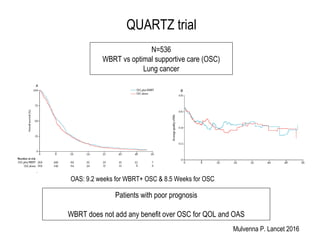
QUARTZ trial
N=536
WBRT vs optimal supportive care (OSC)
Lung cancer
OAS: 9.2 weeks for WBRT+ OSC & 8.5 Weeks for OSC
Patients with poor prognosis
WBRT does not add any benefit over OSC for QOL and OAS
Mulvenna P. Lancet 2016
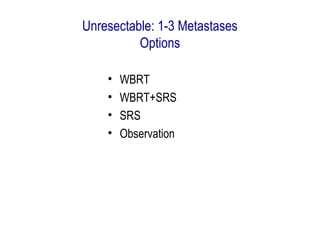
Unresectable: 1-3 Metastases
Options
• WBRT
• WBRT+SRS
• SRS
• Observation
Brain
Mets
S
t
r
a
t
i
f
y
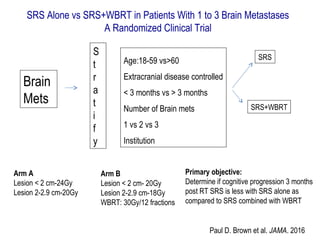
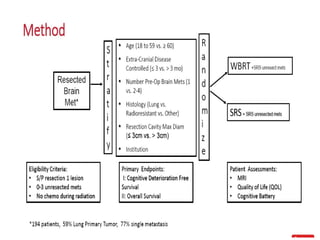
Age:18-59 vs>60
Extracranial disease controlled
< 3 months vs > 3 months
Number of Brain mets
1 vs 2 vs 3
Institution
SRS
SRS+WBRT
Primary objective:
Determine if cognitive progression 3 months
post RT SRS is less with SRS alone as
compared to SRS combined with WBRT
Arm A
Lesion < 2 cm-24Gy
Lesion 2-2.9 cm-20Gy
Arm B
Lesion < 2 cm- 20Gy
Lesion 2-2.9 cm-18Gy
WBRT: 30Gy/12 fractions
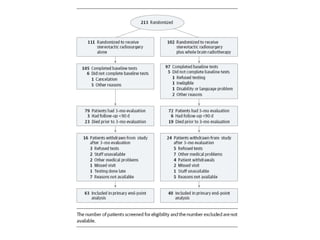
SRS Alone vs SRS+WBRT in Patients With 1 to 3 Brain Metastases
A Randomized Clinical Trial
Paul D. Brown et al. JAMA. 2016
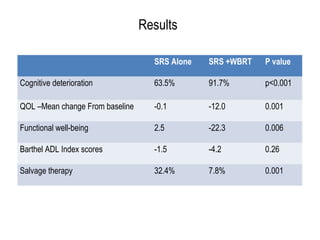
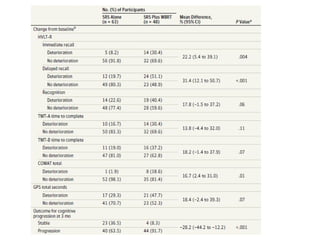
Results
SRS Alone SRS +WBRT P value
Cognitive deterioration 63.5% 91.7% p<0.001
QOL –Mean change From baseline -0.1 -12.0 0.001
Functional well-being 2.5 -22.3 0.006
Barthel ADL Index scores -1.5 -4.2 0.26
Salvage therapy 32.4% 7.8% 0.001
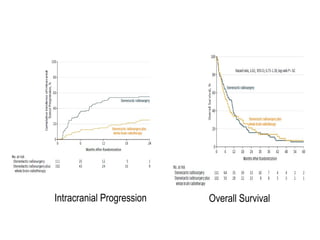
Intracranial Progression Overall Survival
Conclusion: Brown et al study
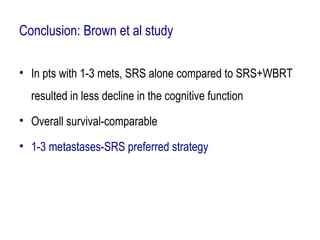
• In pts with 1-3 mets, SRS alone compared to SRS+WBRT
resulted in less decline in the cognitive function
• Overall survival-comparable
• 1-3 metastases-SRS preferred strategy
Brown et al, IJROBP 2016
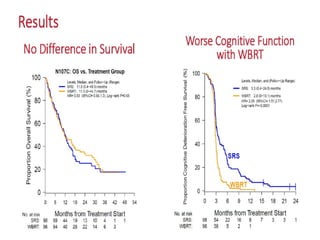
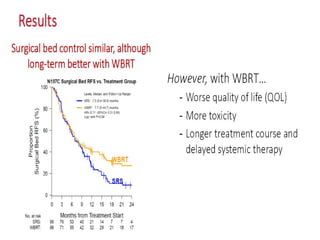
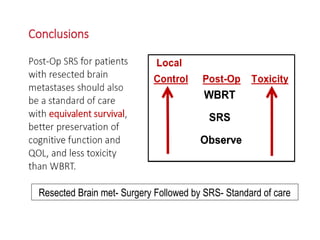
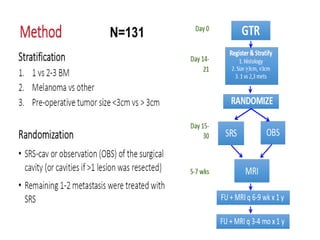
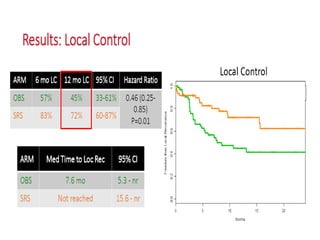
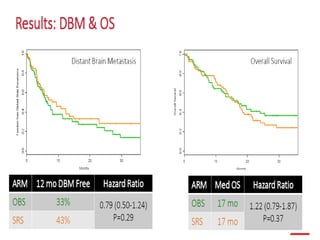
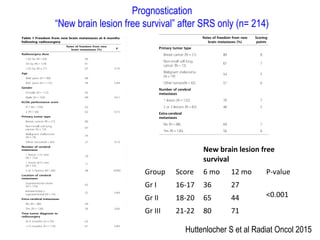
Resected Brain met- Surgery Followed by SRS- Standard of care
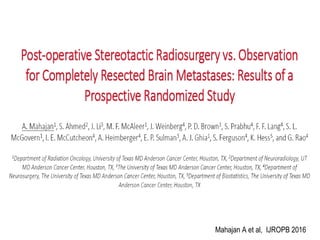
Mahajan A et al, IJROPB 2016
N=131
New brain lesion free
survival (%)
Group Score 6 mo 12 mo P-value
Gr I 16-17 36 27
<0.001Gr II 18-20 65 44
Gr III 21-22 80 71
Prognostication
“New brain lesion free survival” after SRS only (n= 214)
Huttenlocher S et al Radiat Oncol 2015
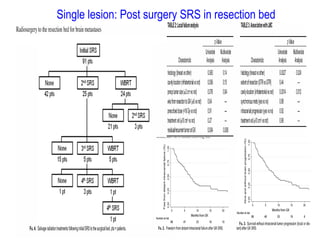
Single lesion: Post surgery SRS in resection bed
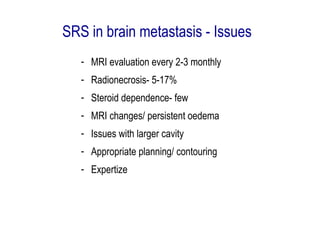
SRS in brain metastasis - Issues
- MRI evaluation every 2-3 monthly
- Radionecrosis- 5-17%
- Steroid dependence- few
- MRI changes/ persistent oedema
- Issues with larger cavity
- Appropriate planning/ contouring
- Expertize
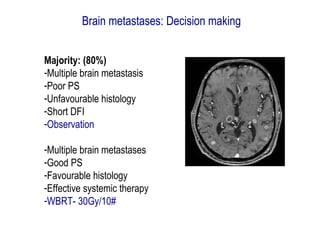
Brain metastases: Decision making
Majority: (80%)
-Multiple brain metastasis
-Poor PS
-Unfavourable histology
-Short DFI
-Observation
-Multiple brain metastases
-Good PS
-Favourable histology
-Effective systemic therapy
-WBRT- 30Gy/10#
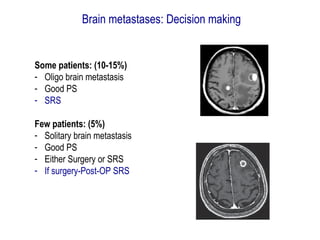
Some patients: (10-15%)
- Oligo brain metastasis
- Good PS
- SRS
Few patients: (5%)
- Solitary brain metastasis
- Good PS
- Either Surgery or SRS
- If surgery-Post-OP SRS
Brain metastases: Decision making
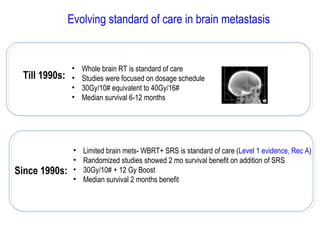
Evolving standard of care in brain metastasis
Till 1990s:
• Whole brain RT is standard of care
• Studies were focused on dosage schedule
• 30Gy/10# equivalent to 40Gy/16#
• Median survival 6-12 months
Since 1990s:
• Limited brain mets- WBRT+ SRS is standard of care (Level 1 evidence, Rec A)
• Randomized studies showed 2 mo survival benefit on addition of SRS
• 30Gy/10# + 12 Gy Boost
• Median survival 2 months benefit
Evolving standard of care in brain metastasis
• 1-3 lesions: SRS is the standard of care (Level 1A evidence, Rec A)
• Post-OP: Cavity boost with SRS is standard of care (Level 1A, Rec A)
Since 2012:
• Limited brain metastasis- SRS alone (Level 1A evidence, Rec A)
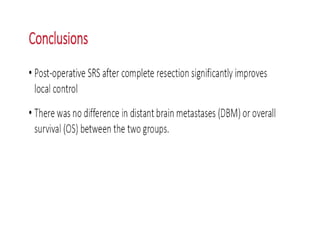
• Randomized studies showed no OS benefit with WBRT
• Meta-analysis confirmed: No OS benefit with WBRT, only LC benefit
• Randomized studies confirmed Cognitive function decline with WBRT
• WBRT only on recurrence / leptomeningial disease
• SRS boost after surgery: reduce local recurrence (Level II, Rec B)
• Preservation of cognitive function
• Hippocampal sparing RT is new & exciting (Level II, Rec B)
• Need randomized study for confirmation of it’s effectiveness
Since 2016:
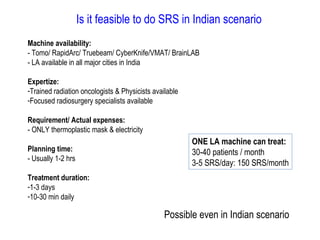
Is it feasible to do SRS in Indian scenario
Machine availability:
- Tomo/ RapidArc/ Truebeam/ CyberKnife/VMAT/ BrainLAB
- LA available in all major cities in India
Expertize:
-Trained radiation oncologists & Physicists available
-Focused radiosurgery specialists available
Requirement/ Actual expenses:
- ONLY thermoplastic mask & electricity
Planning time:
- Usually 1-2 hrs
Treatment duration:
-1-3 days
-10-30 min daily
ONE LA machine can treat:
30-40 patients / month
3-5 SRS/day: 150 SRS/month
Possible even in Indian scenario

Radiosurgery in Brain Metastases

  • 1.
    Debnarayan Dutta, MD Head,Radiation Oncology Amrita Institute of Medical Science, Kochi duttadeb07@gmail.com Radiosurgery in Brain Metastases
  • 2.
    Is WBRT effective? Is SRS alone good enough ? Is SRS only an option after surgery ? Is WBRT an history now? Brain metastasis
  • 3.
    Solitary brain metastasisMultiple brain metastasisLimited brain metastasis Brain metastasis Surgery SRS WBRT ? Surgery/ SRS WBRT • Ph III study • Solitary mets with no Extra cranial site disease • 2 mo survival benefit • Standard of Care • Large series • WBRT-30Gy/10# • MS 6-9 mo • Standard of Care • Till recently NO Standard of Care
  • 4.
    Brain metastasis: ConventionalTreatment • WBRT (30Gy/10#) IS STANDARD OF CARE • Outcome of treatment: Survival 6-12 months • German helmet Field • 30Gy/10# = 40Gy/16# = 20Gy/5# • Prognosis based on RPA (Gasper 1997) • RPA is based on KPS, age, Extra-cranial site disease, Controlled primary RPA Class Age (Yr) KPS Systemic disease Survival (Mo) I <65 >70 Controlled primary No other disease 7.1 II NS >70 NS 4.2 III NS <70 NS 2.3 Gasper et al, IJROBP 1997
  • 5.
    Surgery Whole Brain RTvs Observation WBRT OBS OAS: 46 wks (WBRT) vs 43 wks (OBS) WBRT OBS Death due to neurological cause (p<0.03) WBRT better than Observation Patchell A. JAMA 1998
  • 6.
    Brain metastasis: Solitarymets: WBRT+SRS/Surgery - Single brain metastasis: WBRT + SRS/Sur boost have 2 months survival benefit Andrew D, Lancet 2004
  • 7.
    Tallet et al,Radiat Oncol 2012 Issues with WBRT: Cognitive function impairment Decline in domain scores after WBRT
  • 8.
    Brain metastasis PhII: Survival function (n=294)
  • 9.
    Randomized studies 1-3brain metastasis: SRS Vs SRS+WBRT Age<50, ECOG 0, Controlled primary: SRS= SRS+WBRT
  • 10.
    w w w.t h e l a n c e t .c o m / o n c o l o g y V o l 1 0 N o v e m b e r 2 0 0 9 1037 Neurocognition in patients with brain metastases treated with radiosurgery or radiosurgery plus whole-brain irradiation: a randomised controlled trial EricLChang,JeffreySWefel,KennethRHess,PamelaKAllen, FrederickFLang,DavidGKornguth,RebeccaBArbuckle,JMichael Swint, AlmonSShiu,MosheHMaor, ChristinaAMeyers Summary Background It is unclear whether the benefit of adding whole-brain radiation therapy (WBRT) to stereotactic radiosurgery (SRS) for the control of brain-tumours outweighs the potential neurocognitive risks. We proposed that the learning and memory functions of patients who undergo SRS plus WBRT are worse than those of patients who undergo SRS alone. We did a randomised controlled trial to test our prediction. Methods Patients with one to three newly diagnosed brain metastases were randomly assigned using a standard permutated block algorithm with random block sizes to SRS plus WBRT or SRS alone from Jan 2, 2001, to Sept 14, 2007. Patients were stratified by recursive partitioning analysis class, number of brain metastases, and radioresistant histology. The randomisation sequence was masked until assignation, at which point both clinicians and patients were made aware of the treatment allocation. The primary endpoint was neurocognitive function: objectively measured as a significant deterioration (5-point drop compared with baseline) in Hopkins Verbal Learning Test–Revised (H VLT-R) total recall at 4 months. An independent data monitoring committee monitored the trial using Bayesian statistical methods. Analysis was by intention-to-treat. This trial is registered at www .ClinicalTrials.gov, number NCT00548756. Findings After 58 patients were recruited (n=30 in the SRS alone group, n=28 in the SRS plus WBRT group), the trial was stopped by the data monitoring committee according to early stopping rules on the basis that there was a high probability (96%) that patients randomly assigned to receive SRS plus WBRT were significantly more likely to show a decline in learning and memory function (mean posterior probability of decline 52%) at 4 months than patients assigned to receive SRS alone (mean posterior probability of decline 24%). At 4 months there were four deaths (13%) in the group that received SRS alone, and eight deaths (29%) in the group that received SRS plus WBRT. 73% of patients in the SRS plus WBRT group were free from CNS recurrence at 1 year, compared with 27% of patients who received SRS alone (p=0· 0003). In the SRS plus WBRT group, one case of grade 3 toxicity (seizures, motor neuropathy, depressed level of consciousness) was attributed to radiation treatment. In the group that received SRS, one case of grade 3 toxicity (aphasia) was attributed to radiation treatment. Two cases of grade 4 toxicity in the group that received SRS alone were diagnosed as radiation necrosis. Interpretation Patients treated with SRS plus WBRT were at a greater risk of a significant decline in learning and memory function by 4 months compared with the group that received SRS alone. Initial treatment with a combination of SRS and close clinical monitoring is recommended as the preferred treatment strategy to better preserve learning and memory in patients with newly diagnosed brain metastases. Funding No external funding was received. Introduction About 170000 new brain metastases are diagnosed in the USA each year.1 For over 50 years, wholebrain radiotherapy (WBRT) has served as the standard palliative treatment for brain metastases. More recently, randomised trials have established the added survival benefi t of either surgery or stereotactic radiosurgery (SRS) combined with WBRT over WBRT alone for patients with single brain metastases,2–4 raising questions about the role of WBRT and its possible effect on neurocognitive function. A strategy to preserve neurocognition in patients with one to three newly diagnosed brain metastases is to use SRS alone with clinical monitoring to defer or completely avoid WBRT.5 However, SRS plus WBRT is frequently given to maximise disease control, since the omission of WBRT increases the risk of recurrent brain metastases.6–10 We did a randomised controlled trial to help clarify whether elective WBRT should be given with SRS, or deferred. We proposed that patients treated with SRS plus WBRT would have inferior neurocognitive function based on the Hopkins Verbal Learning Test–Revised (H VLT–R) compared with patients treated with SRS alone. Methods Patients Eligible patients who presented at the Departments of Radiation Oncology, and Neurosurgery, and at the Brain and Spine Center, MD Anderson Cancer Center, Houston, L a n c e t O n c o l 2 0 0 9 ; 1 0 : 1 0 3 7 – 4 4 P u b l i s h e d O n li n e O c t o b e r 5 , 2 0 0 9 D O I:1 0 .1 0 1 6 / S 1 4 7 0 - 2 0 4 5 ( 0 9 ) 7 0 2 6 3 - 3 S e e R e fl e c t i o n a n d R e a c t i o n p a g e 1 0 2 4 D e p a r t m e n t o f R a d i a t i o n O n c o l o g y ( E L C h a n g M D , P K A l l e n P h D , D G K o r n g u t h M D , P r o f M H M a o r M D ) , N e u r o p s y c h o l o g y S e c t i o n , D e p a r t m e n t o f N e u r o - O n c o l o g y ( J S W e f e l P h D , P r o f C A M e y e r s P h D ) , D e p a r t m e n t o f N e u r o s u r g e r y ( P r o f F F L a n g M D ) , D e p a r t m e n t o f B i o s t a t is t i c s ( P r o f K R H e s s P h D ) , D e p a r t m e n t o f P h a r m a c o e c o n o m i c s ( R B A r b u c k l e M S ) , a n d t h e D e p a r t m e n t o f R a d i a t i o n P h y s i c s ( P r o f A S S h i u P h D ) , T h e U n i v e r s i t y o f T e x a s , M D A n d e r s o n C a n c e r C e n t e r , H o u s t o n , T X , U S A ; a n d U n i v e r s i t y o f T e x a s S c h o o l o f P u b li c H e a l t h a n d T h e C e n t e r f o r C l in i c a l R e s e a r c h a n d E v i d e n c e - B a s e d M e d i c i n e , U n i v e r s i t y o f T e x a s – H o u s t o n M e d i c a l S c h o o l, H o u s t o n , T X , U S A ( P r o f J M S w i n t P h D ) C o r r e s p o n d e n c e t o : D r E r i c L C h a n g , D e p a r t m e n t o f R a d i a t i o n O n c o l o g y , U T M D A n d e r s o n C a n c e r C e n t e r , 1 5 1 5 H o l c o m b e B o u le v a r d , U n i t 9 7 , H o u s t o n , T X 7 7 0 3 0 , U S A e c h a n g @ m d a n d e r s o n . o r g Chang E et al, Lancet 2009 - No difference in OS - Impaired recall with WBRT - No difference in cumulative distant brain recurrence
  • 11.
    Analysis 1.1. Comparison1 Whole-Brain Radiotherapy versus Observation, Outcome 1 Overall Survival. Review: Surgery or radiosurgery plus whole brain radiotherapy versus surgery or radiosurgery alone for brain metastases Comparison: 1 Whole-Brain Radiotherapy versus Observation Outcome: 1 Overall Survival Study or subgroup Whole-Brain Radiotherapy Observation log [Hazard Ratio] Hazard Ratio Weight Hazard Ratio N N (SE) IV,Random,95% CI IV,Random,95% CI Patchell 1998 49 46 -0.09 (0.22) 21.5 % 0.91 [ 0.59, 1.41 ] Aoyama 2006 65 67 0 (0.19) 24.6 % 1.00 [ 0.69, 1.45 ] Roos 2006 10 9 0.01 (0.52) 6.6 % 1.01 [ 0.36, 2.80 ] Chang 2009 28 30 0.9 (0.31) 14.5 % 2.46 [ 1.34, 4.52 ] Kocher 2011 180 179 -0.02 (0.12) 32.7 % 0.98 [ 0.77, 1.24 ] Total (95% CI) 332 331 100.0 % 1.11 [ 0.83, 1.48 ] Heterogeneity: Tau2 = 0.05; Chi2 = 8.34, df = 4 (P = 0.08); I2 =52% Test for overall effect: Z = 0.72 (P = 0.47) Test for subgroup differences: Not applicable 0.5 0.7 1 1.5 2 Favours WBRT Favours Observation Soon et al, Cochrene metaanalysis, 2014 Brain metastasis: Cochrane meta-analysis 2014 Surgery/SRS+ WBRT Vs SRS/Surgery alone: Over all Survival No difference in over all survival p-value=0.47
  • 12.
    Analysis 1.2. Comparison1 Whole-Brain Radiotherapy versus Observation, Outcome 2 Progression Free Survival. Review: Surgery or radiosurgery plus whole brain radiotherapy versus surgery or radiosurgery alone for brain metastases Comparison: 1 Whole-Brain Radiotherapy versus Observation Outcome: 2 Progression Free Survival Study or subgroup Whole-Brain Radiotherapy Observation log [Hazard Ratio] Hazard Ratio Weight Hazard Ratio N N (SE) IV,Random,95% CI IV,Random,95% CI Kocher 2011 180 179 -0.34 (0.11) 88.4 % 0.71 [ 0.57, 0.88 ] Roos 2006 10 9 0.24 (0.52) 11.6 % 1.27 [ 0.46, 3.52 ] Total (95% CI) 190 188 100.0 % 0.76 [ 0.53, 1.10 ] Heterogeneity: Tau2 = 0.03; Chi2 = 1.19, df = 1 (P = 0.28); I2 =16% Test for overall effect: Z = 1.47 (P = 0.14) Test for subgroup differences: Not applicable 0.5 0.7 1 1.5 2 Favours WBRT Favours Observation Soon et al, Cochrene metaanalysis, 2014 Brain metastasis: Cochrane meta-analysis 2014 Surgery/SRS+ WBRT Vs SRS/Surgery alone: Progression free Survival WBRT: Definite reduction in local failure p-value=0..14
  • 13.
    QUARTZ trial N=536 WBRT vsoptimal supportive care (OSC) Lung cancer OAS: 9.2 weeks for WBRT+ OSC & 8.5 Weeks for OSC Patients with poor prognosis WBRT does not add any benefit over OSC for QOL and OAS Mulvenna P. Lancet 2016
  • 14.
    Unresectable: 1-3 Metastases Options •WBRT • WBRT+SRS • SRS • Observation
  • 15.
    Brain Mets S t r a t i f y Age:18-59 vs>60 Extracranial diseasecontrolled < 3 months vs > 3 months Number of Brain mets 1 vs 2 vs 3 Institution SRS SRS+WBRT Primary objective: Determine if cognitive progression 3 months post RT SRS is less with SRS alone as compared to SRS combined with WBRT Arm A Lesion < 2 cm-24Gy Lesion 2-2.9 cm-20Gy Arm B Lesion < 2 cm- 20Gy Lesion 2-2.9 cm-18Gy WBRT: 30Gy/12 fractions SRS Alone vs SRS+WBRT in Patients With 1 to 3 Brain Metastases A Randomized Clinical Trial Paul D. Brown et al. JAMA. 2016
  • 17.
    Results SRS Alone SRS+WBRT P value Cognitive deterioration 63.5% 91.7% p<0.001 QOL –Mean change From baseline -0.1 -12.0 0.001 Functional well-being 2.5 -22.3 0.006 Barthel ADL Index scores -1.5 -4.2 0.26 Salvage therapy 32.4% 7.8% 0.001
  • 19.
  • 20.
    Conclusion: Brown etal study • In pts with 1-3 mets, SRS alone compared to SRS+WBRT resulted in less decline in the cognitive function • Overall survival-comparable • 1-3 metastases-SRS preferred strategy
  • 21.
    Brown et al,IJROBP 2016
  • 25.
    Resected Brain met-Surgery Followed by SRS- Standard of care
  • 26.
    Mahajan A etal, IJROPB 2016
  • 28.
  • 32.
    New brain lesionfree survival (%) Group Score 6 mo 12 mo P-value Gr I 16-17 36 27 <0.001Gr II 18-20 65 44 Gr III 21-22 80 71 Prognostication “New brain lesion free survival” after SRS only (n= 214) Huttenlocher S et al Radiat Oncol 2015
  • 33.
    Single lesion: Postsurgery SRS in resection bed
  • 34.
    SRS in brainmetastasis - Issues - MRI evaluation every 2-3 monthly - Radionecrosis- 5-17% - Steroid dependence- few - MRI changes/ persistent oedema - Issues with larger cavity - Appropriate planning/ contouring - Expertize
  • 35.
    Brain metastases: Decisionmaking Majority: (80%) -Multiple brain metastasis -Poor PS -Unfavourable histology -Short DFI -Observation -Multiple brain metastases -Good PS -Favourable histology -Effective systemic therapy -WBRT- 30Gy/10#
  • 36.
    Some patients: (10-15%) -Oligo brain metastasis - Good PS - SRS Few patients: (5%) - Solitary brain metastasis - Good PS - Either Surgery or SRS - If surgery-Post-OP SRS Brain metastases: Decision making
  • 37.
    Evolving standard ofcare in brain metastasis Till 1990s: • Whole brain RT is standard of care • Studies were focused on dosage schedule • 30Gy/10# equivalent to 40Gy/16# • Median survival 6-12 months Since 1990s: • Limited brain mets- WBRT+ SRS is standard of care (Level 1 evidence, Rec A) • Randomized studies showed 2 mo survival benefit on addition of SRS • 30Gy/10# + 12 Gy Boost • Median survival 2 months benefit
  • 38.
    Evolving standard ofcare in brain metastasis • 1-3 lesions: SRS is the standard of care (Level 1A evidence, Rec A) • Post-OP: Cavity boost with SRS is standard of care (Level 1A, Rec A) Since 2012: • Limited brain metastasis- SRS alone (Level 1A evidence, Rec A) • Randomized studies showed no OS benefit with WBRT • Meta-analysis confirmed: No OS benefit with WBRT, only LC benefit • Randomized studies confirmed Cognitive function decline with WBRT • WBRT only on recurrence / leptomeningial disease • SRS boost after surgery: reduce local recurrence (Level II, Rec B) • Preservation of cognitive function • Hippocampal sparing RT is new & exciting (Level II, Rec B) • Need randomized study for confirmation of it’s effectiveness Since 2016:
  • 39.
    Is it feasibleto do SRS in Indian scenario Machine availability: - Tomo/ RapidArc/ Truebeam/ CyberKnife/VMAT/ BrainLAB - LA available in all major cities in India Expertize: -Trained radiation oncologists & Physicists available -Focused radiosurgery specialists available Requirement/ Actual expenses: - ONLY thermoplastic mask & electricity Planning time: - Usually 1-2 hrs Treatment duration: -1-3 days -10-30 min daily ONE LA machine can treat: 30-40 patients / month 3-5 SRS/day: 150 SRS/month Possible even in Indian scenario