PALLIATIVE RADIOTHERAPY
ONCOVISON 2019
LT COL SANKALP SINGH
GD SPL (RADIOTHERAPY)
“The final causes, then, of compassion are to prevent
and to relieve misery.”
 Joseph Butler [1692–1752]
Flow of presentation
History
Definition, Aim, Principles
Differences between Curative & Palliative RT
Clinical indications & how to choose?
Modern technologies
Caveats
Period Site n Fractionation
Used
Response Rates
2013-2015,
CHSC, Pune
Face & Neck 52 30Gy/10fx +
20Gy/10fx (after
4 wk gap)
68% Pain reduction
73% Tumour size
reduction
Period Site n Fractionation
Used
Survival @ 12 months
2011-2013,
AHRR, New
Delhi
Brain (1-3
mets)
25 30Gy/10fx + GKS
Boost of 15 -
24Gy
68% Pain reduction
73% Tumour size
reduction
HISTORY
 X-rays discovered by Wilhelm Roentgen in Nov 1895.
 Emille Grubbe claimed to have successfully palliated a patient of Ca Breast with X-
rays in Jan 1896.
 Lenz & Freid in Ann Surg, 1931, evaluated and found moderate doses of RT
effective in palliation of brain, spine & bone metastases.1
 A review in the BMJ in 1957 reported that a dose of 3000 rad was sufficient for
palliation. Balancing benefit with harm from palliative radiotherapy was now the
task of the radiotherapist. 2
 Chu et al in 1961 described a symptomatic response in 77.8% (123 of 158) patients
of brain metastases treated with 3000 rad of WBRT. 3
1. Lenz M, Freid J. Metastases to the skeleton, brain and spinal cord from cancer of the breast and the effect of radiotherapy. Ann Surg [Internet] 1931; 93: 278–293.
2. Palliative radiotherapy. BMJ 1957; 2: 455–456.
3. Chu FCH, Hilaris B, Chu FC, et al. Value of radiation therapy in the management of intracranial metastases. Cancer [Internet] 1961.
DEFINITION
 Palliative care is the active, holistic care of patients including management of
pain and other distressing symptoms alongwith provision of psychological,
social, and spiritual support, irrespective of stage of disease and need for
other therapies.
 The goal of PC is prevention & reduction of suffering and achievement of the
best quality of life for patients and their families.
 Palliative Radiotherapy is directed towards achieving these goals.
• Hui D, Mori M, Parsons HA, et al. The lack of standard definitions in supportive and palliative oncology literature. J Pain Symptom Manage
2012;43:582-592.
• IOM (Institute of Medicine). 2014 Dying in America: Improving quality and honoring individual preferences near the end of life. Washington,
DC: The National Academic Press.
AIMS
 Rapid symptom relief/control
 Minimal treatment burden in terms of
 Hospital stay or attendance
 Acute side effects
 Symptoms of late effects of radiotherapy should be avoided in expected lifetime
PRINCIPLES
1. Accurate anatomical localisation of the symptomatic tumour deposit.
2. Simple treatment techniques and field arrangements.
3. Short hypofractionated treatment regimes.
4. Moderate dose treatment to achieve a good predictable response and to keep
treatment toxicity to a minimum.
5. Patient selection: Consider the patient’s overall life expectancy when
determining the treatment aims and the treatment duration.
DIFFERENCES BETWEEN RADICAL VS PALLIATIVE RT
RADICAL RT (Curative + palliative RT) PALLIATIVE RT, alone
AIM Tumor eradication & Symptom management Solely for symptom management
TOTAL DOSE 45–50 Gy for microscopic disease & 60–70 Gy for
macroscopic disease
8–30 Gy
FRACTIONATION 1.8–2.0 Gy fractions 3.0–8.0 Gy fractions
DURATION 5–8 weeks 1–2 weeks
ACUTE TOXICITY Increased incidence and severity due to higher total
dose and lengthier treatment duration
Reduced incidence and severity due to smaller
overall dose and shorter treatment duration
LATE TOXICITY Decreased incidence due to smaller fraction size Increased incidence due to larger fraction size
CHEMOTHERAPY Given sequentially or concurrently
in an effort to increase cure rates
May be given sometimes sequentially, but
almost never ?? concurrently (to minimize
toxicity)
CLINICAL INDICATIONS
PALL RT IN BONE METASTASES
 Affects upto 70% patients with advanced cancers & constitutes nearly 40% of all
Pall RT treatments
 Symptoms
 Pain affecting ADLs
 Risk of Pathological# (Consider Surgical stabilization)
 Recommended Dose fractions: 30Gy/10fx, 24Gy/fx, 20Gy/5fx, 8Gy/1fx
 Response rates ~60% at 2-3 weeks with ~30% CR
 Retreatment for recurrence of symptoms possible after 04 weeks with upto 50%
response rates1,2
 Initial flare of pain may be seen in about a third of the patients
 Supplemented with analgesics, radionuclides, bisphosphonates and orthopedic
referrals for stabilization
1 - Chow E, et al. Update of the international consensus on palliative radiotherapy endpoints for future clinical trials in bone metastases. Int J Rad Bio & Phy. 2012 Apr 1;82(5):1730-7. doi:
10.1016/j.ijrobp.2011.02.008. Epub 2011 Apr 12.
2 - Huisman M, van den Bosch MA, Wijlemans JW, et al. Effectiveness of reirradiation for painful bone metastases: A systematic review and meta-analysis. Int J Radiat Oncol Biol Phys. 2012;84:8-14.
PALL RT IN BONE METASTASES
 No difference in pain relief between SF and MF
 Higher retreatment rates after SF
 Evidence of higher rates of pathological # after SF vs MF remains equivocal
 No evidence of significant late effects due to palliative RT for bone mets
Investigator Patients (n) Fractionation Response Rates (%) Repeat Rx rate (%)
Gutierrez
Bayard, 2014,
RCT
90 8Gy/1fx 79 13.3
30Gy/10fx 88 8.8
Chow, 2012, SR 5617 in 25
RCTs
SF 60 20
MF 61 8
Majumder, 2012,
RCT
64 8Gy/1fx 85 NR
30Gy/10fx 77 NR
Sze et al 2004,
SR
3481 in 11
trials
SF 60 21.5
MF 59 7.4
PALL RT IN BONE METASTASES
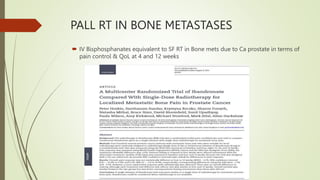
 IV Bisphosphanates equivalent to SF RT in Bone mets due to Ca prostate in terms of
pain control & QoL at 4 and 12 weeks
PALL RT IN BRAIN
METASTASES
 Rising incidence 10-30% of cancer patients
 Median presentation 10m from primary diagnosis & median survival <1 year
 High suspicion index in fresh neurological symptoms/signs in k/c/o cancer : headache,
altered mentation, seizures, focal neurodeficit
 Therapeutic options include Surgery, WBRT, SRS or a combination
 Symptomatic response rates to irradiation vary from 30 to 70%
 Supplemented by targeted therapy, corticosteroids, anticonvulsants, surgery
 Selection of treatment modality/ combination should ideally be based on patient-tumor
characteristics (DS-GPA)
BRAIN METASTASES – PROGNOSTIC
FACTORS
 Upfront presentation vs. k/c/o malignancy
 Lack of histopathology or mass effects
 Age & Performance Status
 Number of brain metastases
 Size & volume of brain metastases
 Status of extracranial disease
 Histology of disease
 Prognostic systems like RPA, GPA & DS-GPA help in stratification of patient to
compare results
BRAIN METASTASES – Prognostic factors
BRAIN METASTASES – HOW TO CHOOSE
THERAPY
 Surgery/SRS improves survival in patients with limited (1-3) brain mets (BM)
 Sx vs SRS – no diff in OS in patients with limited (1-3) BM
 For limited BM with good PS, SRS preferable over WBRT
 Addition of WBRT to Sx/SRS improves local brain control w/out affecting OS
 Omission of WBRT after Sx or SRS can lead to poorer brain control but does not affect OS
 In multiple BM, SRS boost after WBRT improves LC , PS & reduces steroid use but does not
improve OS
 Maximum number of BM that are treatable by SRS is not established & cumulative volume rather
than number maybe relevant
 In poor PS patients with multiple BM & NSCLC primary WBRT does not improve OS or QoL
• Radiotherapeutic and surgical management for newly diagnosed brain metastasis(es): An American Society for Radiation Oncology evidence-based guideline Tsao,
May N. et al. Practical Radiation Oncology , Volume 2 , Issue 3 , 210 - 225
• Paula Mulvenna, et al. Dexamethasone and supportive care with or without whole brain radiotherapy in treating patients with non-small cell lung cancer with brain metastases unsuitable for
resection or stereotactic radiotherapy (QUARTZ): results from a phase 3, non-inferiority, randomised trial. Lancet 2016; 388: 2004–14
BRAIN METASTASES – HOW TO CHOOSE
THERAPY
 No advantage of one fractionation schedule of WBRT over other (30Gy/10fx, 20Gy/5fx,
37.5Gy/15fx, 40Gy/20fx)
 SRS dose fractionation used 15 to 24 Gy depending on tumor size.
 Tumours > 4 cm not preferred for SRS
 In case of recurrence treatment with surgery, SRS or WBRT remains an option
 Reirradiation with WBRT considered if prior response to WBRT
 WBRT dose for reirradiation >20Gy for response and fraction size 1.8-2Gy.
• Wong WW, Schild SE, Sawyer TE, et al. Analysis of outcome in patients reirradiated for brain metastases. Int J Radiat Oncol Biol Phys 1996;34(3):585–590.
• Son CH, Jimenez R, Niemierko A, et al. Outcomes after whole brain reirradiation in patients with brain metastases. Int J Radiat Oncol Biol Phys
2012;82(2):e167–e172
BRAIN METASTASES – HOW TO CHOOSE
THERAPY
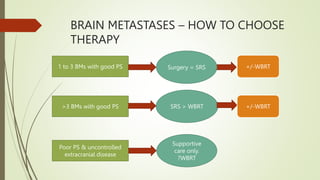
1 to 3 BMs with good PS
>3 BMs with good PS
Poor PS & uncontrolled
extracranial disease
Surgery = SRS
Supportive
care only.
?WBRT
SRS > WBRT
+/-WBRT
+/-WBRT
BRAIN METASTASES – NEUROCOGNITIVE
EFFECTS OF RT
 WBRT causes neurocognitive decline 3-5% patients at one year1
 Multiple contributors – disease progression, corticosteroids, anitconvulsants, chemotherapy
 SRS causes lesser neurocognitive defects than WBRT & preferred in low volume disease
 Hippocampal Avoidance WBRT can improve memory recall scores
 Concurrent Memantine use along with WBRT and continued for 6 months may reduce
neurocognitive decline
• DeAngelis, L.M.; Delattre, J.V.; Posner, J.B. Radiation-induced dementia in patients cured of brain metastases. Neurology?1989, 39, 789–796, doi:10.1212/WNL.39.6.789.
• Gondi V, Pugh SL, Tome WA, et al. Preservation of memory with conformal avoidance of the hippocampal neural stem-cell compartment during whole-brain radiotherapy for brain
metastases (RTOG 0933): a phase II multi-institutional trial. J Clin Oncol 2014;32(34):3810–3816.
• Hidefumi Aoyama, et Al Neurocognitive Function of Patients with Brain Metastasis Who Received Either Whole Brain Radiotherapy Plus Stereotactic Radiosurgery or Radiosurgery
Alone, International Journal of Radiation Oncology*Biology*Physics, Volume 68, Issue 5, 2007, Pages 1388-1395,ISSN 0360-3016,
• Brown PD, Pugh S, Laack NN, et al. Memantine for the prevention of cognitive dysfunction in patients receiving whole-brain radiotherapy: a randomized, double-blind, placebo-
controlled trial. Neuro Oncol. 2013;15(10):1429-37.
 Compression of dural sac & contents by extradural tumour mass
 1/3rd of solid tumours have mets to spine but MSCC occurs in 3 to 7%
 Presentation : Pain (local or radicular) (95%)  Motor weakness  Sensory loss +
incontinence.
 Motor weakness may develop and progress to plegia over days to hours
 Speed of neurologic deficit can effect outcome
 Plegic patients have poor prognosis
 Early confirmation of diagnosis & intervention before significant myelopathy develops is
important
 MRI is investigation of choice with 95% accuracy of detection
PALL RT IN MALIGNANT SPINAL CORD COMPRESSION
 RT can effectively improve QoL by relieving pain & compressive symptoms and
recovering or preserving motor & bladder function when initiated within time
 No difference in single vs multiple fx schedules of RT in recovery of ambulation
 Surgical decompression along with RT gives better improvement of neurodeficit but
careful selection is imp.1
 Survival related to primary but pts of MSCC with no motor dysfunction live longer
 64% of recurrence occur within 2 vertebral bodies of initial site2
 Re-irradiation can be considered within dose constraints (BED -120Gy)
 Indications of SBRT include recurrence after RT or oligometastic dx
PALL RT IN MALIGNANT SPINAL CORD COMPRESSION
1 - Patchell RA, Tibbs PA, Regine WF, et al. Direct decompressive surgical resection in the treatment of spinal cord compression caused by metastatic cancer: a randomised trial. Lancet
2005;366:643-8. 10.1016/S0140-6736(05)66954-1 [PubMed: 16112300]
2 - Maranzano E, Trippa F, Chirico L, et al. Management of metastatic spinal cord compression. Tumori 2003; 89: 469–475.
PALL RT IN MALIGNANT SPINAL CORD COMPRESSION
Author Number of
patients
Short-course RT
regimens (number
of fractions)
Long-course RT
regimens (number
of fractions)
Ambulation
response rate
Maranzano et al.
2005
RCT
300 16 Gy (2) 15 Gy (3) +
15 Gy (5)
68% vs 71%
(NS)
Maranzano et al.
2009 , RCT
327 8 Gy (1) 16 Gy (2) 69% vs 62%
(NS)
Rades et al. 2005
RCT
1304 8 Gy (1)
20 Gy (5)
30 Gy (10)
37.7 Gy (15)
40 Gy (20)
68.5% vs
67% (NS)
Rades et al. 2016 RCT 203 20 Gy (5) 30 Gy (10) 87.2% vs 89.6% (NS)
Patchell et al 2005
RCT
101 Surgical Decompression
+
30 Gy (10)
30 Gy (10) 84% with v 57%
(P=0.001)
Patient selected for palliative radiotherapy
Determine likely prognosis based on:
Performance status, comorbidities,
site, size, stage, tumor growth rate, social support
Prognosis <3 months
Prognosis >3 months not
appropriate for surgery
Prognosis >3 months
Appropriate for surgery :
Controlled primary,good PS,
single site of compression
Treatment options
• Supportive care alone
• Consider short course RT
• Single 8 Gy fx
• 16 Gy/2 fx, 1 week apart
Treatment options
Consider hypofractionated
regimens to a
higher total dose
• 30 Gy/10 fx
• 35 Gy/14 fx
• 20 Gy/5 fx
Treatment options
Surgical decompression with
postoperative RT 30 Gy/10 fx
ALGORITHIM FOR PALLIATION OF MALIGNANT SPINAL CORD COMPRESSION
PALL RT IN HEAD & NECK CANCER
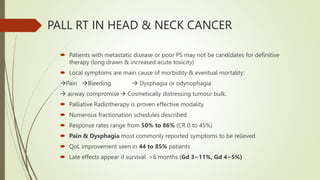
 Patients with metastatic disease or poor PS may not be candidates for definitive
therapy (long drawn & increased acute toxicity)
 Local symptoms are main cause of morbidity & eventual mortality:
Pain Bleeding  Dysphagia or odynophagia
 airway compromise Cosmetically distressing tumour bulk.
 Palliative Radiotherapy is proven effective modality
 Numerous fractionation schedules described
 Response rates range from 50% to 86% (CR 0 to 45%)
 Pain & Dysphagia most commonly reported symptoms to be relieved
 QoL improvement seen in 44 to 85% patients
 Late effects appear if survival >6 months (Gd 3~11%, Gd 4~5%)
HEAD & NECK CANCER
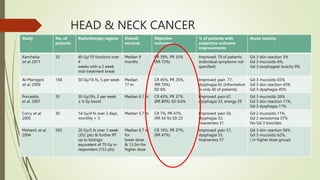
Study No. of
patients
Radiotherapy regime Overall
survival
Objective
outcomes
% of patients with
subjective outcome
improvements
Acute toxicity
Kancherla
et al. 2011
33 40 Gy/10 fractions over
4
weeks with a 2 week
mid-treatment break
Median 9
months
CR 39%, PR 33%
(RR 72%)
Improved: 79 of patients
(individual symptoms not
specified)
Gd 3 skin reaction 3%
Gd 3 mucositis 6%,
Gd 3 esophageal toxicity 9%
Al-Mamgani
et al. 2009
158 50 Gy/16 fx, 5 per week Median
17 m
CR 45%, PR 25%,
(RR 70%)
SD 6%
Improved: pain 77,
dysphagia 65 (information
in only 40 of patients)
Gd 3 mucositis 65%
Gd 3 skin reaction 45%
Gd 3 dysphagia 45%
Porceddu
et al. 2007
35 30 Gy/5fx, 2 per week
± 6 Gy boost
Median 6.1 m CR 43%, PR 37%
(RR 80%) SD 8.6%
Improved: pain 67,
dysphagia 33, energy 29
Gd 3 mucositis 26%,
Gd 3 skin reaction 11%,
Gd 3 dysphagia 11%
Corry et al.
2005
30 14 Gy/4 fx over 2 days,
monthly × 3
Median 5.7 m CR 7%, PR 47%,
(RR 54 %) SD 23
Improved: pain 56,
dysphagia 33,
hoarseness 31
Gd 2 mucositis 11%,
Gd 2 xerostomia 37%
No Gd 3 toxicities
Mohanti et al.
2004
505 20 Gy/5 fx over 1 week
(352 pts) & further RT
up to biologic
equivalent of 70 Gy in
responders (153 pts)
Median 6.7 m
for
lower dose
& 13.3m for
higher dose
CR 10%, PR 37%,
(RR 47%)
Improved: pain 57,
dysphagia 53,
hoarseness 57
Gd 3 skin reaction 56%
Gd 3 mucositis 62%,
( in higher dose group)
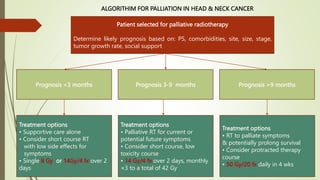
Patient selected for palliative radiotherapy
Determine likely prognosis based on: PS, comorbidities, site, size, stage,
tumor growth rate, social support
Prognosis <3 months Prognosis 3-9 months Prognosis >9 months
Treatment options
• Supportive care alone
• Consider short course RT
with low side effects for
symptoms
• Single 8 Gy or 14Gy/4 fx over 2
days
Treatment options
• Palliative RT for current or
potential future symptoms
• Consider short course, low
toxicity course
• 14 Gy/4 fx over 2 days, monthly
×3 to a total of 42 Gy
Treatment options
• RT to palliate symptoms
& potentially prolong survival
• Consider protracted therapy
course
• 50 Gy/20 fx daily in 4 wks
ALGORITHIM FOR PALLIATION IN HEAD & NECK CANCER
RADIOTHERAPY FOR PALLIATION IN
GYNAECOLOGICAL MALIGNANCIES
 Locally adv dx (IVA) & limited metastatic dx (IIIC2) treated with curative intent
 Indications for local palliative intent of RT :
 Extreme old age or poor PS
 Widely metastatic dx
 Recurrent dx after previous treatment
 Symptoms affecting QoL including bleeding PV, leucorrhoea, fungation & ulceration,
pain & obstruction due to pelvic mass, fistulas
 Multiple hypofractionated regimens of EBRT described with RR from 30 to 100%
 Recurrence of disease as well as Late effects of RT (10-12%) maybe cause of
significant morbidity in patients who survive beyond 01 year
RADIOTHERAPY FOR PALLIATION IN
GYNAECOLOGICAL MALIGNANCIES
Author & year of
publication
Radiation dose
(Gy) per
fraction/
No.
of fractions
No. of
patients
>50% improvement in symptoms > 50% tumor
response
Complications
Bleeding Pain Obstruction
No. (%) No. (%) No. (%)
Halle et al.
1986 [6]
10 Gy/1-3 42 27/30 (90)) 4/9 (44 15/28 (54) 5/42 (12%)
2 also had
uncontrolled
pelvic tumor
Spanos et al.
1989 [8]
RTOG 8502
3.7 Gy/4 in 2
days, 3 such
cycles
136 71/73 (97) 44/65 (68) 14/16 (88) 41/136 (30)
40/92 (43)
for pts receiving all 3
fractions
10/87 (12%)
Gr-3 late
morbidity
Mishra et al.
2005 [9]
10 Gy/1
10 Gy/2
10 Gy/3
100
61
33
(31)
(100)
(3)
(41)
(17)
24/70 (34)
28/45 (62)
25/33 (75)
10 pts (10%) had
Gd 3–4 late
morbidity
van Lonkhuijzen
et al. 2011,SR
10Gy/1 x 3 or
2-4 Gy
fractions
476 in 8 studies 45 to 100 % 31 to 100% 15 to 100% Not reported
consistently
Patient selected for palliative radiotherapy
Determine likely prognosis based on: PS, comorbidities, site, size, stage,
tumor growth rate, social support
Prognosis <3 months Prognosis 3-10 months Prognosis >10 months
Treatment options
• Supportive care alone
• Consider short course RT
10 Gy in a single fraction for
palliation of symptoms
Treatment options
• Pall RT for current or
potential future symptoms
• Consider hypofx regimens :
>14.4 Gy / 4 fx bid monthly,
×3 to a total of 43.2 Gy
>10 Gy/fx repeated monthly upto
30 Gy
Treatment options
• RT to palliate symptoms
& potentially prolong OS
• Avoid 10 Gy fx to limit toxicity
• 30Gy/10fx, 25Gy/5fx with
consideration to convert to std fx
in good PS pts who respond well
to initial therapy
ALGORITHIM FOR PALLIATION IN GYNAECOLOGICAL CANCER
PALLIATIVE RADIOTHERAPY FOR LIVER
METASTASES
 Commonest visceral metastases ~40% with a median OS – 7.5m to 20m
 Asymptomatic / Liver dysfunction on labs / frank jaundice with assoc. nausea,
vomiting, pain, anorexia, abd.
distension
 Surgery, SBRT, RFA, commonly used for limited mets & systemic chemotherapy or
Chemoembolization / Radioembolization for more numerous mets.
 Whole Liver Radiotherapy (WLRT) effective as an aggressive modality for symptom
control
 No improvement in OS [ 8-17 weeks in pts receiving liver RT]
 RR for pain range from 55 to 80%
 Underutilized due to fear of RT induced hepatic toxicity
Series RT schedule
(Gy/fraction #)
No. of
patients
Design Outcomes / comments Median survival
Bydder et
al. 2003 [6],
10/2 28 Prospective
multi-institutional
TROG
Improvement in baseline symptoms in ∼50–66%,
Pain relief in 65%
7% Acute Gd 3/4 toxicity
No late toxicity
10 wk
Leibel et al.
1987 [5] *,
21/7* 214 Randomized ±
Misonidazole
multi-institutional
RTOG
Pain relief in 80% (complete in 54%)
Performance status improved in 28%
Worsening of nausea in 6%
No difference with misonidazole
17 wk
Yeo et al.
2010 [27]
21/7
30/10
(30/15)
10 Further chemotherapy became possible in 40%
Estimated <5% risk of RILD [28]
– May exceed 5% risk of RILD and delivery in 15
fractions may be safer [28]
8 wk
Russell et al.
1993 [26]
27 – 30 / 18 -20
(1.5 Gy per fxn bid)
173 Dose escalation,
multi-institutional
RTOG
6% Acute Grade 3/4 toxicity
10% late liver injury at 33 Gy
No advantage with higher dose
17 wk
Edyta et al.
2015
17Gy/10 fx median
dose & median
dose/fx was 1.8Gy
26 Retrospective Symptom response rates -100% @ 4 wks & 28% @ 3
mths
Pain loss – 28%
01 yr survival - 39%
Gd 3 toxicity – 3%
19.5 wk
• Acute effects of WLRT can include nausea, diarrhea, and a temporary exacerbation of pain
• RILD can appear at 2-12 weeks as a veno-occlusive dx (5% risk with recommended regimens)
• Conformal Partial Liver RT allows higher treatment doses (24–90 Gy) & RRs (60%) without increasing toxicity
PALLIATIVE RADIOTHERAPY FOR LIVER METASTASES
PALLIATIVE RADIOTHERAPY FOR LIVER
METASTASES
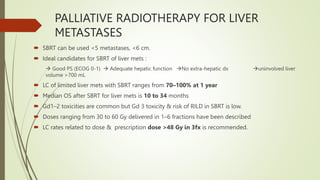
 SBRT can be used <5 metastases, <6 cm.
 Ideal candidates for SBRT of liver mets :
 Good PS (ECOG 0-1)  Adequate hepatic function No extra-hepatic dx uninvolved liver
volume >700 mL
 LC of limited liver mets with SBRT ranges from 70–100% at 1 year
 Median OS after SBRT for liver mets is 10 to 34 months
 Gd1–2 toxicities are common but Gd 3 toxicity & risk of RILD in SBRT is low.
 Doses ranging from 30 to 60 Gy delivered in 1–6 fractions have been described
 LC rates related to dose & prescription dose >48 Gy in 3fx is recommended.
PALLIATIVE RADIOTHERAPY FOR LIVER
METASTASES
Series RT schedule
(Gy/fraction #)
No. of
patients
Primary site Toxicity Outcomes
Herfarth
et al. 2004
[52]
14–26/1
Dose escalation
35 NR No significant
toxicity
1-y LC, 71%;
1-y OS, 72%
Ambrosino
et al. 2009
[57]
25–60/3 27 CRC (11)
Other (16)
No serious
toxicity
Crude LC
rate, 74%
Lee et al.
2009 [56]
27.7–60/6,
Individualized
dose
68 CRC (40)
Breast (12)
Gallbladder (4)
Lung (2)
Anal canal (2)
Melanoma (2)
Other (6)
No RILD
10% G3/4
acute toxicity
No G3/4 late
toxicity
1-y LC, 71%;
Med survival,
17.6 mo
Goodman
et al. 2010
[58]
18–30/1,
Dose
escalation
26 CRC (6)
Pancreatic (3)
Gastric (2)
Ovarian (2)
Other (6)
No dose limiting
toxicity
2 G2 late GI
toxicity
2 G2 late soft
tissue/ rib
Toxicity 1-y
local
failure, 23%;
2-y OS, 49%
Patient selected for palliative radiotherapy
Determine likely prognosis based on:
Performance status, comorbidities,
extent of disease
Prognosis <3 months Prognosis>3months, not
appropriate for Surgery or SBRT
Prognosis >10 months
Treatment options
• Supportive care alone
• Whole liver radiation therapy for
pain
• Single 8 Gy fx
• 10 Gy/2 fx
Treatment options
• Whole liver radiation for pain
• 20 Gy/5 fractions
• 30 Gy/15 fractions
Treatment options
• SBRT preferably on treatment
protocol
• 45 Gy/3 fractions
• 5–50 Gy/5 fractions
• 45 Gy/15 fractions
ALGORITHIM FOR PALLIATION IN LIVER METASTASES
PALLIATION OF LUNG CANCER
 40-50% Ca lung cases are M+ but thoracic dx burden often needs palliation
 Invasion of thoracic structures can cause : dyspnea, cough, hemoptysis, chest pain, superior
vena cava syn, dysphagia, brachial plexopathy, post-obstructive pneumonia
 Palliative thoracic RT can produce symptomatic relief in 60% cases
 Short, hypofx regimens effective with low acute toxicity (10Gy/1fx, 16Gy/2fx, 20Gy/5fx)
 5% improved one year survival with protracted regimens in pts with good PS but longer time of
treatment & more toxicity (30Gy/10fx, 45Gy/15fx)
 No difference in survival or QoL in delaying treatment till progression of symptoms in upfront
asymptomatic pts.
Palliative thoracic radiotherapy in lung cancer: An American Society for Radiation Oncology evidence-based clinical practice guideline Rodrigues, George et al. Practical Radiation
Oncology , Volume 1 , Issue 2 , 60 - 71
Study Y Radiotherapy schedules compared Evaluable
patients
(n)
Survival by regimen
(P = NS unless
specified)
Symptom control by
regimen (P = NS
unless specified)
Nestle
RCT
2000 32 Gy/16 F twice daily/10 d
Vs 60 Gy/30 F/6 wk
152 36% vs 38% (1 y) No difference
Bezjak
RCT
2002 20 Gy/5 F/1 wk
vs 10 Gy/1 F
230 6 mo vs 4.2 mo, P =
.03
Better for 20 Gy on Lung
Cancer Symptom
Scale, P = .009
Sundstrom
RCT
2004 17 Gy/2 F/8 d
vs 42 Gy/15 F/3 wk
Vs 50 Gy/25 F/5 wk
407 6.8 mo vs
7.0 mo vs
8.2 mo
No difference
Erridge
RCT
2005 30 Gy/10 F/2 wk
vs 10 Gy/1 F
148 23 wk vs 28 wk Better for 30-Gy arm,
P = .05
Kramer
RCT
2005 30 Gy/10 F/2 wk
vs 16 Gy/2 F/8 d
297 20% vs 11%, P = .03
(1 y)
No difference
Senkus-Konefka
RCT
2005 20 Gy/5 F/1 wk
vs 16 Gy/2 F/8 d
100 5.3 mo vs 8.0 mo, P =
.016
No difference
PALLIATION OF LUNG CANCER
Patient selected for palliative radiotherapy
Determine likely prognosis based on:
Performance status, comorbidities,
extent of disease
Prognosis <1 months Prognosis > 1month
Treatment options
• Supportive care alone
• consider short course RT with
low side effect for synptoms
• Single 8 to 10 Gy fx
• 16-17 Gy/2 fx, 1 week
apart
Treatment options
• RT to palliate or prevent
symptoms & potentially
prolong survival
• Consider hypofx regimens :
• 30Gy/10fx
• 39Gy/13fx
• 45Gy/15fx
ALGORITHIM FOR PALLIATION IN LUNG CANCER
MODERN TECHNOLOGIES PALLIATIVE RT
MODERN TECHNOLOGIES IN
PALLIATIVE RT
 Longer survival times with improved systemic therapy
 IMRT, IGRT , SBRT can allow dosimetrically superior therapeutic ratio
 Faster symptomatic relief
 Reduction in late toxicity
 Reirradiation potential
 Role in oligometastatic dx
 ?Cost & Access
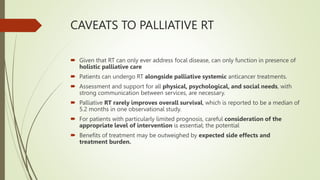
CAVEATS TO PALLIATIVE RT
 Given that RT can only ever address focal disease, can only function in presence of
holistic palliative care
 Patients can undergo RT alongside palliative systemic anticancer treatments.
 Assessment and support for all physical, psychological, and social needs, with
strong communication between services, are necessary.
 Palliative RT rarely improves overall survival, which is reported to be a median of
5.2 months in one observational study.
 For patients with particularly limited prognosis, careful consideration of the
appropriate level of intervention is essential; the potential
 Benefits of treatment may be outweighed by expected side effects and
treatment burden.
OUR EXPERIENCE : CHCC
Year Total number of Pts treated Pts treated with
palliative intent
%
2018 309 91 29%
2017 349 71 20%
2016 334 87 26%
SITE PERCENTAGE
Brain 25.2%
Bone (including Spine) 45.5%
Face & Neck 8.6%
Thorax 13%
Abdomen 2.8%
Pelvis 10.5%
THANK YOU
“In oncology, young oncologists learn how to treat, experienced
oncologists know when to treat, and mature oncologists know when not
to treat.”

Pall RT.pptx

  • 1.
    PALLIATIVE RADIOTHERAPY ONCOVISON 2019 LTCOL SANKALP SINGH GD SPL (RADIOTHERAPY)
  • 2.
    “The final causes,then, of compassion are to prevent and to relieve misery.”  Joseph Butler [1692–1752]
  • 3.
    Flow of presentation History Definition,Aim, Principles Differences between Curative & Palliative RT Clinical indications & how to choose? Modern technologies Caveats
  • 4.
    Period Site nFractionation Used Response Rates 2013-2015, CHSC, Pune Face & Neck 52 30Gy/10fx + 20Gy/10fx (after 4 wk gap) 68% Pain reduction 73% Tumour size reduction Period Site n Fractionation Used Survival @ 12 months 2011-2013, AHRR, New Delhi Brain (1-3 mets) 25 30Gy/10fx + GKS Boost of 15 - 24Gy 68% Pain reduction 73% Tumour size reduction
  • 5.
    HISTORY  X-rays discoveredby Wilhelm Roentgen in Nov 1895.  Emille Grubbe claimed to have successfully palliated a patient of Ca Breast with X- rays in Jan 1896.  Lenz & Freid in Ann Surg, 1931, evaluated and found moderate doses of RT effective in palliation of brain, spine & bone metastases.1  A review in the BMJ in 1957 reported that a dose of 3000 rad was sufficient for palliation. Balancing benefit with harm from palliative radiotherapy was now the task of the radiotherapist. 2  Chu et al in 1961 described a symptomatic response in 77.8% (123 of 158) patients of brain metastases treated with 3000 rad of WBRT. 3 1. Lenz M, Freid J. Metastases to the skeleton, brain and spinal cord from cancer of the breast and the effect of radiotherapy. Ann Surg [Internet] 1931; 93: 278–293. 2. Palliative radiotherapy. BMJ 1957; 2: 455–456. 3. Chu FCH, Hilaris B, Chu FC, et al. Value of radiation therapy in the management of intracranial metastases. Cancer [Internet] 1961.
  • 6.
    DEFINITION  Palliative careis the active, holistic care of patients including management of pain and other distressing symptoms alongwith provision of psychological, social, and spiritual support, irrespective of stage of disease and need for other therapies.  The goal of PC is prevention & reduction of suffering and achievement of the best quality of life for patients and their families.  Palliative Radiotherapy is directed towards achieving these goals. • Hui D, Mori M, Parsons HA, et al. The lack of standard definitions in supportive and palliative oncology literature. J Pain Symptom Manage 2012;43:582-592. • IOM (Institute of Medicine). 2014 Dying in America: Improving quality and honoring individual preferences near the end of life. Washington, DC: The National Academic Press.
  • 7.
    AIMS  Rapid symptomrelief/control  Minimal treatment burden in terms of  Hospital stay or attendance  Acute side effects  Symptoms of late effects of radiotherapy should be avoided in expected lifetime
  • 8.
    PRINCIPLES 1. Accurate anatomicallocalisation of the symptomatic tumour deposit. 2. Simple treatment techniques and field arrangements. 3. Short hypofractionated treatment regimes. 4. Moderate dose treatment to achieve a good predictable response and to keep treatment toxicity to a minimum. 5. Patient selection: Consider the patient’s overall life expectancy when determining the treatment aims and the treatment duration.
  • 9.
    DIFFERENCES BETWEEN RADICALVS PALLIATIVE RT RADICAL RT (Curative + palliative RT) PALLIATIVE RT, alone AIM Tumor eradication & Symptom management Solely for symptom management TOTAL DOSE 45–50 Gy for microscopic disease & 60–70 Gy for macroscopic disease 8–30 Gy FRACTIONATION 1.8–2.0 Gy fractions 3.0–8.0 Gy fractions DURATION 5–8 weeks 1–2 weeks ACUTE TOXICITY Increased incidence and severity due to higher total dose and lengthier treatment duration Reduced incidence and severity due to smaller overall dose and shorter treatment duration LATE TOXICITY Decreased incidence due to smaller fraction size Increased incidence due to larger fraction size CHEMOTHERAPY Given sequentially or concurrently in an effort to increase cure rates May be given sometimes sequentially, but almost never ?? concurrently (to minimize toxicity)
  • 10.
  • 11.
    PALL RT INBONE METASTASES  Affects upto 70% patients with advanced cancers & constitutes nearly 40% of all Pall RT treatments  Symptoms  Pain affecting ADLs  Risk of Pathological# (Consider Surgical stabilization)  Recommended Dose fractions: 30Gy/10fx, 24Gy/fx, 20Gy/5fx, 8Gy/1fx  Response rates ~60% at 2-3 weeks with ~30% CR  Retreatment for recurrence of symptoms possible after 04 weeks with upto 50% response rates1,2  Initial flare of pain may be seen in about a third of the patients  Supplemented with analgesics, radionuclides, bisphosphonates and orthopedic referrals for stabilization 1 - Chow E, et al. Update of the international consensus on palliative radiotherapy endpoints for future clinical trials in bone metastases. Int J Rad Bio & Phy. 2012 Apr 1;82(5):1730-7. doi: 10.1016/j.ijrobp.2011.02.008. Epub 2011 Apr 12. 2 - Huisman M, van den Bosch MA, Wijlemans JW, et al. Effectiveness of reirradiation for painful bone metastases: A systematic review and meta-analysis. Int J Radiat Oncol Biol Phys. 2012;84:8-14.
  • 12.
    PALL RT INBONE METASTASES  No difference in pain relief between SF and MF  Higher retreatment rates after SF  Evidence of higher rates of pathological # after SF vs MF remains equivocal  No evidence of significant late effects due to palliative RT for bone mets Investigator Patients (n) Fractionation Response Rates (%) Repeat Rx rate (%) Gutierrez Bayard, 2014, RCT 90 8Gy/1fx 79 13.3 30Gy/10fx 88 8.8 Chow, 2012, SR 5617 in 25 RCTs SF 60 20 MF 61 8 Majumder, 2012, RCT 64 8Gy/1fx 85 NR 30Gy/10fx 77 NR Sze et al 2004, SR 3481 in 11 trials SF 60 21.5 MF 59 7.4
  • 13.
    PALL RT INBONE METASTASES  IV Bisphosphanates equivalent to SF RT in Bone mets due to Ca prostate in terms of pain control & QoL at 4 and 12 weeks
  • 14.
    PALL RT INBRAIN METASTASES  Rising incidence 10-30% of cancer patients  Median presentation 10m from primary diagnosis & median survival <1 year  High suspicion index in fresh neurological symptoms/signs in k/c/o cancer : headache, altered mentation, seizures, focal neurodeficit  Therapeutic options include Surgery, WBRT, SRS or a combination  Symptomatic response rates to irradiation vary from 30 to 70%  Supplemented by targeted therapy, corticosteroids, anticonvulsants, surgery  Selection of treatment modality/ combination should ideally be based on patient-tumor characteristics (DS-GPA)
  • 15.
    BRAIN METASTASES –PROGNOSTIC FACTORS  Upfront presentation vs. k/c/o malignancy  Lack of histopathology or mass effects  Age & Performance Status  Number of brain metastases  Size & volume of brain metastases  Status of extracranial disease  Histology of disease  Prognostic systems like RPA, GPA & DS-GPA help in stratification of patient to compare results
  • 16.
    BRAIN METASTASES –Prognostic factors
  • 17.
    BRAIN METASTASES –HOW TO CHOOSE THERAPY  Surgery/SRS improves survival in patients with limited (1-3) brain mets (BM)  Sx vs SRS – no diff in OS in patients with limited (1-3) BM  For limited BM with good PS, SRS preferable over WBRT  Addition of WBRT to Sx/SRS improves local brain control w/out affecting OS  Omission of WBRT after Sx or SRS can lead to poorer brain control but does not affect OS  In multiple BM, SRS boost after WBRT improves LC , PS & reduces steroid use but does not improve OS  Maximum number of BM that are treatable by SRS is not established & cumulative volume rather than number maybe relevant  In poor PS patients with multiple BM & NSCLC primary WBRT does not improve OS or QoL • Radiotherapeutic and surgical management for newly diagnosed brain metastasis(es): An American Society for Radiation Oncology evidence-based guideline Tsao, May N. et al. Practical Radiation Oncology , Volume 2 , Issue 3 , 210 - 225 • Paula Mulvenna, et al. Dexamethasone and supportive care with or without whole brain radiotherapy in treating patients with non-small cell lung cancer with brain metastases unsuitable for resection or stereotactic radiotherapy (QUARTZ): results from a phase 3, non-inferiority, randomised trial. Lancet 2016; 388: 2004–14
  • 18.
    BRAIN METASTASES –HOW TO CHOOSE THERAPY  No advantage of one fractionation schedule of WBRT over other (30Gy/10fx, 20Gy/5fx, 37.5Gy/15fx, 40Gy/20fx)  SRS dose fractionation used 15 to 24 Gy depending on tumor size.  Tumours > 4 cm not preferred for SRS  In case of recurrence treatment with surgery, SRS or WBRT remains an option  Reirradiation with WBRT considered if prior response to WBRT  WBRT dose for reirradiation >20Gy for response and fraction size 1.8-2Gy. • Wong WW, Schild SE, Sawyer TE, et al. Analysis of outcome in patients reirradiated for brain metastases. Int J Radiat Oncol Biol Phys 1996;34(3):585–590. • Son CH, Jimenez R, Niemierko A, et al. Outcomes after whole brain reirradiation in patients with brain metastases. Int J Radiat Oncol Biol Phys 2012;82(2):e167–e172
  • 19.
    BRAIN METASTASES –HOW TO CHOOSE THERAPY 1 to 3 BMs with good PS >3 BMs with good PS Poor PS & uncontrolled extracranial disease Surgery = SRS Supportive care only. ?WBRT SRS > WBRT +/-WBRT +/-WBRT
  • 20.
    BRAIN METASTASES –NEUROCOGNITIVE EFFECTS OF RT  WBRT causes neurocognitive decline 3-5% patients at one year1  Multiple contributors – disease progression, corticosteroids, anitconvulsants, chemotherapy  SRS causes lesser neurocognitive defects than WBRT & preferred in low volume disease  Hippocampal Avoidance WBRT can improve memory recall scores  Concurrent Memantine use along with WBRT and continued for 6 months may reduce neurocognitive decline • DeAngelis, L.M.; Delattre, J.V.; Posner, J.B. Radiation-induced dementia in patients cured of brain metastases. Neurology?1989, 39, 789–796, doi:10.1212/WNL.39.6.789. • Gondi V, Pugh SL, Tome WA, et al. Preservation of memory with conformal avoidance of the hippocampal neural stem-cell compartment during whole-brain radiotherapy for brain metastases (RTOG 0933): a phase II multi-institutional trial. J Clin Oncol 2014;32(34):3810–3816. • Hidefumi Aoyama, et Al Neurocognitive Function of Patients with Brain Metastasis Who Received Either Whole Brain Radiotherapy Plus Stereotactic Radiosurgery or Radiosurgery Alone, International Journal of Radiation Oncology*Biology*Physics, Volume 68, Issue 5, 2007, Pages 1388-1395,ISSN 0360-3016, • Brown PD, Pugh S, Laack NN, et al. Memantine for the prevention of cognitive dysfunction in patients receiving whole-brain radiotherapy: a randomized, double-blind, placebo- controlled trial. Neuro Oncol. 2013;15(10):1429-37.
  • 21.
     Compression ofdural sac & contents by extradural tumour mass  1/3rd of solid tumours have mets to spine but MSCC occurs in 3 to 7%  Presentation : Pain (local or radicular) (95%)  Motor weakness  Sensory loss + incontinence.  Motor weakness may develop and progress to plegia over days to hours  Speed of neurologic deficit can effect outcome  Plegic patients have poor prognosis  Early confirmation of diagnosis & intervention before significant myelopathy develops is important  MRI is investigation of choice with 95% accuracy of detection PALL RT IN MALIGNANT SPINAL CORD COMPRESSION
  • 22.
     RT caneffectively improve QoL by relieving pain & compressive symptoms and recovering or preserving motor & bladder function when initiated within time  No difference in single vs multiple fx schedules of RT in recovery of ambulation  Surgical decompression along with RT gives better improvement of neurodeficit but careful selection is imp.1  Survival related to primary but pts of MSCC with no motor dysfunction live longer  64% of recurrence occur within 2 vertebral bodies of initial site2  Re-irradiation can be considered within dose constraints (BED -120Gy)  Indications of SBRT include recurrence after RT or oligometastic dx PALL RT IN MALIGNANT SPINAL CORD COMPRESSION 1 - Patchell RA, Tibbs PA, Regine WF, et al. Direct decompressive surgical resection in the treatment of spinal cord compression caused by metastatic cancer: a randomised trial. Lancet 2005;366:643-8. 10.1016/S0140-6736(05)66954-1 [PubMed: 16112300] 2 - Maranzano E, Trippa F, Chirico L, et al. Management of metastatic spinal cord compression. Tumori 2003; 89: 469–475.
  • 23.
    PALL RT INMALIGNANT SPINAL CORD COMPRESSION Author Number of patients Short-course RT regimens (number of fractions) Long-course RT regimens (number of fractions) Ambulation response rate Maranzano et al. 2005 RCT 300 16 Gy (2) 15 Gy (3) + 15 Gy (5) 68% vs 71% (NS) Maranzano et al. 2009 , RCT 327 8 Gy (1) 16 Gy (2) 69% vs 62% (NS) Rades et al. 2005 RCT 1304 8 Gy (1) 20 Gy (5) 30 Gy (10) 37.7 Gy (15) 40 Gy (20) 68.5% vs 67% (NS) Rades et al. 2016 RCT 203 20 Gy (5) 30 Gy (10) 87.2% vs 89.6% (NS) Patchell et al 2005 RCT 101 Surgical Decompression + 30 Gy (10) 30 Gy (10) 84% with v 57% (P=0.001)
  • 24.
    Patient selected forpalliative radiotherapy Determine likely prognosis based on: Performance status, comorbidities, site, size, stage, tumor growth rate, social support Prognosis <3 months Prognosis >3 months not appropriate for surgery Prognosis >3 months Appropriate for surgery : Controlled primary,good PS, single site of compression Treatment options • Supportive care alone • Consider short course RT • Single 8 Gy fx • 16 Gy/2 fx, 1 week apart Treatment options Consider hypofractionated regimens to a higher total dose • 30 Gy/10 fx • 35 Gy/14 fx • 20 Gy/5 fx Treatment options Surgical decompression with postoperative RT 30 Gy/10 fx ALGORITHIM FOR PALLIATION OF MALIGNANT SPINAL CORD COMPRESSION
  • 25.
    PALL RT INHEAD & NECK CANCER  Patients with metastatic disease or poor PS may not be candidates for definitive therapy (long drawn & increased acute toxicity)  Local symptoms are main cause of morbidity & eventual mortality: Pain Bleeding  Dysphagia or odynophagia  airway compromise Cosmetically distressing tumour bulk.  Palliative Radiotherapy is proven effective modality  Numerous fractionation schedules described  Response rates range from 50% to 86% (CR 0 to 45%)  Pain & Dysphagia most commonly reported symptoms to be relieved  QoL improvement seen in 44 to 85% patients  Late effects appear if survival >6 months (Gd 3~11%, Gd 4~5%)
  • 26.
    HEAD & NECKCANCER Study No. of patients Radiotherapy regime Overall survival Objective outcomes % of patients with subjective outcome improvements Acute toxicity Kancherla et al. 2011 33 40 Gy/10 fractions over 4 weeks with a 2 week mid-treatment break Median 9 months CR 39%, PR 33% (RR 72%) Improved: 79 of patients (individual symptoms not specified) Gd 3 skin reaction 3% Gd 3 mucositis 6%, Gd 3 esophageal toxicity 9% Al-Mamgani et al. 2009 158 50 Gy/16 fx, 5 per week Median 17 m CR 45%, PR 25%, (RR 70%) SD 6% Improved: pain 77, dysphagia 65 (information in only 40 of patients) Gd 3 mucositis 65% Gd 3 skin reaction 45% Gd 3 dysphagia 45% Porceddu et al. 2007 35 30 Gy/5fx, 2 per week ± 6 Gy boost Median 6.1 m CR 43%, PR 37% (RR 80%) SD 8.6% Improved: pain 67, dysphagia 33, energy 29 Gd 3 mucositis 26%, Gd 3 skin reaction 11%, Gd 3 dysphagia 11% Corry et al. 2005 30 14 Gy/4 fx over 2 days, monthly × 3 Median 5.7 m CR 7%, PR 47%, (RR 54 %) SD 23 Improved: pain 56, dysphagia 33, hoarseness 31 Gd 2 mucositis 11%, Gd 2 xerostomia 37% No Gd 3 toxicities Mohanti et al. 2004 505 20 Gy/5 fx over 1 week (352 pts) & further RT up to biologic equivalent of 70 Gy in responders (153 pts) Median 6.7 m for lower dose & 13.3m for higher dose CR 10%, PR 37%, (RR 47%) Improved: pain 57, dysphagia 53, hoarseness 57 Gd 3 skin reaction 56% Gd 3 mucositis 62%, ( in higher dose group)
  • 27.
    Patient selected forpalliative radiotherapy Determine likely prognosis based on: PS, comorbidities, site, size, stage, tumor growth rate, social support Prognosis <3 months Prognosis 3-9 months Prognosis >9 months Treatment options • Supportive care alone • Consider short course RT with low side effects for symptoms • Single 8 Gy or 14Gy/4 fx over 2 days Treatment options • Palliative RT for current or potential future symptoms • Consider short course, low toxicity course • 14 Gy/4 fx over 2 days, monthly ×3 to a total of 42 Gy Treatment options • RT to palliate symptoms & potentially prolong survival • Consider protracted therapy course • 50 Gy/20 fx daily in 4 wks ALGORITHIM FOR PALLIATION IN HEAD & NECK CANCER
  • 28.
    RADIOTHERAPY FOR PALLIATIONIN GYNAECOLOGICAL MALIGNANCIES  Locally adv dx (IVA) & limited metastatic dx (IIIC2) treated with curative intent  Indications for local palliative intent of RT :  Extreme old age or poor PS  Widely metastatic dx  Recurrent dx after previous treatment  Symptoms affecting QoL including bleeding PV, leucorrhoea, fungation & ulceration, pain & obstruction due to pelvic mass, fistulas  Multiple hypofractionated regimens of EBRT described with RR from 30 to 100%  Recurrence of disease as well as Late effects of RT (10-12%) maybe cause of significant morbidity in patients who survive beyond 01 year
  • 29.
    RADIOTHERAPY FOR PALLIATIONIN GYNAECOLOGICAL MALIGNANCIES Author & year of publication Radiation dose (Gy) per fraction/ No. of fractions No. of patients >50% improvement in symptoms > 50% tumor response Complications Bleeding Pain Obstruction No. (%) No. (%) No. (%) Halle et al. 1986 [6] 10 Gy/1-3 42 27/30 (90)) 4/9 (44 15/28 (54) 5/42 (12%) 2 also had uncontrolled pelvic tumor Spanos et al. 1989 [8] RTOG 8502 3.7 Gy/4 in 2 days, 3 such cycles 136 71/73 (97) 44/65 (68) 14/16 (88) 41/136 (30) 40/92 (43) for pts receiving all 3 fractions 10/87 (12%) Gr-3 late morbidity Mishra et al. 2005 [9] 10 Gy/1 10 Gy/2 10 Gy/3 100 61 33 (31) (100) (3) (41) (17) 24/70 (34) 28/45 (62) 25/33 (75) 10 pts (10%) had Gd 3–4 late morbidity van Lonkhuijzen et al. 2011,SR 10Gy/1 x 3 or 2-4 Gy fractions 476 in 8 studies 45 to 100 % 31 to 100% 15 to 100% Not reported consistently
  • 30.
    Patient selected forpalliative radiotherapy Determine likely prognosis based on: PS, comorbidities, site, size, stage, tumor growth rate, social support Prognosis <3 months Prognosis 3-10 months Prognosis >10 months Treatment options • Supportive care alone • Consider short course RT 10 Gy in a single fraction for palliation of symptoms Treatment options • Pall RT for current or potential future symptoms • Consider hypofx regimens : >14.4 Gy / 4 fx bid monthly, ×3 to a total of 43.2 Gy >10 Gy/fx repeated monthly upto 30 Gy Treatment options • RT to palliate symptoms & potentially prolong OS • Avoid 10 Gy fx to limit toxicity • 30Gy/10fx, 25Gy/5fx with consideration to convert to std fx in good PS pts who respond well to initial therapy ALGORITHIM FOR PALLIATION IN GYNAECOLOGICAL CANCER
  • 31.
    PALLIATIVE RADIOTHERAPY FORLIVER METASTASES  Commonest visceral metastases ~40% with a median OS – 7.5m to 20m  Asymptomatic / Liver dysfunction on labs / frank jaundice with assoc. nausea, vomiting, pain, anorexia, abd. distension  Surgery, SBRT, RFA, commonly used for limited mets & systemic chemotherapy or Chemoembolization / Radioembolization for more numerous mets.  Whole Liver Radiotherapy (WLRT) effective as an aggressive modality for symptom control  No improvement in OS [ 8-17 weeks in pts receiving liver RT]  RR for pain range from 55 to 80%  Underutilized due to fear of RT induced hepatic toxicity
  • 32.
    Series RT schedule (Gy/fraction#) No. of patients Design Outcomes / comments Median survival Bydder et al. 2003 [6], 10/2 28 Prospective multi-institutional TROG Improvement in baseline symptoms in ∼50–66%, Pain relief in 65% 7% Acute Gd 3/4 toxicity No late toxicity 10 wk Leibel et al. 1987 [5] *, 21/7* 214 Randomized ± Misonidazole multi-institutional RTOG Pain relief in 80% (complete in 54%) Performance status improved in 28% Worsening of nausea in 6% No difference with misonidazole 17 wk Yeo et al. 2010 [27] 21/7 30/10 (30/15) 10 Further chemotherapy became possible in 40% Estimated <5% risk of RILD [28] – May exceed 5% risk of RILD and delivery in 15 fractions may be safer [28] 8 wk Russell et al. 1993 [26] 27 – 30 / 18 -20 (1.5 Gy per fxn bid) 173 Dose escalation, multi-institutional RTOG 6% Acute Grade 3/4 toxicity 10% late liver injury at 33 Gy No advantage with higher dose 17 wk Edyta et al. 2015 17Gy/10 fx median dose & median dose/fx was 1.8Gy 26 Retrospective Symptom response rates -100% @ 4 wks & 28% @ 3 mths Pain loss – 28% 01 yr survival - 39% Gd 3 toxicity – 3% 19.5 wk • Acute effects of WLRT can include nausea, diarrhea, and a temporary exacerbation of pain • RILD can appear at 2-12 weeks as a veno-occlusive dx (5% risk with recommended regimens) • Conformal Partial Liver RT allows higher treatment doses (24–90 Gy) & RRs (60%) without increasing toxicity PALLIATIVE RADIOTHERAPY FOR LIVER METASTASES
  • 33.
    PALLIATIVE RADIOTHERAPY FORLIVER METASTASES  SBRT can be used <5 metastases, <6 cm.  Ideal candidates for SBRT of liver mets :  Good PS (ECOG 0-1)  Adequate hepatic function No extra-hepatic dx uninvolved liver volume >700 mL  LC of limited liver mets with SBRT ranges from 70–100% at 1 year  Median OS after SBRT for liver mets is 10 to 34 months  Gd1–2 toxicities are common but Gd 3 toxicity & risk of RILD in SBRT is low.  Doses ranging from 30 to 60 Gy delivered in 1–6 fractions have been described  LC rates related to dose & prescription dose >48 Gy in 3fx is recommended.
  • 34.
    PALLIATIVE RADIOTHERAPY FORLIVER METASTASES Series RT schedule (Gy/fraction #) No. of patients Primary site Toxicity Outcomes Herfarth et al. 2004 [52] 14–26/1 Dose escalation 35 NR No significant toxicity 1-y LC, 71%; 1-y OS, 72% Ambrosino et al. 2009 [57] 25–60/3 27 CRC (11) Other (16) No serious toxicity Crude LC rate, 74% Lee et al. 2009 [56] 27.7–60/6, Individualized dose 68 CRC (40) Breast (12) Gallbladder (4) Lung (2) Anal canal (2) Melanoma (2) Other (6) No RILD 10% G3/4 acute toxicity No G3/4 late toxicity 1-y LC, 71%; Med survival, 17.6 mo Goodman et al. 2010 [58] 18–30/1, Dose escalation 26 CRC (6) Pancreatic (3) Gastric (2) Ovarian (2) Other (6) No dose limiting toxicity 2 G2 late GI toxicity 2 G2 late soft tissue/ rib Toxicity 1-y local failure, 23%; 2-y OS, 49%
  • 35.
    Patient selected forpalliative radiotherapy Determine likely prognosis based on: Performance status, comorbidities, extent of disease Prognosis <3 months Prognosis>3months, not appropriate for Surgery or SBRT Prognosis >10 months Treatment options • Supportive care alone • Whole liver radiation therapy for pain • Single 8 Gy fx • 10 Gy/2 fx Treatment options • Whole liver radiation for pain • 20 Gy/5 fractions • 30 Gy/15 fractions Treatment options • SBRT preferably on treatment protocol • 45 Gy/3 fractions • 5–50 Gy/5 fractions • 45 Gy/15 fractions ALGORITHIM FOR PALLIATION IN LIVER METASTASES
  • 36.
    PALLIATION OF LUNGCANCER  40-50% Ca lung cases are M+ but thoracic dx burden often needs palliation  Invasion of thoracic structures can cause : dyspnea, cough, hemoptysis, chest pain, superior vena cava syn, dysphagia, brachial plexopathy, post-obstructive pneumonia  Palliative thoracic RT can produce symptomatic relief in 60% cases  Short, hypofx regimens effective with low acute toxicity (10Gy/1fx, 16Gy/2fx, 20Gy/5fx)  5% improved one year survival with protracted regimens in pts with good PS but longer time of treatment & more toxicity (30Gy/10fx, 45Gy/15fx)  No difference in survival or QoL in delaying treatment till progression of symptoms in upfront asymptomatic pts. Palliative thoracic radiotherapy in lung cancer: An American Society for Radiation Oncology evidence-based clinical practice guideline Rodrigues, George et al. Practical Radiation Oncology , Volume 1 , Issue 2 , 60 - 71
  • 37.
    Study Y Radiotherapyschedules compared Evaluable patients (n) Survival by regimen (P = NS unless specified) Symptom control by regimen (P = NS unless specified) Nestle RCT 2000 32 Gy/16 F twice daily/10 d Vs 60 Gy/30 F/6 wk 152 36% vs 38% (1 y) No difference Bezjak RCT 2002 20 Gy/5 F/1 wk vs 10 Gy/1 F 230 6 mo vs 4.2 mo, P = .03 Better for 20 Gy on Lung Cancer Symptom Scale, P = .009 Sundstrom RCT 2004 17 Gy/2 F/8 d vs 42 Gy/15 F/3 wk Vs 50 Gy/25 F/5 wk 407 6.8 mo vs 7.0 mo vs 8.2 mo No difference Erridge RCT 2005 30 Gy/10 F/2 wk vs 10 Gy/1 F 148 23 wk vs 28 wk Better for 30-Gy arm, P = .05 Kramer RCT 2005 30 Gy/10 F/2 wk vs 16 Gy/2 F/8 d 297 20% vs 11%, P = .03 (1 y) No difference Senkus-Konefka RCT 2005 20 Gy/5 F/1 wk vs 16 Gy/2 F/8 d 100 5.3 mo vs 8.0 mo, P = .016 No difference PALLIATION OF LUNG CANCER
  • 38.
    Patient selected forpalliative radiotherapy Determine likely prognosis based on: Performance status, comorbidities, extent of disease Prognosis <1 months Prognosis > 1month Treatment options • Supportive care alone • consider short course RT with low side effect for synptoms • Single 8 to 10 Gy fx • 16-17 Gy/2 fx, 1 week apart Treatment options • RT to palliate or prevent symptoms & potentially prolong survival • Consider hypofx regimens : • 30Gy/10fx • 39Gy/13fx • 45Gy/15fx ALGORITHIM FOR PALLIATION IN LUNG CANCER
  • 39.
  • 40.
    MODERN TECHNOLOGIES IN PALLIATIVERT  Longer survival times with improved systemic therapy  IMRT, IGRT , SBRT can allow dosimetrically superior therapeutic ratio  Faster symptomatic relief  Reduction in late toxicity  Reirradiation potential  Role in oligometastatic dx  ?Cost & Access
  • 41.
    CAVEATS TO PALLIATIVERT  Given that RT can only ever address focal disease, can only function in presence of holistic palliative care  Patients can undergo RT alongside palliative systemic anticancer treatments.  Assessment and support for all physical, psychological, and social needs, with strong communication between services, are necessary.  Palliative RT rarely improves overall survival, which is reported to be a median of 5.2 months in one observational study.  For patients with particularly limited prognosis, careful consideration of the appropriate level of intervention is essential; the potential  Benefits of treatment may be outweighed by expected side effects and treatment burden.
  • 42.
    OUR EXPERIENCE :CHCC Year Total number of Pts treated Pts treated with palliative intent % 2018 309 91 29% 2017 349 71 20% 2016 334 87 26% SITE PERCENTAGE Brain 25.2% Bone (including Spine) 45.5% Face & Neck 8.6% Thorax 13% Abdomen 2.8% Pelvis 10.5%
  • 43.
    THANK YOU “In oncology,young oncologists learn how to treat, experienced oncologists know when to treat, and mature oncologists know when not to treat.”

Editor's Notes

  • #6 treatment fractionated over two months with kilovoltage eqpt Dose was measured according to skin erythema: less than one erythema dose was a “small” dose, one to two erythema doses was a “moderate” dose, and more than two erythema doses was a “large” dose. 2. Supervoltage voltage machines 3. Orthovoltage Mrs Rose LEE
  • #12 Postmortem studies have detected bone metastases in up to 70% of patients with advanced cancer Mirels PATHOLOGIC FRACTURE RISK Score Pain Location Cortical Destruction Radiographic Appearance 1 Mild Upper limb <1/3 Blastic 2 Moderate Lower limb 1/3–2/3 Mixed 3 Severe Peritrochanteric >2/3 Lytic A score is assigned for each of the four categories, and the sum of those scores is used to estimate the risk of pathologic fracture
  • #13 Postmortem studies have detected bone metastases in up to 70% of patients with advanced cancer Response rates assessed at 3 to 4 weeks
  • #15 Rising incidence due to Improved survival & MRI use Lung  Breast commonest primary
  • #18 1- Benefit of surgery maybe lost in poor PS or patients with advanced extracranial Dx A retrospective study has hinted that surgical resection of multiple BM may also improve survival ASTRO recommends resection of multiple BM causing mass effect in good prognosis patients 2. Only retrospective & case matched analysis In multiple BM, WBRT omission after SRS may not affect OS but there may be a risk of symptomatic brain failure
  • #19 1- Benefit of surgery maybe lost in poor PS or patients with advanced extracranial Dx A retrospective study has hinted that surgical resection of multiple BM may also improve survival ASTRO recommends resection of multiple BM causing mass effect in good prognosis patients 2. Only retrospective & case matched analysis In multiple BM, WBRT omission after SRS may not affect OS but there may be a risk of symptomatic brain failure
  • #21 Rising incidence due to Improved survival & MRI use Lung  Breast commonest primary
  • #22 Spinal cord compression can occur by : 1) expansion of tumour into epidural space 2) Vertebral body collapse and posterior displacement of bony fragments Vacular mechanism : impingement on epidural sac epidural venous plexus  venous stasis  hypoxia  increased vascular permeability  edema which impairs spinal function Advanced cases  interstitial edema + direct pressure cause ischemia and permanent neurologic damage of white matter Local pain  destruction of vertebral body Radicular  compression of nerve
  • #23 Spinal cord compression can occur by : 1) expansion of tumour into epidural space 2) Vertebral body collapse and posterior displacement of bony fragments Vacular mechanism : impingement on epidural sac epidural venous plexus  venous stasis  hypoxia  increased vascular permeability  edema which impairs spinal function Advanced cases  interstitial edema + direct pressure cause ischemia and permanent neurologic damage of white matter Local pain  destruction of vertebral body Radicular  compression of nerve
  • #29 35% women suffer recurrence of which 80% in first 2 years
  • #30 35% women suffer recurrence of which 80% in first 2 years
  • #31 Kim DH, Lee JH, Ki YK, et al. Short-course palliative radiotherapy for uterine cervical cancer. Radiat Oncol J. 2013;31(4):216-21. - 25/5fx
  • #32 Postmortem studies have detected bone metastases in up to 70% of patients with advanced cancer
  • #34 Postmortem studies have detected bone metastases in up to 70% of patients with advanced cancer Hoyer M, Swaminath A, Bydder S, et al. Radiotherapy for liver metastases: a review of evidence. Int J Radiat Oncol Biol Phys 2012; 82: 1047–1057. , with 2-year OS between 30–83%.
  • #36 Kim DH, Lee JH, Ki YK, et al. Short-course palliative radiotherapy for uterine cervical cancer. Radiat Oncol J. 2013;31(4):216-21. - 25/5fx
  • #39 Kim DH, Lee JH, Ki YK, et al. Short-course palliative radiotherapy for uterine cervical cancer. Radiat Oncol J. 2013;31(4):216-21. - 25/5fx