Early lung Cancer:
Radiosurgery
Debnarayan Dutta, MD
Head- Radiation Oncology
Amrita Institute of Medical Science, Kochi
duttadeb07@gmail.com
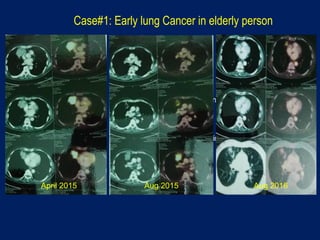
80 yr/ Male
C/o Cough x 3 months
Smoker >20 yrs
PET-CT scan: Mass in Rt lung
Biopsy: Adenocarcinoma
IHC: EGFR- Mutated
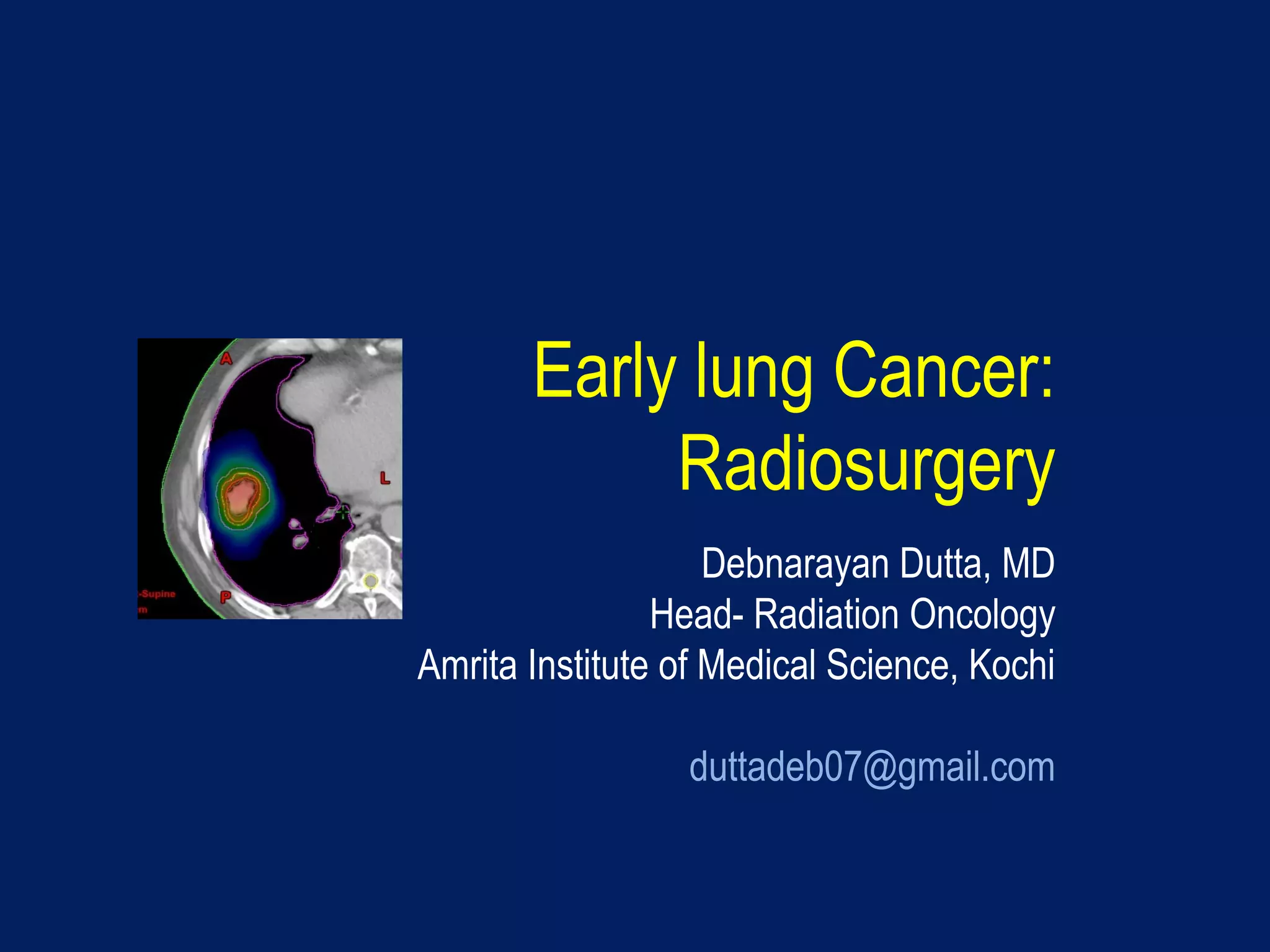
Treated with CyberKnife radiosurgery
45Gy/3#
Pescribed at 85% isodose
Case#1: Early lung Cancer in elderly person
April 2015 Aug 2015 Aug 2016
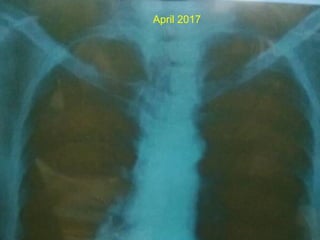
April 2017
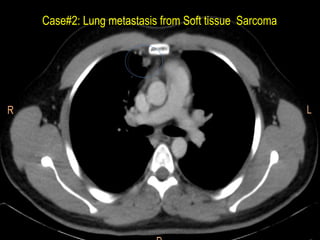
Case#2: Lung metastasis from Soft tissue Sarcoma
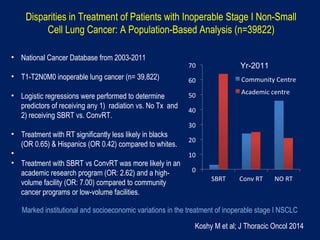
• National Cancer Database from 2003-2011
• T1-T2N0M0 inoperable lung cancer (n= 39,822)
• Logistic regressions were performed to determine
predictors of receiving any 1) radiation vs. No Tx and
2) receiving SBRT vs. ConvRT.
• Treatment with RT significantly less likely in blacks
(OR 0.65) & Hispanics (OR 0.42) compared to whites.
•
• Treatment with SBRT vs ConvRT was more likely in an
academic research program (OR: 2.62) and a high-
volume facility (OR: 7.00) compared to community
cancer programs or low-volume facilities.
Koshy M et al; J Thoracic Oncol 2014
Disparities in Treatment of Patients with Inoperable Stage I Non-Small
Cell Lung Cancer: A Population-Based Analysis (n=39822)
Marked institutional and socioeconomic variations in the treatment of inoperable stage I NSCLC
Yr-2011
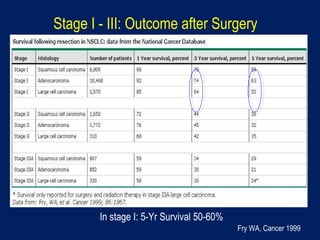
Stage I - III: Outcome after Surgery
Fry WA, Cancer 1999
In stage I: 5-Yr Survival 50-60%
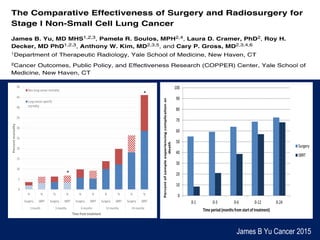
James B Yu Cancer 2015
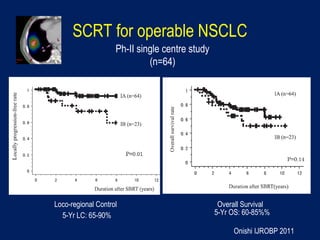
SCRT for operable NSCLC
Onishi IJROBP 2011
Loco-regional Control Overall Survival
5-Yr LC: 65-90% 5-Yr OS: 60-85%%
Ph-II single centre study
(n=64)
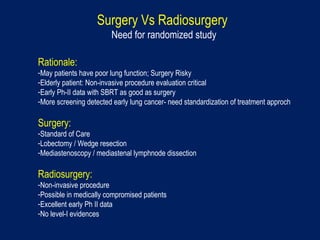
Surgery Vs Radiosurgery
Need for randomized study
Rationale:
-May patients have poor lung function; Surgery Risky
-Elderly patient: Non-invasive procedure evaluation critical
-Early Ph-II data with SBRT as good as surgery
-More screening detected early lung cancer- need standardization of treatment approch
Surgery:
-Standard of Care
-Lobectomy / Wedge resection
-Mediastenoscopy / mediastenal lymphnode dissection
Radiosurgery:
-Non-invasive procedure
-Possible in medically compromised patients
-Excellent early Ph II data
-No level-I evidences
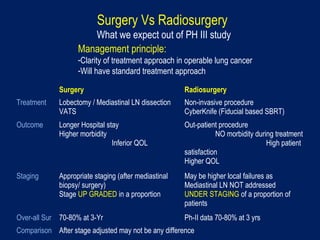
Surgery Vs Radiosurgery
What we expect out of PH III study
Management principle:
-Clarity of treatment approach in operable lung cancer
-Will have standard treatment approach
Surgery Radiosurgery
Treatment Lobectomy / Mediastinal LN dissection
VATS
Non-invasive procedure
CyberKnife (Fiducial based SBRT)
Outcome Longer Hospital stay
Higher morbidity
Inferior QOL
Out-patient procedure
NO morbidity during treatment
High patient
satisfaction
Higher QOL
Staging Appropriate staging (after mediastinal
biopsy/ surgery)
Stage UP GRADED in a proportion
May be higher local failures as
Mediastinal LN NOT addressed
UNDER STAGING of a proportion of
patients
Over-all Sur 70-80% at 3-Yr Ph-II data 70-80% at 3 yrs
Comparison After stage adjusted may not be any difference
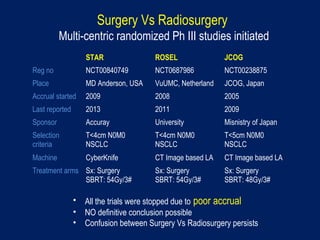
Surgery Vs Radiosurgery
Multi-centric randomized Ph III studies initiated
STAR ROSEL JCOG
Reg no NCT00840749 NCT0687986 NCT00238875
Place MD Anderson, USA VuUMC, Netherland JCOG, Japan
Accrual started 2009 2008 2005
Last reported 2013 2011 2009
Sponsor Accuray University Misnistry of Japan
Selection
criteria
T<4cm N0M0
NSCLC
T<4cm N0M0
NSCLC
T<5cm N0M0
NSCLC
Machine CyberKnife CT Image based LA CT Image based LA
Treatment arms Sx: Surgery
SBRT: 54Gy/3#
Sx: Surgery
SBRT: 54Gy/3#
Sx: Surgery
SBRT: 48Gy/3#
• All the trials were stopped due to poor accrual
• NO definitive conclusion possible
• Confusion between Surgery Vs Radiosurgery persists
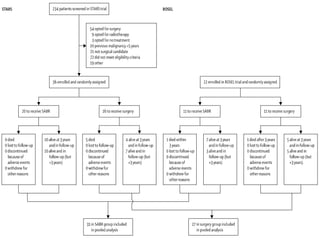
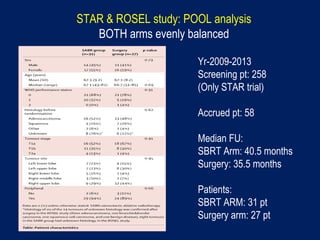
Yr-2009-2013
Screening pt: 258
(Only STAR trial)
Accrued pt: 58
Median FU:
SBRT Arm: 40.5 months
Surgery: 35.5 months
Patients:
SBRT ARM: 31 pt
Surgery arm: 27 pt
STAR & ROSEL study: POOL analysis
BOTH arms evenly balanced
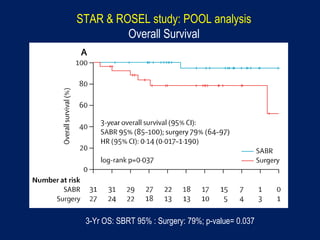
STAR & ROSEL study: POOL analysis
Overall Survival
3-Yr OS: SBRT 95% : Surgery: 79%; p-value= 0.037
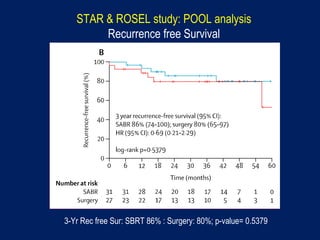
STAR & ROSEL study: POOL analysis
Recurrence free Survival
3-Yr Rec free Sur: SBRT 86% : Surgery: 80%; p-value= 0.5379
STAR & ROSEL study: POOL analysis
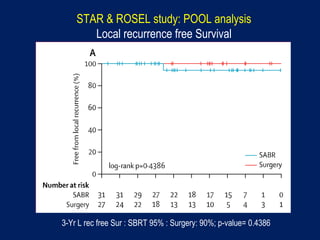
Local recurrence free Survival
3-Yr L rec free Sur : SBRT 95% : Surgery: 90%; p-value= 0.4386
STAR & ROSEL study: POOL analysis
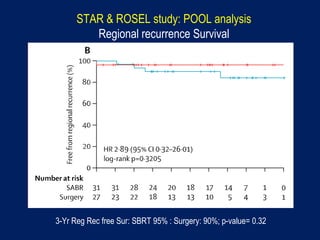
Regional recurrence Survival
3-Yr Reg Rec free Sur: SBRT 95% : Surgery: 90%; p-value= 0.32
STAR & ROSEL study: POOL analysis
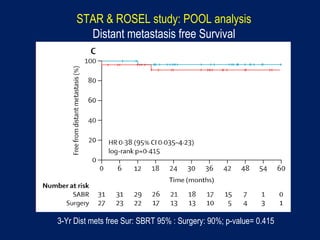
Distant metastasis free Survival
3-Yr Dist mets free Sur: SBRT 95% : Surgery: 90%; p-value= 0.415
STAR & ROSEL study: POOL analysis
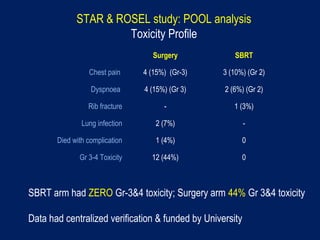
Toxicity Profile
SBRT arm had ZERO Gr-3&4 toxicity; Surgery arm 44% Gr 3&4 toxicity
Data had centralized verification & funded by University
Surgery SBRT
Chest pain 4 (15%) (Gr-3) 3 (10%) (Gr 2)
Dyspnoea 4 (15%) (Gr 3) 2 (6%) (Gr 2)
Rib fracture - 1 (3%)
Lung infection 2 (7%) -
Died with complication 1 (4%) 0
Gr 3-4 Toxicity 12 (44%) 0
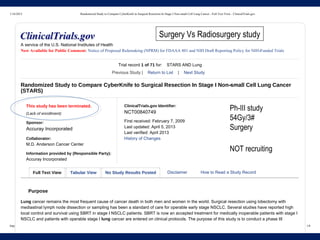
1/16/2015 Randomized Study to Compare CyberKnife to Surgical Resection In Stage I Non-small Cell Lung Cancer - Full Text View - ClinicalTrials.gov
https://clinicaltrials.gov/ct2/show/NCT00840749?term=STARS+AND+Lung&rank=1 1/8
This study has been terminated.
(Lack of enrollment)
Sponsor:
Accuray Incorporated
Collaborator:
M.D. Anderson Cancer Center
Information provided by (Responsible Party):
Accuray Incorporated
ClinicalTrials.gov Identifier:
NCT00840749
First received: February 7, 2009
Last updated: April 5, 2013
Last verified: April 2013
History of Changes
Full Text View Tabular View No Study Results Posted Disclaimer How to Read a Study Record
A service of the U.S. National Institutes of Health
Now Available for Public Comment: Notice of Proposed Rulemaking (NPRM) for FDAAA 801 and NIH Draft Reporting Policy for NIH--Funded Trials
Trial record 1 of 71 for: STARS AND Lung
Previous Study | Return to List | Next Study
Randomized Study to Compare CyberKnife to Surgical Resection In Stage I Non--small Cell Lung Cancer
(STARS)
Purpose
Lung cancer remains the most frequent cause of cancer death in both men and women in the world. Surgical resection using lobectomy with
mediastinal lymph node dissection or sampling has been a standard of care for operable early stage NSCLC. Several studies have reported high
local control and survival using SBRT in stage I NSCLC patients. SBRT is now an accepted treatment for medically inoperable patients with stage I
NSCLC and patients with operable stage I lung cancer are entered on clinical protocols. The purpose of this study is to conduct a phase III
NOT recruiting
Ph-III study
54Gy/3#
Surgery
Surgery Vs Radiosurgery study
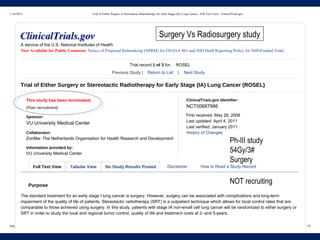
1/16/2015 Trial of Either Surgery or Stereotactic Radiotherapy for Early Stage (IA) Lung Cancer - Full Text View - ClinicalTrials.gov
https://clinicaltrials.gov/ct2/show/NCT00687986?term=ROSEL&rank=1 1/6
This study has been terminated.
(Poor recruitment)
Sponsor:
VU University Medical Center
Collaborator:
ZonMw: The Netherlands Organisation for Health Research and Development
Information provided by:
VU University Medical Center
ClinicalTrials.gov Identifier:
NCT00687986
First received: May 28, 2008
Last updated: April 4, 2011
Last verified: January 2011
History of Changes
Full Text View Tabular View No Study Results Posted Disclaimer How to Read a Study Record
A service of the U.S. National Institutes of Health
Now Available for Public Comment: Notice of Proposed Rulemaking (NPRM) for FDAAA 801 and NIH Draft Reporting Policy for NIH--Funded Trials
Trial record 1 of 3 for: ROSEL
Previous Study | Return to List | Next Study
Trial of Either Surgery or Stereotactic Radiotherapy for Early Stage (IA) Lung Cancer (ROSEL)
Purpose
The standard treatment for an early stage I lung cancer is surgery. However, surgery can be associated with complications and long--term
impairment of the quality of life of patients. Stereotactic radiotherapy (SRT) is a outpatient technique which allows for local control rates that are
comparable to those achieved using surgery. In this study, patients with stage IA non--small cell lung cancer will be randomized to either surgery or
SRT in order to study the local and regional tumor control, quality of life and treatment costs at 2--and 5--years.
NOT recruiting
Ph-III study
54Gy/3#
Surgery
Surgery Vs Radiosurgery study
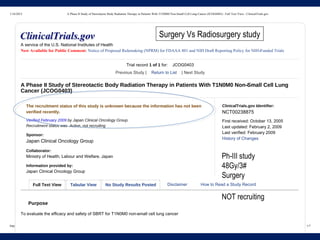
1/16/2015 A Phase II Study of Stereotactic Body Radiation Therapy in Patients With T1N0M0 Non-Small Cell Lung Cancer (JCOG0403) - Full Text View - ClinicalTrials.gov
https://clinicaltrials.gov/ct2/show/NCT00238875?term=JCOG0403&rank=1 1/7
The recruitment status of this study is unknown because the information has not been
verified recently.
Verified February 2009 by Japan Clinical Oncology Group.
Recruitment status was Active, not recruiting
Sponsor:
Japan Clinical Oncology Group
Collaborator:
Ministry of Health, Labour and Welfare, Japan
Information provided by:
Japan Clinical Oncology Group
ClinicalTrials.gov Identifier:
NCT00238875
First received: October 13, 2005
Last updated: February 2, 2009
Last verified: February 2009
History of Changes
Full Text View Tabular View No Study Results Posted Disclaimer How to Read a Study Record
A service of the U.S. National Institutes of Health
Now Available for Public Comment: Notice of Proposed Rulemaking (NPRM) for FDAAA 801 and NIH Draft Reporting Policy for NIH--Funded Trials
Trial record 1 of 1 for: JCOG0403
Previous Study | Return to List | Next Study
A Phase II Study of Stereotactic Body Radiation Therapy in Patients With T1N0M0 Non--Small Cell Lung
Cancer (JCOG0403)
Purpose
To evaluate the efficacy and safety of SBRT for T1N0M0 non--small cell lung cancer
NOT recruiting
Ph-III study
48Gy/3#
Surgery
Surgery Vs Radiosurgery study
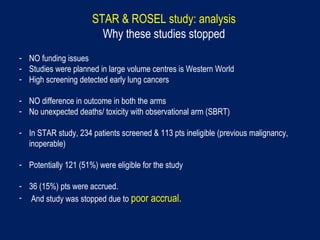
STAR & ROSEL study: analysis
Why these studies stopped
- NO funding issues
- Studies were planned in large volume centres is Western World
- High screening detected early lung cancers
- NO difference in outcome in both the arms
- No unexpected deaths/ toxicity with observational arm (SBRT)
- In STAR study, 234 patients screened & 113 pts ineligible (previous malignancy,
inoperable)
- Potentially 121 (51%) were eligible for the study
- 36 (15%) pts were accrued.
- And study was stopped due to poor accrual.
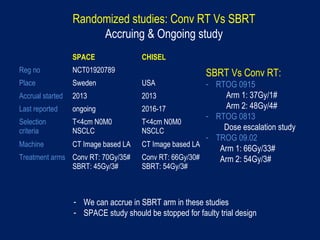
Randomized studies: Conv RT Vs SBRT
Accruing & Ongoing study
SPACE CHISEL
Reg no NCT01920789
Place Sweden USA
Accrual started 2013 2013
Last reported ongoing 2016-17
Selection
criteria
T<4cm N0M0
NSCLC
T<4cm N0M0
NSCLC
Machine CT Image based LA CT Image based LA
Treatment arms Conv RT: 70Gy/35#
SBRT: 45Gy/3#
Conv RT: 66Gy/30#
SBRT: 54Gy/3#
- We can accrue in SBRT arm in these studies
- SPACE study should be stopped for faulty trial design
SBRT Vs Conv RT:
- RTOG 0915
Arm 1: 37Gy/1#
Arm 2: 48Gy/4#
- RTOG 0813
Dose escalation study
- TROG 09.02
Arm 1: 66Gy/33#
Arm 2: 54Gy/3#
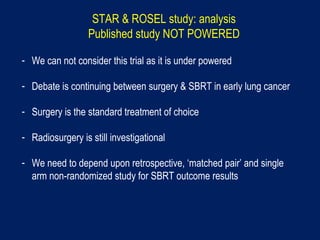
STAR & ROSEL study: analysis
Published study NOT POWERED
- We can not consider this trial as it is under powered
- Debate is continuing between surgery & SBRT in early lung cancer
- Surgery is the standard treatment of choice
- Radiosurgery is still investigational
- We need to depend upon retrospective, ‘matched pair’ and single
arm non-randomized study for SBRT outcome results
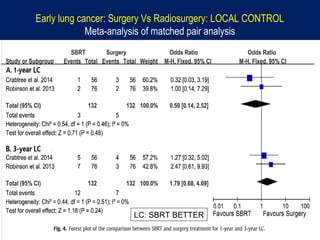
Early lung cancer: Surgery Vs Radiosurgery: LOCAL CONTROL
Meta-analysis of matched pair analysis
LC: SBRT BETTER
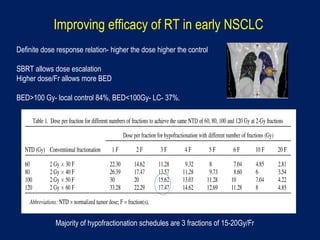
Improving efficacy of RT in early NSCLC
Definite dose response relation- higher the dose higher the control
SBRT allows dose escalation
Higher dose/Fr allows more BED
BED>100 Gy- local control 84%, BED<100Gy- LC- 37%.
Majority of hypofractionation schedules are 3 fractions of 15-20Gy/Fr
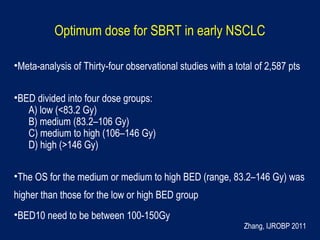
Optimum dose for SBRT in early NSCLC
•Meta-analysis of Thirty-four observational studies with a total of 2,587 pts
•BED divided into four dose groups:
A) low (<83.2 Gy)
B) medium (83.2–106 Gy)
C) medium to high (106–146 Gy)
D) high (>146 Gy)
•The OS for the medium or medium to high BED (range, 83.2–146 Gy) was
higher than those for the low or high BED group
•BED10 need to be between 100-150Gy
Zhang, IJROBP 2011
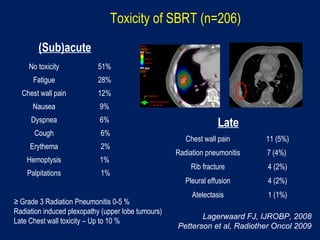
Toxicity of SBRT (n=206)
Chest wall pain 11 (5%)
Radiation pneumonitis 7 (4%)
Rib fracture 4 (2%)
Pleural effusion 4 (2%)
Atelectasis 1 (1%)
No toxicity 51%
Fatigue 28%
Chest wall pain 12%
Nausea 9%
Dyspnea 6%
Cough 6%
Erythema 2%
Hemoptysis 1%
Palpitations 1%
(Sub)acute
Late
≥ Grade 3 Radiation Pneumonitis 0-5 %
Radiation induced plexopathy (upper lobe tumours)
Late Chest wall toxicity – Up to 10 %
Lagerwaard FJ, IJROBP, 2008
Petterson et al, Radiother Oncol 2009
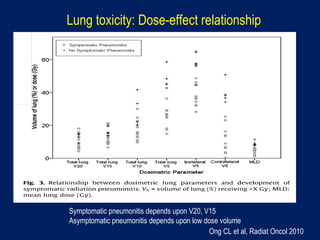
Ong CL et al, Radiat Oncol 2010
Lung toxicity: Dose-effect relationship
Symptomatic pneumonitis depends upon V20, V15
Asymptomatic pneumonitis depends upon low dose volume
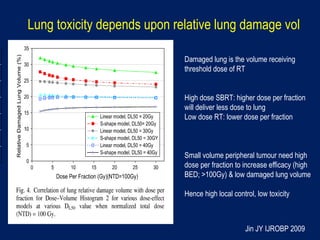
Jin JY IJROBP 2009
Lung toxicity depends upon relative lung damage vol
Damaged lung is the volume receiving
threshold dose of RT
High dose SBRT: higher dose per fraction
will deliver less dose to lung
Low dose RT: lower dose per fraction
Small volume peripheral tumour need high
dose per fraction to increase efficacy (high
BED; >100Gy) & low damaged lung volume
Hence high local control, low toxicity
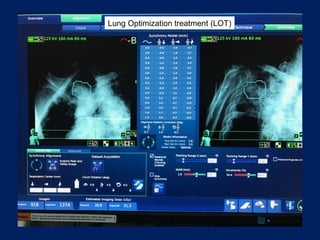
Lung Optimization treatment (LOT)
ACCURAY CONFIDENTIAL. © 2012-2013 Accuray Incorporated. All rights reserved. Treatment Options for Lung · ECK.700395.A
22
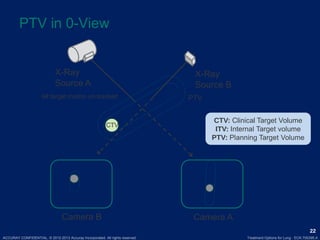
PTV in 0-View
PTVAll target motion un-tracked
CTV
Camera B Camera A
X-Ray
Source B
X-Ray
Source A
CTV: Clinical Target Volume
ITV: Internal Target volume
PTV: Planning Target Volume
ACCURAY CONFIDENTIAL. © 2012-2013 Accuray Incorporated. All rights reserved. Treatment Options for Lung · ECK.700395.A
20
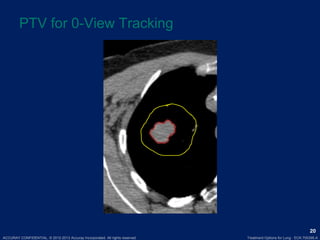
PTV for 0-View Tracking
ACCURAY CONFIDENTIAL. © 2012-2013 Accuray Incorporated. All rights reserved. Treatment Options for Lung · ECK.700395.A
28
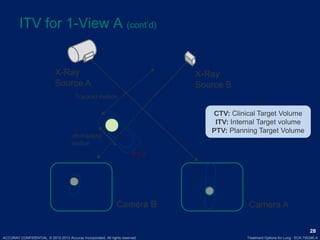
ITV for 1-View A (cont’d)
Un-tracked
motion
Tracked motion
PTV
Camera B Camera A
X-Ray
Source B
X-Ray
Source A
CTV: Clinical Target Volume
ITV: Internal Target volume
PTV: Planning Target Volume
ACCURAY CONFIDENTIAL. © 2012-2013 Accuray Incorporated. All rights reserved. Treatment Options for Lung · ECK.700395.A
35
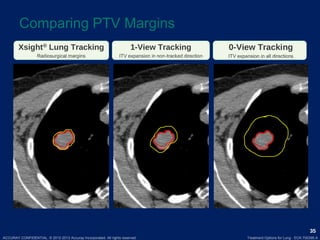
Comparing PTV Margins
1-View Tracking
ITV expansion in non-tracked direction
Xsight® Lung Tracking
Radiosurgical margins
0-View Tracking
ITV expansion in all directions
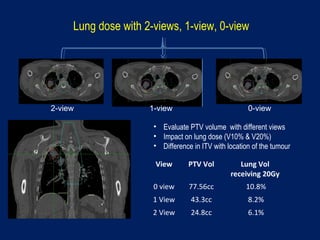
Lung dose with 2-views, 1-view, 0-view
• Evaluate PTV volume with different views
• Impact on lung dose (V10% & V20%)
• Difference in ITV with location of the tumour
2-view 1-view 0-view
View PTV Vol Lung Vol
receiving 20Gy
0 view 77.56cc 10.8%
1 View 43.3cc 8.2%
2 View 24.8cc 6.1%
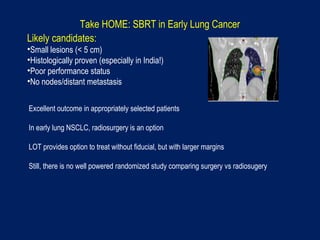
Take HOME: SBRT in Early Lung Cancer
Likely candidates:
•Small lesions (< 5 cm)
•Histologically proven (especially in India!)
•Poor performance status
•No nodes/distant metastasis
Excellent outcome in appropriately selected patients
In early lung NSCLC, radiosurgery is an option
LOT provides option to treat without fiducial, but with larger margins
Still, there is no well powered randomized study comparing surgery vs radiosugery

Early Lung Cancer: Radiosurgery

  • 1.
    Early lung Cancer: Radiosurgery DebnarayanDutta, MD Head- Radiation Oncology Amrita Institute of Medical Science, Kochi duttadeb07@gmail.com
  • 2.
    80 yr/ Male C/oCough x 3 months Smoker >20 yrs PET-CT scan: Mass in Rt lung Biopsy: Adenocarcinoma IHC: EGFR- Mutated Treated with CyberKnife radiosurgery 45Gy/3# Pescribed at 85% isodose Case#1: Early lung Cancer in elderly person April 2015 Aug 2015 Aug 2016
  • 3.
  • 4.
    Case#2: Lung metastasisfrom Soft tissue Sarcoma
  • 5.
    • National CancerDatabase from 2003-2011 • T1-T2N0M0 inoperable lung cancer (n= 39,822) • Logistic regressions were performed to determine predictors of receiving any 1) radiation vs. No Tx and 2) receiving SBRT vs. ConvRT. • Treatment with RT significantly less likely in blacks (OR 0.65) & Hispanics (OR 0.42) compared to whites. • • Treatment with SBRT vs ConvRT was more likely in an academic research program (OR: 2.62) and a high- volume facility (OR: 7.00) compared to community cancer programs or low-volume facilities. Koshy M et al; J Thoracic Oncol 2014 Disparities in Treatment of Patients with Inoperable Stage I Non-Small Cell Lung Cancer: A Population-Based Analysis (n=39822) Marked institutional and socioeconomic variations in the treatment of inoperable stage I NSCLC Yr-2011
  • 6.
    Stage I -III: Outcome after Surgery Fry WA, Cancer 1999 In stage I: 5-Yr Survival 50-60%
  • 7.
    James B YuCancer 2015
  • 8.
    SCRT for operableNSCLC Onishi IJROBP 2011 Loco-regional Control Overall Survival 5-Yr LC: 65-90% 5-Yr OS: 60-85%% Ph-II single centre study (n=64)
  • 9.
    Surgery Vs Radiosurgery Needfor randomized study Rationale: -May patients have poor lung function; Surgery Risky -Elderly patient: Non-invasive procedure evaluation critical -Early Ph-II data with SBRT as good as surgery -More screening detected early lung cancer- need standardization of treatment approch Surgery: -Standard of Care -Lobectomy / Wedge resection -Mediastenoscopy / mediastenal lymphnode dissection Radiosurgery: -Non-invasive procedure -Possible in medically compromised patients -Excellent early Ph II data -No level-I evidences
  • 10.
    Surgery Vs Radiosurgery Whatwe expect out of PH III study Management principle: -Clarity of treatment approach in operable lung cancer -Will have standard treatment approach Surgery Radiosurgery Treatment Lobectomy / Mediastinal LN dissection VATS Non-invasive procedure CyberKnife (Fiducial based SBRT) Outcome Longer Hospital stay Higher morbidity Inferior QOL Out-patient procedure NO morbidity during treatment High patient satisfaction Higher QOL Staging Appropriate staging (after mediastinal biopsy/ surgery) Stage UP GRADED in a proportion May be higher local failures as Mediastinal LN NOT addressed UNDER STAGING of a proportion of patients Over-all Sur 70-80% at 3-Yr Ph-II data 70-80% at 3 yrs Comparison After stage adjusted may not be any difference
  • 11.
    Surgery Vs Radiosurgery Multi-centricrandomized Ph III studies initiated STAR ROSEL JCOG Reg no NCT00840749 NCT0687986 NCT00238875 Place MD Anderson, USA VuUMC, Netherland JCOG, Japan Accrual started 2009 2008 2005 Last reported 2013 2011 2009 Sponsor Accuray University Misnistry of Japan Selection criteria T<4cm N0M0 NSCLC T<4cm N0M0 NSCLC T<5cm N0M0 NSCLC Machine CyberKnife CT Image based LA CT Image based LA Treatment arms Sx: Surgery SBRT: 54Gy/3# Sx: Surgery SBRT: 54Gy/3# Sx: Surgery SBRT: 48Gy/3# • All the trials were stopped due to poor accrual • NO definitive conclusion possible • Confusion between Surgery Vs Radiosurgery persists
  • 14.
    Yr-2009-2013 Screening pt: 258 (OnlySTAR trial) Accrued pt: 58 Median FU: SBRT Arm: 40.5 months Surgery: 35.5 months Patients: SBRT ARM: 31 pt Surgery arm: 27 pt STAR & ROSEL study: POOL analysis BOTH arms evenly balanced
  • 15.
    STAR & ROSELstudy: POOL analysis Overall Survival 3-Yr OS: SBRT 95% : Surgery: 79%; p-value= 0.037
  • 16.
    STAR & ROSELstudy: POOL analysis Recurrence free Survival 3-Yr Rec free Sur: SBRT 86% : Surgery: 80%; p-value= 0.5379
  • 17.
    STAR & ROSELstudy: POOL analysis Local recurrence free Survival 3-Yr L rec free Sur : SBRT 95% : Surgery: 90%; p-value= 0.4386
  • 18.
    STAR & ROSELstudy: POOL analysis Regional recurrence Survival 3-Yr Reg Rec free Sur: SBRT 95% : Surgery: 90%; p-value= 0.32
  • 19.
    STAR & ROSELstudy: POOL analysis Distant metastasis free Survival 3-Yr Dist mets free Sur: SBRT 95% : Surgery: 90%; p-value= 0.415
  • 20.
    STAR & ROSELstudy: POOL analysis Toxicity Profile SBRT arm had ZERO Gr-3&4 toxicity; Surgery arm 44% Gr 3&4 toxicity Data had centralized verification & funded by University Surgery SBRT Chest pain 4 (15%) (Gr-3) 3 (10%) (Gr 2) Dyspnoea 4 (15%) (Gr 3) 2 (6%) (Gr 2) Rib fracture - 1 (3%) Lung infection 2 (7%) - Died with complication 1 (4%) 0 Gr 3-4 Toxicity 12 (44%) 0
  • 21.
    1/16/2015 Randomized Studyto Compare CyberKnife to Surgical Resection In Stage I Non-small Cell Lung Cancer - Full Text View - ClinicalTrials.gov https://clinicaltrials.gov/ct2/show/NCT00840749?term=STARS+AND+Lung&rank=1 1/8 This study has been terminated. (Lack of enrollment) Sponsor: Accuray Incorporated Collaborator: M.D. Anderson Cancer Center Information provided by (Responsible Party): Accuray Incorporated ClinicalTrials.gov Identifier: NCT00840749 First received: February 7, 2009 Last updated: April 5, 2013 Last verified: April 2013 History of Changes Full Text View Tabular View No Study Results Posted Disclaimer How to Read a Study Record A service of the U.S. National Institutes of Health Now Available for Public Comment: Notice of Proposed Rulemaking (NPRM) for FDAAA 801 and NIH Draft Reporting Policy for NIH--Funded Trials Trial record 1 of 71 for: STARS AND Lung Previous Study | Return to List | Next Study Randomized Study to Compare CyberKnife to Surgical Resection In Stage I Non--small Cell Lung Cancer (STARS) Purpose Lung cancer remains the most frequent cause of cancer death in both men and women in the world. Surgical resection using lobectomy with mediastinal lymph node dissection or sampling has been a standard of care for operable early stage NSCLC. Several studies have reported high local control and survival using SBRT in stage I NSCLC patients. SBRT is now an accepted treatment for medically inoperable patients with stage I NSCLC and patients with operable stage I lung cancer are entered on clinical protocols. The purpose of this study is to conduct a phase III NOT recruiting Ph-III study 54Gy/3# Surgery Surgery Vs Radiosurgery study
  • 22.
    1/16/2015 Trial ofEither Surgery or Stereotactic Radiotherapy for Early Stage (IA) Lung Cancer - Full Text View - ClinicalTrials.gov https://clinicaltrials.gov/ct2/show/NCT00687986?term=ROSEL&rank=1 1/6 This study has been terminated. (Poor recruitment) Sponsor: VU University Medical Center Collaborator: ZonMw: The Netherlands Organisation for Health Research and Development Information provided by: VU University Medical Center ClinicalTrials.gov Identifier: NCT00687986 First received: May 28, 2008 Last updated: April 4, 2011 Last verified: January 2011 History of Changes Full Text View Tabular View No Study Results Posted Disclaimer How to Read a Study Record A service of the U.S. National Institutes of Health Now Available for Public Comment: Notice of Proposed Rulemaking (NPRM) for FDAAA 801 and NIH Draft Reporting Policy for NIH--Funded Trials Trial record 1 of 3 for: ROSEL Previous Study | Return to List | Next Study Trial of Either Surgery or Stereotactic Radiotherapy for Early Stage (IA) Lung Cancer (ROSEL) Purpose The standard treatment for an early stage I lung cancer is surgery. However, surgery can be associated with complications and long--term impairment of the quality of life of patients. Stereotactic radiotherapy (SRT) is a outpatient technique which allows for local control rates that are comparable to those achieved using surgery. In this study, patients with stage IA non--small cell lung cancer will be randomized to either surgery or SRT in order to study the local and regional tumor control, quality of life and treatment costs at 2--and 5--years. NOT recruiting Ph-III study 54Gy/3# Surgery Surgery Vs Radiosurgery study
  • 23.
    1/16/2015 A PhaseII Study of Stereotactic Body Radiation Therapy in Patients With T1N0M0 Non-Small Cell Lung Cancer (JCOG0403) - Full Text View - ClinicalTrials.gov https://clinicaltrials.gov/ct2/show/NCT00238875?term=JCOG0403&rank=1 1/7 The recruitment status of this study is unknown because the information has not been verified recently. Verified February 2009 by Japan Clinical Oncology Group. Recruitment status was Active, not recruiting Sponsor: Japan Clinical Oncology Group Collaborator: Ministry of Health, Labour and Welfare, Japan Information provided by: Japan Clinical Oncology Group ClinicalTrials.gov Identifier: NCT00238875 First received: October 13, 2005 Last updated: February 2, 2009 Last verified: February 2009 History of Changes Full Text View Tabular View No Study Results Posted Disclaimer How to Read a Study Record A service of the U.S. National Institutes of Health Now Available for Public Comment: Notice of Proposed Rulemaking (NPRM) for FDAAA 801 and NIH Draft Reporting Policy for NIH--Funded Trials Trial record 1 of 1 for: JCOG0403 Previous Study | Return to List | Next Study A Phase II Study of Stereotactic Body Radiation Therapy in Patients With T1N0M0 Non--Small Cell Lung Cancer (JCOG0403) Purpose To evaluate the efficacy and safety of SBRT for T1N0M0 non--small cell lung cancer NOT recruiting Ph-III study 48Gy/3# Surgery Surgery Vs Radiosurgery study
  • 24.
    STAR & ROSELstudy: analysis Why these studies stopped - NO funding issues - Studies were planned in large volume centres is Western World - High screening detected early lung cancers - NO difference in outcome in both the arms - No unexpected deaths/ toxicity with observational arm (SBRT) - In STAR study, 234 patients screened & 113 pts ineligible (previous malignancy, inoperable) - Potentially 121 (51%) were eligible for the study - 36 (15%) pts were accrued. - And study was stopped due to poor accrual.
  • 25.
    Randomized studies: ConvRT Vs SBRT Accruing & Ongoing study SPACE CHISEL Reg no NCT01920789 Place Sweden USA Accrual started 2013 2013 Last reported ongoing 2016-17 Selection criteria T<4cm N0M0 NSCLC T<4cm N0M0 NSCLC Machine CT Image based LA CT Image based LA Treatment arms Conv RT: 70Gy/35# SBRT: 45Gy/3# Conv RT: 66Gy/30# SBRT: 54Gy/3# - We can accrue in SBRT arm in these studies - SPACE study should be stopped for faulty trial design SBRT Vs Conv RT: - RTOG 0915 Arm 1: 37Gy/1# Arm 2: 48Gy/4# - RTOG 0813 Dose escalation study - TROG 09.02 Arm 1: 66Gy/33# Arm 2: 54Gy/3#
  • 26.
    STAR & ROSELstudy: analysis Published study NOT POWERED - We can not consider this trial as it is under powered - Debate is continuing between surgery & SBRT in early lung cancer - Surgery is the standard treatment of choice - Radiosurgery is still investigational - We need to depend upon retrospective, ‘matched pair’ and single arm non-randomized study for SBRT outcome results
  • 27.
    Early lung cancer:Surgery Vs Radiosurgery: LOCAL CONTROL Meta-analysis of matched pair analysis LC: SBRT BETTER
  • 28.
    Improving efficacy ofRT in early NSCLC Definite dose response relation- higher the dose higher the control SBRT allows dose escalation Higher dose/Fr allows more BED BED>100 Gy- local control 84%, BED<100Gy- LC- 37%. Majority of hypofractionation schedules are 3 fractions of 15-20Gy/Fr
  • 29.
    Optimum dose forSBRT in early NSCLC •Meta-analysis of Thirty-four observational studies with a total of 2,587 pts •BED divided into four dose groups: A) low (<83.2 Gy) B) medium (83.2–106 Gy) C) medium to high (106–146 Gy) D) high (>146 Gy) •The OS for the medium or medium to high BED (range, 83.2–146 Gy) was higher than those for the low or high BED group •BED10 need to be between 100-150Gy Zhang, IJROBP 2011
  • 30.
    Toxicity of SBRT(n=206) Chest wall pain 11 (5%) Radiation pneumonitis 7 (4%) Rib fracture 4 (2%) Pleural effusion 4 (2%) Atelectasis 1 (1%) No toxicity 51% Fatigue 28% Chest wall pain 12% Nausea 9% Dyspnea 6% Cough 6% Erythema 2% Hemoptysis 1% Palpitations 1% (Sub)acute Late ≥ Grade 3 Radiation Pneumonitis 0-5 % Radiation induced plexopathy (upper lobe tumours) Late Chest wall toxicity – Up to 10 % Lagerwaard FJ, IJROBP, 2008 Petterson et al, Radiother Oncol 2009
  • 31.
    Ong CL etal, Radiat Oncol 2010 Lung toxicity: Dose-effect relationship Symptomatic pneumonitis depends upon V20, V15 Asymptomatic pneumonitis depends upon low dose volume
  • 32.
    Jin JY IJROBP2009 Lung toxicity depends upon relative lung damage vol Damaged lung is the volume receiving threshold dose of RT High dose SBRT: higher dose per fraction will deliver less dose to lung Low dose RT: lower dose per fraction Small volume peripheral tumour need high dose per fraction to increase efficacy (high BED; >100Gy) & low damaged lung volume Hence high local control, low toxicity
  • 33.
  • 34.
    ACCURAY CONFIDENTIAL. ©2012-2013 Accuray Incorporated. All rights reserved. Treatment Options for Lung · ECK.700395.A 22 PTV in 0-View PTVAll target motion un-tracked CTV Camera B Camera A X-Ray Source B X-Ray Source A CTV: Clinical Target Volume ITV: Internal Target volume PTV: Planning Target Volume
  • 35.
    ACCURAY CONFIDENTIAL. ©2012-2013 Accuray Incorporated. All rights reserved. Treatment Options for Lung · ECK.700395.A 20 PTV for 0-View Tracking
  • 36.
    ACCURAY CONFIDENTIAL. ©2012-2013 Accuray Incorporated. All rights reserved. Treatment Options for Lung · ECK.700395.A 28 ITV for 1-View A (cont’d) Un-tracked motion Tracked motion PTV Camera B Camera A X-Ray Source B X-Ray Source A CTV: Clinical Target Volume ITV: Internal Target volume PTV: Planning Target Volume
  • 37.
    ACCURAY CONFIDENTIAL. ©2012-2013 Accuray Incorporated. All rights reserved. Treatment Options for Lung · ECK.700395.A 35 Comparing PTV Margins 1-View Tracking ITV expansion in non-tracked direction Xsight® Lung Tracking Radiosurgical margins 0-View Tracking ITV expansion in all directions
  • 38.
    Lung dose with2-views, 1-view, 0-view • Evaluate PTV volume with different views • Impact on lung dose (V10% & V20%) • Difference in ITV with location of the tumour 2-view 1-view 0-view View PTV Vol Lung Vol receiving 20Gy 0 view 77.56cc 10.8% 1 View 43.3cc 8.2% 2 View 24.8cc 6.1%
  • 39.
    Take HOME: SBRTin Early Lung Cancer Likely candidates: •Small lesions (< 5 cm) •Histologically proven (especially in India!) •Poor performance status •No nodes/distant metastasis Excellent outcome in appropriately selected patients In early lung NSCLC, radiosurgery is an option LOT provides option to treat without fiducial, but with larger margins Still, there is no well powered randomized study comparing surgery vs radiosugery