Quality of Life
and Radiotherapy
in
Brain Metastases
Patients
Does radiotherapy improve the quality of life for patients with
brain metastases?
MD PHECHUDI
BRAIN
METASTASES
• What are brain metastases?
• Who is likely to develop brain metastases?
• What are the symptoms?
• How are brain metastases diagnosed and
evaluated?
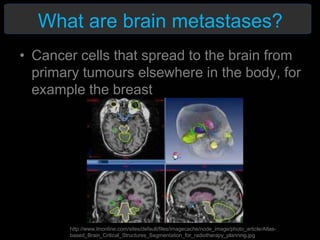
What are brain metastases?
• Cancer cells that spread to the brain from
primary tumours elsewhere in the body, for
example the breast
http://www.itnonline.com/sites/default/files/imagecache/node_image/photo_article/Atlas-
based_Brain_Critical_Structures_Segmentation_for_radiotherapy_planning.jpg
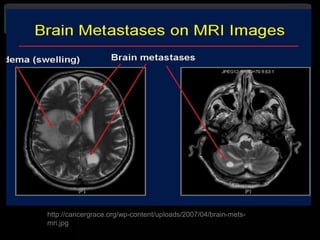
http://cancergrace.org/wp-content/uploads/2007/04/brain-mets-
mri.jpg
Who is likely to develop brain metastases?
• The odds of developing brain metastases based
on the primary type of cancer :
20%
7%
10%
5%
2%
EPIDEMIOLOGY
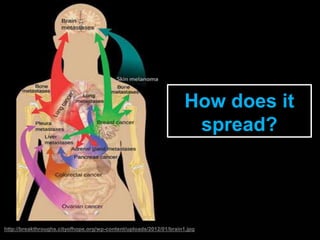
http://breakthroughs.cityofhope.org/wp-content/uploads/2012/01/brain1.jpg
How does it
spread?
What are the typical symptoms?
• Headaches
• Seizures
• Speech problems
• Weakness
• Impaired vision
• Pain or numbness
• Paralysis
• Nausea and
vomiting
One third of brain metastases
patients experience
at all
NO symptoms
Diagnosis And Evaluation
• Brain metastases may be diagnosed and
evaluated using one or more of several
different types of procedures:
MRI Scan
CT Scan
PET Scan
Biopsy
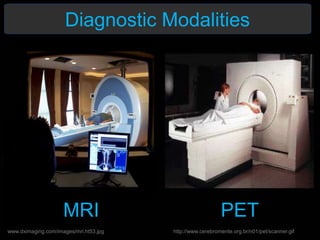
Diagnostic Modalities
www.dximaging.com/images/mri.ht53.jpg http://www.cerebromente.org.br/n01/pet/scanner.gif
MRI PET
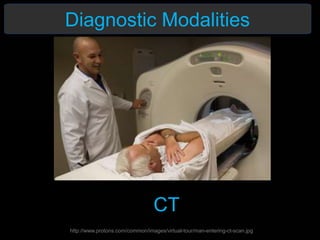
Diagnostic Modalities
http://www.protons.com/common/images/virtual-tour/man-entering-ct-scan.jpg
CT
RADIOTHERAPY
• What is radiotherapy?
• How is radiotherapy used to treat brain
metastases?
• What are typical side effects?
• Is there an improvement in symptoms after
treatment?
• Does radiotherapy improve the quality of
life?
What is radiotherapy?
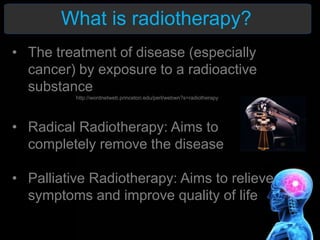
• The treatment of disease (especially
cancer) by exposure to a radioactive
substance
http://wordnetweb.princeton.edu/perl/webwn?s=radiotherapy
• Radical Radiotherapy: Aims to
completely remove the disease
• Palliative Radiotherapy: Aims to relieve
symptoms and improve quality of life
Radiotherapy Techniques
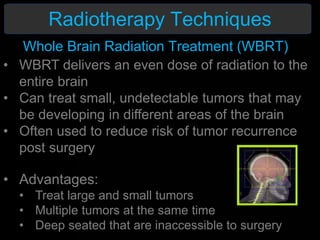
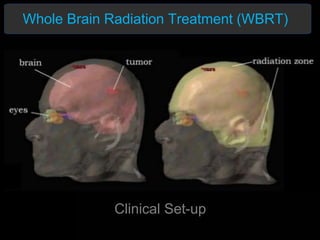
• WBRT delivers an even dose of radiation to the
entire brain
• Can treat small, undetectable tumors that may
be developing in different areas of the brain
• Often used to reduce risk of tumor recurrence
post surgery
• Advantages:
• Treat large and small tumors
• Multiple tumors at the same time
• Deep seated that are inaccessible to surgery
Whole Brain Radiation Treatment (WBRT)
• When is it used?
• Multiple tumors
• People who are not eligible for surgery
• Side effects may
include:
• Nausea
• Vomiting
• Headache
• Fever
• memory loss
• Fatigue
• Small risk of long-
term radiation
injury:
• radiation necrosis
• dementia.
Clinical Set-up
Whole Brain Radiation Treatment (WBRT)
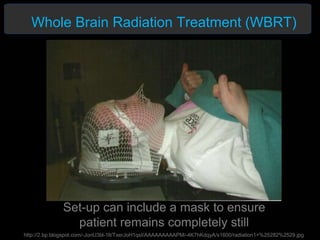
Set-up can include a mask to ensure
patient remains completely still
http://2.bp.blogspot.com/-JonU3bl-1lI/TxerJoH1qsI/AAAAAAAAAPM/-4K7hKdqyA/s1600/radiation1+%25282%2529.jpg
Whole Brain Radiation Treatment (WBRT)
Radiotherapy Techniques
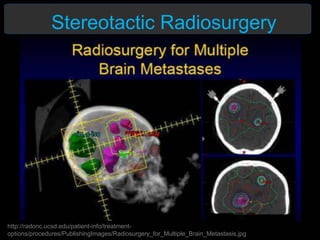
Stereotactic Radiosurgery
• More targeted form of radiation therapy—it isn’t
surgery at all  precise and focused
• Also called Gamma Knife®, XKnife™, Novalis®, and
Cyberknife®
• Delivers a higher dose of radiation to a small tumor
in a single treatment session
• The radiation beam is delivered to the tumor from
many different angles using special computer
planning
• A head frame  keep the patient’s head completely
still during the procedure.
http://radonc.ucsd.edu/patient-info/treatment-
options/procedures/PublishingImages/Radiosurgery_for_Multiple_Brain_Metastasis.jpg
Stereotactic Radiosurgery
Radiotherapy Techniques
Stereotactic Radiosurgery
• Advantages:
• Precise - less likely to hurt healthy tissue
• When is it used?
• To treat people with up to 3 brain tumors that is
not surgically accessible
• Only treats tumors that can be detected on MRI or
CT scans
• Rare side effects include:
• Swelling
• Neurological problems and Necrosis
Video on Stereotactic Radiotherapy
Study of Brain Mets
Patients
• What was the aim?
• Who was included?
• What was the methodology?
• What were the results?
• DOES RADIOTEHRAPY IMPROVE
THE QUALITY OF LIFE FOR BRAIN
METASTASES PATIENTS?
Background
Aim
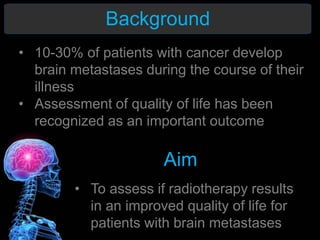
• To assess if radiotherapy results
in an improved quality of life for
patients with brain metastases
• 10-30% of patients with cancer develop
brain metastases during the course of their
illness
• Assessment of quality of life has been
recognized as an important outcome
Who was involved?
• 39 patients aged between 37-81 were
included in the study
• Median age: 59.9 years old
• All patients were receiving WBRT
• 62% female; 38% male
Methodology
• Patients were assessed through
questionnaires at baseline, 1
month, and 3 months after
completion of WBRT
• Between baseline and 3months - large
deterioration of cognitive functions after
the treatment, appetite loss, drowsiness
and hair loss
• General worsening of brain metastases
related symptoms
• Small deterioration of global health status
• 27 deaths occurred during the study
• Median survival time:
Results
3 Months
What does this tell us?
• Patients with a poor prognosis do not
benefit significantly from WBRT in terms of
their quality of life (QoL)and symptoms
• Patients with a better prognosis are seen
to have certain aspects of QoL improved
after WBRT
• Low survival reports reflect poor outcome
of patients
• More research needed to refine treatment
for brain metastases patients
Conclusion
• Radiotherapy does not significantly
improve the quality of life for brain
metastases patients!
REFERENCES
• http://www.braintumor.org/assets/docs/Understanding_Metastatic_Tumors.pdf
– Last Visited: 10 July 2013
• http://www.irsa.org/metastatic_tumors.html
– Last Visited: 23 July 3012
• http://www.medicinenet.com/brain_cancer/article.htm
– Last Visited: 23 July 2013
• http://www.ncbi.nlm.nih.gov/pubmed/16215811
– Last Visited: 29 July 2013

brain metastasis cancer

  • 1.
    Quality of Life andRadiotherapy in Brain Metastases Patients Does radiotherapy improve the quality of life for patients with brain metastases? MD PHECHUDI
  • 2.
    BRAIN METASTASES • What arebrain metastases? • Who is likely to develop brain metastases? • What are the symptoms? • How are brain metastases diagnosed and evaluated?
  • 3.
    What are brainmetastases? • Cancer cells that spread to the brain from primary tumours elsewhere in the body, for example the breast http://www.itnonline.com/sites/default/files/imagecache/node_image/photo_article/Atlas- based_Brain_Critical_Structures_Segmentation_for_radiotherapy_planning.jpg
  • 4.
  • 5.
    Who is likelyto develop brain metastases? • The odds of developing brain metastases based on the primary type of cancer : 20% 7% 10% 5% 2% EPIDEMIOLOGY
  • 6.
  • 7.
    What are thetypical symptoms? • Headaches • Seizures • Speech problems • Weakness • Impaired vision • Pain or numbness • Paralysis • Nausea and vomiting One third of brain metastases patients experience at all NO symptoms
  • 8.
    Diagnosis And Evaluation •Brain metastases may be diagnosed and evaluated using one or more of several different types of procedures: MRI Scan CT Scan PET Scan Biopsy
  • 9.
  • 10.
  • 11.
    RADIOTHERAPY • What isradiotherapy? • How is radiotherapy used to treat brain metastases? • What are typical side effects? • Is there an improvement in symptoms after treatment? • Does radiotherapy improve the quality of life?
  • 12.
    What is radiotherapy? •The treatment of disease (especially cancer) by exposure to a radioactive substance http://wordnetweb.princeton.edu/perl/webwn?s=radiotherapy • Radical Radiotherapy: Aims to completely remove the disease • Palliative Radiotherapy: Aims to relieve symptoms and improve quality of life
  • 13.
    Radiotherapy Techniques • WBRTdelivers an even dose of radiation to the entire brain • Can treat small, undetectable tumors that may be developing in different areas of the brain • Often used to reduce risk of tumor recurrence post surgery • Advantages: • Treat large and small tumors • Multiple tumors at the same time • Deep seated that are inaccessible to surgery Whole Brain Radiation Treatment (WBRT)
  • 14.
    Whole Brain RadiationTreatment (WBRT) • When is it used? • Multiple tumors • People who are not eligible for surgery • Side effects may include: • Nausea • Vomiting • Headache • Fever • memory loss • Fatigue • Small risk of long- term radiation injury: • radiation necrosis • dementia.
  • 15.
    Clinical Set-up Whole BrainRadiation Treatment (WBRT)
  • 16.
    Set-up can includea mask to ensure patient remains completely still http://2.bp.blogspot.com/-JonU3bl-1lI/TxerJoH1qsI/AAAAAAAAAPM/-4K7hKdqyA/s1600/radiation1+%25282%2529.jpg Whole Brain Radiation Treatment (WBRT)
  • 17.
    Radiotherapy Techniques Stereotactic Radiosurgery •More targeted form of radiation therapy—it isn’t surgery at all  precise and focused • Also called Gamma Knife®, XKnife™, Novalis®, and Cyberknife® • Delivers a higher dose of radiation to a small tumor in a single treatment session • The radiation beam is delivered to the tumor from many different angles using special computer planning • A head frame  keep the patient’s head completely still during the procedure.
  • 18.
  • 19.
    Radiotherapy Techniques Stereotactic Radiosurgery •Advantages: • Precise - less likely to hurt healthy tissue • When is it used? • To treat people with up to 3 brain tumors that is not surgically accessible • Only treats tumors that can be detected on MRI or CT scans • Rare side effects include: • Swelling • Neurological problems and Necrosis
  • 20.
  • 21.
    Study of BrainMets Patients • What was the aim? • Who was included? • What was the methodology? • What were the results? • DOES RADIOTEHRAPY IMPROVE THE QUALITY OF LIFE FOR BRAIN METASTASES PATIENTS?
  • 22.
    Background Aim • To assessif radiotherapy results in an improved quality of life for patients with brain metastases • 10-30% of patients with cancer develop brain metastases during the course of their illness • Assessment of quality of life has been recognized as an important outcome
  • 23.
    Who was involved? •39 patients aged between 37-81 were included in the study • Median age: 59.9 years old • All patients were receiving WBRT • 62% female; 38% male Methodology • Patients were assessed through questionnaires at baseline, 1 month, and 3 months after completion of WBRT
  • 24.
    • Between baselineand 3months - large deterioration of cognitive functions after the treatment, appetite loss, drowsiness and hair loss • General worsening of brain metastases related symptoms • Small deterioration of global health status • 27 deaths occurred during the study • Median survival time: Results 3 Months
  • 25.
    What does thistell us? • Patients with a poor prognosis do not benefit significantly from WBRT in terms of their quality of life (QoL)and symptoms • Patients with a better prognosis are seen to have certain aspects of QoL improved after WBRT • Low survival reports reflect poor outcome of patients • More research needed to refine treatment for brain metastases patients
  • 26.
    Conclusion • Radiotherapy doesnot significantly improve the quality of life for brain metastases patients!
  • 28.
    REFERENCES • http://www.braintumor.org/assets/docs/Understanding_Metastatic_Tumors.pdf – LastVisited: 10 July 2013 • http://www.irsa.org/metastatic_tumors.html – Last Visited: 23 July 3012 • http://www.medicinenet.com/brain_cancer/article.htm – Last Visited: 23 July 2013 • http://www.ncbi.nlm.nih.gov/pubmed/16215811 – Last Visited: 29 July 2013