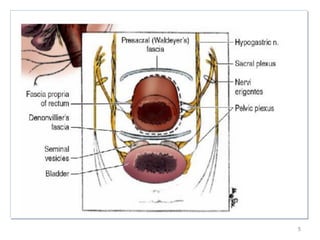
CONTOURING FOR RECTAL CANCERS
Dr. Ashutosh Mukherji
Additional Professor
Department of Radiotherapy,
Regional Cancer Centre, JIPMER
2
3
4
5
6
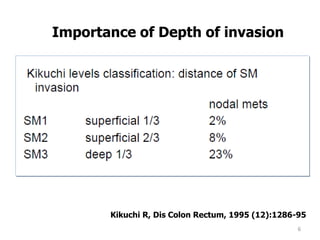
Importance of Depth of invasion
Kikuchi R, Dis Colon Rectum, 1995 (12):1286-95
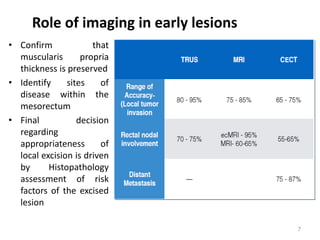
Role of imaging in early lesions
• Confirm that
muscularis propria
thickness is preserved
• Identify sites of
disease within the
mesorectum
• Final decision
regarding
appropriateness of
local excision is driven
by Histopathology
assessment of risk
factors of the excised
lesion
7
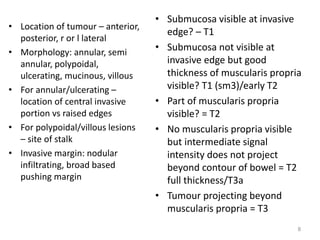
• Location of tumour – anterior,
posterior, r or l lateral
• Morphology: annular, semi
annular, polypoidal,
ulcerating, mucinous, villous
• For annular/ulcerating –
location of central invasive
portion vs raised edges
• For polypoidal/villous lesions
– site of stalk
• Invasive margin: nodular
infiltrating, broad based
pushing margin
8
• Submucosa visible at invasive
edge? – T1
• Submucosa not visible at
invasive edge but good
thickness of muscularis propria
visible? T1 (sm3)/early T2
• Part of muscularis propria
visible? = T2
• No muscularis propria visible
but intermediate signal
intensity does not project
beyond contour of bowel = T2
full thickness/T3a
• Tumour projecting beyond
muscularis propria = T3
9
10
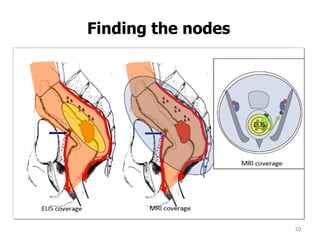
Finding the nodes
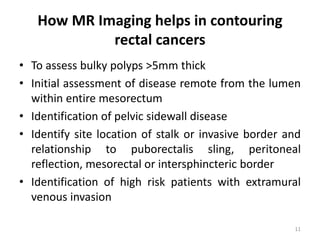
How MR Imaging helps in contouring
rectal cancers
• To assess bulky polyps >5mm thick
• Initial assessment of disease remote from the lumen
within entire mesorectum
• Identification of pelvic sidewall disease
• Identify site location of stalk or invasive border and
relationship to puborectalis sling, peritoneal
reflection, mesorectal or intersphincteric border
• Identification of high risk patients with extramural
venous invasion
11
12
Rectal Cancer Radiotherapy Contouring
Guideline for clinical target volumes (CTV) for neoadjuvant
chemoradiotherapy in locally advanced rectal cancer: gross tumor,
peri-rectal, pre-sacral, internal iliac and external iliac.
NTUH practice:
• GTV: main tumor mass + involved lymph nodes
• CTV:
– GTV with 15 mm expansion
– Distal 20 mm margin to GTV for CTV
– Vessels with 7 mm expansion
– Contour CTV to include mesorectum and pre-sacrum
– Avoid bone and small bowel
Int J Radiat Oncol Biol Phys. 2009 Jul 1;74(3):824-30. doi: 10.1016/j.ijrobp.2008.08.070.
RTOG CONSENSUS PANEL RECOMMENDATIONS
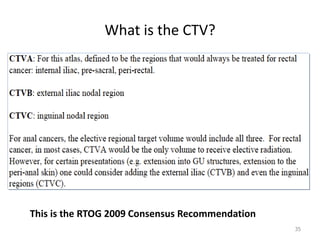
• Risk volumes defined as
CTVs: these were local and
nodal.
• Local CTV included
mesorectum, presacrum,
scar tissue and
anastomosis.
• Nodal CTV included
perirectal, iliac (external
and internal) and inguinal.
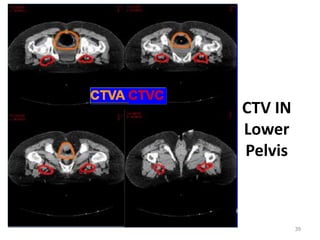
• Nodal CTVs:
– CTVA: internal iliac,
presacral and peri-rectal
– CTVB: external iliac
– CTVC: inguinal
14
https://www.rtog.org/CoreLab/ContouringAtlases/Anorectal.aspx;
Myerson et al. IJROBP 2009
International consensus guidelines on Clinical
Target Volume delineation in rectal cancer
• Consensus was obtained for delineation of the CTV
for elective irradiation of all regional lymph node
levels.
• Seven subsites at risk were identified: presacral
space (PS), mesorectum (M), lateral lymph nodes
(LLN), external iliac nodes (EIN), inguinal nodes (IN),
ischiorectal fossa (IRF) and sphincter complex (SC).
15
Radiotherapy and Oncology 120 (2016) 195–201
http://dx.doi.org/10.1016/j.radonc.2016.07.017
IMMOBILIZATION DEVICES
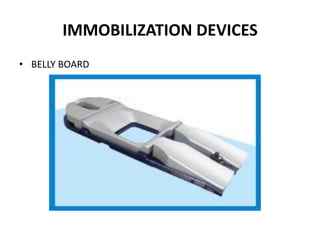
• BELLY BOARD
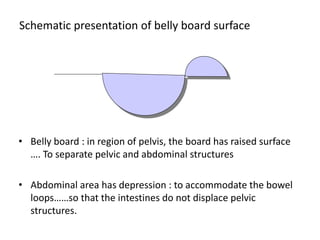
Schematic presentation of belly board surface
• Belly board : in region of pelvis, the board has raised surface
…. To separate pelvic and abdominal structures
• Abdominal area has depression : to accommodate the bowel
loops……so that the intestines do not displace pelvic
structures.
Simulation Protocol
• Full bladder
• Prone on bowel displacement device (if can
do daily OBI or equivalent)
• Anal marker & wire on distal edge of tumor if
possible
• IV & oral contrast
• 2.5 to 5 mm CT slices
18
19
20
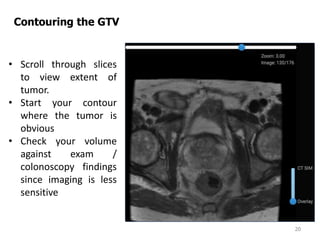
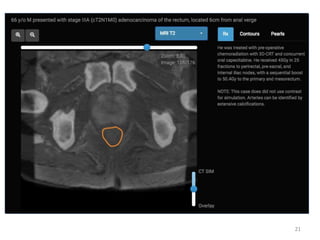
Contouring the GTV
• Scroll through slices
to view extent of
tumor.
• Start your contour
where the tumor is
obvious
• Check your volume
against exam /
colonoscopy findings
since imaging is less
sensitive
21
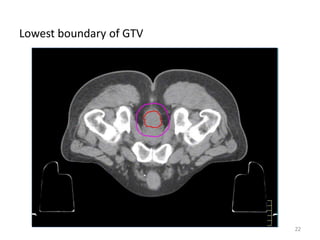
Lowest boundary of GTV
22
23
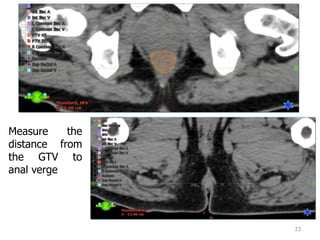
Measure the
distance from
the GTV to
anal verge
24
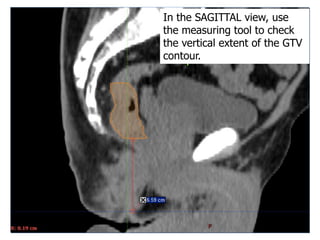
In the SAGITTAL view, use
the measuring tool to check
the vertical extent of the GTV
contour.
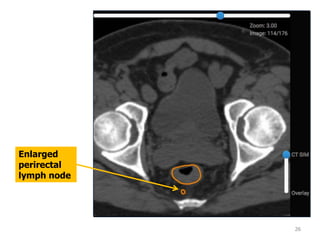
Differentiating a lymph node from a vessel
1. Use MRI overlay
2. Scroll up and down: nodes will be rounded
structures that disappear then reappear
3. Contour the vessels before contouring the GTV
4. Sub-centimeter perirectal nodes are contoured in
the GTV to show you they are in the standard CTV.
These DO NOT need to be contoured unless grossly
enlarged.
25
26
Enlarged
perirectal
lymph node
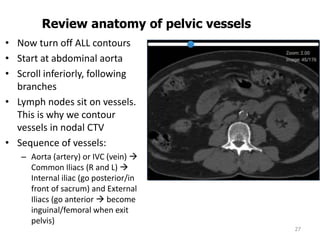
• Now turn off ALL contours
• Start at abdominal aorta
• Scroll inferiorly, following
branches
• Lymph nodes sit on vessels.
This is why we contour
vessels in nodal CTV
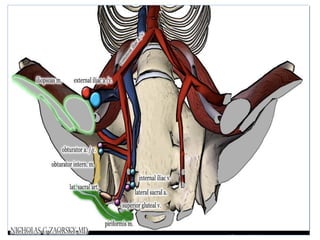
• Sequence of vessels:
– Aorta (artery) or IVC (vein) 
Common Iliacs (R and L) 
Internal iliac (go posterior/in
front of sacrum) and External
Iliacs (go anterior  become
inguinal/femoral when exit
pelvis)
27
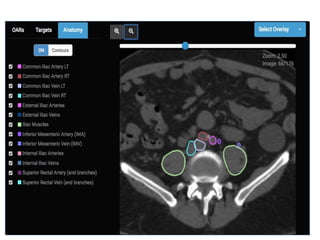
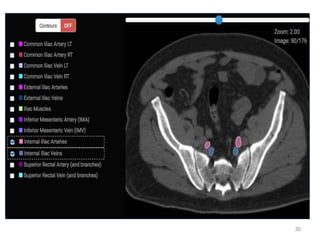
Review anatomy of pelvic vessels
28
29
30
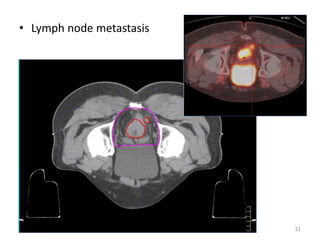
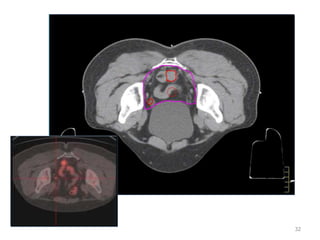
• Lymph node metastasis
31
32
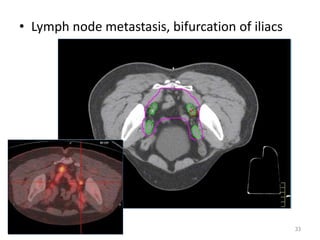
• Lymph node metastasis, bifurcation of iliacs
33
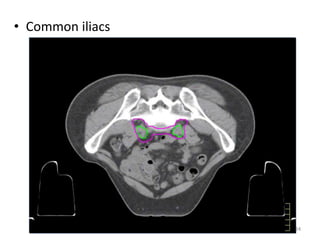
• Common iliacs
34
What is the CTV?
35
This is the RTOG 2009 Consensus Recommendation
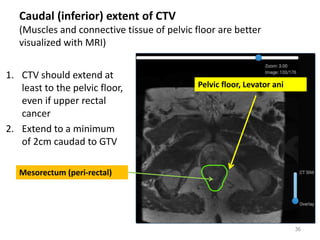
Caudal (inferior) extent of CTV
(Muscles and connective tissue of pelvic floor are better
visualized with MRI)
1. CTV should extend at
least to the pelvic floor,
even if upper rectal
cancer
2. Extend to a minimum
of 2cm caudad to GTV
36
Mesorectum (peri-rectal)
Pelvic floor, Levator ani
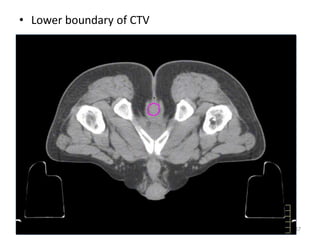
• Lower boundary of CTV
37
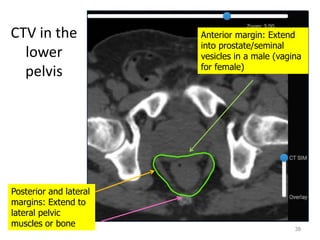
CTV in the
lower
pelvis
38
Posterior and lateral
margins: Extend to
lateral pelvic
muscles or bone
Anterior margin: Extend
into prostate/seminal
vesicles in a male (vagina
for female)
CTV IN
Lower
Pelvis
39
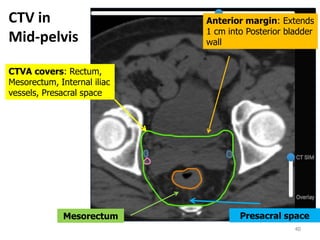
CTV in
Mid-pelvis
40
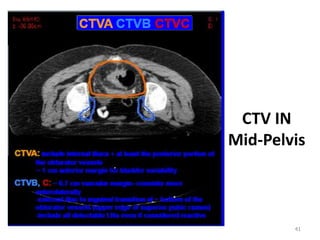
CTVA covers: Rectum,
Mesorectum, Internal iliac
vessels, Presacral space
Mesorectum Presacral space
Anterior margin: Extends
1 cm into Posterior bladder
wall
CTV IN
Mid-Pelvis
41
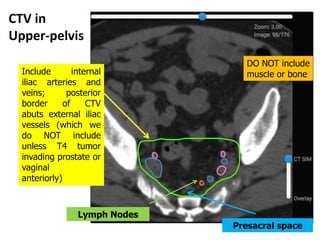
CTV in
Upper-pelvis
42
DO NOT include
muscle or boneInclude internal
iliac arteries and
veins; posterior
border of CTV
abuts external iliac
vessels (which we
do NOT include
unless T4 tumor
invading prostate or
vaginal
anteriorly)
Presacral space
Lymph Nodes
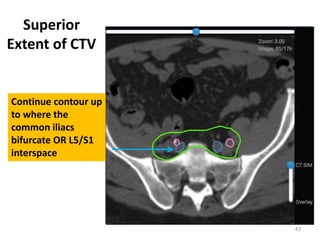
Superior
Extent of CTV
43
Continue contour up
to where the
common iliacs
bifurcate OR L5/S1
interspace
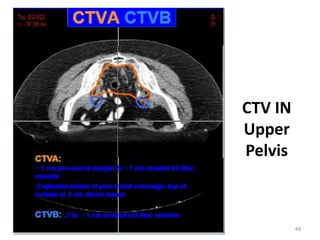
CTV IN
Upper
Pelvis
44
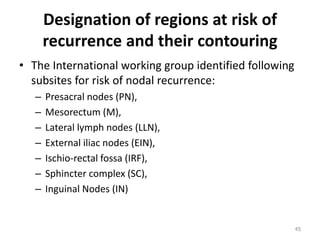
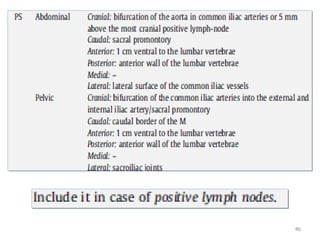
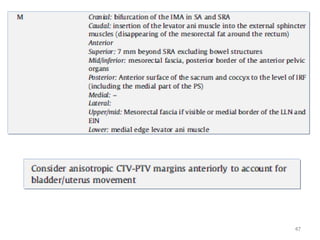
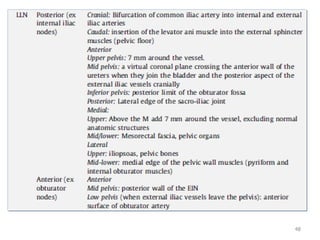
Designation of regions at risk of
recurrence and their contouring
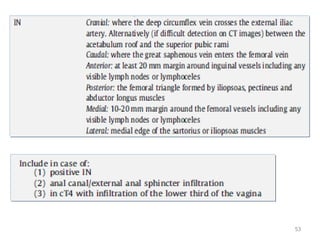
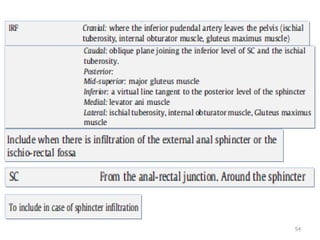
• The International working group identified following
subsites for risk of nodal recurrence:
– Presacral nodes (PN),
– Mesorectum (M),
– Lateral lymph nodes (LLN),
– External iliac nodes (EIN),
– Ischio-rectal fossa (IRF),
– Sphincter complex (SC),
– Inguinal Nodes (IN)
45
46
47
48
49
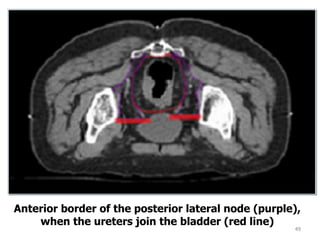
Anterior border of the posterior lateral node (purple),
when the ureters join the bladder (red line)
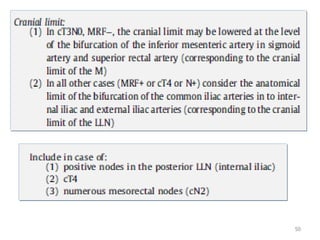
50
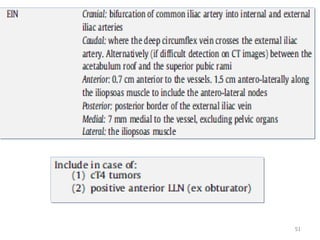
51
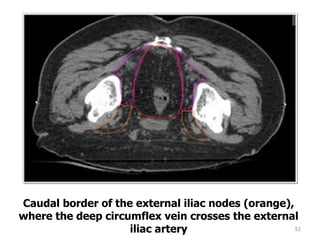
52
Caudal border of the external iliac nodes (orange),
where the deep circumflex vein crosses the external
iliac artery
53
54
55
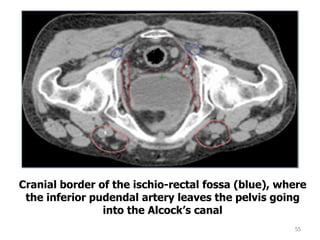
Cranial border of the ischio-rectal fossa (blue), where
the inferior pudendal artery leaves the pelvis going
into the Alcock’s canal
56
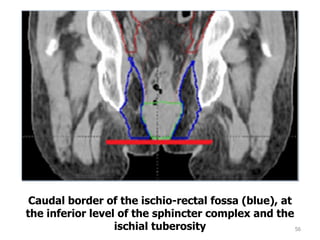
Caudal border of the ischio-rectal fossa (blue), at
the inferior level of the sphincter complex and the
ischial tuberosity
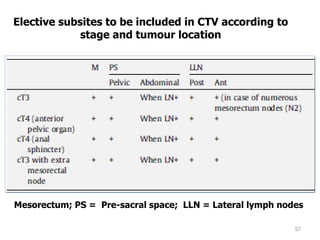
57
Elective subsites to be included in CTV according to
stage and tumour location
Mesorectum; PS = Pre-sacral space; LLN = Lateral lymph nodes
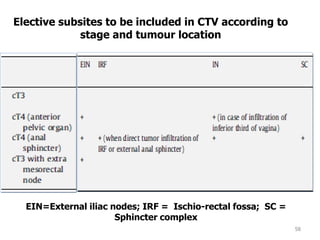
58
EIN=External iliac nodes; IRF = Ischio-rectal fossa; SC =
Sphincter complex
Elective subsites to be included in CTV according to
stage and tumour location
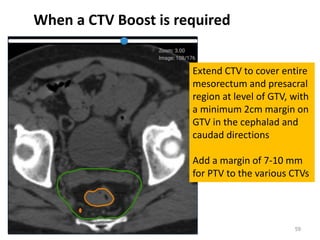
When a CTV Boost is required
59
Extend CTV to cover entire
mesorectum and presacral
region at level of GTV, with
a minimum 2cm margin on
GTV in the cephalad and
caudad directions
Add a margin of 7-10 mm
for PTV to the various CTVs
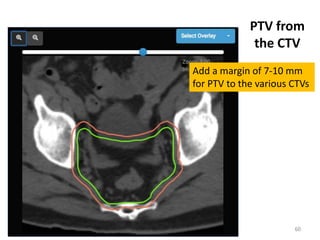
PTV from
the CTV
60
Add a margin of 7-10 mm
for PTV to the various CTVs
61
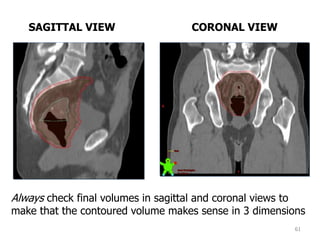
SAGITTAL VIEW CORONAL VIEW
Always check final volumes in sagittal and coronal views to
make that the contoured volume makes sense in 3 dimensions
62
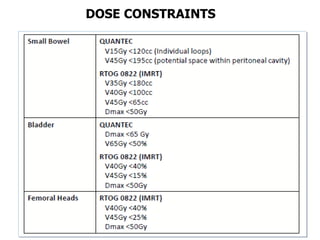
DOSE CONSTRAINTS
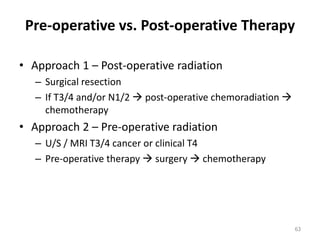
Pre-operative vs. Post-operative Therapy
• Approach 1 – Post-operative radiation
– Surgical resection
– If T3/4 and/or N1/2  post-operative chemoradiation 
chemotherapy
• Approach 2 – Pre-operative radiation
– U/S / MRI T3/4 cancer or clinical T4
– Pre-operative therapy  surgery  chemotherapy
63
64
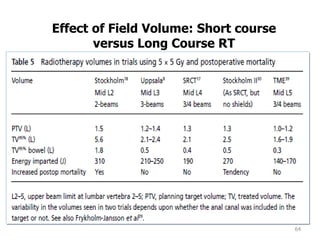
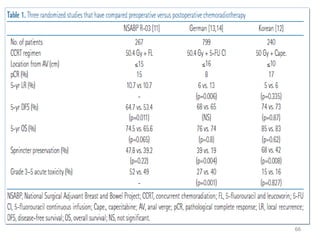
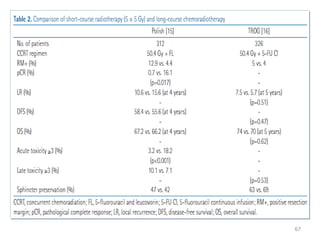
Effect of Field Volume: Short course
versus Long Course RT
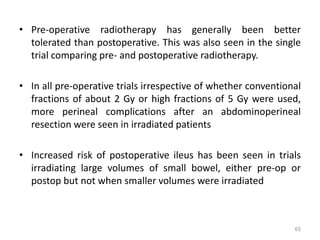
• Pre-operative radiotherapy has generally been better
tolerated than postoperative. This was also seen in the single
trial comparing pre- and postoperative radiotherapy.
• In all pre-operative trials irrespective of whether conventional
fractions of about 2 Gy or high fractions of 5 Gy were used,
more perineal complications after an abdominoperineal
resection were seen in irradiated patients
• Increased risk of postoperative ileus has been seen in trials
irradiating large volumes of small bowel, either pre-op or
postop but not when smaller volumes were irradiated
65
66
67
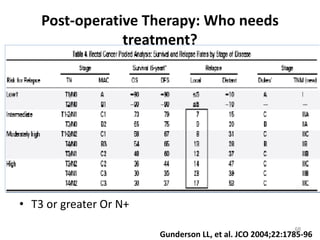
Post-operative Therapy: Who needs
treatment?
• T3 or greater Or N+
Gunderson LL, et al. JCO 2004;22:1785-96
68
• Low-risk patients (LRR <10%) are recommended TME
alone,
• intermediate-risk patients (LRR 10%–20%) are
advised preoperative SCRT followed by TME and
adjuvant chemotherapy as standard treatment,
• high-risk patients (LRR >20%) are recommended
preoperative CRT followed by TME and adjuvant
chemotherapy.
69
TAKE HOME MESSAGE
Contouring guideline
 GTV: main tumor mass + involved lymph nodes
 CTV:
– GTV with 15 mm expansion
– Distal 20 mm margin to GTV for CTV
– Vessels with 7 mm expansion
– Contour CTV to include mesorectum, lateral nodes, External
and internal iliac nodes, pre-sacrum, ischiorectal fossa,
sphincter complex and inguinal nodes where required
– Avoid bone and small bowel
– Boost CTV where required with a minimum 2cm margin on
GTV in the cephalad and caudad directions
 PTV: 7-10 mm margin to the CTV
71
According to Roel’s:
• The CTV should encompass the tumor, the MS, and the PPS in
all cases. The Inferior pelvis is at risk if the tumor is located
within 6 cm from the anal margin and the surgeon aims at a
sphincter-saving procedure, or the tumor invades the anal
sphincter and an APR is necessary.
• MLN and the LLN are included into the CTV for all patients.
• The obturator nodes should be included when the tumor is
located <10 cm from the anal margin.
• The External iliac LN should be part of the CTV only when
anterior organ involvement is highly suspected
• Inguinal LN should be part of the CTV only when the tumor
invades the lower third of the vagina or there is major tumor
extension into the internal and external anal sphincter.
72
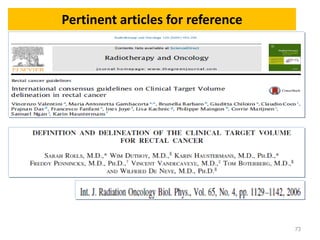
Pertinent articles for reference
73
Thank you

Contouring rectal cancers

  • 1.
    CONTOURING FOR RECTALCANCERS Dr. Ashutosh Mukherji Additional Professor Department of Radiotherapy, Regional Cancer Centre, JIPMER
  • 2.
  • 3.
  • 4.
  • 5.
  • 6.
    6 Importance of Depthof invasion Kikuchi R, Dis Colon Rectum, 1995 (12):1286-95
  • 7.
    Role of imagingin early lesions • Confirm that muscularis propria thickness is preserved • Identify sites of disease within the mesorectum • Final decision regarding appropriateness of local excision is driven by Histopathology assessment of risk factors of the excised lesion 7
  • 8.
    • Location oftumour – anterior, posterior, r or l lateral • Morphology: annular, semi annular, polypoidal, ulcerating, mucinous, villous • For annular/ulcerating – location of central invasive portion vs raised edges • For polypoidal/villous lesions – site of stalk • Invasive margin: nodular infiltrating, broad based pushing margin 8 • Submucosa visible at invasive edge? – T1 • Submucosa not visible at invasive edge but good thickness of muscularis propria visible? T1 (sm3)/early T2 • Part of muscularis propria visible? = T2 • No muscularis propria visible but intermediate signal intensity does not project beyond contour of bowel = T2 full thickness/T3a • Tumour projecting beyond muscularis propria = T3
  • 9.
  • 10.
  • 11.
    How MR Imaginghelps in contouring rectal cancers • To assess bulky polyps >5mm thick • Initial assessment of disease remote from the lumen within entire mesorectum • Identification of pelvic sidewall disease • Identify site location of stalk or invasive border and relationship to puborectalis sling, peritoneal reflection, mesorectal or intersphincteric border • Identification of high risk patients with extramural venous invasion 11
  • 12.
  • 13.
    Rectal Cancer RadiotherapyContouring Guideline for clinical target volumes (CTV) for neoadjuvant chemoradiotherapy in locally advanced rectal cancer: gross tumor, peri-rectal, pre-sacral, internal iliac and external iliac. NTUH practice: • GTV: main tumor mass + involved lymph nodes • CTV: – GTV with 15 mm expansion – Distal 20 mm margin to GTV for CTV – Vessels with 7 mm expansion – Contour CTV to include mesorectum and pre-sacrum – Avoid bone and small bowel Int J Radiat Oncol Biol Phys. 2009 Jul 1;74(3):824-30. doi: 10.1016/j.ijrobp.2008.08.070.
  • 14.
    RTOG CONSENSUS PANELRECOMMENDATIONS • Risk volumes defined as CTVs: these were local and nodal. • Local CTV included mesorectum, presacrum, scar tissue and anastomosis. • Nodal CTV included perirectal, iliac (external and internal) and inguinal. • Nodal CTVs: – CTVA: internal iliac, presacral and peri-rectal – CTVB: external iliac – CTVC: inguinal 14 https://www.rtog.org/CoreLab/ContouringAtlases/Anorectal.aspx; Myerson et al. IJROBP 2009
  • 15.
    International consensus guidelineson Clinical Target Volume delineation in rectal cancer • Consensus was obtained for delineation of the CTV for elective irradiation of all regional lymph node levels. • Seven subsites at risk were identified: presacral space (PS), mesorectum (M), lateral lymph nodes (LLN), external iliac nodes (EIN), inguinal nodes (IN), ischiorectal fossa (IRF) and sphincter complex (SC). 15 Radiotherapy and Oncology 120 (2016) 195–201 http://dx.doi.org/10.1016/j.radonc.2016.07.017
  • 16.
  • 17.
    Schematic presentation ofbelly board surface • Belly board : in region of pelvis, the board has raised surface …. To separate pelvic and abdominal structures • Abdominal area has depression : to accommodate the bowel loops……so that the intestines do not displace pelvic structures.
  • 18.
    Simulation Protocol • Fullbladder • Prone on bowel displacement device (if can do daily OBI or equivalent) • Anal marker & wire on distal edge of tumor if possible • IV & oral contrast • 2.5 to 5 mm CT slices 18
  • 19.
  • 20.
    20 Contouring the GTV •Scroll through slices to view extent of tumor. • Start your contour where the tumor is obvious • Check your volume against exam / colonoscopy findings since imaging is less sensitive
  • 21.
  • 22.
  • 23.
  • 24.
    24 In the SAGITTALview, use the measuring tool to check the vertical extent of the GTV contour.
  • 25.
    Differentiating a lymphnode from a vessel 1. Use MRI overlay 2. Scroll up and down: nodes will be rounded structures that disappear then reappear 3. Contour the vessels before contouring the GTV 4. Sub-centimeter perirectal nodes are contoured in the GTV to show you they are in the standard CTV. These DO NOT need to be contoured unless grossly enlarged. 25
  • 26.
  • 27.
    • Now turnoff ALL contours • Start at abdominal aorta • Scroll inferiorly, following branches • Lymph nodes sit on vessels. This is why we contour vessels in nodal CTV • Sequence of vessels: – Aorta (artery) or IVC (vein)  Common Iliacs (R and L)  Internal iliac (go posterior/in front of sacrum) and External Iliacs (go anterior  become inguinal/femoral when exit pelvis) 27 Review anatomy of pelvic vessels
  • 28.
  • 29.
  • 30.
  • 31.
    • Lymph nodemetastasis 31
  • 32.
  • 33.
    • Lymph nodemetastasis, bifurcation of iliacs 33
  • 34.
  • 35.
    What is theCTV? 35 This is the RTOG 2009 Consensus Recommendation
  • 36.
    Caudal (inferior) extentof CTV (Muscles and connective tissue of pelvic floor are better visualized with MRI) 1. CTV should extend at least to the pelvic floor, even if upper rectal cancer 2. Extend to a minimum of 2cm caudad to GTV 36 Mesorectum (peri-rectal) Pelvic floor, Levator ani
  • 37.
  • 38.
    CTV in the lower pelvis 38 Posteriorand lateral margins: Extend to lateral pelvic muscles or bone Anterior margin: Extend into prostate/seminal vesicles in a male (vagina for female)
  • 39.
  • 40.
    CTV in Mid-pelvis 40 CTVA covers:Rectum, Mesorectum, Internal iliac vessels, Presacral space Mesorectum Presacral space Anterior margin: Extends 1 cm into Posterior bladder wall
  • 41.
  • 42.
    CTV in Upper-pelvis 42 DO NOTinclude muscle or boneInclude internal iliac arteries and veins; posterior border of CTV abuts external iliac vessels (which we do NOT include unless T4 tumor invading prostate or vaginal anteriorly) Presacral space Lymph Nodes
  • 43.
    Superior Extent of CTV 43 Continuecontour up to where the common iliacs bifurcate OR L5/S1 interspace
  • 44.
  • 45.
    Designation of regionsat risk of recurrence and their contouring • The International working group identified following subsites for risk of nodal recurrence: – Presacral nodes (PN), – Mesorectum (M), – Lateral lymph nodes (LLN), – External iliac nodes (EIN), – Ischio-rectal fossa (IRF), – Sphincter complex (SC), – Inguinal Nodes (IN) 45
  • 46.
  • 47.
  • 48.
  • 49.
    49 Anterior border ofthe posterior lateral node (purple), when the ureters join the bladder (red line)
  • 50.
  • 51.
  • 52.
    52 Caudal border ofthe external iliac nodes (orange), where the deep circumflex vein crosses the external iliac artery
  • 53.
  • 54.
  • 55.
    55 Cranial border ofthe ischio-rectal fossa (blue), where the inferior pudendal artery leaves the pelvis going into the Alcock’s canal
  • 56.
    56 Caudal border ofthe ischio-rectal fossa (blue), at the inferior level of the sphincter complex and the ischial tuberosity
  • 57.
    57 Elective subsites tobe included in CTV according to stage and tumour location Mesorectum; PS = Pre-sacral space; LLN = Lateral lymph nodes
  • 58.
    58 EIN=External iliac nodes;IRF = Ischio-rectal fossa; SC = Sphincter complex Elective subsites to be included in CTV according to stage and tumour location
  • 59.
    When a CTVBoost is required 59 Extend CTV to cover entire mesorectum and presacral region at level of GTV, with a minimum 2cm margin on GTV in the cephalad and caudad directions Add a margin of 7-10 mm for PTV to the various CTVs
  • 60.
    PTV from the CTV 60 Adda margin of 7-10 mm for PTV to the various CTVs
  • 61.
    61 SAGITTAL VIEW CORONALVIEW Always check final volumes in sagittal and coronal views to make that the contoured volume makes sense in 3 dimensions
  • 62.
  • 63.
    Pre-operative vs. Post-operativeTherapy • Approach 1 – Post-operative radiation – Surgical resection – If T3/4 and/or N1/2  post-operative chemoradiation  chemotherapy • Approach 2 – Pre-operative radiation – U/S / MRI T3/4 cancer or clinical T4 – Pre-operative therapy  surgery  chemotherapy 63
  • 64.
    64 Effect of FieldVolume: Short course versus Long Course RT
  • 65.
    • Pre-operative radiotherapyhas generally been better tolerated than postoperative. This was also seen in the single trial comparing pre- and postoperative radiotherapy. • In all pre-operative trials irrespective of whether conventional fractions of about 2 Gy or high fractions of 5 Gy were used, more perineal complications after an abdominoperineal resection were seen in irradiated patients • Increased risk of postoperative ileus has been seen in trials irradiating large volumes of small bowel, either pre-op or postop but not when smaller volumes were irradiated 65
  • 66.
  • 67.
  • 68.
    Post-operative Therapy: Whoneeds treatment? • T3 or greater Or N+ Gunderson LL, et al. JCO 2004;22:1785-96 68
  • 69.
    • Low-risk patients(LRR <10%) are recommended TME alone, • intermediate-risk patients (LRR 10%–20%) are advised preoperative SCRT followed by TME and adjuvant chemotherapy as standard treatment, • high-risk patients (LRR >20%) are recommended preoperative CRT followed by TME and adjuvant chemotherapy. 69
  • 70.
  • 71.
    Contouring guideline  GTV:main tumor mass + involved lymph nodes  CTV: – GTV with 15 mm expansion – Distal 20 mm margin to GTV for CTV – Vessels with 7 mm expansion – Contour CTV to include mesorectum, lateral nodes, External and internal iliac nodes, pre-sacrum, ischiorectal fossa, sphincter complex and inguinal nodes where required – Avoid bone and small bowel – Boost CTV where required with a minimum 2cm margin on GTV in the cephalad and caudad directions  PTV: 7-10 mm margin to the CTV 71
  • 72.
    According to Roel’s: •The CTV should encompass the tumor, the MS, and the PPS in all cases. The Inferior pelvis is at risk if the tumor is located within 6 cm from the anal margin and the surgeon aims at a sphincter-saving procedure, or the tumor invades the anal sphincter and an APR is necessary. • MLN and the LLN are included into the CTV for all patients. • The obturator nodes should be included when the tumor is located <10 cm from the anal margin. • The External iliac LN should be part of the CTV only when anterior organ involvement is highly suspected • Inguinal LN should be part of the CTV only when the tumor invades the lower third of the vagina or there is major tumor extension into the internal and external anal sphincter. 72
  • 73.
  • 74.