CARCIONMA LUNG WITH BRAIN
METASTASIS – TREATMENT
DECISIONS
DR. UPASNA SAXENA
SENIOR CONSULTANT
RADIATION ONCOLOGY
HCG, MUMBAI
INCIDENCE
• 20% lung cancers present with brain metastasis at diagnosis and 40-50%
develop up later
• Highest in small cell lung cancer
• About 5% in squamous and 10-16% in adenocarcinoma
• Of adenocarcinoma, 23-30% have EGFR mutation and 3-5% have ALK
mutation
• Of all the EGFR positive, about 23-32% have brain metastasis and of all
ALK positive about 24-42% (increasing to 58% at 3 years)
• Most common symptoms (depending on number and location of
metastasis are) – headache, altered mental status, seiaures, ataxia, focal
motor or sensory deficits etc
• With better systemic therapy  longer survival median survival has
improved to 12-15 months, esp for adenocarcinoma)  rising incidence of
brain metastasis
• Highest GPA score could entail a survival of upto 4 years
TREATMENT -ONE LINER ANSWER
• Extensive metastasis in body and brain – whole brain radiation with
or without boost to gross metastasis- 30Gy/10#, 20Gy/5#
• Few sites of deposit in brain and extracranial (oligometastatic) –
address all lesions with SRS/FSRS
• Brain Limited disease
– Multiple lesions – whole brain with boost to gross disease+/- hippocampal
avoidance
– Few lesions (evolving definition) – surgery or FSRS/FSRS or both
READING IN BETWEEN LINES
• Expected survival
• Importance of QOL and neurocognition
• Histopathology
• Response to therapy
• Available options of systemic therapy
• Possibility of FSRS + immunotherapy
Paradigm shift in
decision making for
brain metastasis
selection of
modality is essential
CRITERIA FOR TREATMENT CUSTOMISATION
RECURSIVE PARTITION ANALYSIS
DS-GPA
• Disease specific – graded prognostic assessment
• Purose is to
– Estimate survival
– Take clinical decisions about treatment
– To use as stratification in future trials
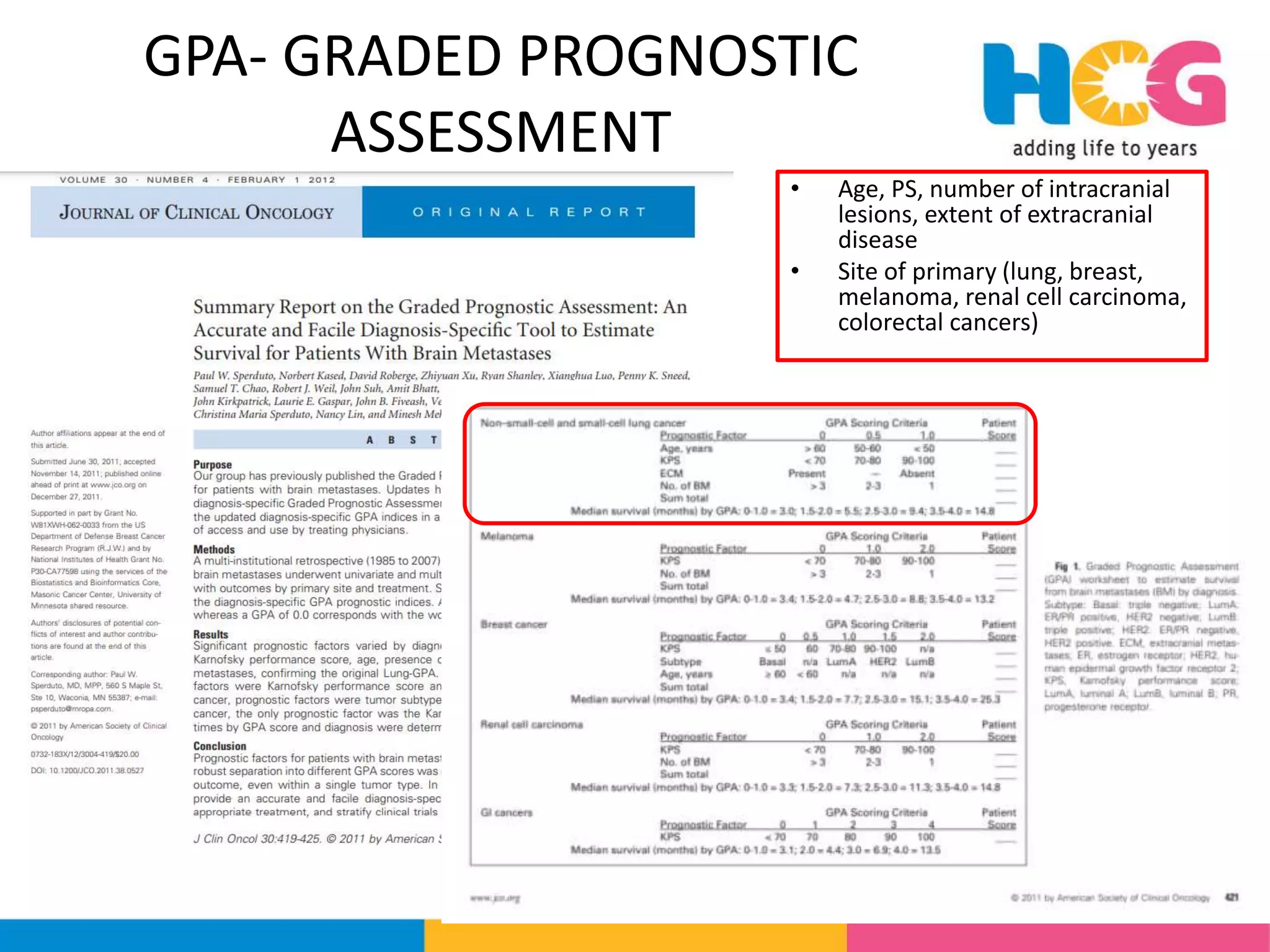
GPA- GRADED PROGNOSTIC
ASSESSMENT
• Age, PS, number of intracranial
lesions, extent of extracranial
disease
• Site of primary (lung, breast,
melanoma, renal cell carcinoma,
colorectal cancers)
SURVIVAL WITH BRAIN
METASTASIS
• Around 3-7 months
• Assess RPA and GPA score
– Gaspar et al – RPA II average survival 4.2 months and RPA III 2.3
months
– Sperduto et al – average survival for GPA 1.5-2.5 was 5.5 months
and GPA 0-1 was 3 months
– Indian data for the same in JP Agarwal et al 2020
• Median survival for RPA II and III 5.2mo and 2.6 mo respectively
• Median survival GPA 1.5-2.5 is 4 mo and 0-1 is 2.4 mo
Lung-molGPA
JAMA 2017
• In the various classes, survival
ranges from 3-46.8 months
• A molecular GPA score of 3.5-4
entailed a median survival of 4
years
• This makes mol GPA scoring
essential to decide the type of
brain radiation bearing in mind
neurocognitive decline, survival,
need for re RT
The DS-GPA (diagnosis specific graded prognostic assesment) has shown nuances
not seen previously
• EGFR/ ALK mutations shows superior survival and higher risk of
leptomeningeal disease
• Number of brain metastasis and extracranial metastasis is an important factor
affecting survival
• For score > 3, addition of WBRT to SRS gives survival benefit contrary to
practice to avoid WBRT- IJROBP 2014, Sperduto et al and JAMA 2015, Aoyama et al
• Accurate survival is crucial to take informed decision of treatment choice and
for prognostication
JAMA 2017
UPDATED Lung-molGPA- 2022
TREATMENT DECISION MAKING
EVOLVING GUIDELINES
Moravan et al
EVOLVING GUIDELINES
 Cost and Accesibility to
third generation TKI
 Regular MRI cost and
accessibility
 Education and awareness
to understand the same
 Risk of precipitating
symptoms in larger
metastasis
Moravan et al
BRAIN METASTASIS FROM SMALL
CELL LUNG CANCER
• Prophylactic cranial irradiation for limited and extensive stage (with
good response to chemotherapy) small cell lung cancer is the norm
– No survival benefit
– reduces brain metastasis by half but at the cost of QOL and
neurocognitive decline
– based on NRC-CC001 trial, memantine or hippocampal sparing can be
used
– With improved survival using immunotherapy, neurocognitive decline
is a concern
• SWOG S1827 is evaluating the role of MRI surveillance both with and without
PCI
• Multiple studies have shown similar outocmes of SRS versus WBRT (similar OS)
for SCLC brain metastasis
• ENCHEPHALON , German study is evaluating WBRT versus SRS for 1-20
metastasis from SCLC.
• Intracranial penetration is seen with etoposide, irinotecan, topotecan,
temozolamide. Also with atezoleumab and durvalumab
ASCO-SNO-
ASTRO 2021
recommend
s WBRT not
SRS
Brain metastasis from NSCLC
SELCTION OF TREATMENT
MODALITY
• ASCO-SNO-ASTRO –
Dec 2021
SINGLE METASTASIS IN BRAIN
• Best outcome for Large/symptomatic – prefer surgery  SRS or
FSRS
– surgery  SRS or FSRS
– Also gives histopathology
• Cochrane review 2018 – OS and LC superior for surgery +SRS vs SRS
alone
• Surgery alone inferior to SRS alone EORTC 22952-26001
• If unfit for surgery – due to comorbs or eloquent areas
– SRS or FSRS is the choice
UPFRONT FOCAL RT
• Initial RTOG 9005 compared
– WBRT vs WBRT+SRS
– LC 71% vs 81% at 1 year, no survival advantage
• Subsequent trials advocated – JAMA 2006, Lancet 2009, JCO 2011, JAMA
2016
– SRS/FSRS for 1-4 lesions
– Omission of WBRT
• Larger lesions SRS vs FSRS – Vellayappan et al , Frontal Oncol 2018
– 1 year LC 79.2% vs 92.9%
– RN 7.5% vs 6.3%
ROLE OF SURGERY
• Indications – mass effect with good PS and prognosis OR diagnostic uncertainty, solitary
brain metastasis with no extracranial disease
• Superior outcome for surgery + SRS versus WBRT.
• Rades et al showed median OS of 6 months with WBRT alone and 11.5 months with
surgery +WBRT. IJROBP 2008
• Single versus multiple
– Surgery advisable for single metastasis (Vetch CJ et al, ANN Neurol 1993)
– Multiple are difficult to access, hence surgery not preferred
– Can be opted for multiple if – all accessible through single craniotomy, to release mass effect
at one of the sites
• Recurrent setting – surgery is preferred for
– <40 years, time to recurrence > 4 months, KPS>70, non breast/non melanoma histology
Kalkanis et al, J Neuronc 2010
POST OP RADIOTHERAPY
• Post op radiotherapy resulted in a 3 year OS of 17.5% - J Thorac Onco
2012
• Patchell et al – LC 18% vs 80%. Neurological death 44% vs 14%.
• Trials POST OP OBSERVATION VS SRS
– Observation – 60% LR in 1 year
– Both arms - 60% rate of new BM
– 12 month LC 72% for SRS and 43% for observation
• Trial WBRT vs SRS – NCCTG-N107C/CEC.3
– Freedom from cognitive decline – 3 versus 3.7 months
– Cognintive decline at 6 months – 85% vs 52%
– WBRT vs SRS – LC at surgical bed 80% vs 60% (less dose for larger cavities) –
can be managed with hypofractionated FSRS in 3-5 sessions
– Time to progression 27.5 mo vs 6.4 mo
– Similar OS 11.6 mo vs 12.2 mo
• ESTRON German trial has similar results
• Alliance trial evaluating SF-SRS verus F-SRS (3-5 #) – local control and
patterns of spread
• Another trial evaluating – rates of leptomeningeal spread, local control,
distant BM and OS in preop versus postop SRS
• Currently focal radiation is preferred
Cancer April 2020
NEOADJUVANT SRS
• Post op SRS might cause higher incidence of leptomeningeal disease as
compared to WBRT
• Newer forte
– Evaluated in PROPS-BS trial
– 16Gy/1# given few days (1-3) prior to surgery
– 1 yr LC 85%, median survival > 16 mo, LMD 7.9%, RN 7%.
• Better target definition, less risk of leptomeningeal disease (16.6% vs
3.2%)
• Under evaluation in trials – MD Anderson, Mayo and Alberta
• Promising approach for single lesions
WBRT
• Reduces growth temporaraily, reduces mass effect and
consequently neurologic symptoms
• Increases Neurocognitive decline and QOL
• Reduced risk of distant brain recurrence
• No benefit in OS by adding WBRT to surgery or SRS
• Preferably used sequentially with systemic agents
• ?? Role with immunotherapy
WBRT
• Reduces distant BM rates 50% and improves LC 25-30%
• Some studies report a better OS with use of WBRT than with SRS for good
PS patients- RTOG 9508
• HA-IMRT and memantine (Bowler et al) helps reduce neurocognitive
decline
• HA-IMRT- more costly, not for metastasis near hippocampus, risk of
recurrence in hippocampal area
• Going out of favour due to better survival with newer systemic, similar OS
+less neurocognitive decline with SRS
SRS Vs WBRT+SRS
• Adding WBRT – lower LR, same OS, more neurotoxicity at 3-12 months – Alliance and EORTC trials
• JROSG – DS-GPA 2.5-4 – OS 10.6 mo VS 16.7 mo. Benefit not seen for unfavourable DS-GPA
• SRS+WBRT has similar outcomes as surgery for 1-3 metastasis –Rades et al Eur J Cancer 2009, Schlogg et al
Acta Neurachir 2000
• A better alternative is WBRT with SIB to gross disease with HA – if patient is a candidate for HA
• JCOG0506 – For upfront WBRT vs salvage SRS – OS was 15.6 mo for both. PFS was 10.4 mo versus 4 mo, NC
decline 16.4% vs 7.7%
• As of now SRS is preferred over WBRT
• With improving prognosis and systemic therapy options, could conclude
to use WBRT+SRS +HA for molGPA 4 – NRG BN009
Polymetastatic
• Yamomoto et al and Nichol et al, Dutch et al, showed that SRS to five or
more lesions was non inferior to when used for 2-3 lesions. Lancet, 2014
• Trial [JLGK0901]evaluating SRS in 1-10 BM – reported similar OS with no
increase in toxicity. Didn’t evaluate OS. Only 17% had more than 5 mets
• Another ongoing trial [NCT03550391] – evaluating SRS versus WBRT in 5-
15 metastasis. Outcomes are OS and neurotoxicity PFS.
Polymetastatic
• MDACC
NEUROPROTECTORS
• RTOG 0614
– Uses memantine for 24 weeks during and after radiation
– Improves all components of neurocognitive decline - short term
memory issues, executive function, attention and concentration,
severe dementia and learning difficulties
• Under evaluation – none shown beneficial yet
– Donepezil use has shown some but not significant improvement
– Motexafin Gadolinium
– BMX-001
HIPPOCAMPAL AVOIDANCE
• For 30Gy/10#
• Hippocampal max 15.3Gy and mean 7.8Gy on linac
and 12.8Gy, 5.5Gy on tomotherapy respectively
• First Genda et al, then RTOG 0933 evaluated for
the same – Hopkin’s verbal learning test at 4
months 7% vs 30%
• NRG-CC001 showed decreased neurocognitive
decline with WBRT+HA+memantine versus
WBRT+HA (58.5% vs 68.2%)
• Hippocampus is 2% of brain volume and risk of
recurrence in those areas is less than 10%
• Trials evaluating the sub areas of hippocampus, eg
cornu ammonis, are underway
WBRT+SIB+HA
• Improves LC while preserving
from neurocognitive decline
• SIB improves PFS 9.1 mo vs
5.9 mo and medican OS 14
mo bs 11 mo
Combined brain radiation and systemic
therapy
• Most systemic therapy have no brain penetration
• Erlotinib and Gefitinb has penetration due to tumour induced disruption
of BBB. Lou U et al, Oncotarget 2015
• Welsch et al (JCO2013), Erlotinib +WBRT for brain metastasis showed 86%
control with no increase in neurotoxicity
• Nagwa et al, Nat rev cancer 2018 – using immunotherapy to enhance the
abscopal effect
• Improved ORR, OS, PFS = WBRT+TKI
• No increased toxicity with ICI, slight increase in RN
POOR PEFROMANCE STATUS OR
PROGNOSIS
• Do not opt for surgery or SRS
• WBRT is preferred
• Assess individually the number, location of the metastasis to decide benefit
from WBRT
• If PS is too poor, keep option of BSC
• QUARTZ Trial show no benefit of OS of use of WBRT, just of quality of life
adjusted years- median survival 2 months (9.2 weeks vs 8.5 weeks )
• Tibdewal et al reported 25% patients succumbed within 30 days of diagnosis
of brain metastasis – 16% were RPA I-II and 36% were GPA > 2.5
• ASCO-SNO-ASTRO 2021 – omit WBRT for KPS<=50 and <70 with no systemic
options
THANKYOU

LUNG WITH BRAIN METASTASIS- DR UPASNA.pptx

  • 1.
    CARCIONMA LUNG WITHBRAIN METASTASIS – TREATMENT DECISIONS DR. UPASNA SAXENA SENIOR CONSULTANT RADIATION ONCOLOGY HCG, MUMBAI
  • 2.
    INCIDENCE • 20% lungcancers present with brain metastasis at diagnosis and 40-50% develop up later • Highest in small cell lung cancer • About 5% in squamous and 10-16% in adenocarcinoma • Of adenocarcinoma, 23-30% have EGFR mutation and 3-5% have ALK mutation • Of all the EGFR positive, about 23-32% have brain metastasis and of all ALK positive about 24-42% (increasing to 58% at 3 years) • Most common symptoms (depending on number and location of metastasis are) – headache, altered mental status, seiaures, ataxia, focal motor or sensory deficits etc • With better systemic therapy  longer survival median survival has improved to 12-15 months, esp for adenocarcinoma)  rising incidence of brain metastasis • Highest GPA score could entail a survival of upto 4 years
  • 3.
    TREATMENT -ONE LINERANSWER • Extensive metastasis in body and brain – whole brain radiation with or without boost to gross metastasis- 30Gy/10#, 20Gy/5# • Few sites of deposit in brain and extracranial (oligometastatic) – address all lesions with SRS/FSRS • Brain Limited disease – Multiple lesions – whole brain with boost to gross disease+/- hippocampal avoidance – Few lesions (evolving definition) – surgery or FSRS/FSRS or both
  • 4.
    READING IN BETWEENLINES • Expected survival • Importance of QOL and neurocognition • Histopathology • Response to therapy • Available options of systemic therapy • Possibility of FSRS + immunotherapy Paradigm shift in decision making for brain metastasis selection of modality is essential
  • 5.
  • 6.
  • 7.
    DS-GPA • Disease specific– graded prognostic assessment • Purose is to – Estimate survival – Take clinical decisions about treatment – To use as stratification in future trials
  • 8.
    GPA- GRADED PROGNOSTIC ASSESSMENT •Age, PS, number of intracranial lesions, extent of extracranial disease • Site of primary (lung, breast, melanoma, renal cell carcinoma, colorectal cancers)
  • 9.
    SURVIVAL WITH BRAIN METASTASIS •Around 3-7 months • Assess RPA and GPA score – Gaspar et al – RPA II average survival 4.2 months and RPA III 2.3 months – Sperduto et al – average survival for GPA 1.5-2.5 was 5.5 months and GPA 0-1 was 3 months – Indian data for the same in JP Agarwal et al 2020 • Median survival for RPA II and III 5.2mo and 2.6 mo respectively • Median survival GPA 1.5-2.5 is 4 mo and 0-1 is 2.4 mo
  • 10.
    Lung-molGPA JAMA 2017 • Inthe various classes, survival ranges from 3-46.8 months • A molecular GPA score of 3.5-4 entailed a median survival of 4 years • This makes mol GPA scoring essential to decide the type of brain radiation bearing in mind neurocognitive decline, survival, need for re RT
  • 11.
    The DS-GPA (diagnosisspecific graded prognostic assesment) has shown nuances not seen previously • EGFR/ ALK mutations shows superior survival and higher risk of leptomeningeal disease • Number of brain metastasis and extracranial metastasis is an important factor affecting survival • For score > 3, addition of WBRT to SRS gives survival benefit contrary to practice to avoid WBRT- IJROBP 2014, Sperduto et al and JAMA 2015, Aoyama et al • Accurate survival is crucial to take informed decision of treatment choice and for prognostication JAMA 2017
  • 12.
  • 15.
  • 16.
  • 17.
    EVOLVING GUIDELINES  Costand Accesibility to third generation TKI  Regular MRI cost and accessibility  Education and awareness to understand the same  Risk of precipitating symptoms in larger metastasis Moravan et al
  • 19.
    BRAIN METASTASIS FROMSMALL CELL LUNG CANCER • Prophylactic cranial irradiation for limited and extensive stage (with good response to chemotherapy) small cell lung cancer is the norm – No survival benefit – reduces brain metastasis by half but at the cost of QOL and neurocognitive decline – based on NRC-CC001 trial, memantine or hippocampal sparing can be used – With improved survival using immunotherapy, neurocognitive decline is a concern • SWOG S1827 is evaluating the role of MRI surveillance both with and without PCI • Multiple studies have shown similar outocmes of SRS versus WBRT (similar OS) for SCLC brain metastasis • ENCHEPHALON , German study is evaluating WBRT versus SRS for 1-20 metastasis from SCLC. • Intracranial penetration is seen with etoposide, irinotecan, topotecan, temozolamide. Also with atezoleumab and durvalumab
  • 20.
  • 21.
  • 22.
  • 23.
  • 26.
    SINGLE METASTASIS INBRAIN • Best outcome for Large/symptomatic – prefer surgery  SRS or FSRS – surgery  SRS or FSRS – Also gives histopathology • Cochrane review 2018 – OS and LC superior for surgery +SRS vs SRS alone • Surgery alone inferior to SRS alone EORTC 22952-26001 • If unfit for surgery – due to comorbs or eloquent areas – SRS or FSRS is the choice
  • 27.
    UPFRONT FOCAL RT •Initial RTOG 9005 compared – WBRT vs WBRT+SRS – LC 71% vs 81% at 1 year, no survival advantage • Subsequent trials advocated – JAMA 2006, Lancet 2009, JCO 2011, JAMA 2016 – SRS/FSRS for 1-4 lesions – Omission of WBRT • Larger lesions SRS vs FSRS – Vellayappan et al , Frontal Oncol 2018 – 1 year LC 79.2% vs 92.9% – RN 7.5% vs 6.3%
  • 28.
    ROLE OF SURGERY •Indications – mass effect with good PS and prognosis OR diagnostic uncertainty, solitary brain metastasis with no extracranial disease • Superior outcome for surgery + SRS versus WBRT. • Rades et al showed median OS of 6 months with WBRT alone and 11.5 months with surgery +WBRT. IJROBP 2008 • Single versus multiple – Surgery advisable for single metastasis (Vetch CJ et al, ANN Neurol 1993) – Multiple are difficult to access, hence surgery not preferred – Can be opted for multiple if – all accessible through single craniotomy, to release mass effect at one of the sites • Recurrent setting – surgery is preferred for – <40 years, time to recurrence > 4 months, KPS>70, non breast/non melanoma histology Kalkanis et al, J Neuronc 2010
  • 29.
    POST OP RADIOTHERAPY •Post op radiotherapy resulted in a 3 year OS of 17.5% - J Thorac Onco 2012 • Patchell et al – LC 18% vs 80%. Neurological death 44% vs 14%. • Trials POST OP OBSERVATION VS SRS – Observation – 60% LR in 1 year – Both arms - 60% rate of new BM – 12 month LC 72% for SRS and 43% for observation • Trial WBRT vs SRS – NCCTG-N107C/CEC.3 – Freedom from cognitive decline – 3 versus 3.7 months – Cognintive decline at 6 months – 85% vs 52% – WBRT vs SRS – LC at surgical bed 80% vs 60% (less dose for larger cavities) – can be managed with hypofractionated FSRS in 3-5 sessions – Time to progression 27.5 mo vs 6.4 mo – Similar OS 11.6 mo vs 12.2 mo • ESTRON German trial has similar results • Alliance trial evaluating SF-SRS verus F-SRS (3-5 #) – local control and patterns of spread • Another trial evaluating – rates of leptomeningeal spread, local control, distant BM and OS in preop versus postop SRS • Currently focal radiation is preferred Cancer April 2020
  • 30.
    NEOADJUVANT SRS • Postop SRS might cause higher incidence of leptomeningeal disease as compared to WBRT • Newer forte – Evaluated in PROPS-BS trial – 16Gy/1# given few days (1-3) prior to surgery – 1 yr LC 85%, median survival > 16 mo, LMD 7.9%, RN 7%. • Better target definition, less risk of leptomeningeal disease (16.6% vs 3.2%) • Under evaluation in trials – MD Anderson, Mayo and Alberta • Promising approach for single lesions
  • 32.
    WBRT • Reduces growthtemporaraily, reduces mass effect and consequently neurologic symptoms • Increases Neurocognitive decline and QOL • Reduced risk of distant brain recurrence • No benefit in OS by adding WBRT to surgery or SRS • Preferably used sequentially with systemic agents • ?? Role with immunotherapy
  • 33.
    WBRT • Reduces distantBM rates 50% and improves LC 25-30% • Some studies report a better OS with use of WBRT than with SRS for good PS patients- RTOG 9508 • HA-IMRT and memantine (Bowler et al) helps reduce neurocognitive decline • HA-IMRT- more costly, not for metastasis near hippocampus, risk of recurrence in hippocampal area • Going out of favour due to better survival with newer systemic, similar OS +less neurocognitive decline with SRS
  • 34.
    SRS Vs WBRT+SRS •Adding WBRT – lower LR, same OS, more neurotoxicity at 3-12 months – Alliance and EORTC trials • JROSG – DS-GPA 2.5-4 – OS 10.6 mo VS 16.7 mo. Benefit not seen for unfavourable DS-GPA • SRS+WBRT has similar outcomes as surgery for 1-3 metastasis –Rades et al Eur J Cancer 2009, Schlogg et al Acta Neurachir 2000 • A better alternative is WBRT with SIB to gross disease with HA – if patient is a candidate for HA • JCOG0506 – For upfront WBRT vs salvage SRS – OS was 15.6 mo for both. PFS was 10.4 mo versus 4 mo, NC decline 16.4% vs 7.7% • As of now SRS is preferred over WBRT • With improving prognosis and systemic therapy options, could conclude to use WBRT+SRS +HA for molGPA 4 – NRG BN009
  • 36.
    Polymetastatic • Yamomoto etal and Nichol et al, Dutch et al, showed that SRS to five or more lesions was non inferior to when used for 2-3 lesions. Lancet, 2014 • Trial [JLGK0901]evaluating SRS in 1-10 BM – reported similar OS with no increase in toxicity. Didn’t evaluate OS. Only 17% had more than 5 mets • Another ongoing trial [NCT03550391] – evaluating SRS versus WBRT in 5- 15 metastasis. Outcomes are OS and neurotoxicity PFS.
  • 38.
  • 39.
    NEUROPROTECTORS • RTOG 0614 –Uses memantine for 24 weeks during and after radiation – Improves all components of neurocognitive decline - short term memory issues, executive function, attention and concentration, severe dementia and learning difficulties • Under evaluation – none shown beneficial yet – Donepezil use has shown some but not significant improvement – Motexafin Gadolinium – BMX-001
  • 40.
    HIPPOCAMPAL AVOIDANCE • For30Gy/10# • Hippocampal max 15.3Gy and mean 7.8Gy on linac and 12.8Gy, 5.5Gy on tomotherapy respectively • First Genda et al, then RTOG 0933 evaluated for the same – Hopkin’s verbal learning test at 4 months 7% vs 30% • NRG-CC001 showed decreased neurocognitive decline with WBRT+HA+memantine versus WBRT+HA (58.5% vs 68.2%) • Hippocampus is 2% of brain volume and risk of recurrence in those areas is less than 10% • Trials evaluating the sub areas of hippocampus, eg cornu ammonis, are underway
  • 41.
    WBRT+SIB+HA • Improves LCwhile preserving from neurocognitive decline • SIB improves PFS 9.1 mo vs 5.9 mo and medican OS 14 mo bs 11 mo
  • 42.
    Combined brain radiationand systemic therapy • Most systemic therapy have no brain penetration • Erlotinib and Gefitinb has penetration due to tumour induced disruption of BBB. Lou U et al, Oncotarget 2015 • Welsch et al (JCO2013), Erlotinib +WBRT for brain metastasis showed 86% control with no increase in neurotoxicity • Nagwa et al, Nat rev cancer 2018 – using immunotherapy to enhance the abscopal effect • Improved ORR, OS, PFS = WBRT+TKI • No increased toxicity with ICI, slight increase in RN
  • 44.
    POOR PEFROMANCE STATUSOR PROGNOSIS • Do not opt for surgery or SRS • WBRT is preferred • Assess individually the number, location of the metastasis to decide benefit from WBRT • If PS is too poor, keep option of BSC • QUARTZ Trial show no benefit of OS of use of WBRT, just of quality of life adjusted years- median survival 2 months (9.2 weeks vs 8.5 weeks ) • Tibdewal et al reported 25% patients succumbed within 30 days of diagnosis of brain metastasis – 16% were RPA I-II and 36% were GPA > 2.5 • ASCO-SNO-ASTRO 2021 – omit WBRT for KPS<=50 and <70 with no systemic options
  • 45.

Editor's Notes

  • #64 Radiation induces leukencephalopathy which cause demyelination, vascular compromise and direct neuron damage. Vascular damage, microangiopathy  vascular insufficiendy  infarction Also damage to hippocampus. This affects short term memory issues, executive function, attention and concentration, severe dementia and learning difficulties