By
Tarek A. ElHewala
Lecturer of Orthopaedic Surgery
Faculty of Medicine – Zagazig University
 (1) Location of the lesion
 (2) Extent of the lesion
 (3) What is the lesion doing to the bone?
 (4) What is the bone doing to the lesion?
 (5) Hint as to its tissue type / matrix
 Location and age of patient most important
parameters in classifying a primary bone
tumor.
 Simple to determine from plain radiographs.
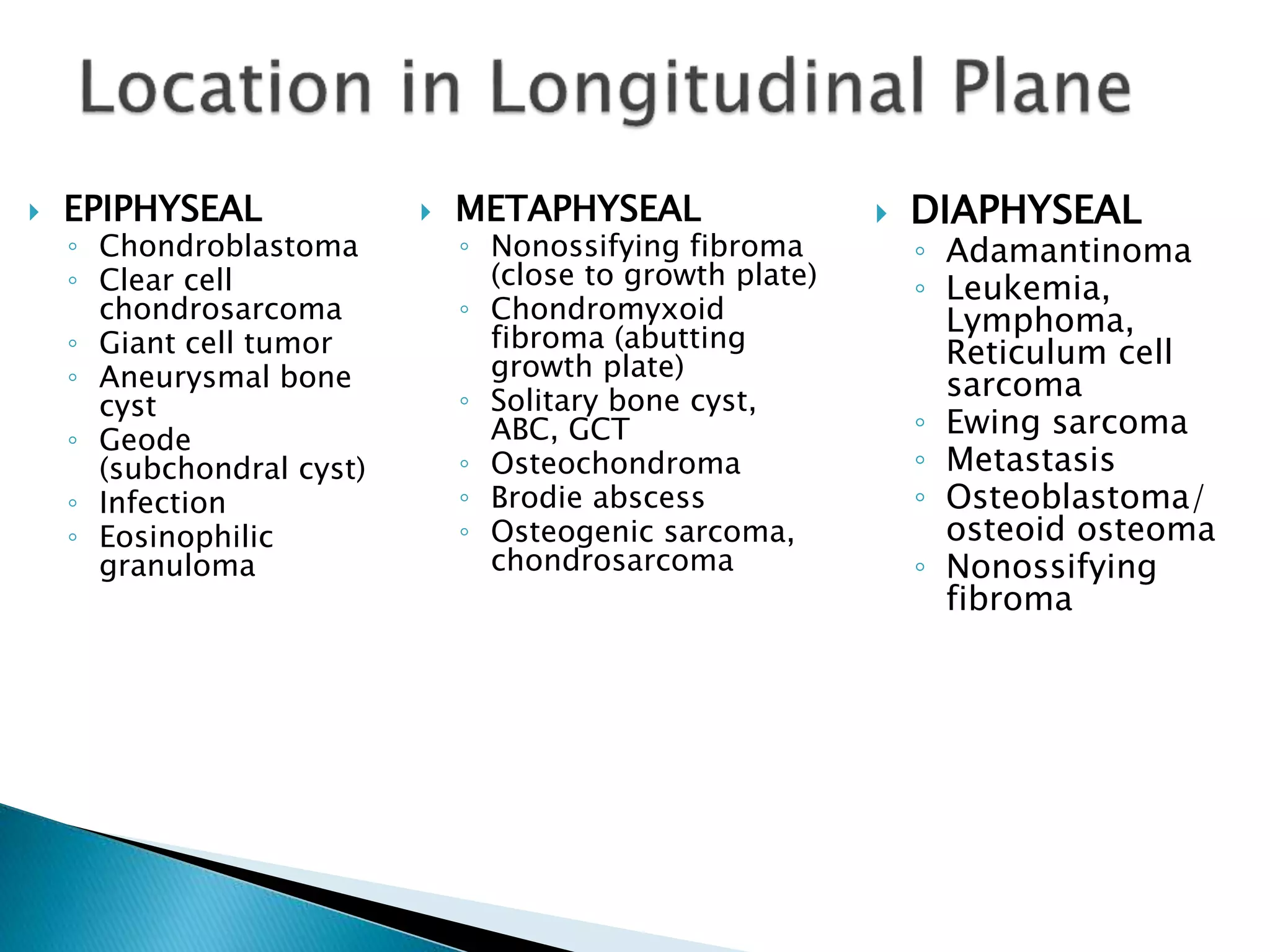
 EPIPHYSEAL
◦ Chondroblastoma
◦ Clear cell
chondrosarcoma
◦ Giant cell tumor
◦ Aneurysmal bone
cyst
◦ Geode
(subchondral cyst)
◦ Infection
◦ Eosinophilic
granuloma
 DIAPHYSEAL
◦ Adamantinoma
◦ Leukemia,
Lymphoma,
Reticulum cell
sarcoma
◦ Ewing sarcoma
◦ Metastasis
◦ Osteoblastoma/
osteoid osteoma
◦ Nonossifying
fibroma
 METAPHYSEAL
◦ Nonossifying fibroma
(close to growth plate)
◦ Chondromyxoid
fibroma (abutting
growth plate)
◦ Solitary bone cyst,
ABC, GCT
◦ Osteochondroma
◦ Brodie abscess
◦ Osteogenic sarcoma,
chondrosarcoma
 Central: Enchondroma
 Eccentric: GCT, CMF,
osteosarcoma
 Cortical: osteoid osteoma,
NOF
 Parosteal: osteochondroma,
parosteal osteosarcoma
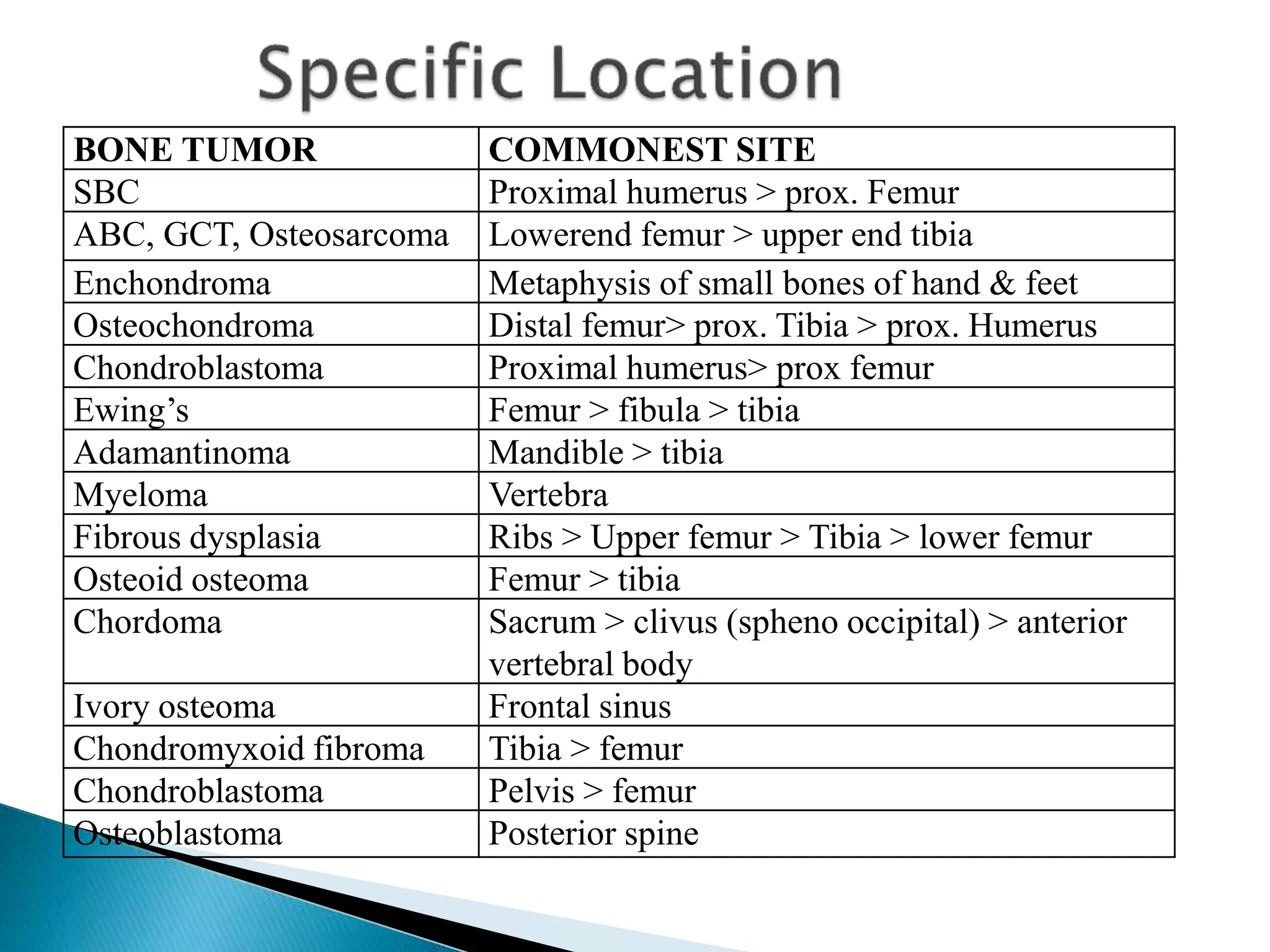
BONE TUMOR COMMONEST SITE
SBC Proximal humerus > prox. Femur
ABC, GCT, Osteosarcoma Lowerend femur > upper end tibia
Enchondroma Metaphysis of small bones of hand & feet
Osteochondroma Distal femur> prox. Tibia > prox. Humerus
Chondroblastoma Proximal humerus> prox femur
Ewing’s Femur > fibula > tibia
Adamantinoma Mandible > tibia
Myeloma Vertebra
Fibrous dysplasia Ribs > Upper femur > Tibia > lower femur
Osteoid osteoma Femur > tibia
Chordoma Sacrum > clivus (spheno occipital) > anterior
vertebral body
Ivory osteoma Frontal sinus
Chondromyxoid fibroma Tibia > femur
Chondroblastoma Pelvis > femur
Osteoblastoma Posterior spine
Patterns of bone destruction:
 Lytic
 Sclerotic
•PERMEATIVE
•GEOGRAPHIC
•MOTHEATEN
Poorly demarcated lesion imperceptibly
merging with uninvolved bone
Long zone of transition
Areas of destruction with ragged borders.
Less well defined / demarcated lesional margin
Longer zone of transition
Well-defined smooth / irregular margin
Short zone of transition
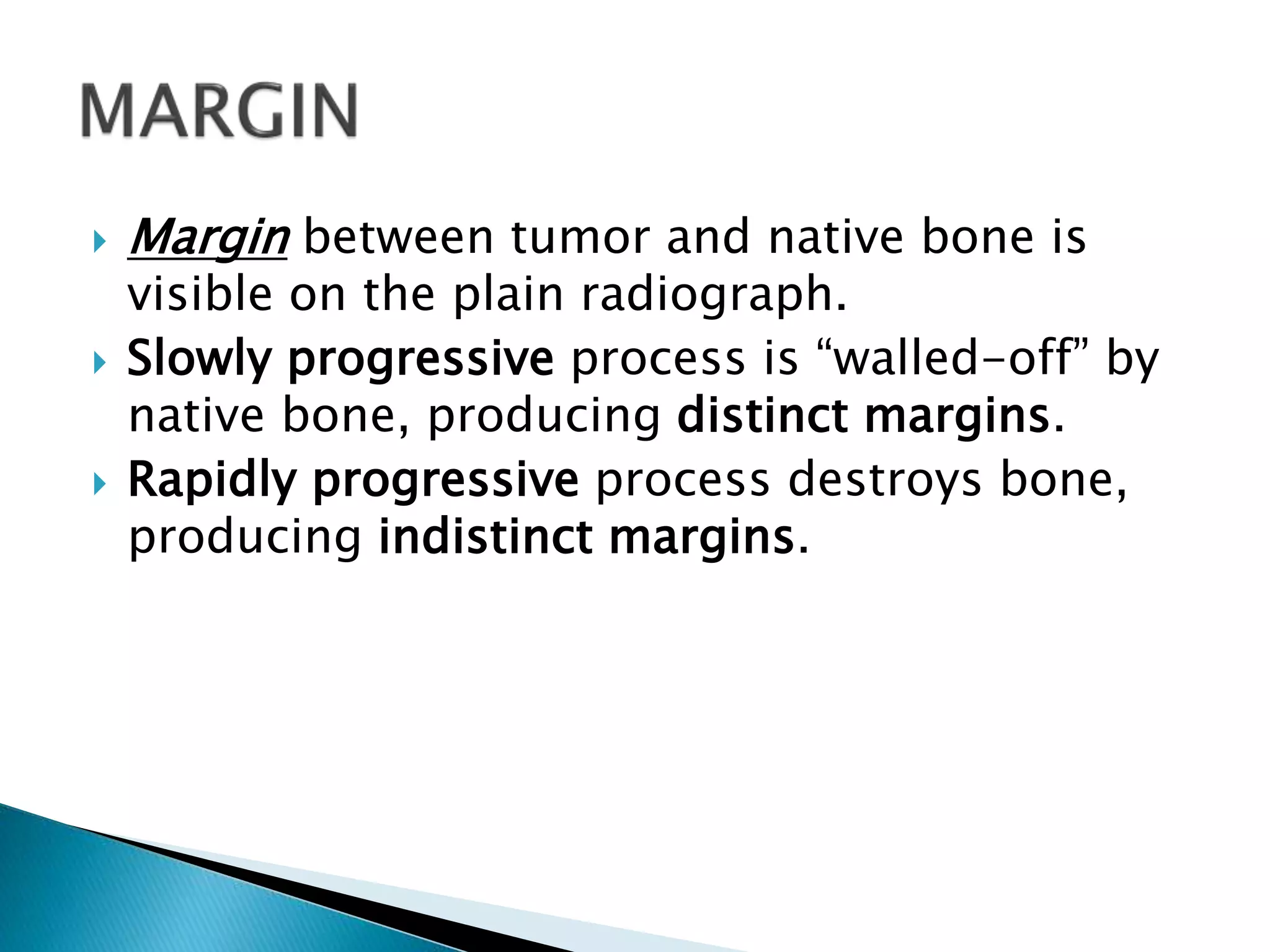
 Margin between tumor and native bone is
visible on the plain radiograph.
 Slowly progressive process is “walled-off” by
native bone, producing distinct margins.
 Rapidly progressive process destroys bone,
producing indistinct margins.
 Margin types 1A, 1B, 1C, 2, and 3
◦ least aggressive 1A, to most aggressive 3
 Aggressive lesions destroy bone.
 Aggressiveness increases likelihood of
malignancy.
◦ BUT, not all aggressive processes are malignant.
◦ AND, not all malignant diseases are aggressive.
increasing aggressiveness
A well circumscribed lesion
with a narrow zone of
transition
 simple cyst (UBC)
 enchondroma
 FD
 chondroblastoma
 GCT
 chondrosarcoma
(rare)
 MFH (rare)
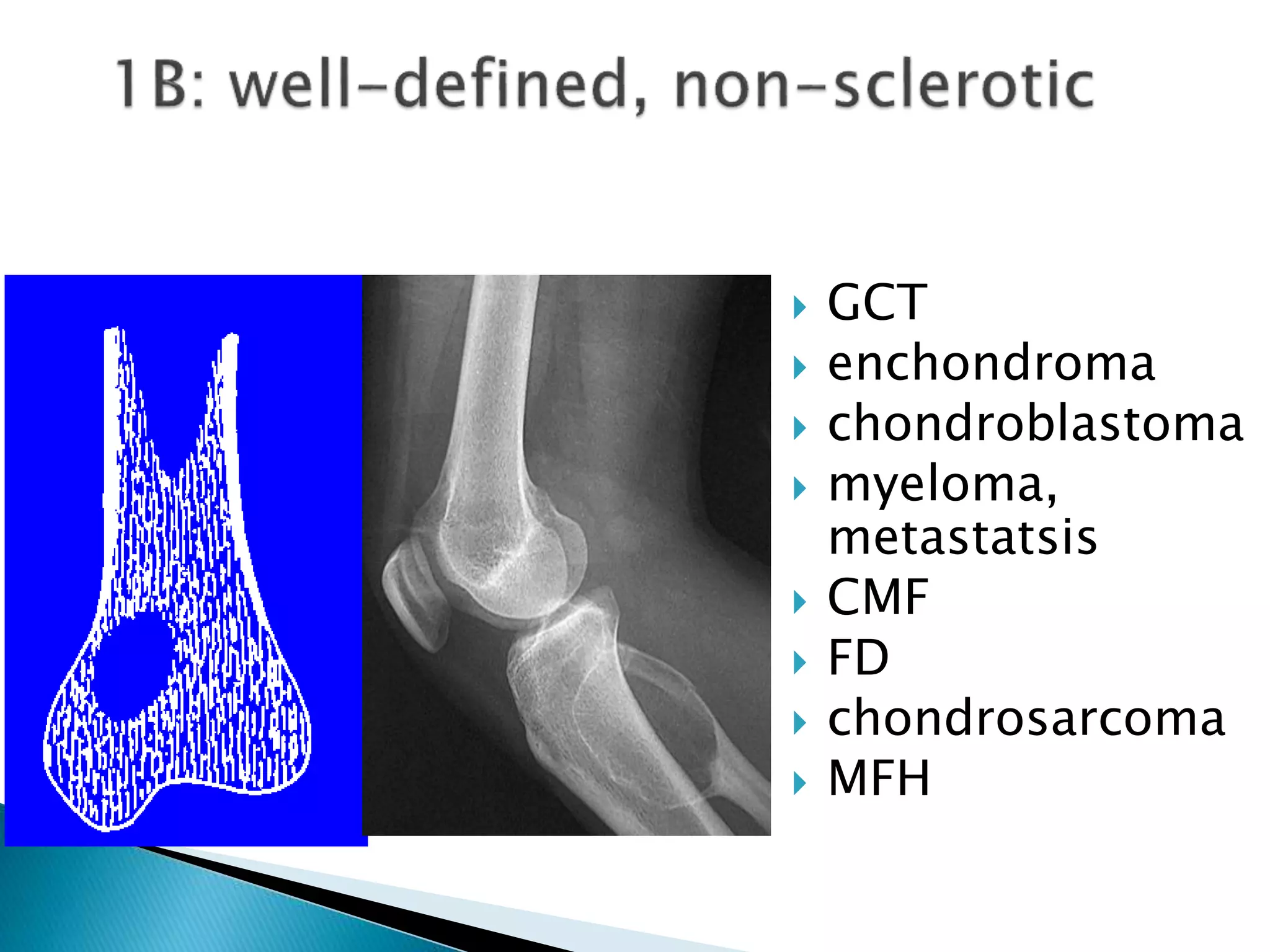
 GCT
 enchondroma
 chondroblastoma
 myeloma,
metastatsis
 CMF
 FD
 chondrosarcoma
 MFH
 chondrosarcoma
 MFH
 osteosarcoma
 GCT
 metastasis
 infection
 EG
 lymphoma
 myeloma,
metastases
 infection
 EG
 osteosarcoma
 chondrosarcoma
 lymphoma
Multiple scattered holes that vary in
size & seem to arise separately
 Ewing
 EG
 infection
 myeloma,
metastasis
 lymphoma
 osteosarcoma
Poorly demarcated from normal, numerous
elongated holes/slots in cortex, run parallel to
long axis of bone
 Limited responses of bone
Destruction: lysis (lucency)
Reaction: sclerosis
Remodeling: periosteal reaction
 Rate of growth determines bone response
◦ slow progression, sclerosis prevails
◦ rapid progression, destruction prevails
 Periosteal reaction must mineralize to be
seen on X ray ( 10 days – 3 weeks)
 Configuration of periosteal reaction
◦ Nature of inciting process
◦ Intensity
◦ Aggressiveness
◦ Duration
 Thick, uninterrupted
◦ long standing process, often non-aggressive
 stress fracture
 chronic infection
 osteoid osteoma
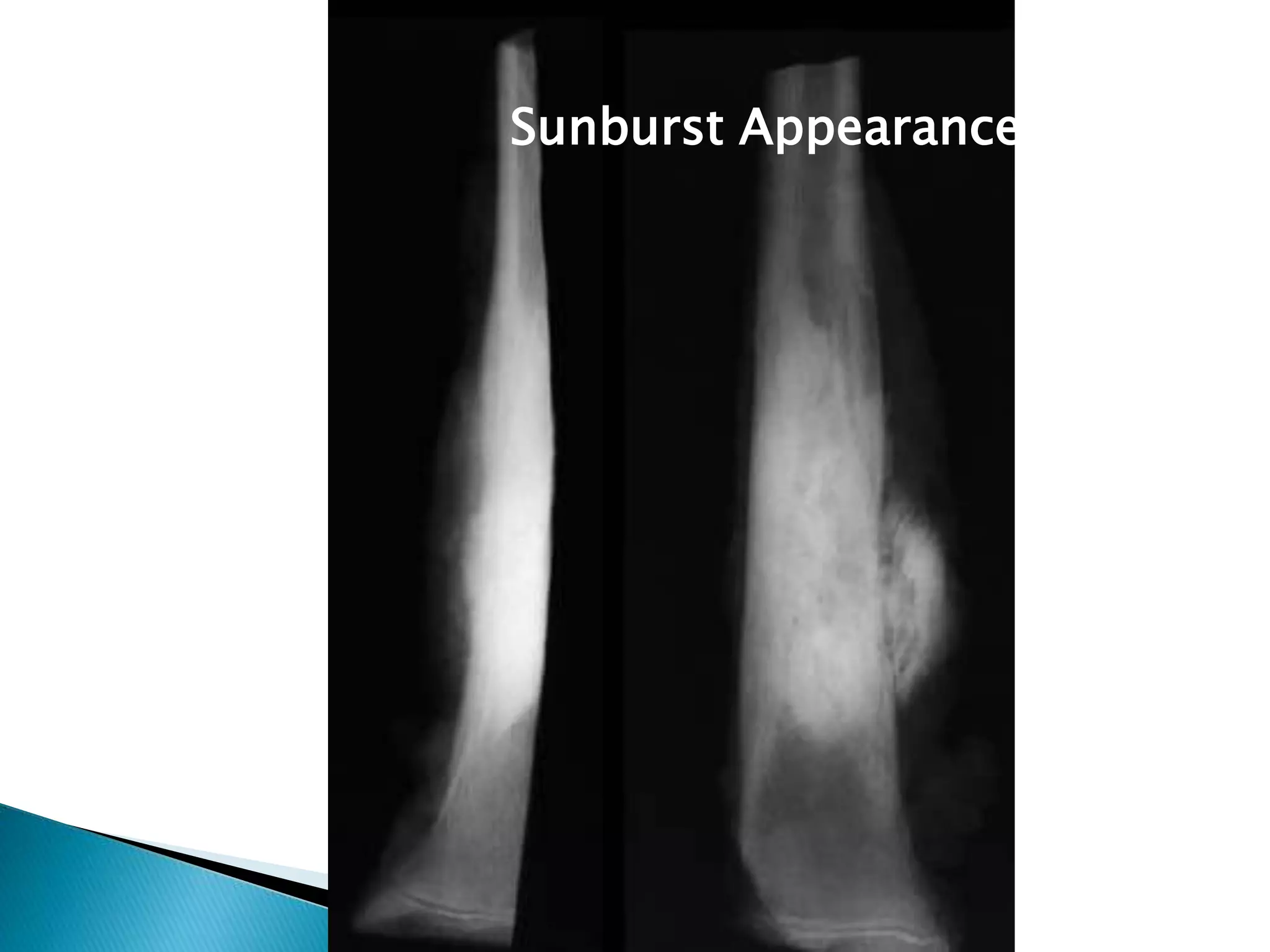
 Spiculated, lamellated
◦ aggressive process
◦ tumor likely
periosteal reaction
tumor
advancing tumor margin
destroys periosteal new
bone before it ossifies
Codman
Triangle
Sunburst Appearance
 “Matrix” is the internal tissue of the tumor
 Most tumor matrix is soft tissue in nature.
◦ Radiolucent (lytic) on x-ray
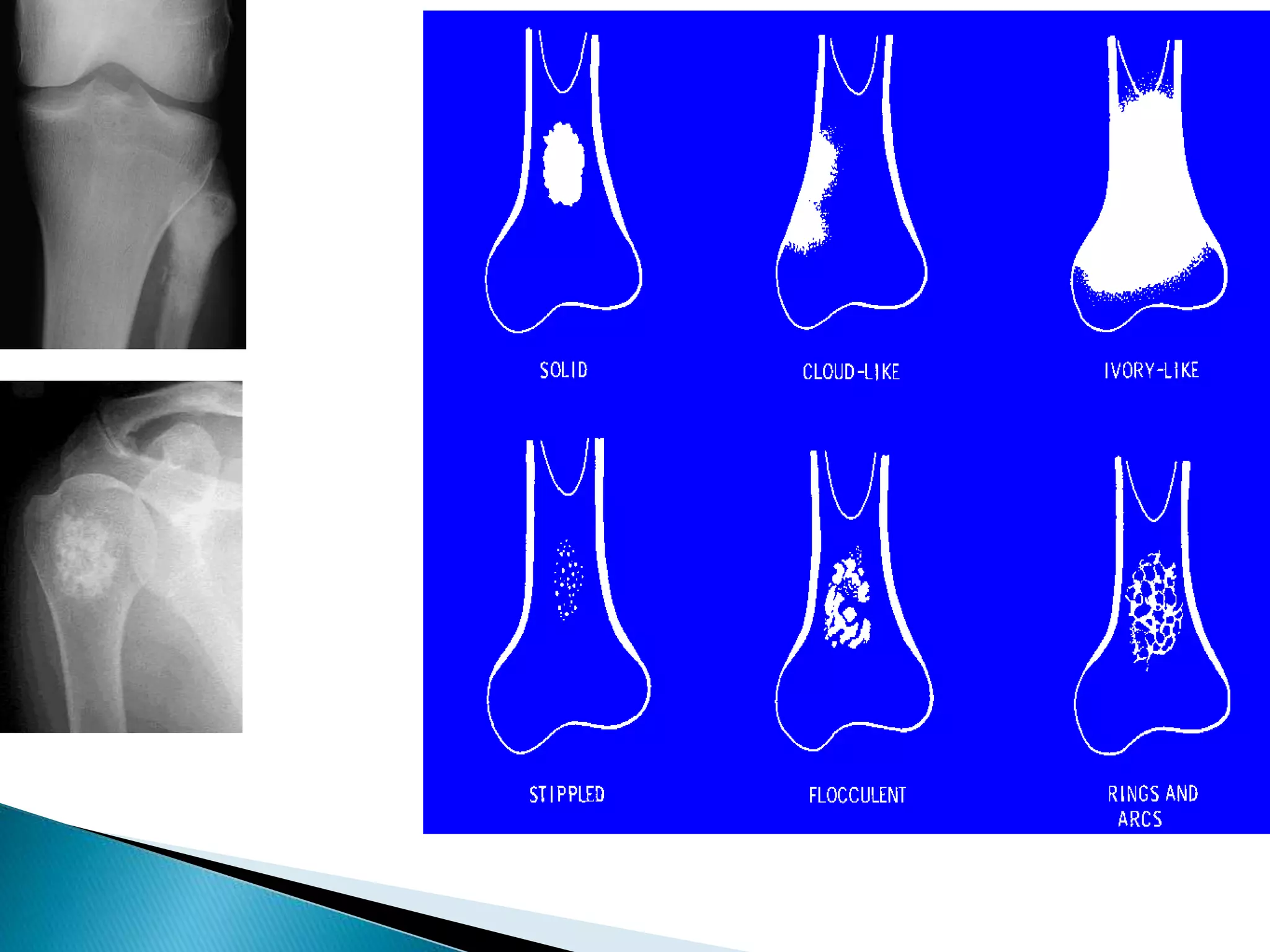
 Cartilage matrix
◦ calcified rings, arcs, dots (stippled)
◦ enchondroma, chondroblastoma, chondrosarcoma
 Ossific matrix
◦ osteosarcoma
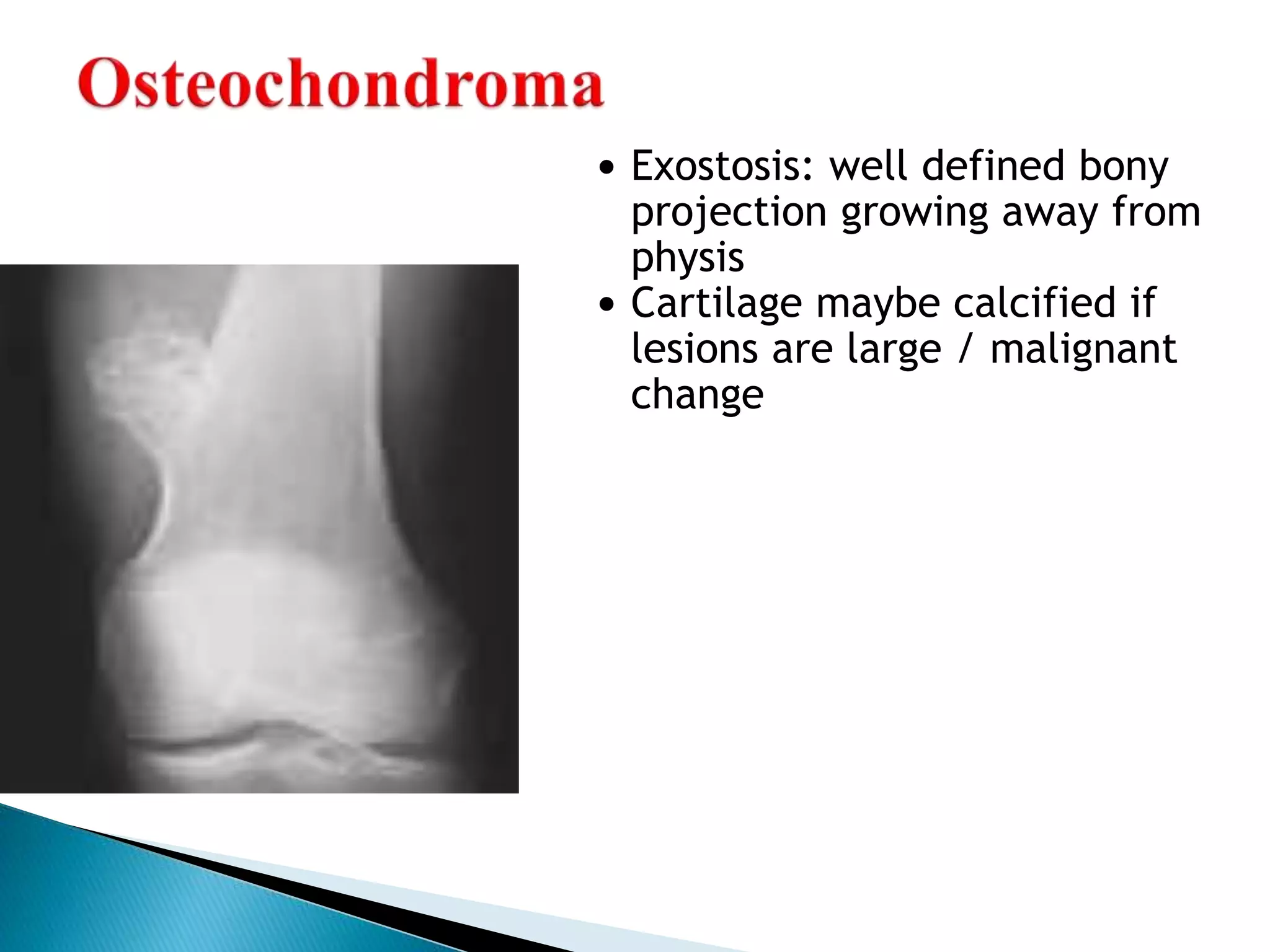
 Exostosis: well defined bony
projection growing away from
physis
 Cartilage maybe calcified if
lesions are large / malignant
change
 Nidus: a tiny radiolucent area
 If in diaphysis surrounded by dense bone and thickened cortex
Metaphysis less cortical thickening
 Double density sign on bone scan – increased uptake in nidus and
decreased uptake in reactive sclerotic zone (also seen in Brodie’s abcess)
 Lytic nidus surrounded by sclerotic bone in CT
 Centre of nidus may be calcified
 Well demarcated osteolytic lesion sometimes
containing flecks of calcification
 Less reactive bone than osteoid osteoma
 Bone scan - intense activity
 Cystic radiolucency on the diaphysial side of the growth plate
 Cortex may be thinned and bone expanded with well defined thin
sclerotic margin
 May have pseudo-loculated appearance secondary to irregular
cortical thinning and thin septal ridges
 Falling fragment sign typical and the lesion is never wider than
epiphysial plate
 Bone scan cold or minimal activity unless fractured
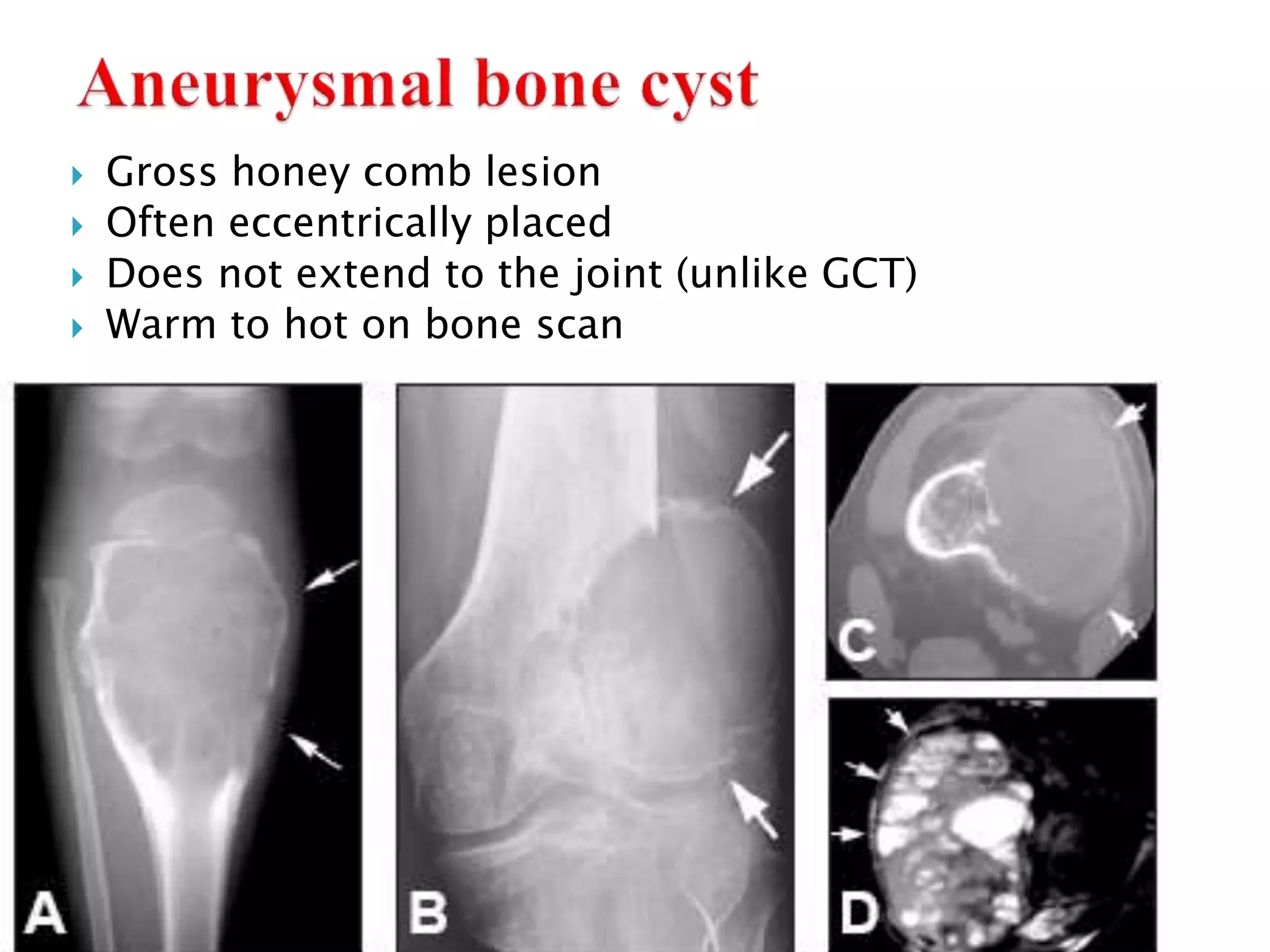
 Gross honey comb lesion
 Often eccentrically placed
 Does not extend to the joint (unlike GCT)
 Warm to hot on bone scan
 Usually well defined geographic lytic lesion
in the epiphysis/metaphysis extending up to
the joint surface without marginal sclerosis
 Junction with normal bone often poorly
defined
 Cortex thinned and sometimes ballooned
 Bone scan warm to hot
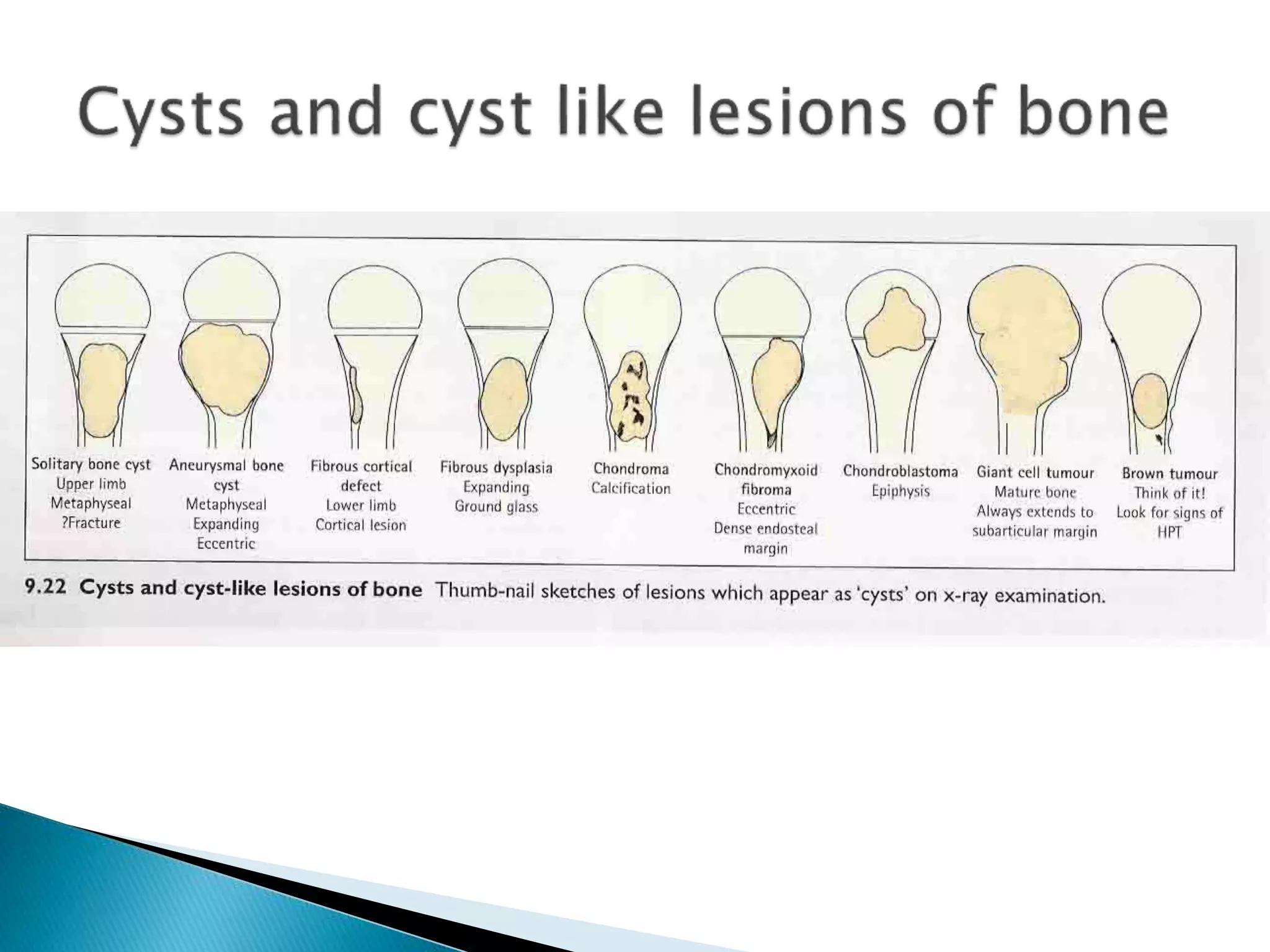
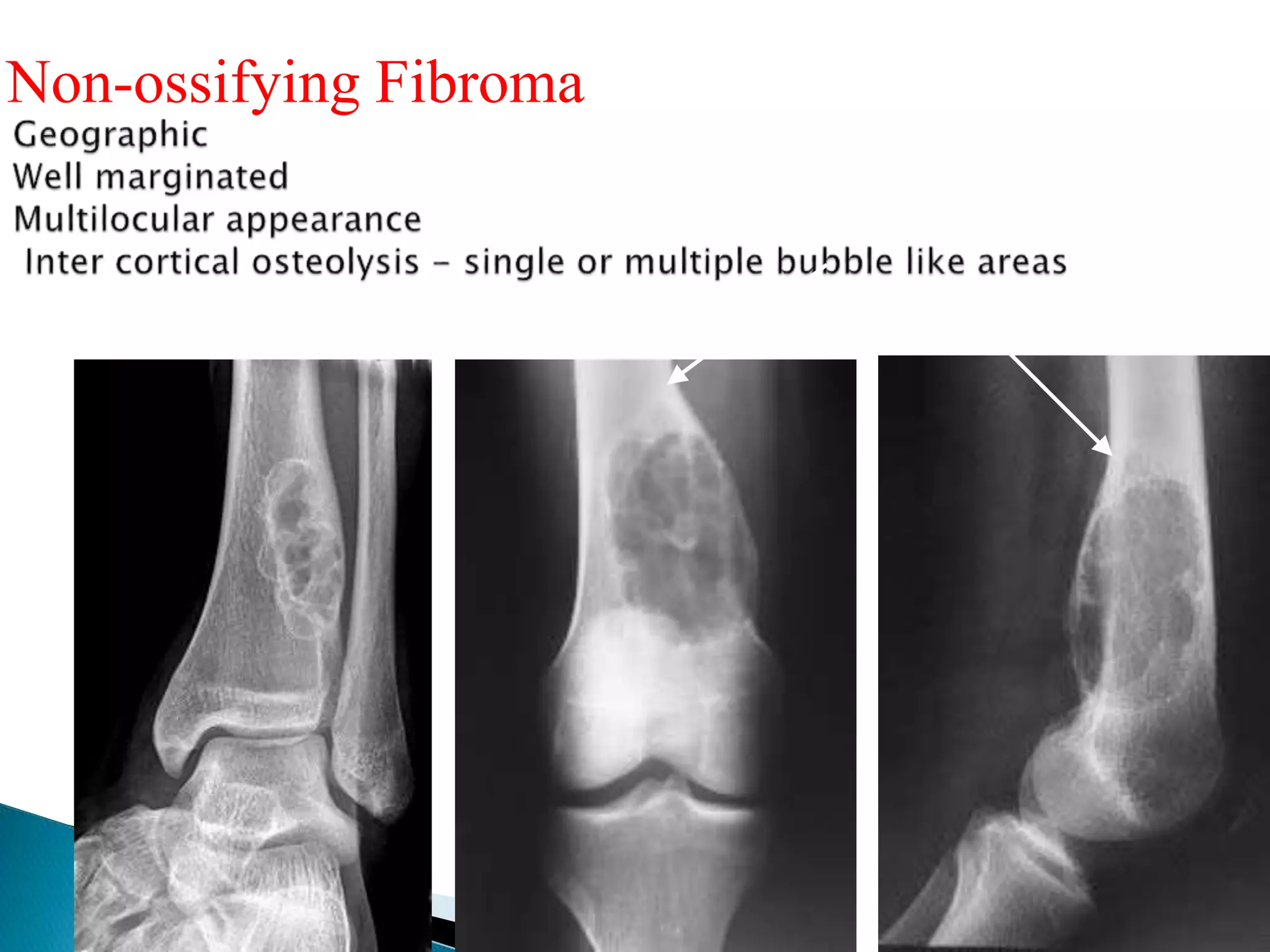
Fibrous cortical defect
 Margin well defined, sometimes scalloped
and often sclerosed
Non-ossifying Fibroma
 Ground glass appearance typical
 Shepherds crook deformity of proximal femur
 Variable appearance with expansion of cortex
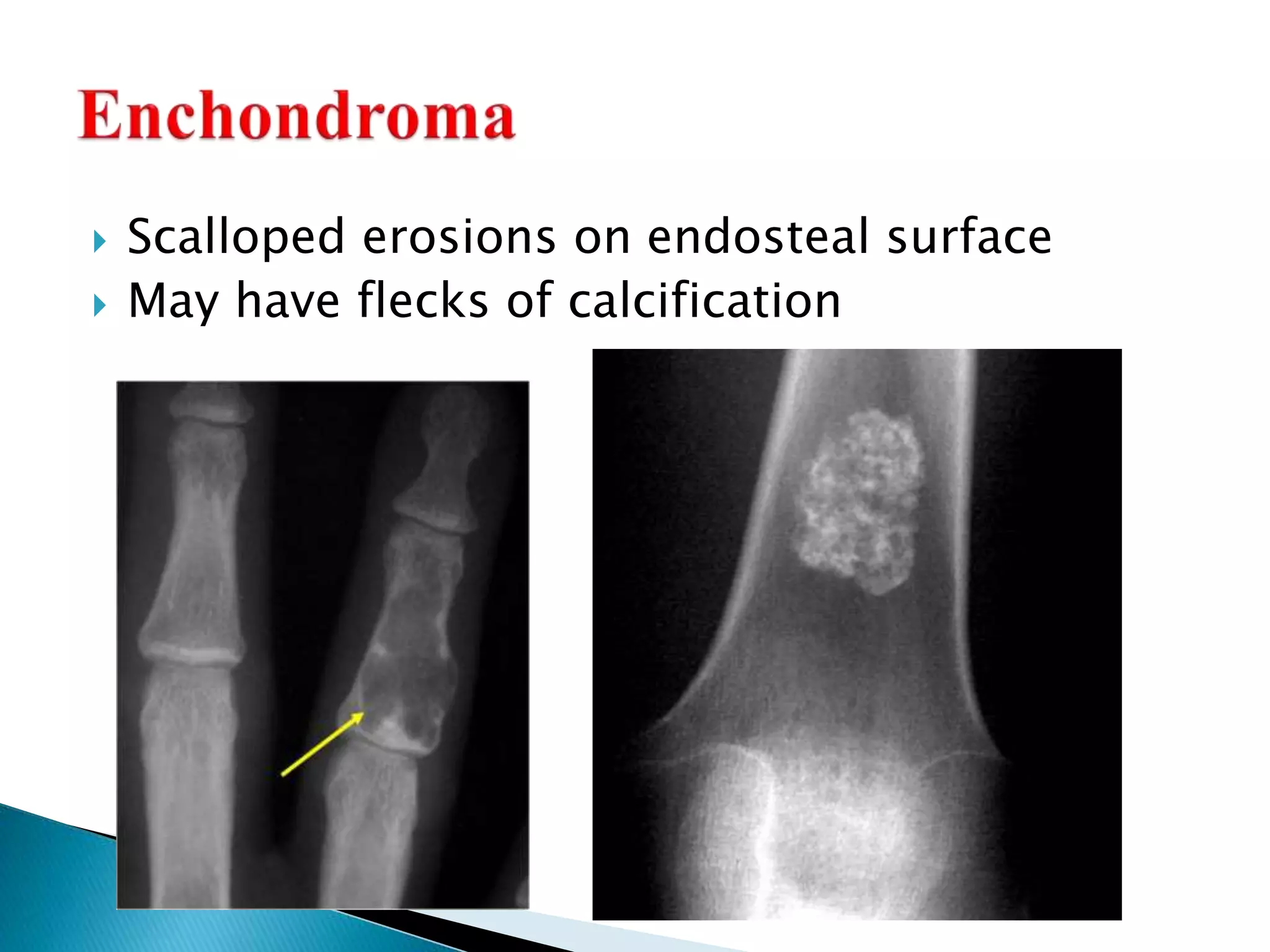
 Scalloped erosions on endosteal surface
 May have flecks of calcification
 Rounded or oval rare area
 Usually eccentrically placed
 May cross the growth plate
 Sharp outline and sclerotic rim
 Scalloped margin and thin cortex
 Well defined area of rarefaction eccentrically placed in
the epiphysis or across the growth plate
 No reaction in surrounding bone
 50% show central calcification, 50% show linear
periosteal reaction
 Bone scan increased uptake at margins
 Multiple loose bodies
 Large osteolytic lesion in the midline
 May contain flecks of calcification
 Marked bone destruction
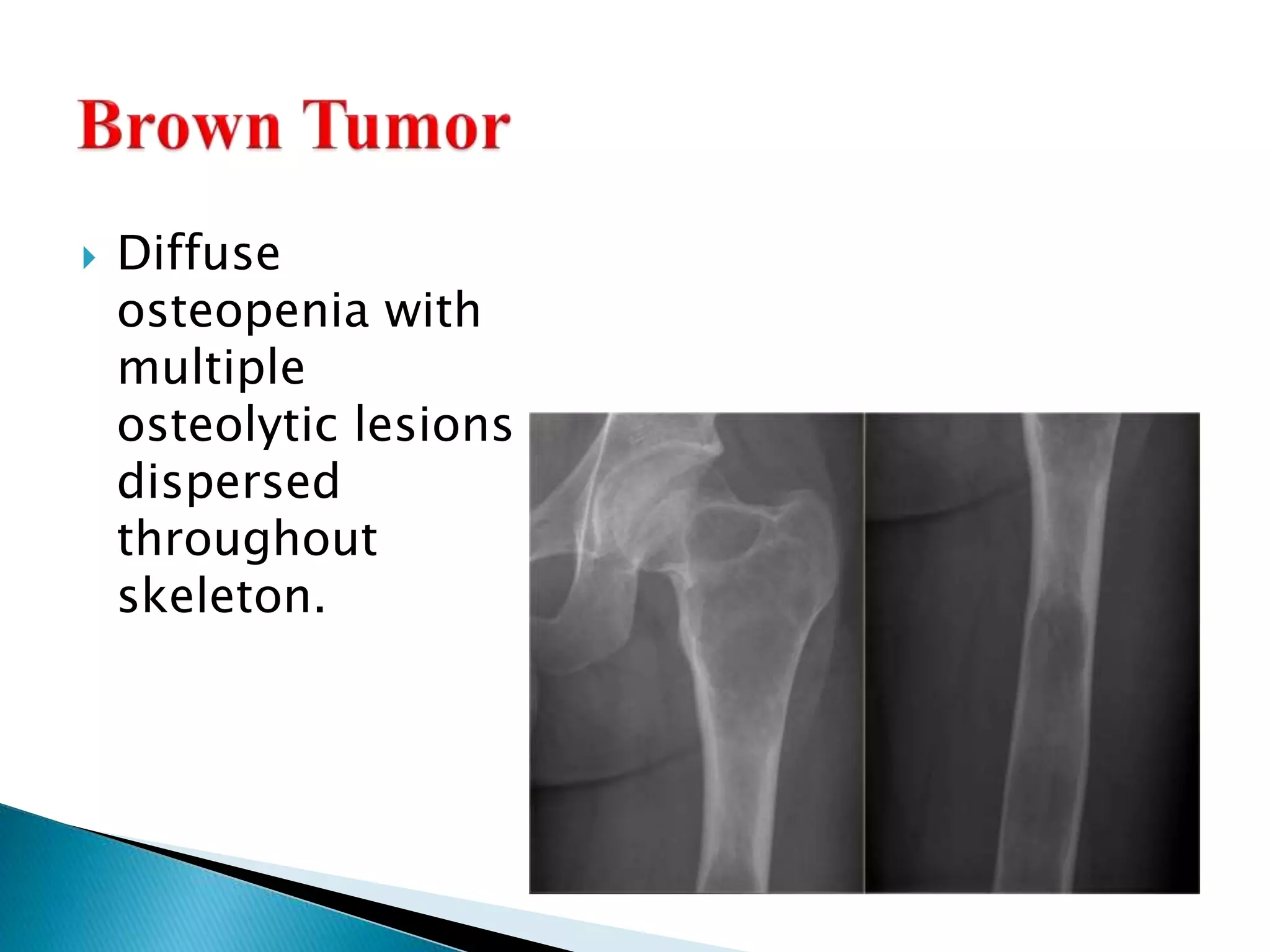
 Diffuse
osteopenia with
multiple
osteolytic lesions
dispersed
throughout
skeleton.
 Characteristic honey comb appearance in
diaphysis
 Cortical thinning with expansion
 Vertical striations without bone expansion
and coarse trabecular appearance (corduroy
appearance)
 Mottled lytic defect usually no
sclerotic rim
 May destroy cortex
 Usually endosteal or periosteal
reaction
 Lesions in flat bones and ribs
appear punched out
 May appear loculated due to sparing
of large trabeculae
 Spinal lesions- collapse (vertebra
plana), which may heal
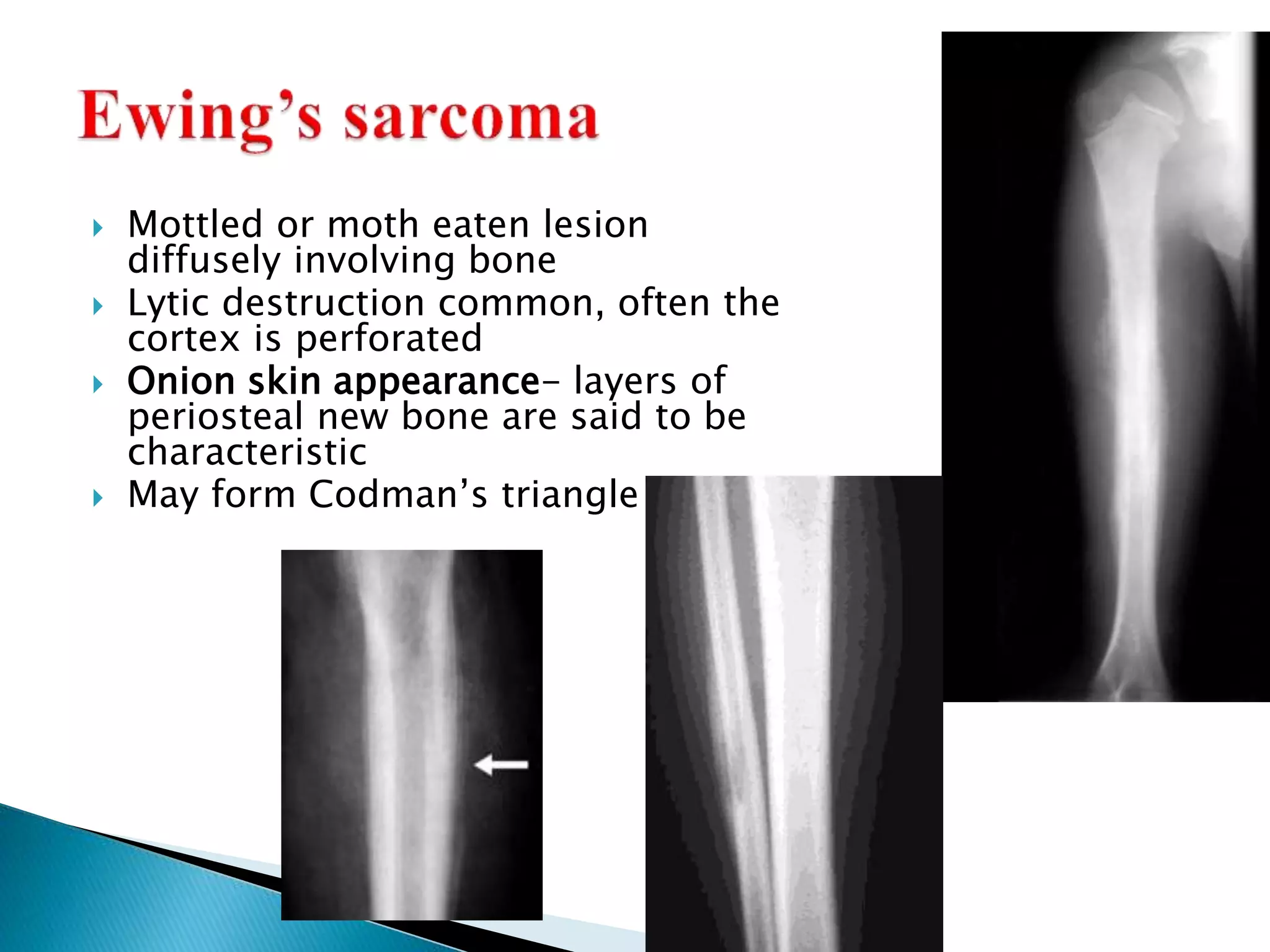
 Mottled or moth eaten lesion
diffusely involving bone
 Lytic destruction common, often the
cortex is perforated
 Onion skin appearance- layers of
periosteal new bone are said to be
characteristic
 May form Codman’s triangle
 Variable with combination of bone destruction and bone
formation
 Sun ray spicules/ sun burst appearance and Codman’s triangle
may be evident
 Cortical breach common
 Adjacent soft tissue mass
 Joint space rarely involved
◦ 25% Lytic
◦ 35% Sclerotic
◦ 40% Mixed
 Telangiectatic type- purely lytic
 Variable appearance with 60 - 70% have calcification
and 50% have sub periosteal new bone
 May be a large cystic lesion with cortical destruction
and central calcification, endosteal scalloping and
cortical expansion; annular, punctate or comma
shaped calcification
 Bone often mottled or moth eaten
with extension into soft tissue
 Osteolytic lesion may be
surrounded by reactive bone
 Destructive appearance
radiologically
 Usually little periosteal reaction
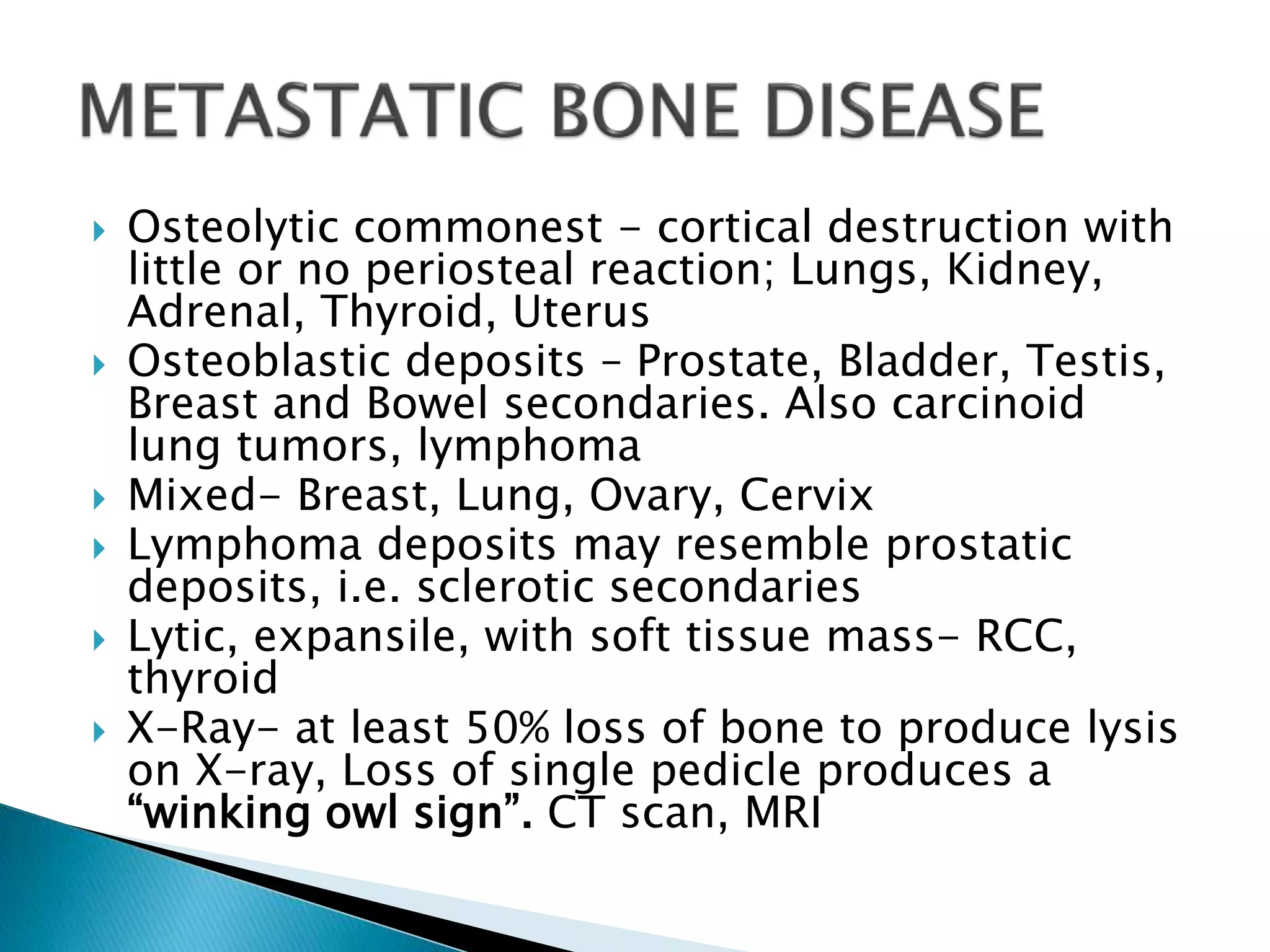
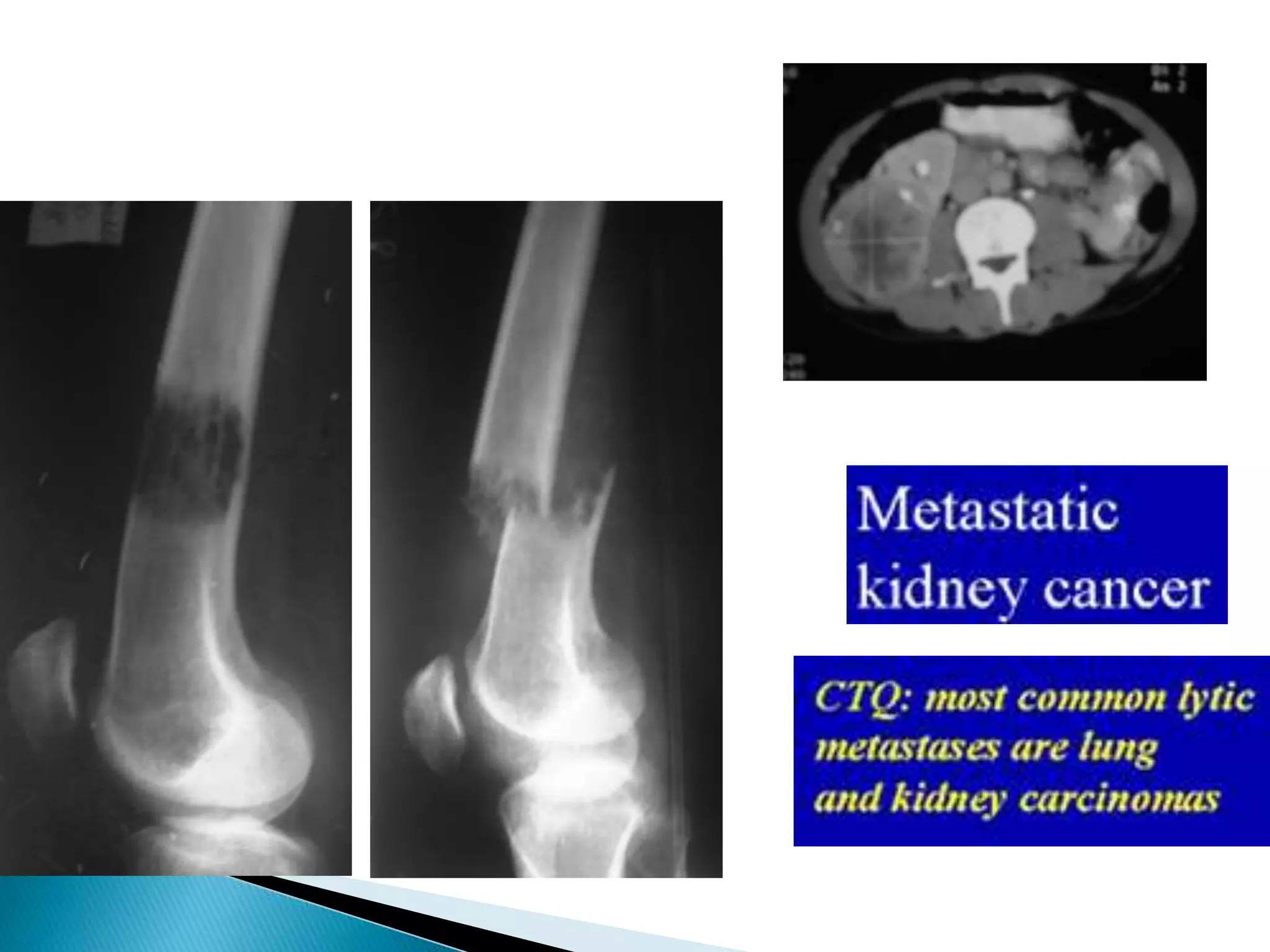
 Osteolytic commonest - cortical destruction with
little or no periosteal reaction; Lungs, Kidney,
Adrenal, Thyroid, Uterus
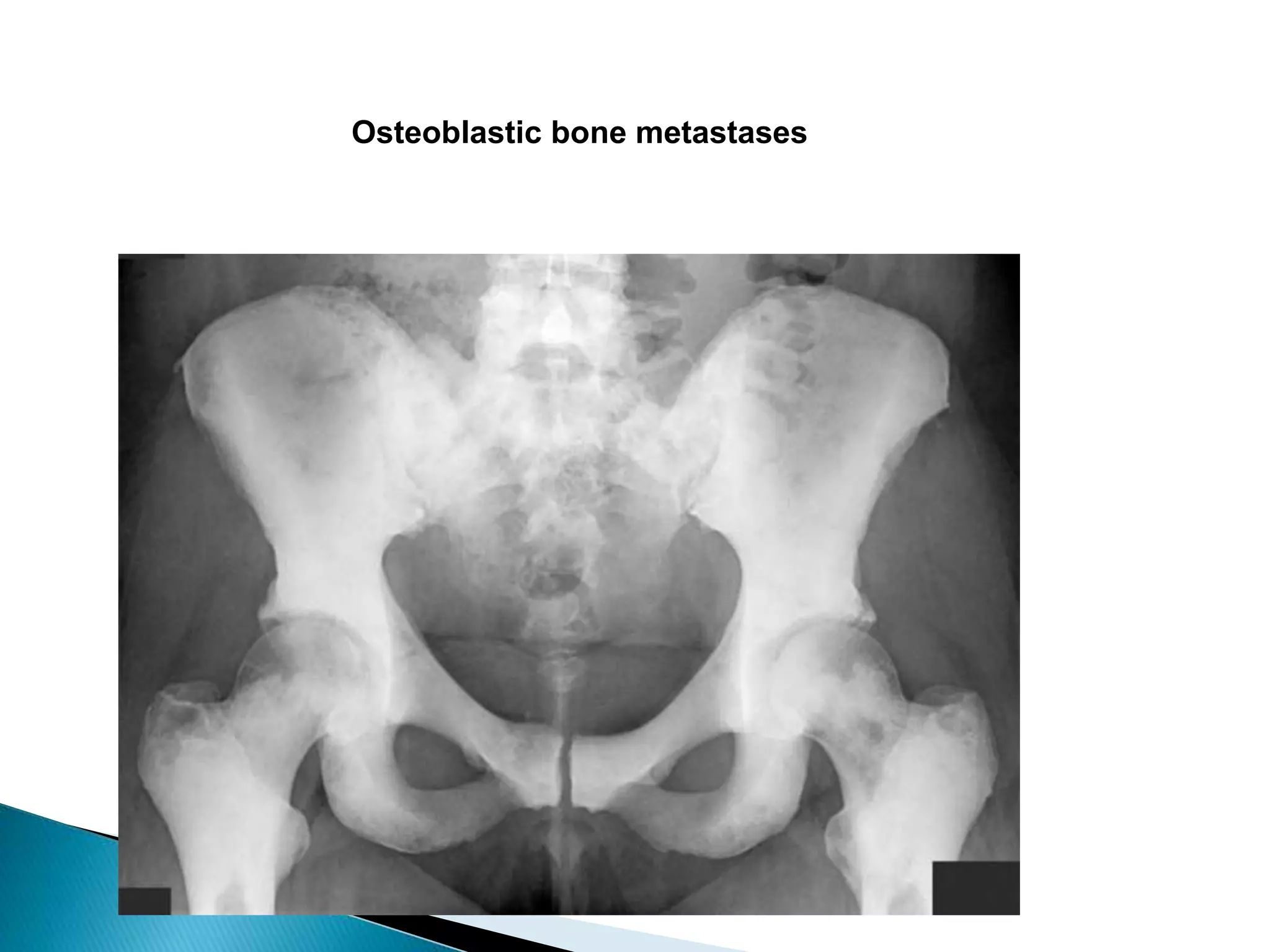
 Osteoblastic deposits – Prostate, Bladder, Testis,
Breast and Bowel secondaries. Also carcinoid
lung tumors, lymphoma
 Mixed- Breast, Lung, Ovary, Cervix
 Lymphoma deposits may resemble prostatic
deposits, i.e. sclerotic secondaries
 Lytic, expansile, with soft tissue mass- RCC,
thyroid
 X-Ray- at least 50% loss of bone to produce lysis
on X-ray, Loss of single pedicle produces a
“winking owl sign”. CT scan, MRI
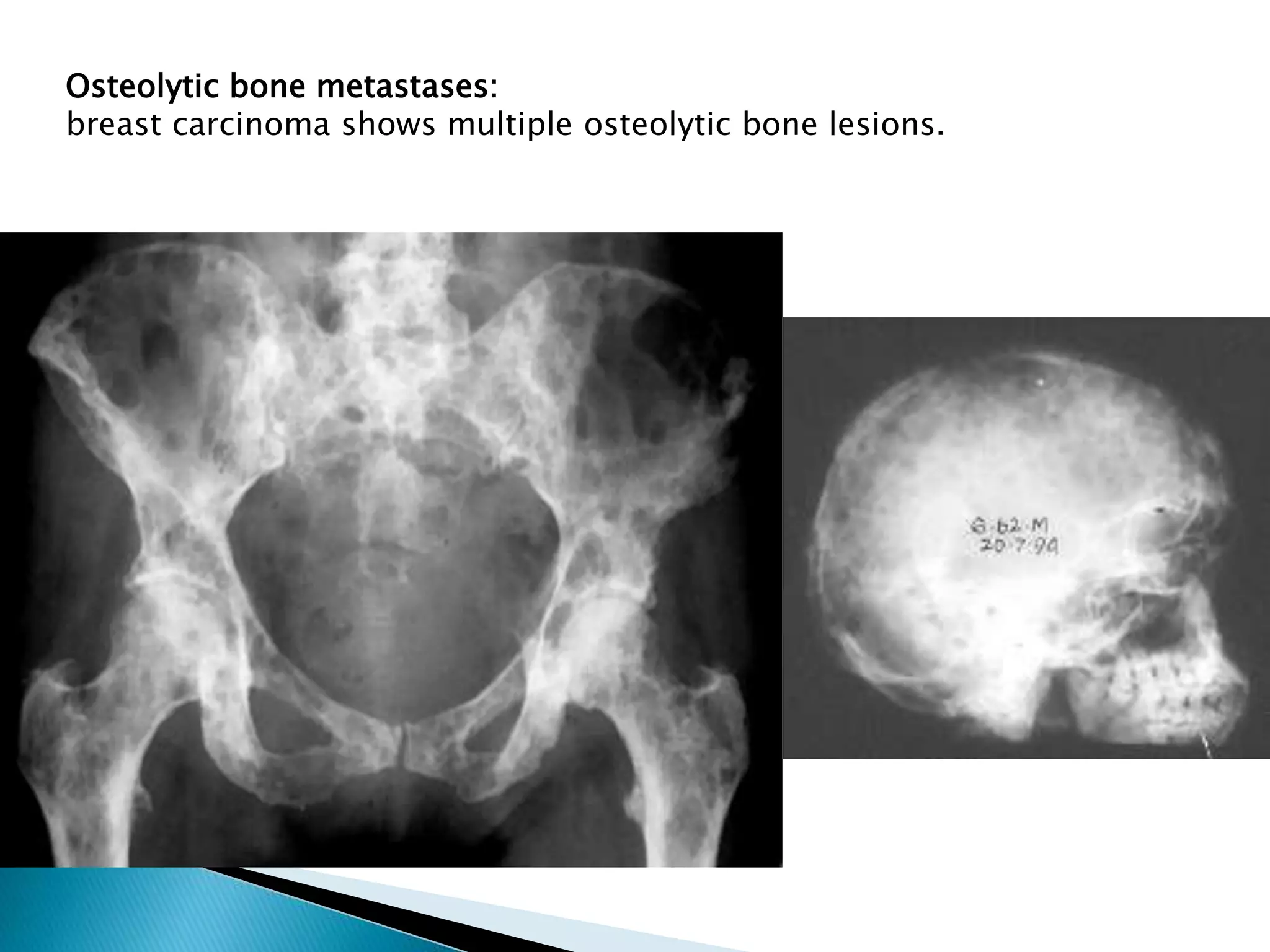
Osteolytic bone metastases:
breast carcinoma shows multiple osteolytic bone lesions.
Osteoblastic bone metastases
Mixed pattern bone metastases:
 Early - vague mottled lucent areas
 Diffuse destructive lytic lesion with little
periosteal reaction
 Usually combination of patchy sclerosis and
mottled destruction
 Hogkins disease - typical appearance of ivory
vertebrae
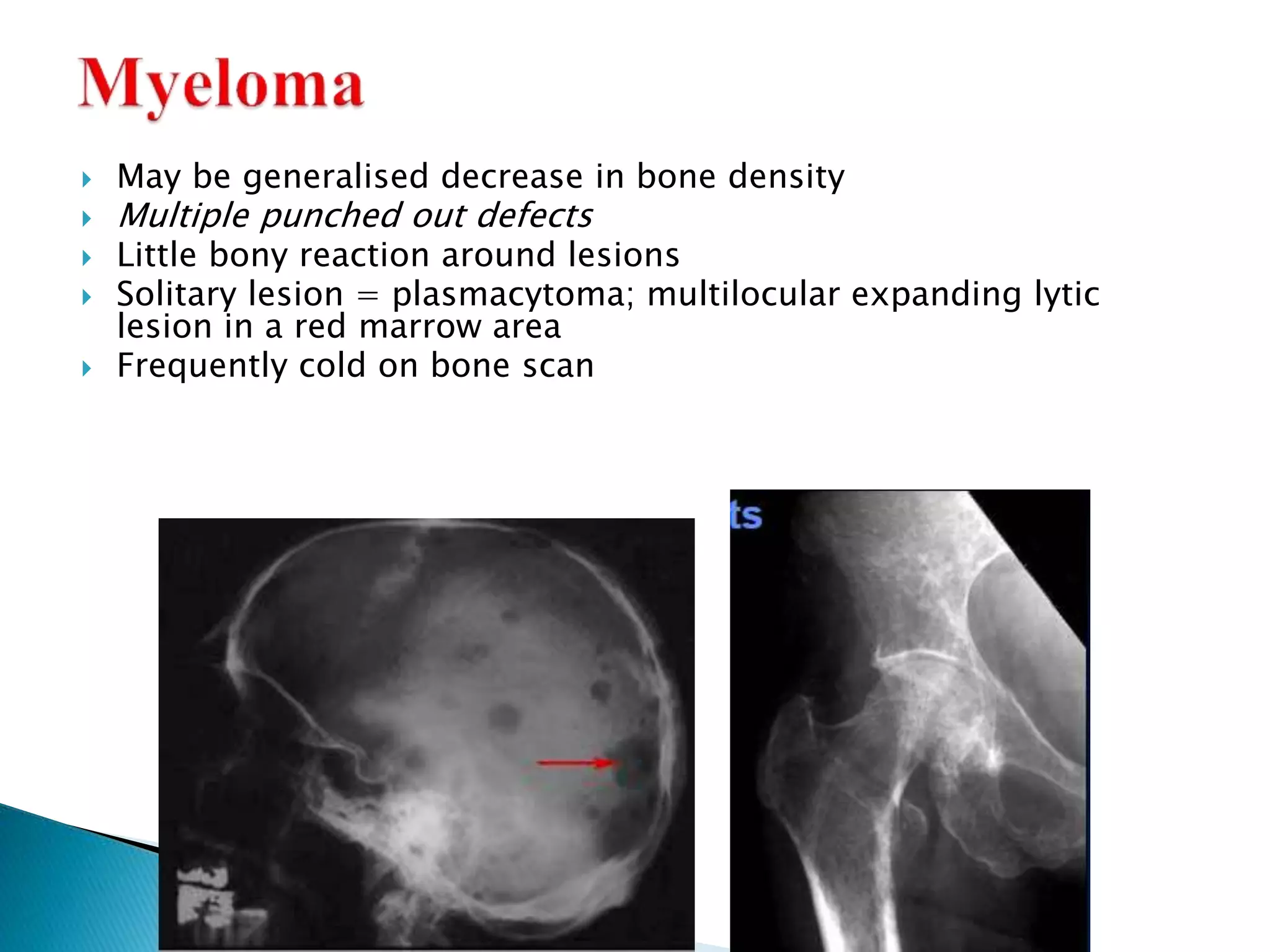
 May be generalised decrease in bone density
 Multiple punched out defects
 Little bony reaction around lesions
 Solitary lesion = plasmacytoma; multilocular expanding lytic
lesion in a red marrow area
 Frequently cold on bone scan
Radiology of Bone Tumours

Radiology of Bone Tumours

  • 1.
    By Tarek A. ElHewala Lecturerof Orthopaedic Surgery Faculty of Medicine – Zagazig University
  • 2.
     (1) Locationof the lesion  (2) Extent of the lesion  (3) What is the lesion doing to the bone?  (4) What is the bone doing to the lesion?  (5) Hint as to its tissue type / matrix
  • 3.
     Location andage of patient most important parameters in classifying a primary bone tumor.  Simple to determine from plain radiographs.
  • 5.
     EPIPHYSEAL ◦ Chondroblastoma ◦Clear cell chondrosarcoma ◦ Giant cell tumor ◦ Aneurysmal bone cyst ◦ Geode (subchondral cyst) ◦ Infection ◦ Eosinophilic granuloma  DIAPHYSEAL ◦ Adamantinoma ◦ Leukemia, Lymphoma, Reticulum cell sarcoma ◦ Ewing sarcoma ◦ Metastasis ◦ Osteoblastoma/ osteoid osteoma ◦ Nonossifying fibroma  METAPHYSEAL ◦ Nonossifying fibroma (close to growth plate) ◦ Chondromyxoid fibroma (abutting growth plate) ◦ Solitary bone cyst, ABC, GCT ◦ Osteochondroma ◦ Brodie abscess ◦ Osteogenic sarcoma, chondrosarcoma
  • 6.
     Central: Enchondroma Eccentric: GCT, CMF, osteosarcoma  Cortical: osteoid osteoma, NOF  Parosteal: osteochondroma, parosteal osteosarcoma
  • 7.
    BONE TUMOR COMMONESTSITE SBC Proximal humerus > prox. Femur ABC, GCT, Osteosarcoma Lowerend femur > upper end tibia Enchondroma Metaphysis of small bones of hand & feet Osteochondroma Distal femur> prox. Tibia > prox. Humerus Chondroblastoma Proximal humerus> prox femur Ewing’s Femur > fibula > tibia Adamantinoma Mandible > tibia Myeloma Vertebra Fibrous dysplasia Ribs > Upper femur > Tibia > lower femur Osteoid osteoma Femur > tibia Chordoma Sacrum > clivus (spheno occipital) > anterior vertebral body Ivory osteoma Frontal sinus Chondromyxoid fibroma Tibia > femur Chondroblastoma Pelvis > femur Osteoblastoma Posterior spine
  • 9.
    Patterns of bonedestruction:  Lytic  Sclerotic •PERMEATIVE •GEOGRAPHIC •MOTHEATEN Poorly demarcated lesion imperceptibly merging with uninvolved bone Long zone of transition Areas of destruction with ragged borders. Less well defined / demarcated lesional margin Longer zone of transition Well-defined smooth / irregular margin Short zone of transition
  • 10.
     Margin betweentumor and native bone is visible on the plain radiograph.  Slowly progressive process is “walled-off” by native bone, producing distinct margins.  Rapidly progressive process destroys bone, producing indistinct margins.
  • 11.
     Margin types1A, 1B, 1C, 2, and 3 ◦ least aggressive 1A, to most aggressive 3  Aggressive lesions destroy bone.  Aggressiveness increases likelihood of malignancy. ◦ BUT, not all aggressive processes are malignant. ◦ AND, not all malignant diseases are aggressive.
  • 12.
    increasing aggressiveness A wellcircumscribed lesion with a narrow zone of transition
  • 13.
     simple cyst(UBC)  enchondroma  FD  chondroblastoma  GCT  chondrosarcoma (rare)  MFH (rare)
  • 14.
     GCT  enchondroma chondroblastoma  myeloma, metastatsis  CMF  FD  chondrosarcoma  MFH
  • 15.
     chondrosarcoma  MFH osteosarcoma  GCT  metastasis  infection  EG  lymphoma
  • 16.
     myeloma, metastases  infection EG  osteosarcoma  chondrosarcoma  lymphoma Multiple scattered holes that vary in size & seem to arise separately
  • 17.
     Ewing  EG infection  myeloma, metastasis  lymphoma  osteosarcoma Poorly demarcated from normal, numerous elongated holes/slots in cortex, run parallel to long axis of bone
  • 18.
     Limited responsesof bone Destruction: lysis (lucency) Reaction: sclerosis Remodeling: periosteal reaction  Rate of growth determines bone response ◦ slow progression, sclerosis prevails ◦ rapid progression, destruction prevails
  • 19.
     Periosteal reactionmust mineralize to be seen on X ray ( 10 days – 3 weeks)  Configuration of periosteal reaction ◦ Nature of inciting process ◦ Intensity ◦ Aggressiveness ◦ Duration
  • 20.
     Thick, uninterrupted ◦long standing process, often non-aggressive  stress fracture  chronic infection  osteoid osteoma  Spiculated, lamellated ◦ aggressive process ◦ tumor likely
  • 22.
    periosteal reaction tumor advancing tumormargin destroys periosteal new bone before it ossifies Codman Triangle
  • 23.
  • 24.
     “Matrix” isthe internal tissue of the tumor  Most tumor matrix is soft tissue in nature. ◦ Radiolucent (lytic) on x-ray  Cartilage matrix ◦ calcified rings, arcs, dots (stippled) ◦ enchondroma, chondroblastoma, chondrosarcoma  Ossific matrix ◦ osteosarcoma
  • 27.
     Exostosis: welldefined bony projection growing away from physis  Cartilage maybe calcified if lesions are large / malignant change
  • 28.
     Nidus: atiny radiolucent area  If in diaphysis surrounded by dense bone and thickened cortex Metaphysis less cortical thickening  Double density sign on bone scan – increased uptake in nidus and decreased uptake in reactive sclerotic zone (also seen in Brodie’s abcess)  Lytic nidus surrounded by sclerotic bone in CT  Centre of nidus may be calcified
  • 29.
     Well demarcatedosteolytic lesion sometimes containing flecks of calcification  Less reactive bone than osteoid osteoma  Bone scan - intense activity
  • 30.
     Cystic radiolucencyon the diaphysial side of the growth plate  Cortex may be thinned and bone expanded with well defined thin sclerotic margin  May have pseudo-loculated appearance secondary to irregular cortical thinning and thin septal ridges  Falling fragment sign typical and the lesion is never wider than epiphysial plate  Bone scan cold or minimal activity unless fractured
  • 31.
     Gross honeycomb lesion  Often eccentrically placed  Does not extend to the joint (unlike GCT)  Warm to hot on bone scan
  • 32.
     Usually welldefined geographic lytic lesion in the epiphysis/metaphysis extending up to the joint surface without marginal sclerosis  Junction with normal bone often poorly defined  Cortex thinned and sometimes ballooned  Bone scan warm to hot
  • 33.
    Fibrous cortical defect Margin well defined, sometimes scalloped and often sclerosed
  • 34.
  • 35.
     Ground glassappearance typical  Shepherds crook deformity of proximal femur  Variable appearance with expansion of cortex
  • 36.
     Scalloped erosionson endosteal surface  May have flecks of calcification
  • 37.
     Rounded oroval rare area  Usually eccentrically placed  May cross the growth plate  Sharp outline and sclerotic rim  Scalloped margin and thin cortex
  • 38.
     Well definedarea of rarefaction eccentrically placed in the epiphysis or across the growth plate  No reaction in surrounding bone  50% show central calcification, 50% show linear periosteal reaction  Bone scan increased uptake at margins
  • 39.
  • 40.
     Large osteolyticlesion in the midline  May contain flecks of calcification  Marked bone destruction
  • 41.
     Diffuse osteopenia with multiple osteolyticlesions dispersed throughout skeleton.
  • 42.
     Characteristic honeycomb appearance in diaphysis  Cortical thinning with expansion
  • 43.
     Vertical striationswithout bone expansion and coarse trabecular appearance (corduroy appearance)
  • 44.
     Mottled lyticdefect usually no sclerotic rim  May destroy cortex  Usually endosteal or periosteal reaction  Lesions in flat bones and ribs appear punched out  May appear loculated due to sparing of large trabeculae  Spinal lesions- collapse (vertebra plana), which may heal
  • 45.
     Mottled ormoth eaten lesion diffusely involving bone  Lytic destruction common, often the cortex is perforated  Onion skin appearance- layers of periosteal new bone are said to be characteristic  May form Codman’s triangle
  • 46.
     Variable withcombination of bone destruction and bone formation  Sun ray spicules/ sun burst appearance and Codman’s triangle may be evident  Cortical breach common  Adjacent soft tissue mass  Joint space rarely involved ◦ 25% Lytic ◦ 35% Sclerotic ◦ 40% Mixed  Telangiectatic type- purely lytic
  • 47.
     Variable appearancewith 60 - 70% have calcification and 50% have sub periosteal new bone  May be a large cystic lesion with cortical destruction and central calcification, endosteal scalloping and cortical expansion; annular, punctate or comma shaped calcification
  • 48.
     Bone oftenmottled or moth eaten with extension into soft tissue  Osteolytic lesion may be surrounded by reactive bone  Destructive appearance radiologically  Usually little periosteal reaction
  • 49.
     Osteolytic commonest- cortical destruction with little or no periosteal reaction; Lungs, Kidney, Adrenal, Thyroid, Uterus  Osteoblastic deposits – Prostate, Bladder, Testis, Breast and Bowel secondaries. Also carcinoid lung tumors, lymphoma  Mixed- Breast, Lung, Ovary, Cervix  Lymphoma deposits may resemble prostatic deposits, i.e. sclerotic secondaries  Lytic, expansile, with soft tissue mass- RCC, thyroid  X-Ray- at least 50% loss of bone to produce lysis on X-ray, Loss of single pedicle produces a “winking owl sign”. CT scan, MRI
  • 51.
    Osteolytic bone metastases: breastcarcinoma shows multiple osteolytic bone lesions.
  • 52.
  • 53.
    Mixed pattern bonemetastases:
  • 54.
     Early -vague mottled lucent areas  Diffuse destructive lytic lesion with little periosteal reaction  Usually combination of patchy sclerosis and mottled destruction  Hogkins disease - typical appearance of ivory vertebrae
  • 55.
     May begeneralised decrease in bone density  Multiple punched out defects  Little bony reaction around lesions  Solitary lesion = plasmacytoma; multilocular expanding lytic lesion in a red marrow area  Frequently cold on bone scan