NUCLEAR CHEMISTRY
Dr.A.Ramya., M.Sc., M.Phil., Ph.D.,
Assistant Professor of Chemistry
EMG Yadava Women’s College
Madurai-14
The Nucleus
• The nucleus is composed of nucleons
– protons
– neutrons
• A nucleus is characterized by two numbers
– atomic mass number(A; total # of nucleons)
– atomic number (Z; number of protons)
Z
A
E
13
27
Al
• total number of nucleons is 27
• total number of protons is 13
• the number of neutrons is 14
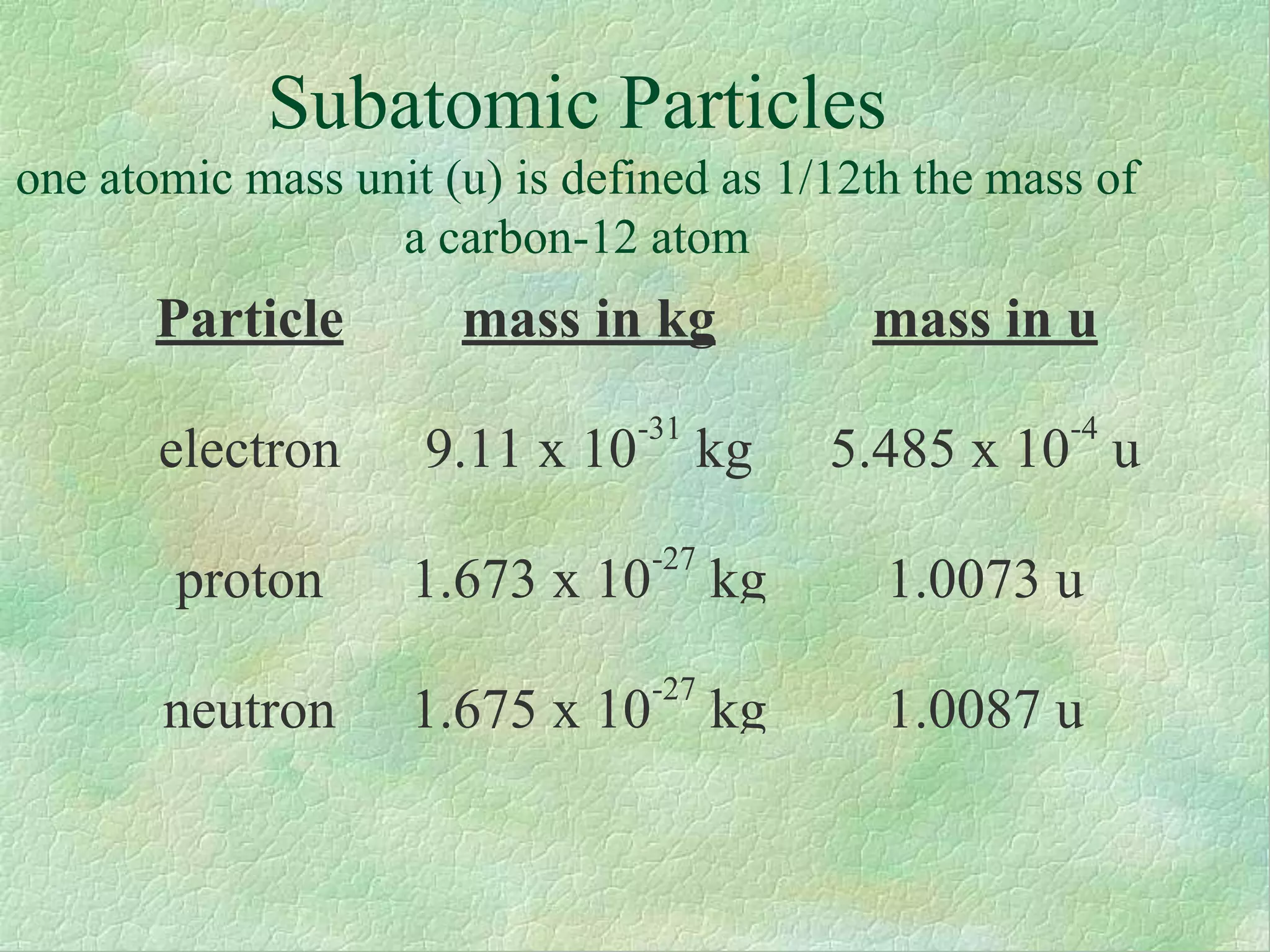
Subatomic Particles
one atomic mass unit (u) is defined as 1/12th the mass of
a carbon-12 atom
Particle mass in kg mass in u
electron 9.11 x 10⁻³¹
kg 5.485 x 10⁻⁴
u
proton 1.673 x 10⁻²⁷
kg 1.0073 u
neutron 1.675 x 10⁻²⁷
kg 1.0087 u
Mass Defect
• Carbon-12 has a mass of 12.000 u
• Its nucleus contains 12 nucleons (6 p & 6n)
• Each nucleon has a mass >1 u
• The mass of a nucleus is slightly less than
the mass of the individual nucleons
• The missing mass is called the mass defect
• mass defect:m = mass nucleons - mass nucleus
Einstein’s Equation
• Energy and mass can be interconverted
• E = mc2
• When protons & neutrons are packed
together to form a nucleus, some of the
mass is converted to energy and released
• This amount of mass is equal to the force of
attraction holding the nucleons together
Einstein’s Equation
• The total energy required to break
up a nucleus into its constituent
protons & neutrons
• binding energy = mc2
• The nuclear binding energy is
measured in MeV which is much
larger than the few eV required to
hold electrons to an atom
Binding Energy Curve
• graph peaks at A=56
• the more BE released
per nucleon, the more
stable the nucleus
• mass number of 56 is
maximum possible
stability
§ Theoretically, all nuclei will try to become larger
or smaller to attain as mass number of nucleons
§ To the right of 56 => want to become smaller
§ To the left of 56 => want become larger
How Many Neutrons?
§ The number of neutrons in a nucleus can
vary
§ Range limited by the degree of instability
created by
 having too many neutrons
 too few neutrons
§ Stable nuclei do not decay spontaneously
§ Unstable nuclei have a certain probability to
decay
Nuclear Stability Facts
§ 270 Stable nuclides
§ 1700 radionuclides
§ Every element has at least one one
radioisotope
§ For light elements (Z20), Z:N ratio is ~1
§ Z:N ratio increases toward 1.5 for heavy
elements
§ For Z>83, all isotopes are radioactive
Nuclear Stability Facts
§ The greater the number of protons, the more
neutrons are needed
§ “Magic numbers” of protons or neutrons
which are unusually stable
 2, 8, 20, 28, 50, 82, 126
• Sn (Z=50) has 10 isotopes; In (Z=49)& Sb (Z=51)
have only 2
• Pb-208 has a double magic number (126n, 82p) & is
very stable
Band of Nuclear Stability
§ A plot of the known isotopes
on a neutron/proton grid
gives
§ Stable isotopes form a band
of stability from H to U
§ Z:N ratios to either side of
this band are too unstable &
are not known
Nuclear Band of Stability
Radioactivity
• The spontaneous decomposition of an
unstable nucleus into a more stable nucleus
by releasing fragments or energy.
• Sometimes it releases both.
Electromagnetic Radiation
§ Electromagnetic radiation is a form of
energy that can pass through empty space
§ It is not just a particle, and it is not just a
wave. It may be both.
Electromagnetic Radiation
§ The shorter the wavelength, the more
energy it possesses
§ gamma rays are very energetic
§ radio waves are not ver energetic
Some Types of Radioactive
Decay
• Alpha Decay (increases N:Z ratio)
• Beta Decay (decreases N:Z ratio)
• Gamma Decay
Alpha Emission
• Z
AX Z-2
A-4
Y + 2
4

• Identity of the atom changes
• 92
235
U 90
231
Th + 2
4

• Quick way for a large atom to lose a lot of nucleons
Beta Emission
• Ejection of a high speed electron from the nucleus
• Z
AX Z+1
A
Y + 0
-1

• 19
40
K 20
40
Ca + 0
-1

• Identity of atom changes
Gamma Emission
• Emission of high energy electromagnetic radiation
• Usually occurs after emission of a decay particle
forms a metastable nucleus
• Does not change the isotope or element
Radiation Energetics
§ Alpha Particles
 relatively heavy and doubly charged
 lose energy quickly in matter
§ Beta Particles
 much smaller and singly charged
 interact more slowly with matter
§ Gamma Rays & X-rays
 high energy
 more lengthy interaction with matter
Hazards of Radiation Types
§ Alpha Emissions
 easily shielded
 considered hazardous if alpha emitting material
is ingested or inhaled
§ Beta Emissions
 shielded by thin layers of material
 considered hazardous is a beta emitter is
ingested or inhaled
§ Gamma Emissions
 need dense material for shielding
 considered hazardous when external to the body
Radioactive Decay Rates
§ Relative stability of nuclei can be expressed
in terms of the time required for half of the
sample to decay
§ Examples: time for 1 g to decay to .5 g
 Co-60 5 yr
 Cu-64 13 h
 U-238 4.51 x 10⁹ yr
 U-235 7.1 x 10⁸ yr
Half-Life
The time required for half of a sample to decay
Half-Life
§ The level of radioactivity of an isotope is
inversely proportional to its half-life.
 The shorter the half-life, more unstable the
nucleus
§ The half-life of a radionuclide is constant
§ Rate of disintegration is independent of
temperature or the number of radioactive
nuclei present
Half-Life
Number of
Half-Lives
Fraction of
Initial Amount
Remaining
Amount
Remaining (mg)
0 1 20.00 (initial)
1 1/2 10.00
2 1/4 5.00
3 1/8 2.50
4 1/16 1.25
5 1/32 0.625
Half-Life
§ A plot the logarithm of activity vs. the time is a
straight line.
§ The quantity of any radioactive element will diminish
by a factor of 1000 during a 10 half-life span
Trying To Reach Nuclear
Stability
§ Some nuclides (particularly those Z>83)
cannot attain a stable, nonradioactive
nucleus by a single emission.
§ The product of such an emission is itself
radioactive and will undergo a further decay
process.
§ Heavy nuclei may undergo a whole decay
series of nuclear disintegrations before
reaching a nonradioactive product.
Decay Series
A series of elements produced
from the successive emission of alpha
& beta particles
The Four Known Decay Series
Parent
Radioisotope
# of Decay
Steps
Final Product
of Series
Uranium-238 14 Lead-206
Thorium-232 10 Lead-208
Uranium-235 11 Lead-207
Plutonium-241 13 Bismuth-209
The Radon Story
Radon-222
§ Originates from U-238 which occurs
naturally in most types of granite
§ Radon-222 has a half-life of 3.825 days
§ It decays via alpha emissions
§ This isotope is a particular problem because
it is a gas which can leave the surrounding
rock and enter buildings with the
atmospheric air
nuclear chemistry ppt.ppt

nuclear chemistry ppt.ppt

  • 1.
    NUCLEAR CHEMISTRY Dr.A.Ramya., M.Sc.,M.Phil., Ph.D., Assistant Professor of Chemistry EMG Yadava Women’s College Madurai-14
  • 2.
    The Nucleus • Thenucleus is composed of nucleons – protons – neutrons • A nucleus is characterized by two numbers – atomic mass number(A; total # of nucleons) – atomic number (Z; number of protons) Z A E
  • 3.
    13 27 Al • total numberof nucleons is 27 • total number of protons is 13 • the number of neutrons is 14
  • 4.
    Subatomic Particles one atomicmass unit (u) is defined as 1/12th the mass of a carbon-12 atom Particle mass in kg mass in u electron 9.11 x 10⁻³¹ kg 5.485 x 10⁻⁴ u proton 1.673 x 10⁻²⁷ kg 1.0073 u neutron 1.675 x 10⁻²⁷ kg 1.0087 u
  • 5.
    Mass Defect • Carbon-12has a mass of 12.000 u • Its nucleus contains 12 nucleons (6 p & 6n) • Each nucleon has a mass >1 u • The mass of a nucleus is slightly less than the mass of the individual nucleons • The missing mass is called the mass defect • mass defect:m = mass nucleons - mass nucleus
  • 6.
    Einstein’s Equation • Energyand mass can be interconverted • E = mc2 • When protons & neutrons are packed together to form a nucleus, some of the mass is converted to energy and released • This amount of mass is equal to the force of attraction holding the nucleons together
  • 7.
    Einstein’s Equation • Thetotal energy required to break up a nucleus into its constituent protons & neutrons • binding energy = mc2 • The nuclear binding energy is measured in MeV which is much larger than the few eV required to hold electrons to an atom
  • 8.
    Binding Energy Curve •graph peaks at A=56 • the more BE released per nucleon, the more stable the nucleus • mass number of 56 is maximum possible stability
  • 9.
    § Theoretically, allnuclei will try to become larger or smaller to attain as mass number of nucleons § To the right of 56 => want to become smaller § To the left of 56 => want become larger
  • 10.
    How Many Neutrons? §The number of neutrons in a nucleus can vary § Range limited by the degree of instability created by  having too many neutrons  too few neutrons § Stable nuclei do not decay spontaneously § Unstable nuclei have a certain probability to decay
  • 11.
    Nuclear Stability Facts §270 Stable nuclides § 1700 radionuclides § Every element has at least one one radioisotope § For light elements (Z20), Z:N ratio is ~1 § Z:N ratio increases toward 1.5 for heavy elements § For Z>83, all isotopes are radioactive
  • 12.
    Nuclear Stability Facts §The greater the number of protons, the more neutrons are needed § “Magic numbers” of protons or neutrons which are unusually stable  2, 8, 20, 28, 50, 82, 126 • Sn (Z=50) has 10 isotopes; In (Z=49)& Sb (Z=51) have only 2 • Pb-208 has a double magic number (126n, 82p) & is very stable
  • 13.
    Band of NuclearStability § A plot of the known isotopes on a neutron/proton grid gives § Stable isotopes form a band of stability from H to U § Z:N ratios to either side of this band are too unstable & are not known
  • 15.
    Nuclear Band ofStability
  • 16.
    Radioactivity • The spontaneousdecomposition of an unstable nucleus into a more stable nucleus by releasing fragments or energy. • Sometimes it releases both.
  • 17.
    Electromagnetic Radiation § Electromagneticradiation is a form of energy that can pass through empty space § It is not just a particle, and it is not just a wave. It may be both.
  • 18.
    Electromagnetic Radiation § Theshorter the wavelength, the more energy it possesses § gamma rays are very energetic § radio waves are not ver energetic
  • 19.
    Some Types ofRadioactive Decay • Alpha Decay (increases N:Z ratio) • Beta Decay (decreases N:Z ratio) • Gamma Decay
  • 20.
    Alpha Emission • Z AXZ-2 A-4 Y + 2 4  • Identity of the atom changes • 92 235 U 90 231 Th + 2 4  • Quick way for a large atom to lose a lot of nucleons
  • 21.
    Beta Emission • Ejectionof a high speed electron from the nucleus • Z AX Z+1 A Y + 0 -1  • 19 40 K 20 40 Ca + 0 -1  • Identity of atom changes
  • 22.
    Gamma Emission • Emissionof high energy electromagnetic radiation • Usually occurs after emission of a decay particle forms a metastable nucleus • Does not change the isotope or element
  • 23.
    Radiation Energetics § AlphaParticles  relatively heavy and doubly charged  lose energy quickly in matter § Beta Particles  much smaller and singly charged  interact more slowly with matter § Gamma Rays & X-rays  high energy  more lengthy interaction with matter
  • 25.
    Hazards of RadiationTypes § Alpha Emissions  easily shielded  considered hazardous if alpha emitting material is ingested or inhaled § Beta Emissions  shielded by thin layers of material  considered hazardous is a beta emitter is ingested or inhaled § Gamma Emissions  need dense material for shielding  considered hazardous when external to the body
  • 26.
    Radioactive Decay Rates §Relative stability of nuclei can be expressed in terms of the time required for half of the sample to decay § Examples: time for 1 g to decay to .5 g  Co-60 5 yr  Cu-64 13 h  U-238 4.51 x 10⁹ yr  U-235 7.1 x 10⁸ yr
  • 27.
    Half-Life The time requiredfor half of a sample to decay
  • 28.
    Half-Life § The levelof radioactivity of an isotope is inversely proportional to its half-life.  The shorter the half-life, more unstable the nucleus § The half-life of a radionuclide is constant § Rate of disintegration is independent of temperature or the number of radioactive nuclei present
  • 30.
    Half-Life Number of Half-Lives Fraction of InitialAmount Remaining Amount Remaining (mg) 0 1 20.00 (initial) 1 1/2 10.00 2 1/4 5.00 3 1/8 2.50 4 1/16 1.25 5 1/32 0.625
  • 31.
    Half-Life § A plotthe logarithm of activity vs. the time is a straight line. § The quantity of any radioactive element will diminish by a factor of 1000 during a 10 half-life span
  • 32.
    Trying To ReachNuclear Stability § Some nuclides (particularly those Z>83) cannot attain a stable, nonradioactive nucleus by a single emission. § The product of such an emission is itself radioactive and will undergo a further decay process. § Heavy nuclei may undergo a whole decay series of nuclear disintegrations before reaching a nonradioactive product.
  • 33.
    Decay Series A seriesof elements produced from the successive emission of alpha & beta particles
  • 35.
    The Four KnownDecay Series Parent Radioisotope # of Decay Steps Final Product of Series Uranium-238 14 Lead-206 Thorium-232 10 Lead-208 Uranium-235 11 Lead-207 Plutonium-241 13 Bismuth-209
  • 37.
  • 38.
    Radon-222 § Originates fromU-238 which occurs naturally in most types of granite § Radon-222 has a half-life of 3.825 days § It decays via alpha emissions § This isotope is a particular problem because it is a gas which can leave the surrounding rock and enter buildings with the atmospheric air