RADIOACTIVE ISOTOPES – RADIOACTIVE
DECAY
Submitted by,
R. Pavithra
RADIOACTIVE ISOTOPES
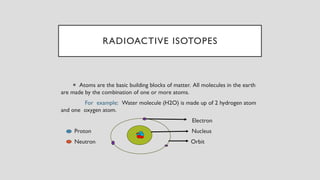
⁕ Atoms are the basic building blocks of matter. All molecules in the earth
are made by the combination of one or more atoms.
For example: Water molecule (H2O) is made up of 2 hydrogen atom
and one oxygen atom.
Electron
Proton Nucleus
Neutron Orbit
⁕ Atom word meaning was ‘indivisible’. Because in olden days scientist
thought atoms are not divisible(very small). But, nowadays all people know that
atom is made up of 3 subatomic particles. That is electron, proton and neutron.
So, atom can able to divide into subatomic particles.
⁕ Electron is negative charge. Proton are positive charge and the neutron
are neutral charge. So, atom is in neutral charge.
⁕ Atom can be measured as picometer(pm) and Angstrom(Å).
1000 pm = 1 nm 1 Å = 100 pm
⁕ Atom size range in 3 to 30 pm. When we take it in angstrom atom is
0.3 Å in size.
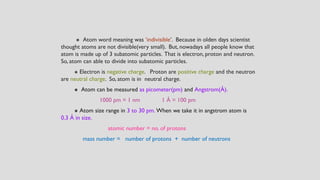
atomic number = no. of protons
mass number = number of protons + number of neutrons
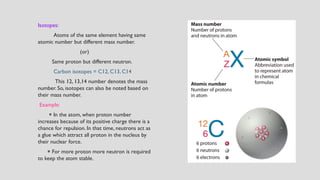
Isotopes:
Atoms of the same element having same
atomic number but different mass number.
(or)
Same proton but different neutron.
Carbon isotopes = C12, C13, C14
This 12, 13,14 number denotes the mass
number. So, isotopes can also be noted based on
their mass number.
Example:
⁕ In the atom, when proton number
increases because of its positive charge there is a
chance for repulsion. In that time, neutrons act as
a glue which attract all proton in the nucleus by
their nuclear force.
⁕ For more proton more neutron is required
to keep the atom stable.
ISOTOPES
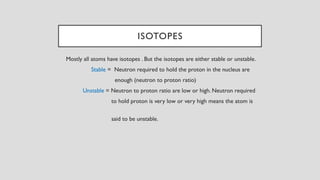
Mostly all atoms have isotopes . But the isotopes are either stable or unstable.
Stable = Neutron required to hold the proton in the nucleus are
enough (neutron to proton ratio)
Unstable = Neutron to proton ratio are low or high. Neutron required
to hold proton is very low or very high means the atom is
said to be unstable.
RADIOACTIVE ISOTOPES
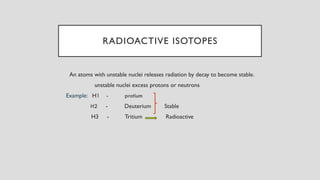
An atoms with unstable nuclei releases radiation by decay to become stable.
unstable nuclei excess protons or neutrons
Example: H1 - protium
H2 - Deuterium Stable
H3 - Tritium Radioactive
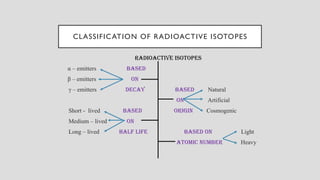
CLASSIFICATION OF RADIOACTIVE ISOTOPES
Radioactive isotopes
α – emitters Based
β – emitters on
γ – emitters Decay Based Natural
on Artificial
Short - lived Based Origin Cosmogenic
Medium – lived on
Long – lived Half life Based on Light
atomic number Heavy
Classification:
Based on decay:
α emitters -The unstable atom which emit alpha particles to become
stable. Example: Uranium -238
emitters
β –The unstable atom which emit beta particles to become
stable. Example: Carbon -14
emitters
γ –The unstable atom which emit gamma radiation to become
stable. Example: Cobalt – 60
Based on Origin:
Natural : The isotopes which are present in the environment naturally.
Artificial: The isotopes created in laboratories or nuclear reactors.
(Iodone-131). Mostly artificial isotopes are radioactive.
Cosmogenic: Cosmic rays in the universe react with the stable nuclei in the
atmosphere form cosmogenic isotopes. Example: C14 (Cosmic rays + N14)
Based on atomic number:
Light – atoms with low atomic number example : H3(tritium)
Heavy – atoms with high atomic number.
Based on half life:
Half life:
Half life refers the time required for the exactly half of the entities(atom) to
decay. For example: 1 second is required for the atom is undergo decay and
become stable means 0.5 second is the half life of that atom.
Short-lived = half life seconds to days. (Iodine-131)
Medium – lived = days to years. (Cobalt-60)
Long – lived = years to billions. (Uranium-238 – 4.5 billion years)
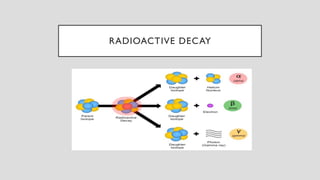
RADIOACTIVE DECAY
⁕ It is a natural process by which unstable nuclei lose energy by emitting
radiation to become stable.
⁕ This process results in the transformation of one element into another or
the release of energy.
Types of radioactive decay:
• Alpha decay
• Beta decay
• Gamma decay
ALPHA DECAY
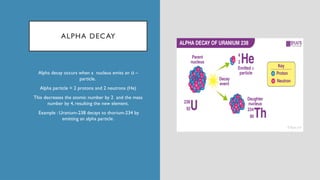
Alpha decay occurs when a nucleus emits an α –
particle.
Alpha particle = 2 protons and 2 neutrons (He)
This decreases the atomic number by 2 and the mass
number by 4, resulting the new element.
Example : Uranium-238 decays to thorium-234 by
emitting an alpha particle.
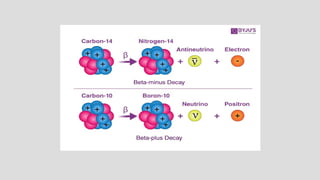
2. Beta Decay :
Conversion of neutron into a proton within the nucleus, resulting in the emission
of beta particle (an electron or positron).
This changes the atomic number by 1 but the mass number unchanged, resulting in
a different element.
Example: Carbon – 14 decays into Nitrogen-14 by emitting a beta particle.
Two types :
1. Beta minus decay
2. Beta plus decay
Beta minus decay – Neutron present in the atom is converted to proton by emitting
electron and antineutrino.
Beta plus decay – Proton present in the atom is converted to neutron by emitting
positron with neutrino.
Positron(antielectron) because it has same mass as electron but it is positive charge.
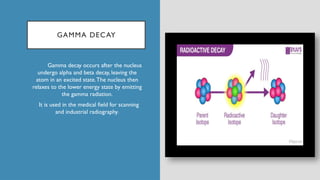
GAMMA DECAY
Gamma decay occurs after the nucleus
undergo alpha and beta decay, leaving the
atom in an excited state.The nucleus then
relaxes to the lower energy state by emitting
the gamma radiation.
It is used in the medical field for scanning
and industrial radiography.
RADIOACTIVE DECAY
APPLICATIONS
• Carbon 14 - Used in radiocarbon dating. (Cosmic rays + nitrogen 14 = C14)
in environment it is in the form of CO2. plants utilize it and produce its food
while humans and animals consume it enters their body after the organism
died detecting the stage of C14 decay age can be detected.
• Amercium-241 – It is an alpha emitter used in smoke detector.
• Helium produced in alpha decay were collected and used for cryogenics and as
a lifting gas in balloons.
• Uranium-238 – Used in uranium-lead dating of rocks.
• Plutonium -238 –While it decay it produce heat it is used for electricity in
spacecraft.
THANK YOU

Radioactive isotopes – radioactive decay1.pptx

  • 1.
    RADIOACTIVE ISOTOPES –RADIOACTIVE DECAY Submitted by, R. Pavithra
  • 2.
    RADIOACTIVE ISOTOPES ⁕ Atomsare the basic building blocks of matter. All molecules in the earth are made by the combination of one or more atoms. For example: Water molecule (H2O) is made up of 2 hydrogen atom and one oxygen atom. Electron Proton Nucleus Neutron Orbit
  • 3.
    ⁕ Atom wordmeaning was ‘indivisible’. Because in olden days scientist thought atoms are not divisible(very small). But, nowadays all people know that atom is made up of 3 subatomic particles. That is electron, proton and neutron. So, atom can able to divide into subatomic particles. ⁕ Electron is negative charge. Proton are positive charge and the neutron are neutral charge. So, atom is in neutral charge. ⁕ Atom can be measured as picometer(pm) and Angstrom(Å). 1000 pm = 1 nm 1 Å = 100 pm ⁕ Atom size range in 3 to 30 pm. When we take it in angstrom atom is 0.3 Å in size. atomic number = no. of protons mass number = number of protons + number of neutrons
  • 4.
    Isotopes: Atoms of thesame element having same atomic number but different mass number. (or) Same proton but different neutron. Carbon isotopes = C12, C13, C14 This 12, 13,14 number denotes the mass number. So, isotopes can also be noted based on their mass number. Example: ⁕ In the atom, when proton number increases because of its positive charge there is a chance for repulsion. In that time, neutrons act as a glue which attract all proton in the nucleus by their nuclear force. ⁕ For more proton more neutron is required to keep the atom stable.
  • 5.
    ISOTOPES Mostly all atomshave isotopes . But the isotopes are either stable or unstable. Stable = Neutron required to hold the proton in the nucleus are enough (neutron to proton ratio) Unstable = Neutron to proton ratio are low or high. Neutron required to hold proton is very low or very high means the atom is said to be unstable.
  • 6.
    RADIOACTIVE ISOTOPES An atomswith unstable nuclei releases radiation by decay to become stable. unstable nuclei excess protons or neutrons Example: H1 - protium H2 - Deuterium Stable H3 - Tritium Radioactive
  • 7.
    CLASSIFICATION OF RADIOACTIVEISOTOPES Radioactive isotopes α – emitters Based β – emitters on γ – emitters Decay Based Natural on Artificial Short - lived Based Origin Cosmogenic Medium – lived on Long – lived Half life Based on Light atomic number Heavy
  • 8.
    Classification: Based on decay: αemitters -The unstable atom which emit alpha particles to become stable. Example: Uranium -238 emitters β –The unstable atom which emit beta particles to become stable. Example: Carbon -14 emitters γ –The unstable atom which emit gamma radiation to become stable. Example: Cobalt – 60 Based on Origin: Natural : The isotopes which are present in the environment naturally. Artificial: The isotopes created in laboratories or nuclear reactors. (Iodone-131). Mostly artificial isotopes are radioactive. Cosmogenic: Cosmic rays in the universe react with the stable nuclei in the atmosphere form cosmogenic isotopes. Example: C14 (Cosmic rays + N14)
  • 9.
    Based on atomicnumber: Light – atoms with low atomic number example : H3(tritium) Heavy – atoms with high atomic number. Based on half life: Half life: Half life refers the time required for the exactly half of the entities(atom) to decay. For example: 1 second is required for the atom is undergo decay and become stable means 0.5 second is the half life of that atom. Short-lived = half life seconds to days. (Iodine-131) Medium – lived = days to years. (Cobalt-60) Long – lived = years to billions. (Uranium-238 – 4.5 billion years)
  • 10.
    RADIOACTIVE DECAY ⁕ Itis a natural process by which unstable nuclei lose energy by emitting radiation to become stable. ⁕ This process results in the transformation of one element into another or the release of energy. Types of radioactive decay: • Alpha decay • Beta decay • Gamma decay
  • 11.
    ALPHA DECAY Alpha decayoccurs when a nucleus emits an α – particle. Alpha particle = 2 protons and 2 neutrons (He) This decreases the atomic number by 2 and the mass number by 4, resulting the new element. Example : Uranium-238 decays to thorium-234 by emitting an alpha particle.
  • 12.
    2. Beta Decay: Conversion of neutron into a proton within the nucleus, resulting in the emission of beta particle (an electron or positron). This changes the atomic number by 1 but the mass number unchanged, resulting in a different element. Example: Carbon – 14 decays into Nitrogen-14 by emitting a beta particle. Two types : 1. Beta minus decay 2. Beta plus decay Beta minus decay – Neutron present in the atom is converted to proton by emitting electron and antineutrino. Beta plus decay – Proton present in the atom is converted to neutron by emitting positron with neutrino. Positron(antielectron) because it has same mass as electron but it is positive charge.
  • 14.
    GAMMA DECAY Gamma decayoccurs after the nucleus undergo alpha and beta decay, leaving the atom in an excited state.The nucleus then relaxes to the lower energy state by emitting the gamma radiation. It is used in the medical field for scanning and industrial radiography.
  • 15.
  • 16.
    APPLICATIONS • Carbon 14- Used in radiocarbon dating. (Cosmic rays + nitrogen 14 = C14) in environment it is in the form of CO2. plants utilize it and produce its food while humans and animals consume it enters their body after the organism died detecting the stage of C14 decay age can be detected. • Amercium-241 – It is an alpha emitter used in smoke detector. • Helium produced in alpha decay were collected and used for cryogenics and as a lifting gas in balloons. • Uranium-238 – Used in uranium-lead dating of rocks. • Plutonium -238 –While it decay it produce heat it is used for electricity in spacecraft.
  • 17.