Presented by: Muhammad Salman BSCHEM01173013
1
Muhammad Deen BSCHEM01173031
Muhammad Zeeshan BSCHEM01173036
Hafiz Muhammad Saad Ali BSCHEM01173025
Muhammad Waqas BSCHEM01173011
BS Chemistry (8th Semester)
GROUP NO II
CONTENTS
• Radiation
• Dosimetry
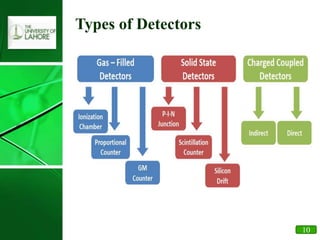
• Types
• Gas Filled Detectors
• Ionization Chamber
• GM Counter
• Scintillation Counter
2
3
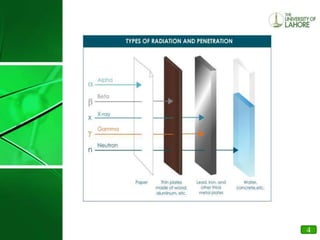
Radiation
Radiation is the kind of energy, that comes from a
source & travels through space & may be able to
penetrate various materials
Or
Is the emission of energy as electromagnetic waves or as
moving subatomic particles, especially high-energy
particles which cause ionization.
Types of the radiation
(1) CHARGED PARTICLES (2) UNCHARGED PARTICLES
(a) Alpha Radiation (a) Gamma Radiation
(b) Beta Radiation (b) Neutrons
4
Dosimetry
• Radiation Dosimetry is a study in physics which deals with
the measurement of radiation which may include Exposure,
Absorbed dose etc.,
• Detectors that indicate the net amount of energy deposited in
the detector by multiple interactions are called dosimeters
• Dosimetry is extensively used for radiation protection and is
routinely applied to radiation workers, where irradiation is
expected but regulatory levels must not be exceeded.
• Dosimetry contains required quantitative methods which are
used to determine the dose of radiation, which helps in,
a. The need of protection against ionizing radiation,
b. Application of radiation in medicine.
5
Dosimetric quantities
1. Activity
2. Exposure
3. Absorbed dose
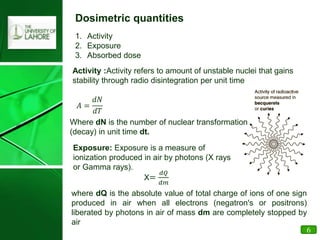
Activity :Activity refers to amount of unstable nuclei that gains
stability through radio disintegration per unit time
𝐴 =
𝑑𝑁
𝑑𝑇
Where dN is the number of nuclear transformation
(decay) in unit time dt.
Exposure: Exposure is a measure of
ionization produced in air by photons (X rays
or Gamma rays).
X=
𝑑𝑄
𝑑𝑚
where dQ is the absolute value of total charge of ions of one sign
produced in air when all electrons (negatron's or positrons)
liberated by photons in air of mass dm are completely stopped by
air
6
• SI unit of exposure is C/Kg.
• Special Unit of exposure is Roentgen.
• It is applicable only for:
• Photon energies below 3 MeV
• Interaction is only between photons and air.
Absorbed dose:
The Absorbed dose (D), is the energy absorbed per unit
mass. This quantity is defined for all ionizing radiation (not only
for EM radiation, as in the case of the exposure) and for any
material.
D=
𝑑𝐸
𝑑𝑚
where, dE is the energy imparted to matter of mass dm.
The unit of absorbed dose is Gray.
7
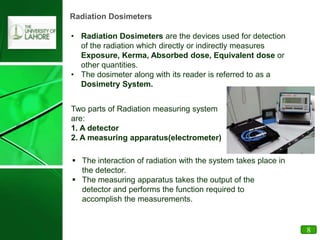
Radiation Dosimeters
• Radiation Dosimeters are the devices used for detection
of the radiation which directly or indirectly measures
Exposure, Kerma, Absorbed dose, Equivalent dose or
other quantities.
• The dosimeter along with its reader is referred to as a
Dosimetry System.
Two parts of Radiation measuring system
are:
1. A detector
2. A measuring apparatus(electrometer)
 The interaction of radiation with the system takes place in
the detector.
 The measuring apparatus takes the output of the
detector and performs the function required to
accomplish the measurements.
8
Properties of an useful dosimeter
are as follows
1. High accuracy and precision
2. Linearity of signal with dose over a wide range
3. Small dose and dose rate dependence
4. Flat Energy response(Quality dependence)
5. Small directional dependence
6. High spatial resolution
9
Types of Detectors
10
7
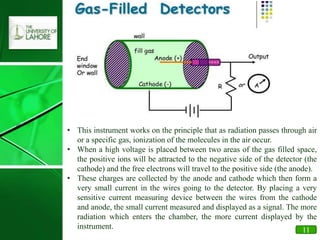
• This instrument works on the principle that as radiation passes through air
or a specific gas, ionization of the molecules in the air occur.
• When a high voltage is placed between two areas of the gas filled space,
the positive ions will be attracted to the negative side of the detector (the
cathode) and the free electrons will travel to the positive side (the anode).
• These charges are collected by the anode and cathode which then form a
very small current in the wires going to the detector. By placing a very
sensitive current measuring device between the wires from the cathode
and anode, the small current measured and displayed as a signal. The more
radiation which enters the chamber, the more current displayed by the
instrument. 11
7
12
21
Types of Gas Filled Detectors
• Ionization chamber
• Proportional counter
• GM counter
 Ionization chambers have wider range of physical shape (parallel
plates, concentric cylinders, etc.)
 Proportional counters and GM counters must have thin wire anode
13
21
14
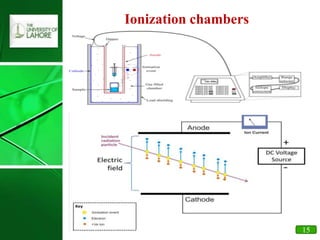
 “Ionization chamber measures the charge from the number of
ion pairs created within a gas caused by incident radiation.”
 Ion-pairs move towards opposite polarity electrodes
 Generating an ionization current which is measured by an
electrometer circuit.
 The chamber cannot discriminate between radiation types (beta
or gamma).
 It cannot produce an energy spectrum of radiation
 Straight pleateu as there is no “multiplication” and also no
“recombination”.
Ionization chambers
Ionization chambers
15
16
1. Nuclear industry:
o Used where a constant high dose rate is being measured
o They have a greater operating lifetime than standard GM
tubes, which suffer from gas break down.
2. Smoke detectors:
i. Ionization chamber contains an alpha-emitter
ii. Producing constant ion current
iii. Smoke enters, disrupts this current because ions strike smoke
particles and are neutralized.
iv. This drop in current triggers the alarm
3. Medical radiation measurement:
Ionization chambers are used to ensure that the dose delivered from
a therapy unit.
Applications
11
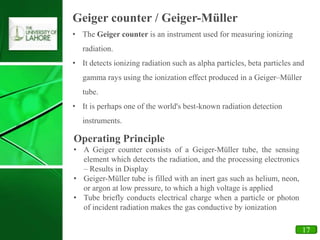
• The Geiger counter is an instrument used for measuring ionizing
radiation.
• It detects ionizing radiation such as alpha particles, beta particles and
gamma rays using the ionization effect produced in a Geiger–Müller
tube.
• It is perhaps one of the world's best-known radiation detection
instruments.
Geiger counter / Geiger-Müller
Operating Principle
• A Geiger counter consists of a Geiger-Müller tube, the sensing
element which detects the radiation, and the processing electronics
– Results in Display
• Geiger-Müller tube is filled with an inert gas such as helium, neon,
or argon at low pressure, to which a high voltage is applied
• Tube briefly conducts electrical charge when a particle or photon
of incident radiation makes the gas conductive by ionization
17
12
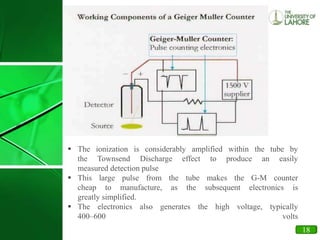
 The ionization is considerably amplified within the tube by
the Townsend Discharge effect to produce an easily
measured detection pulse
 This large pulse from the tube makes the G-M counter
cheap to manufacture, as the subsequent electronics is
greatly simplified.
 The electronics also generates the high voltage, typically
400–600 volts
18
13
Application
• For the detection of alpha and beta particles
• To detect radioactive rocks and minerals in the course of mineral
prospecting or as a mineral collector
• To check for environmental levels of radioactivity
• For Fire and Police first responders to a analysis for making an initial
determination of radiation risk.
19
14
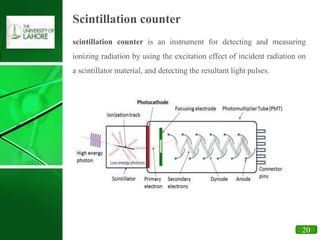
Scintillation counter
scintillation counter is an instrument for detecting and measuring
ionizing radiation by using the excitation effect of incident radiation on
a scintillator material, and detecting the resultant light pulses.
20
15
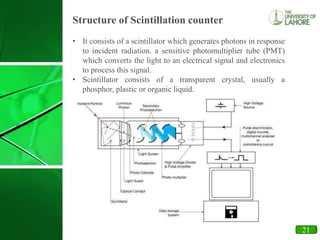
Structure of Scintillation counter
• It consists of a scintillator which generates photons in response
to incident radiation. a sensitive photomultiplier tube (PMT)
which converts the light to an electrical signal and electronics
to process this signal.
• Scintillator consists of a transparent crystal, usually a
phosphor, plastic or organic liquid.
21
16
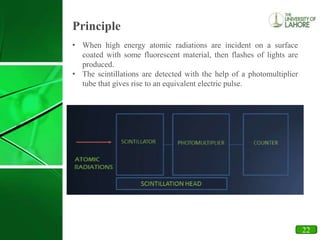
Principle
• When high energy atomic radiations are incident on a surface
coated with some fluorescent material, then flashes of lights are
produced.
• The scintillations are detected with the help of a photomultiplier
tube that gives rise to an equivalent electric pulse.
22
17
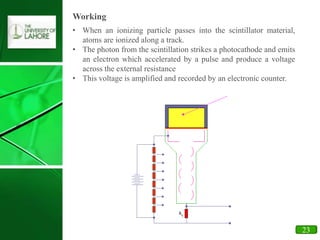
Working
• When an ionizing particle passes into the scintillator material,
atoms are ionized along a track.
• The photon from the scintillation strikes a photocathode and emits
an electron which accelerated by a pulse and produce a voltage
across the external resistance
• This voltage is amplified and recorded by an electronic counter.
23
19
Application
• Scintillation counters are used to measure radiation in a variety of
applications including hand held radiation survey meters, personnel
and environmental monitoring for radioactive contamination,
medical imaging, radiometric assay, nuclear security and nuclear
plant safety.
• Scintillation counters designed for freight terminals, border security,
ports, weigh bridge applications, scrap metal yards and
contamination monitoring of nuclear waste.
24
19
References
1. C Baldock, Y De Deene, S Doran, G Ibbott, A Jirasek, M Lepage, KB
McAuley, M Oldham, LJ Schreiner 2010. Polymer gel dosimetry. Physics in
Medicine and Biology 55 (5) R1
2. Feinendegen LE. The cell dose concept; potential application in radiation
protection. 1990 Phys. Med. Biol. 35 597
3. Senthil Srinivasan, V.S.; Pandya, Arun (2011). "Dosimetry aspects of
hafnium oxide metal-oxide-semiconductor (MOS) capacitor". Thin Solid
Films. 520 (1): 574–
577. Bibcode:2011TSF...520..574S. doi:10.1016/j.tsf.2011.07.010.
4. Curran, Samuel C. (1949). Counting tubes, theory and applications.
Academic Press (New York). p. 235.
5. ^ Oxford Dictionary of National Biography
6. ^ "Automatic Radiation Detection and Monitoring System". Archived
from the original on 2014-08-14.
7. ^ "Automatic Radiation Detection Vehicles". Archived from the original on
2014-08-14.
8. ^ Portable MicroR Survey Meters Archived 2009-12-07 at the Wayback
Machine
25


Nuclear detectors

  • 1.
    Presented by: MuhammadSalman BSCHEM01173013 1 Muhammad Deen BSCHEM01173031 Muhammad Zeeshan BSCHEM01173036 Hafiz Muhammad Saad Ali BSCHEM01173025 Muhammad Waqas BSCHEM01173011 BS Chemistry (8th Semester) GROUP NO II
  • 2.
    CONTENTS • Radiation • Dosimetry •Types • Gas Filled Detectors • Ionization Chamber • GM Counter • Scintillation Counter 2
  • 3.
    3 Radiation Radiation is thekind of energy, that comes from a source & travels through space & may be able to penetrate various materials Or Is the emission of energy as electromagnetic waves or as moving subatomic particles, especially high-energy particles which cause ionization. Types of the radiation (1) CHARGED PARTICLES (2) UNCHARGED PARTICLES (a) Alpha Radiation (a) Gamma Radiation (b) Beta Radiation (b) Neutrons
  • 4.
  • 5.
    Dosimetry • Radiation Dosimetryis a study in physics which deals with the measurement of radiation which may include Exposure, Absorbed dose etc., • Detectors that indicate the net amount of energy deposited in the detector by multiple interactions are called dosimeters • Dosimetry is extensively used for radiation protection and is routinely applied to radiation workers, where irradiation is expected but regulatory levels must not be exceeded. • Dosimetry contains required quantitative methods which are used to determine the dose of radiation, which helps in, a. The need of protection against ionizing radiation, b. Application of radiation in medicine. 5
  • 6.
    Dosimetric quantities 1. Activity 2.Exposure 3. Absorbed dose Activity :Activity refers to amount of unstable nuclei that gains stability through radio disintegration per unit time 𝐴 = 𝑑𝑁 𝑑𝑇 Where dN is the number of nuclear transformation (decay) in unit time dt. Exposure: Exposure is a measure of ionization produced in air by photons (X rays or Gamma rays). X= 𝑑𝑄 𝑑𝑚 where dQ is the absolute value of total charge of ions of one sign produced in air when all electrons (negatron's or positrons) liberated by photons in air of mass dm are completely stopped by air 6
  • 7.
    • SI unitof exposure is C/Kg. • Special Unit of exposure is Roentgen. • It is applicable only for: • Photon energies below 3 MeV • Interaction is only between photons and air. Absorbed dose: The Absorbed dose (D), is the energy absorbed per unit mass. This quantity is defined for all ionizing radiation (not only for EM radiation, as in the case of the exposure) and for any material. D= 𝑑𝐸 𝑑𝑚 where, dE is the energy imparted to matter of mass dm. The unit of absorbed dose is Gray. 7
  • 8.
    Radiation Dosimeters • RadiationDosimeters are the devices used for detection of the radiation which directly or indirectly measures Exposure, Kerma, Absorbed dose, Equivalent dose or other quantities. • The dosimeter along with its reader is referred to as a Dosimetry System. Two parts of Radiation measuring system are: 1. A detector 2. A measuring apparatus(electrometer)  The interaction of radiation with the system takes place in the detector.  The measuring apparatus takes the output of the detector and performs the function required to accomplish the measurements. 8
  • 9.
    Properties of anuseful dosimeter are as follows 1. High accuracy and precision 2. Linearity of signal with dose over a wide range 3. Small dose and dose rate dependence 4. Flat Energy response(Quality dependence) 5. Small directional dependence 6. High spatial resolution 9
  • 10.
  • 11.
    7 • This instrumentworks on the principle that as radiation passes through air or a specific gas, ionization of the molecules in the air occur. • When a high voltage is placed between two areas of the gas filled space, the positive ions will be attracted to the negative side of the detector (the cathode) and the free electrons will travel to the positive side (the anode). • These charges are collected by the anode and cathode which then form a very small current in the wires going to the detector. By placing a very sensitive current measuring device between the wires from the cathode and anode, the small current measured and displayed as a signal. The more radiation which enters the chamber, the more current displayed by the instrument. 11
  • 12.
  • 13.
    21 Types of GasFilled Detectors • Ionization chamber • Proportional counter • GM counter  Ionization chambers have wider range of physical shape (parallel plates, concentric cylinders, etc.)  Proportional counters and GM counters must have thin wire anode 13
  • 14.
    21 14  “Ionization chambermeasures the charge from the number of ion pairs created within a gas caused by incident radiation.”  Ion-pairs move towards opposite polarity electrodes  Generating an ionization current which is measured by an electrometer circuit.  The chamber cannot discriminate between radiation types (beta or gamma).  It cannot produce an energy spectrum of radiation  Straight pleateu as there is no “multiplication” and also no “recombination”. Ionization chambers
  • 15.
  • 16.
    16 1. Nuclear industry: oUsed where a constant high dose rate is being measured o They have a greater operating lifetime than standard GM tubes, which suffer from gas break down. 2. Smoke detectors: i. Ionization chamber contains an alpha-emitter ii. Producing constant ion current iii. Smoke enters, disrupts this current because ions strike smoke particles and are neutralized. iv. This drop in current triggers the alarm 3. Medical radiation measurement: Ionization chambers are used to ensure that the dose delivered from a therapy unit. Applications
  • 17.
    11 • The Geigercounter is an instrument used for measuring ionizing radiation. • It detects ionizing radiation such as alpha particles, beta particles and gamma rays using the ionization effect produced in a Geiger–Müller tube. • It is perhaps one of the world's best-known radiation detection instruments. Geiger counter / Geiger-Müller Operating Principle • A Geiger counter consists of a Geiger-Müller tube, the sensing element which detects the radiation, and the processing electronics – Results in Display • Geiger-Müller tube is filled with an inert gas such as helium, neon, or argon at low pressure, to which a high voltage is applied • Tube briefly conducts electrical charge when a particle or photon of incident radiation makes the gas conductive by ionization 17
  • 18.
    12  The ionizationis considerably amplified within the tube by the Townsend Discharge effect to produce an easily measured detection pulse  This large pulse from the tube makes the G-M counter cheap to manufacture, as the subsequent electronics is greatly simplified.  The electronics also generates the high voltage, typically 400–600 volts 18
  • 19.
    13 Application • For thedetection of alpha and beta particles • To detect radioactive rocks and minerals in the course of mineral prospecting or as a mineral collector • To check for environmental levels of radioactivity • For Fire and Police first responders to a analysis for making an initial determination of radiation risk. 19
  • 20.
    14 Scintillation counter scintillation counteris an instrument for detecting and measuring ionizing radiation by using the excitation effect of incident radiation on a scintillator material, and detecting the resultant light pulses. 20
  • 21.
    15 Structure of Scintillationcounter • It consists of a scintillator which generates photons in response to incident radiation. a sensitive photomultiplier tube (PMT) which converts the light to an electrical signal and electronics to process this signal. • Scintillator consists of a transparent crystal, usually a phosphor, plastic or organic liquid. 21
  • 22.
    16 Principle • When highenergy atomic radiations are incident on a surface coated with some fluorescent material, then flashes of lights are produced. • The scintillations are detected with the help of a photomultiplier tube that gives rise to an equivalent electric pulse. 22
  • 23.
    17 Working • When anionizing particle passes into the scintillator material, atoms are ionized along a track. • The photon from the scintillation strikes a photocathode and emits an electron which accelerated by a pulse and produce a voltage across the external resistance • This voltage is amplified and recorded by an electronic counter. 23
  • 24.
    19 Application • Scintillation countersare used to measure radiation in a variety of applications including hand held radiation survey meters, personnel and environmental monitoring for radioactive contamination, medical imaging, radiometric assay, nuclear security and nuclear plant safety. • Scintillation counters designed for freight terminals, border security, ports, weigh bridge applications, scrap metal yards and contamination monitoring of nuclear waste. 24
  • 25.
    19 References 1. C Baldock,Y De Deene, S Doran, G Ibbott, A Jirasek, M Lepage, KB McAuley, M Oldham, LJ Schreiner 2010. Polymer gel dosimetry. Physics in Medicine and Biology 55 (5) R1 2. Feinendegen LE. The cell dose concept; potential application in radiation protection. 1990 Phys. Med. Biol. 35 597 3. Senthil Srinivasan, V.S.; Pandya, Arun (2011). "Dosimetry aspects of hafnium oxide metal-oxide-semiconductor (MOS) capacitor". Thin Solid Films. 520 (1): 574– 577. Bibcode:2011TSF...520..574S. doi:10.1016/j.tsf.2011.07.010. 4. Curran, Samuel C. (1949). Counting tubes, theory and applications. Academic Press (New York). p. 235. 5. ^ Oxford Dictionary of National Biography 6. ^ "Automatic Radiation Detection and Monitoring System". Archived from the original on 2014-08-14. 7. ^ "Automatic Radiation Detection Vehicles". Archived from the original on 2014-08-14. 8. ^ Portable MicroR Survey Meters Archived 2009-12-07 at the Wayback Machine 25
  • 26.