DONE BY
SANGEETHA S
INTRODUCTION
 The instrument used to detect the nuclear particles or
radiation are called nuclear radiation detectors
 These are based on the principle of excitation or
ionization of atoms of medium in which the incident
charged particles pass through.
G-M counter
 The Geiger-Muller tube or the G-M tube is the sensor
element of the Geiger counter instrument used for the
detection of ionizing radiation.
 Particle detector that measures ionizing radiation.
 The particles are usually beta and gamma rays, but
certain models can also detect alpha particles.
CONSTRUCTION
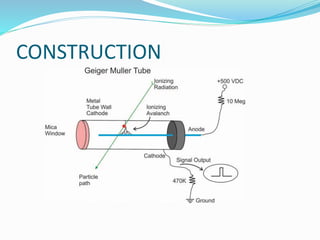
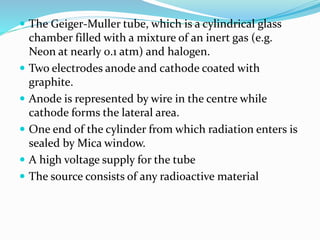
 The Geiger-Muller tube, which is a cylindrical glass
chamber filled with a mixture of an inert gas (e.g.
Neon at nearly 0.1 atm) and halogen.
 Two electrodes anode and cathode coated with
graphite.
 Anode is represented by wire in the centre while
cathode forms the lateral area.
 One end of the cylinder from which radiation enters is
sealed by Mica window.
 A high voltage supply for the tube
 The source consists of any radioactive material
WORKING
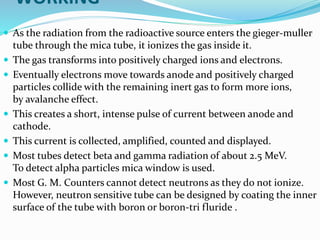
 As the radiation from the radioactive source enters the gieger-muller
tube through the mica tube, it ionizes the gas inside it.
 The gas transforms into positively charged ions and electrons.
 Eventually electrons move towards anode and positively charged
particles collide with the remaining inert gas to form more ions,
by avalanche effect.
 This creates a short, intense pulse of current between anode and
cathode.
 This current is collected, amplified, counted and displayed.
 Most tubes detect beta and gamma radiation of about 2.5 MeV.
To detect alpha particles mica window is used.
 Most G. M. Counters cannot detect neutrons as they do not ionize.
However, neutron sensitive tube can be designed by coating the inner
surface of the tube with boron or boron-tri fluride .
SOURCES
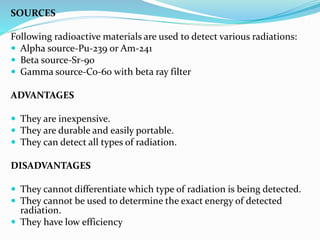
Following radioactive materials are used to detect various radiations:
 Alpha source-Pu-239 or Am-241
 Beta source-Sr-90
 Gamma source-Co-60 with beta ray filter
ADVANTAGES
 They are inexpensive.
 They are durable and easily portable.
 They can detect all types of radiation.
DISADVANTAGES
 They cannot differentiate which type of radiation is being detected.
 They cannot be used to determine the exact energy of detected
radiation.
 They have low efficiency
PROPOTIONAL COUNTER
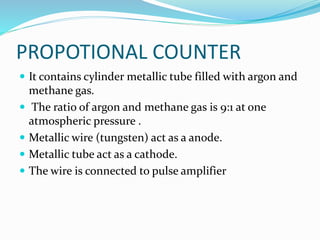
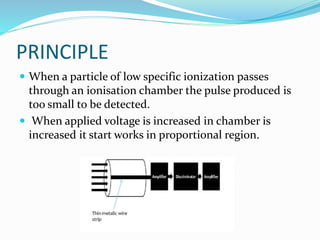
 It contains cylinder metallic tube filled with argon and
methane gas.
 The ratio of argon and methane gas is 9:1 at one
atmospheric pressure .
 Metallic wire (tungsten) act as a anode.
 Metallic tube act as a cathode.
 The wire is connected to pulse amplifier
PRINCIPLE
 When a particle of low specific ionization passes
through an ionisation chamber the pulse produced is
too small to be detected.
 When applied voltage is increased in chamber is
increased it start works in proportional region.
Uses
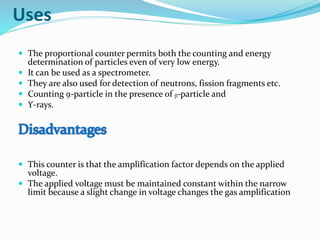
 The proportional counter permits both the counting and energy
determination of particles even of very low energy.
 It can be used as a spectrometer.
 They are also used for detection of neutrons, fission fragments etc.
 Counting ᾳ-particle in the presence of ᵦ-particle and
 ϒ-rays.
 This counter is that the amplification factor depends on the applied
voltage.
 The applied voltage must be maintained constant within the narrow
limit because a slight change in voltage changes the gas amplification
Solid state detector
These are reverse biased semiconductor diode which is
used to detect nuclear radiations.
Construction
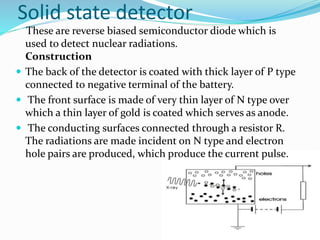
 The back of the detector is coated with thick layer of P type
connected to negative terminal of the battery.
 The front surface is made of very thin layer of N type over
which a thin layer of gold is coated which serves as anode.
 The conducting surfaces connected through a resistor R.
The radiations are made incident on N type and electron
hole pairs are produced, which produce the current pulse.
Working
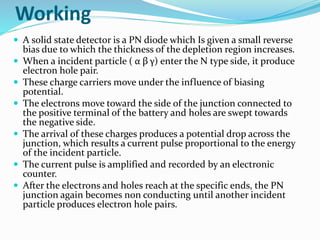
 A solid state detector is a PN diode which Is given a small reverse
bias due to which the thickness of the depletion region increases.
 When a incident particle ( α β γ) enter the N type side, it produce
electron hole pair.
 These charge carriers move under the influence of biasing
potential.
 The electrons move toward the side of the junction connected to
the positive terminal of the battery and holes are swept towards
the negative side.
 The arrival of these charges produces a potential drop across the
junction, which results a current pulse proportional to the energy
of the incident particle.
 The current pulse is amplified and recorded by an electronic
counter.
 After the electrons and holes reach at the specific ends, the PN
junction again becomes non conducting until another incident
particle produces electron hole pairs.
Uses
 This device is useful to detect low energy particles.
 The device can count fast and operates at low voltage.
 It is more efficient and accurate.
 It is useful for detection of alpha and beta particles,
whereas a specifically designed detector having amplifier
to detect the gamma rays.
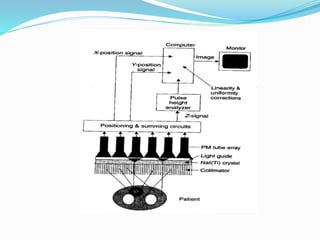
GAMMA CAMERA
 An electronic device that detects gamma rays emitted
by radio pharmaceutical that have been introduced
into body as tracers.
 The position of the source of radioactivity can be
plotted and displayed on a TV monitor or
photographic film.
COMPONENTS
 Collimator
 Nal crystal
 Photomultiplier tubes
 Pre amplifier
 Position logic circuits
 Amplifier
 Pulse height analyser
 Data analysis computer
 Dislay
 Gantry
APPLICATIONS
 Gamma camera gives structural and functional images
of the body organs.
 Bone scan
 Lungs scan
 Kidney function
 Whole body scan

Nuclear radiation detecters

  • 1.
  • 2.
    INTRODUCTION  The instrumentused to detect the nuclear particles or radiation are called nuclear radiation detectors  These are based on the principle of excitation or ionization of atoms of medium in which the incident charged particles pass through.
  • 3.
    G-M counter  TheGeiger-Muller tube or the G-M tube is the sensor element of the Geiger counter instrument used for the detection of ionizing radiation.  Particle detector that measures ionizing radiation.  The particles are usually beta and gamma rays, but certain models can also detect alpha particles.
  • 4.
  • 5.
     The Geiger-Mullertube, which is a cylindrical glass chamber filled with a mixture of an inert gas (e.g. Neon at nearly 0.1 atm) and halogen.  Two electrodes anode and cathode coated with graphite.  Anode is represented by wire in the centre while cathode forms the lateral area.  One end of the cylinder from which radiation enters is sealed by Mica window.  A high voltage supply for the tube  The source consists of any radioactive material
  • 6.
    WORKING  As theradiation from the radioactive source enters the gieger-muller tube through the mica tube, it ionizes the gas inside it.  The gas transforms into positively charged ions and electrons.  Eventually electrons move towards anode and positively charged particles collide with the remaining inert gas to form more ions, by avalanche effect.  This creates a short, intense pulse of current between anode and cathode.  This current is collected, amplified, counted and displayed.  Most tubes detect beta and gamma radiation of about 2.5 MeV. To detect alpha particles mica window is used.  Most G. M. Counters cannot detect neutrons as they do not ionize. However, neutron sensitive tube can be designed by coating the inner surface of the tube with boron or boron-tri fluride .
  • 7.
    SOURCES Following radioactive materialsare used to detect various radiations:  Alpha source-Pu-239 or Am-241  Beta source-Sr-90  Gamma source-Co-60 with beta ray filter ADVANTAGES  They are inexpensive.  They are durable and easily portable.  They can detect all types of radiation. DISADVANTAGES  They cannot differentiate which type of radiation is being detected.  They cannot be used to determine the exact energy of detected radiation.  They have low efficiency
  • 8.
    PROPOTIONAL COUNTER  Itcontains cylinder metallic tube filled with argon and methane gas.  The ratio of argon and methane gas is 9:1 at one atmospheric pressure .  Metallic wire (tungsten) act as a anode.  Metallic tube act as a cathode.  The wire is connected to pulse amplifier
  • 9.
    PRINCIPLE  When aparticle of low specific ionization passes through an ionisation chamber the pulse produced is too small to be detected.  When applied voltage is increased in chamber is increased it start works in proportional region.
  • 10.
    Uses  The proportionalcounter permits both the counting and energy determination of particles even of very low energy.  It can be used as a spectrometer.  They are also used for detection of neutrons, fission fragments etc.  Counting ᾳ-particle in the presence of ᵦ-particle and  ϒ-rays.  This counter is that the amplification factor depends on the applied voltage.  The applied voltage must be maintained constant within the narrow limit because a slight change in voltage changes the gas amplification
  • 11.
    Solid state detector Theseare reverse biased semiconductor diode which is used to detect nuclear radiations. Construction  The back of the detector is coated with thick layer of P type connected to negative terminal of the battery.  The front surface is made of very thin layer of N type over which a thin layer of gold is coated which serves as anode.  The conducting surfaces connected through a resistor R. The radiations are made incident on N type and electron hole pairs are produced, which produce the current pulse.
  • 12.
    Working  A solidstate detector is a PN diode which Is given a small reverse bias due to which the thickness of the depletion region increases.  When a incident particle ( α β γ) enter the N type side, it produce electron hole pair.  These charge carriers move under the influence of biasing potential.  The electrons move toward the side of the junction connected to the positive terminal of the battery and holes are swept towards the negative side.  The arrival of these charges produces a potential drop across the junction, which results a current pulse proportional to the energy of the incident particle.  The current pulse is amplified and recorded by an electronic counter.  After the electrons and holes reach at the specific ends, the PN junction again becomes non conducting until another incident particle produces electron hole pairs.
  • 13.
    Uses  This deviceis useful to detect low energy particles.  The device can count fast and operates at low voltage.  It is more efficient and accurate.  It is useful for detection of alpha and beta particles, whereas a specifically designed detector having amplifier to detect the gamma rays.
  • 14.
    GAMMA CAMERA  Anelectronic device that detects gamma rays emitted by radio pharmaceutical that have been introduced into body as tracers.  The position of the source of radioactivity can be plotted and displayed on a TV monitor or photographic film.
  • 15.
    COMPONENTS  Collimator  Nalcrystal  Photomultiplier tubes  Pre amplifier  Position logic circuits  Amplifier  Pulse height analyser  Data analysis computer  Dislay  Gantry
  • 17.
    APPLICATIONS  Gamma cameragives structural and functional images of the body organs.  Bone scan  Lungs scan  Kidney function  Whole body scan