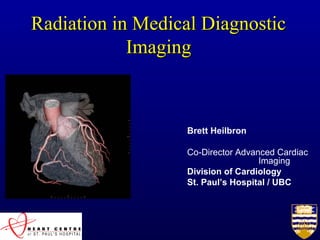

Radiation in Medical DiagnosticRadiation in Medical Diagnostic
ImagingImaging
Brett Heilbron
Co-Director Advanced Cardiac
Imaging
Division of Cardiology
St. Paul’s Hospital / UBC
Disclosure & Acknowledgements
Honoraria, Advisory Boards, Research
funding
Investments: none
Learning ObjectivesLearning Objectives
 Understand the risks associated withUnderstand the risks associated with
ionizing radiationionizing radiation
 Identify ways to optimize patient benefitIdentify ways to optimize patient benefit
and minimize riskand minimize risk
 Discuss some of the controversies aroundDiscuss some of the controversies around
medical imaging radiationmedical imaging radiation
IntroductionIntroduction
 Radiation sources and terminologyRadiation sources and terminology
 Radiation health risk dataRadiation health risk data
 Radiation dose reduction techniquesRadiation dose reduction techniques
 The futureThe future
Radiation Sources & Dose
NCRP Report # 160
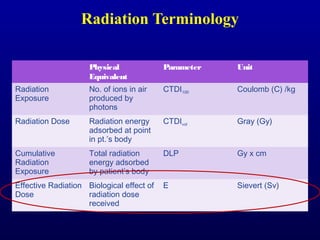
Radiation Terminology
Physical
Equivalent
Parameter Unit
Radiation
Exposure
No. of ions in air
produced by
photons
CTDI100 Coulomb (C) /kg
Radiation Dose Radiation energy
adsorbed at point
in pt.’s body
CTDIvol Gray (Gy)
Cumulative
Radiation
Exposure
Total radiation
energy adsorbed
by patient’s body
DLP Gy x cm
Effective Radiation
Dose
Biological effect of
radiation dose
received
E Sievert (Sv)
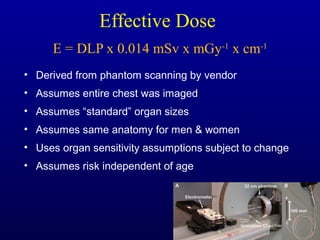
Effective Dose
E = DLP x 0.014 mSv x mGy-1
x cm-1
• Derived from phantom scanning by vendor
• Assumes entire chest was imaged
• Assumes “standard” organ sizes
• Assumes same anatomy for men & women
• Uses organ sensitivity assumptions subject to change
• Assumes risk independent of age
Epidemiologic Studies Of Pilots And Aircrew
    
Abstract
During flight, pilots and cabin crew are exposed to increased levels of cosmic radiation which 
consists primarily of neutrons and gamma rays. Neutron dosimetry is not straightforward, but typical 
annual effective doses are estimated to range between two and five mSv. Higher dose rates are 
experienced at the highest altitudes and in the polar regions. Mean doses have been increasing over 
time as longer flights at higher altitudes have become more frequent. Because there are so few 
populations exposed to neutrons, studies of airline personnel are of particular interest. However, 
because the cumulative radiation exposure is so low, statistical power is a major concern. Further, 
finding an appropriate comparison group is problematic due to selection into these occupations and a 
number of biases are possible. For example, increased rates of breast cancer among flight 
attendants have been attributed to reproductive factors such as nulliparity and increased rates of 
melanoma among pilots have been attributed to excessive sun exposure during leisure time 
activities. 
Epidemiologic studies conducted over the last 20 y provide little consistent evidence linking cancer 
with radiation exposures from air travel.
Boice, John D. Jr.; Blettner, Maria; Auvinen, Anssi
  Health Physics:  November 2000 - Volume 79 - Issue 5 - pp 576-584
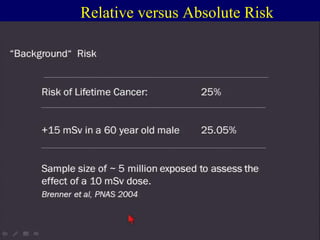
Perception of Risk
Risks are Relative
Relative versus Absolute Risk
 Prospective “step and shoot” gatingProspective “step and shoot” gating
 Prospective high-pitch spiralProspective high-pitch spiral
 Reduce kVp and mAReduce kVp and mA
 Limit Z-axis coverageLimit Z-axis coverage
 Iterative ReconstructionIterative Reconstruction
 Limit paddingLimit padding
LaBounty T, Earls J, Leipsic J, et al. Am J Cardiol 2010; 106:1663-1667
Leipsic J, LaBounty T, Heilbron B, et al AJR 195: Sept 2010
Reducing Image Noise:Reducing Image Noise:
Adaptive Statistical Iterative ReconstructionAdaptive Statistical Iterative Reconstruction
Filtered backprojection ASIR
Leipsic, J et al AJR 197: Nov 2011
Chest radiographs – 2 views 0.06 mSv (5)
Natural Background (Annual) 3-7 mSv (1,4)
Nuclear
Tc-99m (rest+stress) (MIBI) 9 – 18 mSv (1,2)
Tl-201 (rest+stress) ~34 mSv (1,2)
Cardiac Catheterization 2-14 mSv
CCTA
Calcium Scoring 1-2 mSv
Prospective pulse / high-pitch spiral 0.5-4 mSv
Radiation Dose Comparison
(1) Society of Nuclear MediPulse Procedure Guideline for Myocardial Perfusion Imaging:
http://interactive.snm.org/index.cfm?PageID=1110&RPID=780&FileID=1302
(2) US Nuclear Regulatory Commission, Radiation Dose Estimates for Radiopharmaceuticals:
http://www.nrc.gov/reading-rm/doc-collections/nuregs/contract/cr6345/cr6345.pdf
(4) Journal of the American College of Cardiology, Vol. 47, No. 9, 2006. Radiation Exposure of Computed and Direct Intracoronary
Angiography.
(5) Committee to Assess Health risks from Low Levels of Ionizing Radiation, National Research Council, 2005.
Have you ever noticed that anyone
driving slower than you is an idiot and
anyone driving faster is a maniac?
George Carlin
Radiation Dose IssuesRadiation Dose Issues
Fully diagnostic image quality is the primary goal - ALARAFully diagnostic image quality is the primary goal - ALARA
Balance radiation risks against benefits ofBalance radiation risks against benefits of
diagnosis & risk of misdiagnosisdiagnosis & risk of misdiagnosis
Radiation dose estimates are impreciseRadiation dose estimates are imprecise
Uncertainty of risks of low-level radiationUncertainty of risks of low-level radiation
Radiation dose discussion is here to stayRadiation dose discussion is here to stay
Learning ObjectivesLearning Objectives
 Understand the risks associated withUnderstand the risks associated with
ionizing radiationionizing radiation
 Identify ways to optimize patient benefitIdentify ways to optimize patient benefit
and minimize riskand minimize risk
 Discuss some of the controversies aroundDiscuss some of the controversies around
medical imaging radiationmedical imaging radiation
Thank you

Radiation in Medical Diagnostic Imaging

  • 1.
    Radiation in MedicalDiagnosticRadiation in Medical Diagnostic ImagingImaging Brett Heilbron Co-Director Advanced Cardiac Imaging Division of Cardiology St. Paul’s Hospital / UBC
  • 2.
    Disclosure & Acknowledgements Honoraria,Advisory Boards, Research funding Investments: none
  • 3.
    Learning ObjectivesLearning Objectives Understand the risks associated withUnderstand the risks associated with ionizing radiationionizing radiation  Identify ways to optimize patient benefitIdentify ways to optimize patient benefit and minimize riskand minimize risk  Discuss some of the controversies aroundDiscuss some of the controversies around medical imaging radiationmedical imaging radiation
  • 4.
    IntroductionIntroduction  Radiation sourcesand terminologyRadiation sources and terminology  Radiation health risk dataRadiation health risk data  Radiation dose reduction techniquesRadiation dose reduction techniques  The futureThe future
  • 7.
    Radiation Sources &Dose NCRP Report # 160
  • 8.
    Radiation Terminology Physical Equivalent Parameter Unit Radiation Exposure No.of ions in air produced by photons CTDI100 Coulomb (C) /kg Radiation Dose Radiation energy adsorbed at point in pt.’s body CTDIvol Gray (Gy) Cumulative Radiation Exposure Total radiation energy adsorbed by patient’s body DLP Gy x cm Effective Radiation Dose Biological effect of radiation dose received E Sievert (Sv)
  • 9.
    Effective Dose E =DLP x 0.014 mSv x mGy-1 x cm-1 • Derived from phantom scanning by vendor • Assumes entire chest was imaged • Assumes “standard” organ sizes • Assumes same anatomy for men & women • Uses organ sensitivity assumptions subject to change • Assumes risk independent of age
  • 16.
    Epidemiologic Studies OfPilots And Aircrew      Abstract During flight, pilots and cabin crew are exposed to increased levels of cosmic radiation which  consists primarily of neutrons and gamma rays. Neutron dosimetry is not straightforward, but typical  annual effective doses are estimated to range between two and five mSv. Higher dose rates are  experienced at the highest altitudes and in the polar regions. Mean doses have been increasing over  time as longer flights at higher altitudes have become more frequent. Because there are so few  populations exposed to neutrons, studies of airline personnel are of particular interest. However,  because the cumulative radiation exposure is so low, statistical power is a major concern. Further,  finding an appropriate comparison group is problematic due to selection into these occupations and a  number of biases are possible. For example, increased rates of breast cancer among flight  attendants have been attributed to reproductive factors such as nulliparity and increased rates of  melanoma among pilots have been attributed to excessive sun exposure during leisure time  activities.  Epidemiologic studies conducted over the last 20 y provide little consistent evidence linking cancer  with radiation exposures from air travel. Boice, John D. Jr.; Blettner, Maria; Auvinen, Anssi   Health Physics:  November 2000 - Volume 79 - Issue 5 - pp 576-584
  • 20.
  • 21.
  • 22.
  • 25.
     Prospective “stepand shoot” gatingProspective “step and shoot” gating  Prospective high-pitch spiralProspective high-pitch spiral  Reduce kVp and mAReduce kVp and mA  Limit Z-axis coverageLimit Z-axis coverage  Iterative ReconstructionIterative Reconstruction  Limit paddingLimit padding
  • 26.
    LaBounty T, EarlsJ, Leipsic J, et al. Am J Cardiol 2010; 106:1663-1667
  • 27.
    LaBounty T, EarlsJ, Leipsic J, et al. Am J Cardiol 2010; 106:1663-1667
  • 28.
    Leipsic J, LaBountyT, Heilbron B, et al AJR 195: Sept 2010
  • 29.
    Reducing Image Noise:ReducingImage Noise: Adaptive Statistical Iterative ReconstructionAdaptive Statistical Iterative Reconstruction Filtered backprojection ASIR
  • 30.
    Leipsic, J etal AJR 197: Nov 2011
  • 31.
    Leipsic, J etal AJR 197: Nov 2011
  • 32.
    Chest radiographs –2 views 0.06 mSv (5) Natural Background (Annual) 3-7 mSv (1,4) Nuclear Tc-99m (rest+stress) (MIBI) 9 – 18 mSv (1,2) Tl-201 (rest+stress) ~34 mSv (1,2) Cardiac Catheterization 2-14 mSv CCTA Calcium Scoring 1-2 mSv Prospective pulse / high-pitch spiral 0.5-4 mSv Radiation Dose Comparison (1) Society of Nuclear MediPulse Procedure Guideline for Myocardial Perfusion Imaging: http://interactive.snm.org/index.cfm?PageID=1110&RPID=780&FileID=1302 (2) US Nuclear Regulatory Commission, Radiation Dose Estimates for Radiopharmaceuticals: http://www.nrc.gov/reading-rm/doc-collections/nuregs/contract/cr6345/cr6345.pdf (4) Journal of the American College of Cardiology, Vol. 47, No. 9, 2006. Radiation Exposure of Computed and Direct Intracoronary Angiography. (5) Committee to Assess Health risks from Low Levels of Ionizing Radiation, National Research Council, 2005.
  • 33.
    Have you evernoticed that anyone driving slower than you is an idiot and anyone driving faster is a maniac? George Carlin
  • 34.
    Radiation Dose IssuesRadiationDose Issues Fully diagnostic image quality is the primary goal - ALARAFully diagnostic image quality is the primary goal - ALARA Balance radiation risks against benefits ofBalance radiation risks against benefits of diagnosis & risk of misdiagnosisdiagnosis & risk of misdiagnosis Radiation dose estimates are impreciseRadiation dose estimates are imprecise Uncertainty of risks of low-level radiationUncertainty of risks of low-level radiation Radiation dose discussion is here to stayRadiation dose discussion is here to stay
  • 35.
    Learning ObjectivesLearning Objectives Understand the risks associated withUnderstand the risks associated with ionizing radiationionizing radiation  Identify ways to optimize patient benefitIdentify ways to optimize patient benefit and minimize riskand minimize risk  Discuss some of the controversies aroundDiscuss some of the controversies around medical imaging radiationmedical imaging radiation
  • 36.

Editor's Notes

  • #4 American Heart Association. Heart Disease and Stroke Statistics—2004 Update . Dallas, Tex: American Heart Association; 2003. Feinberg WM, Blackshear JL, Laupacis A, Kronmal R, Hart RG. Prevalence, age distribution, and gender of patients with atrial fibrillation. Arch Intern Med . 1995;155:469-473. Waktare JEP, Camm AJ. Acute treatment of atrial fibrillation: why and when to maintain sinus rhythm. Am J Cardiol . 1998;81:3C-15C. Atrial fibrillation (AF) is one of the deadliest arrhythmias in the United States. According to the Heart Disease and Stroke Statistics — Update 2004 published by the American Heart Association (AHA), 71,000 people die per year from AF or atrial flutter (AFl). AF is highly prevalent in the United States, affecting approximately 2 million people nationwide. The median age of AF patients is 75 years, with a prevalence of 2.3% in people older than 40 years and 5.9% in those over age 65. Approximately 70% of individuals with AF are between 65 and 85 years of age. Because the incidence of AF increases with age, its prevalence is increasingly proportionate to the rise in the elderly US population. In addition, AF is often associated with risk of stroke. Approximately 15% to 20% of strokes occur in patients with AF. AF is the cause of 416,000 hospitalizations per year, the most common arrhythmia requiring hospitalization. The high rate of hospitalization of individuals with AF reflects that this arrhythmia is associated with stroke, heart failure (HF), and death. Only 14% of patients with AF and 55% with paroxysmal AF show no demonstrable cardiac disease. AF also has a significant negative impact on exercise capacity and overall quality of life. AF Forum: Management, Anticoagulation, and Stroke Prevention Slide 2
  • #37 American Heart Association. Heart Disease and Stroke Statistics—2004 Update . Dallas, Tex: American Heart Association; 2003. Feinberg WM, Blackshear JL, Laupacis A, Kronmal R, Hart RG. Prevalence, age distribution, and gender of patients with atrial fibrillation. Arch Intern Med . 1995;155:469-473. Waktare JEP, Camm AJ. Acute treatment of atrial fibrillation: why and when to maintain sinus rhythm. Am J Cardiol . 1998;81:3C-15C. Atrial fibrillation (AF) is one of the deadliest arrhythmias in the United States. According to the Heart Disease and Stroke Statistics — Update 2004 published by the American Heart Association (AHA), 71,000 people die per year from AF or atrial flutter (AFl). AF is highly prevalent in the United States, affecting approximately 2 million people nationwide. The median age of AF patients is 75 years, with a prevalence of 2.3% in people older than 40 years and 5.9% in those over age 65. Approximately 70% of individuals with AF are between 65 and 85 years of age. Because the incidence of AF increases with age, its prevalence is increasingly proportionate to the rise in the elderly US population. In addition, AF is often associated with risk of stroke. Approximately 15% to 20% of strokes occur in patients with AF. AF is the cause of 416,000 hospitalizations per year, the most common arrhythmia requiring hospitalization. The high rate of hospitalization of individuals with AF reflects that this arrhythmia is associated with stroke, heart failure (HF), and death. Only 14% of patients with AF and 55% with paroxysmal AF show no demonstrable cardiac disease. AF also has a significant negative impact on exercise capacity and overall quality of life. AF Forum: Management, Anticoagulation, and Stroke Prevention Slide 2