RADIOTHERAPY
AND
IT’S SAFETY PRECAUTIONS
Anas.k.p
2Nd PBbsc
gcnt
OBJECTIVES:
• Definition of RT
• Treatment and types
• Side effects of RT
• Safety precautions
Definition:
Radiotherapy (also called Radiation therapy) is
a cancer treatment that uses high doses of radiation to kill
cancer cells and shrink tumors.
• Radiation therapy works by damaging the DNA within
cancer cell and destroying their ability to reproduce
• When the damaged cancer cells are destroyed by radiation,
the body naturally eliminates them.
• Normal cells can be affected by radiation , but they are able
to repair themselves.
• sometimes radiation therapy is the only treatment a patient
needs.
• Other times , it is combined with other treatments, like
surgery and chemotherapy.
Different types of ionizing radiation are used to treat cancer,
including electromagnetic radiation( ie, x-rays, gamma rays )
and particulate radiation ( alpha particles , electrons,
neutrons, protons.)
High energy x-rays (photons) are generated by an electric
machine, such as a linear accelerator.
Treatment :
Mainly Two types of Treatment Methods
1. External Radiation Therapy
2. Internal Radiation Therapy
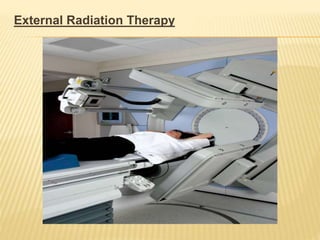
External Radiation Therapy
• Also known as Teletherapy
• Radiation can be delivered externally
• Teletherapy (external beam radiation) is the most common
form of radiation treatment delivery.
• In this technique , patient is exposed to radiation from a
megavoltage treatment machine.
• Eternal radiation is given by a trained medical specialist in a
designated area in a hospital or clinic
• Patient receiving external radiation therapy do not emit
radioactive material and do not require any safety
precautions before or after treatment.
• A Linear accelerator may be used to deliver different type of
treatment technique
Treatment Techniques are :
• Two – dimensional therapy
• Three – dimensional conformal therapy
• Intensity – modulated radiation therapy (IMRT)
• Volumetric – modulated arc therapy (VMAT)
• Tomotherapy
• Image – guided radiation therapy (IGRT)
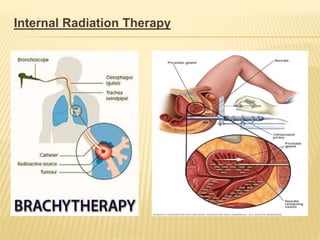
Internal Radiation Therapy:
• Also known as Brachytherapy
• Radiation can also be delivered as brachytherapy , which
means “Close” or internal radiation treatment.
• It consists of the implantation or insertion of radioactive
materials directly into the tumor or close proximity to the
tumor
• Direct delivery of radiation to the target with minimal
exposure to surrounding healthy tissues.
• Brachytherapy is commonly used in combination with
external; radiation as a supplemental “boost” treatment , but
may also be used as primary or adjuvant therapy.
• Patient with internal radioactive materials that have been
implanted into tissue or body cavities or administered orally
or intravenously
• Patient receiving internal radiation therapy emit radioactive
material
• Personnel involved in radiation therapy must recognize
three factors to protect themselves : time , distance and
shielding
Nursing responsibilities include knowledge about:
• Radiation source being used
• Method of administration
• Start of treatment
• Length of treatment
• Prescribed nursing precautions
Sources of Radiation:
• Cobalt 60
• Cesium 137
• Iodine 131
• Iridium 192
• Radium 226
• Radon 222
• Strontium 90
External Radiation Therapy
Internal Radiation Therapy
Side Effects
Acute:
Nausea and vomiting
Skin desquamation
Late:
Alopecia
Lymphoedema
Pneumonitis
Cardiac problems
Intimal thickening of arteries and arterioles
Dilatation of capillaries and venules
Fibrosis
Ischemia
Dry mouth
Diarrhea
Anorexia
Specific Precautions:
• Principles from the basis of a broader radiation safety
concept of ALARA ( as low as reasonably achievable)
• Time , distance, shielding are vital to health care
professional safety when caring for the person with a source
of internal radiation.
• Organize care to limit the time spent in direct contact with
the patient
• To minimize anxiety and confusion tell the patient the
reason for time and distance limitations before the
procedure
• Use shielding , if available , and do not deliver care without
wearing film badge indicating cumulative radiation exposure.
• Do not share film badges.
First few days after treatment:-
• Wash your hands thoroughly after using the toilets
• Use separate utensils and towels
• Drink plenty of water to flush the remaining radioactive
materials from the body
• Avoid sexual contact
• Try to avoid contacts with infants , children's , and pregnant
women.
Recapitulation:
 What is radiation therapy ?
 What are the types of radiation therapy ?
 What are the side effects of RT ?
 What are the safety precautions taking in RT ?
Assignment
Nursing management of patient under gone Radiation therapy
Bibliography:
 Lewis’s, Medical surgical nursing , second south asia
edition , Volume I, Elsevier , Page no: 271-276
 Linda s. Williams and Paula D. Hopper , Understanding
medical and surgical nursing, Fifth edition, Jaypee
Publishers, Page no: 185 - 187
Radiotherapy and its safety precautions

Radiotherapy and its safety precautions

  • 2.
  • 3.
    OBJECTIVES: • Definition ofRT • Treatment and types • Side effects of RT • Safety precautions
  • 4.
    Definition: Radiotherapy (also calledRadiation therapy) is a cancer treatment that uses high doses of radiation to kill cancer cells and shrink tumors. • Radiation therapy works by damaging the DNA within cancer cell and destroying their ability to reproduce • When the damaged cancer cells are destroyed by radiation, the body naturally eliminates them. • Normal cells can be affected by radiation , but they are able to repair themselves. • sometimes radiation therapy is the only treatment a patient needs. • Other times , it is combined with other treatments, like surgery and chemotherapy.
  • 5.
    Different types ofionizing radiation are used to treat cancer, including electromagnetic radiation( ie, x-rays, gamma rays ) and particulate radiation ( alpha particles , electrons, neutrons, protons.) High energy x-rays (photons) are generated by an electric machine, such as a linear accelerator. Treatment : Mainly Two types of Treatment Methods 1. External Radiation Therapy 2. Internal Radiation Therapy
  • 6.
    External Radiation Therapy •Also known as Teletherapy • Radiation can be delivered externally • Teletherapy (external beam radiation) is the most common form of radiation treatment delivery. • In this technique , patient is exposed to radiation from a megavoltage treatment machine. • Eternal radiation is given by a trained medical specialist in a designated area in a hospital or clinic • Patient receiving external radiation therapy do not emit radioactive material and do not require any safety precautions before or after treatment. • A Linear accelerator may be used to deliver different type of treatment technique
  • 7.
    Treatment Techniques are: • Two – dimensional therapy • Three – dimensional conformal therapy • Intensity – modulated radiation therapy (IMRT) • Volumetric – modulated arc therapy (VMAT) • Tomotherapy • Image – guided radiation therapy (IGRT)
  • 8.
    Internal Radiation Therapy: •Also known as Brachytherapy • Radiation can also be delivered as brachytherapy , which means “Close” or internal radiation treatment. • It consists of the implantation or insertion of radioactive materials directly into the tumor or close proximity to the tumor • Direct delivery of radiation to the target with minimal exposure to surrounding healthy tissues. • Brachytherapy is commonly used in combination with external; radiation as a supplemental “boost” treatment , but may also be used as primary or adjuvant therapy. • Patient with internal radioactive materials that have been implanted into tissue or body cavities or administered orally or intravenously
  • 9.
    • Patient receivinginternal radiation therapy emit radioactive material • Personnel involved in radiation therapy must recognize three factors to protect themselves : time , distance and shielding Nursing responsibilities include knowledge about: • Radiation source being used • Method of administration • Start of treatment • Length of treatment • Prescribed nursing precautions
  • 10.
    Sources of Radiation: •Cobalt 60 • Cesium 137 • Iodine 131 • Iridium 192 • Radium 226 • Radon 222 • Strontium 90
  • 11.
  • 12.
  • 13.
    Side Effects Acute: Nausea andvomiting Skin desquamation Late: Alopecia Lymphoedema Pneumonitis Cardiac problems Intimal thickening of arteries and arterioles Dilatation of capillaries and venules Fibrosis Ischemia Dry mouth Diarrhea Anorexia
  • 14.
    Specific Precautions: • Principlesfrom the basis of a broader radiation safety concept of ALARA ( as low as reasonably achievable) • Time , distance, shielding are vital to health care professional safety when caring for the person with a source of internal radiation. • Organize care to limit the time spent in direct contact with the patient • To minimize anxiety and confusion tell the patient the reason for time and distance limitations before the procedure • Use shielding , if available , and do not deliver care without wearing film badge indicating cumulative radiation exposure. • Do not share film badges.
  • 15.
    First few daysafter treatment:- • Wash your hands thoroughly after using the toilets • Use separate utensils and towels • Drink plenty of water to flush the remaining radioactive materials from the body • Avoid sexual contact • Try to avoid contacts with infants , children's , and pregnant women.
  • 16.
    Recapitulation:  What isradiation therapy ?  What are the types of radiation therapy ?  What are the side effects of RT ?  What are the safety precautions taking in RT ? Assignment Nursing management of patient under gone Radiation therapy
  • 17.
    Bibliography:  Lewis’s, Medicalsurgical nursing , second south asia edition , Volume I, Elsevier , Page no: 271-276  Linda s. Williams and Paula D. Hopper , Understanding medical and surgical nursing, Fifth edition, Jaypee Publishers, Page no: 185 - 187