1Built-to-Spec | Product Approval | Engineering Services | Software Development
ABC of CEM and RCS
Basics explained for beginners
2
©ZeusNumerixPvtLtd:ConfidentialDocument
About the Training Programme
ABC of CEM and RCS
 This is an introductory course in computational electromagnetics (CEM)
 The emphasis is on foundations and methods of predicting Radar Cross Section
(RCS) of Aerial Targets
 The course is neither targeted towards scientists who wish to develop their own
application nor towards engineers who wish to use a proprietary software for solving
their own problems
 Demonstrations on the last two days are for illustrating steps required to calculate
RCS
2
14-Sep-2012
3
©ZeusNumerixPvtLtd:ConfidentialDocument
Contents
ABC of CEM and RCS
 Basics of stealth and importance of RCS
 Electromagnetic wave, Frequency, wave number and Poynting vector, electrical and
magnetic field
 Frequencies and bands used in Radar
 Detection, inverse scattering, Types of scattering and types of RCS
 Units of RCS, Range equation, Polarisation and scattering matrix
 RCs of simple shapes, scattering regions, RCS of flying object and maritime objects
 Classification of RADAR echoes
 Some information of IR and acoustics stealth
3
14-Sep-2012
4
©ZeusNumerixPvtLtd:ConfidentialDocument
ABC of CEM and RCS
4
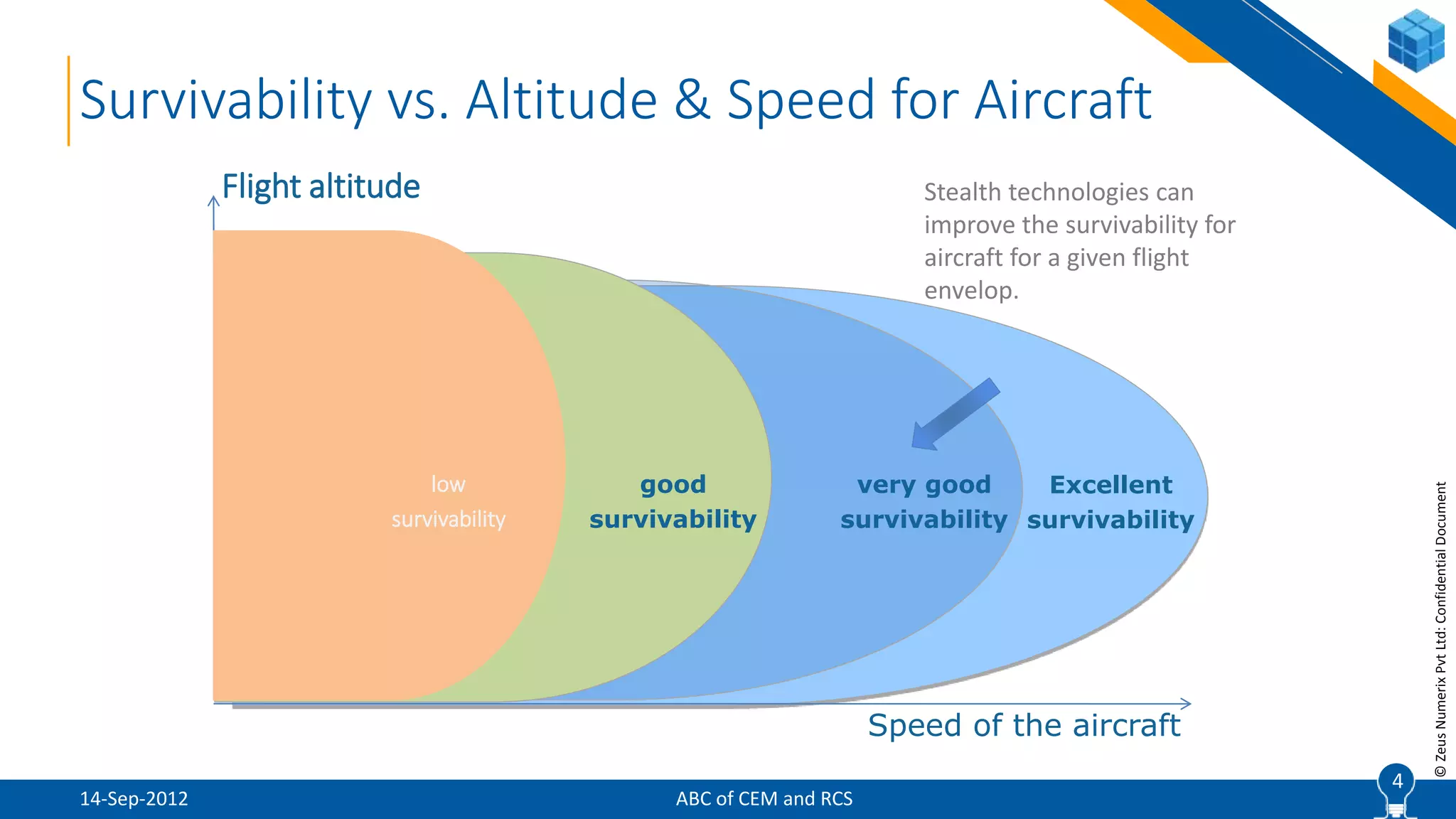
Survivability vs. Altitude & Speed for Aircraft
Flight altitude
Speed of the aircraft
Excellent
survivability
very good
survivability
good
survivability
low
survivability
Stealth technologies can
improve the survivability for
aircraft for a given flight
envelop.
14-Sep-2012
5
©ZeusNumerixPvtLtd:ConfidentialDocument
ABC of CEM and RCS
5
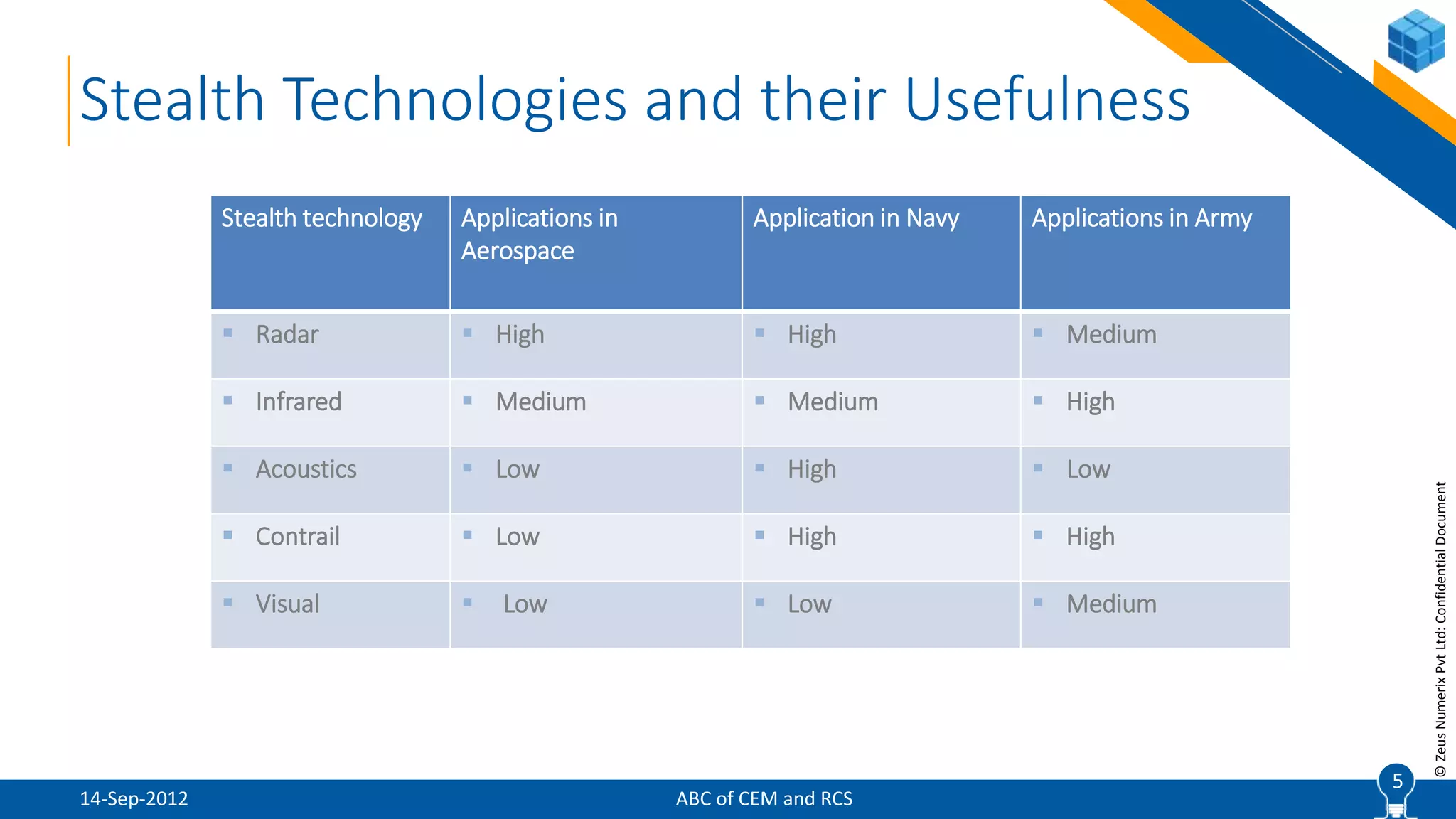
Stealth Technologies and their Usefulness
Stealth technology Applications in
Aerospace
Application in Navy Applications in Army
 Radar  High  High  Medium
 Infrared  Medium  Medium  High
 Acoustics  Low  High  Low
 Contrail  Low  High  High
 Visual  Low  Low  Medium
14-Sep-2012
6
©ZeusNumerixPvtLtd:ConfidentialDocument
Electromagnetic Wave
ABC of CEM and RCS
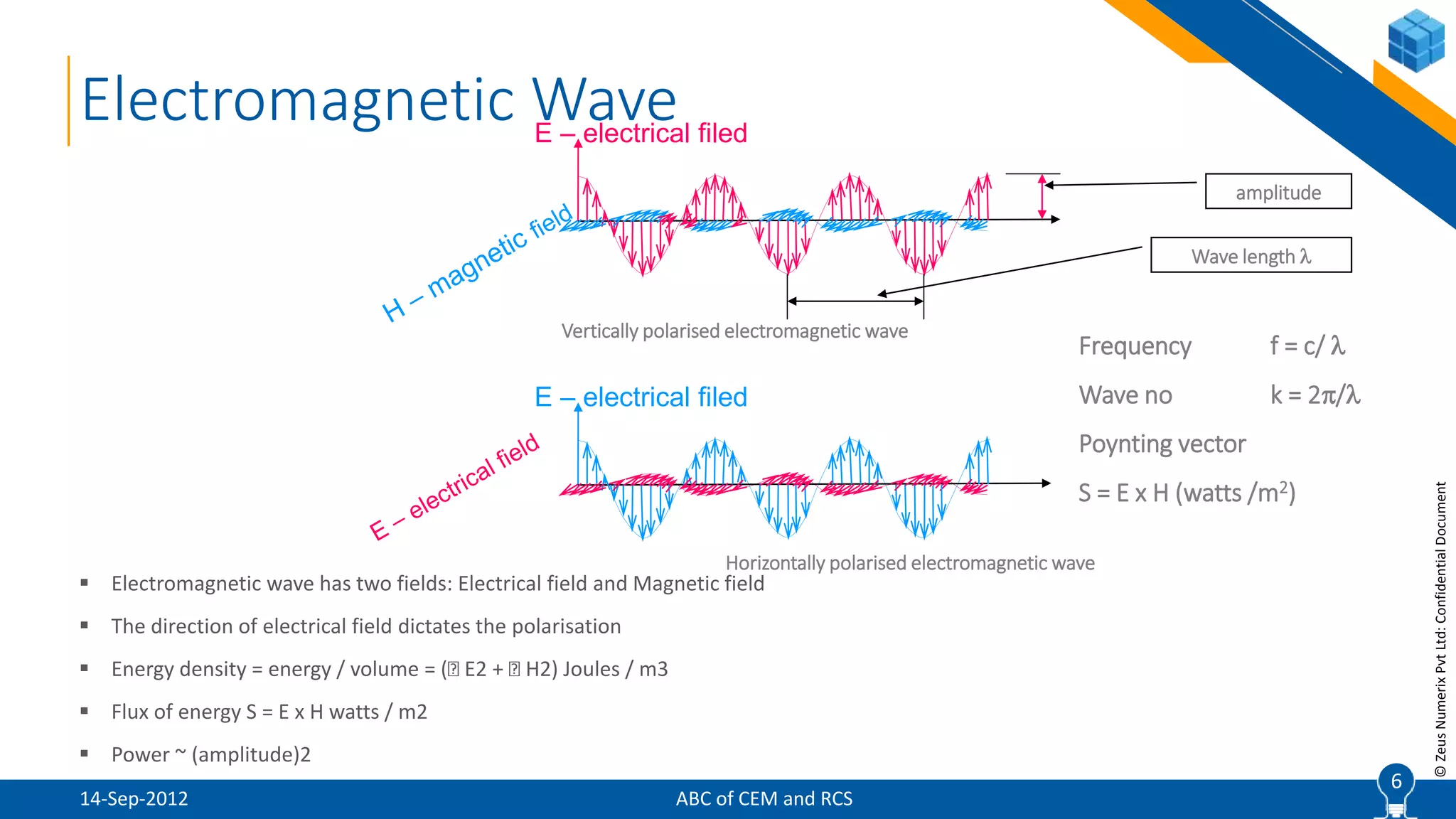
 Electromagnetic wave has two fields: Electrical field and Magnetic field
 The direction of electrical field dictates the polarisation
 Energy density = energy / volume = ( E2 + H2) Joules / m3
 Flux of energy S = E x H watts / m2
 Power ~ (amplitude)2
6
E – electrical filed
Horizontally polarised electromagnetic wave
E – electrical filed
Vertically polarised electromagnetic wave
amplitude
Wave length 
Frequency f = c/ 
Wave no k = 2/
Poynting vector
S = E x H (watts /m2)
14-Sep-2012
7
©ZeusNumerixPvtLtd:ConfidentialDocument
ABC of CEM and RCS
7
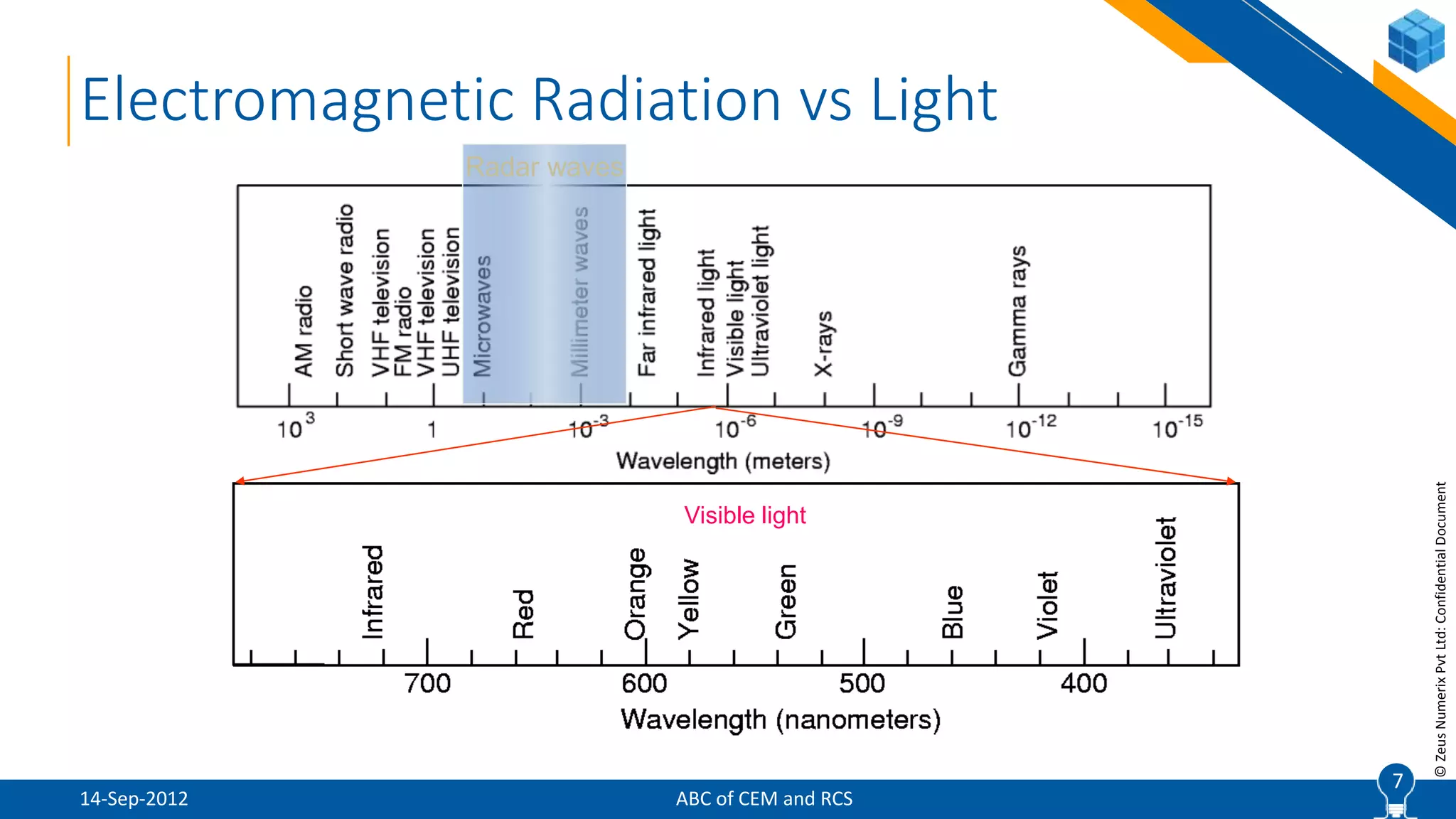
Electromagnetic Radiation vs Light
Visible light
Radar waves
14-Sep-2012
8
©ZeusNumerixPvtLtd:ConfidentialDocument
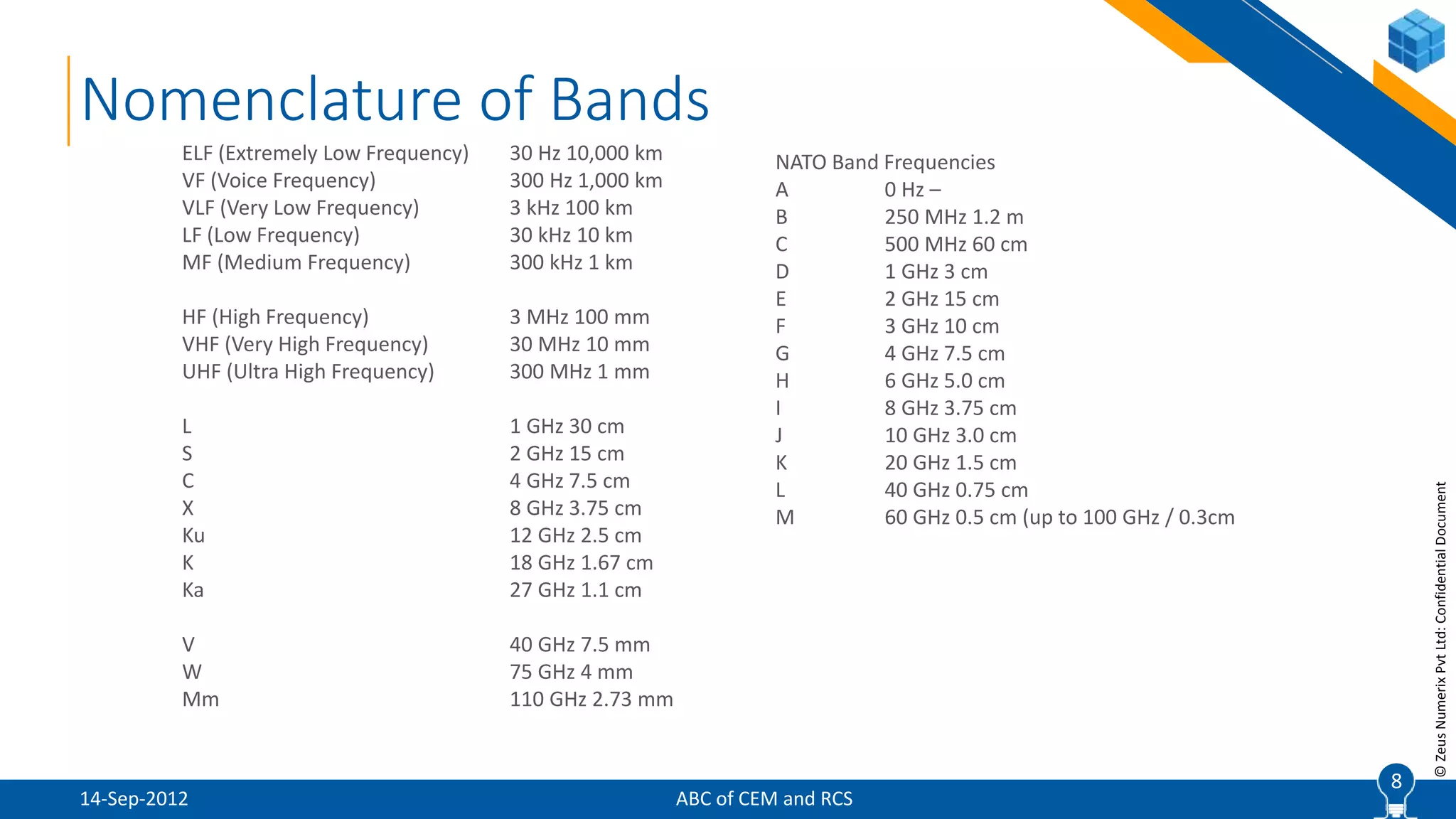
Nomenclature of Bands
ABC of CEM and RCS
8
ELF (Extremely Low Frequency) 30 Hz 10,000 km
VF (Voice Frequency) 300 Hz 1,000 km
VLF (Very Low Frequency) 3 kHz 100 km
LF (Low Frequency) 30 kHz 10 km
MF (Medium Frequency) 300 kHz 1 km
HF (High Frequency) 3 MHz 100 mm
VHF (Very High Frequency) 30 MHz 10 mm
UHF (Ultra High Frequency) 300 MHz 1 mm
L 1 GHz 30 cm
S 2 GHz 15 cm
C 4 GHz 7.5 cm
X 8 GHz 3.75 cm
Ku 12 GHz 2.5 cm
K 18 GHz 1.67 cm
Ka 27 GHz 1.1 cm
V 40 GHz 7.5 mm
W 75 GHz 4 mm
Mm 110 GHz 2.73 mm
NATO Band Frequencies
A 0 Hz –
B 250 MHz 1.2 m
C 500 MHz 60 cm
D 1 GHz 3 cm
E 2 GHz 15 cm
F 3 GHz 10 cm
G 4 GHz 7.5 cm
H 6 GHz 5.0 cm
I 8 GHz 3.75 cm
J 10 GHz 3.0 cm
K 20 GHz 1.5 cm
L 40 GHz 0.75 cm
M 60 GHz 0.5 cm (up to 100 GHz / 0.3cm
14-Sep-2012
9
©ZeusNumerixPvtLtd:ConfidentialDocument
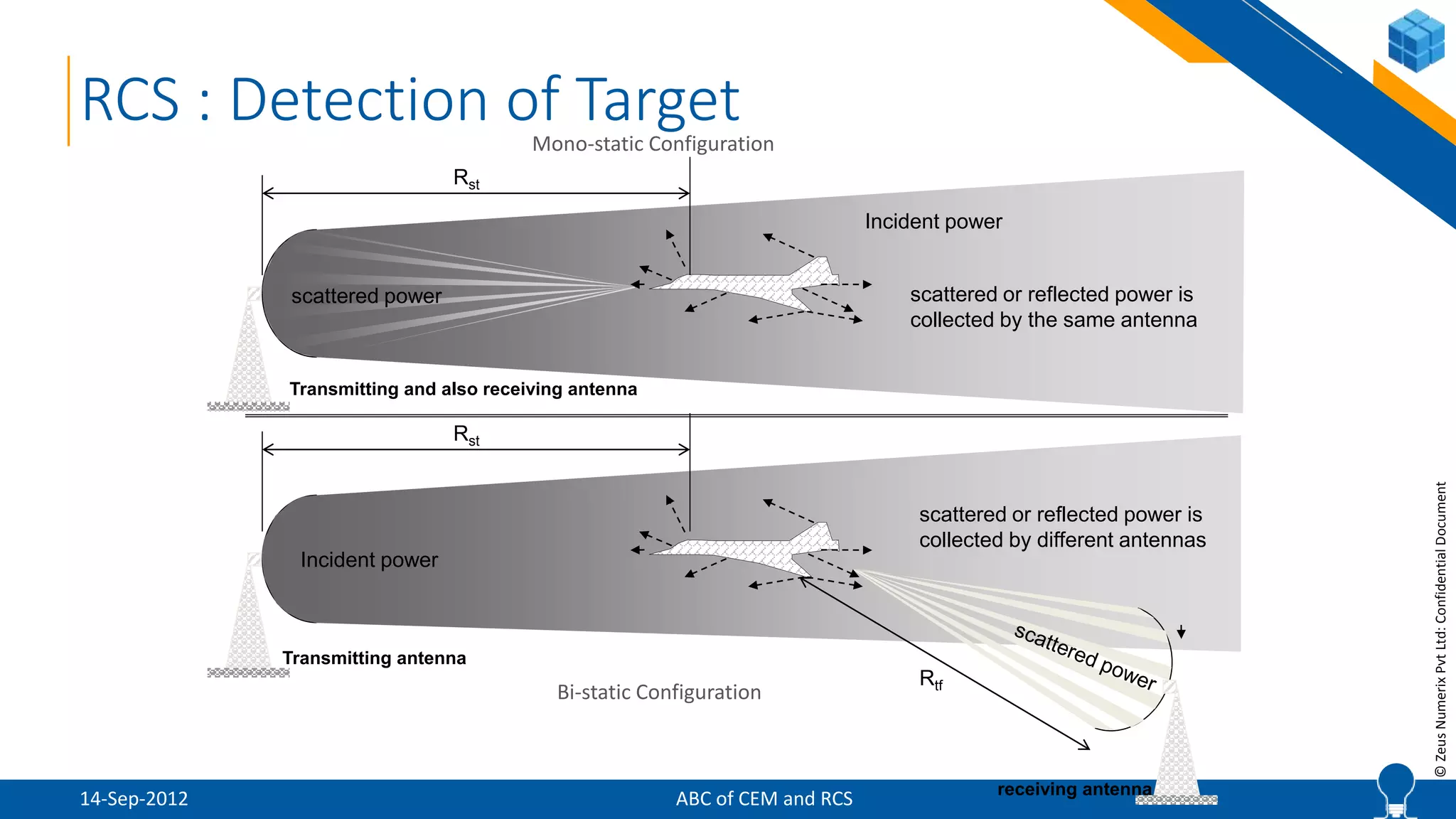
RCS : Detection of Target
Incident power
scattered or reflected power is
collected by different antennas
Bi-static Configuration
Mono-static Configuration
scattered or reflected power is
collected by the same antenna
Rst
Rtf
Rst
Incident power
scattered power
Transmitting and also receiving antenna
Transmitting antenna
receiving antenna
ABC of CEM and RCS14-Sep-2012
10
©ZeusNumerixPvtLtd:ConfidentialDocument
Detection vs Inverse Scattering
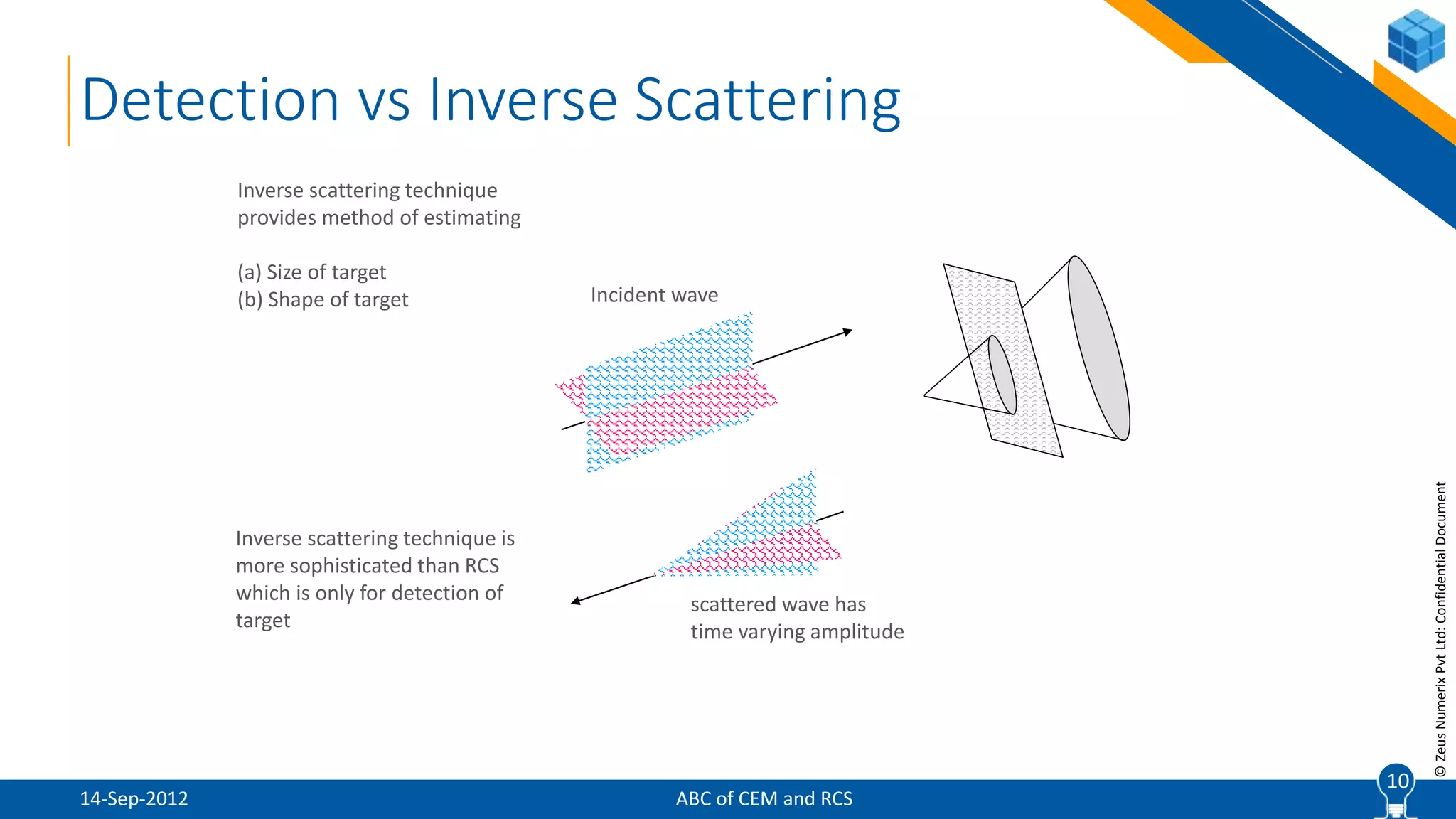
Incident wave
scattered wave has
time varying amplitude
Inverse scattering technique
provides method of estimating
(a) Size of target
(b) Shape of target
Inverse scattering technique is
more sophisticated than RCS
which is only for detection of
target
10
ABC of CEM and RCS14-Sep-2012
11
©ZeusNumerixPvtLtd:ConfidentialDocument
Scattered Power
Mono-static radar RCS : Energy scattered towards the source is called backscattered energy
Bi-static RCS: Energy scattered in any other directions
RCS (normally denoted by ) is defined as
 = 4 ( Ps / Pi); Ps scattered or reflected power per solid angle (w/sold
angle)
Pi incident power density (w/m2)
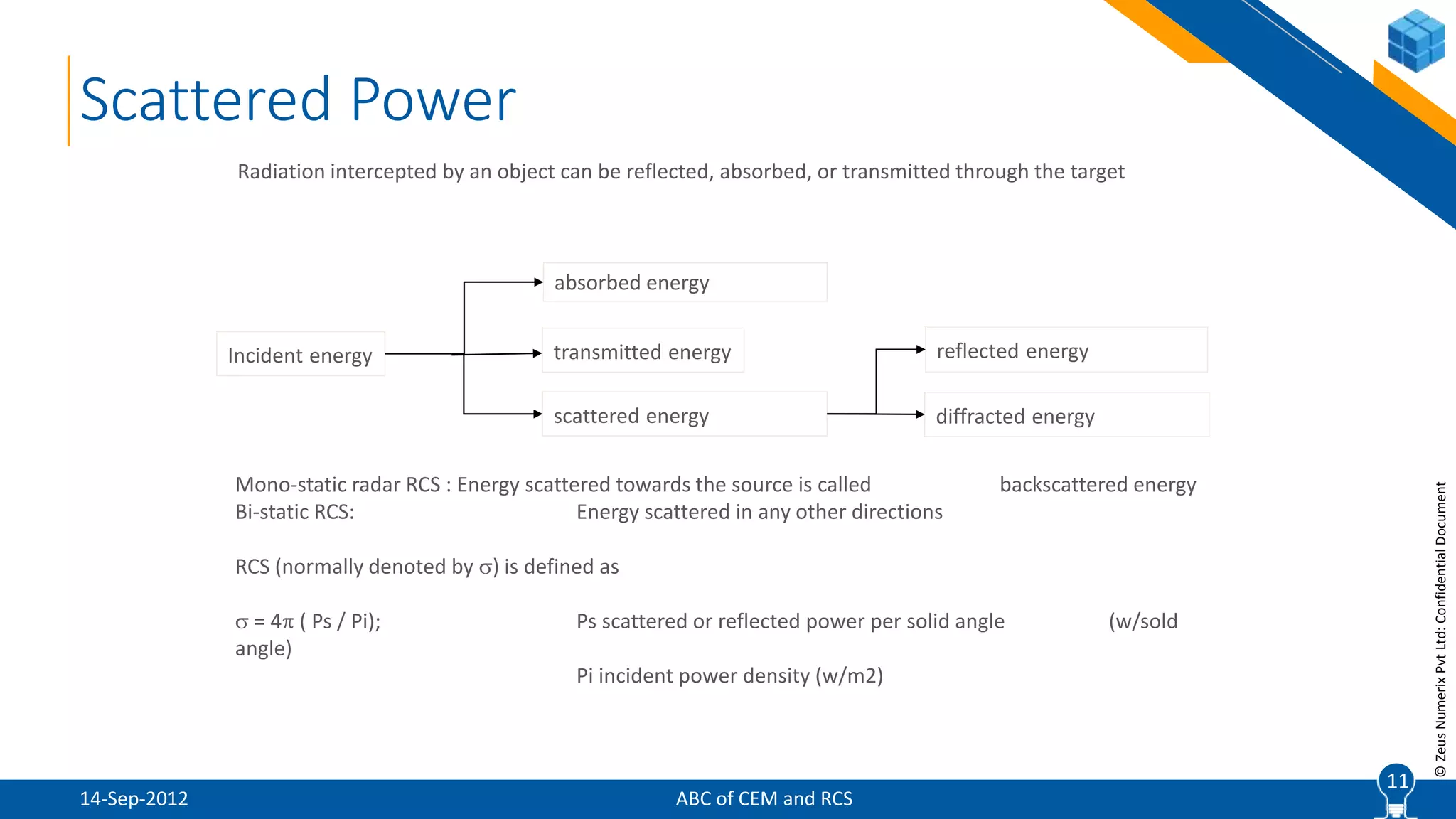
Radiation intercepted by an object can be reflected, absorbed, or transmitted through the target
Incident energy
absorbed energy
transmitted energy
scattered energy
reflected energy
diffracted energy
11
ABC of CEM and RCS14-Sep-2012
12
©ZeusNumerixPvtLtd:ConfidentialDocument
 RCS depends up on:
 Shape of the target
 Orientation of target with respect to source of radiation
 Orientation of the receiving radar with respect to target (only for Bi-static RCS)
 Material of the surface
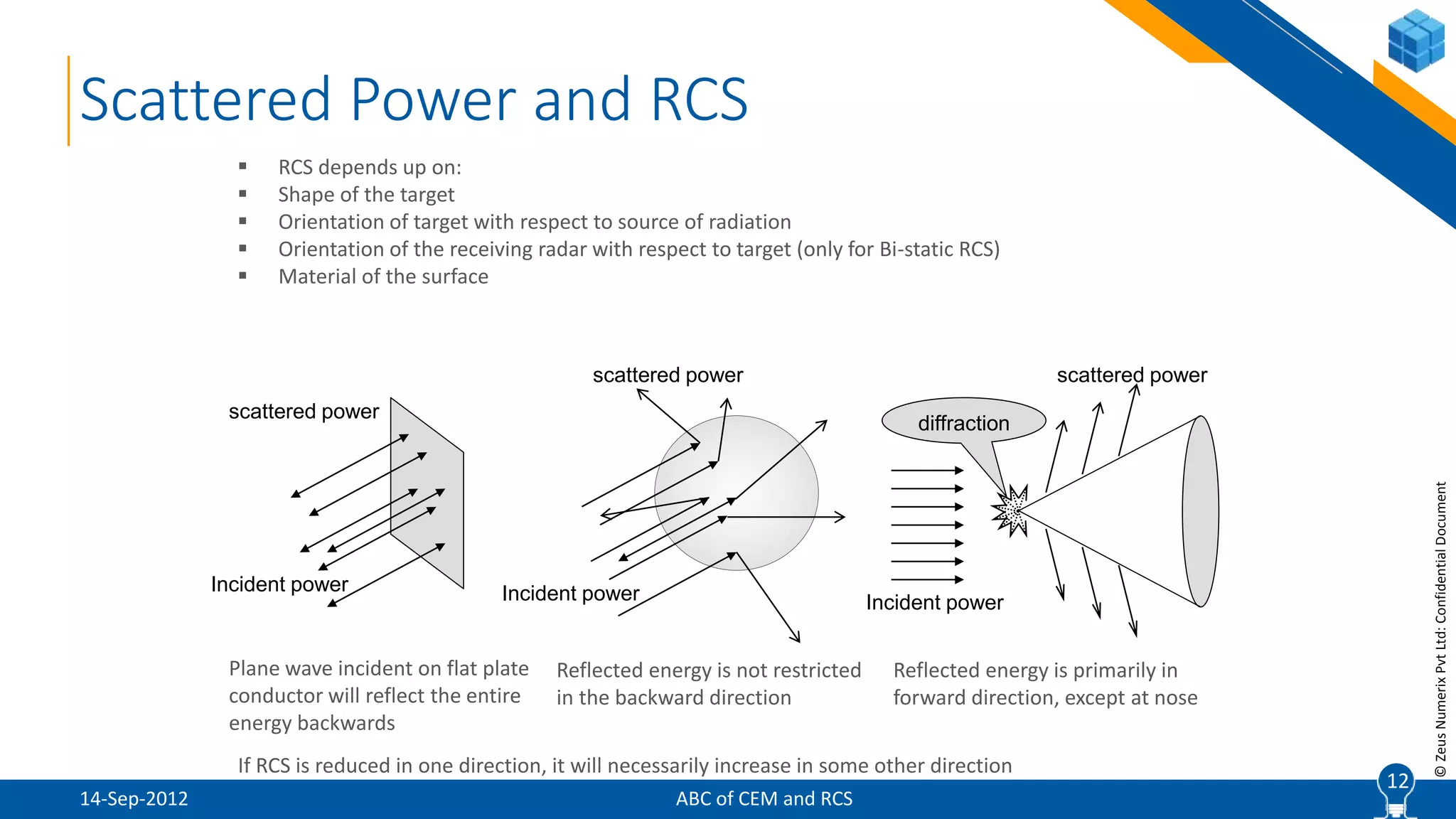
Plane wave incident on flat plate
conductor will reflect the entire
energy backwards
Reflected energy is not restricted
in the backward direction
Reflected energy is primarily in
forward direction, except at nose
diffraction
If RCS is reduced in one direction, it will necessarily increase in some other direction
scattered power
scattered power scattered power
Incident power Incident power Incident power
12
Scattered Power and RCS
ABC of CEM and RCS14-Sep-2012
13
©ZeusNumerixPvtLtd:ConfidentialDocument
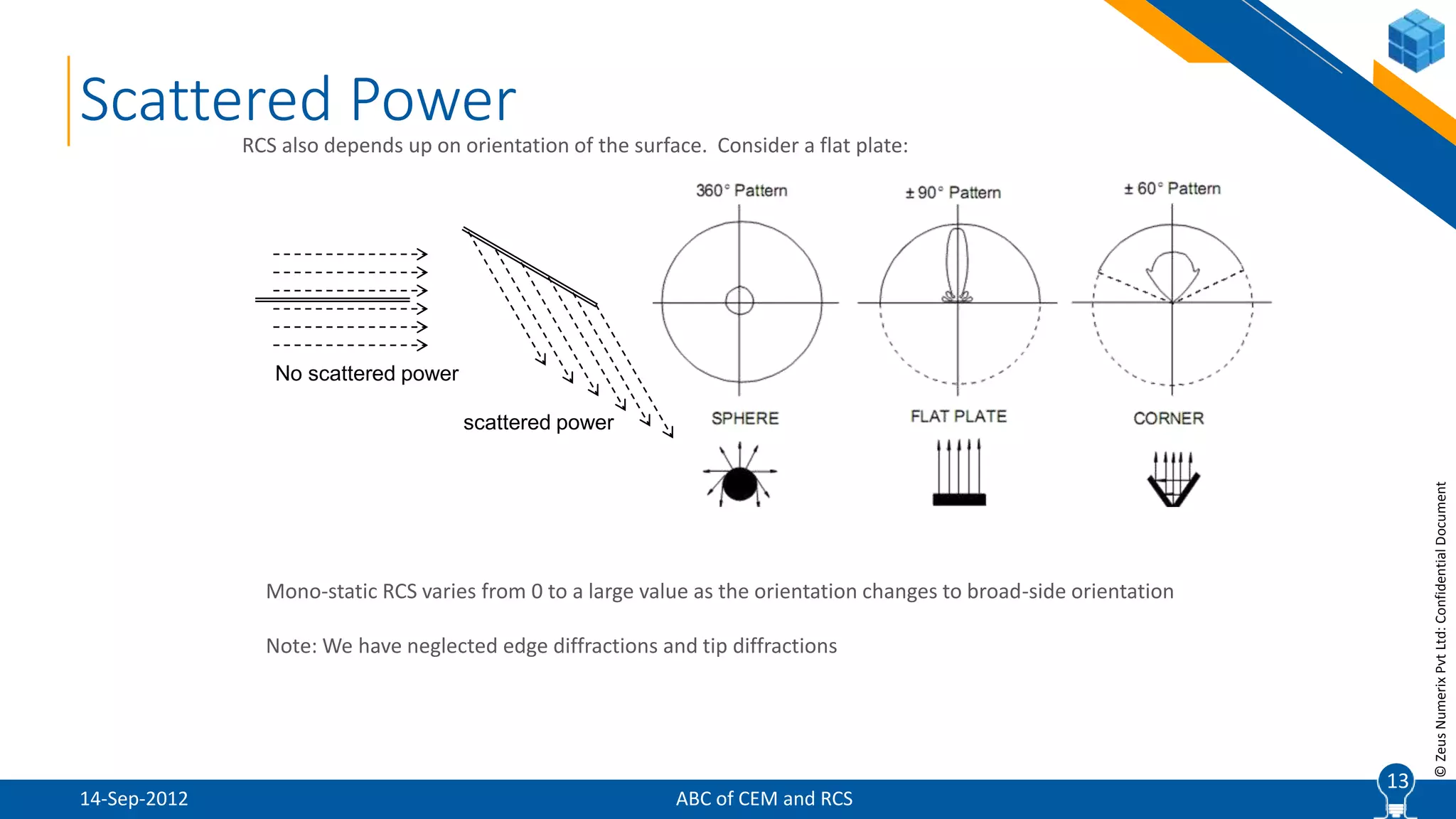
RCS also depends up on orientation of the surface. Consider a flat plate:
Mono-static RCS varies from 0 to a large value as the orientation changes to broad-side orientation
Note: We have neglected edge diffractions and tip diffractions
No scattered power
scattered power
13
Scattered Power
ABC of CEM and RCS14-Sep-2012
14
©ZeusNumerixPvtLtd:ConfidentialDocument
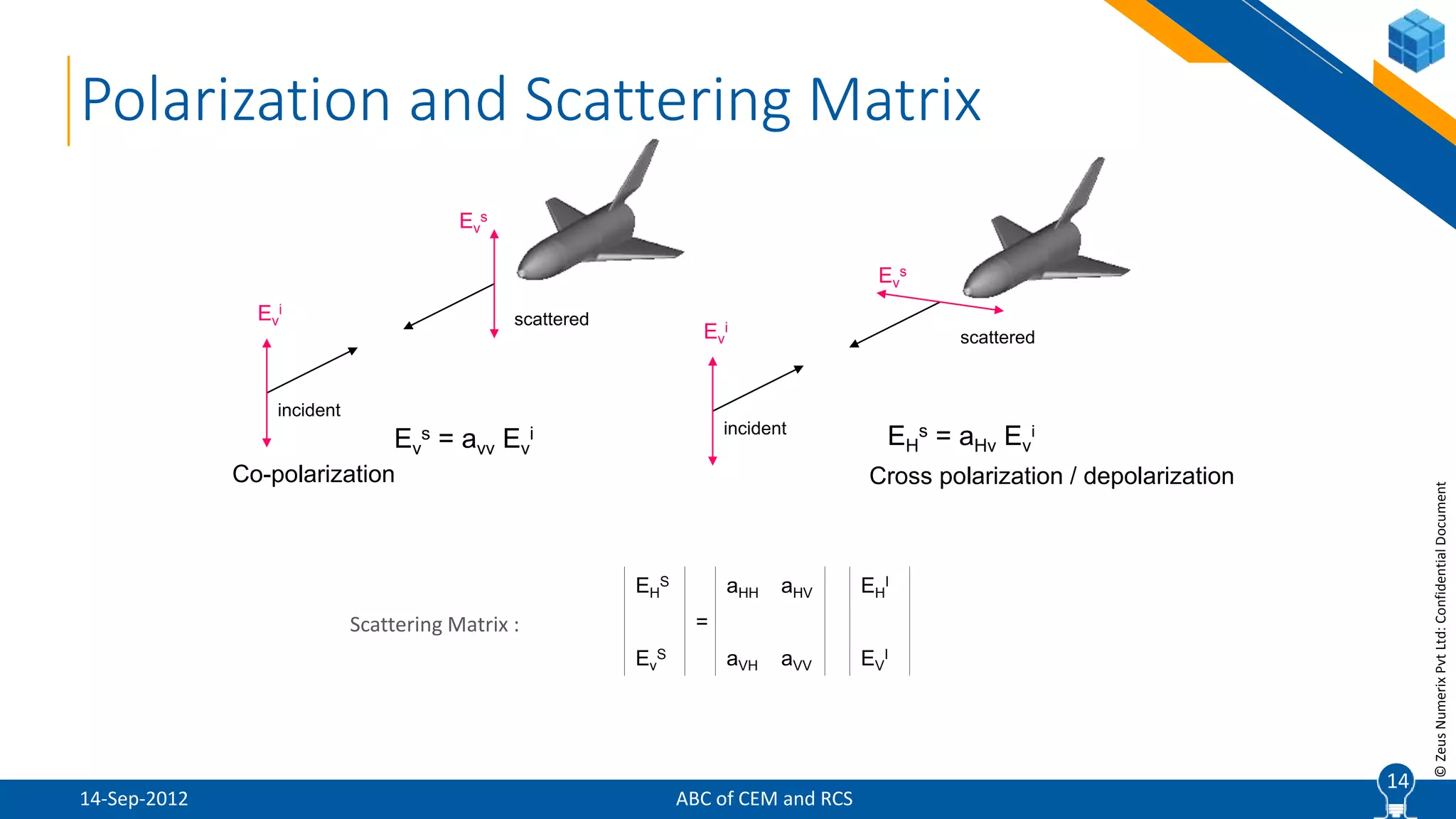
Ev
i
incident
scattered
Ev
s
Ev
i
incident
scattered
Ev
s
Ev
s = avv Ev
i EH
s = aHv Ev
i
Cross polarization / depolarization
EH
S aHH aHV EH
I
=
Ev
S aVH aVV EV
I
Scattering Matrix :
Co-polarization
14
Polarization and Scattering Matrix
ABC of CEM and RCS14-Sep-2012
15
©ZeusNumerixPvtLtd:ConfidentialDocument
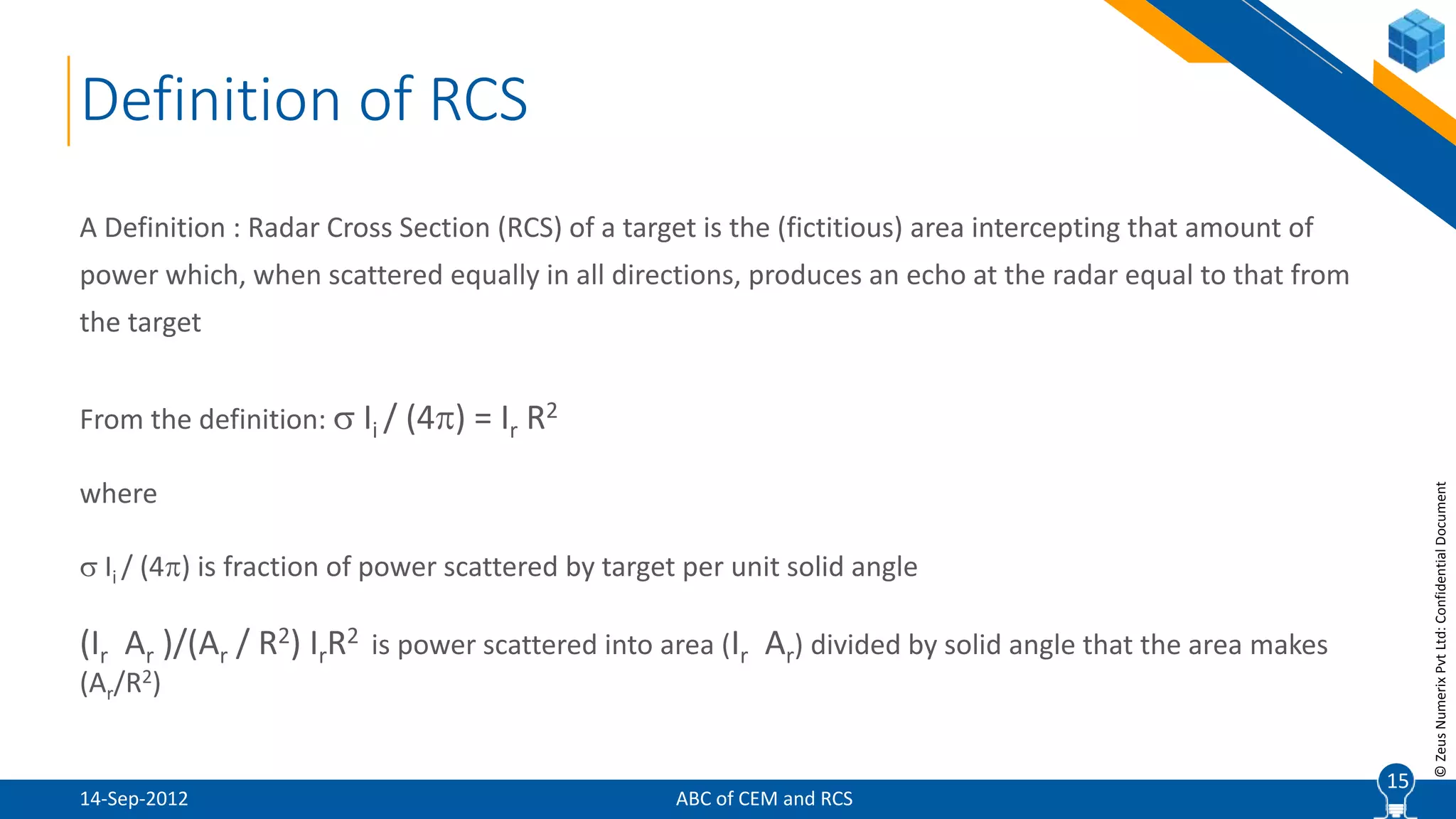
A Definition : Radar Cross Section (RCS) of a target is the (fictitious) area intercepting that amount of
power which, when scattered equally in all directions, produces an echo at the radar equal to that from
the target
From the definition:  Ii / (4) = Ir R2
where
 Ii / (4) is fraction of power scattered by target per unit solid angle
(Ir Ar )/(Ar / R2) IrR2 is power scattered into area (Ir Ar) divided by solid angle that the area makes
(Ar/R2)
15
Definition of RCS
ABC of CEM and RCS14-Sep-2012
16
©ZeusNumerixPvtLtd:ConfidentialDocument
Definition of RCS
Amount of energy scattered by aircraft = energy scattered by sphere
Aircraft scatters different amount of energy in different direction; RCS is different in different directions
 = (power reflected by the target per solid angle) / (incident power density / 4)
= limit 4 R2 | Er / Ei | or
R  
= limit 4 R2 | Hr / Hi|
R  
= limit 4 R2 | Ir / Ii |, I is power density
R  
RCS (expressed in db): db = 10 log [( in m2)/(1 m2)]
Equivalent
sphere
16
ABC of CEM and RCS14-Sep-2012
17
©ZeusNumerixPvtLtd:ConfidentialDocument
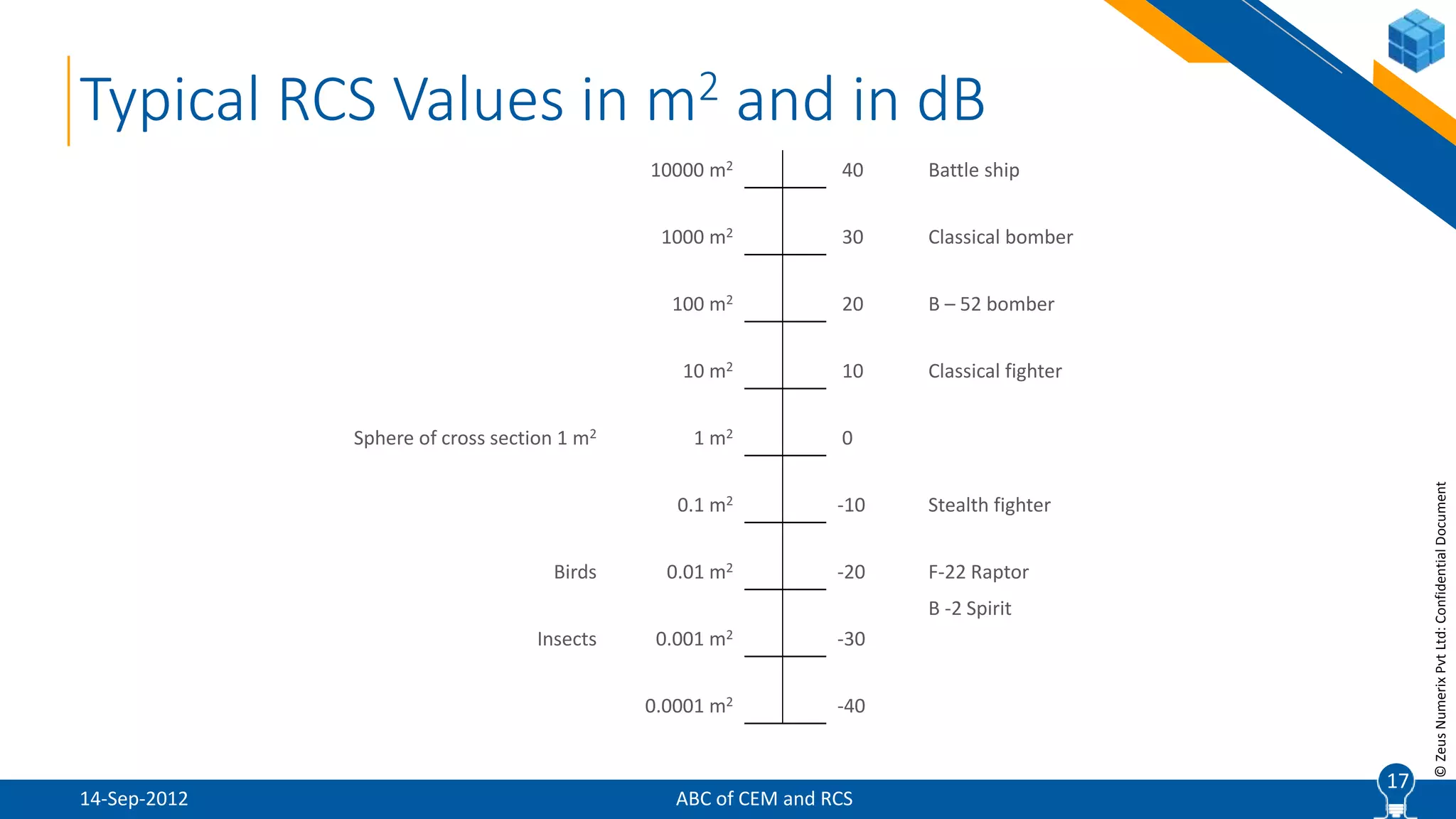
10000 m2 40 Battle ship
1000 m2 30 Classical bomber
100 m2 20 B – 52 bomber
10 m2 10 Classical fighter
Sphere of cross section 1 m2 1 m2 0
0.1 m2 -10 Stealth fighter
Birds 0.01 m2 -20 F-22 Raptor
Insects 0.001 m2 -30
B -2 Spirit
0.0001 m2 -40
17
Typical RCS Values in m2 and in dB
ABC of CEM and RCS14-Sep-2012
18
©ZeusNumerixPvtLtd:ConfidentialDocument
 Power density at the target (St )
(Psource Gtransmission_antenna) / (4 Rsource-to-target
2), where
Psource = Power transmitted by source radar &
Gtransmission_antenna = gain of the transmitting antenna
Power received by target (Pincident )
= Ssource  = (Psource Gtransmission_antenna ) / (4R2
source-to-target), where
 = surface area of target
For (PEC) perfectly electrical conductor, the entire power is scattered. If the scattered
energy is isotropic (not a function of the direction), then scattered energy by receiving
radar (Sscattered)
Sscattered = Pincident / (4R2
target-to-receiver) = (Ps Gs )/[(4R2
source-to-target)(4R2
target-to-receiver)]
Range for Given RCS Value
18
ABC of CEM and RCS14-Sep-2012
19
©ZeusNumerixPvtLtd:ConfidentialDocument
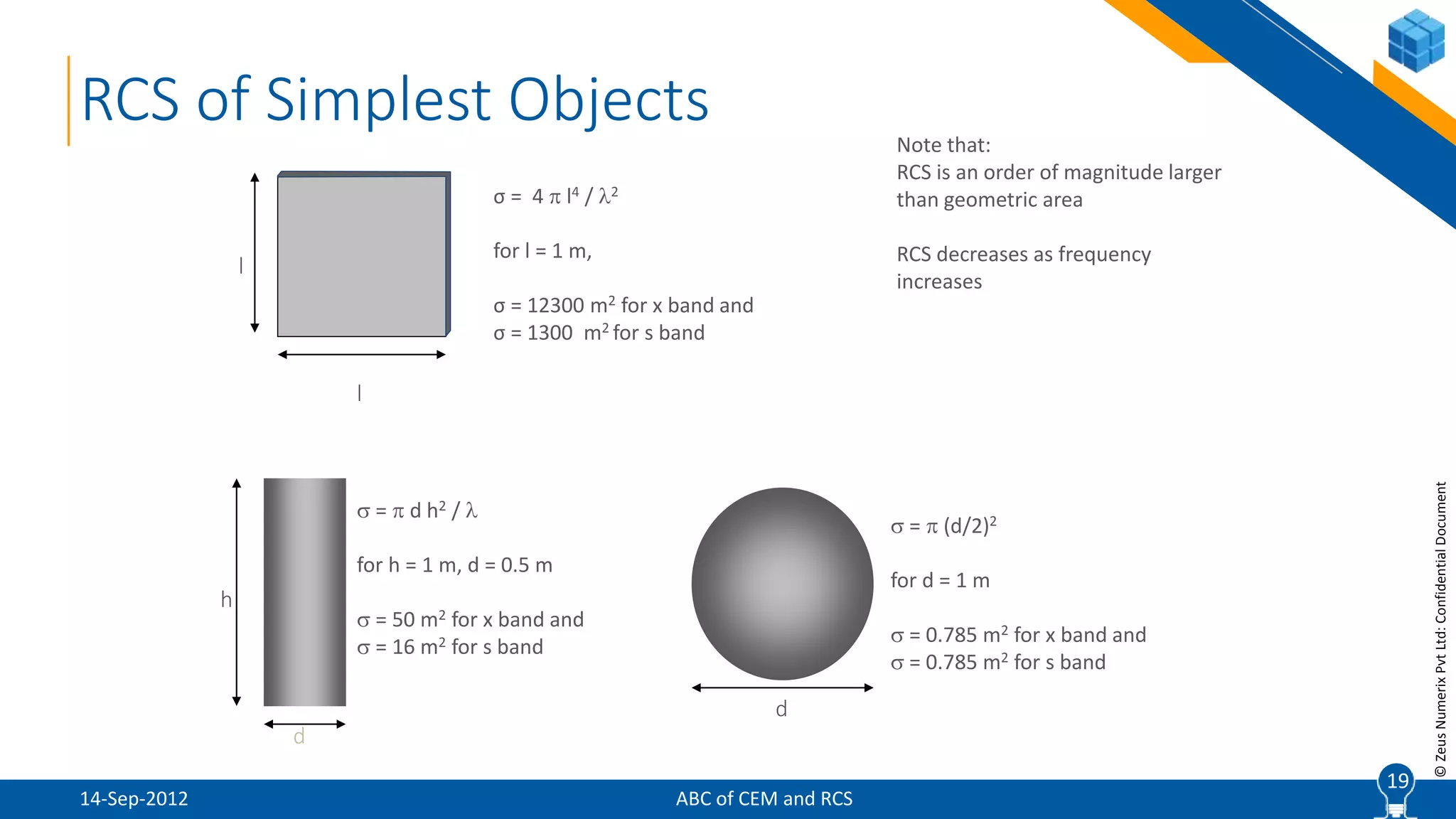
h
d
 =  d h2 / 
for h = 1 m, d = 0.5 m
 = 50 m2 for x band and
 = 16 m2 for s band
d
 =  (d/2)2
for d = 1 m
 = 0.785 m2 for x band and
 = 0.785 m2 for s band
σ = 4  l4 / 2
for l = 1 m,
σ = 12300 m2 for x band and
σ = 1300 m2 for s band
l
l
Note that:
RCS is an order of magnitude larger
than geometric area
RCS decreases as frequency
increases
19
RCS of Simplest Objects
ABC of CEM and RCS14-Sep-2012
20
©ZeusNumerixPvtLtd:ConfidentialDocument
ABC of CEM and RCS
20
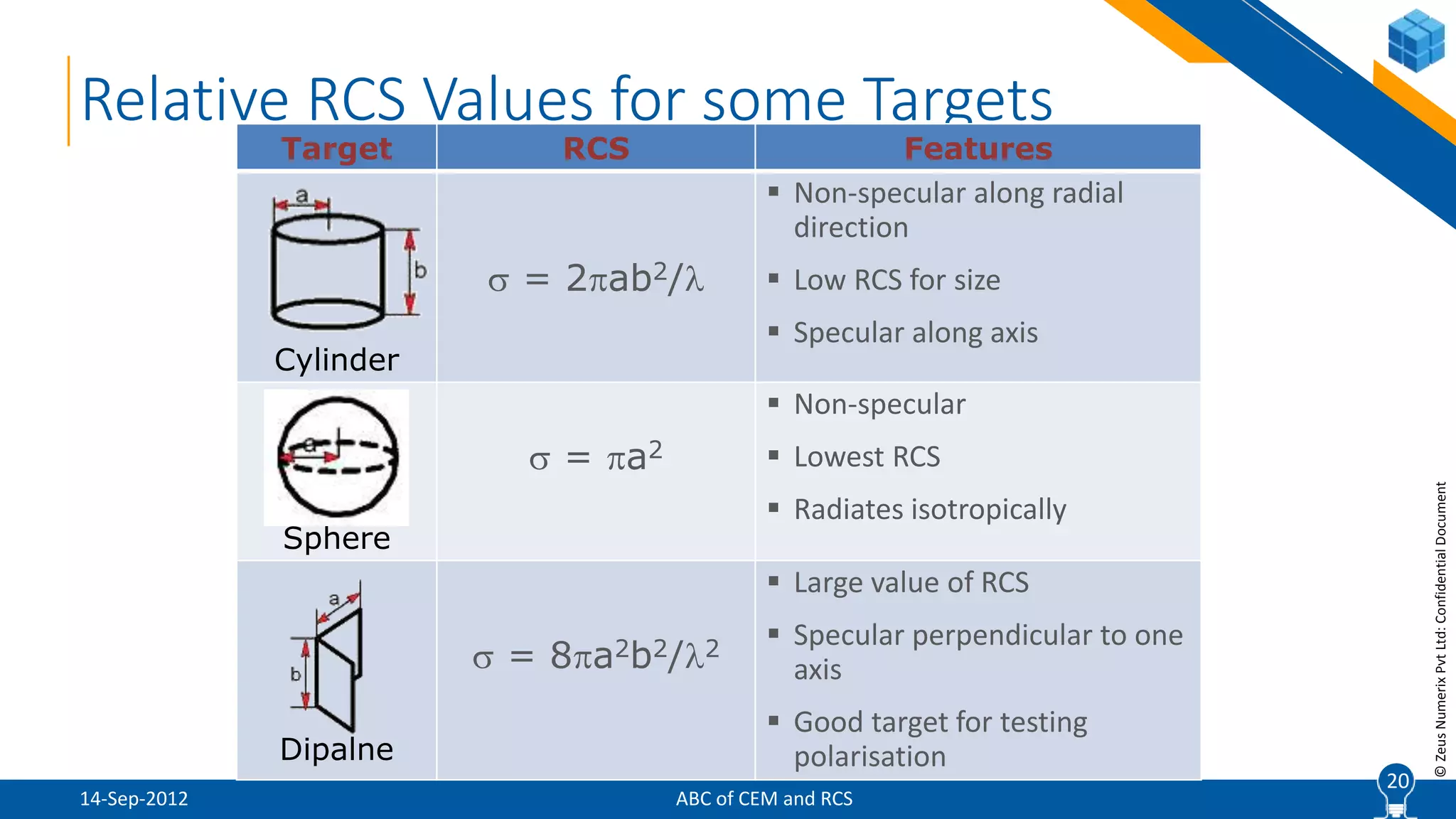
Relative RCS Values for some Targets
Target RCS Features
Cylinder
 = 2ab2/
 Non-specular along radial
direction
 Low RCS for size
 Specular along axis
Sphere
 = a2
 Non-specular
 Lowest RCS
 Radiates isotropically
Dipalne
 = 8a2b2/2
 Large value of RCS
 Specular perpendicular to one
axis
 Good target for testing
polarisation
14-Sep-2012
21
©ZeusNumerixPvtLtd:ConfidentialDocument
ABC of CEM and RCS
21
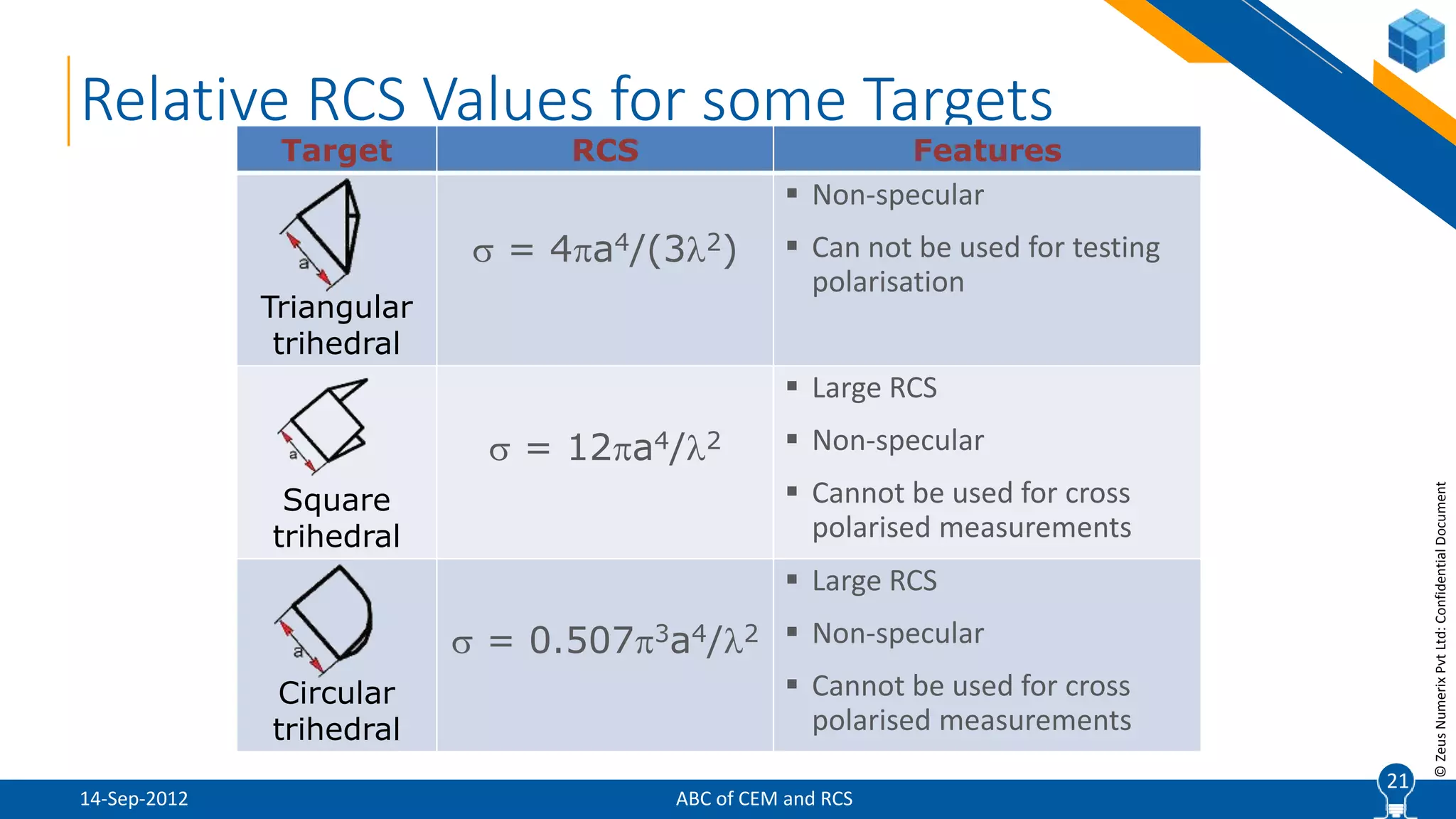
Relative RCS Values for some Targets
Target RCS Features
Triangular
trihedral
 = 4a4/(32)
 Non-specular
 Can not be used for testing
polarisation
Square
trihedral
 = 12a4/2
 Large RCS
 Non-specular
 Cannot be used for cross
polarised measurements
Circular
trihedral
 = 0.5073a4/2
 Large RCS
 Non-specular
 Cannot be used for cross
polarised measurements
14-Sep-2012
22
©ZeusNumerixPvtLtd:ConfidentialDocument
ABC of CEM and RCS
22
Relative RCS Values for some Targets
Target RCS Features
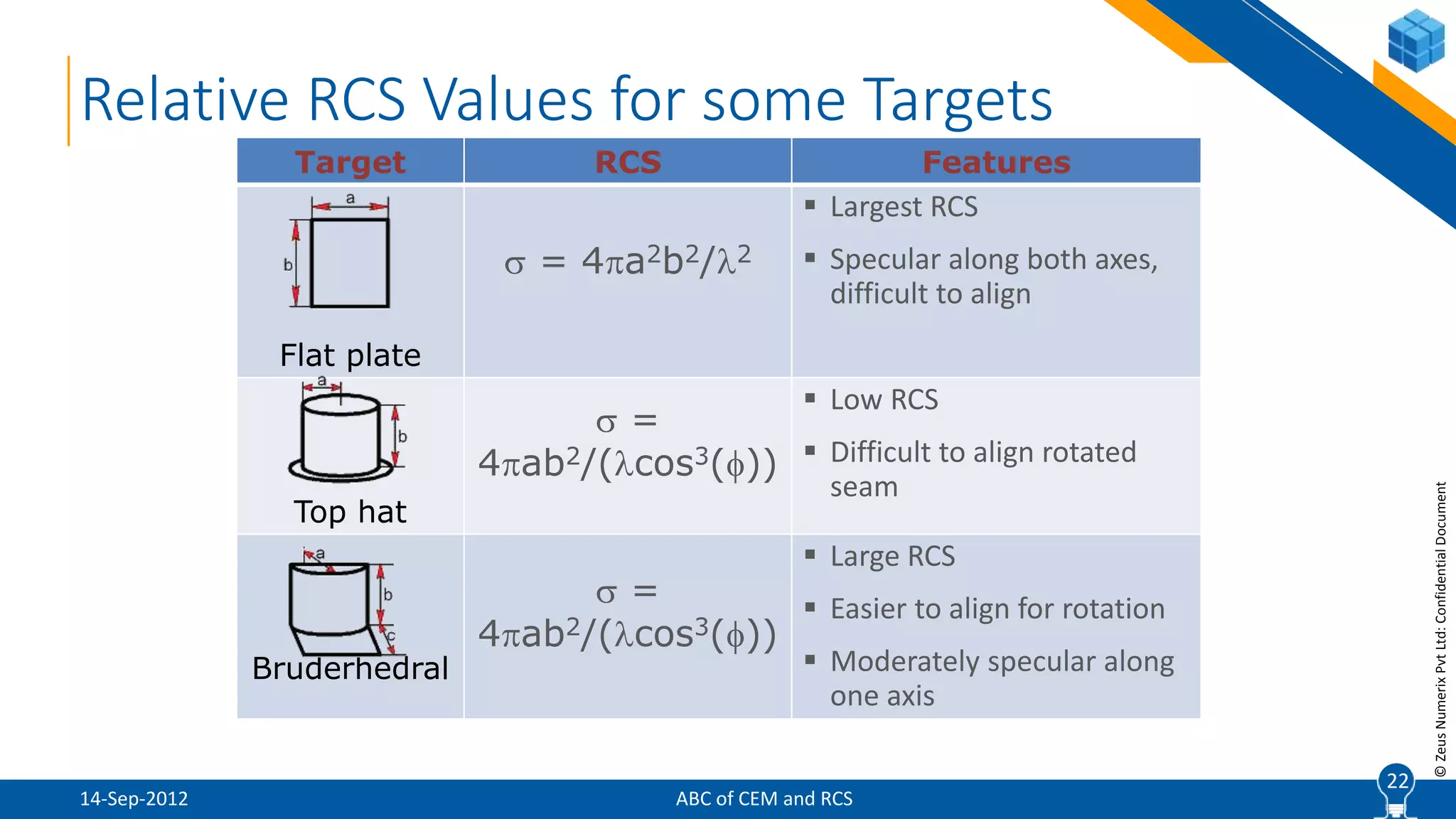
Flat plate
 = 4a2b2/2
 Largest RCS
 Specular along both axes,
difficult to align
Top hat
 =
4ab2/(cos3())
 Low RCS
 Difficult to align rotated
seam
Bruderhedral
 =
4ab2/(cos3())
 Large RCS
 Easier to align for rotation
 Moderately specular along
one axis
14-Sep-2012
23
©ZeusNumerixPvtLtd:ConfidentialDocument
Factors Affecting RCS
ABC of CEM and RCS
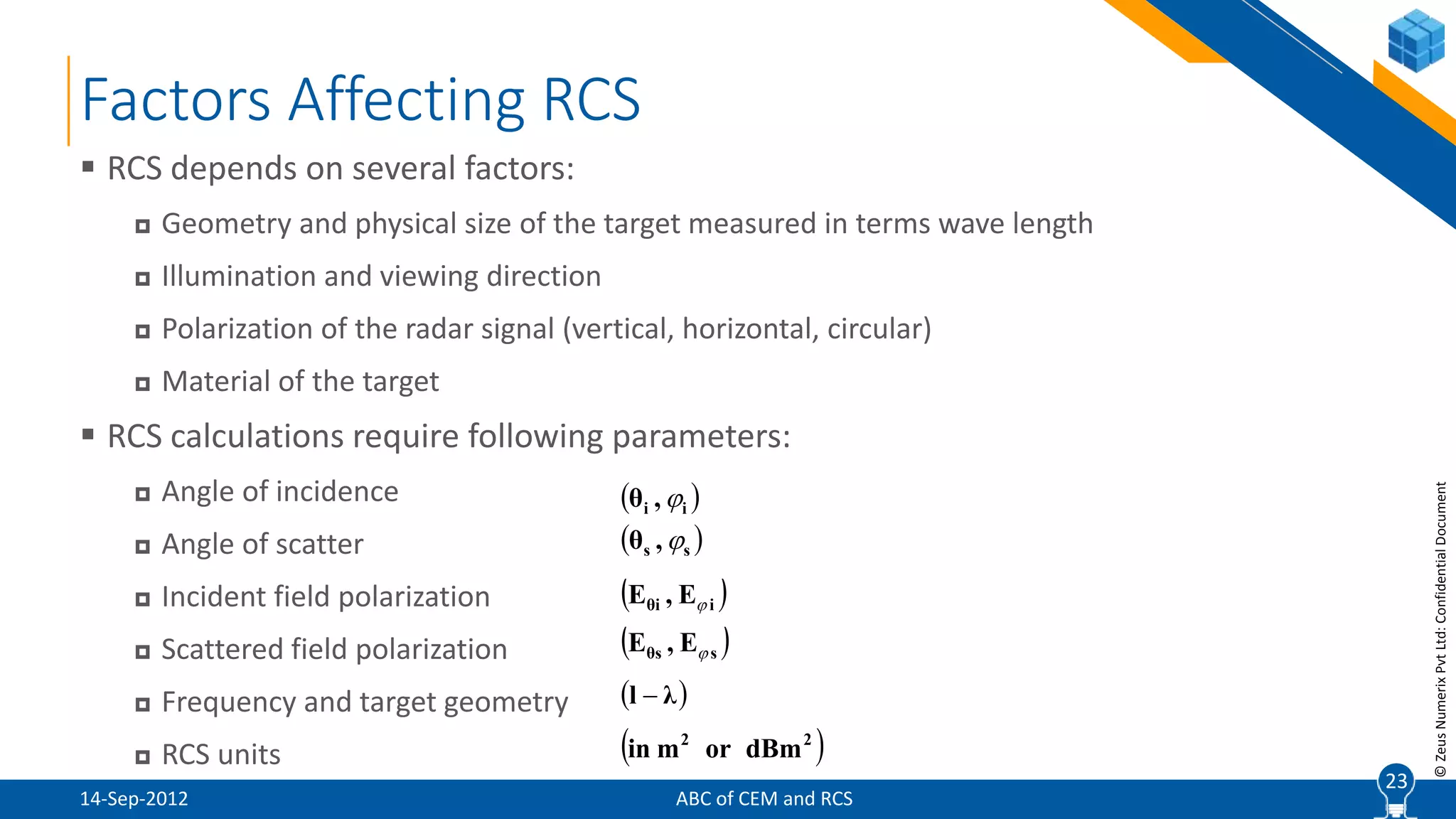
 RCS depends on several factors:
 Geometry and physical size of the target measured in terms wave length
 Illumination and viewing direction
 Polarization of the radar signal (vertical, horizontal, circular)
 Material of the target
 RCS calculations require following parameters:
 Angle of incidence
 Angle of scatter
 Incident field polarization
 Scattered field polarization
 Frequency and target geometry
 RCS units
23
 ii ,θ 
 ss ,θ 
 iθi E,E 
 sθs E,E 
 λl 
 22
dBmormin
14-Sep-2012
24
©ZeusNumerixPvtLtd:ConfidentialDocument
Variation of RCS with Electrical Size
ABC of CEM and RCS
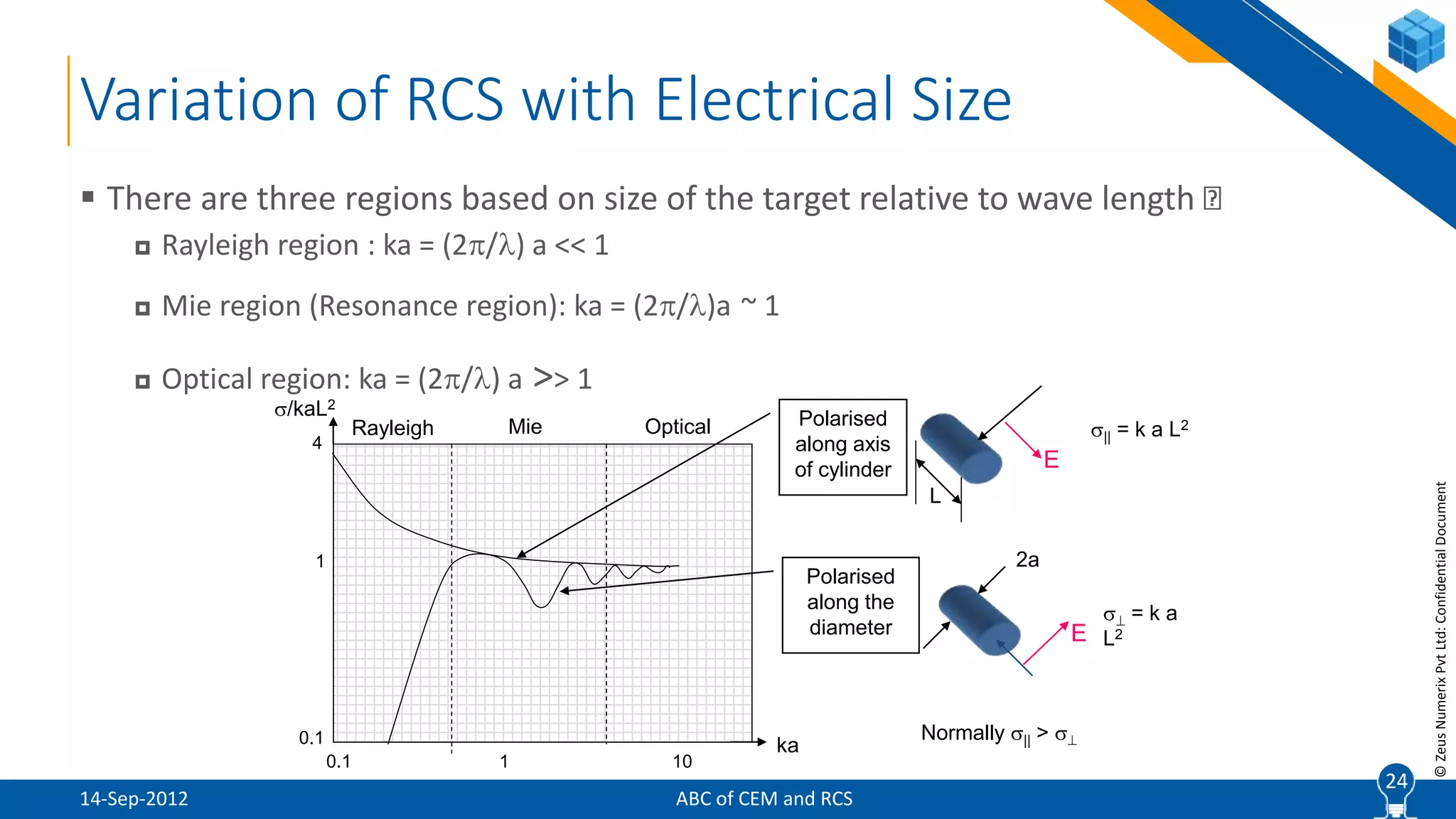
 There are three regions based on size of the target relative to wave length
 Rayleigh region : ka = (2/) a << 1
 Mie region (Resonance region): ka = (2/)a ~ 1
 Optical region: ka = (2/) a >> 1
24
Polarised
along axis
of cylinder
Polarised
along the
diameter
Rayleigh Mie Optical
E
E
|| = k a L2
2a
L
 = k a
L2
1
0.1
4
0.1 101
/kaL2
ka
Normally || > 
14-Sep-2012
25
©ZeusNumerixPvtLtd:ConfidentialDocument
Scattering Regions
ABC of CEM and RCS
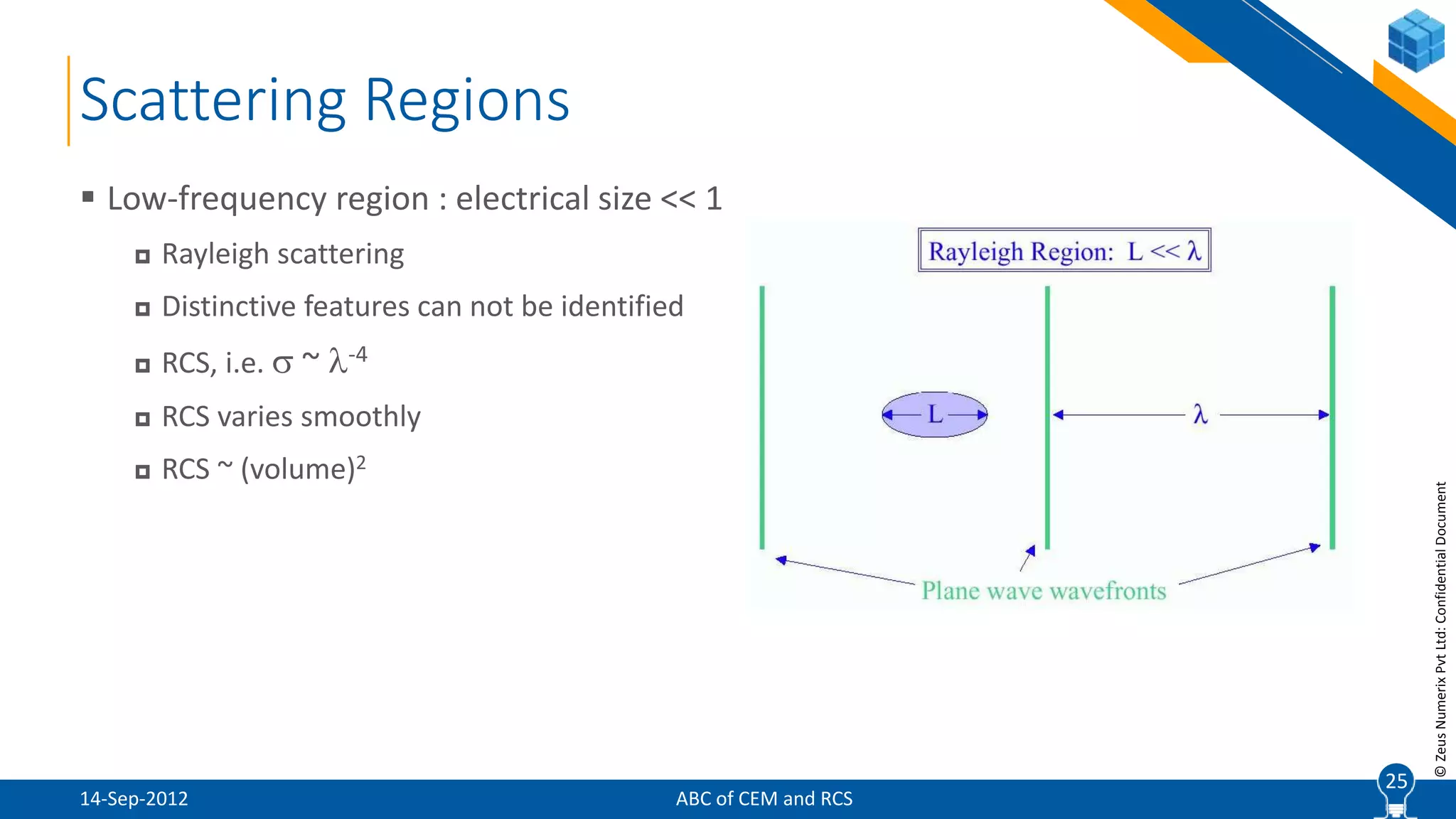
 Low-frequency region : electrical size << 1
 Rayleigh scattering
 Distinctive features can not be identified
 RCS, i.e.  ~ -4
 RCS varies smoothly
 RCS ~ (volume)2
25
14-Sep-2012
26
©ZeusNumerixPvtLtd:ConfidentialDocument
Scattering Regions
ABC of CEM and RCS
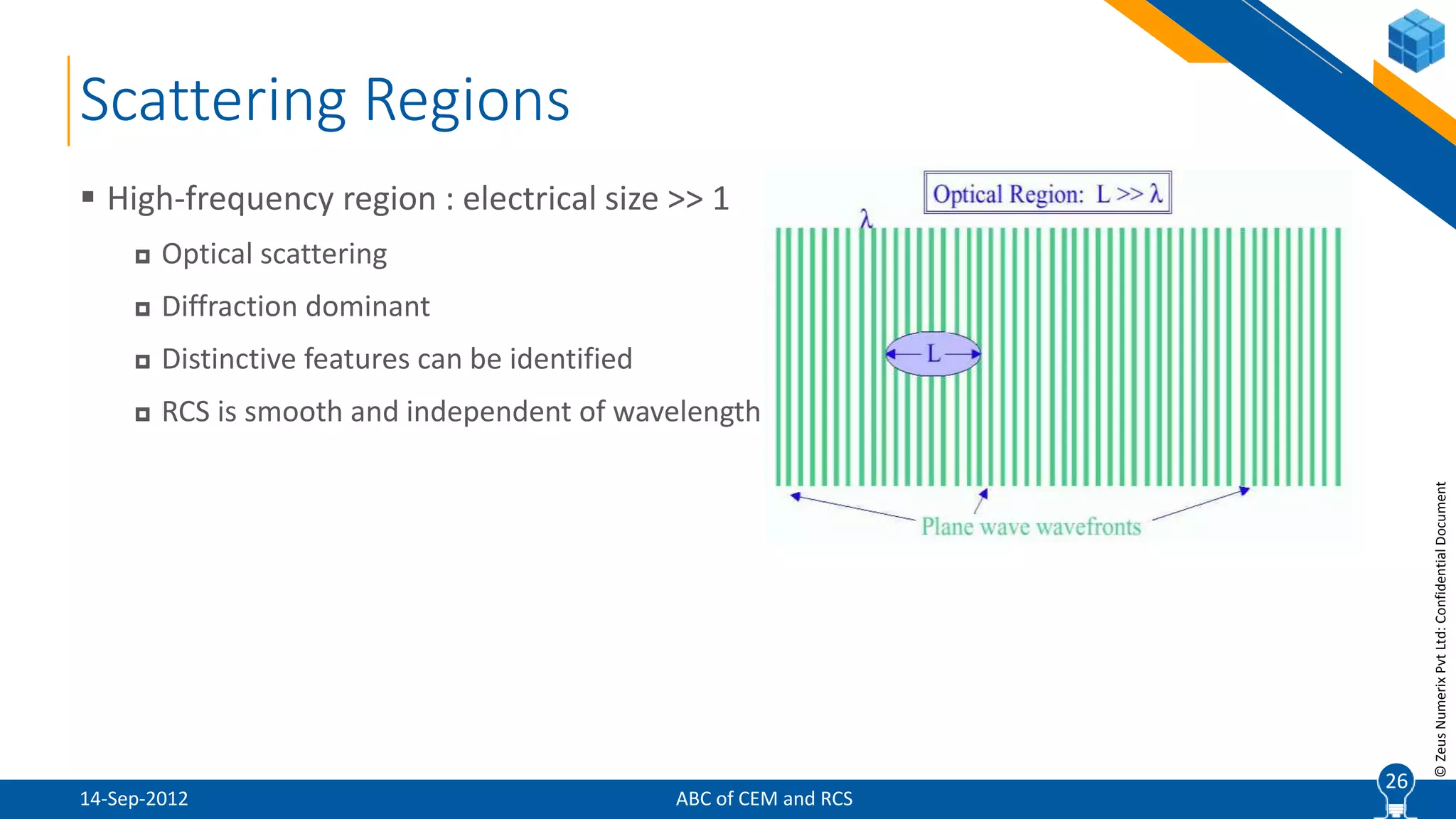
 High-frequency region : electrical size >> 1
 Optical scattering
 Diffraction dominant
 Distinctive features can be identified
 RCS is smooth and independent of wavelength
26
14-Sep-2012
27
©ZeusNumerixPvtLtd:ConfidentialDocument
ABC of CEM and RCS
27
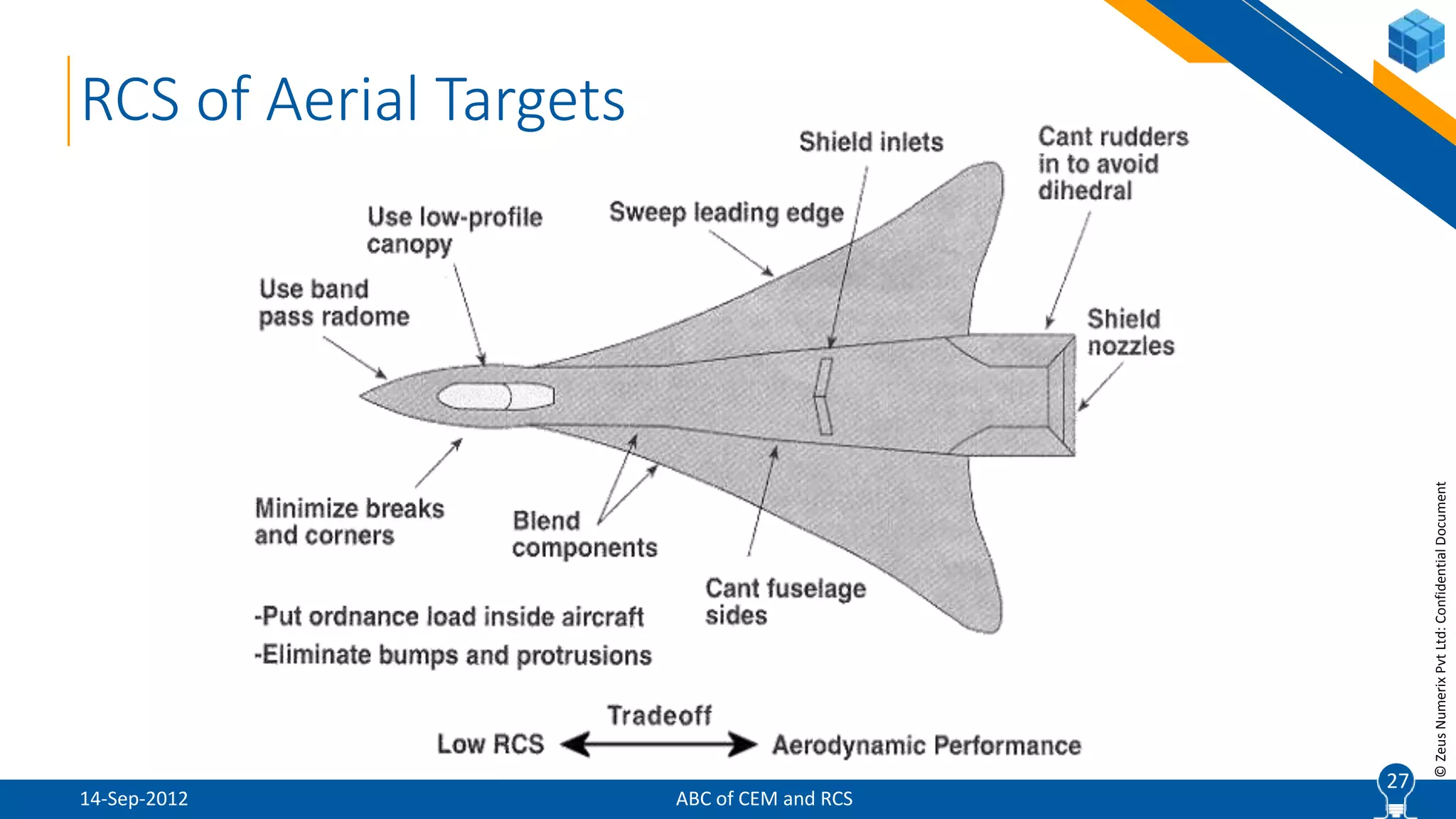
RCS of Aerial Targets
14-Sep-2012
28
©ZeusNumerixPvtLtd:ConfidentialDocument
ABC of CEM and RCS
28
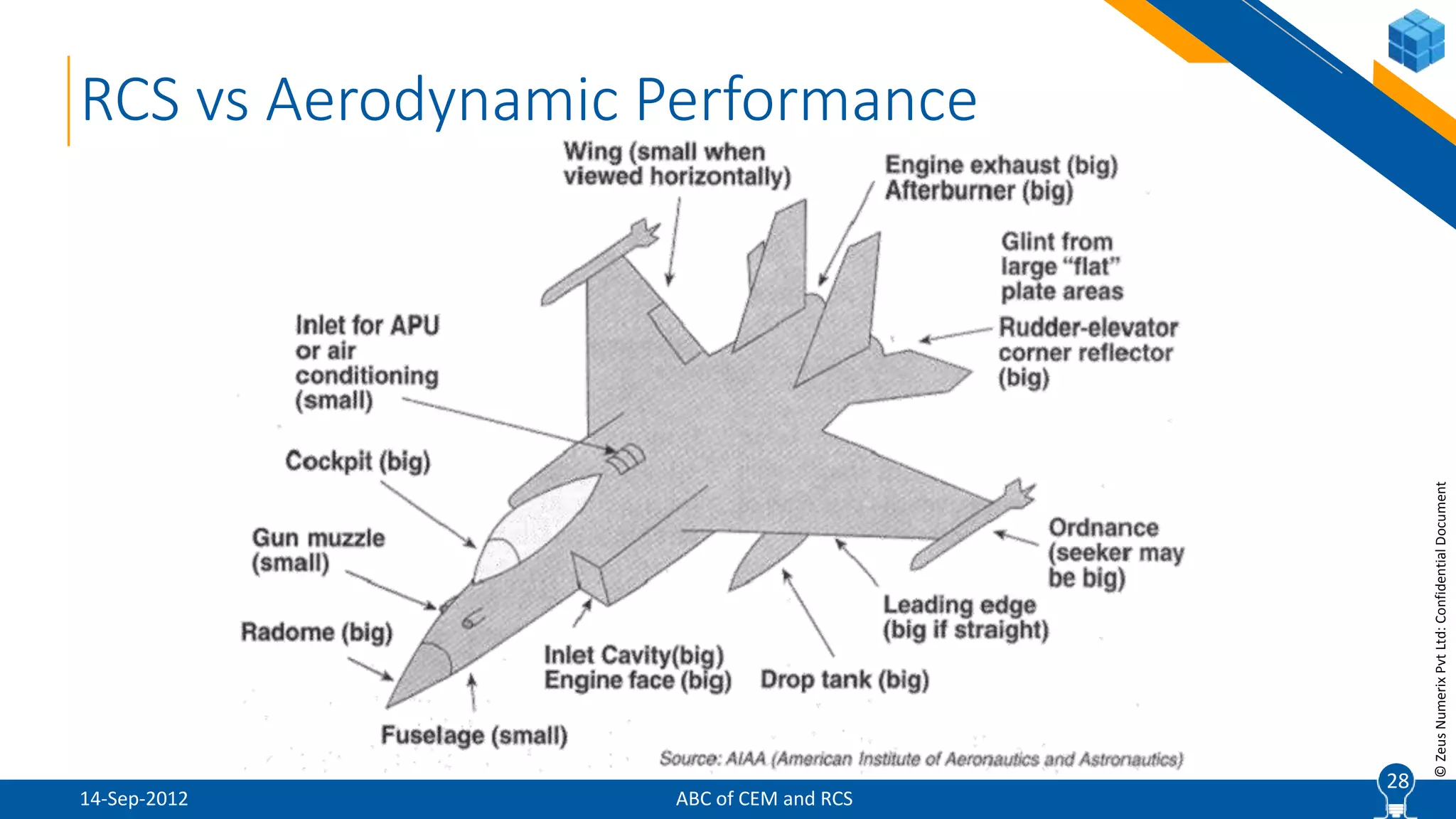
RCS vs Aerodynamic Performance
14-Sep-2012
29
©ZeusNumerixPvtLtd:ConfidentialDocument
RCS Reduction by Shaping
ABC of CEM and RCS
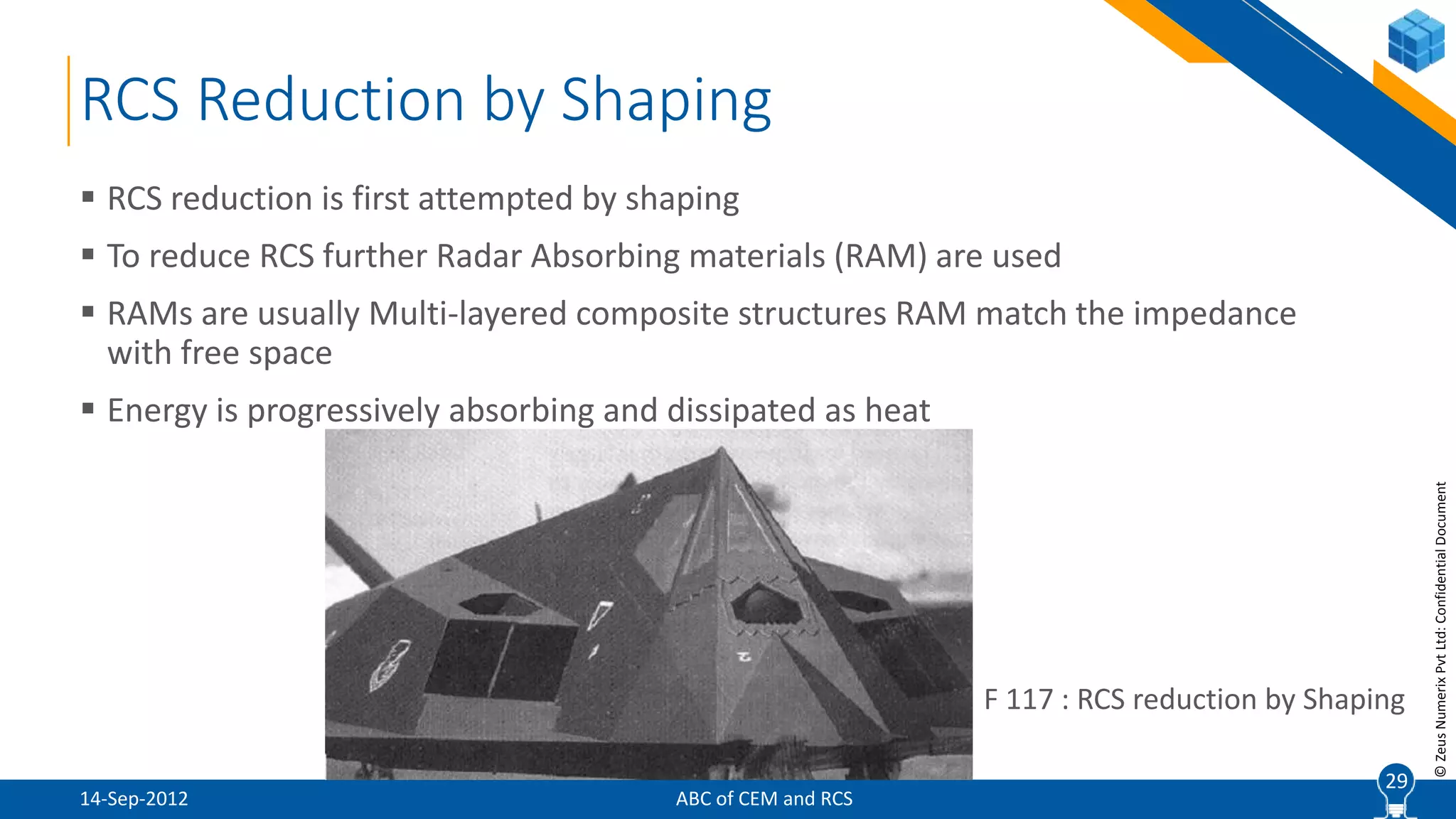
 RCS reduction is first attempted by shaping
 To reduce RCS further Radar Absorbing materials (RAM) are used
 RAMs are usually Multi-layered composite structures RAM match the impedance
with free space
 Energy is progressively absorbing and dissipated as heat
29
F 117 : RCS reduction by Shaping
14-Sep-2012
30
©ZeusNumerixPvtLtd:ConfidentialDocument
RCS of Maritime Targets
ABC of CEM and RCS
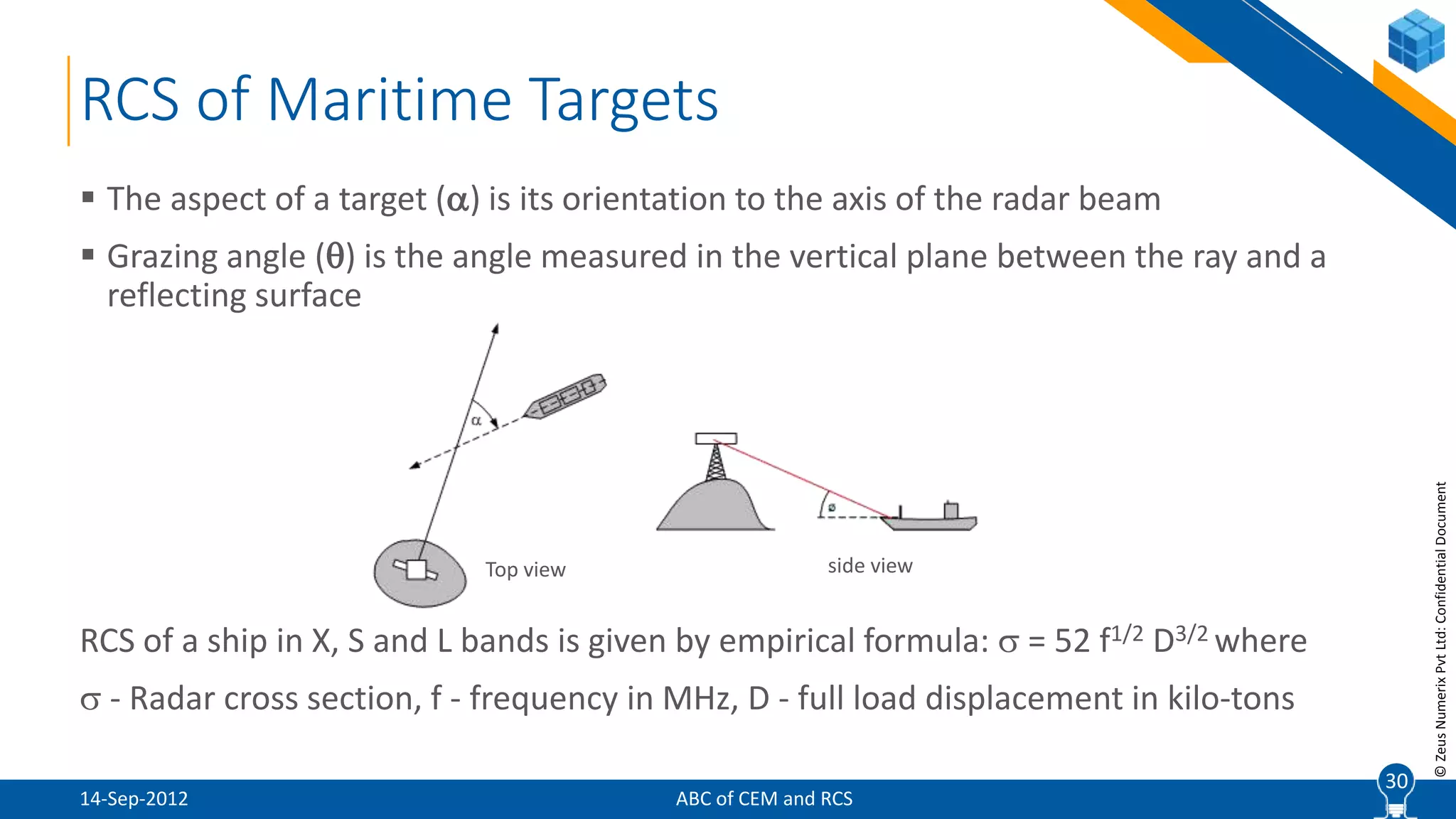
 The aspect of a target () is its orientation to the axis of the radar beam
 Grazing angle () is the angle measured in the vertical plane between the ray and a
reflecting surface
RCS of a ship in X, S and L bands is given by empirical formula:  = 52 f1/2 D3/2 where
 - Radar cross section, f - frequency in MHz, D - full load displacement in kilo-tons
30
Top view side view
14-Sep-2012
31
©ZeusNumerixPvtLtd:ConfidentialDocument
Radar Absorbing Materials
ABC of CEM and RCS
 Cockpit windows are covered with conductive materials to minimise penetration into
the cockpit,
 Air intakes are covered with mesh, or follow convoluted paths designed to ensure
that the radar signal is reflected many times and mostly absorbed before it exits.
 Research is being conducted to create a plasma that can cover the aircraft. Plasma
makes an excellent RAM as is not reflective but offers high attenuation.
 Under certain circumstances, a 10mm thick plasma could reduce the radar
reflectivity of the underlying surface by 20dB.
31
14-Sep-2012
32
©ZeusNumerixPvtLtd:ConfidentialDocument
Types of Radar Echoes
ABC of CEM and RCS
 RCS fluctuates from one echo to the next. The fluctuation is caused by:
 Target scintillation
 Multipath effects
 Environmental effects as caused by atmosphere / seastate
 Changes due to aspect / grazing angles
 These are treated statistically and properties can be determined:
 RCS mean or median value
 Shape of the probability density function (PDF)
 Autocorrelation function (ACF)
 There are five (Peter Swerling) distinct cases describing typical radar echo
fluctuations
 Knowing the type of case helps in radar range calculations 32
14-Sep-2012
33
©ZeusNumerixPvtLtd:ConfidentialDocument
Types of Radar Echoes
ABC of CEM and RCS
 Swerling case 1 (Echoes from aerial/maritime targets)
 Echoes do not fluctuate much from one radar pulse to the next
 However echoes from two successive scans are independent from each other.
 Swerling case 2 (Rapidly fluctuating target)
 Echoes can vary from pulse to pulse
 Echos vary from scan to scan
 For Case 1 & Case 2 PDF is given by:
 P() = (1/ave) e –(/ave)
 Case 3 and Case 4
 These apply to target targets having one dominant reflecting surface For these Swerling
cases PDF is given by P() = (4/(ave)2) e –(2/ave)
33
14-Sep-2012
34
©ZeusNumerixPvtLtd:ConfidentialDocument
Electronic Counter Measures
ABC of CEM and RCS
Anti stealth technology includes the following techniques:
 Radar with wavelengths longer than the aircraft
 Bi-static and multi static radar configurations. These can use dedicated transmitters or
existing FM or even mobile phone broadcasts!
 Wide-band radar because it is difficult to make good wide-band RAM
 Wake and exhaust detection and tracking; neither of these can be completely eliminated
 Wingtip vortex detection as vortices generate low density regions capable of significant
changes in refractive index and hence generating radar echoes
34
14-Sep-2012
35
©ZeusNumerixPvtLtd:ConfidentialDocument
What about IR and Visible Range?
ABC of CEM and RCS
Important difference between Radar and IR / Visible frequency detection are:
 Laser targets are always larger than beam size
 Targets appearing smooth in microwave will appear as rough targets are wavelength
is smaller
 Diffuse surface at Radar frequencies may appear as a collection specular scatterer
 At higher IR and visible radiation cross section is  = GA
 where
  - cross section (m2)
  - reflectivity of surface
 G - gain of target
 A – projected physical area
35
14-Sep-2012
36
©ZeusNumerixPvtLtd:ConfidentialDocument
 Engineering Electromagnetics, 2nd
edition,
 N. Ida, Springer Verlag, NY, May 2004.
 Antenna Theory (Analysis and
Design)
 Constantine A. Balanis, John Wiley &
Sons, INC
 Radar Principles
 Peyton Z. Peebles, Jr., John Wiely and
Sons Inc.
 Electromagnetics
 Joseph A. Edminister, International
Edition, Schaum’s Radar Cross Section
Lectures
 Radar Cross Section Lectures
 Allen E. Fuhs, AIAA, 1633 Bradway,
New York, 100 19
 Radar Absorbing Materials (from
theory to Design and
Characterisation)
 K. J. Vinoy and R. M. Jha, NAL
Bangalore
 Time Domain Electromagetics
 S. M. Rao (editor), Academic Press
ABC of CEM and RCS
36
Recommended Books / Report
14-Sep-2012
37
www.zeusnumerix.com
+91 72760 31511
Abhishek Jain
abhishek@zeusnumerix.com
Thank You !

CEM Workshop Lectures (1/11): ABC of CEM and RCS

  • 1.
    1Built-to-Spec | ProductApproval | Engineering Services | Software Development ABC of CEM and RCS Basics explained for beginners
  • 2.
    2 ©ZeusNumerixPvtLtd:ConfidentialDocument About the TrainingProgramme ABC of CEM and RCS  This is an introductory course in computational electromagnetics (CEM)  The emphasis is on foundations and methods of predicting Radar Cross Section (RCS) of Aerial Targets  The course is neither targeted towards scientists who wish to develop their own application nor towards engineers who wish to use a proprietary software for solving their own problems  Demonstrations on the last two days are for illustrating steps required to calculate RCS 2 14-Sep-2012
  • 3.
    3 ©ZeusNumerixPvtLtd:ConfidentialDocument Contents ABC of CEMand RCS  Basics of stealth and importance of RCS  Electromagnetic wave, Frequency, wave number and Poynting vector, electrical and magnetic field  Frequencies and bands used in Radar  Detection, inverse scattering, Types of scattering and types of RCS  Units of RCS, Range equation, Polarisation and scattering matrix  RCs of simple shapes, scattering regions, RCS of flying object and maritime objects  Classification of RADAR echoes  Some information of IR and acoustics stealth 3 14-Sep-2012
  • 4.
    4 ©ZeusNumerixPvtLtd:ConfidentialDocument ABC of CEMand RCS 4 Survivability vs. Altitude & Speed for Aircraft Flight altitude Speed of the aircraft Excellent survivability very good survivability good survivability low survivability Stealth technologies can improve the survivability for aircraft for a given flight envelop. 14-Sep-2012
  • 5.
    5 ©ZeusNumerixPvtLtd:ConfidentialDocument ABC of CEMand RCS 5 Stealth Technologies and their Usefulness Stealth technology Applications in Aerospace Application in Navy Applications in Army  Radar  High  High  Medium  Infrared  Medium  Medium  High  Acoustics  Low  High  Low  Contrail  Low  High  High  Visual  Low  Low  Medium 14-Sep-2012
  • 6.
    6 ©ZeusNumerixPvtLtd:ConfidentialDocument Electromagnetic Wave ABC ofCEM and RCS  Electromagnetic wave has two fields: Electrical field and Magnetic field  The direction of electrical field dictates the polarisation  Energy density = energy / volume = ( E2 + H2) Joules / m3  Flux of energy S = E x H watts / m2  Power ~ (amplitude)2 6 E – electrical filed Horizontally polarised electromagnetic wave E – electrical filed Vertically polarised electromagnetic wave amplitude Wave length  Frequency f = c/  Wave no k = 2/ Poynting vector S = E x H (watts /m2) 14-Sep-2012
  • 7.
    7 ©ZeusNumerixPvtLtd:ConfidentialDocument ABC of CEMand RCS 7 Electromagnetic Radiation vs Light Visible light Radar waves 14-Sep-2012
  • 8.
    8 ©ZeusNumerixPvtLtd:ConfidentialDocument Nomenclature of Bands ABCof CEM and RCS 8 ELF (Extremely Low Frequency) 30 Hz 10,000 km VF (Voice Frequency) 300 Hz 1,000 km VLF (Very Low Frequency) 3 kHz 100 km LF (Low Frequency) 30 kHz 10 km MF (Medium Frequency) 300 kHz 1 km HF (High Frequency) 3 MHz 100 mm VHF (Very High Frequency) 30 MHz 10 mm UHF (Ultra High Frequency) 300 MHz 1 mm L 1 GHz 30 cm S 2 GHz 15 cm C 4 GHz 7.5 cm X 8 GHz 3.75 cm Ku 12 GHz 2.5 cm K 18 GHz 1.67 cm Ka 27 GHz 1.1 cm V 40 GHz 7.5 mm W 75 GHz 4 mm Mm 110 GHz 2.73 mm NATO Band Frequencies A 0 Hz – B 250 MHz 1.2 m C 500 MHz 60 cm D 1 GHz 3 cm E 2 GHz 15 cm F 3 GHz 10 cm G 4 GHz 7.5 cm H 6 GHz 5.0 cm I 8 GHz 3.75 cm J 10 GHz 3.0 cm K 20 GHz 1.5 cm L 40 GHz 0.75 cm M 60 GHz 0.5 cm (up to 100 GHz / 0.3cm 14-Sep-2012
  • 9.
    9 ©ZeusNumerixPvtLtd:ConfidentialDocument RCS : Detectionof Target Incident power scattered or reflected power is collected by different antennas Bi-static Configuration Mono-static Configuration scattered or reflected power is collected by the same antenna Rst Rtf Rst Incident power scattered power Transmitting and also receiving antenna Transmitting antenna receiving antenna ABC of CEM and RCS14-Sep-2012
  • 10.
    10 ©ZeusNumerixPvtLtd:ConfidentialDocument Detection vs InverseScattering Incident wave scattered wave has time varying amplitude Inverse scattering technique provides method of estimating (a) Size of target (b) Shape of target Inverse scattering technique is more sophisticated than RCS which is only for detection of target 10 ABC of CEM and RCS14-Sep-2012
  • 11.
    11 ©ZeusNumerixPvtLtd:ConfidentialDocument Scattered Power Mono-static radarRCS : Energy scattered towards the source is called backscattered energy Bi-static RCS: Energy scattered in any other directions RCS (normally denoted by ) is defined as  = 4 ( Ps / Pi); Ps scattered or reflected power per solid angle (w/sold angle) Pi incident power density (w/m2) Radiation intercepted by an object can be reflected, absorbed, or transmitted through the target Incident energy absorbed energy transmitted energy scattered energy reflected energy diffracted energy 11 ABC of CEM and RCS14-Sep-2012
  • 12.
    12 ©ZeusNumerixPvtLtd:ConfidentialDocument  RCS dependsup on:  Shape of the target  Orientation of target with respect to source of radiation  Orientation of the receiving radar with respect to target (only for Bi-static RCS)  Material of the surface Plane wave incident on flat plate conductor will reflect the entire energy backwards Reflected energy is not restricted in the backward direction Reflected energy is primarily in forward direction, except at nose diffraction If RCS is reduced in one direction, it will necessarily increase in some other direction scattered power scattered power scattered power Incident power Incident power Incident power 12 Scattered Power and RCS ABC of CEM and RCS14-Sep-2012
  • 13.
    13 ©ZeusNumerixPvtLtd:ConfidentialDocument RCS also dependsup on orientation of the surface. Consider a flat plate: Mono-static RCS varies from 0 to a large value as the orientation changes to broad-side orientation Note: We have neglected edge diffractions and tip diffractions No scattered power scattered power 13 Scattered Power ABC of CEM and RCS14-Sep-2012
  • 14.
    14 ©ZeusNumerixPvtLtd:ConfidentialDocument Ev i incident scattered Ev s Ev i incident scattered Ev s Ev s = avvEv i EH s = aHv Ev i Cross polarization / depolarization EH S aHH aHV EH I = Ev S aVH aVV EV I Scattering Matrix : Co-polarization 14 Polarization and Scattering Matrix ABC of CEM and RCS14-Sep-2012
  • 15.
    15 ©ZeusNumerixPvtLtd:ConfidentialDocument A Definition :Radar Cross Section (RCS) of a target is the (fictitious) area intercepting that amount of power which, when scattered equally in all directions, produces an echo at the radar equal to that from the target From the definition:  Ii / (4) = Ir R2 where  Ii / (4) is fraction of power scattered by target per unit solid angle (Ir Ar )/(Ar / R2) IrR2 is power scattered into area (Ir Ar) divided by solid angle that the area makes (Ar/R2) 15 Definition of RCS ABC of CEM and RCS14-Sep-2012
  • 16.
    16 ©ZeusNumerixPvtLtd:ConfidentialDocument Definition of RCS Amountof energy scattered by aircraft = energy scattered by sphere Aircraft scatters different amount of energy in different direction; RCS is different in different directions  = (power reflected by the target per solid angle) / (incident power density / 4) = limit 4 R2 | Er / Ei | or R   = limit 4 R2 | Hr / Hi| R   = limit 4 R2 | Ir / Ii |, I is power density R   RCS (expressed in db): db = 10 log [( in m2)/(1 m2)] Equivalent sphere 16 ABC of CEM and RCS14-Sep-2012
  • 17.
    17 ©ZeusNumerixPvtLtd:ConfidentialDocument 10000 m2 40Battle ship 1000 m2 30 Classical bomber 100 m2 20 B – 52 bomber 10 m2 10 Classical fighter Sphere of cross section 1 m2 1 m2 0 0.1 m2 -10 Stealth fighter Birds 0.01 m2 -20 F-22 Raptor Insects 0.001 m2 -30 B -2 Spirit 0.0001 m2 -40 17 Typical RCS Values in m2 and in dB ABC of CEM and RCS14-Sep-2012
  • 18.
    18 ©ZeusNumerixPvtLtd:ConfidentialDocument  Power densityat the target (St ) (Psource Gtransmission_antenna) / (4 Rsource-to-target 2), where Psource = Power transmitted by source radar & Gtransmission_antenna = gain of the transmitting antenna Power received by target (Pincident ) = Ssource  = (Psource Gtransmission_antenna ) / (4R2 source-to-target), where  = surface area of target For (PEC) perfectly electrical conductor, the entire power is scattered. If the scattered energy is isotropic (not a function of the direction), then scattered energy by receiving radar (Sscattered) Sscattered = Pincident / (4R2 target-to-receiver) = (Ps Gs )/[(4R2 source-to-target)(4R2 target-to-receiver)] Range for Given RCS Value 18 ABC of CEM and RCS14-Sep-2012
  • 19.
    19 ©ZeusNumerixPvtLtd:ConfidentialDocument h d  = d h2 /  for h = 1 m, d = 0.5 m  = 50 m2 for x band and  = 16 m2 for s band d  =  (d/2)2 for d = 1 m  = 0.785 m2 for x band and  = 0.785 m2 for s band σ = 4  l4 / 2 for l = 1 m, σ = 12300 m2 for x band and σ = 1300 m2 for s band l l Note that: RCS is an order of magnitude larger than geometric area RCS decreases as frequency increases 19 RCS of Simplest Objects ABC of CEM and RCS14-Sep-2012
  • 20.
    20 ©ZeusNumerixPvtLtd:ConfidentialDocument ABC of CEMand RCS 20 Relative RCS Values for some Targets Target RCS Features Cylinder  = 2ab2/  Non-specular along radial direction  Low RCS for size  Specular along axis Sphere  = a2  Non-specular  Lowest RCS  Radiates isotropically Dipalne  = 8a2b2/2  Large value of RCS  Specular perpendicular to one axis  Good target for testing polarisation 14-Sep-2012
  • 21.
    21 ©ZeusNumerixPvtLtd:ConfidentialDocument ABC of CEMand RCS 21 Relative RCS Values for some Targets Target RCS Features Triangular trihedral  = 4a4/(32)  Non-specular  Can not be used for testing polarisation Square trihedral  = 12a4/2  Large RCS  Non-specular  Cannot be used for cross polarised measurements Circular trihedral  = 0.5073a4/2  Large RCS  Non-specular  Cannot be used for cross polarised measurements 14-Sep-2012
  • 22.
    22 ©ZeusNumerixPvtLtd:ConfidentialDocument ABC of CEMand RCS 22 Relative RCS Values for some Targets Target RCS Features Flat plate  = 4a2b2/2  Largest RCS  Specular along both axes, difficult to align Top hat  = 4ab2/(cos3())  Low RCS  Difficult to align rotated seam Bruderhedral  = 4ab2/(cos3())  Large RCS  Easier to align for rotation  Moderately specular along one axis 14-Sep-2012
  • 23.
    23 ©ZeusNumerixPvtLtd:ConfidentialDocument Factors Affecting RCS ABCof CEM and RCS  RCS depends on several factors:  Geometry and physical size of the target measured in terms wave length  Illumination and viewing direction  Polarization of the radar signal (vertical, horizontal, circular)  Material of the target  RCS calculations require following parameters:  Angle of incidence  Angle of scatter  Incident field polarization  Scattered field polarization  Frequency and target geometry  RCS units 23  ii ,θ   ss ,θ   iθi E,E   sθs E,E   λl   22 dBmormin 14-Sep-2012
  • 24.
    24 ©ZeusNumerixPvtLtd:ConfidentialDocument Variation of RCSwith Electrical Size ABC of CEM and RCS  There are three regions based on size of the target relative to wave length  Rayleigh region : ka = (2/) a << 1  Mie region (Resonance region): ka = (2/)a ~ 1  Optical region: ka = (2/) a >> 1 24 Polarised along axis of cylinder Polarised along the diameter Rayleigh Mie Optical E E || = k a L2 2a L  = k a L2 1 0.1 4 0.1 101 /kaL2 ka Normally || >  14-Sep-2012
  • 25.
    25 ©ZeusNumerixPvtLtd:ConfidentialDocument Scattering Regions ABC ofCEM and RCS  Low-frequency region : electrical size << 1  Rayleigh scattering  Distinctive features can not be identified  RCS, i.e.  ~ -4  RCS varies smoothly  RCS ~ (volume)2 25 14-Sep-2012
  • 26.
    26 ©ZeusNumerixPvtLtd:ConfidentialDocument Scattering Regions ABC ofCEM and RCS  High-frequency region : electrical size >> 1  Optical scattering  Diffraction dominant  Distinctive features can be identified  RCS is smooth and independent of wavelength 26 14-Sep-2012
  • 27.
    27 ©ZeusNumerixPvtLtd:ConfidentialDocument ABC of CEMand RCS 27 RCS of Aerial Targets 14-Sep-2012
  • 28.
    28 ©ZeusNumerixPvtLtd:ConfidentialDocument ABC of CEMand RCS 28 RCS vs Aerodynamic Performance 14-Sep-2012
  • 29.
    29 ©ZeusNumerixPvtLtd:ConfidentialDocument RCS Reduction byShaping ABC of CEM and RCS  RCS reduction is first attempted by shaping  To reduce RCS further Radar Absorbing materials (RAM) are used  RAMs are usually Multi-layered composite structures RAM match the impedance with free space  Energy is progressively absorbing and dissipated as heat 29 F 117 : RCS reduction by Shaping 14-Sep-2012
  • 30.
    30 ©ZeusNumerixPvtLtd:ConfidentialDocument RCS of MaritimeTargets ABC of CEM and RCS  The aspect of a target () is its orientation to the axis of the radar beam  Grazing angle () is the angle measured in the vertical plane between the ray and a reflecting surface RCS of a ship in X, S and L bands is given by empirical formula:  = 52 f1/2 D3/2 where  - Radar cross section, f - frequency in MHz, D - full load displacement in kilo-tons 30 Top view side view 14-Sep-2012
  • 31.
    31 ©ZeusNumerixPvtLtd:ConfidentialDocument Radar Absorbing Materials ABCof CEM and RCS  Cockpit windows are covered with conductive materials to minimise penetration into the cockpit,  Air intakes are covered with mesh, or follow convoluted paths designed to ensure that the radar signal is reflected many times and mostly absorbed before it exits.  Research is being conducted to create a plasma that can cover the aircraft. Plasma makes an excellent RAM as is not reflective but offers high attenuation.  Under certain circumstances, a 10mm thick plasma could reduce the radar reflectivity of the underlying surface by 20dB. 31 14-Sep-2012
  • 32.
    32 ©ZeusNumerixPvtLtd:ConfidentialDocument Types of RadarEchoes ABC of CEM and RCS  RCS fluctuates from one echo to the next. The fluctuation is caused by:  Target scintillation  Multipath effects  Environmental effects as caused by atmosphere / seastate  Changes due to aspect / grazing angles  These are treated statistically and properties can be determined:  RCS mean or median value  Shape of the probability density function (PDF)  Autocorrelation function (ACF)  There are five (Peter Swerling) distinct cases describing typical radar echo fluctuations  Knowing the type of case helps in radar range calculations 32 14-Sep-2012
  • 33.
    33 ©ZeusNumerixPvtLtd:ConfidentialDocument Types of RadarEchoes ABC of CEM and RCS  Swerling case 1 (Echoes from aerial/maritime targets)  Echoes do not fluctuate much from one radar pulse to the next  However echoes from two successive scans are independent from each other.  Swerling case 2 (Rapidly fluctuating target)  Echoes can vary from pulse to pulse  Echos vary from scan to scan  For Case 1 & Case 2 PDF is given by:  P() = (1/ave) e –(/ave)  Case 3 and Case 4  These apply to target targets having one dominant reflecting surface For these Swerling cases PDF is given by P() = (4/(ave)2) e –(2/ave) 33 14-Sep-2012
  • 34.
    34 ©ZeusNumerixPvtLtd:ConfidentialDocument Electronic Counter Measures ABCof CEM and RCS Anti stealth technology includes the following techniques:  Radar with wavelengths longer than the aircraft  Bi-static and multi static radar configurations. These can use dedicated transmitters or existing FM or even mobile phone broadcasts!  Wide-band radar because it is difficult to make good wide-band RAM  Wake and exhaust detection and tracking; neither of these can be completely eliminated  Wingtip vortex detection as vortices generate low density regions capable of significant changes in refractive index and hence generating radar echoes 34 14-Sep-2012
  • 35.
    35 ©ZeusNumerixPvtLtd:ConfidentialDocument What about IRand Visible Range? ABC of CEM and RCS Important difference between Radar and IR / Visible frequency detection are:  Laser targets are always larger than beam size  Targets appearing smooth in microwave will appear as rough targets are wavelength is smaller  Diffuse surface at Radar frequencies may appear as a collection specular scatterer  At higher IR and visible radiation cross section is  = GA  where   - cross section (m2)   - reflectivity of surface  G - gain of target  A – projected physical area 35 14-Sep-2012
  • 36.
    36 ©ZeusNumerixPvtLtd:ConfidentialDocument  Engineering Electromagnetics,2nd edition,  N. Ida, Springer Verlag, NY, May 2004.  Antenna Theory (Analysis and Design)  Constantine A. Balanis, John Wiley & Sons, INC  Radar Principles  Peyton Z. Peebles, Jr., John Wiely and Sons Inc.  Electromagnetics  Joseph A. Edminister, International Edition, Schaum’s Radar Cross Section Lectures  Radar Cross Section Lectures  Allen E. Fuhs, AIAA, 1633 Bradway, New York, 100 19  Radar Absorbing Materials (from theory to Design and Characterisation)  K. J. Vinoy and R. M. Jha, NAL Bangalore  Time Domain Electromagetics  S. M. Rao (editor), Academic Press ABC of CEM and RCS 36 Recommended Books / Report 14-Sep-2012
  • 37.
    37 www.zeusnumerix.com +91 72760 31511 AbhishekJain abhishek@zeusnumerix.com Thank You !