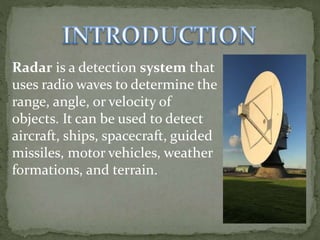
Radar is a detection system that
uses radio waves to determine the
range, angle, or velocity of
objects. It can be used to detect
aircraft, ships, spacecraft, guided
missiles, motor vehicles, weather
formations, and terrain.
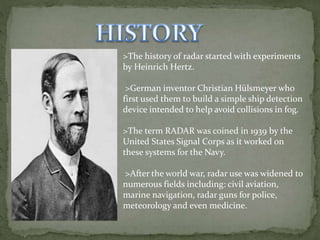
>The history of radar started with experiments
by Heinrich Hertz.
>German inventor Christian Hülsmeyer who
first used them to build a simple ship detection
device intended to help avoid collisions in fog.
>The term RADAR was coined in 1939 by the
United States Signal Corps as it worked on
these systems for the Navy.
>After the world war, radar use was widened to
numerous fields including: civil aviation,
marine navigation, radar guns for police,
meteorology and even medicine.
>>The RADAR system generally consists
of a transmitter which produces an
electromagnetic signal which is radiated
into space by an antenna.
>>When this signal strikes any object, it
gets reflected or reradiated in many
directions.
>>This reflected or echo signal is received
by the radar antenna which delivers it to
the receiver.
>>The receiver processes it to determine
the geographical statistics of the object.
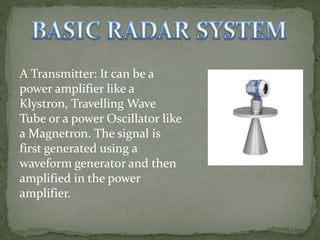
A Transmitter: It can be a
power amplifier like a
Klystron, Travelling Wave
Tube or a power Oscillator like
a Magnetron. The signal is
first generated using a
waveform generator and then
amplified in the power
amplifier.
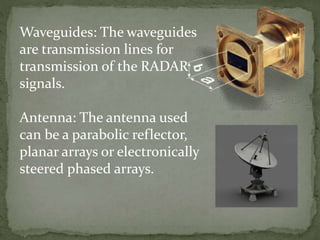
Waveguides: The waveguides
are transmission lines for
transmission of the RADAR
signals.
Antenna: The antenna used
can be a parabolic reflector,
planar arrays or electronically
steered phased arrays.
>> Duplexer: A duplexer allows
the antenna to be used as a
transmitter or a receiver. It can
be a gaseous device that would
produce a short circuit at the
input to the receiver when
transmitter is working.
>> Receiver: It can be super
heterodyne receiver or any
other receiver which consists of
a processor to process the
signal and detect it.
Threshold Decision: The
output of the receiver is
compared with a
threshold to detect the
presence of any object. If
the output is below any
threshold, the presence
of noise is assumed.
.In air defense it is used for target
detection, target recognition and
weapon control (directing the
weapon to the tracked targets).
In missile system to guide the
weapon.
Identifying enemy locations in
map.
.To control air traffic near
airports.
The Air Surveillance RADAR
is used to detect and display
the aircraft’s position in the
airport terminals.
To guide the aircraft to land
in bad weather using
Precision Approach RADAR.
To scan the airport surface for
aircraft and ground vehicle
positions
Space:
.To guide the space vehicle for
safe landing on moon
To observe the planetary
systems
To detect and track satellites
To monitor the meteors
Radar system
Radar system

Radar system

  • 3.
    Radar is adetection system that uses radio waves to determine the range, angle, or velocity of objects. It can be used to detect aircraft, ships, spacecraft, guided missiles, motor vehicles, weather formations, and terrain.
  • 4.
    >The history ofradar started with experiments by Heinrich Hertz. >German inventor Christian Hülsmeyer who first used them to build a simple ship detection device intended to help avoid collisions in fog. >The term RADAR was coined in 1939 by the United States Signal Corps as it worked on these systems for the Navy. >After the world war, radar use was widened to numerous fields including: civil aviation, marine navigation, radar guns for police, meteorology and even medicine.
  • 5.
    >>The RADAR systemgenerally consists of a transmitter which produces an electromagnetic signal which is radiated into space by an antenna. >>When this signal strikes any object, it gets reflected or reradiated in many directions. >>This reflected or echo signal is received by the radar antenna which delivers it to the receiver. >>The receiver processes it to determine the geographical statistics of the object.
  • 7.
    A Transmitter: Itcan be a power amplifier like a Klystron, Travelling Wave Tube or a power Oscillator like a Magnetron. The signal is first generated using a waveform generator and then amplified in the power amplifier.
  • 8.
    Waveguides: The waveguides aretransmission lines for transmission of the RADAR signals. Antenna: The antenna used can be a parabolic reflector, planar arrays or electronically steered phased arrays.
  • 9.
    >> Duplexer: Aduplexer allows the antenna to be used as a transmitter or a receiver. It can be a gaseous device that would produce a short circuit at the input to the receiver when transmitter is working. >> Receiver: It can be super heterodyne receiver or any other receiver which consists of a processor to process the signal and detect it.
  • 10.
    Threshold Decision: The outputof the receiver is compared with a threshold to detect the presence of any object. If the output is below any threshold, the presence of noise is assumed.
  • 11.
    .In air defenseit is used for target detection, target recognition and weapon control (directing the weapon to the tracked targets). In missile system to guide the weapon. Identifying enemy locations in map.
  • 12.
    .To control airtraffic near airports. The Air Surveillance RADAR is used to detect and display the aircraft’s position in the airport terminals. To guide the aircraft to land in bad weather using Precision Approach RADAR. To scan the airport surface for aircraft and ground vehicle positions
  • 13.
    Space: .To guide thespace vehicle for safe landing on moon To observe the planetary systems To detect and track satellites To monitor the meteors