
PRESENTED BY:- RACHIT SONI
13CH43
B.TECH FINAL YEAR
CHEMICAL
9/9/2016
1
2
CONTENT
1. INTRODUCTION
2. OBJECTIVE
3. RECYCLING PROCESS
4. ACTIVATED CARBON FROM CARBON BLACK
5. OTHER VARIOUS ITEM BY RECYCLED TYRE
6. OTHER USES OF WASTE TYRES
7. BENEFITS
8. CONCLUSION
9. REFERENCES
9/9/2016
INTRODUCTION
 The word tyre is derive from the word "tie" which
refers to the outer steel ring part of a wooden cart
wheel.
 A tyre is a ring shaped vehicle component that
covers the wheel’s rim to protect it and give better
vehicle performance.
 Activated carbon, also called activated charcoal,
is a form of carbon processed to have small, low-
volume pores that increase the surface
area available for adsorption or chemical recations.
3
9/9/2016
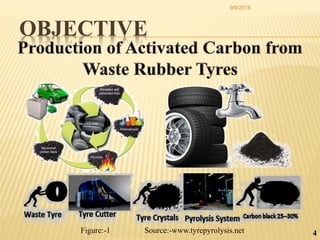
4Figure:-1 Source:-www.tyrepyrolysis.net
OBJECTIVE
9/9/2016
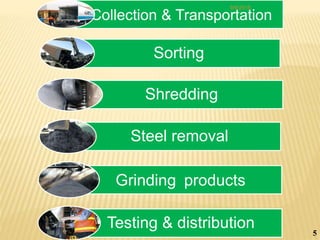
Collection & Transportation
Sorting
Shredding
Steel removal
Grinding products
Testing & distribution 5
9/9/2016
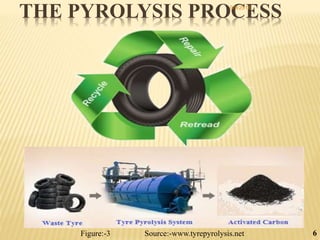
6Figure:-3 Source:-www.tyrepyrolysis.net
THE PYROLYSIS PROCESS9/9/2016
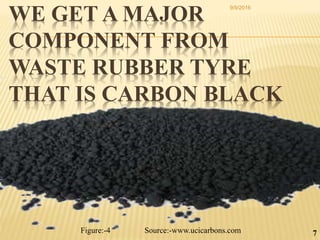
WE GET A MAJOR
COMPONENT FROM
WASTE RUBBER TYRE
THAT IS CARBON BLACK
7Figure:-4 Source:-www.ucicarbons.com
9/9/2016
ACTIVATED CARBON
FROM CARBON BLACK
8
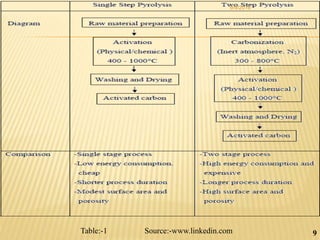
•There are 2 different methods in the
preparation of activated carbon from black
carbon
•Single step pyrolysis and Two step pyrolysis.
•Single step pyrolysis usually applied in the
preparation of activated carbon using chemical
activation process.
•Two step pyrolysis usually applied in the
preparation of activated carbon using
carbonization process and activation process.
The product quality of two step pyrolysis is
9/9/2016
9Table:-1 Source:-www.linkedin.com
9/9/2016
10
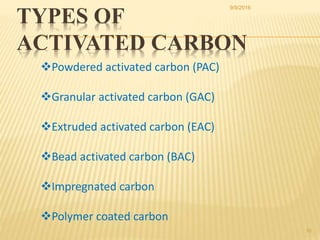
Powdered activated carbon (PAC)
Granular activated carbon (GAC)
Extruded activated carbon (EAC)
Bead activated carbon (BAC)
Impregnated carbon
Polymer coated carbon
TYPES OF
ACTIVATED CARBON
9/9/2016
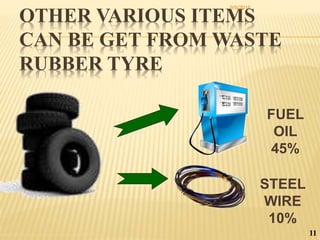
OTHER VARIOUS ITEMS
CAN BE GET FROM WASTE
RUBBER TYRE
11
FUEL
OIL
45%
STEEL
WIRE
10%
9/9/2016
 Save Oil and Energy
 Avoid Health and Environmental Problems
 Reduce Pollution
 Saves Landfill Space
 Creates New Products
12
BENEFITS
9/9/2016
APPLICATIONS OF
ACTIVATED CARBON
13
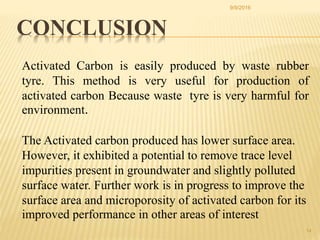
•FOOD AND BEVERAGES
•OIL REFINING
•DRUG INDUSTRY
•WATER TREATMENT
9/9/2016
14
Activated Carbon is easily produced by waste rubber
tyre. This method is very useful for production of
activated carbon Because waste tyre is very harmful for
environment.
The Activated carbon produced has lower surface area.
However, it exhibited a potential to remove trace level
impurities present in groundwater and slightly polluted
surface water. Further work is in progress to improve the
surface area and microporosity of activated carbon for its
improved performance in other areas of interest
CONCLUSION
9/9/2016
 Serio MA, Wójtowicz MA, Teng H,
Solomon PR. Pyrolytic Reprocessing
of Scrap Tires into Value-Added
Products.
 William Petrich, Independent
Environmental Services.
 Bandosz, T.J. 2006. Activated Carbon
Surfaces in Environmental
Remediation.
15
REFERENCE
9/9/2016
16
9/9/2016

Rachit soni seminar ppt edit

  • 1.
    PRESENTED BY:- RACHITSONI 13CH43 B.TECH FINAL YEAR CHEMICAL 9/9/2016 1
  • 2.
    2 CONTENT 1. INTRODUCTION 2. OBJECTIVE 3.RECYCLING PROCESS 4. ACTIVATED CARBON FROM CARBON BLACK 5. OTHER VARIOUS ITEM BY RECYCLED TYRE 6. OTHER USES OF WASTE TYRES 7. BENEFITS 8. CONCLUSION 9. REFERENCES 9/9/2016
  • 3.
    INTRODUCTION  The wordtyre is derive from the word "tie" which refers to the outer steel ring part of a wooden cart wheel.  A tyre is a ring shaped vehicle component that covers the wheel’s rim to protect it and give better vehicle performance.  Activated carbon, also called activated charcoal, is a form of carbon processed to have small, low- volume pores that increase the surface area available for adsorption or chemical recations. 3 9/9/2016
  • 4.
  • 5.
    Collection & Transportation Sorting Shredding Steelremoval Grinding products Testing & distribution 5 9/9/2016
  • 6.
  • 7.
    WE GET AMAJOR COMPONENT FROM WASTE RUBBER TYRE THAT IS CARBON BLACK 7Figure:-4 Source:-www.ucicarbons.com 9/9/2016
  • 8.
    ACTIVATED CARBON FROM CARBONBLACK 8 •There are 2 different methods in the preparation of activated carbon from black carbon •Single step pyrolysis and Two step pyrolysis. •Single step pyrolysis usually applied in the preparation of activated carbon using chemical activation process. •Two step pyrolysis usually applied in the preparation of activated carbon using carbonization process and activation process. The product quality of two step pyrolysis is 9/9/2016
  • 9.
  • 10.
    10 Powdered activated carbon(PAC) Granular activated carbon (GAC) Extruded activated carbon (EAC) Bead activated carbon (BAC) Impregnated carbon Polymer coated carbon TYPES OF ACTIVATED CARBON 9/9/2016
  • 11.
    OTHER VARIOUS ITEMS CANBE GET FROM WASTE RUBBER TYRE 11 FUEL OIL 45% STEEL WIRE 10% 9/9/2016
  • 12.
     Save Oiland Energy  Avoid Health and Environmental Problems  Reduce Pollution  Saves Landfill Space  Creates New Products 12 BENEFITS 9/9/2016
  • 13.
    APPLICATIONS OF ACTIVATED CARBON 13 •FOODAND BEVERAGES •OIL REFINING •DRUG INDUSTRY •WATER TREATMENT 9/9/2016
  • 14.
    14 Activated Carbon iseasily produced by waste rubber tyre. This method is very useful for production of activated carbon Because waste tyre is very harmful for environment. The Activated carbon produced has lower surface area. However, it exhibited a potential to remove trace level impurities present in groundwater and slightly polluted surface water. Further work is in progress to improve the surface area and microporosity of activated carbon for its improved performance in other areas of interest CONCLUSION 9/9/2016
  • 15.
     Serio MA,Wójtowicz MA, Teng H, Solomon PR. Pyrolytic Reprocessing of Scrap Tires into Value-Added Products.  William Petrich, Independent Environmental Services.  Bandosz, T.J. 2006. Activated Carbon Surfaces in Environmental Remediation. 15 REFERENCE 9/9/2016
  • 16.

Editor's Notes

  • #6 Step 1. Collection and transportation Tyrecycle collects scrap tyres from each retail location, and transports them to a secure Tyrecycle processing facility for processing. Step 2. Sorting Tyres are unloaded and sorted by size and composition for further processing. Tyres suitable for recycling are placed on a large conveyor towards the Sims production line. Step 3. Shredding The tyres are shredded in preparation for further processing. The tyre pieces are further reduced in size by a granulator. Step 4. Steel removal The steel at the centre of each tyre is recovered for re-use. In fact, Sims recycles over 2,500 metric tonnes of steel as a result of this process. The steel free tyre granules are then stored in large hoppers. Step 5. Grinding into finished product Depending on the fineness required, the granules are ground by large rollers and pushed through sieves. Rubber products produced are: buffings and shred (used in matting, sport surfaces, turf and playgrounds); granules and chips (used in athletic tracks, playgrounds, horse arenas and asphalt); crumbs and powders (used in new tyres, brake pads, road sealing, adhesives and paints); and large shred tyre chips (used in civil engineering and fuel derivatives). Learn more about final applications. Step 6. Testing & distribution All rubber crumb products undergo routine quality testing by our trained staff in our on-site laboratory, for particle distribution, moisture content and metal contamination - before being packed for distribution.
  • #9 Carbonization The terms carbonization means to convert organic matter to elemental carbon at high temperature in the absence of oxygen. This process drives off the volatiles matter to form char. The char obtained normally has low surface area and adsorption capacity since the porous structure is not well developed (Ahmad, 2006). 2.2.2 Activation The activation process creates or increases porosity on the activated carbon surface as illustrated in Figure 2.1. There are three main activation process; physical activation, chemical activation and physiochemical activation. Figure 2.1: Two-dimensional representation of carbon activation (Lehmann, 1998) 2.2.2 (a) Physical activation Physical activation using carbon dioxide or steam as oxidizing agents are the most commonly used processes in the production of tyre carbons. It is a conventional manufacturing process of activated carbon. The overall process usually consists of two steps: thermal pyrolysis at a relatively low temperature (typically 400-700oC) in the presence of nitrogen or helium to break down the cross-linkage between carbon 17 atoms, and activation with activating gas at 800-1000oC for further development of the porosity of tyre carbon (Mui et al., 2004). Carbon characteristics are greatly influenced by the degree of the activation but also by the nature of the activating agent (steam or carbon dioxide) and process temperature. For the purpose of elevating the degree of burn-off, the activation temperature is usually higher than 900oC to maintain a sufficiently high reaction rate. A sharp increase in the surface area was observed when the activation took place at a temperature of 770oC or above and based on current technologies and literature results (Mui et al., 2004), tyre char activation below 700oC is impractical. Previous studies have discover that steam is a better activating agent compare to CO2 because the tyre char present higher reactivity with steam than with CO2 (Miguel et al., 2003; Zabaniotou and Stavropoulos, 2003). However, contradictory information has been published regarding the type of porosity generated by each activating agent. Gonzalez et al., (2006) studied the preparation of activated carbons from scrap tyres by gasification with both steam and carbon dioxide under different activation temperature and time. In the carbonization step, the temperature used was 800°C under nitrogen flow for 1 h and approximately a percentage of 43% chars were obtained from this process. Then the yielded chars proceed to the activation process under steam or carbon dioxide flow at different temperature and time ranging from 750 to 900°C and 1 to 3 h respectively. For burn-off higher than 50%, a slight increased in the average equivalent radius of micropores was observed, indicating a widening of the micropores. As the activation proceeds, this widening of the micropores can contribute to the strong increase of the mesoporosity detected in the 18 activated carbon. The highest BET surface area values of 1317 m2/g and 496 m2/g was obtained by activation with steam and carbon dioxide respectively. These results proved that steam is a better activating agent compare to CO2. Figure 2.2 shows the thermal treatment scheme of two-step physical activation method applied in their work. Figure 2.2: Thermal treatment scheme of two-step physical activation method (Gonzalez et al., 2006) In addition, the particle size of the tyre rubber was found to have influence on the porosity of the resultant carbon generated from steam activation. Both surface area and micropore volume of carbons produced from powdered tyre rubber (particle size < 0.42 mm) were 5% and 40% higher than those carbons prepared from particles in larger size (particle size < 2.0 mm) (Miguel et al., 2003). It was believed that smaller particles allowed better diffusion of steam molecules into the structure, Carbonization 800ºC, (1 h) 850ºC, (1-3 h) Activation Room Temp. 900ºC, (1-3 h) Temperature, ºC 800ºC, (1-3 h) 750ºC, (1-3 h) Time, h N2 (100cm3/min) Steam (600cm3 steam/min) or CO2 (600cm3/min) 19 leading to a more homogeneous activation of the carbonized precursor. However, it is worth noting that other research yielded a different point of view and suggested that particle size had not affected the surface area development in CO2 activation (Teng et al., 1995). Table 2.2 presents summary of previous works on preparation of activated carbons produced from waste tyres using physical activation method. 2.2.2 (b) Chemical activation Chemical activation is another process for the production of activated carbon from tyres. It allows both pyrolysis and activation to be integrated into a single, relatively lower temperature process in the absence of oxygen. Chemical agents such as phosphoric acid, zinc chloride and potassium hydroxide act as dehydrating and stabilizing agents that enhance the development of porous structure in the activated carbon. Although wide varieties of activating agents are known, using potassium hydroxide (KOH) in making carbons has become popular in recent studies (Mui et al., 2004). In addition, KOH also was found to be more effective than phosphoric acid and zinc chloride in creating porosity in activated carbons derived from tyres (Teng et al., 2000). Chemical activation offers several advantages since it is carried out in a single step which combining the carbonization and activation process, performed at lower temperatures, produced a much higher yield than the physical activation, and therefore resulting in the development of a better porous structure (Ioannidou and Zabaniotou, 2007; Lillo-Ródenas et al., 2003). However, there are also some disadvantages of chemical activation process such as corrosiveness of the process and the washing stage (Teng and Lin, 1998).
  • #13 Recycling tires saves oil. It takes a little more than half a barrel of crude oil to create the rubber for only one truck tire, according to Western Michigan University. That means about 22 gallons of oil is used for each tire, advises Earth 911. Retreading a tire, in contrast, takes only seven gallons of oil. Tires also can be used in lieu of fossil fuels for some manufacturing processes, which reduces consumption of such fuels, according to Earth 911. Tire-derived fuel, or TDF, involves using granulated tires instead of traditional fuels. It can be utilized for cement kilns, electric utilities and paper and pulp factories. TDF produces the same amount of energy as oil, and creates 25 percent more energy than coal. Tyre Recycling Plant Tyre recycling machine manufacturer Pyrolysis Plant Call Now-9879233363 keshaventerprise.com Sponsored Links Avoid Health and Environmental Problems Tossing tires causes health and environmental problems. Discarded tires often serve as habitats for disease-carrying mosquitoes, according to the Illinois Environmental Protection Agency. Mosquitoes can carry diseases such as dengue fever and encephalitis. In Illinois, improper tire disposal is responsible for the proliferation of the Asian Tiger Mosquito, a harmful mosquito species, advises the IEPA. Large tire piles also are fire hazards, advises the U.S. Environmental Protection Agency. Fires in tire piles can burn for months, leaving a hazardous oily residue behind and creating smoke. Some tire-fire sites have even become Superfund pollution sites, advises the EPA. Versatility of Reuse Tires have a versatile range of uses when recycled, advises the EPA. Whole tires are used to create artificial reefs and breakwaters, highway crash barriers, erosion control barriers and playground equipment. Split tires are used in floor mats, gaskets, belts, shoe soles, seals, dock bumpers, muffler hangers, shims, insulators and washers. Shredded tires may be used for sludge composting, as a playground gravel substitute or in lightweight road-construction material. Ground tires can be used for rubber railroad crossings, as additives for asphalt pavement and in rubber and plastic products. These products include molded floor mats, carpet padding, mud guards and plastic adhesives.