
Fuel extraction from plastic waste 
Prof. DI. Imre Sárközi, Eng Ass.prof. Robinson Etseyatse ( Senior Technical Adviser) DI. Eduard Buzetzki, WORLD TECHNICAL SOLUTION LTD, HUNGARY, 9011 GYŐR, VÁCI MIHÁLY UTCA 65 Eng.Robinson Etseyatse (Technical Consultant & Adviser) Email: wsufco@gmail.com CEll: +3630-372-47-27 
(Cg. 08-09-022029, adóazonosító: 23400449-2-08) 
Email:wsufco@gmail.com 
Tel: +3696348150, Cell: +36303724727 
Eng.Robinson Etseyatse 
(Technical Consultant & Adviser) 
HUNGARY
Basic situation in plastic waste management 
•According to the origin, the wastes tend to be divided into municipal, industrial, waste from mining, forestry and agriculture, etc. 
•Since the plastic waste is a blend of various plastics with changing composition, its processing is more complicated than in the case of mono types. 
•The primary objective was to remove the wastes hygienically, but the wastes began soon to be used as a material and energy source. 
•This is a key trend in the modern waste management together with the waste prevention and the reduction of landfill amounts. Although recycling is preferred, i.e. material utilization of waste, this hierarchy may be changed based on life cycle assessment in favor of energy production - energetic waste utilization (EWU).
The goal 
The focus is on the production of liquid products, which are used as a fuel or its components in the automotive 
sector or in co-generation units. This also applies to the formed gases. An energetic and/or thermal recycling of solid residuum.
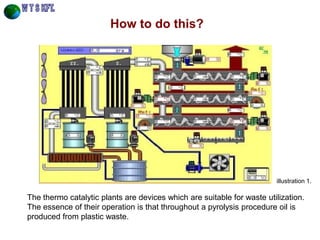
How to do this? 
The thermo catalytic plants are devices which are suitable for waste utilization. 
The essence of their operation is that throughout a pyrolysis procedure oil is 
produced from plastic waste. 
illustration 1.
Utilization of plastic and Rubber waste 
Rubber and plastic are special parts of organic wastes. 
Elimination cannot be solved with simple tools or burning (damage the environment to a great extent). 
The shortly described depolymerization process, if it is maintained by heat energy then it is considered pyrolysis, supposing that the reaction space is kept hermetic. 
Part of the plastic wastes is renewable, but there is a part which cannot be reused due to production or other reasons, (polluted, etc.) to which the above mentioned solution, like in case of rubber, can be applied, since plastics are fundamentally crude oil derivatives, with less carbon type filler. 
The Pyrolysator works according to the principle of thermo catalytic depolymerization. The essence of the device (illustration 1.) is that the above mentioned slowly dissolving organic waste (rubber, plastic) after homogenizing (given 20-25 mm measure) grind, heated with external cape heating in an inside space strangulated from oxygen forwarded by pulley dosage, the waste arrives to the steam- and gas phase, and at the end of the process Pyro-coke is produced. 
The developing steam phase exiting from the device goes through a condensation system. The output is a dark brownish liquid (Pyro-oil).
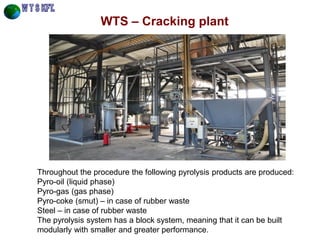
WTS – Cracking plant 
Throughout the procedure the following pyrolysis products are produced: 
Pyro-oil (liquid phase) 
Pyro-gas (gas phase) 
Pyro-coke (smut) – in case of rubber waste 
Steel – in case of rubber waste 
The pyrolysis system has a block system, meaning that it can be built 
modularly with smaller and greater performance.
Advantages of the technology 
• External energy source is needed for the process (PB-, or line gas for the external cape heating), as long as the reactor, reaching the working temperature, can produce respective amount of Pyro gas. From this point the pyrolyse process becomes self-supporting, since the gas produced from the waste ensures the further energy need of heat dissociation. 
• The room need of both the pyrolysator and the complex pyrolysator power producing block is small, it can be placed in a usual regional waste management center most optimally fitted to the technological process. 
• The pyrolytic system was developed in a way that it is trouble free from dosage to end product, its operation is automatic, with this the chance of an eventual shutdown is reduced to minimum. With the application of special security technologies, it overdoes any other pyrolytic devices. 
• The process can be easily tracked down and driven, it is assisted by a control technical machine which plans and controls the temperature parameters, which were given in advance, in each phase of the process. For the automatic pause of the process high level security mechanisms were integrated.
Disadvantages of the technology 
• The obtained Pyro-oil have to be processed, to get usable material. No possibillity to fractionate the liquid output. Too high chlorine and sulfur content. 
• The produced Pyro-cocke and water is waste (too high hydrocarbon, chlorine and sulfur content). 
• The input material have to be grinded in a small dimension (20-25mm). Troubles when the input material has contaminants larger then 20 mm. 
• The Pyro-gas contains high amounts of chlorine and sulfur.
Conclusion 
Because of the serious disadvantages of pyrolysis technology, we have decided, with the Slovak Technical University and technical consulting company s.r.o. together to rebuild the system for a catalytic cracking process. 
In the following lectures, you will see that we have made the right decision.
Thank you 
for your 
attention 
(Cg. 08-09-022029, adóazonosító: 23400449-2-08) 
Email: wsufco@gmail.com 
TEL:+3696-348150 Cell nr: +3630-372-4727 
Eng.Robinson Etseyatse 
( Technical Consultant & Adviser) 
HUNGARY

Presentation wts plastic

  • 1.
    Fuel extraction fromplastic waste Prof. DI. Imre Sárközi, Eng Ass.prof. Robinson Etseyatse ( Senior Technical Adviser) DI. Eduard Buzetzki, WORLD TECHNICAL SOLUTION LTD, HUNGARY, 9011 GYŐR, VÁCI MIHÁLY UTCA 65 Eng.Robinson Etseyatse (Technical Consultant & Adviser) Email: wsufco@gmail.com CEll: +3630-372-47-27 (Cg. 08-09-022029, adóazonosító: 23400449-2-08) Email:wsufco@gmail.com Tel: +3696348150, Cell: +36303724727 Eng.Robinson Etseyatse (Technical Consultant & Adviser) HUNGARY
  • 2.
    Basic situation inplastic waste management •According to the origin, the wastes tend to be divided into municipal, industrial, waste from mining, forestry and agriculture, etc. •Since the plastic waste is a blend of various plastics with changing composition, its processing is more complicated than in the case of mono types. •The primary objective was to remove the wastes hygienically, but the wastes began soon to be used as a material and energy source. •This is a key trend in the modern waste management together with the waste prevention and the reduction of landfill amounts. Although recycling is preferred, i.e. material utilization of waste, this hierarchy may be changed based on life cycle assessment in favor of energy production - energetic waste utilization (EWU).
  • 3.
    The goal Thefocus is on the production of liquid products, which are used as a fuel or its components in the automotive sector or in co-generation units. This also applies to the formed gases. An energetic and/or thermal recycling of solid residuum.
  • 4.
    How to dothis? The thermo catalytic plants are devices which are suitable for waste utilization. The essence of their operation is that throughout a pyrolysis procedure oil is produced from plastic waste. illustration 1.
  • 5.
    Utilization of plasticand Rubber waste Rubber and plastic are special parts of organic wastes. Elimination cannot be solved with simple tools or burning (damage the environment to a great extent). The shortly described depolymerization process, if it is maintained by heat energy then it is considered pyrolysis, supposing that the reaction space is kept hermetic. Part of the plastic wastes is renewable, but there is a part which cannot be reused due to production or other reasons, (polluted, etc.) to which the above mentioned solution, like in case of rubber, can be applied, since plastics are fundamentally crude oil derivatives, with less carbon type filler. The Pyrolysator works according to the principle of thermo catalytic depolymerization. The essence of the device (illustration 1.) is that the above mentioned slowly dissolving organic waste (rubber, plastic) after homogenizing (given 20-25 mm measure) grind, heated with external cape heating in an inside space strangulated from oxygen forwarded by pulley dosage, the waste arrives to the steam- and gas phase, and at the end of the process Pyro-coke is produced. The developing steam phase exiting from the device goes through a condensation system. The output is a dark brownish liquid (Pyro-oil).
  • 6.
    WTS – Crackingplant Throughout the procedure the following pyrolysis products are produced: Pyro-oil (liquid phase) Pyro-gas (gas phase) Pyro-coke (smut) – in case of rubber waste Steel – in case of rubber waste The pyrolysis system has a block system, meaning that it can be built modularly with smaller and greater performance.
  • 7.
    Advantages of thetechnology • External energy source is needed for the process (PB-, or line gas for the external cape heating), as long as the reactor, reaching the working temperature, can produce respective amount of Pyro gas. From this point the pyrolyse process becomes self-supporting, since the gas produced from the waste ensures the further energy need of heat dissociation. • The room need of both the pyrolysator and the complex pyrolysator power producing block is small, it can be placed in a usual regional waste management center most optimally fitted to the technological process. • The pyrolytic system was developed in a way that it is trouble free from dosage to end product, its operation is automatic, with this the chance of an eventual shutdown is reduced to minimum. With the application of special security technologies, it overdoes any other pyrolytic devices. • The process can be easily tracked down and driven, it is assisted by a control technical machine which plans and controls the temperature parameters, which were given in advance, in each phase of the process. For the automatic pause of the process high level security mechanisms were integrated.
  • 8.
    Disadvantages of thetechnology • The obtained Pyro-oil have to be processed, to get usable material. No possibillity to fractionate the liquid output. Too high chlorine and sulfur content. • The produced Pyro-cocke and water is waste (too high hydrocarbon, chlorine and sulfur content). • The input material have to be grinded in a small dimension (20-25mm). Troubles when the input material has contaminants larger then 20 mm. • The Pyro-gas contains high amounts of chlorine and sulfur.
  • 9.
    Conclusion Because ofthe serious disadvantages of pyrolysis technology, we have decided, with the Slovak Technical University and technical consulting company s.r.o. together to rebuild the system for a catalytic cracking process. In the following lectures, you will see that we have made the right decision.
  • 10.
    Thank you foryour attention (Cg. 08-09-022029, adóazonosító: 23400449-2-08) Email: wsufco@gmail.com TEL:+3696-348150 Cell nr: +3630-372-4727 Eng.Robinson Etseyatse ( Technical Consultant & Adviser) HUNGARY