Pulp Industries
Prepared by:
Milan Bhatt (16BCH034)
Arpit Modh (16BCH035)
Mihir Modi (16BCH036)
Nikunj Patel (16BCH037)
Introduction
• Pulp is a lignocellulosic fibrous material prepared by chemically or mechanically
separating cellulose fibres from wood, fiber crops, waste paper, or rags.
• One of the most abundant raw material worldwide.
• The aim of pulping is to break down the bulk structure of the fibre source, be it
chips, stems or other plant parts, into the constituent fibres.
• Chemical pulping achieves this by degrading the lignin and hemicellulose into
small, water-soluble molecules which can be washed away from the cellulose
fibres without depolymerizing the cellulose fibres (chemically depolymerizing the
cellulose weakens the fibres).
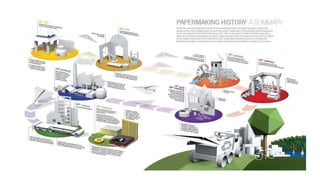
History
• Pulp for papermaking was produced by macerating mulberry bark as early as
the 2nd century in Han dynasty.
• first official report on the manufacture of paper by pulping was reported in
China in 105 AD.
• Before it, writing paper first appeared between 2000 to 2500 a.c. , made
from a tall papyrus which grows along the Nile river in Egypt.
• The Chinese invented good processes for paper manufactured from Bamboo
and Cotton about A.D. 105 and continue to make good paper by hand today.
• Keller from Saxony made a process for making pulp from wood , but
the quality of paper produced from was low.
• The Soda process for making pulp from wood was developed by Watt.
• An American chemist Tightman produced readily bleachable pulp by
Sulfite process.
• Kraft process generally referred as Sulfate process because sodium
sulphate is used as make up chemical for cooking liquor.
• The Sulfate process dominates in pulp industry.
Current Production
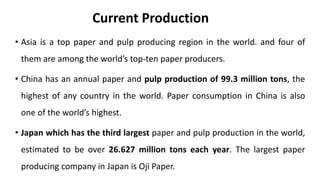
• Asia is a top paper and pulp producing region in the world. and four of
them are among the world’s top-ten paper producers.
• China has an annual paper and pulp production of 99.3 million tons, the
highest of any country in the world. Paper consumption in China is also
one of the world’s highest.
• Japan which has the third largest paper and pulp production in the world,
estimated to be over 26.627 million tons each year. The largest paper
producing company in Japan is Oji Paper.
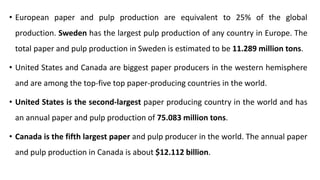
• European paper and pulp production are equivalent to 25% of the global
production. Sweden has the largest pulp production of any country in Europe. The
total paper and pulp production in Sweden is estimated to be 11.289 million tons.
• United States and Canada are biggest paper producers in the western hemisphere
and are among the top-five top paper-producing countries in the world.
• United States is the second-largest paper producing country in the world and has
an annual paper and pulp production of 75.083 million tons.
• Canada is the fifth largest paper and pulp producer in the world. The annual paper
and pulp production in Canada is about $12.112 billion.
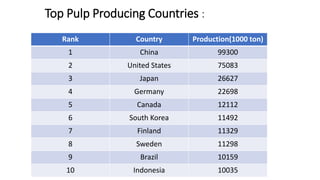
Rank Country Production(1000 ton)
1 China 99300
2 United States 75083
3 Japan 26627
4 Germany 22698
5 Canada 12112
6 South Korea 11492
7 Finland 11329
8 Sweden 11298
9 Brazil 10159
10 Indonesia 10035
Top Pulp Producing Countries :
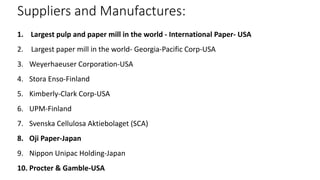
Suppliers and Manufactures:
1. Largest pulp and paper mill in the world - International Paper- USA
2. Largest paper mill in the world- Georgia-Pacific Corp-USA
3. Weyerhaeuser Corporation-USA
4. Stora Enso-Finland
5. Kimberly-Clark Corp-USA
6. UPM-Finland
7. Svenska Cellulosa Aktiebolaget (SCA)
8. Oji Paper-Japan
9. Nippon Unipac Holding-Japan
10. Procter & Gamble-USA
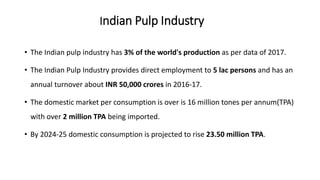
Indian Pulp Industry
• The Indian pulp industry has 3% of the world's production as per data of 2017.
• The Indian Pulp Industry provides direct employment to 5 lac persons and has an
annual turnover about INR 50,000 crores in 2016-17.
• The domestic market per consumption is over is 16 million tones per annum(TPA)
with over 2 million TPA being imported.
• By 2024-25 domestic consumption is projected to rise 23.50 million TPA.
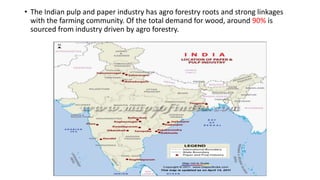
• The Indian pulp and paper industry has agro forestry roots and strong linkages
with the farming community. Of the total demand for wood, around 90% is
sourced from industry driven by agro forestry.
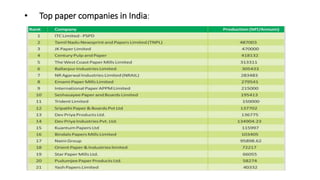
• Top paper companies in India:
Manufacture of Pulp
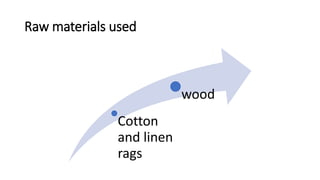
Raw materials used
Cotton
and linen
rags
wood
Types of wood:
• Hard wood (decidorous)
• Soft wood (coniferous)
Bark is non fibrous so it is removed at the pulp mill by debarking
methods.
It can be debarked by two methods:
• Mechanically
• Hydraulic
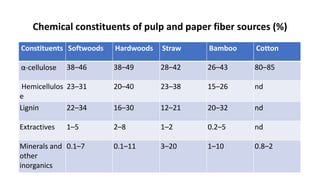
Chemical constituents of pulp and paper fiber sources (%)
Constituents Softwoods Hardwoods Straw Bamboo Cotton
α-cellulose 38–46 38–49 28–42 26–43 80–85
Hemicellulos
e
23–31 20–40 23–38 15–26 nd
Lignin 22–34 16–30 12–21 20–32 nd
Extractives 1–5 2–8 1–2 0.2–5 nd
Minerals and
other
inorganics
0.1–7 0.1–11 3–20 1–10 0.8–2
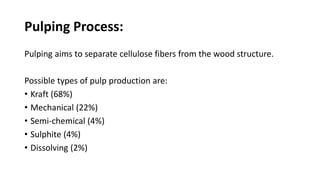
Pulping Process:
Pulping aims to separate cellulose fibers from the wood structure.
Possible types of pulp production are:
• Kraft (68%)
• Mechanical (22%)
• Semi-chemical (4%)
• Sulphite (4%)
• Dissolving (2%)
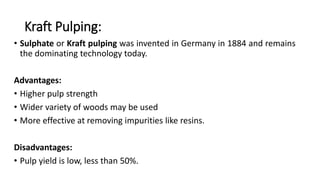
Kraft Pulping:
• Sulphate or Kraft pulping was invented in Germany in 1884 and remains
the dominating technology today.
Advantages:
• Higher pulp strength
• Wider variety of woods may be used
• More effective at removing impurities like resins.
Disadvantages:
• Pulp yield is low, less than 50%.
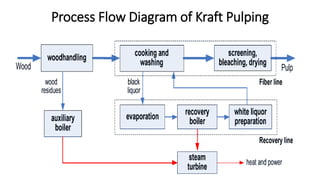
Process Flow Diagram of Kraft Pulping
• Step 1 - Wood preparation
The bark is removed from in-coming logs, and these are then chipped.
Sometimes, the wood arrives at the plant already chipped, meaning that this
step is unnecessary.
• Step 2 - Cooking
The wood chips are heated in a solution of NaOH and Na2S(white liquor) in a
pressure cooker, during which a lot of the lignin is removed from the wood.
The pressure is then released suddenly, causing the chips to fly apart into
fibers.
• Step 3 - Pulp washing
The pulp is washed with water to wash out the cooking chemicals and lignin
from the fiber so that they will not interfere with later process steps.
• Step 4 - Pulp screening
A sieve is used to remove knots and clumped-together uncooked fibers from the pulp.
• Step 5 - Bleaching
This is done in two stages. Firstly the pulp is treated with NaOH in the presence of O2.
The NaOH removes hydrogen ions from the lignin and then the O2 breaks down the
polymer. Then, the pulp is treated with ClO2 then a mixture of NaOH, O2 and peroxide
and finally with ClO2 again to remove the remaining lignin.
• Step 6 - Paper making
The fibers are mechanically treated to make them bond better to each other
(strengthening the paper), chemicals added to provide special properties such as
colour or water resistance, and then the water is squeezed out and the pulp is rolled
smooth and dried.
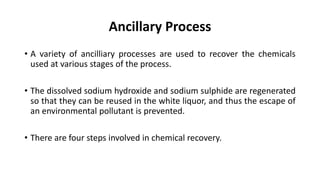
Ancillary Process
• A variety of ancilliary processes are used to recover the chemicals
used at various stages of the process.
• The dissolved sodium hydroxide and sodium sulphide are regenerated
so that they can be reused in the white liquor, and thus the escape of
an environmental pollutant is prevented.
• There are four steps involved in chemical recovery.
• Step 1 – Evaporation:
The black liquor from the pulp washing contains 15-17% solids, and this
needs to be concentrated to about 60-70% solids before it can be burnt in
the recovery furnace.
• Step 2 - Combustion of the black liquor in the recovery boiler:
The recovery boiler burns the organic material in the concentrated black
liquor, at the same time reducing the oxidized Sulphur compounds to
sulphide. The burning of the organics generates high pressure steam in the
boiler, which is normally passed through a turbine, generating electricity.
The low pressure steam, which is exhausted from the turbine, is then used
for process heat in the pulp mill and paper mill.
• Step 3 – Causticizing:
In this step caustic soda is renewed. Clarified green liquor and burned lime
(calcium oxide) are fed continuously in metered amounts into a reaction vessel,
called a slacker. The calcium oxide reacts with the water in an exothermic
reaction to form calcium hydroxide or milk of lime:
CaO + H2O → Ca(OH)2 + heat
The slacker also contains a “classifier” section which removes unreacted
particles (grit).
After slaking, the slurry is carried through a series of agitated tanks, which
provide the retention time for the causticizing reaction as shown below:
Ca(OH)2 + Na2CO3 → CaCO3 + 2NaOH
• Step 4 - Conversion of CaCO3 to CaO:
The slurry from the causticisers is pumped to a clarifier which, as for the green
liquor clarifier mentioned previously, is a gravity settling device. Generally the
white liquor clarifier also serves as a white liquor storage tank.
Washing out the sodium compounds as much as possible is important for
several reasons:
• The sodium sulphide can contribute to the emission of H2S from kiln stack.
• Sodium salts melt and function as a glue for the lime particles, producing
rings and balls inside the kiln.
CaCO3 + heat → CaO + CO2
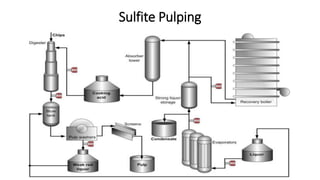
Sulfite Pulping
NSSC or Semi chemical Pulping
• Neutral Sulfite semi-chemical uses less chemicals with the higher
yield (65-80%) of pulp using wood
• Poor quality and bleach ability
• Main idea is to make a mild cook weakens the binding material
among fibers and then separate them.
• High yield offers reduced steam pollution problems
• Products: Liner boards and corrugating paper
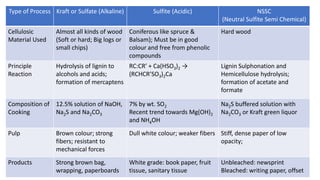
Type of Process Kraft or Sulfate (Alkaline) Sulfite (Acidic) NSSC
(Neutral Sulfite Semi Chemical)
Cellulosic
Material Used
Almost all kinds of wood
(Soft or hard; Big logs or
small chips)
Coniferous like spruce &
Balsam); Must be in good
colour and free from phenolic
compounds
Hard wood
Principle
Reaction
Hydrolysis of lignin to
alcohols and acids;
formation of mercaptens
RC:CR’ + Ca(HSO3)2 →
(RCHCR’SO3)2Ca
Lignin Sulphonation and
Hemicellulose hydrolysis;
formation of acetate and
formate
Composition of
Cooking
12.5% solution of NaOH,
Na2S and Na2CO3
7% by wt. SO2
Recent trend towards Mg(OH)2
and NH4OH
Na2S buffered solution with
Na2CO3 or Kraft green liquor
Pulp Brown colour; strong
fibers; resistant to
mechanical forces
Dull white colour; weaker fibers Stiff, dense paper of low
opacity;
Products Strong brown bag,
wrapping, paperboards
White grade: book paper, fruit
tissue, sanitary tissue
Unbleached: newsprint
Bleached: writing paper, offset
Mechanical and Thermodynamic Pulping
New Pulping Process
• It’s a solvent pulping based on ethanol and phenol
• Trend in Holopulping; Oxygen and Nitric acid pulping; Anthraquinone catalyst
to speed up
• Pilot plants are there and innovating the salable by-product
Secondary Fiber Pulping
• Inclination of market using repulping of recycled paper
• Removal of dirt; Deinked with alkali wash; cooked with mild alkali; bleached
• Largest use as a multi-ply cylinder board
Mechanical and Thermodynamic Pulping
Rag Pulping
• Cotton rags or cotton linters
• Old is gold; Textile manufacturers are the source of raw material
• Synthetics are undesired but rayon is suitable
• Still undeveloped plants though they have more storage life
Dissolving Pulp
• Cellulose are desired due to solubility of it in NaOH is 18%
• Cotton linters are the main source; no sufficient supply of it
• It’s a posttreatment of Sulfite process; increases the cost of paper
Utilities
Reaction Tower:
• In bleaching “’Tower” is needed to achieve retention time around 1-4 hours
• Critical temperature and chemical environment
• ClO2 is harmful so that use of ceramic tiles on steel or titanium
Chemical Mixer:
• Good mixing itself is a bigger task in a bleaching though there is progress
• Invention of Medium consistency of about 10%
• Almost Solid pulp becomes a fluidized like water
Utilities
Washers:
• In bleaching series, removal of solubilized lignin after every stage. Important
when there is a pH change
• Washing equipment: Drum filters or diffuser washer
• MOC: Highly alloyed SS or titanium due to corrosivity
Pumps:
• Transportation of pulp, chemicals, water and wash liquor
• Liquid (4-5% consistency) - Centrifugal pump
• Pulp (10-12% consistency) - MC pump to use fluidization and centrifugal forces
Major Engineering Problems:
• Use of soda Process
• Pollution and waste disposal
• Recovery of cooking chemicals
• By product utilization
• Scale formation in the pulp milling equipment
• Modified process for other raw materials
• Over 20% of The world paper now comes from the repulping of recycled
paper.
• There are a great grades produced varying widely in quality. For such
purposes batch process is used.
• Secondary fiber worth about 5 times as its value as waste paper.
• The largest single use is in the manufacture of multi-ply cylinder board.
Increased demand of raw materials in the
pulp Industry
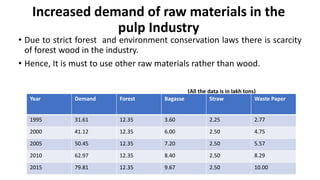
• Due to strict forest and environment conservation laws there is scarcity
of forest wood in the industry.
• Hence, It is must to use other raw materials rather than wood.
(All the data is in lakh tons)
Year Demand Forest Bagasse Straw Waste Paper
1995 31.61 12.35 3.60 2.25 2.77
2000 41.12 12.35 6.00 2.50 4.75
2005 50.45 12.35 7.20 2.50 5.57
2010 62.97 12.35 8.40 2.50 8.29
2015 79.81 12.35 9.67 2.50 10.00
Energy Use
• The Pulp Industry uses 84% of the fuel energy consumed by the forest
product industry as a whole.
• It is one of the largest producers of greenhouse gas emissions.
• Over the past few years, the pulp and paper industry has considerably
reduced its CHG emissions by introducing energy conservation projects
and by increasing its use of biomass as an energy source.
Recent Advances in Pulping process
• Chlorine Free Bleaching:
Chlorine bleaching creates a by-product called dioxin which has extremely
harmful effect on the environment. TCF process is the latest process which
uses the oxygen from H2O2.
• Organosolv pulping:
This method was developed to reduce the sulfur emission. The method
breaks up lignocellulosic biomass to obtain cellulosic fibers for pulp and
paper making. Organosolv pulping process produce high yield pulp, low
residual lignin content, high brightness and good strength.
• Pulping of Non -Wood Plant Species:
This is mostly made up of 44% straw, 18% bagasse, 14% reeds, 13% bamboo
and 11% others.
• Nano Technology In Pulp and Paper Making
Cellulose and lignocellulose have great potential as Nano materials and
also abundantly renewable. wide range of paper and packaging industries
have already incorporated nanotechnology throughout their production
systems.
• Use of hardwood fibers
Due to matrix arrangement the hardwood fibers were not used in the
pulping industry. These fibers tends to flocculate and in order to
overcome bad formation, the fiber length are reduced through beating, a
process which influences important properties paper such as bulk,
opacity and tearing strength.
Environmental Issues
• Waste water releases include chlorinated phenols, dioxins, furan and
other chlorinated compounds, phosphates and suspended sediments.
• Many organic compound as suspended solids are present lost cellulose
fiber, lignin, starch, hemi cellulose etc.
• For the soft wood as a raw material deforestation is done illegally in
many countries.
• Consumption of fresh water can seriously harm habitants near mills,
reduced water levels, Change in water temperature etc. are critical
environmental factors for aquatic creatures.
Steps towards the environment
conservation
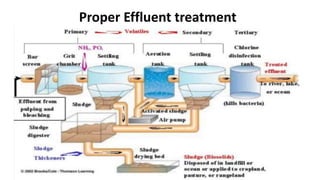
• Due to the new water recycling technologies water use is significantly
reduced in last few decades.
• Recycling of the waste paper.
 Sorting
Dissolving
Di-Inking
Mixing
Paper Making.
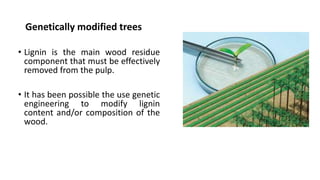
Genetically modified trees
• Lignin is the main wood residue
component that must be effectively
removed from the pulp.
• It has been possible the use genetic
engineering to modify lignin
content and/or composition of the
wood.
Proper Effluent treatment
References
• Charles E. Dryden. Editors, M. Gopala Rao, Marshall Sittig. Edition, 2. Publisher, Affiliated East-
West Press, 1973
• Shreve, R. Norris, and George T. Austin. Shreve's Chemical Process Industries. New York: McGraw-
Hill, 1984. Learn more about these citation styles: APA (6th ed.) | Chicago (Author-Date, 15th ed.)
| Harvard (18th ed.) | MLA (7th ed.) | Turabian (6th ed.)
• http://www.fao.org/3/a-i3961t.pdf
• https://www.worldatlas.com/articles/the-top-pulp-and-paper-producing-countries-in-the-
world.html
• https://www.slideshare.net/keemoko/india-1804790
• www.iiste.org/Journals/index.php/IEL/article/viewFile/16471/16804
• https://pubs.acs.org/doi/pdf/10.1021/ie50153a058
• http://www.kpatents.com/assets/files/applications/3.00.00%20Pulp%20and%20Paper/APN%203.
02.00%20Sulfite_Pulp_Process.pdf
Thank You !!

Pulp industries

  • 1.
    Pulp Industries Prepared by: MilanBhatt (16BCH034) Arpit Modh (16BCH035) Mihir Modi (16BCH036) Nikunj Patel (16BCH037)
  • 2.
    Introduction • Pulp isa lignocellulosic fibrous material prepared by chemically or mechanically separating cellulose fibres from wood, fiber crops, waste paper, or rags. • One of the most abundant raw material worldwide. • The aim of pulping is to break down the bulk structure of the fibre source, be it chips, stems or other plant parts, into the constituent fibres. • Chemical pulping achieves this by degrading the lignin and hemicellulose into small, water-soluble molecules which can be washed away from the cellulose fibres without depolymerizing the cellulose fibres (chemically depolymerizing the cellulose weakens the fibres).
  • 3.
    History • Pulp forpapermaking was produced by macerating mulberry bark as early as the 2nd century in Han dynasty. • first official report on the manufacture of paper by pulping was reported in China in 105 AD. • Before it, writing paper first appeared between 2000 to 2500 a.c. , made from a tall papyrus which grows along the Nile river in Egypt. • The Chinese invented good processes for paper manufactured from Bamboo and Cotton about A.D. 105 and continue to make good paper by hand today.
  • 4.
    • Keller fromSaxony made a process for making pulp from wood , but the quality of paper produced from was low. • The Soda process for making pulp from wood was developed by Watt. • An American chemist Tightman produced readily bleachable pulp by Sulfite process. • Kraft process generally referred as Sulfate process because sodium sulphate is used as make up chemical for cooking liquor. • The Sulfate process dominates in pulp industry.
  • 6.
    Current Production • Asiais a top paper and pulp producing region in the world. and four of them are among the world’s top-ten paper producers. • China has an annual paper and pulp production of 99.3 million tons, the highest of any country in the world. Paper consumption in China is also one of the world’s highest. • Japan which has the third largest paper and pulp production in the world, estimated to be over 26.627 million tons each year. The largest paper producing company in Japan is Oji Paper.
  • 7.
    • European paperand pulp production are equivalent to 25% of the global production. Sweden has the largest pulp production of any country in Europe. The total paper and pulp production in Sweden is estimated to be 11.289 million tons. • United States and Canada are biggest paper producers in the western hemisphere and are among the top-five top paper-producing countries in the world. • United States is the second-largest paper producing country in the world and has an annual paper and pulp production of 75.083 million tons. • Canada is the fifth largest paper and pulp producer in the world. The annual paper and pulp production in Canada is about $12.112 billion.
  • 8.
    Rank Country Production(1000ton) 1 China 99300 2 United States 75083 3 Japan 26627 4 Germany 22698 5 Canada 12112 6 South Korea 11492 7 Finland 11329 8 Sweden 11298 9 Brazil 10159 10 Indonesia 10035 Top Pulp Producing Countries :
  • 11.
    Suppliers and Manufactures: 1.Largest pulp and paper mill in the world - International Paper- USA 2. Largest paper mill in the world- Georgia-Pacific Corp-USA 3. Weyerhaeuser Corporation-USA 4. Stora Enso-Finland 5. Kimberly-Clark Corp-USA 6. UPM-Finland 7. Svenska Cellulosa Aktiebolaget (SCA) 8. Oji Paper-Japan 9. Nippon Unipac Holding-Japan 10. Procter & Gamble-USA
  • 12.
    Indian Pulp Industry •The Indian pulp industry has 3% of the world's production as per data of 2017. • The Indian Pulp Industry provides direct employment to 5 lac persons and has an annual turnover about INR 50,000 crores in 2016-17. • The domestic market per consumption is over is 16 million tones per annum(TPA) with over 2 million TPA being imported. • By 2024-25 domestic consumption is projected to rise 23.50 million TPA.
  • 13.
    • The Indianpulp and paper industry has agro forestry roots and strong linkages with the farming community. Of the total demand for wood, around 90% is sourced from industry driven by agro forestry.
  • 14.
    • Top papercompanies in India:
  • 15.
  • 16.
  • 17.
    Types of wood: •Hard wood (decidorous) • Soft wood (coniferous) Bark is non fibrous so it is removed at the pulp mill by debarking methods. It can be debarked by two methods: • Mechanically • Hydraulic
  • 18.
    Chemical constituents ofpulp and paper fiber sources (%) Constituents Softwoods Hardwoods Straw Bamboo Cotton α-cellulose 38–46 38–49 28–42 26–43 80–85 Hemicellulos e 23–31 20–40 23–38 15–26 nd Lignin 22–34 16–30 12–21 20–32 nd Extractives 1–5 2–8 1–2 0.2–5 nd Minerals and other inorganics 0.1–7 0.1–11 3–20 1–10 0.8–2
  • 19.
    Pulping Process: Pulping aimsto separate cellulose fibers from the wood structure. Possible types of pulp production are: • Kraft (68%) • Mechanical (22%) • Semi-chemical (4%) • Sulphite (4%) • Dissolving (2%)
  • 20.
    Kraft Pulping: • Sulphateor Kraft pulping was invented in Germany in 1884 and remains the dominating technology today. Advantages: • Higher pulp strength • Wider variety of woods may be used • More effective at removing impurities like resins. Disadvantages: • Pulp yield is low, less than 50%.
  • 21.
    Process Flow Diagramof Kraft Pulping
  • 22.
    • Step 1- Wood preparation The bark is removed from in-coming logs, and these are then chipped. Sometimes, the wood arrives at the plant already chipped, meaning that this step is unnecessary. • Step 2 - Cooking The wood chips are heated in a solution of NaOH and Na2S(white liquor) in a pressure cooker, during which a lot of the lignin is removed from the wood. The pressure is then released suddenly, causing the chips to fly apart into fibers. • Step 3 - Pulp washing The pulp is washed with water to wash out the cooking chemicals and lignin from the fiber so that they will not interfere with later process steps.
  • 23.
    • Step 4- Pulp screening A sieve is used to remove knots and clumped-together uncooked fibers from the pulp. • Step 5 - Bleaching This is done in two stages. Firstly the pulp is treated with NaOH in the presence of O2. The NaOH removes hydrogen ions from the lignin and then the O2 breaks down the polymer. Then, the pulp is treated with ClO2 then a mixture of NaOH, O2 and peroxide and finally with ClO2 again to remove the remaining lignin. • Step 6 - Paper making The fibers are mechanically treated to make them bond better to each other (strengthening the paper), chemicals added to provide special properties such as colour or water resistance, and then the water is squeezed out and the pulp is rolled smooth and dried.
  • 24.
    Ancillary Process • Avariety of ancilliary processes are used to recover the chemicals used at various stages of the process. • The dissolved sodium hydroxide and sodium sulphide are regenerated so that they can be reused in the white liquor, and thus the escape of an environmental pollutant is prevented. • There are four steps involved in chemical recovery.
  • 25.
    • Step 1– Evaporation: The black liquor from the pulp washing contains 15-17% solids, and this needs to be concentrated to about 60-70% solids before it can be burnt in the recovery furnace. • Step 2 - Combustion of the black liquor in the recovery boiler: The recovery boiler burns the organic material in the concentrated black liquor, at the same time reducing the oxidized Sulphur compounds to sulphide. The burning of the organics generates high pressure steam in the boiler, which is normally passed through a turbine, generating electricity. The low pressure steam, which is exhausted from the turbine, is then used for process heat in the pulp mill and paper mill.
  • 26.
    • Step 3– Causticizing: In this step caustic soda is renewed. Clarified green liquor and burned lime (calcium oxide) are fed continuously in metered amounts into a reaction vessel, called a slacker. The calcium oxide reacts with the water in an exothermic reaction to form calcium hydroxide or milk of lime: CaO + H2O → Ca(OH)2 + heat The slacker also contains a “classifier” section which removes unreacted particles (grit). After slaking, the slurry is carried through a series of agitated tanks, which provide the retention time for the causticizing reaction as shown below: Ca(OH)2 + Na2CO3 → CaCO3 + 2NaOH
  • 27.
    • Step 4- Conversion of CaCO3 to CaO: The slurry from the causticisers is pumped to a clarifier which, as for the green liquor clarifier mentioned previously, is a gravity settling device. Generally the white liquor clarifier also serves as a white liquor storage tank. Washing out the sodium compounds as much as possible is important for several reasons: • The sodium sulphide can contribute to the emission of H2S from kiln stack. • Sodium salts melt and function as a glue for the lime particles, producing rings and balls inside the kiln. CaCO3 + heat → CaO + CO2
  • 28.
  • 29.
    NSSC or Semichemical Pulping • Neutral Sulfite semi-chemical uses less chemicals with the higher yield (65-80%) of pulp using wood • Poor quality and bleach ability • Main idea is to make a mild cook weakens the binding material among fibers and then separate them. • High yield offers reduced steam pollution problems • Products: Liner boards and corrugating paper
  • 30.
    Type of ProcessKraft or Sulfate (Alkaline) Sulfite (Acidic) NSSC (Neutral Sulfite Semi Chemical) Cellulosic Material Used Almost all kinds of wood (Soft or hard; Big logs or small chips) Coniferous like spruce & Balsam); Must be in good colour and free from phenolic compounds Hard wood Principle Reaction Hydrolysis of lignin to alcohols and acids; formation of mercaptens RC:CR’ + Ca(HSO3)2 → (RCHCR’SO3)2Ca Lignin Sulphonation and Hemicellulose hydrolysis; formation of acetate and formate Composition of Cooking 12.5% solution of NaOH, Na2S and Na2CO3 7% by wt. SO2 Recent trend towards Mg(OH)2 and NH4OH Na2S buffered solution with Na2CO3 or Kraft green liquor Pulp Brown colour; strong fibers; resistant to mechanical forces Dull white colour; weaker fibers Stiff, dense paper of low opacity; Products Strong brown bag, wrapping, paperboards White grade: book paper, fruit tissue, sanitary tissue Unbleached: newsprint Bleached: writing paper, offset
  • 31.
    Mechanical and ThermodynamicPulping New Pulping Process • It’s a solvent pulping based on ethanol and phenol • Trend in Holopulping; Oxygen and Nitric acid pulping; Anthraquinone catalyst to speed up • Pilot plants are there and innovating the salable by-product Secondary Fiber Pulping • Inclination of market using repulping of recycled paper • Removal of dirt; Deinked with alkali wash; cooked with mild alkali; bleached • Largest use as a multi-ply cylinder board
  • 32.
    Mechanical and ThermodynamicPulping Rag Pulping • Cotton rags or cotton linters • Old is gold; Textile manufacturers are the source of raw material • Synthetics are undesired but rayon is suitable • Still undeveloped plants though they have more storage life Dissolving Pulp • Cellulose are desired due to solubility of it in NaOH is 18% • Cotton linters are the main source; no sufficient supply of it • It’s a posttreatment of Sulfite process; increases the cost of paper
  • 33.
    Utilities Reaction Tower: • Inbleaching “’Tower” is needed to achieve retention time around 1-4 hours • Critical temperature and chemical environment • ClO2 is harmful so that use of ceramic tiles on steel or titanium Chemical Mixer: • Good mixing itself is a bigger task in a bleaching though there is progress • Invention of Medium consistency of about 10% • Almost Solid pulp becomes a fluidized like water
  • 34.
    Utilities Washers: • In bleachingseries, removal of solubilized lignin after every stage. Important when there is a pH change • Washing equipment: Drum filters or diffuser washer • MOC: Highly alloyed SS or titanium due to corrosivity Pumps: • Transportation of pulp, chemicals, water and wash liquor • Liquid (4-5% consistency) - Centrifugal pump • Pulp (10-12% consistency) - MC pump to use fluidization and centrifugal forces
  • 35.
    Major Engineering Problems: •Use of soda Process • Pollution and waste disposal • Recovery of cooking chemicals • By product utilization • Scale formation in the pulp milling equipment • Modified process for other raw materials
  • 36.
    • Over 20%of The world paper now comes from the repulping of recycled paper. • There are a great grades produced varying widely in quality. For such purposes batch process is used. • Secondary fiber worth about 5 times as its value as waste paper. • The largest single use is in the manufacture of multi-ply cylinder board.
  • 37.
    Increased demand ofraw materials in the pulp Industry • Due to strict forest and environment conservation laws there is scarcity of forest wood in the industry. • Hence, It is must to use other raw materials rather than wood. (All the data is in lakh tons) Year Demand Forest Bagasse Straw Waste Paper 1995 31.61 12.35 3.60 2.25 2.77 2000 41.12 12.35 6.00 2.50 4.75 2005 50.45 12.35 7.20 2.50 5.57 2010 62.97 12.35 8.40 2.50 8.29 2015 79.81 12.35 9.67 2.50 10.00
  • 38.
    Energy Use • ThePulp Industry uses 84% of the fuel energy consumed by the forest product industry as a whole. • It is one of the largest producers of greenhouse gas emissions. • Over the past few years, the pulp and paper industry has considerably reduced its CHG emissions by introducing energy conservation projects and by increasing its use of biomass as an energy source.
  • 39.
    Recent Advances inPulping process • Chlorine Free Bleaching: Chlorine bleaching creates a by-product called dioxin which has extremely harmful effect on the environment. TCF process is the latest process which uses the oxygen from H2O2. • Organosolv pulping: This method was developed to reduce the sulfur emission. The method breaks up lignocellulosic biomass to obtain cellulosic fibers for pulp and paper making. Organosolv pulping process produce high yield pulp, low residual lignin content, high brightness and good strength. • Pulping of Non -Wood Plant Species: This is mostly made up of 44% straw, 18% bagasse, 14% reeds, 13% bamboo and 11% others.
  • 40.
    • Nano TechnologyIn Pulp and Paper Making Cellulose and lignocellulose have great potential as Nano materials and also abundantly renewable. wide range of paper and packaging industries have already incorporated nanotechnology throughout their production systems. • Use of hardwood fibers Due to matrix arrangement the hardwood fibers were not used in the pulping industry. These fibers tends to flocculate and in order to overcome bad formation, the fiber length are reduced through beating, a process which influences important properties paper such as bulk, opacity and tearing strength.
  • 41.
    Environmental Issues • Wastewater releases include chlorinated phenols, dioxins, furan and other chlorinated compounds, phosphates and suspended sediments. • Many organic compound as suspended solids are present lost cellulose fiber, lignin, starch, hemi cellulose etc. • For the soft wood as a raw material deforestation is done illegally in many countries. • Consumption of fresh water can seriously harm habitants near mills, reduced water levels, Change in water temperature etc. are critical environmental factors for aquatic creatures.
  • 42.
    Steps towards theenvironment conservation • Due to the new water recycling technologies water use is significantly reduced in last few decades. • Recycling of the waste paper.  Sorting Dissolving Di-Inking Mixing Paper Making.
  • 43.
    Genetically modified trees •Lignin is the main wood residue component that must be effectively removed from the pulp. • It has been possible the use genetic engineering to modify lignin content and/or composition of the wood.
  • 44.
  • 45.
    References • Charles E.Dryden. Editors, M. Gopala Rao, Marshall Sittig. Edition, 2. Publisher, Affiliated East- West Press, 1973 • Shreve, R. Norris, and George T. Austin. Shreve's Chemical Process Industries. New York: McGraw- Hill, 1984. Learn more about these citation styles: APA (6th ed.) | Chicago (Author-Date, 15th ed.) | Harvard (18th ed.) | MLA (7th ed.) | Turabian (6th ed.) • http://www.fao.org/3/a-i3961t.pdf • https://www.worldatlas.com/articles/the-top-pulp-and-paper-producing-countries-in-the- world.html • https://www.slideshare.net/keemoko/india-1804790 • www.iiste.org/Journals/index.php/IEL/article/viewFile/16471/16804 • https://pubs.acs.org/doi/pdf/10.1021/ie50153a058 • http://www.kpatents.com/assets/files/applications/3.00.00%20Pulp%20and%20Paper/APN%203. 02.00%20Sulfite_Pulp_Process.pdf
  • 46.