By Thomas Hartwell
We have used our audience feedback effectively right from the start of the
coursework. From research and planning right through to evaluating how
successful our products were. During the research and planning stages we
handed out questionnaires creating a small pilot study in order to get a better
understanding of our target audience, how much knowledge they had on our
chosen topic and also any opinions they had. We asked questions like ‘How
much do you know about the change in university fees?’. From this we learnt that
the majority of people knew a moderate amount about the change (8/20), most of
the people felt that the university fees would have a moderate impact on their
lives (12/20) and 13/20 people felt that the situation was putting pressure on
them. This audience feedback helped us to gauge how much our target audience
knew about the topic, highlighting that there are many people who need to be
informed properly on the situation. It also helped us to identify the majority’s
opinion, in this case feeling that the rise in fees is unfair, this is supported further
by 18/20 people saying this in the results.

I feel that having collected all of our audience feedback from the research and
planning stage it influenced the direction in which the documentary went. By
combining the audience feedback with secondary research, facts and figures
from various sources, it enabled us to portray a relatively balanced argument on
the issue but it was apparent that there was a majority opinion throughout. The
questionnaires and direct audience feedback worked quite well for us as a group
throughout the research and planning stages so therefore we felt that it was an
appropriate method to use in order to get honest, true opinions on our three
products but also crucially from our target audience.
We also took a slightly different approach within certain stages of our research,
we recorded a short video asking 16-18 year old students what they would like to
see in a documentary. This was appropriate as this is our target audience and it
was useful for us to get some audience feedback that was personal and real
rather than just a tick in a box, although we did do this method as well. From this
we found that the informative aspects of the documentary were important with
integrated facts and figures ‘in a clear and easy to understand way’ and also
‘interesting shots’ were a big factor if we were to keep our audience’s attention
throughout. We tried to integrate all of the desired elements that our audience
feedback highlighted. For example using a variety of shots/ angles in both fillers
and interviews to keep the documentary interesting.
We started the evaluation by showing our three final products to our target
audience, firstly the documentary. We then provided questionnaires to sixteen
people, which all fit the criteria for our target audience, and asked various
questions all in order to get proper audience feedback. The first question asked
was ‘On a scale of one to ten how much did you enjoy our documentary?’


                 On a scale of 1 to 10 how much
                 did you enjoy our documentary?
             8
             7
             6
             5
             4
             3                                            People

             2
             1
             0
                 1   2   3   4   5   6   7   8   9   10


This proved to be quite encouraging for us as 6/16 gave it 10/10 with the highest
number of people giving it a 9/10 (7). Also, having no results lower than 7/10 it
gave us satisfaction in that we had ultimately achieved an important objective for
us as a group which was to entertain the audience, this was a vitally important
factor to consider if the product were to be successful. This also links to the
question ‘How professional does our documentary look?’ which highlighted
that 75% of people said very with the other 25% saying relatively.
We then moved from the overall impact of the documentary to specifics like
audio and sound. It was very encouraging to see that all of the people who
answered the question ‘Did the music contribute positively to the
documentary?’ said ‘yes’. This was also the case when we asked the question
‘Was the voice-over informative enough?’. We were very pleased as a group
when we obtained these results as these elements of the documentary were very
important to us in achieving our own personal goals and standards within the
main product.


            Did the music                                        Was the voiceover
        contribute positively to                               informative enough?
          the documentary?                                20
                                                          15
   20
   15                                                     10
   10                                                      5
    5
    0                                                      0                                   People
                                                 People
               Yes                 No                             Yes                No

        Did the music contribute positively to                 Was the voiceover informative
                 the documentary?                                        enough?


After we had gained some useful feedback on the audio elements within the
documentary, we then decided to focus on the visual aspects like ‘Were there
enough shots to keep you entertained?’ but also how these visuals were
linked to the audio and how effective this link was with the question ‘Do you feel
like the interviews contributed appropriately to the narrative?’. This showed
that all the people (16/16) felt that there were enough shot types to keep them
entertained which also gives us some encouragement and highlights how the
time and effort spent on the storyboard when planning shots paid off. Similarly, all
of the people felt that the interviews did work well with the narrative and
contribute positively.


          Do you feel like the                               Were there enough
        interviews contributed                               shots to keep you
          appropriately to the                                 entertained?
               narrative?                            20

   20                                                15
   15                                                10
   10
    5                                                 5
    0
                                                      0                                         People
             Yes                 No         People
                                                                Yes                No
          Do you feel like the interviews
         contributed appropriately to the                 Were there enough shots to keep you
                    narrative?                                        entertained?


The final question that we asked within the documentary section of the
questionnaire was ‘Do you feel like you learnt much throughout the
documentary?’. This was a very important one for us as the informative
purposes of our documentary are vital. This highlighted that there is room for
improvement as five people said ‘very’ but the rest said ‘relatively’. If I was given
the opportunity to create our main product again I would definitely take this into
consideration and try to include more facts, possibly a more informative style of
interview and generally try and fulfil elements that the target audience feel are
missing.
We approached the radio trail section within the questionnaire in a similar to the
documentary. Also, much like the documentary, we got some useful and
interesting feedback. We felt that a suitable place to start was the overall
rating, ‘On a scale of one to ten how much did you enjoy our radio trail?’.
We were pleased with the majority of the feedback that was provided, five people
scoring 10/10 and a further eight scoring between eight and nine.


Similar to the documentary section, this question was followed by the question
relating to professionalism ‘Does our radio trail sound professional?’. This
showed that 50% said ‘very’ and the other 50% said ‘relatively’. We were happy
with the feedback from both of these questions relating to the overall impact of
the radio trailer and it showed to us that overall the standard set by the
documentary was followed within the radio trail.
We then wanted to find out if the music used within the radio trail was suitable
with the question ‘Did the music contribute positively to the radio trail?’.
Given that we decided to use the same background music as the one we made
for the documentary. This was because we felt it added continuity, allowed the
products to combine and highlights a clear connection between the two. By
asking this question we found that 15/16 people said ‘yes’ with one person
saying no their reason being ‘it’s too distracting’. This is something that we could
possibly correct or certainly look into if we could do the radio trail again, it could
be a case of just automating the volume down slightly but given that it was just
one person we are pretty satisfied with the outcome of the music.

                     Did the music contribute        No
                    positively to the radio trail?   6%


                                              Yes
                                              94%
Within our final few questions in the radio trail section we decided to focus on the
documentary, asking questions like ‘Were the snippets from the documentary
appropriate?’ where all sixteen people said ‘yes’ and the crucial question
‘Would the radio trail make you want to watch the documentary?’ where
15/16 said ‘yes’ which showed that overall our radio trailer was of a good
standard and achieved its purpose. This section’s feedback proved to be very
useful as it highlighted a direct correlation between the documentary and the
radio trail and allowed us to draw comparisons between the two sets of
feedback.
After creating the documentary and radio trail sections of the questionnaire, we
decided that it was sensible to follow the same sort of style questions for the TV
listings magazine article, this would enable us to get broad feedback on the
overall impact of the article whilst also focussing on certain elements within the
article. Much like the other sections, the first question we asked for the article
was ‘On a scale of one to ten how much did you enjoy the double page
spread?’. This helped us identify that this particular ancillary task was not as
successful as the other ancillary task and the main product, with only 1/16 saying
10/10, 6/16 giving it a 9/10 but we did have five results lower than eight which is
something that we wasn't pleased with and highlighted that, if we were to do this
magazine article again, we would maybe need to take the audience into
consideration more.


We then asked ‘How professional does the double page spread look?’ and
provided four options, much like the other sections. These were
‘Very’, ‘Relatively’, ‘Not really’, ‘No’. It was quite promising that the majority of
people answered either ‘Very’ or ‘Relatively’ with 7/16 in each. But one person
said ‘Not really’ and another person said ‘No’. This is something that I looked into
as one of the main pieces of criteria for us as a group and the task was to make
it look professional but also as if it belongs to a specific magazine, in our case we
chose ‘TV and Satellite Week magazine’. So I compared our magazine article to
the one in this magazine and I felt that we had incorporated the typical
conventions of both a professional magazine and ones within this particular
magazine. Due to the fact that it was a very small minority that said ‘Not really’
and ‘No’ I feel that we can be reasonably satisfied with the results from this
question.

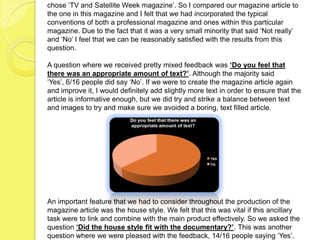
A question where we received pretty mixed feedback was ‘Do you feel that
there was an appropriate amount of text?’. Although the majority said
‘Yes’, 6/16 people did say ‘No’. If we were to create the magazine article again
and improve it, I would definitely add slightly more text in order to ensure that the
article is informative enough, but we did try and strike a balance between text
and images to try and make sure we avoided a boring, text filled article.


An important feature that we had to consider throughout the production of the
magazine article was the house style. We felt that this was vital if this ancillary
task were to link and combine with the main product effectively. So we asked the
question ‘Did the house style fit with the documentary?’. This was another
question where we were pleased with the feedback, 14/16 people saying ‘Yes’.
It was a massive objective for us to make the double page spread aesthetically
stimulating and ultimately encourage people to read it and therefore watch the
documentary. From our audience feedback we learned that this was the case
with 14/16 people saying ‘Yes’ which pleased it us a group.

                     Was the overall aesthetic
                          eye-catching?
                                                     Yes
                                                     No

The final question that we asked was definitely one of the most important
questions that would determine whether this ancillary task was successful of not.
This was asking our target audience ‘Does the article make you want to watch
the documentary?’. Given that this was the main purpose of this TV listings
magazine article, we were quite apprehensive as a group as to what people
would say, but 14/16 people said ‘Yes’ which is a figure that we were happy with.
This also highlighted to us that this ancillary task and the main product combined
well and people were able to draw clear links between the two throughout.

                       Does the article make you
                          want to watch the
                            documentary?

                                                     Yes
                                                     No
Overall I feel that, throughout the whole project, our audience feedback and
methods used to get this have been a vital part in creating successful products
that ultimately appeal to our target audience. I have learned various things
throughout the audience feedback from how much our audience knew about our
chosen topic when research and planning, right through to what improvements
we could make within the final product. The majority of our feedback across the
three products was good and highlighted that we have created suitable
products, the constructive criticism and answers that highlights flaws can only
benefit me in the future when creating similar products and I can adapt the
processes used within these tasks to many others within the media industry.

Question 3

  • 1.
  • 2.
    We have usedour audience feedback effectively right from the start of the coursework. From research and planning right through to evaluating how successful our products were. During the research and planning stages we handed out questionnaires creating a small pilot study in order to get a better understanding of our target audience, how much knowledge they had on our chosen topic and also any opinions they had. We asked questions like ‘How much do you know about the change in university fees?’. From this we learnt that the majority of people knew a moderate amount about the change (8/20), most of the people felt that the university fees would have a moderate impact on their lives (12/20) and 13/20 people felt that the situation was putting pressure on them. This audience feedback helped us to gauge how much our target audience knew about the topic, highlighting that there are many people who need to be informed properly on the situation. It also helped us to identify the majority’s opinion, in this case feeling that the rise in fees is unfair, this is supported further by 18/20 people saying this in the results. I feel that having collected all of our audience feedback from the research and planning stage it influenced the direction in which the documentary went. By combining the audience feedback with secondary research, facts and figures from various sources, it enabled us to portray a relatively balanced argument on the issue but it was apparent that there was a majority opinion throughout. The questionnaires and direct audience feedback worked quite well for us as a group throughout the research and planning stages so therefore we felt that it was an appropriate method to use in order to get honest, true opinions on our three products but also crucially from our target audience.
  • 3.
    We also tooka slightly different approach within certain stages of our research, we recorded a short video asking 16-18 year old students what they would like to see in a documentary. This was appropriate as this is our target audience and it was useful for us to get some audience feedback that was personal and real rather than just a tick in a box, although we did do this method as well. From this we found that the informative aspects of the documentary were important with integrated facts and figures ‘in a clear and easy to understand way’ and also ‘interesting shots’ were a big factor if we were to keep our audience’s attention throughout. We tried to integrate all of the desired elements that our audience feedback highlighted. For example using a variety of shots/ angles in both fillers and interviews to keep the documentary interesting.
  • 4.
    We started theevaluation by showing our three final products to our target audience, firstly the documentary. We then provided questionnaires to sixteen people, which all fit the criteria for our target audience, and asked various questions all in order to get proper audience feedback. The first question asked was ‘On a scale of one to ten how much did you enjoy our documentary?’ On a scale of 1 to 10 how much did you enjoy our documentary? 8 7 6 5 4 3 People 2 1 0 1 2 3 4 5 6 7 8 9 10 This proved to be quite encouraging for us as 6/16 gave it 10/10 with the highest number of people giving it a 9/10 (7). Also, having no results lower than 7/10 it gave us satisfaction in that we had ultimately achieved an important objective for us as a group which was to entertain the audience, this was a vitally important factor to consider if the product were to be successful. This also links to the question ‘How professional does our documentary look?’ which highlighted that 75% of people said very with the other 25% saying relatively.
  • 5.
    We then movedfrom the overall impact of the documentary to specifics like audio and sound. It was very encouraging to see that all of the people who answered the question ‘Did the music contribute positively to the documentary?’ said ‘yes’. This was also the case when we asked the question ‘Was the voice-over informative enough?’. We were very pleased as a group when we obtained these results as these elements of the documentary were very important to us in achieving our own personal goals and standards within the main product. Did the music Was the voiceover contribute positively to informative enough? the documentary? 20 15 20 15 10 10 5 5 0 0 People People Yes No Yes No Did the music contribute positively to Was the voiceover informative the documentary? enough? After we had gained some useful feedback on the audio elements within the documentary, we then decided to focus on the visual aspects like ‘Were there enough shots to keep you entertained?’ but also how these visuals were linked to the audio and how effective this link was with the question ‘Do you feel like the interviews contributed appropriately to the narrative?’. This showed that all the people (16/16) felt that there were enough shot types to keep them entertained which also gives us some encouragement and highlights how the
  • 6.
    time and effortspent on the storyboard when planning shots paid off. Similarly, all of the people felt that the interviews did work well with the narrative and contribute positively. Do you feel like the Were there enough interviews contributed shots to keep you appropriately to the entertained? narrative? 20 20 15 15 10 10 5 5 0 0 People Yes No People Yes No Do you feel like the interviews contributed appropriately to the Were there enough shots to keep you narrative? entertained? The final question that we asked within the documentary section of the questionnaire was ‘Do you feel like you learnt much throughout the documentary?’. This was a very important one for us as the informative purposes of our documentary are vital. This highlighted that there is room for improvement as five people said ‘very’ but the rest said ‘relatively’. If I was given the opportunity to create our main product again I would definitely take this into consideration and try to include more facts, possibly a more informative style of interview and generally try and fulfil elements that the target audience feel are missing.
  • 7.
    We approached theradio trail section within the questionnaire in a similar to the documentary. Also, much like the documentary, we got some useful and interesting feedback. We felt that a suitable place to start was the overall rating, ‘On a scale of one to ten how much did you enjoy our radio trail?’. We were pleased with the majority of the feedback that was provided, five people scoring 10/10 and a further eight scoring between eight and nine. Similar to the documentary section, this question was followed by the question relating to professionalism ‘Does our radio trail sound professional?’. This showed that 50% said ‘very’ and the other 50% said ‘relatively’. We were happy with the feedback from both of these questions relating to the overall impact of the radio trailer and it showed to us that overall the standard set by the documentary was followed within the radio trail.
  • 8.
    We then wantedto find out if the music used within the radio trail was suitable with the question ‘Did the music contribute positively to the radio trail?’. Given that we decided to use the same background music as the one we made for the documentary. This was because we felt it added continuity, allowed the products to combine and highlights a clear connection between the two. By asking this question we found that 15/16 people said ‘yes’ with one person saying no their reason being ‘it’s too distracting’. This is something that we could possibly correct or certainly look into if we could do the radio trail again, it could be a case of just automating the volume down slightly but given that it was just one person we are pretty satisfied with the outcome of the music. Did the music contribute No positively to the radio trail? 6% Yes 94% Within our final few questions in the radio trail section we decided to focus on the documentary, asking questions like ‘Were the snippets from the documentary appropriate?’ where all sixteen people said ‘yes’ and the crucial question ‘Would the radio trail make you want to watch the documentary?’ where 15/16 said ‘yes’ which showed that overall our radio trailer was of a good standard and achieved its purpose. This section’s feedback proved to be very useful as it highlighted a direct correlation between the documentary and the radio trail and allowed us to draw comparisons between the two sets of feedback.
  • 9.
    After creating thedocumentary and radio trail sections of the questionnaire, we decided that it was sensible to follow the same sort of style questions for the TV listings magazine article, this would enable us to get broad feedback on the overall impact of the article whilst also focussing on certain elements within the article. Much like the other sections, the first question we asked for the article was ‘On a scale of one to ten how much did you enjoy the double page spread?’. This helped us identify that this particular ancillary task was not as successful as the other ancillary task and the main product, with only 1/16 saying 10/10, 6/16 giving it a 9/10 but we did have five results lower than eight which is something that we wasn't pleased with and highlighted that, if we were to do this magazine article again, we would maybe need to take the audience into consideration more. We then asked ‘How professional does the double page spread look?’ and provided four options, much like the other sections. These were ‘Very’, ‘Relatively’, ‘Not really’, ‘No’. It was quite promising that the majority of people answered either ‘Very’ or ‘Relatively’ with 7/16 in each. But one person said ‘Not really’ and another person said ‘No’. This is something that I looked into as one of the main pieces of criteria for us as a group and the task was to make it look professional but also as if it belongs to a specific magazine, in our case we
  • 10.
    chose ‘TV andSatellite Week magazine’. So I compared our magazine article to the one in this magazine and I felt that we had incorporated the typical conventions of both a professional magazine and ones within this particular magazine. Due to the fact that it was a very small minority that said ‘Not really’ and ‘No’ I feel that we can be reasonably satisfied with the results from this question. A question where we received pretty mixed feedback was ‘Do you feel that there was an appropriate amount of text?’. Although the majority said ‘Yes’, 6/16 people did say ‘No’. If we were to create the magazine article again and improve it, I would definitely add slightly more text in order to ensure that the article is informative enough, but we did try and strike a balance between text and images to try and make sure we avoided a boring, text filled article. An important feature that we had to consider throughout the production of the magazine article was the house style. We felt that this was vital if this ancillary task were to link and combine with the main product effectively. So we asked the question ‘Did the house style fit with the documentary?’. This was another question where we were pleased with the feedback, 14/16 people saying ‘Yes’.
  • 11.
    It was amassive objective for us to make the double page spread aesthetically stimulating and ultimately encourage people to read it and therefore watch the documentary. From our audience feedback we learned that this was the case with 14/16 people saying ‘Yes’ which pleased it us a group. Was the overall aesthetic eye-catching? Yes No The final question that we asked was definitely one of the most important questions that would determine whether this ancillary task was successful of not. This was asking our target audience ‘Does the article make you want to watch the documentary?’. Given that this was the main purpose of this TV listings magazine article, we were quite apprehensive as a group as to what people would say, but 14/16 people said ‘Yes’ which is a figure that we were happy with. This also highlighted to us that this ancillary task and the main product combined well and people were able to draw clear links between the two throughout. Does the article make you want to watch the documentary? Yes No
  • 12.
    Overall I feelthat, throughout the whole project, our audience feedback and methods used to get this have been a vital part in creating successful products that ultimately appeal to our target audience. I have learned various things throughout the audience feedback from how much our audience knew about our chosen topic when research and planning, right through to what improvements we could make within the final product. The majority of our feedback across the three products was good and highlighted that we have created suitable products, the constructive criticism and answers that highlights flaws can only benefit me in the future when creating similar products and I can adapt the processes used within these tasks to many others within the media industry.