WHAT HAVE YOU LEARNT FROM YOUR
AUDIENCE FEEDBACK?
QUESTIONNAIRE
 We used a questionnaire after the first showing of our
documentary to an audience in order to get an idea of
what they thought. This was important to us because it
allowed us to see if we had achieved everything that we
set out to upon starting the project. The questionnaire
consisted of numerous questions regarding sound levels,
hosting and usefulness of content.
PRESENTERS
 We asked our audience whether they though the
combination of off and on screen presenters was an
affective addition. We where pleased to see that 17 out
of 17 members voted yes, agreeing that it was an
affective feature. In addition to these results we where
able to get some additional comments from our
audience, many stating that it “worked really well".
Overall we are please with this fact, this proved to us
that our analysis of hosts in existing documentaries
equipped us with the efficient knowledge to create our
own affective hosts.
AUDIO LEVELS
 Here we gave the audience a small box to make
comments on whether or not they thought the sound
levels where good. As a result we got some mixed
responses. For the most part, the voice overs and vox
pops where well adjusted, however there where some
points where the sound levels dipped. One member
said: “Most sound levels where equal”. We understand
that the results for this question are very subjective and
will vary from person to person. We also took into
account the speaker set that the documentary was
playing on. When reviewing the documentary on a Mac
we had no issues with sound, however when playing it
from a windows pc we noticed how certain sound
effects and segments sounds where slightly off.
DEMOGRAPHIC (AGE)
 We asked the audience what they thought was the
appropriate age demographic for the documentary. We
listed some ages, each spanning five years from 10 - 40+
years old. It is worth mentioning that when planning the
documentary we planned to have our age demographic
be 16-21 years old and so we where hoping this would
have the most ticks. We where pleased to find that this
was in fact the case with 16-21 having 11 ticks, 22-27
having 5 and 28-32 having 1. Whilst the last tick seemed
rather far from our initial plan, we where still pleased
with the majority of the results.
DEMOGRAPHIC (GENDER)
 The next part to the question involved asking the
audience what they though the gender demographic was
for the documentary. It is worth noting that we wanted
the documentary to be for both genders. Upon receiving
the results we saw answers across all three of the boxes
with ‘both’ taking the most with 11 ticks, ‘male’ with 4
and ‘female’ with 2. Whilst we where happy with the
results we where disappointed to see that male scored
above female. This is because we initially planned for
he documentary to have a slight lean towards female
audiences.
DEMOGRAPHIC (OCCUPATION)
 The final part to the question involved asking the
audience what they thought the occupation of the
demographic would be. The possible answers consisted
of the following; Student, part time employee, full time
employee, unemployed and/or all/any. The results
showed that student was the most likely demographic
occupation with 14 votes and pat time second with 5.
This fitted with the age and gender answers as both
young female and male viewers would be attending
education and a part time job.
APPEAL
 We asked whether they thought “Branded” could better
appeal to the target audience. The results varied but
mostly consisted of useful information. A common
theme was that there was not enough females in the
documentary. In all seriousness we could have done
more to appeal to this but we where cut for time whilst
filming. Another suggested that we “talk more about
clothes – things that appeal to a younger audience”.
This was useful, we realized that we may have dwelled
too long on coca cola and not looked beyond it at a
range of different products. We understand how this
goes against the target audience. Despite these factors
however, many people had little to say and seemed
content with the documentary’s appeal.
PACING
 Pacing is extremely important for a documentary as it
controls the audiences incentive to continue watching,
if something interesting doesn't’t happen every few
scenes, the viewer is bound to lose interest. We aimed
to have something to intrigue the viewer every few
moments with rhetorical questions and enigmas. We ask
the audience whether they had any trouble keeping up
with pace. Most answers given said that the “pace was
good” and that “it was fine”. 3 answers said that it was
“slightly faster than I would've liked”. Despite this, we
are still pleased with the pacing as it was something we
spent allot of time editing.
TOPIC
 We asked the audience how effective they thought the
documentary was at presenting the issue of brand
overpowering. This was done on a scale of 1 – 10. The
majority of answers where between 8 – 10, other
answers stooped as low 5 which was certainly a shock to
us because ewe spent so much time writing the
script/content. However, the fact that the majority was
with the higher end, we are incline to believe that this
was the most likely result and so we are very pleased.
This is essentially the main thing that we set out to
achieve when we chose to do this topic in the planning
phases.
MUSIC
 We asked whether the audience thought the music for
the documentary added anything in terms of style and
atmosphere. We hoped that the majority would be a yes
vote because we spent allot of time finding the correct
tone and style of music for the documentary. We where
pleased to see that 16 out of 17 thought the music was
appropriate with only 1 answer that thought otherwise.
Some said that it was “suitable music” and that it “fit
the topic well”.
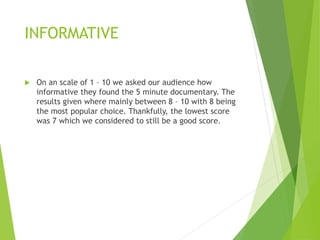
INFORMATIVE
 On an scale of 1 – 10 we asked our audience how
informative they found the 5 minute documentary. The
results given where mainly between 8 – 10 with 8 being
the most popular choice. Thankfully, the lowest score
was 7 which we considered to still be a good score.
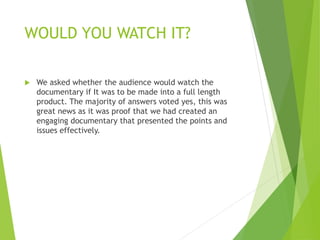
WOULD YOU WATCH IT?
 We asked whether the audience would watch the
documentary if It was to be made into a full length
product. The majority of answers voted yes, this was
great news as it was proof that we had created an
engaging documentary that presented the points and
issues effectively.
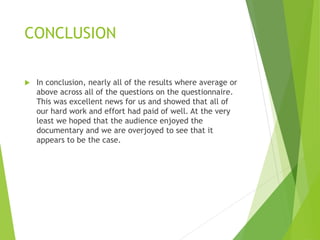
CONCLUSION
 In conclusion, nearly all of the results where average or
above across all of the questions on the questionnaire.
This was excellent news for us and showed that all of
our hard work and effort had paid of well. At the very
least we hoped that the audience enjoyed the
documentary and we are overjoyed to see that it
appears to be the case.

Question 3

  • 1.
    WHAT HAVE YOULEARNT FROM YOUR AUDIENCE FEEDBACK?
  • 2.
    QUESTIONNAIRE  We useda questionnaire after the first showing of our documentary to an audience in order to get an idea of what they thought. This was important to us because it allowed us to see if we had achieved everything that we set out to upon starting the project. The questionnaire consisted of numerous questions regarding sound levels, hosting and usefulness of content.
  • 3.
    PRESENTERS  We askedour audience whether they though the combination of off and on screen presenters was an affective addition. We where pleased to see that 17 out of 17 members voted yes, agreeing that it was an affective feature. In addition to these results we where able to get some additional comments from our audience, many stating that it “worked really well". Overall we are please with this fact, this proved to us that our analysis of hosts in existing documentaries equipped us with the efficient knowledge to create our own affective hosts.
  • 4.
    AUDIO LEVELS  Herewe gave the audience a small box to make comments on whether or not they thought the sound levels where good. As a result we got some mixed responses. For the most part, the voice overs and vox pops where well adjusted, however there where some points where the sound levels dipped. One member said: “Most sound levels where equal”. We understand that the results for this question are very subjective and will vary from person to person. We also took into account the speaker set that the documentary was playing on. When reviewing the documentary on a Mac we had no issues with sound, however when playing it from a windows pc we noticed how certain sound effects and segments sounds where slightly off.
  • 5.
    DEMOGRAPHIC (AGE)  Weasked the audience what they thought was the appropriate age demographic for the documentary. We listed some ages, each spanning five years from 10 - 40+ years old. It is worth mentioning that when planning the documentary we planned to have our age demographic be 16-21 years old and so we where hoping this would have the most ticks. We where pleased to find that this was in fact the case with 16-21 having 11 ticks, 22-27 having 5 and 28-32 having 1. Whilst the last tick seemed rather far from our initial plan, we where still pleased with the majority of the results.
  • 6.
    DEMOGRAPHIC (GENDER)  Thenext part to the question involved asking the audience what they though the gender demographic was for the documentary. It is worth noting that we wanted the documentary to be for both genders. Upon receiving the results we saw answers across all three of the boxes with ‘both’ taking the most with 11 ticks, ‘male’ with 4 and ‘female’ with 2. Whilst we where happy with the results we where disappointed to see that male scored above female. This is because we initially planned for he documentary to have a slight lean towards female audiences.
  • 7.
    DEMOGRAPHIC (OCCUPATION)  Thefinal part to the question involved asking the audience what they thought the occupation of the demographic would be. The possible answers consisted of the following; Student, part time employee, full time employee, unemployed and/or all/any. The results showed that student was the most likely demographic occupation with 14 votes and pat time second with 5. This fitted with the age and gender answers as both young female and male viewers would be attending education and a part time job.
  • 8.
    APPEAL  We askedwhether they thought “Branded” could better appeal to the target audience. The results varied but mostly consisted of useful information. A common theme was that there was not enough females in the documentary. In all seriousness we could have done more to appeal to this but we where cut for time whilst filming. Another suggested that we “talk more about clothes – things that appeal to a younger audience”. This was useful, we realized that we may have dwelled too long on coca cola and not looked beyond it at a range of different products. We understand how this goes against the target audience. Despite these factors however, many people had little to say and seemed content with the documentary’s appeal.
  • 9.
    PACING  Pacing isextremely important for a documentary as it controls the audiences incentive to continue watching, if something interesting doesn't’t happen every few scenes, the viewer is bound to lose interest. We aimed to have something to intrigue the viewer every few moments with rhetorical questions and enigmas. We ask the audience whether they had any trouble keeping up with pace. Most answers given said that the “pace was good” and that “it was fine”. 3 answers said that it was “slightly faster than I would've liked”. Despite this, we are still pleased with the pacing as it was something we spent allot of time editing.
  • 10.
    TOPIC  We askedthe audience how effective they thought the documentary was at presenting the issue of brand overpowering. This was done on a scale of 1 – 10. The majority of answers where between 8 – 10, other answers stooped as low 5 which was certainly a shock to us because ewe spent so much time writing the script/content. However, the fact that the majority was with the higher end, we are incline to believe that this was the most likely result and so we are very pleased. This is essentially the main thing that we set out to achieve when we chose to do this topic in the planning phases.
  • 11.
    MUSIC  We askedwhether the audience thought the music for the documentary added anything in terms of style and atmosphere. We hoped that the majority would be a yes vote because we spent allot of time finding the correct tone and style of music for the documentary. We where pleased to see that 16 out of 17 thought the music was appropriate with only 1 answer that thought otherwise. Some said that it was “suitable music” and that it “fit the topic well”.
  • 12.
    INFORMATIVE  On anscale of 1 – 10 we asked our audience how informative they found the 5 minute documentary. The results given where mainly between 8 – 10 with 8 being the most popular choice. Thankfully, the lowest score was 7 which we considered to still be a good score.
  • 13.
    WOULD YOU WATCHIT?  We asked whether the audience would watch the documentary if It was to be made into a full length product. The majority of answers voted yes, this was great news as it was proof that we had created an engaging documentary that presented the points and issues effectively.
  • 14.
    CONCLUSION  In conclusion,nearly all of the results where average or above across all of the questions on the questionnaire. This was excellent news for us and showed that all of our hard work and effort had paid of well. At the very least we hoped that the audience enjoyed the documentary and we are overjoyed to see that it appears to be the case.