AUDIENCE RESEARCH
At the beginning of the coursework module, we
conducted audience research to learn about our
audience’s understanding and opinions of the topic of
our documentary, body modification.
The people who we gave the questionnaire to
predominantly reflect our target audience, although we
included some people outside of the target audience so
as not to alienate anyone who could possibly view the
documentary and to determine if there was a difference
in knowledge/opinions of the topic dependent on age.
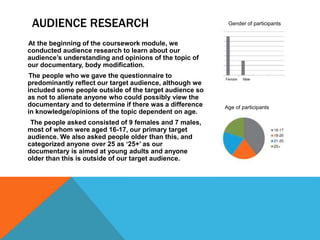
The people asked consisted of 9 females and 7 males,
most of whom were aged 16-17, our primary target
audience. We also asked people older than this, and
categorized anyone over 25 as ‘25+’ as our
documentary is aimed at young adults and anyone
older than this is outside of our target audience.
Gender of participants
Age of participants
AUDIENCE RESEARCH
Do you have any piercings?
If so, how many?
Do you have any tattoos?
If so, how many?
We asked the audience about
their own experience with body
modification to gain an idea of
how much body modification is
practiced within our target
audience. We found that it was
quite popular, and that more
females than males had
piercings, whilst more males
than females had tattoos. This
allowed us to consider the
knowledge/opinion each part of
our target audience had and
cater the documentary to this
accordingly.
AUDIENCE RESEARCH
Are all piercings appropriate?
Should jobs be restricted/terminated
due to piercings?
Do you think people should be discriminated
against for having tattoos/piercings?
Should jobs be restricted/terminated
due to tattoos?
This section of our
research allowed us to
see how the audience
feels about
discrimination, the main
topic of our documentary.
Whilst, as expected, the
majority of the audience
felt that people with body
modification should not
be discriminated against,
some people believed
that they should be. This
showed us that, as our
documentary aims to
show these people who
have been discriminated
against in a positive light,
we needed to broach the
subject carefully in order
to change the minds of
some people in our
audience.
EVALUATION QUESTIONNAIRE
After showing 13 participants from our target
audience the documentary, magazine spread
and radio trailer, we distributed a
questionnaire to gain their thoughts & opinions
of the final, completed products to get an idea
of how successful the products are.
The questionnaire is set out as a series of
statements and the participant can choose
whether they ‘Strongly Agree’, ‘Agree’,
‘Disagree’ or ‘Strongly Disagree’. It is
important to have four options instead of five
so that there is not a central option to ensure
that the participant really considers their
answer and doesn’t just opt for the neutral
choice.
EVALUATION QUESTIONNAIRE
0
5
10
The documentary looked professional.
0
5
10
I learned a lot from the documentary.
0
5
10
The music added positively to the documentary.
0
5
10
The voiceover was informative.
This section of
the questionnaire
showed that the
main text, the
documentary, was
extremely
successful.
EVALUATION QUESTIONNAIRE
0
5
10
0
2
4
6
0
5
10
0
5
10
The radio trailer effectively promoted the documentary
The radio trailer sounded professional
The snippets from the documentary were appropriate
The magazine spread is aesthetically pleasing
This section of
the
questionnaire
indicated that
the ancillary
texts were also
extremely
successful and
appealed to the
audience.
CONCLUSION
0
2
4
6
8
Strongly
Agree
Agree Disagree Strongly
Disagree
Nothing could be improved for any of the media
products
The final question of the questionnaire showed
that the audience believed every product was
extremely successful and did not need to be
improved. This view was also expressed by the
focus group we conducted, in which positive
views were expressed and the group stated
that the products were extremely successful
and had a clear and effective brand identity.

Question 3

  • 2.
    AUDIENCE RESEARCH At thebeginning of the coursework module, we conducted audience research to learn about our audience’s understanding and opinions of the topic of our documentary, body modification. The people who we gave the questionnaire to predominantly reflect our target audience, although we included some people outside of the target audience so as not to alienate anyone who could possibly view the documentary and to determine if there was a difference in knowledge/opinions of the topic dependent on age. The people asked consisted of 9 females and 7 males, most of whom were aged 16-17, our primary target audience. We also asked people older than this, and categorized anyone over 25 as ‘25+’ as our documentary is aimed at young adults and anyone older than this is outside of our target audience. Gender of participants Age of participants
  • 3.
    AUDIENCE RESEARCH Do youhave any piercings? If so, how many? Do you have any tattoos? If so, how many? We asked the audience about their own experience with body modification to gain an idea of how much body modification is practiced within our target audience. We found that it was quite popular, and that more females than males had piercings, whilst more males than females had tattoos. This allowed us to consider the knowledge/opinion each part of our target audience had and cater the documentary to this accordingly.
  • 4.
    AUDIENCE RESEARCH Are allpiercings appropriate? Should jobs be restricted/terminated due to piercings? Do you think people should be discriminated against for having tattoos/piercings? Should jobs be restricted/terminated due to tattoos? This section of our research allowed us to see how the audience feels about discrimination, the main topic of our documentary. Whilst, as expected, the majority of the audience felt that people with body modification should not be discriminated against, some people believed that they should be. This showed us that, as our documentary aims to show these people who have been discriminated against in a positive light, we needed to broach the subject carefully in order to change the minds of some people in our audience.
  • 5.
    EVALUATION QUESTIONNAIRE After showing13 participants from our target audience the documentary, magazine spread and radio trailer, we distributed a questionnaire to gain their thoughts & opinions of the final, completed products to get an idea of how successful the products are. The questionnaire is set out as a series of statements and the participant can choose whether they ‘Strongly Agree’, ‘Agree’, ‘Disagree’ or ‘Strongly Disagree’. It is important to have four options instead of five so that there is not a central option to ensure that the participant really considers their answer and doesn’t just opt for the neutral choice.
  • 6.
    EVALUATION QUESTIONNAIRE 0 5 10 The documentarylooked professional. 0 5 10 I learned a lot from the documentary. 0 5 10 The music added positively to the documentary. 0 5 10 The voiceover was informative. This section of the questionnaire showed that the main text, the documentary, was extremely successful.
  • 7.
    EVALUATION QUESTIONNAIRE 0 5 10 0 2 4 6 0 5 10 0 5 10 The radiotrailer effectively promoted the documentary The radio trailer sounded professional The snippets from the documentary were appropriate The magazine spread is aesthetically pleasing This section of the questionnaire indicated that the ancillary texts were also extremely successful and appealed to the audience.
  • 8.
    CONCLUSION 0 2 4 6 8 Strongly Agree Agree Disagree Strongly Disagree Nothingcould be improved for any of the media products The final question of the questionnaire showed that the audience believed every product was extremely successful and did not need to be improved. This view was also expressed by the focus group we conducted, in which positive views were expressed and the group stated that the products were extremely successful and had a clear and effective brand identity.