Quantum Dots
Quantum Dots
Quantum dots, also known as
nanocrystals, are a special class of
materials known as semiconductors, which
are crystals composed of periodic groups
of II-VI, III-V, or IV-VI materials.
Quantum dots are unique class of
semiconductor because they are so small,
ranging from 2-10 nanometers (10-50
atoms) in diameter.
Quantum Dots
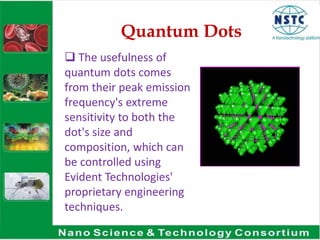
 The usefulness of
quantum dots comes
from their peak emission
frequency's extreme
sensitivity to both the
dot's size and
composition, which can
be controlled using
Evident Technologies'
proprietary engineering
techniques.
History of Quantum Dots
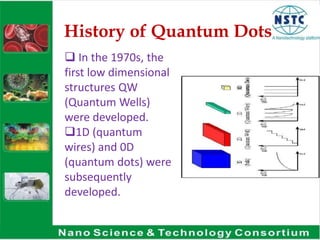
 In the 1970s, the
first low dimensional
structures QW
(Quantum Wells)
were developed.
1D (quantum
wires) and 0D
(quantum dots) were
subsequently
developed.
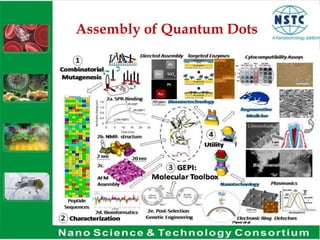
Assembly of Quantum Dots
Formation of Quantum Dots
 Quantum dots form when very thin
semiconductor films buckle due to the stress
of having lattice structures slightly different in
size from those of the material upon which
the films are grown
These huge pressures, as new layers are
deposited, force the initially flat film to
separate into dots and then pop up into the
third dimension to relieve stress, rather than
continue to grow against resistance in two
dimensions. Continued…
Formation of Quantum Dots
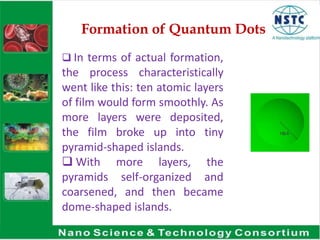
 In terms of actual formation,
the process characteristically
went like this: ten atomic layers
of film would form smoothly. As
more layers were deposited,
the film broke up into tiny
pyramid-shaped islands.
 With more layers, the
pyramids self-organized and
coarsened, and then became
dome-shaped islands.
Characterization of
Quantum Dots
Quantum Dots can be characterized by two techniques:
 Optical Characterization
 Electrochemical Characterization
 Optical Characterization:
Electron microscopes and atomic force microscopes (AFM) are
widely used for the optical characterization of the size of the qdots.
For the cross-sectional investigation of qdots structures,
transmission electron microscopy (TEM) is the most used.
 Electrochemical Characterization:
Qdots can be detected directly (without the need to be dissolved)
or indirectly by oxidatively dissolving the metal ion into aqueous
metal ions and then electrochemically sensing the ions by using
stripping voltammetry or potentiometry or electrochemical
impedance spectroscopy (EIS).
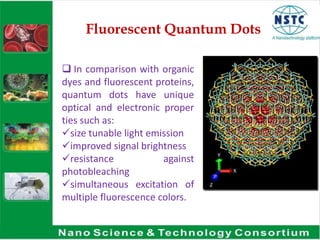
Fluorescent Quantum Dots
 In comparison with organic
dyes and fluorescent proteins,
quantum dots have unique
optical and electronic proper
ties such as:
size tunable light emission
improved signal brightness
resistance against
photobleaching
simultaneous excitation of
multiple fluorescence colors.
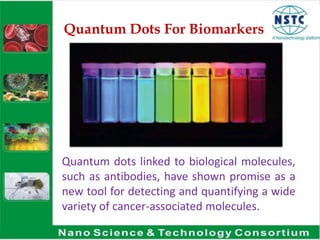
Quantum Dots For Biomarkers
Quantum dots linked to biological molecules,
such as antibodies, have shown promise as a
new tool for detecting and quantifying a wide
variety of cancer-associated molecules.
Conjugation of Quantum Dots
to Biological Molecules
Quatum Dots can conjugate with biological
molecules such as:
 proteins
 peptides
 nucleic acids
 small organic-molecules
Applications of Quantum Dots
Optical and optoelectronic devices, quantum
computing, and information storage.
Semiconductors with QDs as Material for
Cascade Lasers
Semiconductors with QDs as Material for IR
Photodetectors
 Injection Lasers with QDs
Color Coded Quantum Dots For Fast DNA Testing
3-D Imaging Inside Living Organism, Using
Quantum Dots
Continued…
Applications of Quantum Dots
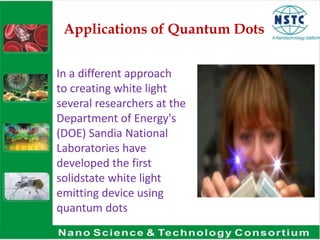
In a different approach
to creating white light
several researchers at the
Department of Energy's
(DOE) Sandia National
Laboratories have
developed the first
solidstate white light
emitting device using
quantum dots

Quatum dots

  • 1.
  • 2.
    Quantum Dots Quantum dots,also known as nanocrystals, are a special class of materials known as semiconductors, which are crystals composed of periodic groups of II-VI, III-V, or IV-VI materials. Quantum dots are unique class of semiconductor because they are so small, ranging from 2-10 nanometers (10-50 atoms) in diameter.
  • 3.
    Quantum Dots  Theusefulness of quantum dots comes from their peak emission frequency's extreme sensitivity to both the dot's size and composition, which can be controlled using Evident Technologies' proprietary engineering techniques.
  • 4.
    History of QuantumDots  In the 1970s, the first low dimensional structures QW (Quantum Wells) were developed. 1D (quantum wires) and 0D (quantum dots) were subsequently developed.
  • 5.
  • 6.
    Formation of QuantumDots  Quantum dots form when very thin semiconductor films buckle due to the stress of having lattice structures slightly different in size from those of the material upon which the films are grown These huge pressures, as new layers are deposited, force the initially flat film to separate into dots and then pop up into the third dimension to relieve stress, rather than continue to grow against resistance in two dimensions. Continued…
  • 7.
    Formation of QuantumDots  In terms of actual formation, the process characteristically went like this: ten atomic layers of film would form smoothly. As more layers were deposited, the film broke up into tiny pyramid-shaped islands.  With more layers, the pyramids self-organized and coarsened, and then became dome-shaped islands.
  • 8.
    Characterization of Quantum Dots QuantumDots can be characterized by two techniques:  Optical Characterization  Electrochemical Characterization  Optical Characterization: Electron microscopes and atomic force microscopes (AFM) are widely used for the optical characterization of the size of the qdots. For the cross-sectional investigation of qdots structures, transmission electron microscopy (TEM) is the most used.  Electrochemical Characterization: Qdots can be detected directly (without the need to be dissolved) or indirectly by oxidatively dissolving the metal ion into aqueous metal ions and then electrochemically sensing the ions by using stripping voltammetry or potentiometry or electrochemical impedance spectroscopy (EIS).
  • 9.
    Fluorescent Quantum Dots In comparison with organic dyes and fluorescent proteins, quantum dots have unique optical and electronic proper ties such as: size tunable light emission improved signal brightness resistance against photobleaching simultaneous excitation of multiple fluorescence colors.
  • 10.
    Quantum Dots ForBiomarkers Quantum dots linked to biological molecules, such as antibodies, have shown promise as a new tool for detecting and quantifying a wide variety of cancer-associated molecules.
  • 11.
    Conjugation of QuantumDots to Biological Molecules Quatum Dots can conjugate with biological molecules such as:  proteins  peptides  nucleic acids  small organic-molecules
  • 12.
    Applications of QuantumDots Optical and optoelectronic devices, quantum computing, and information storage. Semiconductors with QDs as Material for Cascade Lasers Semiconductors with QDs as Material for IR Photodetectors  Injection Lasers with QDs Color Coded Quantum Dots For Fast DNA Testing 3-D Imaging Inside Living Organism, Using Quantum Dots Continued…
  • 13.
    Applications of QuantumDots In a different approach to creating white light several researchers at the Department of Energy's (DOE) Sandia National Laboratories have developed the first solidstate white light emitting device using quantum dots