Micro and Nano
Manufacturing
(7ME6.1A)- Part I
Mohit Ostwal
Assistant Professor
Department of Mechanical Engineering
Jodhpur Institute of Engineering and Technology- Coed, Jodhpur
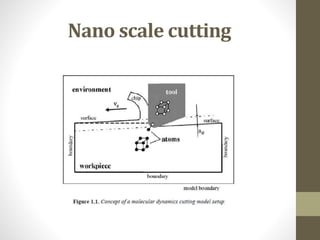
Nano scale cutting
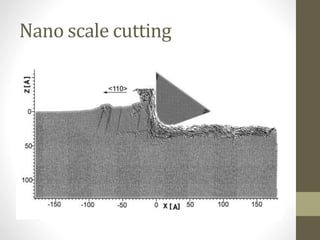
Nano scale cutting
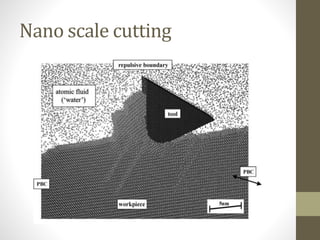
Nano scale cutting
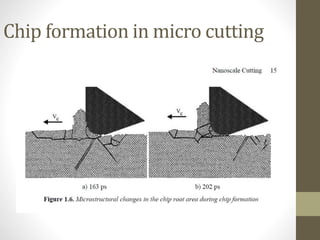
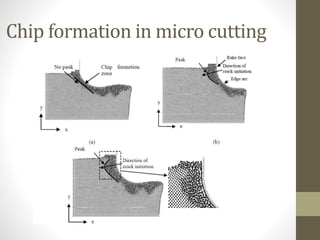
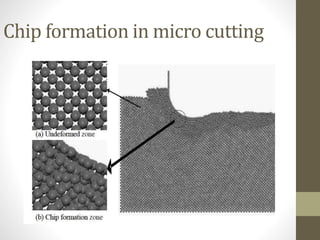
Chip formation in micro cutting
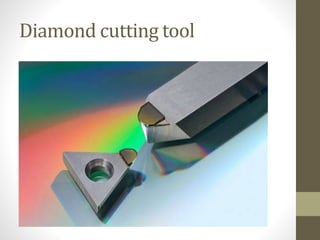
Diamond cutting tool
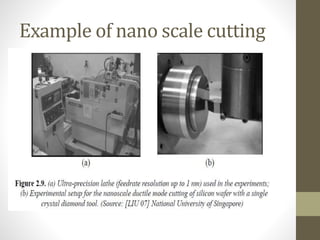
Example of nano scale cutting
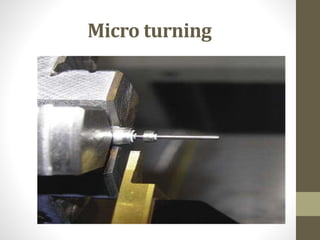
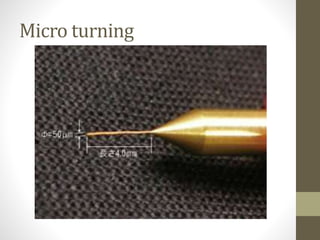
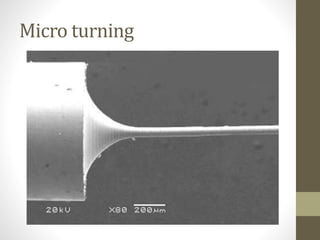
Micro turning
Micro turning
• Characteristic Features and application
• Swiss-type machine tools, ultra-precision lathes for diamond
turning and miniature desktop machines, are used to perform
micro turning operations on parts made of different materials.
• Maximum Machining Diameter – 7 mm
Maximum Machining Length – 40 mm
• Hard to machine surfaces such as electroless nickel, glass ,
ceramics, quartz etc. without any subsurface damage.
• Mirror surfaces of less than 10 nm surface finish can be obtained.
• Ultra-precision diamond turning – electroless nickel dies – plastic
optical parts for LCD Tv’s (less than 6 nm)
Micro turning
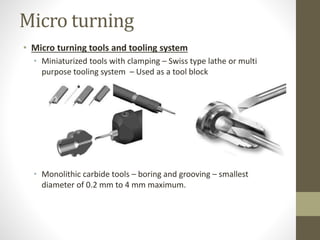
• Micro turning tools and tooling system
• Miniaturized tools with clamping – Swiss type lathe or multi
purpose tooling system – Used as a tool block
• Monolithic carbide tools – boring and grooving – smallest
diameter of 0.2 mm to 4 mm maximum.
Micro turning
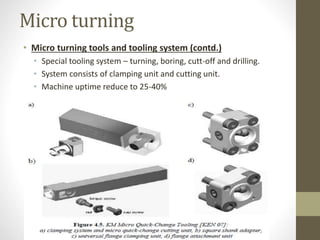
• Micro turning tools and tooling system (contd.)
• Special tooling system – turning, boring, cutt-off and drilling.
• System consists of clamping unit and cutting unit.
• Machine uptime reduce to 25-40%
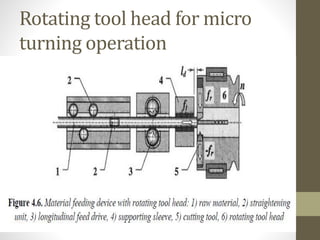
Rotating tool head for micro
turning operation
Micro turning
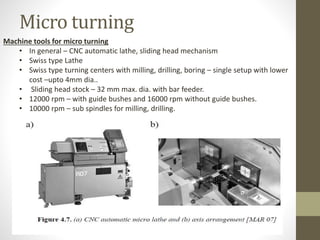
Machine tools for micro turning
• In general – CNC automatic lathe, sliding head mechanism
• Swiss type Lathe
• Swiss type turning centers with milling, drilling, boring – single setup with lower
cost –upto 4mm dia..
• Sliding head stock – 32 mm max. dia. with bar feeder.
• 12000 rpm – with guide bushes and 16000 rpm without guide bushes.
• 10000 rpm – sub spindles for milling, drilling.
Micro turning
Micro turning
Micro turning
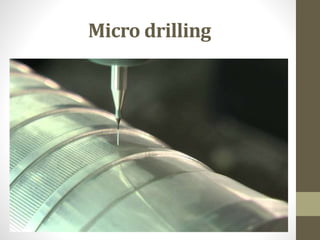
Micro drilling
Micro drilling
• Characteristic Features and application
• Holes – tens of micrometers – PCB
• Inkjet printers – single row of 251 holes – 50 μm dia.
• Used below 0.5 mm.
• Minimum diameter of micro drills -> 5-50 μm.
• Advantages of micro drilling:
1. Metals, plastics and composites can be drilled – electrical
properties do not influence the workpiece (wire EDM).
2. Controllability
• Disadvantages of micro drilling:
1. Inclination of holes
2. Brittle and hard materials – break micro drills – diamond drills.
Micro drilling
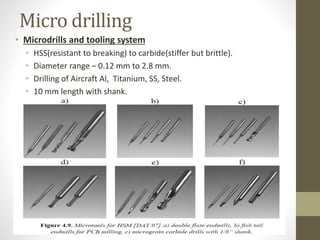
• Microdrills and tooling system
• HSS(resistant to breaking) to carbide(stiffer but brittle).
• Diameter range – 0.12 mm to 2.8 mm.
• Drilling of Aircraft Al, Titanium, SS, Steel.
• 10 mm length with shank.
Micro drilling
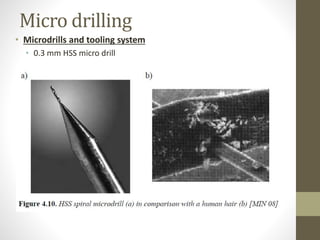
• Microdrills and tooling system
• 0.3 mm HSS micro drill
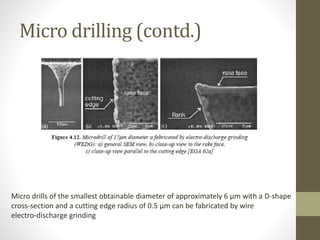
Micro drilling (contd.)
Micro drills of the smallest obtainable diameter of approximately 6 μm with a D-shape
cross-section and a cutting edge radius of 0.5 μm can be fabricated by wire
electro-discharge grinding
Micro drill
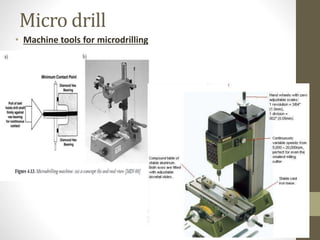
• Machine tools for microdrilling
Micro drill
• Machine tools for microdrilling (contd.)
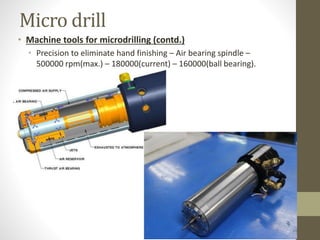
• Precision to eliminate hand finishing – Air bearing spindle –
500000 rpm(max.) – 180000(current) – 160000(ball bearing).
Micro drill
• Machine tools for microdrilling (contd.)
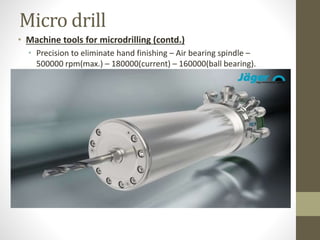
• Precision to eliminate hand finishing – Air bearing spindle –
500000 rpm(max.) – 180000(current) – 160000(ball bearing).
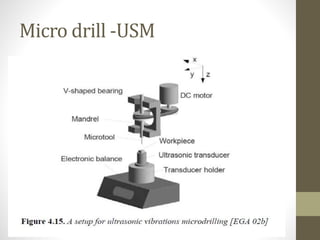
Micro drill -USM
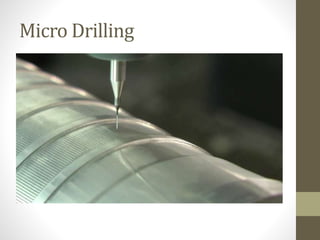
Micro Drilling
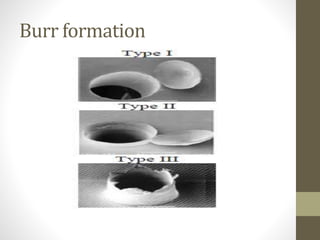
Burr formation
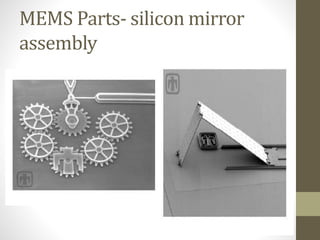
MEMS Parts- silicon mirror
assembly
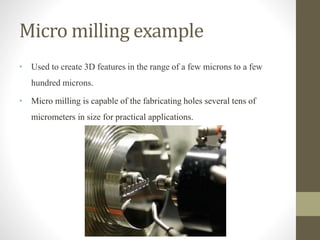
Micro milling example
• Used to create 3D features in the range of a few microns to a few
hundred microns.
• Micro milling is capable of the fabricating holes several tens of
micrometers in size for practical applications.
Micro manufacturing example
• A mite measuring 500m long sits on a mirror array used for optical data switching.
• The mirror [flat in the left image, folded in the right] is positioned with a gear mechanism
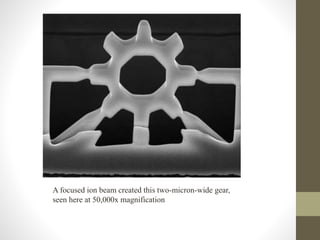
A focused ion beam created this two-micron-wide gear,
seen here at 50,000x magnification

Micro and nano manufacturing

  • 1.
    Micro and Nano Manufacturing (7ME6.1A)-Part I Mohit Ostwal Assistant Professor Department of Mechanical Engineering Jodhpur Institute of Engineering and Technology- Coed, Jodhpur
  • 2.
  • 3.
  • 4.
  • 5.
    Chip formation inmicro cutting
  • 6.
    Chip formation inmicro cutting
  • 7.
    Chip formation inmicro cutting
  • 8.
  • 9.
    Example of nanoscale cutting
  • 10.
  • 11.
    Micro turning • CharacteristicFeatures and application • Swiss-type machine tools, ultra-precision lathes for diamond turning and miniature desktop machines, are used to perform micro turning operations on parts made of different materials. • Maximum Machining Diameter – 7 mm Maximum Machining Length – 40 mm • Hard to machine surfaces such as electroless nickel, glass , ceramics, quartz etc. without any subsurface damage. • Mirror surfaces of less than 10 nm surface finish can be obtained. • Ultra-precision diamond turning – electroless nickel dies – plastic optical parts for LCD Tv’s (less than 6 nm)
  • 12.
    Micro turning • Microturning tools and tooling system • Miniaturized tools with clamping – Swiss type lathe or multi purpose tooling system – Used as a tool block • Monolithic carbide tools – boring and grooving – smallest diameter of 0.2 mm to 4 mm maximum.
  • 13.
    Micro turning • Microturning tools and tooling system (contd.) • Special tooling system – turning, boring, cutt-off and drilling. • System consists of clamping unit and cutting unit. • Machine uptime reduce to 25-40%
  • 14.
    Rotating tool headfor micro turning operation
  • 15.
    Micro turning Machine toolsfor micro turning • In general – CNC automatic lathe, sliding head mechanism • Swiss type Lathe • Swiss type turning centers with milling, drilling, boring – single setup with lower cost –upto 4mm dia.. • Sliding head stock – 32 mm max. dia. with bar feeder. • 12000 rpm – with guide bushes and 16000 rpm without guide bushes. • 10000 rpm – sub spindles for milling, drilling.
  • 16.
  • 17.
  • 18.
  • 19.
  • 20.
    Micro drilling • CharacteristicFeatures and application • Holes – tens of micrometers – PCB • Inkjet printers – single row of 251 holes – 50 μm dia. • Used below 0.5 mm. • Minimum diameter of micro drills -> 5-50 μm. • Advantages of micro drilling: 1. Metals, plastics and composites can be drilled – electrical properties do not influence the workpiece (wire EDM). 2. Controllability • Disadvantages of micro drilling: 1. Inclination of holes 2. Brittle and hard materials – break micro drills – diamond drills.
  • 21.
    Micro drilling • Microdrillsand tooling system • HSS(resistant to breaking) to carbide(stiffer but brittle). • Diameter range – 0.12 mm to 2.8 mm. • Drilling of Aircraft Al, Titanium, SS, Steel. • 10 mm length with shank.
  • 22.
    Micro drilling • Microdrillsand tooling system • 0.3 mm HSS micro drill
  • 23.
    Micro drilling (contd.) Microdrills of the smallest obtainable diameter of approximately 6 μm with a D-shape cross-section and a cutting edge radius of 0.5 μm can be fabricated by wire electro-discharge grinding
  • 24.
    Micro drill • Machinetools for microdrilling
  • 25.
    Micro drill • Machinetools for microdrilling (contd.) • Precision to eliminate hand finishing – Air bearing spindle – 500000 rpm(max.) – 180000(current) – 160000(ball bearing).
  • 26.
    Micro drill • Machinetools for microdrilling (contd.) • Precision to eliminate hand finishing – Air bearing spindle – 500000 rpm(max.) – 180000(current) – 160000(ball bearing).
  • 27.
  • 28.
  • 29.
  • 31.
    MEMS Parts- siliconmirror assembly
  • 32.
    Micro milling example •Used to create 3D features in the range of a few microns to a few hundred microns. • Micro milling is capable of the fabricating holes several tens of micrometers in size for practical applications.
  • 33.
    Micro manufacturing example •A mite measuring 500m long sits on a mirror array used for optical data switching. • The mirror [flat in the left image, folded in the right] is positioned with a gear mechanism
  • 34.
    A focused ionbeam created this two-micron-wide gear, seen here at 50,000x magnification