QUANTUM DOTS
BY : GAURAV SINGH
DEPARTMENT OF PHYSICS
HNBGU, A CENTRAL UNIVERSITY
INTRODUCTION:
 QUANTUM DOTS are nanometerscale semiconductor crystals composed of
group II-VI (e.g.CdS ,CdSe ) or III-V elements.
 They are defined as particles with physical dimensions smaller than the
exciton bohr radius which are confined in all 3 dimensions of space.
 They obey the basic principle of quantum confinement .
 The term quantum dot was coined by MARK REED in 1988 ; however they
were first discovered in a glass matrix by ALEXEY EKIMOV in 1981 and in
colloidal solutions by LOUIS E. BRUS in 1985.
Quantum Confinement:
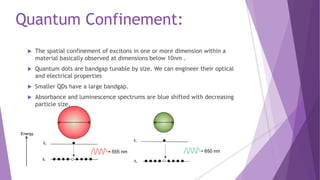
 The spatial confinement of excitons in one or more dimension within a
material basically observed at dimensions below 10nm .
 Quantum dots are bandgap tunable by size. We can engineer their optical
and electrical properties
 Smaller QDs have a large bandgap.
 Absorbance and luminescence spectrums are blue shifted with decreasing
particle size.
Energy
650 nm
555 nm
PROPERTIES OF QUANTUM DOTS:
 Nanocrystals (2-10 nm) of semiconductor compounds.
 Can be of different shapes (cube , sphere , pyramid etc.)
 Small size leads to confinement of excitons.
 Quantized energy levels and altered relaxation dynamics.
 Examples: CdSe, PbSe, PbTe, InP.
APPLICATIONS OF QUANTUM DOTS :
 Light emitters
 Biological applications
 Quantum computation
 Solar cells
LIGHT EMITTERS:
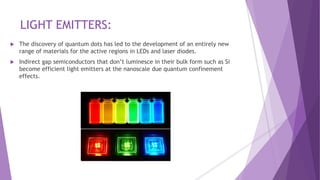
 The discovery of quantum dots has led to the development of an entirely new
range of materials for the active regions in LEDs and laser diodes.
 Indirect gap semiconductors that don’t luminesce in their bulk form such as Si
become efficient light emitters at the nanoscale due quantum confinement
effects.
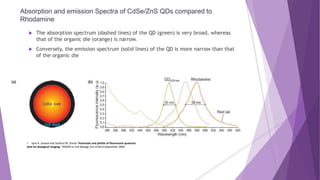
Absorption and emission Spectra of CdSe/ZnS QDs compared to
Rhodamine
 The absorption spectrum (dashed lines) of the QD (green) is very broad, whereas
that of the organic die (orange) is narrow.
 Conversely, the emission spectrum (solid lines) of the QD is more narrow than that
of the organic die
• Jyoti K. Jaiswal and Sanford M. Simon. Potentials and pitfalls of fluorescent quantum
dots for biological imaging. TRENDS in Cell Biology Vol.14 No.9 September 2004
BIOLOGICAL
APPLICATIONS:
• Biological assays and
microarrays
• Biological Tagging
and Labeling
• Labeling of cells and
intracellular
structures
• Pathogen and Toxin
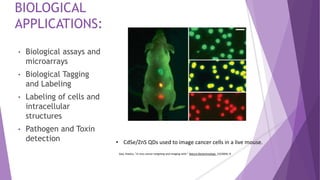
detection • CdSe/ZnS QDs used to image cancer cells in a live mouse.
Gao, Xiaohu. "In vivo cancer targeting and imaging with." Nature Biotechnology 22(2004): 8
REFERENCE :
 http://nanohub.org
 www.researchgate.net/post/what_is_Quantum_confinement_effect
(QUANTUM DOTS)PRESENTATION BY GAURAV SINGH.pptx

(QUANTUM DOTS)PRESENTATION BY GAURAV SINGH.pptx

  • 1.
    QUANTUM DOTS BY :GAURAV SINGH DEPARTMENT OF PHYSICS HNBGU, A CENTRAL UNIVERSITY
  • 2.
    INTRODUCTION:  QUANTUM DOTSare nanometerscale semiconductor crystals composed of group II-VI (e.g.CdS ,CdSe ) or III-V elements.  They are defined as particles with physical dimensions smaller than the exciton bohr radius which are confined in all 3 dimensions of space.  They obey the basic principle of quantum confinement .  The term quantum dot was coined by MARK REED in 1988 ; however they were first discovered in a glass matrix by ALEXEY EKIMOV in 1981 and in colloidal solutions by LOUIS E. BRUS in 1985.
  • 3.
    Quantum Confinement:  Thespatial confinement of excitons in one or more dimension within a material basically observed at dimensions below 10nm .  Quantum dots are bandgap tunable by size. We can engineer their optical and electrical properties  Smaller QDs have a large bandgap.  Absorbance and luminescence spectrums are blue shifted with decreasing particle size. Energy 650 nm 555 nm
  • 4.
    PROPERTIES OF QUANTUMDOTS:  Nanocrystals (2-10 nm) of semiconductor compounds.  Can be of different shapes (cube , sphere , pyramid etc.)  Small size leads to confinement of excitons.  Quantized energy levels and altered relaxation dynamics.  Examples: CdSe, PbSe, PbTe, InP.
  • 5.
    APPLICATIONS OF QUANTUMDOTS :  Light emitters  Biological applications  Quantum computation  Solar cells
  • 6.
    LIGHT EMITTERS:  Thediscovery of quantum dots has led to the development of an entirely new range of materials for the active regions in LEDs and laser diodes.  Indirect gap semiconductors that don’t luminesce in their bulk form such as Si become efficient light emitters at the nanoscale due quantum confinement effects.
  • 7.
    Absorption and emissionSpectra of CdSe/ZnS QDs compared to Rhodamine  The absorption spectrum (dashed lines) of the QD (green) is very broad, whereas that of the organic die (orange) is narrow.  Conversely, the emission spectrum (solid lines) of the QD is more narrow than that of the organic die • Jyoti K. Jaiswal and Sanford M. Simon. Potentials and pitfalls of fluorescent quantum dots for biological imaging. TRENDS in Cell Biology Vol.14 No.9 September 2004
  • 8.
    BIOLOGICAL APPLICATIONS: • Biological assaysand microarrays • Biological Tagging and Labeling • Labeling of cells and intracellular structures • Pathogen and Toxin detection • CdSe/ZnS QDs used to image cancer cells in a live mouse. Gao, Xiaohu. "In vivo cancer targeting and imaging with." Nature Biotechnology 22(2004): 8
  • 9.
    REFERENCE :  http://nanohub.org www.researchgate.net/post/what_is_Quantum_confinement_effect