Biophysics in
Radiology and
Nuclear medicine
dejan.zikic@med.bg.ac.rs
dzikic@gmail.com
Basic physics of ionizing
radiation
◼ Electromagnetic waves
◼ Atomic Structure
◼ Nuclear stability
◼ Radioactive decay
2
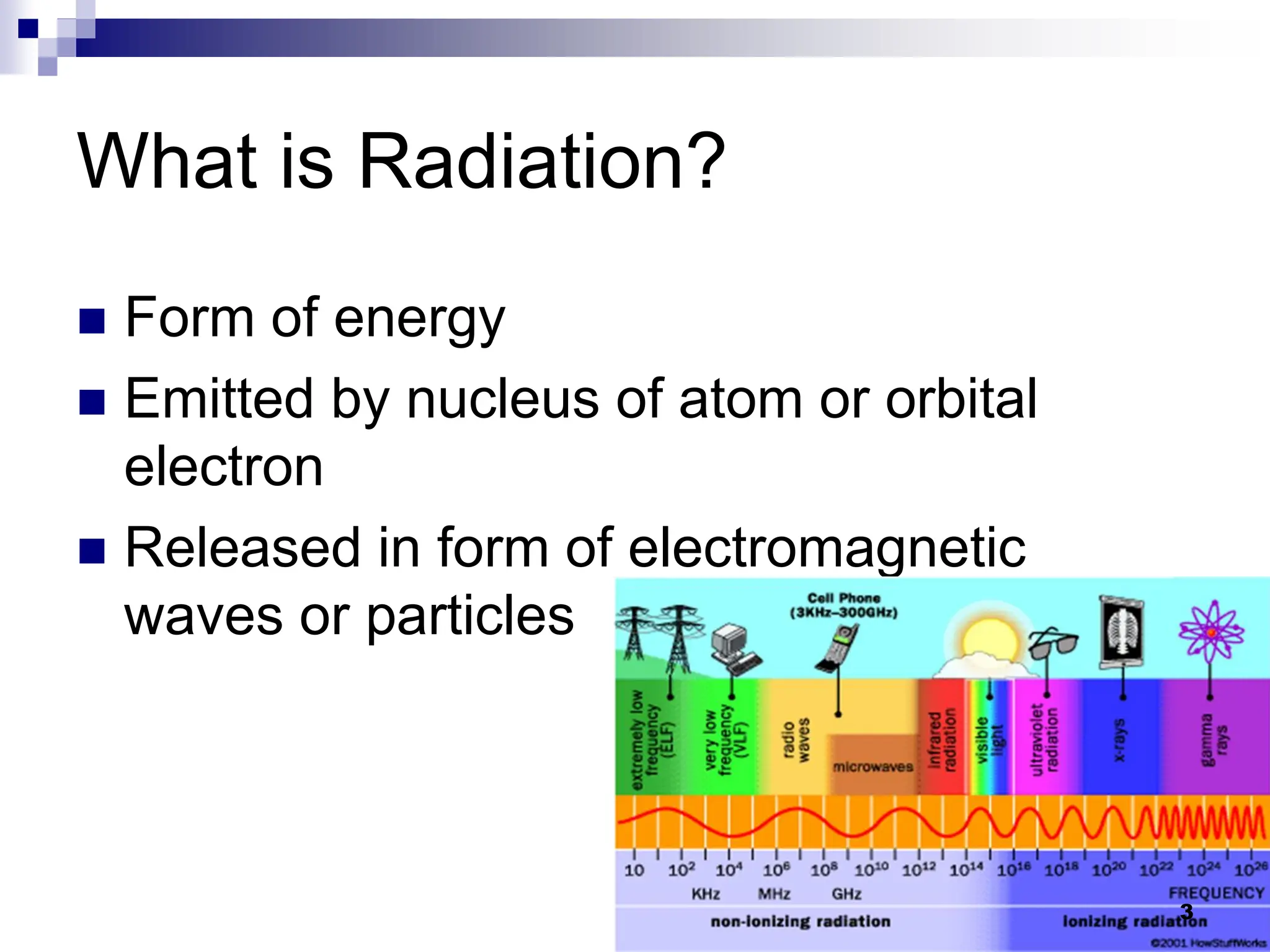
What is Radiation?
◼ Form of energy
◼ Emitted by nucleus of atom or orbital
electron
◼ Released in form of electromagnetic
waves or particles
3
Vibration?
4
smooth sinusoidal oscillation
5
Wave?
6
Types of waves in physics
◼ Transverse waves - particle vibration is
perpendicular to the direction of wave
propagation
7
Types of waves in physics
◼ Longitudinal waves - particle vibrating
parallel to the direction of wave
propagation
8
Characteristics of Waves
Amplitude – x [m]
Wavelength – l [m]
Period -T [s]
Wave Speed – c [m/s]
Frequency – n [1/s=Hz]
9
By the nature
of origin
mechanical
electromagnetic
By way of creation
Transverse
Longitudinal
Classification:
10
By way of propagation
line
plane
spherical
11
Electromagnetic Waves…
◼ Do not need matter to transfer energy.
◼ Are made by vibrating electric charges and
can travel through space by transferring
energy between vibrating electric and
magnetic fields.
12
How do moving charges create
magnetic fields?
◼ Any moving electric charge is surrounded by an
electric field and a magnetic field.
13
What happens when electric and
magnetic fields change?
E
14
• Electric and magnetic fields are perpendicular to
the direction of wave propagation
• The electric field is perpendicular to the magnetic
field
• Transversal waves
15
Properties of EM Waves
◼ All matter contains charged particles that
are always moving; therefore, all objects
emit EM waves.
◼ The wavelengths become shorter as the
temperature of the material increases.
◼ EM waves carry radiant energy (the energy of
electromagnetic radiation).
16
What is the speed of EM waves?
◼ All EM waves travel
300,000 km/sec in
space. (speed of light-
nature’s limit!)
◼ EM waves usually
travel slowest in
solids and fastest in
gases.
Material Speed
(km/s)
Vacuum 300,000
Air <300,000
Water 226,000
Glass 200,000
Diamond 124,000
17
Can a wave be a particle?
◼ In 1887, Heinrich Hertz discovered that
shining light on a metal caused electrons
to be ejected.
◼ Whether or not electrons
were ejected depended
upon frequency
not the amplitude
of the light!
18
Can a wave be a particle?
◼ Years later, Albert
Einstein explained
Hertz’s discovery: EM
waves can behave as a
particle called a photon
whose energy depends
on the frequency of the
waves.
E=hn 19
The whole range of EM wave…
◼ frequencies is called the electromagnetic
spectrum.
◼ EM spectrum includes all EM waves.
◼ Different parts interact with matter in
different ways.
20
The whole range of EM wave…
◼ Nature of EM waves is the same, but their
energies and frequencies are different and
in a wide range.
◼ Sources of EM waves are very different,
but still represent a change in the energies
of charge.
◼ The frequencies that humans can see are
called visible light, a small part of the
whole spectrum.
21
As wavelength decreases,
frequency increases…
22
Radio waves
◼ Radio waves are low
frequency EM waves with
wavelengths 1mm - km
◼ Antenna – detects radio
waves
◼ These waves must be
turned into sound waves
by a radio before you can
hear them.
23
Microwaves
◼ Microwaves are radio
waves with wavelengths
1mm – 1m
◼ Communications
frequencies
◼ Cell phones and satellites
use microwaves between
1 cm & 20 cm for
communication.
24
Microwaves
◼ In microwave ovens, a vibrating electric field
causes water molecules to rotate billions of
times per second causing friction which heats
the food.
25
Infrared Waves
◼ Every objects gives off infrared waves;
26
Infrared Waves
◼ EM with wavelengths between 1mm & 760
nm.
◼ Used daily in remote controls
27
Visible Light
◼ Range of EM humans can see from 760
nm to 380 nm.
28
Ultraviolet Waves
◼ EM waves with wavelengths from about
10nm – 380nm
◼ Have enough energy to enter skin cells
Longer wavelengths – UVA
Shorter wavelengths – UVB rays
Both can cause skin cancer
29
Ultraviolet Waves
30
Can UV radiation be useful?
◼ Helps body make vitamin D for healthy
bones and teeth
◼ Used to sterilize medical supplies & equip
◼ Detectives use fluorescent powder (absorbs
UV & glows) to find fingerprints
31
32
X Rays
◼ EM waves 0.01nm –
10nm
◼ High Energy- go
through skin & muscle
◼ High level exposure
causes cancer
33
X Rays
34
Gamma Rays
◼ EM with wavelengths
shorter than < 0,01nm
◼ Highest energy, can
travel through several
centimeters of lead.
◼ Both can be used in
radiation therapy to
kill diseased cells.
◼ The composite image
shows the all sky
gamma ray
background.
35

Basic physics of ionizing radiation I.pdf

  • 1.
    Biophysics in Radiology and Nuclearmedicine dejan.zikic@med.bg.ac.rs dzikic@gmail.com
  • 2.
    Basic physics ofionizing radiation ◼ Electromagnetic waves ◼ Atomic Structure ◼ Nuclear stability ◼ Radioactive decay 2
  • 3.
    What is Radiation? ◼Form of energy ◼ Emitted by nucleus of atom or orbital electron ◼ Released in form of electromagnetic waves or particles 3
  • 4.
  • 5.
  • 6.
  • 7.
    Types of wavesin physics ◼ Transverse waves - particle vibration is perpendicular to the direction of wave propagation 7
  • 8.
    Types of wavesin physics ◼ Longitudinal waves - particle vibrating parallel to the direction of wave propagation 8
  • 9.
    Characteristics of Waves Amplitude– x [m] Wavelength – l [m] Period -T [s] Wave Speed – c [m/s] Frequency – n [1/s=Hz] 9
  • 10.
    By the nature oforigin mechanical electromagnetic By way of creation Transverse Longitudinal Classification: 10
  • 11.
    By way ofpropagation line plane spherical 11
  • 12.
    Electromagnetic Waves… ◼ Donot need matter to transfer energy. ◼ Are made by vibrating electric charges and can travel through space by transferring energy between vibrating electric and magnetic fields. 12
  • 13.
    How do movingcharges create magnetic fields? ◼ Any moving electric charge is surrounded by an electric field and a magnetic field. 13
  • 14.
    What happens whenelectric and magnetic fields change? E 14
  • 15.
    • Electric andmagnetic fields are perpendicular to the direction of wave propagation • The electric field is perpendicular to the magnetic field • Transversal waves 15
  • 16.
    Properties of EMWaves ◼ All matter contains charged particles that are always moving; therefore, all objects emit EM waves. ◼ The wavelengths become shorter as the temperature of the material increases. ◼ EM waves carry radiant energy (the energy of electromagnetic radiation). 16
  • 17.
    What is thespeed of EM waves? ◼ All EM waves travel 300,000 km/sec in space. (speed of light- nature’s limit!) ◼ EM waves usually travel slowest in solids and fastest in gases. Material Speed (km/s) Vacuum 300,000 Air <300,000 Water 226,000 Glass 200,000 Diamond 124,000 17
  • 18.
    Can a wavebe a particle? ◼ In 1887, Heinrich Hertz discovered that shining light on a metal caused electrons to be ejected. ◼ Whether or not electrons were ejected depended upon frequency not the amplitude of the light! 18
  • 19.
    Can a wavebe a particle? ◼ Years later, Albert Einstein explained Hertz’s discovery: EM waves can behave as a particle called a photon whose energy depends on the frequency of the waves. E=hn 19
  • 20.
    The whole rangeof EM wave… ◼ frequencies is called the electromagnetic spectrum. ◼ EM spectrum includes all EM waves. ◼ Different parts interact with matter in different ways. 20
  • 21.
    The whole rangeof EM wave… ◼ Nature of EM waves is the same, but their energies and frequencies are different and in a wide range. ◼ Sources of EM waves are very different, but still represent a change in the energies of charge. ◼ The frequencies that humans can see are called visible light, a small part of the whole spectrum. 21
  • 22.
  • 23.
    Radio waves ◼ Radiowaves are low frequency EM waves with wavelengths 1mm - km ◼ Antenna – detects radio waves ◼ These waves must be turned into sound waves by a radio before you can hear them. 23
  • 24.
    Microwaves ◼ Microwaves areradio waves with wavelengths 1mm – 1m ◼ Communications frequencies ◼ Cell phones and satellites use microwaves between 1 cm & 20 cm for communication. 24
  • 25.
    Microwaves ◼ In microwaveovens, a vibrating electric field causes water molecules to rotate billions of times per second causing friction which heats the food. 25
  • 26.
    Infrared Waves ◼ Everyobjects gives off infrared waves; 26
  • 27.
    Infrared Waves ◼ EMwith wavelengths between 1mm & 760 nm. ◼ Used daily in remote controls 27
  • 28.
    Visible Light ◼ Rangeof EM humans can see from 760 nm to 380 nm. 28
  • 29.
    Ultraviolet Waves ◼ EMwaves with wavelengths from about 10nm – 380nm ◼ Have enough energy to enter skin cells Longer wavelengths – UVA Shorter wavelengths – UVB rays Both can cause skin cancer 29
  • 30.
  • 31.
    Can UV radiationbe useful? ◼ Helps body make vitamin D for healthy bones and teeth ◼ Used to sterilize medical supplies & equip ◼ Detectives use fluorescent powder (absorbs UV & glows) to find fingerprints 31
  • 32.
  • 33.
    X Rays ◼ EMwaves 0.01nm – 10nm ◼ High Energy- go through skin & muscle ◼ High level exposure causes cancer 33
  • 34.
  • 35.
    Gamma Rays ◼ EMwith wavelengths shorter than < 0,01nm ◼ Highest energy, can travel through several centimeters of lead. ◼ Both can be used in radiation therapy to kill diseased cells. ◼ The composite image shows the all sky gamma ray background. 35