

+
A broad overview of
Teleconsultation
through SocialNUI lens
Deepti Aggarwal
+
Agenda
Introduction of
teleconsultation:
types and
mediums
Discussion of
SocialNUI theme
fitting into
teleconsultation
Research
Opportunities
+
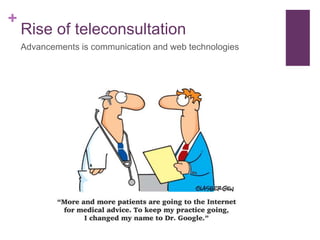
Rise of teleconsultation
Advancements is communication and web technologies
+
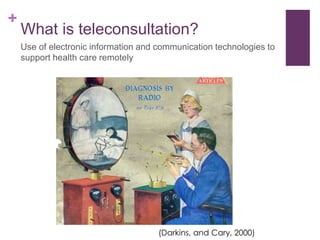
What is teleconsultation?
Use of electronic information and communication technologies to
support health care remotely
(Darkins, and Cary, 2000)
+
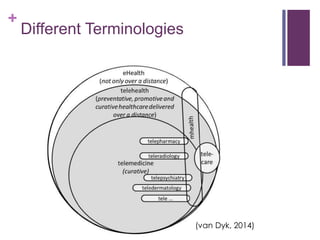
Different Terminologies
(van Dyk, 2014)
+
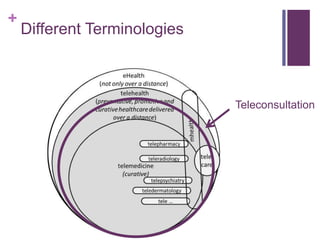
Different Terminologies
Teleconsultation
+
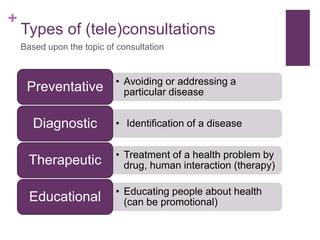
Types of (tele)consultations
• Avoiding or addressing a
particular diseasePreventative
• Identification of a diseaseDiagnostic
• Treatment of a health problem by
drug, human interaction (therapy)Therapeutic
• Educating people about health
(can be promotional)Educational
Based upon the topic of consultation
+
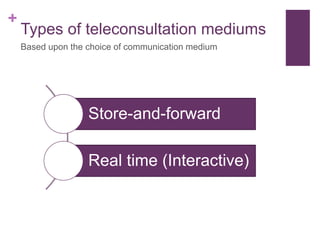
Types of teleconsultation mediums
Store-and-forward
Real time (Interactive)
Based upon the choice of communication medium
+
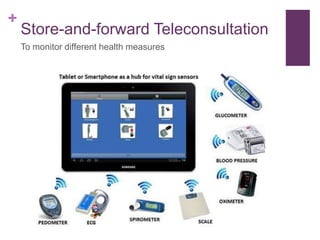
Store-and-forward Teleconsultation
To monitor different health measures
+
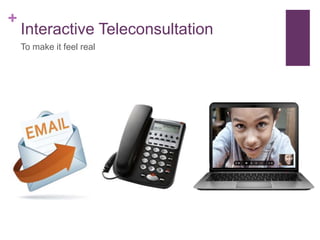
Interactive Teleconsultation
To make it feel real
+
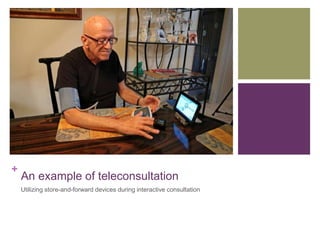
An example of teleconsultation
Utilizing store-and-forward devices during interactive consultation
+
Understanding teleconsultation
through SocialNUI projects
+
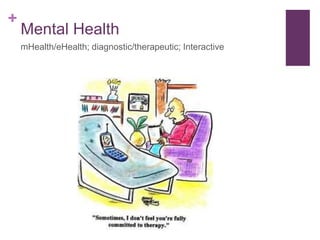
Mental Health
mHealth/eHealth; diagnostic/therapeutic; Interactive
+
Improving Vitamin D status
eHealth/telecare; Preventative; Store-and-forward
+
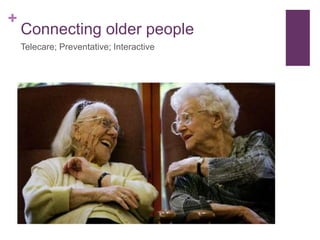
Connecting older people
Telecare; Preventative; Interactive
+
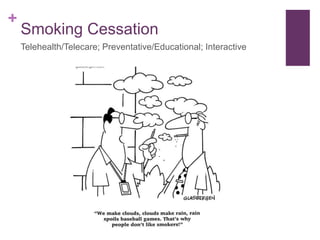
Smoking Cessation
Telehealth/Telecare; Preventative/Educational; Interactive
+
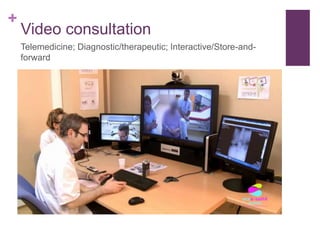
Video consultation
Telemedicine; Diagnostic/therapeutic; Interactive/Store-and-
forward
+
Need to redefine
teleconsultation
Stretching the boundaries of teleconsultation
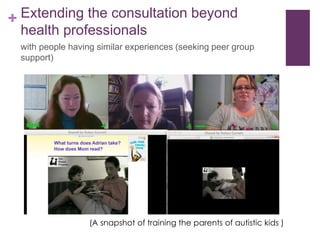
+ Extending the consultation beyond
health professionals
with people having similar experiences (seeking peer group
support)
(A snapshot of training the parents of autistic kids )
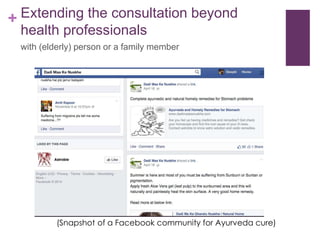
+ Extending the consultation beyond
health professionals
with (elderly) person or a family member
(Snapshot of a Facebook community for Ayurveda cure)
+
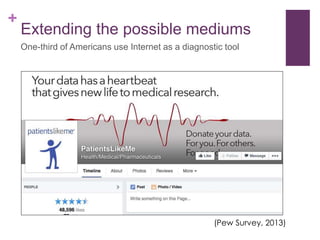
Extending the possible mediums
One-third of Americans use Internet as a diagnostic tool
(Pew Survey, 2013)
+
Research Gaps
+
Scarcity of (landmark) literature
Lack of standardization; less understanding
+
Lack of holistic understanding
Technology and people are separately investigated
+
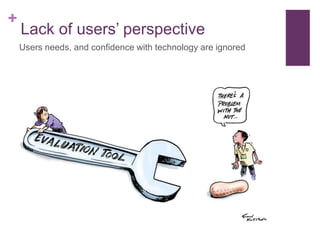
Lack of users’ perspective
Users needs, and confidence with technology are ignored
+
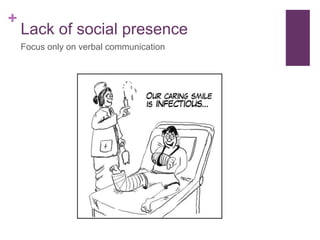
Lack of social presence
Focus only on verbal communication
+
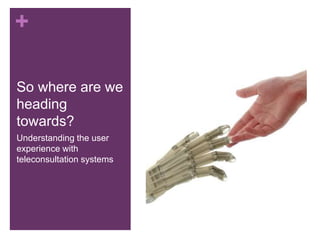
So where are we
heading
towards?
Understanding the user
experience with
teleconsultation systems
+
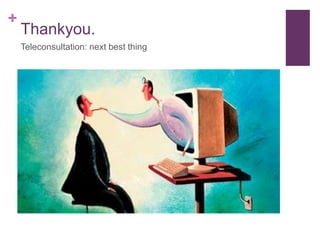
Thankyou.
Teleconsultation: next best thing
+
References
Teleconsultation in Remote communities.
http://teleconsultremote.blogspot.com.au/
Preventive Healthcare. http://en.wikipedia.org/wiki/Preventive_healthcare
Medical Diagnosis. http://en.wikipedia.org/wiki/Medical _diagnosis
Fox, S., and Duggan, M. 2013. Health Online. Pew Internet and American Life Project.
van Dyk, L. 2014. A review of Telehealth Service Implementation Frameworks. In
Environmental Research and Public Health, 11, 1279-1298.
Darkins, W. A., and Cary, A. M. 2000. Telemedicine and Telehealth: Priniciples, Policies,
Performance and Pitfalls. Springer.
Yellowlees, P. 2005. Successfully developing a telemedicine system. In J. Telemed. Telecare,
11, 331-336.

A broad overview of Tele-consultation through SocialNUI lens

Editor's Notes

  • #4 With the recent advancements in communication and web technologies, traditional healthcare is increasingly moving to a digital space. Thus providing opportunities to serve less privildged people who otherwise do not have an easy local access to such services. Teleconsultation is one such promising field of research that has been popular from last two decades.
  • #5 Teleconsultation is the Use of electronic information and communication technologies to provide and support health care when distance separates the participants. However, it is not a new concept. It originated in around 1975 and took up different forms depending upon the needs. In ancient time, it was used mainly to support military regions, or regions that suffered witj natural calamities. The medium that time was radio based communication. But the real interest in using teleconsultation arose in late 1980s. Since its origin, the medium of communication has changed, and teleconsultation has been tested to support different health domains like oncology, dermatology, psychiatry etc.
  • #6 Although teleconsultation is around from last three decades, there is a scarcity of literature that could provide standard definition to different terminologies relevant to teleconsultation. It is difficult to find out how different terms are similar or dissimilar from each other. Van Dyk proposed a model that differentiates terms used inter exchangeably to communicate the same meaning.
  • #8 Based upon the topic of consultation
  • #9 Based upon the choice of communication medium
  • #11 So far, three mediums of communication are explored for the teleconsultation, which are text via email, audio via a telephone call and visual via video call. There have been various studies to find out which medium provides a near best experience to the traditional face to face consultation and visual medium has been found to provide the best experience so far because of its ability to make eye contact. However, if we talk about the recent advancements in the communication medium, then its mainly the shift from using desktop computers to tablets or other mobile dedicated devices for making a skype call
  • #12 And often it happens that both the mediums are used together to support teleconsultation. For example, an elderly person here is checking his pulse rate when asked by the nurse on the video call.
  • #20 therapeutic
  • #23 Technology restricted (same technology for different diseases) -not investigated from user centered design
  • #25 By reviewing the lit survey, I found two research opportunities. Although teleconsultation is around from about two decades but so far the research focus has been on determining the technical feasibility for different clinical outcomes y implementing almost the same setup. There is little focus on understanding how the involved users experience its implementation, and how technology can be improved to increase the system usability. Not all the users are familiar with technology. To maintain and implement the setup for a teleconsultation, they have to rely on a technical supporter. However, the studies have shown that the presence of third person makes the patient to speak less and thus effecting the flow of information to the clinician. Therefore, there is a need to design such technology which takes an account of user’s capability, especially when he is sick. Therefore, I am bringing an HCI perspective to teleconsultation that focuses on the user experience of patients and doctors during the consultation.
  • #26 By reviewing the lit survey, I found two research opportunities. Although teleconsultation is around from about two decades but so far the research focus has been on determining the technical feasibility for different clinical outcomes y implementing almost the same setup. There is little focus on understanding how the involved users experience its implementation, and how technology can be improved to increase the system usability. Not all the users are familiar with technology. To maintain and implement the setup for a teleconsultation, they have to rely on a technical supporter. However, the studies have shown that the presence of third person makes the patient to speak less and thus effecting the flow of information to the clinician. Therefore, there is a need to design such technology which takes an account of user’s capability, especially when he is sick. Therefore, I am bringing an HCI perspective to teleconsultation that focuses on the user experience of patients and doctors during the consultation.
  • #27 When conversation happens spontaneously without any interventions. Such a conversation includes both verbal and non-verbal cues. Such conversation has other implicit factors such as people take turns depending upon when one is completing. This type of turn taking is not defined yet. The focus has mainly been on the verbal communication. However, in teleconsultation, most of the time people face technical issues, where Teleconsultation today do not support the physical interactions that happen b/w the doctor and patient during a consultation session. Doctors who are known for their magical touch and their ability to sense the patients issues, current technology further puts a limitation here. For example, if a patient is having a wound in his right ankle, he can touch his ankle to give the context of pain when having a face to face consultation. However, this physical touch is not possible through teleconsultation. The patient now needs to convey the location of his wound verbally. Even if the patient takes photographs, the contextual information about the wound is not conveyed to the clinician. For conditions like pains, which is not even visible and can not be captured through technology like cameras, verbal communication becomes more difficult. And it has been found that for a good diagonisis, clinician should get the complete understanding of the health issue, which is possible only if the users are given the right technology. Given that teleconsultation is all about communication, however, not much exploration has been done in the direction of developing new ways of communication medium. Therefore, I am bringing an HCI perspective to teleconsultation that focuses on developing technology while accounting user experience and preferences. for my research, I am interested in exploring tangible interfaces to support physical interactions during teleconsultation sessions.
  • #29 With this I would like to end by saying that Although technology can not really substitute the face to face consultation, but if it is developed properly, it can serve the next best possible way of consultation.