What are waves?
•A wave transmits information or energy from one point to another in the form
of signals but no material object makes this journey. The frequency of a wave is
obtained by including a factor of time in the mix. We are completely dependent
on waves for all of our wireless communications.
• For example, you make a call to your friend in another city with your mobile
phone, the entire communication is happening via audio but the entire process
of transmission of a signal from the talker to the receiver occurs as a waveform.
The phone converts your voice into an electrical signal with then propagates
either through copper wires or through antennae in wireless communication.
3.
What are ElectromagneticWave?
• Definition
Electromagnetic waves or EM waves
are waves that are created as a result of
vibrations between an electric field and
a magnetic field. In other words, EM
waves are composed of oscillating
magnetic and electric fields.
• Description
Electromagnetic waves are formed
when an electric field comes in contact
with a magnetic field. They are hence
known as ‘electromagnetic’ waves. The
electric field and magnetic field of an
electromagnetic wave are
perpendicular (at right angles) to each
other. They are also perpendicular to
the direction of the EM wave.
4.
Who discover Electromagneticwaves?
• He received a Ph.D. magna cum laude from
the University of Berlin in 1880, where he
studied under Hermann von Helmholtz. In
1883 he began his studies of Maxwell’s
electromagnetic theory. Between 1885 and
1889, while he was professor of physics at
the Karlsruhe Polytechnic, he produced
electromagnetic waves in the laboratory
and measured their length and velocity. He
showed that the nature of their vibration
and their susceptibility to reflection and
refraction were the same as those of light
and heat waves. As a result, he established
beyond any doubt that light and heat are
electromagnetic radiations.
Heinrich Hertz
5.
• The electromagneticwaves were called Hertzian and, later, radio waves. (He was
not the first to produce such waves. Anglo-American inventor David Hughes had
done so in work that was almost universally ignored in 1879, but Hertz was the
first to correctly understand their electromagnetic nature.) In 1889 Hertz was
appointed professor of physics at the University of Bonn, where he continued
his research on the discharge of electricity in rarefied gases.
• His scientific papers were translated into English and published in three
volumes: Electric Waves (1893), Miscellaneous Papers (1896), and Principles of
Mechanics (1899).
6.
How do electromagneticwaves travel?
• Electromagnetic waves are created by the vibration of an electric charge. This
vibration creates a wave which has both an electric and a magnetic component.
An electromagnetic wave transports its energy through a vacuum at a speed of
3.00 x 10⁸ m/s (a speed value commonly represented by the symbol c). The
propagation of an electromagnetic wave through a material medium occurs at a
net speed which is less than 3.00 x 10⁸ m/s.
7.
• The mechanismof energy transport through a medium involves the absorption and
reemission of the wave energy by the atoms of the material. When an electromagnetic
wave impinges upon the atoms of a material, the energy of that wave is absorbed. The
absorption of energy causes the electrons within the atoms to undergo vibrations. After a
short period of vibrational motion, the vibrating electrons create a new electromagnetic
wave with the same frequency as the first electromagnetic wave. While these vibrations
occur for only a very short time, they delay the motion of the wave through the medium.
Once the energy of the electromagnetic wave is reemitted by an atom, it travels through
a small region of space between atoms. Once it reaches the next atom, the
electromagnetic wave is absorbed, transformed into electron vibrations and then
reemitted as an electromagnetic wave. While the electromagnetic wave will travel at a
speed of c (3 x 10⁸ m/s) through the vacuum of interatomic space, the absorption and
reemission process causes the net speed of the electromagnetic wave to be less than c.
8.
• The actualspeed of an electromagnetic wave through a material medium is dependent
upon the optical density of that medium. Different materials cause a different amount of
delay due to the absorption and reemission process. Furthermore, different materials
have their atoms more closely packed and thus the amount of distance between atoms is
less. These two factors are dependent upon the nature of the material through which the
electromagnetic wave is traveling. As a result, the speed of an electromagnetic wave is
dependent upon the material through which it is traveling.
9.
What are the7 types of electromagnetic waves?
The electromagnetic (EM) spectrum encompasses all wave frequencies, including radio,
visible light and X-rays. All EM waves are made up of photons that travel through space
until they interact with matter; some waves are absorbed and others are reflected.
Though the sciences generally classify EM waves into seven basic types, all are
manifestations of the same phenomenon.
10.
1.Radio Waves: InstantCommunication
• Radio waves are the lowest-frequency
waves in the EM spectrum. Radio waves
can be used to carry other signals to
receivers that subsequently translate these
signals into usable information. Many
objects, both natural and man-made, emit
radio waves. Anything that emits heat
emits radiation across the entire spectrum,
but in different amounts. Stars, planets and
other cosmic bodies emit radio waves.
Radio and television stations and cellphone
companies all produce radio waves that
carry signals to be received by the
antennae in your television, radio or
cellphone.
11.
2.Microwaves: Data andHeat
• Microwaves are the second-lowest
frequency waves in the EM spectrum.
Whereas radio waves can be up to miles
in length, microwaves measure from a
few centimeters up to a foot. Due to their
higher frequency, microwaves can
penetrate obstacles that interfere with
radio waves such as clouds, smoke and
rain. Microwaves carry radar, landline
phone calls and computer data
transmissions as well as cook your dinner.
Microwave remnants of the "Big Bang"
radiate from all directions throughout the
universe.
12.
3. Infrared Waves:Invisible Heat
• Infrared waves are in the lower-
middle range of frequencies in the
EM spectrum, between microwaves
and visible light. The size of infrared
waves ranges from a few
millimeters down to microscopic
lengths. The longer-wavelength
infrared waves produce heat and
include radiation emitted by fire,
the sun and other heat-producing
objects; shorter-wavelength
infrared rays do not produce much
heat and are used in remote
controls and imaging technologies.
13.
4. Visible LightRays
• Visible light waves let you see the
world around you. The different
frequencies of visible light are
experienced by people as the colors
of the rainbow. The frequencies
move from the lower wavelengths,
detected as reds, up to the higher
visible wavelengths, detected as
violet hues. The most noticeable
natural source of visible light is, of
course, the sun. Objects are
perceived as different colors based
on which wavelengths of light an
object absorbs and which it reflects.
14.
5. Ultraviolet Waves:Energetic Light
• Ultraviolet waves have even
shorter wavelengths than visible
light. UV waves are the cause of
sunburn and can cause cancer in
living organisms. High-
temperature processes emit UV
rays; these can be detected
throughout the universe from
every star in the sky. Detecting
UV waves assists astronomers,
for example, in learning about
the structure of galaxies.
15.
6. X-rays: PenetratingRadiation
• X-rays are extremely high-energy waves
with wavelengths between 0.03 and 3
nanometers -- not much longer than an
atom. X-rays are emitted by sources
producing very high temperatures like
the sun's corona, which is much hotter
than the surface of the sun. Natural
sources of x-rays include enormously
energetic cosmic phenomena such as
pulsars, supernovae and black holes. X-
rays are commonly used in imaging
technology to view bone structures
within the body.
16.
7. Gamma Rays:Nuclear Energy Gamma rays
• Gamma waves are the highest-frequency
EM waves, and are emitted by only the
most energetic cosmic objects such pulsars,
neutron stars, supernova and black holes.
Terrestrial sources include lightning, nuclear
explosions and radioactive decay. Gamma
wave wavelengths are measured on the
subatomic level and can actually pass
through the empty space within an atom.
Gamma rays can destroy living cells;
fortunately, the Earth's atmosphere absorbs
any gamma rays that reach the planet.
17.
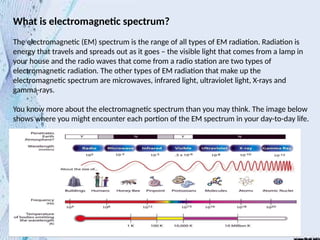
What is electromagneticspectrum?
The electromagnetic (EM) spectrum is the range of all types of EM radiation. Radiation is
energy that travels and spreads out as it goes – the visible light that comes from a lamp in
your house and the radio waves that come from a radio station are two types of
electromagnetic radiation. The other types of EM radiation that make up the
electromagnetic spectrum are microwaves, infrared light, ultraviolet light, X-rays and
gamma-rays.
You know more about the electromagnetic spectrum than you may think. The image below
shows where you might encounter each portion of the EM spectrum in your day-to-day life.
18.
Radio: Your radiocaptures radio waves emitted by radio stations, bringing your favorite
tunes. Radio waves are also emitted by stars and gases in space.
Microwave: Microwave radiation will cook your popcorn in just a few minutes, but is
also used by astronomers to learn about the structure of nearby galaxies.
Infrared: Night vision goggles pick up the infrared light emitted by our skin and objects
with heat. In space, infrared light helps us map the dust between stars.
Visible: Our eyes detect visible light. Fireflies, light bulbs, and stars all emit visible light.
Ultraviolet: Ultraviolet radiation is emitted by the Sun and are the reason skin tans and
burns. "Hot" objects in space emit UV radiation as well.
X-ray: A dentist uses X-rays to image your teeth, and airport security uses them to see
through your bag. Hot gases in the Universe also emit X-rays.
Gamma ray: Doctors use gamma-ray imaging to see inside your body. The biggest
gamma-ray generator of all is the Universe.
19.
Wave Behavior
• Wavesdisplay several basic phenomena. In reflection, a wave encounters an
obstacle and is reflected back. In refraction, a wave bends when it enters a medium
through which it has a different speed. In diffraction, waves bend when they pass
around small obstacles and spread out when they pass through small openings. In
interference, when two waves meet, they can interfere constructively, creating a
wave with larger amplitude than the original waves, or destructively, creating a
wave with a smaller (or even zero) amplitude.
20.
1. Reflection
• Whenwaves hit a boundary and are reflected, the
angle of incidence equals the angle of reflection. The
angle of incidence is the angle between the direction
of motion of the wave and a line drawn
perpendicular to the reflecting boundary.
21.
2. Refraction
• Thespeed of a wave depends on the properties of the medium through which it
travels. For example, sound travels much faster through water than through air.
When a wave enters at an angle a medium through which its speed would be
slower, the wave is bent toward the perpendicular. When a wave enters at an angle
a medium in which its speed would be increased, the opposite effect happens. With
light, this change can be expressed by using Snell’s law of refraction.
22.
3. Diffraction
• Whena wave encounters a small obstacle or a small
opening (that is, small compared with the
wavelength of the wave), the wave can bend around
the obstacle or pass through the opening and then
spread out. This bending or spreading out is called
diffraction.
23.
4. Interference
• Thewaves from two or more centres of disturbance may reinforce each other in
some directions and cancel in others. This phenomenon is called the
interference of waves.
24.
Examples of interference
•When two waves of identical wavelength are in phase, they form a new wave
with an amplitude equal to the sum of their individual amplitudes (constructive
interference). When two waves are of completely opposite phase, they either
form a new wave of reduced amplitude (partial destructive interference) or
cancel each other out (complete destructive interference). Much more
complicated constructive and destructive interference patterns emerge when
waves with different wavelengths interact.
25.
5. Doppler Effect
•When the source of a wave moves relative to an observer, the observer notices
a change in the frequency of the wave. This change is called the Doppler effect,
after its discoverer, Austrian physicist Christian Doppler.
26.
6. Standing Waves
•If a wave is confined to a closed space, it undergoes both reflection and
interference. For example, consider a tube of length l. A disturbance anywhere
in the air in the tube will be reflected from both ends and produce in general a
series of waves traveling in both directions along the tube. From the geometry
of the situation and the finite constant value of acoustic velocity, these must be
periodic waves with frequencies fixed by the boundary conditions at the end of
the tube.
Electromagnetic waves areused to transmit long/short/FM wavelength radio
waves, and TV/telephone/wireless signals or energies. They are also responsible
for energy in the form of microwaves, infrared radiation (IR), visible light (VIS),
ultraviolet light (UV), X-rays, and transmitting gamma rays. Each region of this
spectrum plays an important part in our lives, and in the business involving
communication technology. The list given above is in increasing frequency (or
decreasing wavelength) order. Here again is the list of regions and the approximate
wavelengths in them. For simplicity, we choose to give only the magnitudes of
frequencies. That is we give log (frequency) (log(f)).




![QUARTER 2 MODULE 1 LESSON [Autosaved].pptx](https://cdn.slidesharecdn.com/ss_thumbnails/quarter2module1lessonautosaved-250617110230-9b4f88eb-thumbnail.jpg?width=640&height=640&fit=bounds)


