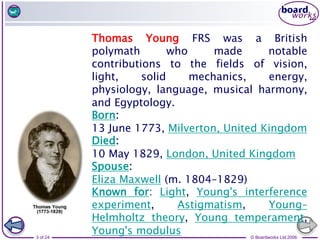
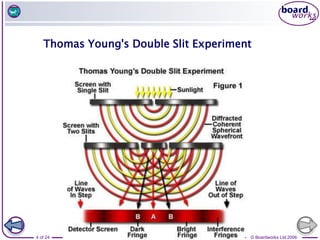
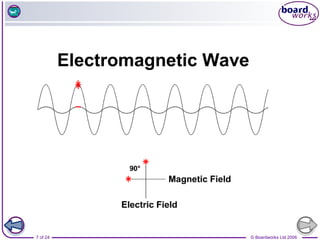
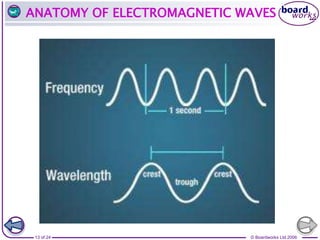
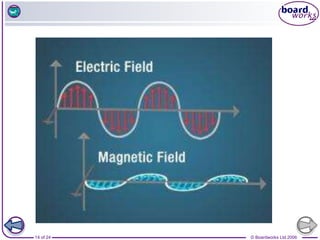
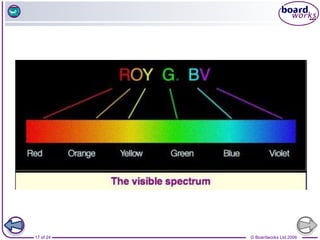
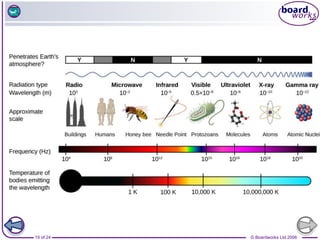
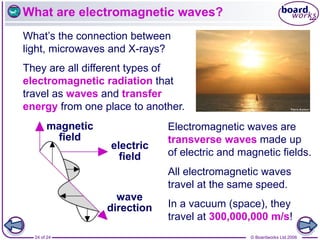
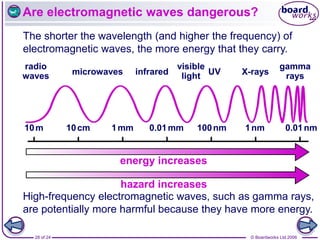
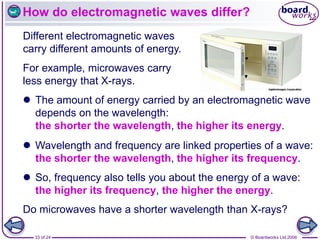
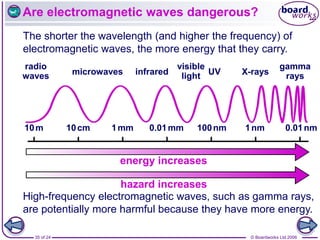
Thomas Young was a British polymath who performed an experiment in 1801 that provided strong evidence for the wave-like nature of light. The experiment involved passing light through two slits and observing an interference pattern, demonstrating that light behaves as waves that can interfere with each other under certain conditions. The electromagnetic spectrum consists of all types of electromagnetic radiation, including visible light as well as waves like radio waves, microwaves, infrared radiation, ultraviolet light, X-rays, and gamma rays, which differ in their wavelength and frequency.




![Conservation of Mech Energy [Autosaved].ppt](https://cdn.slidesharecdn.com/ss_thumbnails/conservationofmechenergyautosaved-251110121538-36a25d24-thumbnail.jpg?width=640&height=640&fit=bounds)


