© Boardworks Ltd 2006
1 of 24
© Boardworks Ltd 2006
2 of 24
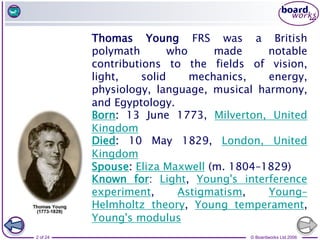
Thomas Young FRS was a British
polymath who made notable
contributions to the fields of vision,
light, solid mechanics, energy,
physiology, language, musical harmony,
and Egyptology.
Born: 13 June 1773, Milverton, United
Kingdom
Died: 10 May 1829, London, United
Kingdom
Spouse: Eliza Maxwell (m. 1804–1829)
Known for: Light, Young's interference
experiment, Astigmatism, Young–
Helmholtz theory, Young temperament,
Young's modulus
© Boardworks Ltd 2006
3 of 24
Thomas Young's Double Slit Experiment
© Boardworks Ltd 2006
4 of 24
• In 1801, an English physicist named
Thomas Young performed an experiment
that strongly inferred the wave-like nature
of light. Because he believed that light was
composed of waves, Young reasoned that
some type of interaction would occur when
two light waves met. This interactive
tutorial explores how coherent light waves
interact when passed through two closely
spaced slits.
© Boardworks Ltd 2006
5 of 24
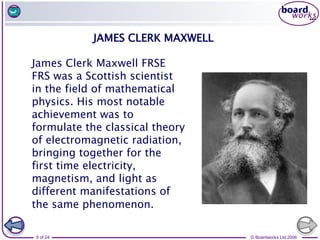
JAMES CLERK MAXWELL
James Clerk Maxwell FRSE
FRS was a Scottish scientist
in the field of mathematical
physics. His most notable
achievement was to
formulate the classical theory
of electromagnetic radiation,
bringing together for the
first time electricity,
magnetism, and light as
different manifestations of
the same phenomenon.
© Boardworks Ltd 2006
6 of 24
© Boardworks Ltd 2006
7 of 24
Electricity can be static, like what
holds a balloon to the wall or
makes your hair stand on end.
Magnetism can also be static like
a refrigerator magnet. But when
they change or move together,
they make waves -
electromagnetic waves
What are electromagnetic waves?
© Boardworks Ltd 2006
8 of 24
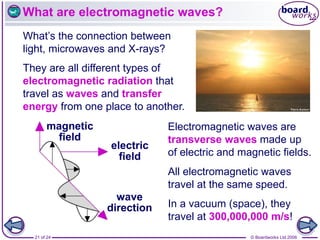
• Electromagnetic waves are formed when
an electric field (which is shown in blue
arrows) couples with a magnetic field
(which is shown in red arrows). Magnetic
and electric fields of an electromagnetic
wave are perpendicular to each other and
to the direction of the wave. James Clerk
Maxwell and Heinrich Hertz are two
scientists who studied how
electromagnetic waves are formed and
how fast they travel.
© Boardworks Ltd 2006
9 of 24
• Electromagnetic waves are created by
oscillating charges (which radiate
whenever accelerated) and have the same
frequency as the oscillation. Since the
electric and magnetic fields in most
electromagnetic waves are
perpendicular to the direction in which the
wave moves, it is ordinarily a transverse
wave.
© Boardworks Ltd 2006
10 of 24
© Boardworks Ltd 2006
11 of 24
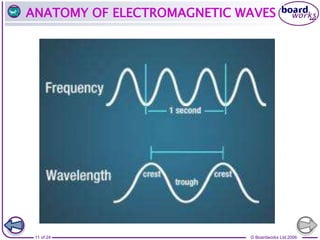
ANATOMY OF ELECTROMAGNETIC WAVES
© Boardworks Ltd 2006
12 of 24
© Boardworks Ltd 2006
13 of 24
ELECTROMAGNETIC SPECTRUM
• Light is a wave of alternating electric and magnetic
fields. The propagation of light isn’t much different than
waves crossing an ocean. Like any other wave, light has
a few fundamental properties that describe it. One is its
frequency, measured in hertz (Hz), which counts the
number of waves that pass by a point in one second.
Another closely related property is wavelength: the
distance from the peak of one wave to the peak of the
next. These two attributes are inversely related. The
larger the frequency, the smaller the wavelength – and
vice versa.
© Boardworks Ltd 2006
14 of 24
© Boardworks Ltd 2006
15 of 24
• The electromagnetic waves your eyes detect – visible
light – oscillate between 400 and 790 terahertz (THz).
That’s several hundred trillion times a second. The
wavelengths are roughly the size of a large virus: 390 –
750 nanometers (1 nanometer = 1 billionth of a meter; a
meter is about 39 inches long). Our brain interprets the
various wavelengths of light as different colors. Red has
the longest wavelength, and violet the shortest. When
we pass sunlight through a prism, we see that it’s
actually composed of many wavelengths of light. The
prism creates a rainbow by redirecting each wavelength
out at a slightly different angle.
© Boardworks Ltd 2006
16 of 24
© Boardworks Ltd 2006
17 of 24
• The electromagnetic (EM) spectrum is the
range of all types of EM radiation.
Radiation is the energy that travels and
spreads out as it goes – the visible light
that comes from a lamp in your house and
the radio waves that come from a radio
station are two types of electromagnetic
radiation. The other types of EM radiation
that make up the electromagnetic
spectrum are microwaves, infrared light,
ultraviolet light, X-rays and gamma-rays.
© Boardworks Ltd 2006
18 of 24
• https://forms.gle/msErLMU6PH22NvNa7
© Boardworks Ltd 2006
19 of 24
© Boardworks Ltd 2006
20 of 24
© Boardworks Ltd 2006
21 of 24
What are electromagnetic waves?
What’s the connection between
light, microwaves and X-rays?
Electromagnetic waves are
transverse waves made up
of electric and magnetic fields.
magnetic
field
electric
field
wave
direction
They are all different types of
electromagnetic radiation that
travel as waves and transfer
energy from one place to another.
All electromagnetic waves
travel at the same speed.
In a vacuum (space), they
travel at 300,000,000 m/s!
© Boardworks Ltd 2006
22 of 24
What happens when waves hit a surface?
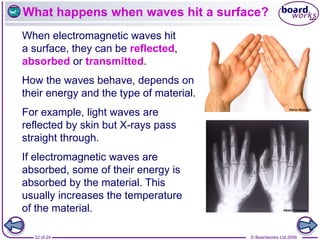
When electromagnetic waves hit
a surface, they can be reflected,
absorbed or transmitted.
How the waves behave, depends on
their energy and the type of material.
For example, light waves are
reflected by skin but X-rays pass
straight through.
If electromagnetic waves are
absorbed, some of their energy is
absorbed by the material. This
usually increases the temperature
of the material.
© Boardworks Ltd 2006
23 of 24
What happens when waves are reflected?
Some surfaces can reflect
electromagnetic waves. Shiny
surfaces are good reflectors
of light waves.
A mirror reflects most of
the light waves that hit it.
When waves are reflected,
some of their energy may also
be absorbed by the material.
The curved satellite dish
reflects microwaves from
a satellite to the receiver.
How does reflection allow
us to see?
© Boardworks Ltd 2006
24 of 24
© Boardworks Ltd 2006
25 of 24
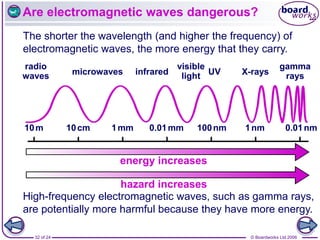
Are electromagnetic waves dangerous?
The shorter the wavelength (and higher the frequency) of
electromagnetic waves, the more energy that they carry.
gamma
rays
X-rays
UV
visible
light
infrared
microwaves
radio
waves
energy increases
hazard increases
High-frequency electromagnetic waves, such as gamma rays,
are potentially more harmful because they have more energy.
0.01nm
100nm 1nm
0.01mm
1mm
10cm
10m
© Boardworks Ltd 2006
26 of 24
Wavelength of electromagnetic waves
© Boardworks Ltd 2006
27 of 24
© Boardworks Ltd 2006
28 of 24
© Boardworks Ltd 2006
29 of 24
© Boardworks Ltd 2006
30 of 24
How do electromagnetic waves differ?
Different electromagnetic waves
carry different amounts of energy.
 The amount of energy carried by an electromagnetic wave
depends on the wavelength:
the shorter the wavelength, the higher its energy.
Do microwaves have a shorter wavelength than X-rays?
For example, microwaves carry
less energy that X-rays.
 Wavelength and frequency are linked properties of a wave:
the shorter the wavelength, the higher its frequency.
 So, frequency also tells you about the energy of a wave:
the higher its frequency, the higher the energy.
© Boardworks Ltd 2006
31 of 24
The electromagnetic spectrum
© Boardworks Ltd 2006
32 of 24
Are electromagnetic waves dangerous?
The shorter the wavelength (and higher the frequency) of
electromagnetic waves, the more energy that they carry.
gamma
rays
X-rays
UV
visible
light
infrared
microwaves
radio
waves
energy increases
hazard increases
High-frequency electromagnetic waves, such as gamma rays,
are potentially more harmful because they have more energy.
0.01nm
100nm 1nm
0.01mm
1mm
10cm
10m
© Boardworks Ltd 2006
33 of 24
The electromagnetic spectrum
How many different electromagnetic waves can you spot?
© Boardworks Ltd 2006
34 of 24
Effect of electromagnetic waves
© Boardworks Ltd 2006
35 of 24
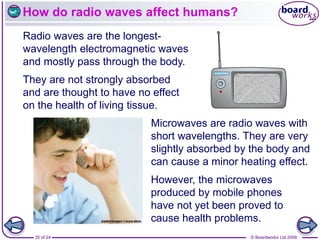
How do radio waves affect humans?
Radio waves are the longest-
wavelength electromagnetic waves
and mostly pass through the body.
Microwaves are radio waves with
short wavelengths. They are very
slightly absorbed by the body and
can cause a minor heating effect.
They are not strongly absorbed
and are thought to have no effect
on the health of living tissue.
However, the microwaves
produced by mobile phones
have not yet been proved to
cause health problems.
© Boardworks Ltd 2006
36 of 24
How do infrared waves affect humans?
Infrared waves are absorbed
by skin to a limited depth. They
transfer their energy to the skin
tissue warming it up.
Infrared waves from this grill
heat the surface of the meat.
If the meat absorbs too much
energy, it will become burnt.
it will become burnt.
If skin is exposed to too many
high-energy infrared waves,
This heating effect is detected
by temperature-sensitive nerve
endings in the skin.
© Boardworks Ltd 2006
37 of 24
How does visible light affect humans?
Your eyes detect visible light, which does
not normally pose any health risk.
Lasers are very intense sources of
visible light. The lasers used in light
shows are not powerful enough to
cause harm but must be used safely.
However, very bright light can damage
your eyes and may even make you blind.
This is why you should not look at the
Sun through a telescope or binoculars.
Some very powerful lasers can cut
through materials such as metal.
These would also be able to burn
through living tissue.
© Boardworks Ltd 2006
38 of 24
How do ionizing waves affect humans?
Ionizing waves have enough energy to ionize the atoms in
materials. These waves can have a severe effect on living
tissue by killing cells or damaging DNA.
 Ultraviolet rays are absorbed by the
body. Skin tissues can be ionized and
damaged by the shortest-wavelength
ultraviolet radiation causing skin cancer.
 X-rays pass through soft body tissue,
such as skin and muscle, without being
absorbed. Denser tissue, such as bone,
absorb some X-rays and can be ionized.
 Gamma rays pass through the body
but very high energy waves can ionize
atoms in living tissue.
© Boardworks Ltd 2006
39 of 24
How to protect yourself from EM radiations

EM waves.ppt

  • 1.
    © Boardworks Ltd2006 1 of 24
  • 2.
    © Boardworks Ltd2006 2 of 24 Thomas Young FRS was a British polymath who made notable contributions to the fields of vision, light, solid mechanics, energy, physiology, language, musical harmony, and Egyptology. Born: 13 June 1773, Milverton, United Kingdom Died: 10 May 1829, London, United Kingdom Spouse: Eliza Maxwell (m. 1804–1829) Known for: Light, Young's interference experiment, Astigmatism, Young– Helmholtz theory, Young temperament, Young's modulus
  • 3.
    © Boardworks Ltd2006 3 of 24 Thomas Young's Double Slit Experiment
  • 4.
    © Boardworks Ltd2006 4 of 24 • In 1801, an English physicist named Thomas Young performed an experiment that strongly inferred the wave-like nature of light. Because he believed that light was composed of waves, Young reasoned that some type of interaction would occur when two light waves met. This interactive tutorial explores how coherent light waves interact when passed through two closely spaced slits.
  • 5.
    © Boardworks Ltd2006 5 of 24 JAMES CLERK MAXWELL James Clerk Maxwell FRSE FRS was a Scottish scientist in the field of mathematical physics. His most notable achievement was to formulate the classical theory of electromagnetic radiation, bringing together for the first time electricity, magnetism, and light as different manifestations of the same phenomenon.
  • 6.
    © Boardworks Ltd2006 6 of 24
  • 7.
    © Boardworks Ltd2006 7 of 24 Electricity can be static, like what holds a balloon to the wall or makes your hair stand on end. Magnetism can also be static like a refrigerator magnet. But when they change or move together, they make waves - electromagnetic waves What are electromagnetic waves?
  • 8.
    © Boardworks Ltd2006 8 of 24 • Electromagnetic waves are formed when an electric field (which is shown in blue arrows) couples with a magnetic field (which is shown in red arrows). Magnetic and electric fields of an electromagnetic wave are perpendicular to each other and to the direction of the wave. James Clerk Maxwell and Heinrich Hertz are two scientists who studied how electromagnetic waves are formed and how fast they travel.
  • 9.
    © Boardworks Ltd2006 9 of 24 • Electromagnetic waves are created by oscillating charges (which radiate whenever accelerated) and have the same frequency as the oscillation. Since the electric and magnetic fields in most electromagnetic waves are perpendicular to the direction in which the wave moves, it is ordinarily a transverse wave.
  • 10.
    © Boardworks Ltd2006 10 of 24
  • 11.
    © Boardworks Ltd2006 11 of 24 ANATOMY OF ELECTROMAGNETIC WAVES
  • 12.
    © Boardworks Ltd2006 12 of 24
  • 13.
    © Boardworks Ltd2006 13 of 24 ELECTROMAGNETIC SPECTRUM • Light is a wave of alternating electric and magnetic fields. The propagation of light isn’t much different than waves crossing an ocean. Like any other wave, light has a few fundamental properties that describe it. One is its frequency, measured in hertz (Hz), which counts the number of waves that pass by a point in one second. Another closely related property is wavelength: the distance from the peak of one wave to the peak of the next. These two attributes are inversely related. The larger the frequency, the smaller the wavelength – and vice versa.
  • 14.
    © Boardworks Ltd2006 14 of 24
  • 15.
    © Boardworks Ltd2006 15 of 24 • The electromagnetic waves your eyes detect – visible light – oscillate between 400 and 790 terahertz (THz). That’s several hundred trillion times a second. The wavelengths are roughly the size of a large virus: 390 – 750 nanometers (1 nanometer = 1 billionth of a meter; a meter is about 39 inches long). Our brain interprets the various wavelengths of light as different colors. Red has the longest wavelength, and violet the shortest. When we pass sunlight through a prism, we see that it’s actually composed of many wavelengths of light. The prism creates a rainbow by redirecting each wavelength out at a slightly different angle.
  • 16.
    © Boardworks Ltd2006 16 of 24
  • 17.
    © Boardworks Ltd2006 17 of 24 • The electromagnetic (EM) spectrum is the range of all types of EM radiation. Radiation is the energy that travels and spreads out as it goes – the visible light that comes from a lamp in your house and the radio waves that come from a radio station are two types of electromagnetic radiation. The other types of EM radiation that make up the electromagnetic spectrum are microwaves, infrared light, ultraviolet light, X-rays and gamma-rays.
  • 18.
    © Boardworks Ltd2006 18 of 24 • https://forms.gle/msErLMU6PH22NvNa7
  • 19.
    © Boardworks Ltd2006 19 of 24
  • 20.
    © Boardworks Ltd2006 20 of 24
  • 21.
    © Boardworks Ltd2006 21 of 24 What are electromagnetic waves? What’s the connection between light, microwaves and X-rays? Electromagnetic waves are transverse waves made up of electric and magnetic fields. magnetic field electric field wave direction They are all different types of electromagnetic radiation that travel as waves and transfer energy from one place to another. All electromagnetic waves travel at the same speed. In a vacuum (space), they travel at 300,000,000 m/s!
  • 22.
    © Boardworks Ltd2006 22 of 24 What happens when waves hit a surface? When electromagnetic waves hit a surface, they can be reflected, absorbed or transmitted. How the waves behave, depends on their energy and the type of material. For example, light waves are reflected by skin but X-rays pass straight through. If electromagnetic waves are absorbed, some of their energy is absorbed by the material. This usually increases the temperature of the material.
  • 23.
    © Boardworks Ltd2006 23 of 24 What happens when waves are reflected? Some surfaces can reflect electromagnetic waves. Shiny surfaces are good reflectors of light waves. A mirror reflects most of the light waves that hit it. When waves are reflected, some of their energy may also be absorbed by the material. The curved satellite dish reflects microwaves from a satellite to the receiver. How does reflection allow us to see?
  • 24.
    © Boardworks Ltd2006 24 of 24
  • 25.
    © Boardworks Ltd2006 25 of 24 Are electromagnetic waves dangerous? The shorter the wavelength (and higher the frequency) of electromagnetic waves, the more energy that they carry. gamma rays X-rays UV visible light infrared microwaves radio waves energy increases hazard increases High-frequency electromagnetic waves, such as gamma rays, are potentially more harmful because they have more energy. 0.01nm 100nm 1nm 0.01mm 1mm 10cm 10m
  • 26.
    © Boardworks Ltd2006 26 of 24 Wavelength of electromagnetic waves
  • 27.
    © Boardworks Ltd2006 27 of 24
  • 28.
    © Boardworks Ltd2006 28 of 24
  • 29.
    © Boardworks Ltd2006 29 of 24
  • 30.
    © Boardworks Ltd2006 30 of 24 How do electromagnetic waves differ? Different electromagnetic waves carry different amounts of energy.  The amount of energy carried by an electromagnetic wave depends on the wavelength: the shorter the wavelength, the higher its energy. Do microwaves have a shorter wavelength than X-rays? For example, microwaves carry less energy that X-rays.  Wavelength and frequency are linked properties of a wave: the shorter the wavelength, the higher its frequency.  So, frequency also tells you about the energy of a wave: the higher its frequency, the higher the energy.
  • 31.
    © Boardworks Ltd2006 31 of 24 The electromagnetic spectrum
  • 32.
    © Boardworks Ltd2006 32 of 24 Are electromagnetic waves dangerous? The shorter the wavelength (and higher the frequency) of electromagnetic waves, the more energy that they carry. gamma rays X-rays UV visible light infrared microwaves radio waves energy increases hazard increases High-frequency electromagnetic waves, such as gamma rays, are potentially more harmful because they have more energy. 0.01nm 100nm 1nm 0.01mm 1mm 10cm 10m
  • 33.
    © Boardworks Ltd2006 33 of 24 The electromagnetic spectrum How many different electromagnetic waves can you spot?
  • 34.
    © Boardworks Ltd2006 34 of 24 Effect of electromagnetic waves
  • 35.
    © Boardworks Ltd2006 35 of 24 How do radio waves affect humans? Radio waves are the longest- wavelength electromagnetic waves and mostly pass through the body. Microwaves are radio waves with short wavelengths. They are very slightly absorbed by the body and can cause a minor heating effect. They are not strongly absorbed and are thought to have no effect on the health of living tissue. However, the microwaves produced by mobile phones have not yet been proved to cause health problems.
  • 36.
    © Boardworks Ltd2006 36 of 24 How do infrared waves affect humans? Infrared waves are absorbed by skin to a limited depth. They transfer their energy to the skin tissue warming it up. Infrared waves from this grill heat the surface of the meat. If the meat absorbs too much energy, it will become burnt. it will become burnt. If skin is exposed to too many high-energy infrared waves, This heating effect is detected by temperature-sensitive nerve endings in the skin.
  • 37.
    © Boardworks Ltd2006 37 of 24 How does visible light affect humans? Your eyes detect visible light, which does not normally pose any health risk. Lasers are very intense sources of visible light. The lasers used in light shows are not powerful enough to cause harm but must be used safely. However, very bright light can damage your eyes and may even make you blind. This is why you should not look at the Sun through a telescope or binoculars. Some very powerful lasers can cut through materials such as metal. These would also be able to burn through living tissue.
  • 38.
    © Boardworks Ltd2006 38 of 24 How do ionizing waves affect humans? Ionizing waves have enough energy to ionize the atoms in materials. These waves can have a severe effect on living tissue by killing cells or damaging DNA.  Ultraviolet rays are absorbed by the body. Skin tissues can be ionized and damaged by the shortest-wavelength ultraviolet radiation causing skin cancer.  X-rays pass through soft body tissue, such as skin and muscle, without being absorbed. Denser tissue, such as bone, absorb some X-rays and can be ionized.  Gamma rays pass through the body but very high energy waves can ionize atoms in living tissue.
  • 39.
    © Boardworks Ltd2006 39 of 24 How to protect yourself from EM radiations

Editor's Notes

  • #21 Boardworks GCSE Science: Physics Electromagnetic Waves
  • #22 Boardworks GCSE Science: Physics Electromagnetic Waves
  • #23 Boardworks GCSE Science: Physics Electromagnetic Waves
  • #24 Boardworks GCSE Science: Physics Electromagnetic Waves
  • #25 Boardworks GCSE Science: Physics Electromagnetic Waves
  • #26 Boardworks GCSE Science: Physics Electromagnetic Waves
  • #27 Boardworks GCSE Science: Physics Electromagnetic Waves
  • #28 Boardworks GCSE Science: Physics Electromagnetic Waves
  • #30 Boardworks GCSE Science: Physics Electromagnetic Waves
  • #31 Boardworks GCSE Science: Physics Electromagnetic Waves
  • #32 Boardworks GCSE Science: Physics Electromagnetic Waves
  • #33 Boardworks GCSE Science: Physics Electromagnetic Waves
  • #34 Boardworks GCSE Science: Physics Electromagnetic Waves
  • #35 Boardworks GCSE Science: Physics Electromagnetic Waves
  • #36 Boardworks GCSE Science: Physics Electromagnetic Waves
  • #37 Boardworks GCSE Science: Physics Electromagnetic Waves
  • #38 Boardworks GCSE Science: Physics Electromagnetic Waves
  • #39 Boardworks GCSE Science: Physics Electromagnetic Waves