QUANTUM COMPUTERS
SUBMITTED BY
Mr. Nolesh Premraj Warke.
The subject of quantum computing brings together ideas from
classical information theory, computer science, and quantum
physics.
Quantum Computing merges two great scientific revolutions of the
20th century: Computer science and Quantum physics.
Quantum devices rely on the ability to control and manipulate
binary data.
Quantum computing is the design of hardware and software that
replaces Boolean logic by quantum law at the algorithmic level.
What is Quantum computer ?
A quantum computer is a machine that performs calculations
based on the laws of quantum mechanics, which is the behavior
of particles at the sub-atomic level.
A Quantum is a smallest possible discrete unit of any physical
property Quantum Computing.
Computation depends on principle of quantum theory.
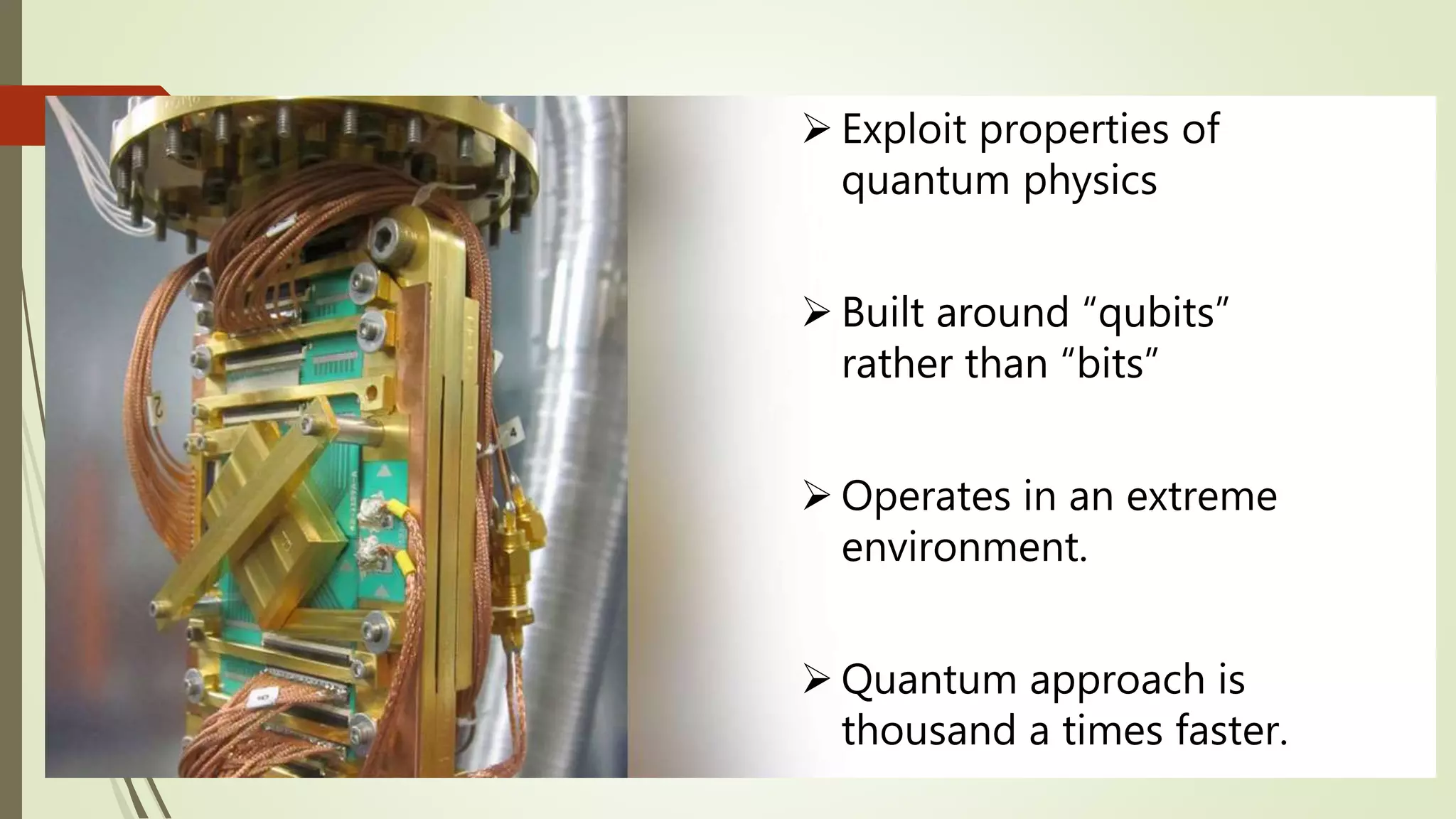
 Exploit properties of
quantum physics
 Built around “qubits”
rather than “bits”
 Operates in an extreme
environment.
 Quantum approach is
thousand a times faster.
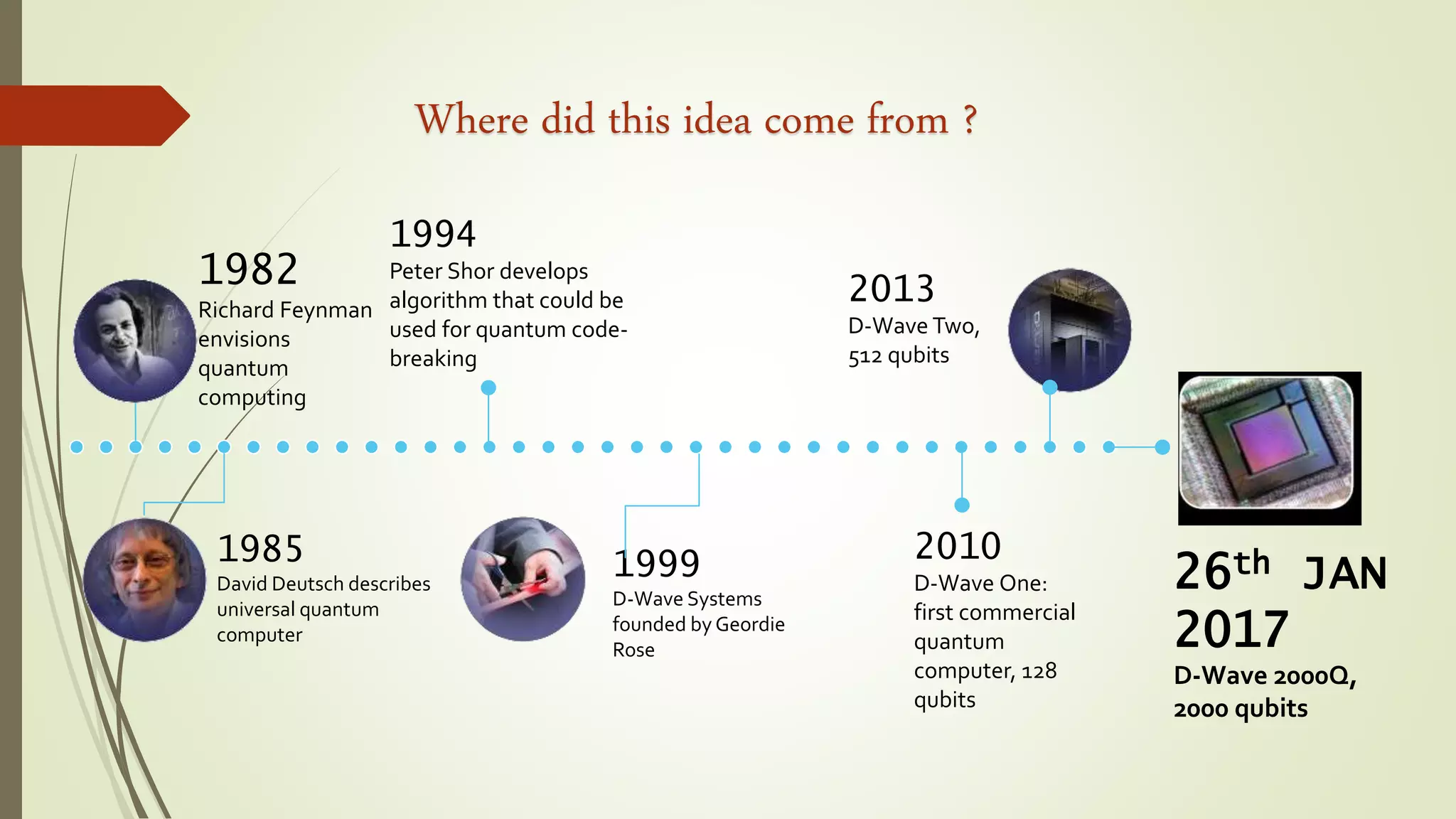
Where did this idea come from ?
1982
Richard Feynman
envisions
quantum
computing
1985
David Deutsch describes
universal quantum
computer
1994
Peter Shor develops
algorithm that could be
used for quantum code-
breaking
1999
D-Wave Systems
founded by Geordie
Rose
2010
D-Wave One:
first commercial
quantum
computer, 128
qubits
2013
D-Wave Two,
512 qubits
26th JAN
2017
D-Wave 2000Q,
2000 qubits
Why Quantum Computing?
"The number of transistors incorporated in a chip will
approximately double every 24 months."
-- Gordon Moore, Intel Co-Founder
Why Quantum Computing?
 By 2020 to 2025, transistors will be so small and it will
generate so much heat that standard silicon technology may
eventually collapse.
 Already Intel has implemented 32nm silicon technology
 If scale becomes too small, Electrons tunnel through micro-
thin barriers between wires corrupting signals.
Beauty of Quantum Theory
 Quantum Mechanical theories are totally
different from the point of common sense.
 But it agrees fully with experimental facts.
 This is the beauty of Quantum Mechanics.
Quantum computers unlike classical computers make use
of qubits.
Qubits are nothing but Quantum bits.
Classical computers make use of classical bits.
Classical bits used in classical computers store single
binary value at a single instance i.e. 0 or 1.
Qubits can store combination of 0 and 1 which can
multiply the speed of processing into n times than that of
classical computers.
These Qubits help Quantum computers to solve
impractical or impossible to solve for a classical
computer.
Traveling Salesman Problem:
 It is one of the best example for explaining working of a
quantum computer and speed as well.
 A salesman always tries to figure out the shortest route
to travel.
 Here the conventional computer will compute for each
and every route and will give the optimized route to the
salesman which is very time consuming.
 Quantum computers make use of qubits as they can
represent more than one thing simultaneously i.e. they can
work parallel.
 This means Quantum computers can try insane number of
routes at the same time and return the answer in seconds.
 A problem having n number of cities to be traveled to
computed the shortest distance a classical computer will
require 100’s or 1000’s of years, but a Quantum computer
can work for it within seconds or minutes.
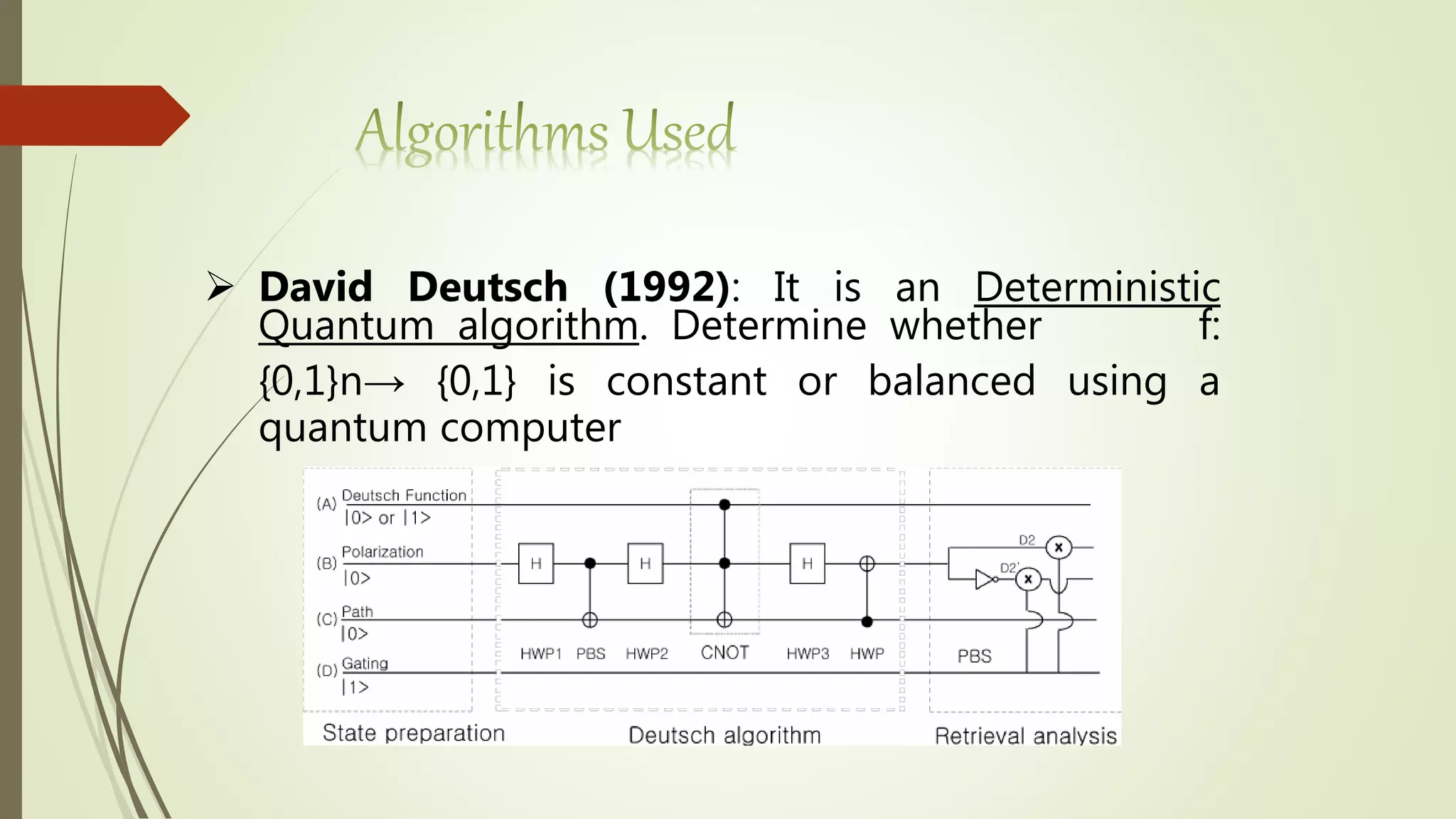
 David Deutsch (1992): It is an Deterministic
Quantum algorithm. Determine whether f:
{0,1}n→ {0,1} is constant or balanced using a
quantum computer
 Daniel Simon (1994): Special case of the abelian hidden
subgroup problem
 Peter Shor (1994): Given an integer N, find its prime
factors
 Lov Grover (1996): It is an optimization algorithm. Search
an unsorted database with N entries in O(N1/2) time
 Superposition
 De coherence
 Entanglement
 Uncertainty principle
 Linear algebra
 Dirac notation
Superposition
 Property to exist in multiple states.
 In a quantum system, if a particle can be in
states |A and |B, then it can also be in the
state 1|A + 2|B ; 1 and 2 are complex
numbers.
 Totally different from common sense.
De coherence
 The biggest problem.
 States that if a coherent (superposed) state interacts with
the environment, it falls into a classical state without
superposition.
 So quantum computer to work with superposed states, it
has to be completely isolated from the rest of the universe
(not observing the state, not measuring it, ...)
Most important property in quantum information.
States that two or more particles can be linked, and if
linked, can change properties of particle(s) changing
the linked one.
Two particles can be linked and changed each other
without interaction.
Entanglement
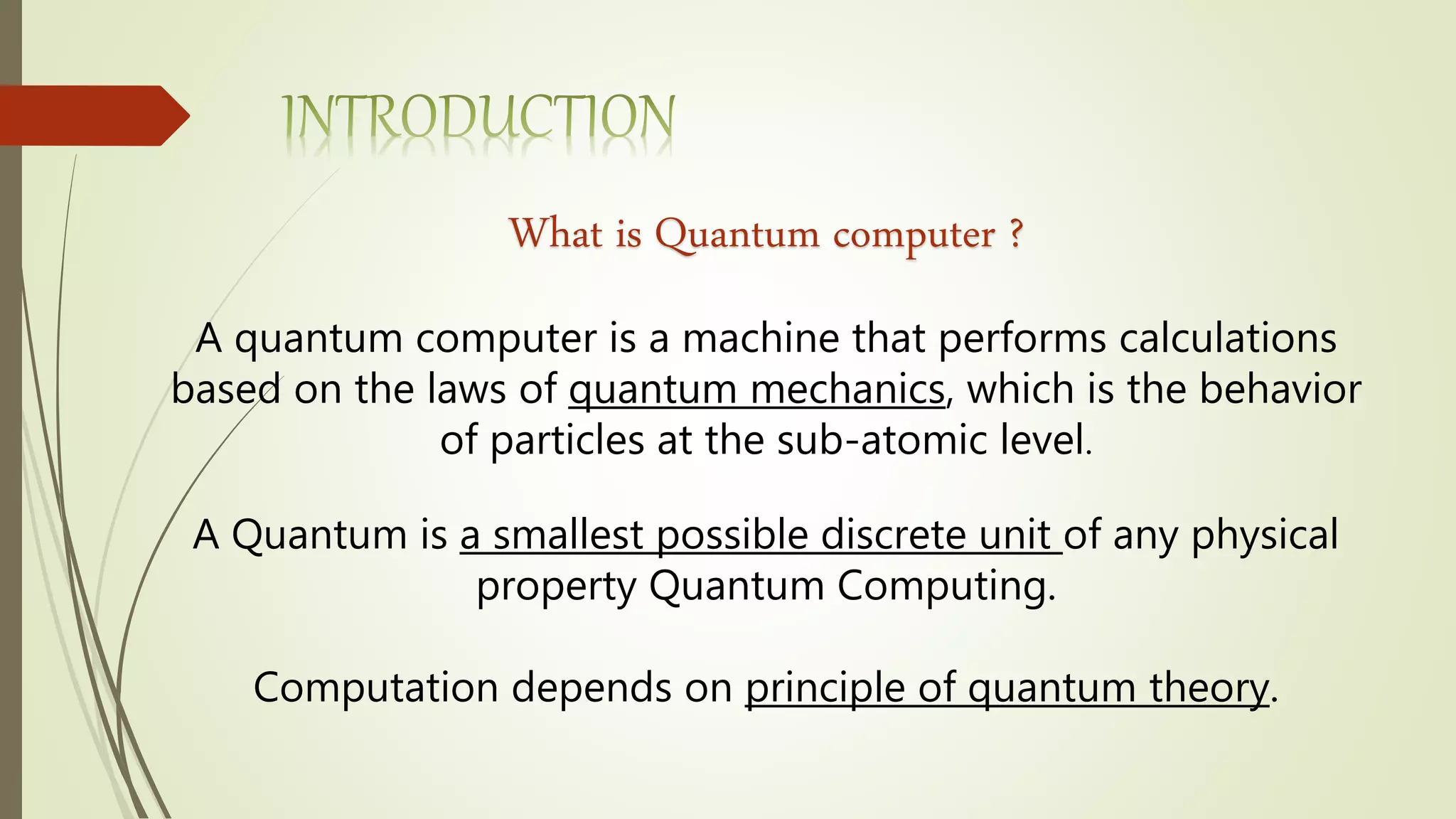
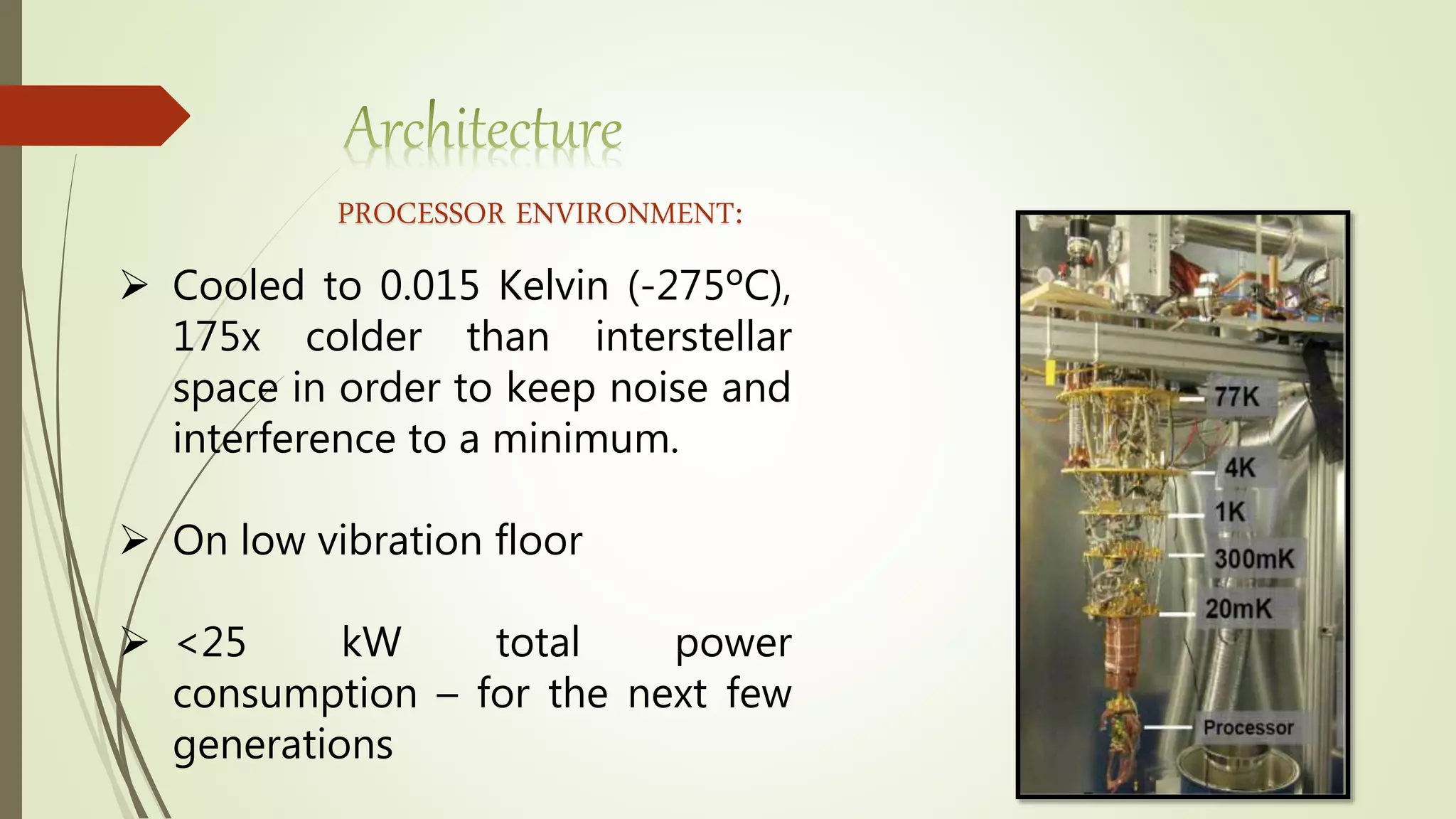
PROCESSOR ENVIRONMENT:
 Cooled to 0.015 Kelvin (-275ºC),
175x colder than interstellar
space in order to keep noise and
interference to a minimum.
 On low vibration floor
 <25 kW total power
consumption – for the next few
generations
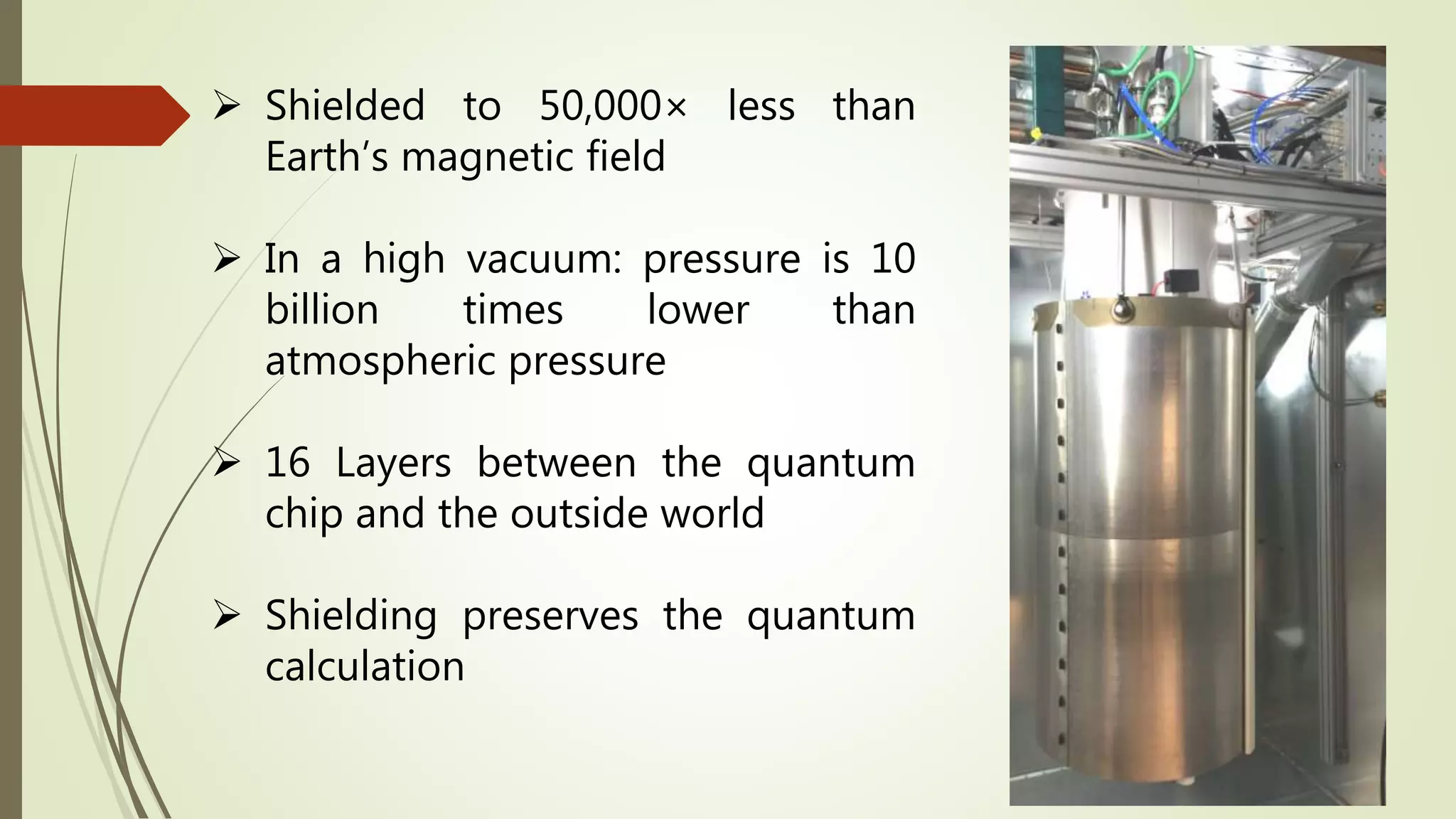
 Shielded to 50,000× less than
Earth’s magnetic field
 In a high vacuum: pressure is 10
billion times lower than
atmospheric pressure
 16 Layers between the quantum
chip and the outside world
 Shielding preserves the quantum
calculation
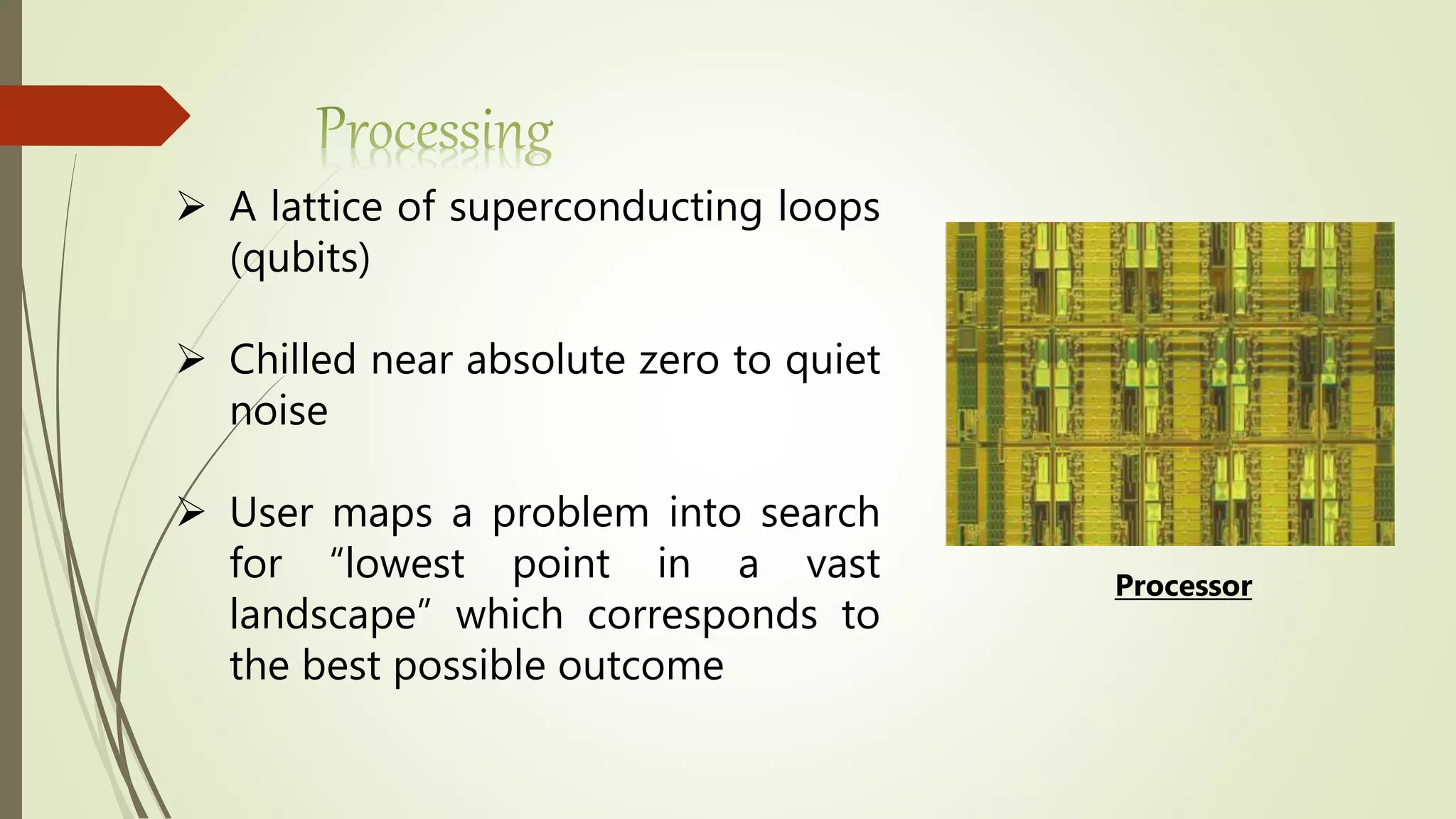
 A lattice of superconducting loops
(qubits)
 Chilled near absolute zero to quiet
noise
 User maps a problem into search
for “lowest point in a vast
landscape” which corresponds to
the best possible outcome
Processor
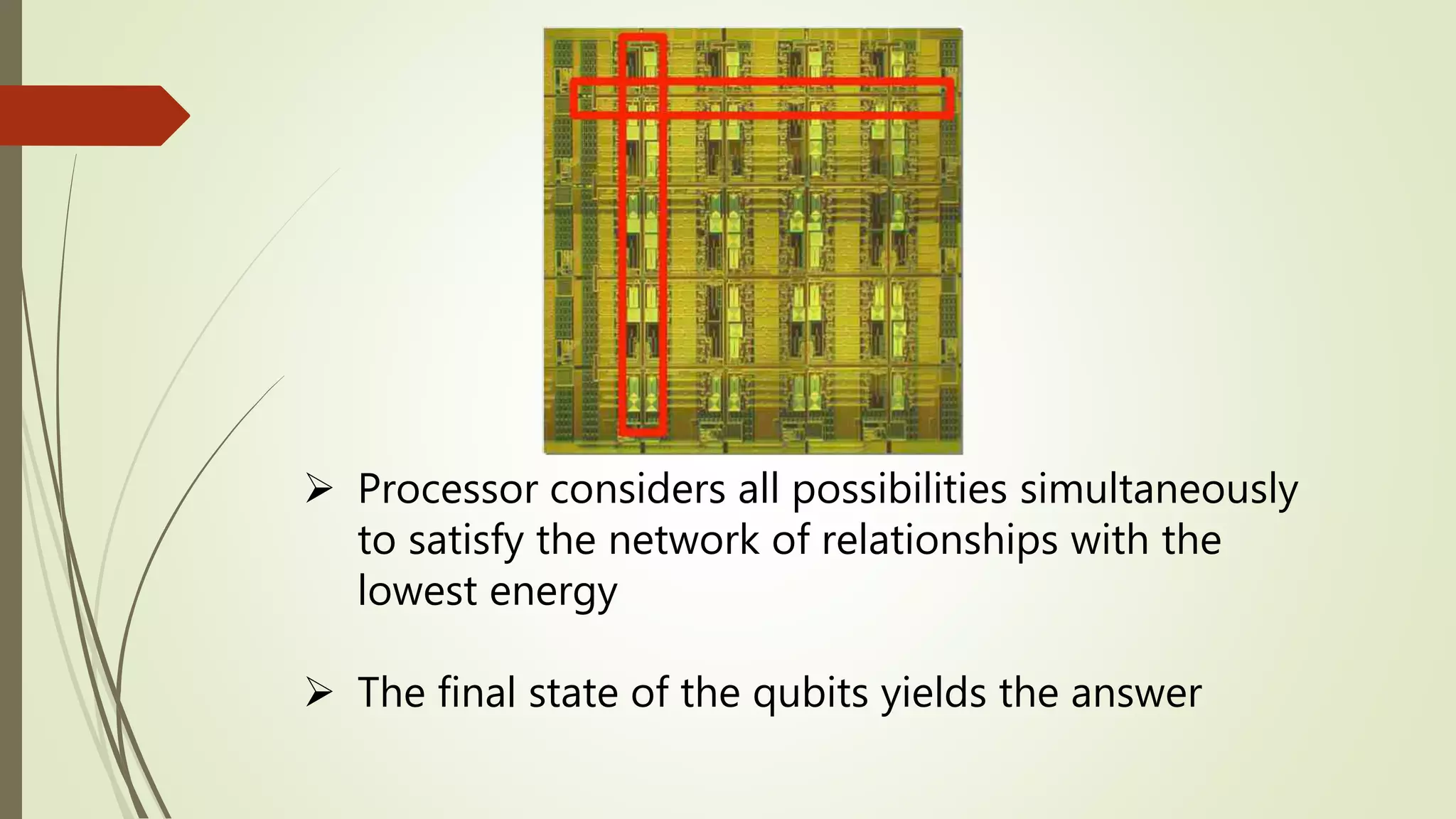
 Processor considers all possibilities simultaneously
to satisfy the network of relationships with the
lowest energy
 The final state of the qubits yields the answer
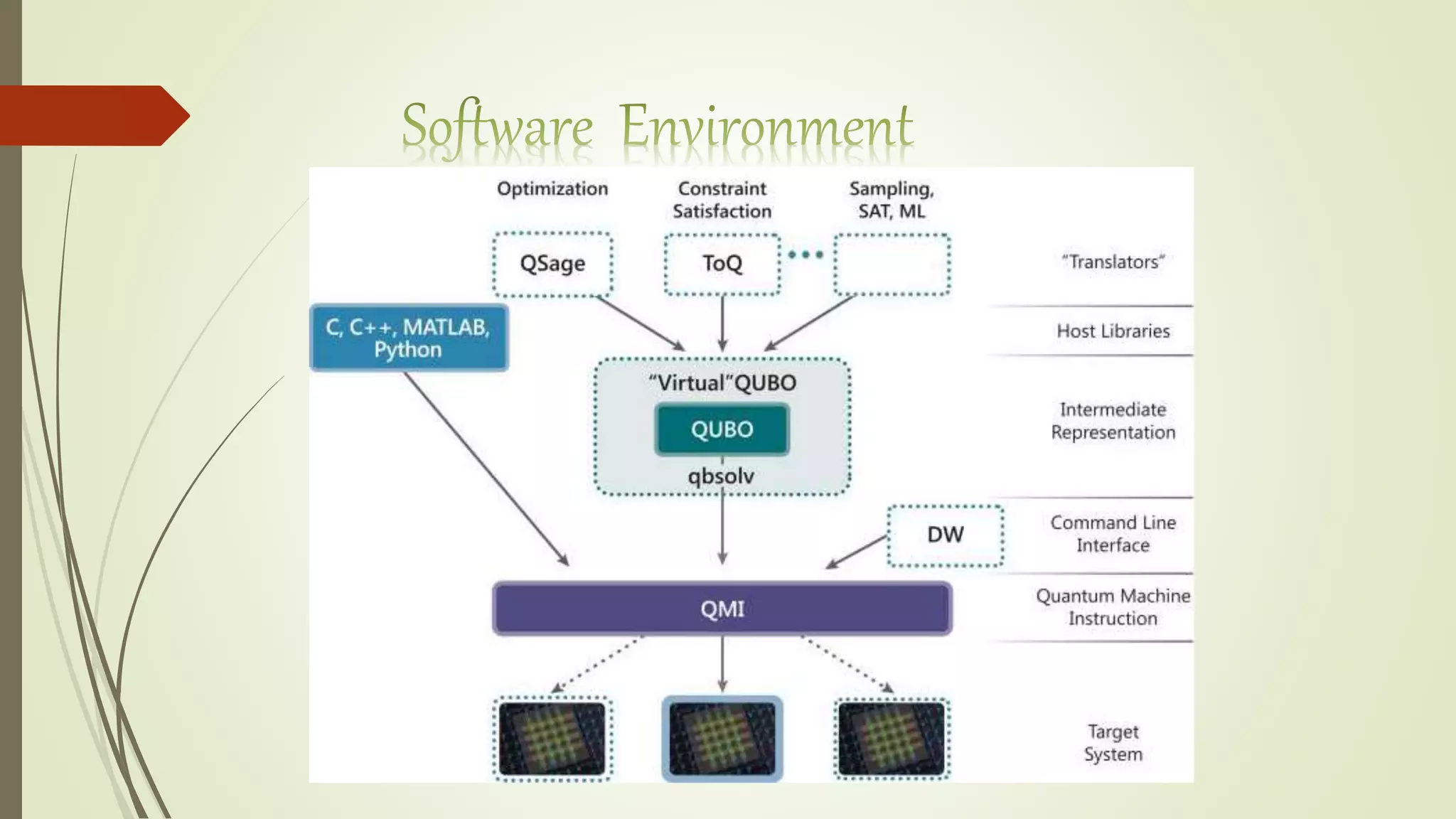
 Operates in a hybrid mode with a HPC System or Data Analytic
Engine acting as a co-processor or accelerator
 A system is “front-ended” on a network by a standard server
(Host)
 User formulates problem as a series of Quantum Machine
Instructions (QMIs)
 Host sends QMI to quantum processor (QP)
 QP samples from the distribution of bit-strings
defined by the QMI
 Results are returned to the Host and back to the
user
 Good for complex calculations
 Public key Cryptography
 Data Encryption
For data encryption of 1024 bite code it needs 3000 years for a classical
computer and a minute for Quantum computer.
 Data security
 Could process massive amount of complex data.
 Ability to solve scientific and commercial problems.
 Process data in a much faster speed.
 Capability to convey more accurate answers.
 More can be computed in less time.
 MUCH MORE…..
 De coherence (must be isolated)
 Uncertainty Principle (Can’t measure without disturb)
 Ability to crack passwords
 Can Break every level of encryption
 Complex Hardware Schemes
 Cost
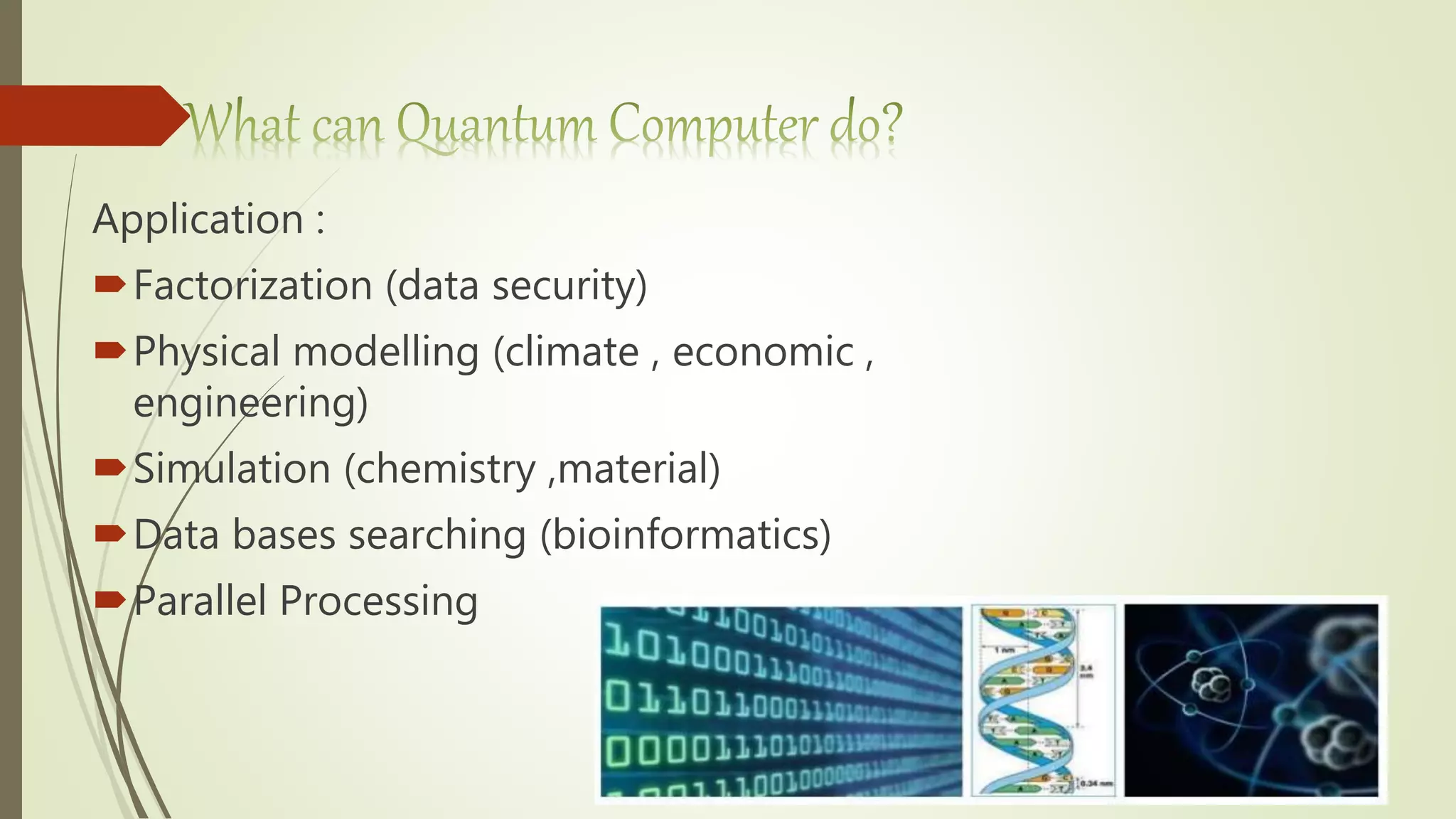
Application :
Factorization (data security)
Physical modelling (climate , economic ,
engineering)
Simulation (chemistry ,material)
Data bases searching (bioinformatics)
Parallel Processing
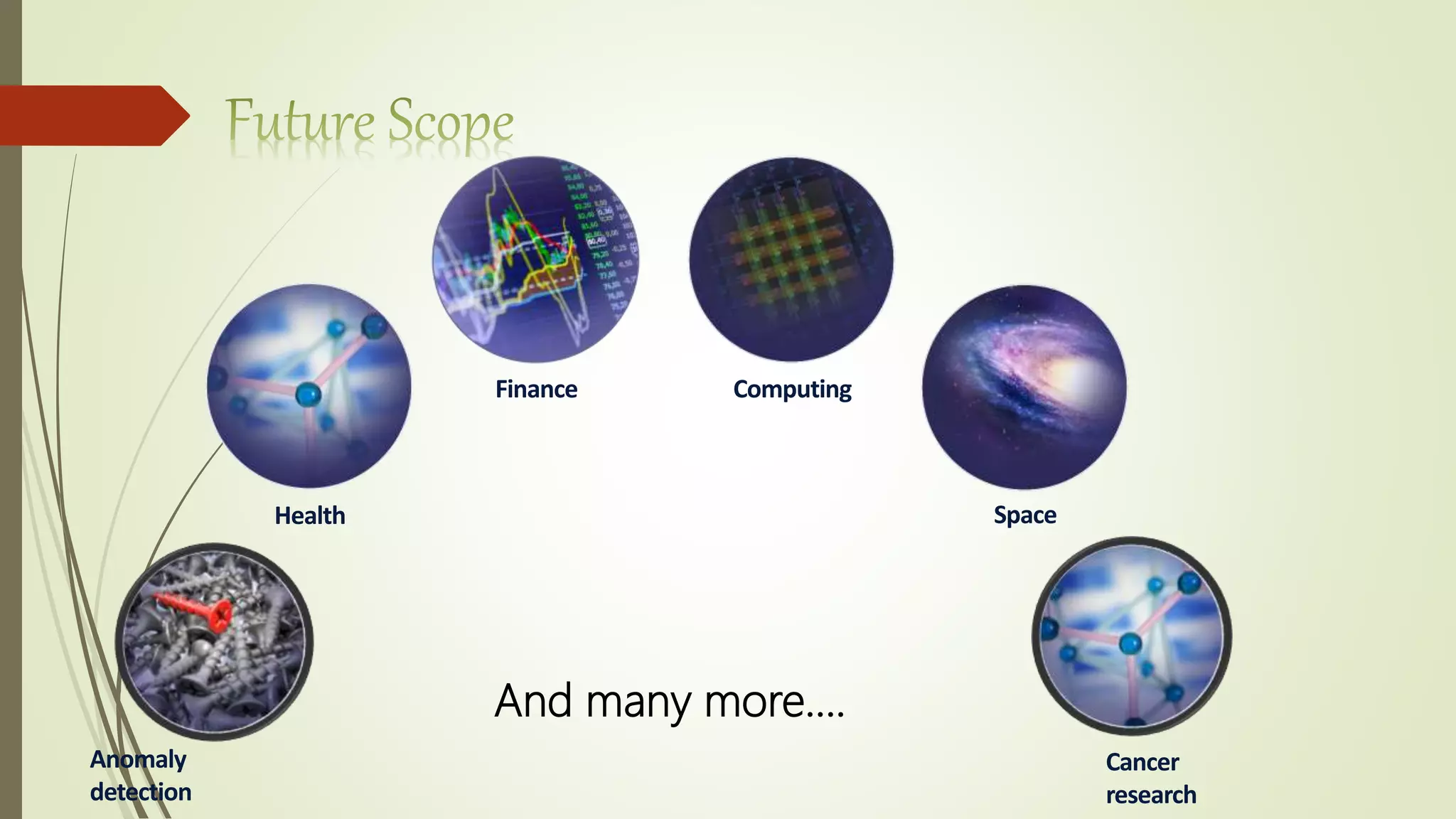
Health
Finance Computing
Space
Cancer
research
Anomaly
detection
And many more….
 Powerful new resource for computation
 Complementary to classical computers
 Accessible via the cloud
 Emergence of quantum software ecosystem
 Developer tools
 Optimized algorithms
 Applications
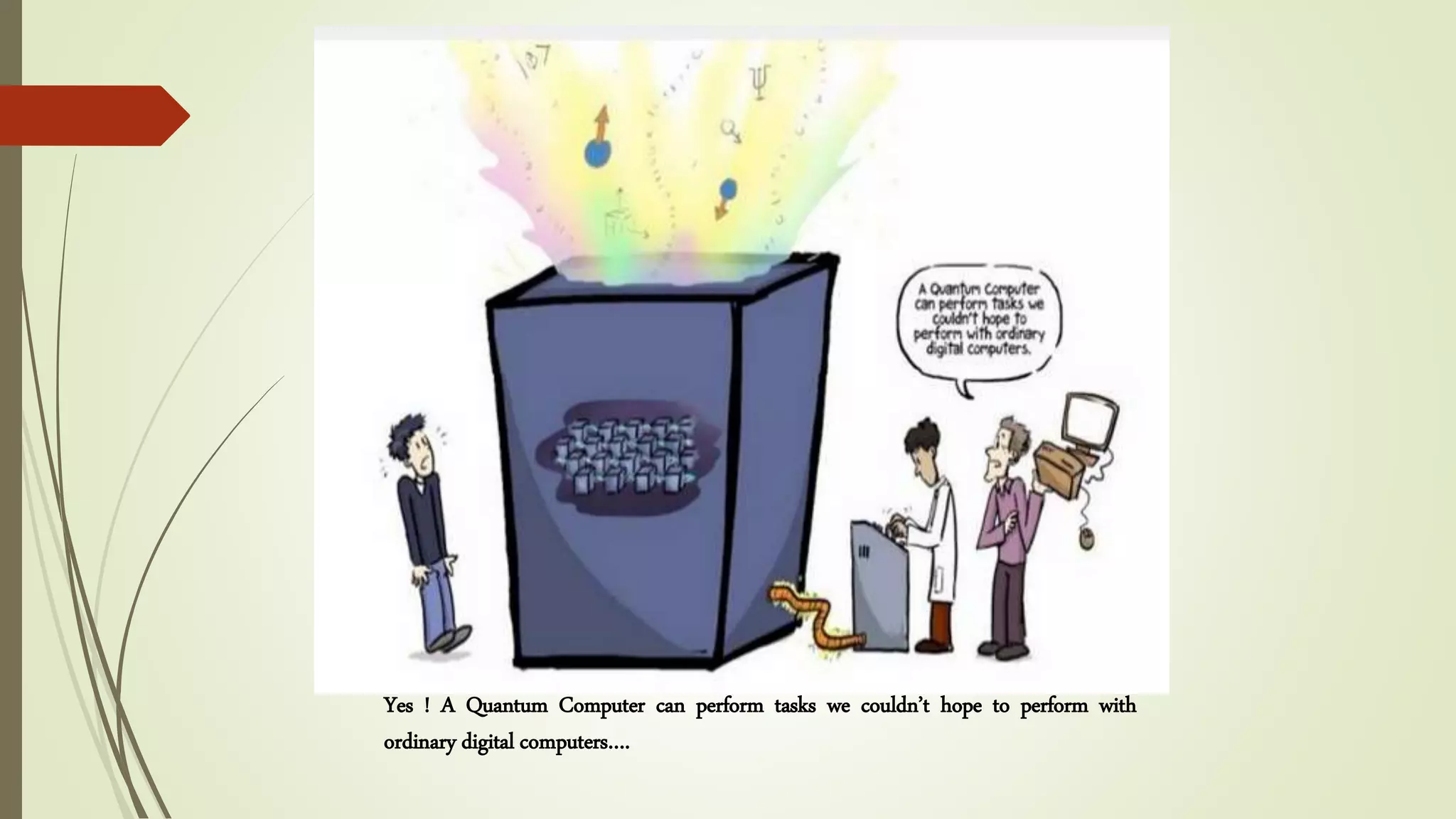
Yes ! A Quantum Computer can perform tasks we couldn’t hope to perform with
ordinary digital computers….
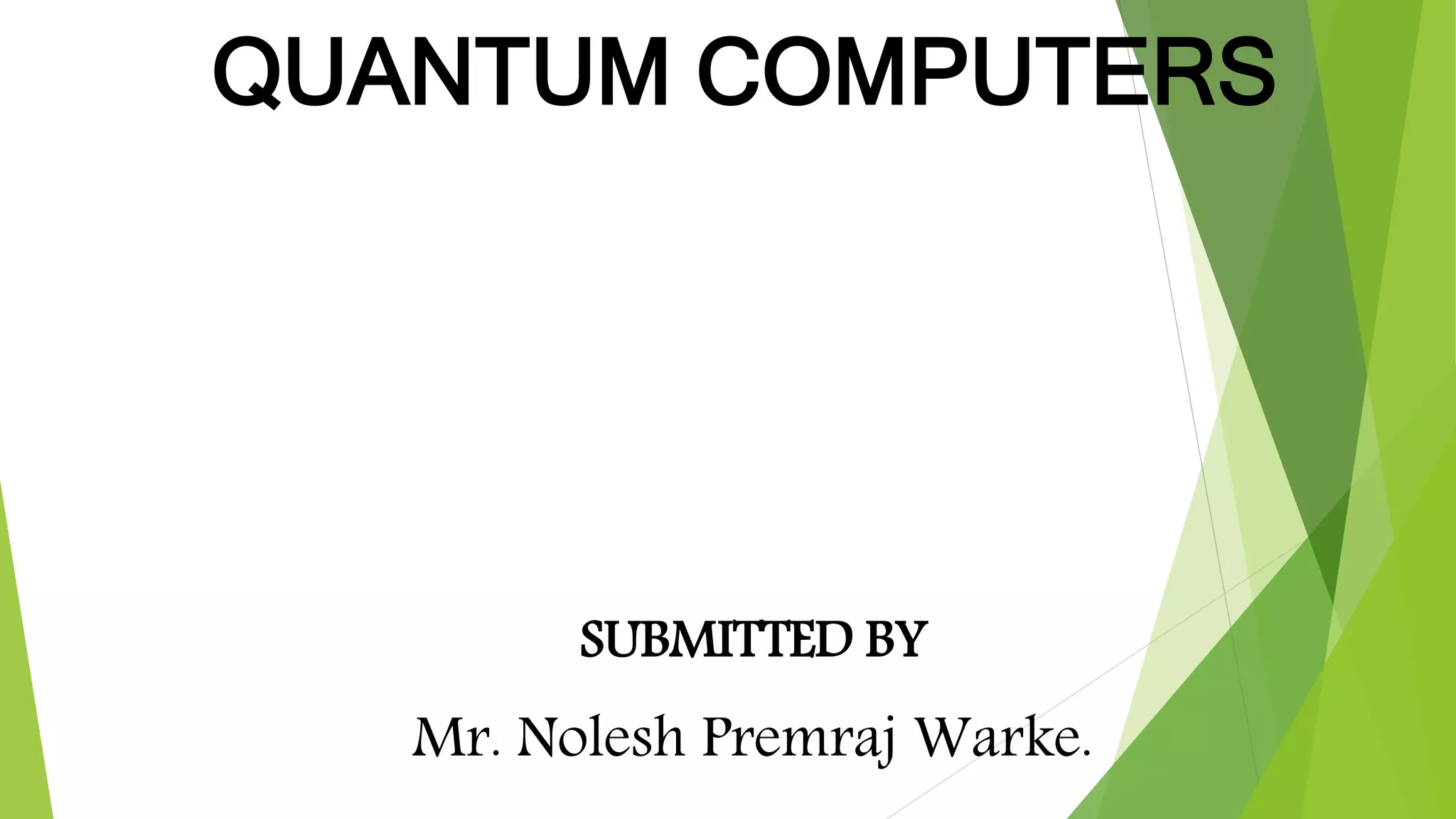
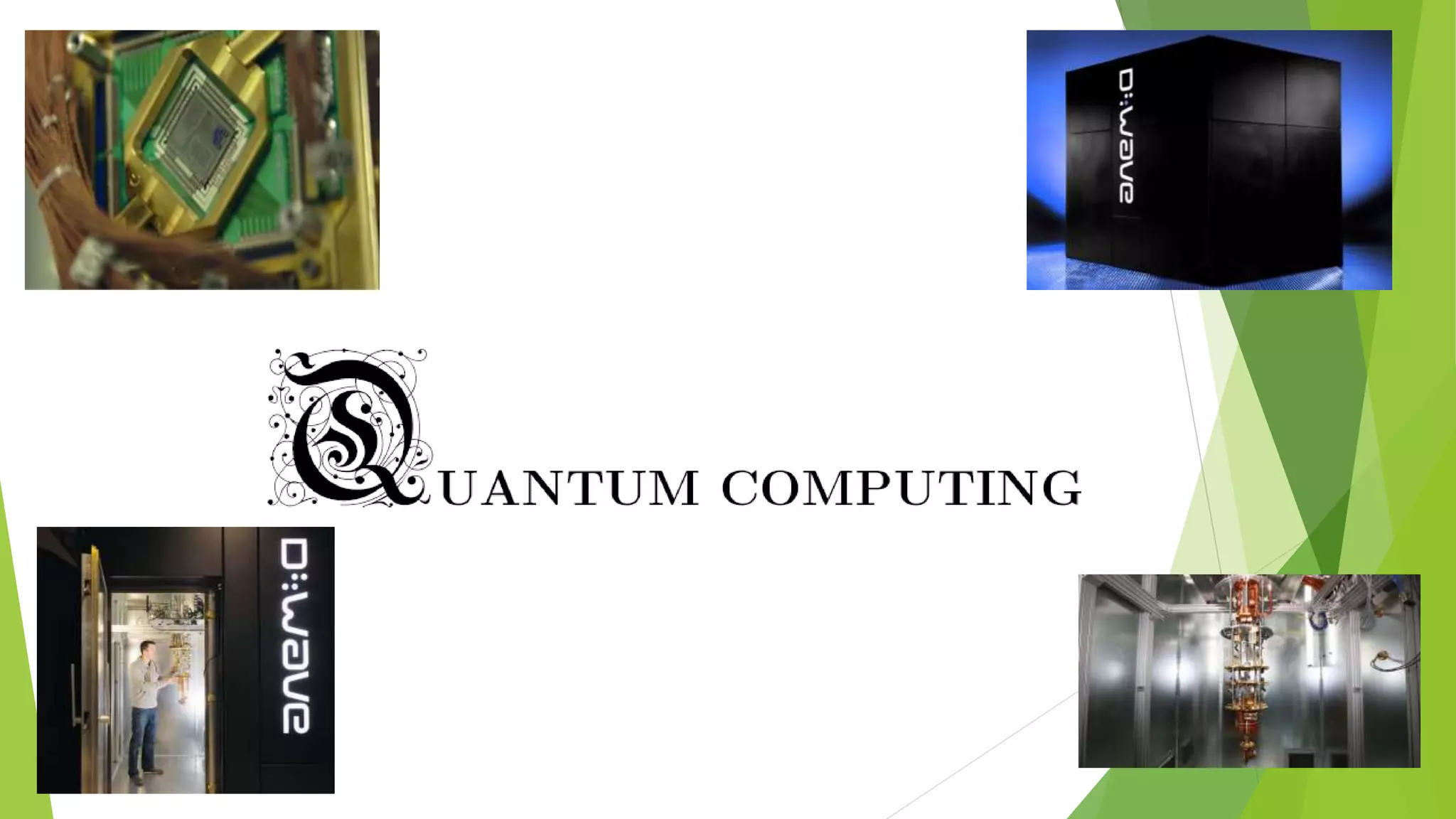
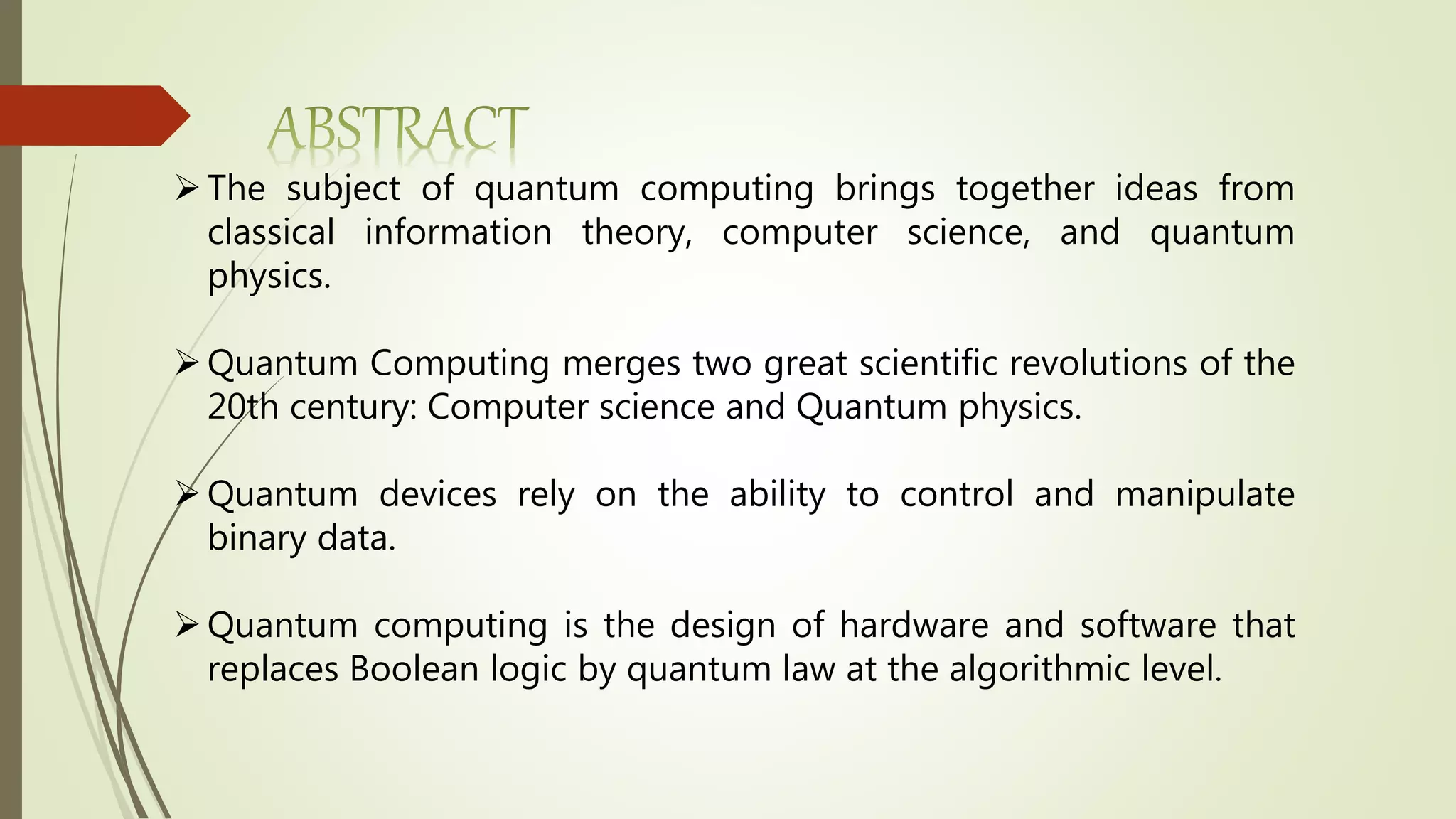
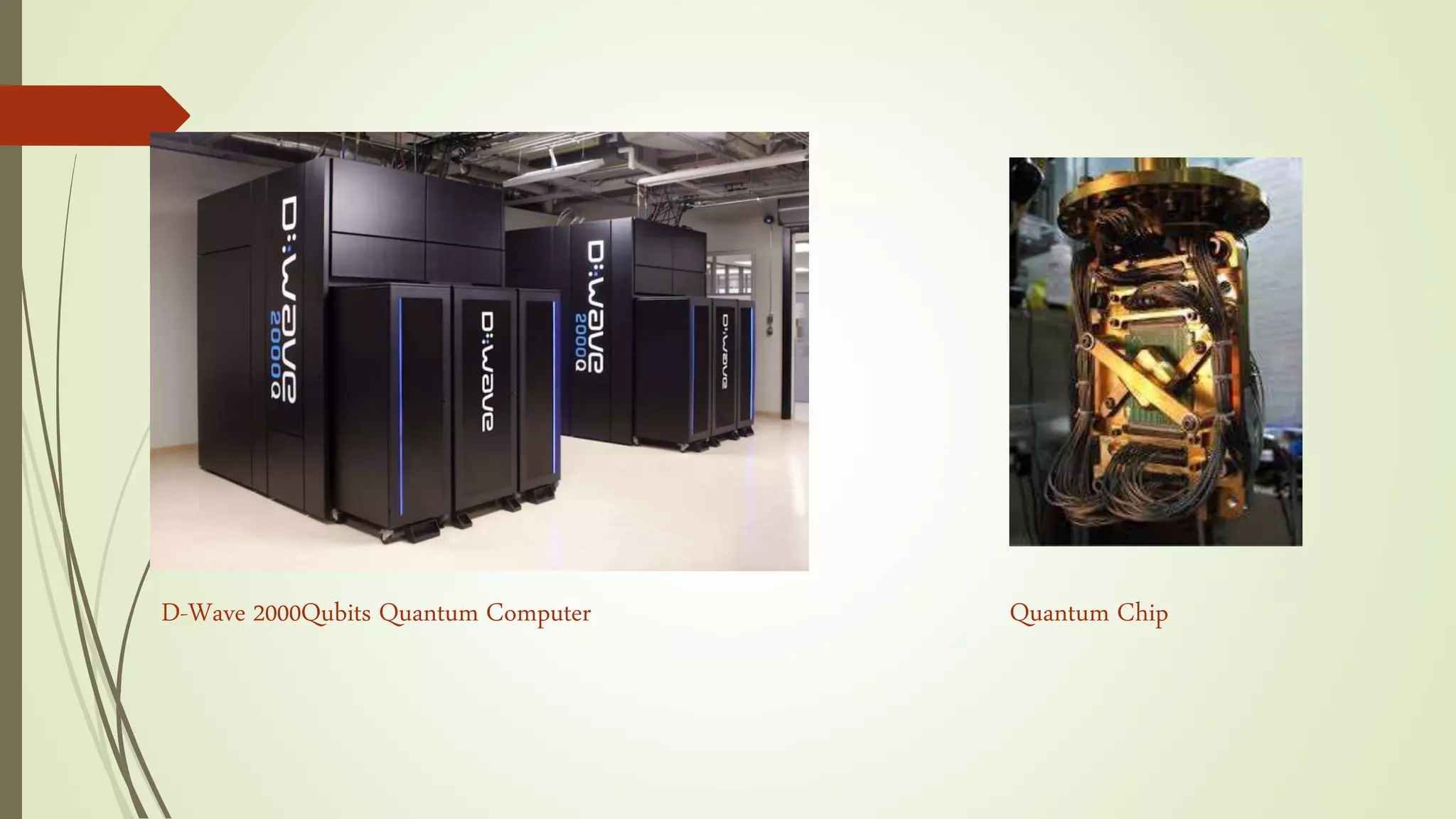
D-Wave 2000Qubits Quantum Computer Quantum Chip
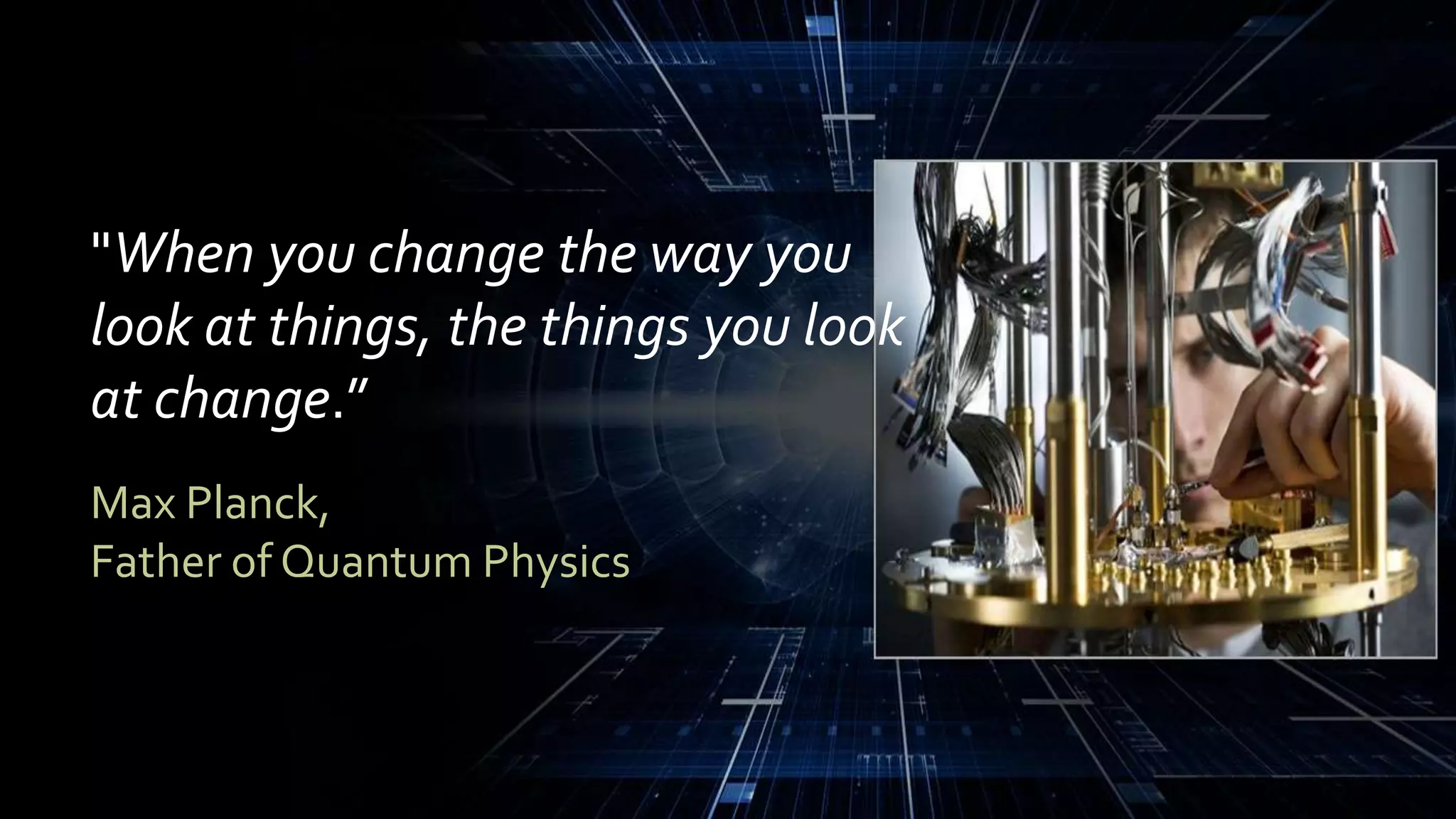
"When you change the way you
look at things, the things you look
at change.”
Max Planck,
Father of Quantum Physics
[1] P.K. Amiri "quantum computers" IEEE Potentials ( Volume: 21, Issue: 5, Dec 2002/Jan 2003 )
Dept. of Electr. Eng., Sharif Univ. of Technol., Tehran, Iran
[2] David Deutsch, ``Quantum Computational Networks'', Proc. Soc. R. Lond. A400, pp. 97-117, 1985.
[3 Peter. W. Shor, ``Polynomial-Time Algorithms For Prime Factorization and Discrete Logarithms on a
Quantum Computer'', 35th Annual Symposium on Foundations of Computer Science, pp. 124-134
[4] The excitonic quantum computer F. Rossi IEEE Transactions on Nanotechnology Year: 2004,
Volume: 3, IEEE Journals & Magazines
[5] R. W. Keyes “Challenges for quantum computing with solid-state devices” Computer
Year: 2005, Volume: 38
[6] C. P. Williams “Quantum search algorithms in science and engineering”
Computing in Science & EngineeringYear: 2001, Volume: 3
[7] Quantum computing: the final frontier? R. J. Hughes; C. P. Williams IEEE Intelligent Systems and their Applications
Year: 2000, Volume: 15
[8] G. Fairbanks, D. Garlan, and W. Scherlis, "Design fragments make using frameworks easier," in Proceedings of the
21st annual ACM SIGPLAN conference on Object-oriented programming systems, languages, and applications Portland,
Oregon, USA: ACM, 2006.
[9] N. D. Mermin, “Quantum Computer Science: An Introduction,” 1 ed. Cambridge,
UK: Cambridge University Press, 2007.
[10] R. J. Hughes; C. P. Williams "Quantum computing: the final frontier" .IEEE Intelligent Systems and their
Applications Year: 2000, Volume: 15
[11] L. Grover, ``A Fast Quantum Mechanical Algorithm for Database Search'' Symposium on Theory of Computing -
STOC-96, pp. 212-219, 1996..
[12] [Childs2002]. A. M. Childs, E. Farhi, and J. Preskill, ``Robustness of adiabatic quantum computation'', Phys. Rev.
A65, 2002, quant-ph/0108048
[13] https://en.wikipedia.org/wiki/Quantum_computing
[14] http://www.qubitapplications.com
[15] https://www.dwavesys.com/
[16] Bulk Spin Resonance Quantum Computation http://feynman.stanford.edu
Thank you

Queries Are Most Welcomed

Quantum computers

  • 1.
  • 3.
    The subject ofquantum computing brings together ideas from classical information theory, computer science, and quantum physics. Quantum Computing merges two great scientific revolutions of the 20th century: Computer science and Quantum physics. Quantum devices rely on the ability to control and manipulate binary data. Quantum computing is the design of hardware and software that replaces Boolean logic by quantum law at the algorithmic level.
  • 4.
    What is Quantumcomputer ? A quantum computer is a machine that performs calculations based on the laws of quantum mechanics, which is the behavior of particles at the sub-atomic level. A Quantum is a smallest possible discrete unit of any physical property Quantum Computing. Computation depends on principle of quantum theory.
  • 5.
     Exploit propertiesof quantum physics  Built around “qubits” rather than “bits”  Operates in an extreme environment.  Quantum approach is thousand a times faster.
  • 6.
    Where did thisidea come from ? 1982 Richard Feynman envisions quantum computing 1985 David Deutsch describes universal quantum computer 1994 Peter Shor develops algorithm that could be used for quantum code- breaking 1999 D-Wave Systems founded by Geordie Rose 2010 D-Wave One: first commercial quantum computer, 128 qubits 2013 D-Wave Two, 512 qubits 26th JAN 2017 D-Wave 2000Q, 2000 qubits
  • 7.
    Why Quantum Computing? "Thenumber of transistors incorporated in a chip will approximately double every 24 months." -- Gordon Moore, Intel Co-Founder
  • 8.
    Why Quantum Computing? By 2020 to 2025, transistors will be so small and it will generate so much heat that standard silicon technology may eventually collapse.  Already Intel has implemented 32nm silicon technology  If scale becomes too small, Electrons tunnel through micro- thin barriers between wires corrupting signals.
  • 9.
    Beauty of QuantumTheory  Quantum Mechanical theories are totally different from the point of common sense.  But it agrees fully with experimental facts.  This is the beauty of Quantum Mechanics.
  • 10.
    Quantum computers unlikeclassical computers make use of qubits. Qubits are nothing but Quantum bits. Classical computers make use of classical bits. Classical bits used in classical computers store single binary value at a single instance i.e. 0 or 1.
  • 11.
    Qubits can storecombination of 0 and 1 which can multiply the speed of processing into n times than that of classical computers. These Qubits help Quantum computers to solve impractical or impossible to solve for a classical computer.
  • 12.
    Traveling Salesman Problem: It is one of the best example for explaining working of a quantum computer and speed as well.  A salesman always tries to figure out the shortest route to travel.  Here the conventional computer will compute for each and every route and will give the optimized route to the salesman which is very time consuming.
  • 13.
     Quantum computersmake use of qubits as they can represent more than one thing simultaneously i.e. they can work parallel.  This means Quantum computers can try insane number of routes at the same time and return the answer in seconds.  A problem having n number of cities to be traveled to computed the shortest distance a classical computer will require 100’s or 1000’s of years, but a Quantum computer can work for it within seconds or minutes.
  • 14.
     David Deutsch(1992): It is an Deterministic Quantum algorithm. Determine whether f: {0,1}n→ {0,1} is constant or balanced using a quantum computer
  • 15.
     Daniel Simon(1994): Special case of the abelian hidden subgroup problem  Peter Shor (1994): Given an integer N, find its prime factors  Lov Grover (1996): It is an optimization algorithm. Search an unsorted database with N entries in O(N1/2) time
  • 16.
     Superposition  Decoherence  Entanglement  Uncertainty principle  Linear algebra  Dirac notation
  • 17.
    Superposition  Property toexist in multiple states.  In a quantum system, if a particle can be in states |A and |B, then it can also be in the state 1|A + 2|B ; 1 and 2 are complex numbers.  Totally different from common sense.
  • 18.
    De coherence  Thebiggest problem.  States that if a coherent (superposed) state interacts with the environment, it falls into a classical state without superposition.  So quantum computer to work with superposed states, it has to be completely isolated from the rest of the universe (not observing the state, not measuring it, ...)
  • 19.
    Most important propertyin quantum information. States that two or more particles can be linked, and if linked, can change properties of particle(s) changing the linked one. Two particles can be linked and changed each other without interaction. Entanglement
  • 20.
    PROCESSOR ENVIRONMENT:  Cooledto 0.015 Kelvin (-275ºC), 175x colder than interstellar space in order to keep noise and interference to a minimum.  On low vibration floor  <25 kW total power consumption – for the next few generations
  • 21.
     Shielded to50,000× less than Earth’s magnetic field  In a high vacuum: pressure is 10 billion times lower than atmospheric pressure  16 Layers between the quantum chip and the outside world  Shielding preserves the quantum calculation
  • 22.
     A latticeof superconducting loops (qubits)  Chilled near absolute zero to quiet noise  User maps a problem into search for “lowest point in a vast landscape” which corresponds to the best possible outcome Processor
  • 23.
     Processor considersall possibilities simultaneously to satisfy the network of relationships with the lowest energy  The final state of the qubits yields the answer
  • 25.
     Operates ina hybrid mode with a HPC System or Data Analytic Engine acting as a co-processor or accelerator  A system is “front-ended” on a network by a standard server (Host)  User formulates problem as a series of Quantum Machine Instructions (QMIs)
  • 26.
     Host sendsQMI to quantum processor (QP)  QP samples from the distribution of bit-strings defined by the QMI  Results are returned to the Host and back to the user
  • 28.
     Good forcomplex calculations  Public key Cryptography  Data Encryption For data encryption of 1024 bite code it needs 3000 years for a classical computer and a minute for Quantum computer.  Data security
  • 29.
     Could processmassive amount of complex data.  Ability to solve scientific and commercial problems.  Process data in a much faster speed.  Capability to convey more accurate answers.  More can be computed in less time.  MUCH MORE…..
  • 30.
     De coherence(must be isolated)  Uncertainty Principle (Can’t measure without disturb)  Ability to crack passwords  Can Break every level of encryption  Complex Hardware Schemes  Cost
  • 31.
    Application : Factorization (datasecurity) Physical modelling (climate , economic , engineering) Simulation (chemistry ,material) Data bases searching (bioinformatics) Parallel Processing
  • 32.
  • 33.
     Powerful newresource for computation  Complementary to classical computers  Accessible via the cloud  Emergence of quantum software ecosystem  Developer tools  Optimized algorithms  Applications
  • 34.
    Yes ! AQuantum Computer can perform tasks we couldn’t hope to perform with ordinary digital computers….
  • 35.
    D-Wave 2000Qubits QuantumComputer Quantum Chip
  • 36.
    "When you changethe way you look at things, the things you look at change.” Max Planck, Father of Quantum Physics
  • 37.
    [1] P.K. Amiri"quantum computers" IEEE Potentials ( Volume: 21, Issue: 5, Dec 2002/Jan 2003 ) Dept. of Electr. Eng., Sharif Univ. of Technol., Tehran, Iran [2] David Deutsch, ``Quantum Computational Networks'', Proc. Soc. R. Lond. A400, pp. 97-117, 1985. [3 Peter. W. Shor, ``Polynomial-Time Algorithms For Prime Factorization and Discrete Logarithms on a Quantum Computer'', 35th Annual Symposium on Foundations of Computer Science, pp. 124-134 [4] The excitonic quantum computer F. Rossi IEEE Transactions on Nanotechnology Year: 2004, Volume: 3, IEEE Journals & Magazines [5] R. W. Keyes “Challenges for quantum computing with solid-state devices” Computer Year: 2005, Volume: 38 [6] C. P. Williams “Quantum search algorithms in science and engineering” Computing in Science & EngineeringYear: 2001, Volume: 3
  • 38.
    [7] Quantum computing:the final frontier? R. J. Hughes; C. P. Williams IEEE Intelligent Systems and their Applications Year: 2000, Volume: 15 [8] G. Fairbanks, D. Garlan, and W. Scherlis, "Design fragments make using frameworks easier," in Proceedings of the 21st annual ACM SIGPLAN conference on Object-oriented programming systems, languages, and applications Portland, Oregon, USA: ACM, 2006. [9] N. D. Mermin, “Quantum Computer Science: An Introduction,” 1 ed. Cambridge, UK: Cambridge University Press, 2007. [10] R. J. Hughes; C. P. Williams "Quantum computing: the final frontier" .IEEE Intelligent Systems and their Applications Year: 2000, Volume: 15 [11] L. Grover, ``A Fast Quantum Mechanical Algorithm for Database Search'' Symposium on Theory of Computing - STOC-96, pp. 212-219, 1996.. [12] [Childs2002]. A. M. Childs, E. Farhi, and J. Preskill, ``Robustness of adiabatic quantum computation'', Phys. Rev. A65, 2002, quant-ph/0108048 [13] https://en.wikipedia.org/wiki/Quantum_computing [14] http://www.qubitapplications.com [15] https://www.dwavesys.com/ [16] Bulk Spin Resonance Quantum Computation http://feynman.stanford.edu
  • 39.

Editor's Notes

  • #7 1982 - Feynman proposed the idea of creating machines based on the laws of quantum mechanics instead of the laws of classical physics. 1985 - David Deutsch developed the Quantum Turing Machine, showing that quantum circuits are universal. 1994 - Peter Shor came up with a quantum algorithm to factor very large numbers in polynomial time. 1997 - Lov Grover develops a quantum search algorithm with O(√N) complexity. In 2001, a 7 qubit machine was built and programmed to run Shor’s algorithm to successfully factor 15.