Quantum
Computing
Anant kumar
233087
Quantum Computing
Contents
a. Introduction
b. History
c. What is Quantum Computing?
d. Architecture of Quantum computer
e. What is a Quantum Computer?
f. How Quantum Computer works?
g. What is a qubits?
h. Requirement of quantum computer
i. Conclusion
Introduction
Quantum computing is a new way of doing computer science that uses the strange rules of quantum mechanics to solve
problems faster than regular computers. It's like a super-powerful computer that can process a huge amount of
information at the same time.
Quantum computers are not intended to replace classical computers, they are expected to be a different tool we will use
to solve complex problems.
A classical computer is a type of computer that uses bits to store and process information. It's the traditional type of
computer that we've been using for decades.
Regular computers use "bits" to store and process information, which can only be 0 or 1 at a time. Quantum computers
use "qubits" which can be 0, 1, or both at the same time! This means quantum computers can process a huge amount of
information much faster than regular computers.
Quantum computers use the principles of quantum mechanics, like superposition and entanglement, to perform
calculations. This allows them to explore a huge number of possibilities simultaneously, making them much faster than
regular computers.
History
 1982 - Feynman proposed the idea of creating machines based on the laws of
quantum mechanics instead of the laws of classical physics.
 1985 - David Deutsch developed the quantum Turing Machine, showing that
 quantum circuits are universal.
 1994 - Peter Shor came up with a quantum algorithm to factor very large number in
polynomial time.
 1997 - Lov Grover develops a quantum search algorithm with O(√N) complexity.
 In 2001,a 7 qubit machine was built and programmed to run Shor’s algorithm to
successfully factor 15
What is Quantum computing?
Quantum computing is the area of study focused on developing computer technology based on the principles of quantum
theory , which explains the nature and behaviour of energy and matter on the quantum (atomic and subatomic) level.
Qantum computing operates on the principles of quantum mechanics, a branch of physics that describes the behaviour of
matter and energy at the subatomic level. Unlike classical bits, which can exist in a state of either 0 or 1, quantum bits, or
qubits, can exist in multiple states simultaneously due to the phenomenon of superposition. This unique property enables
quantum computers to perform complex calculations with an exponential speedup over their classical counterparts.
 Computers based on this theory are so smaller and faster than digital computers.
 Calculation based on the laws of Quantum mechanics .
 Uses Quantum Mechanical Phenomena to perform operations on data
 Operations done at an atomic/sub-atomic level.
Architecture of Quantum Computer
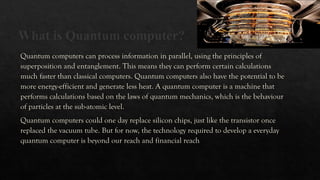
Quantum computers can process information in parallel, using the principles of
superposition and entanglement. This means they can perform certain calculations
much faster than classical computers. Quantum computers also have the potential to be
more energy-efficient and generate less heat. A quantum computer is a machine that
performs calculations based on the laws of quantum mechanics, which is the behaviour
of particles at the sub-atomic level.
Quantum computers could one day replace silicon chips, just like the transistor once
replaced the vacuum tube. But for now, the technology required to develop a everyday
quantum computer is beyond our reach and financial reach
What is Quantum computer?
What is a qubits?
A qubit (quantum bit) is the fundamental unit of quantum information in a quantum computer. It's the quantum equivalent
of a classical bit, which is the basic unit of information in a classical computer.
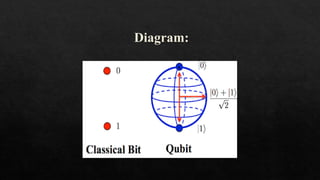
A qubit can exist in multiple states simultaneously, represented by a combination of 0 and 1. This is known as a superposition.
Properties of qubit:
1 .Superposition: A qubit can exist in multiple states at the same time, which allows it to process multiple possibilities
simultaneously.
2. Entanglement: Qubits can become "entangled" in a way that the state of one qubit is dependent on the state of the other,
even if they are separated by large distances.
3. Quantum Measurement: When a qubit is measured, its state is said to "collapse" to one of the possible outcomes.
Requirement of Quantum Computing
• Many kind of numerical problems like algorithm cannot be solved using digital computer.
• Requirement of faster technology
• Requirement of smaller calculating devices is increased as it is powerfull
• It help to build more effective and accurate artificial intelligence applications
• National security require advance supercomputers
• Require advanced technology for civilian, business, trade and environmental
• Quantum computers can simulate complex systems, such as molecular interactions, that are difficult or
impossible to model using classical computers.
• Quantum computers can create unbreakable encryption methods, such as quantum key distribution, to secure
online transactions and communication.
Diagram:
Summary
 A quantum computer is a machine that perform calculations based on laws of quantum mechanics , which is the
behaviour of particles at the sub-atomic level
 Quantum computer use qubits to do operations faster than classical computers
 Superposition and Entanglement are main building block of Quantum computing and these property speed up
Quantum computer exponentially.
 Every time we add a Qubit we double the computation power of Quantum computer.
 If we built this computer then it would revolutionized our human society .
 Quantum computer has more to offer.
Thankyou
Any queries and questions

Quantum Computing and what is qbits.pptx

  • 1.
  • 2.
    Quantum Computing Contents a. Introduction b.History c. What is Quantum Computing? d. Architecture of Quantum computer e. What is a Quantum Computer? f. How Quantum Computer works? g. What is a qubits? h. Requirement of quantum computer i. Conclusion
  • 3.
    Introduction Quantum computing isa new way of doing computer science that uses the strange rules of quantum mechanics to solve problems faster than regular computers. It's like a super-powerful computer that can process a huge amount of information at the same time. Quantum computers are not intended to replace classical computers, they are expected to be a different tool we will use to solve complex problems. A classical computer is a type of computer that uses bits to store and process information. It's the traditional type of computer that we've been using for decades. Regular computers use "bits" to store and process information, which can only be 0 or 1 at a time. Quantum computers use "qubits" which can be 0, 1, or both at the same time! This means quantum computers can process a huge amount of information much faster than regular computers. Quantum computers use the principles of quantum mechanics, like superposition and entanglement, to perform calculations. This allows them to explore a huge number of possibilities simultaneously, making them much faster than regular computers.
  • 4.
    History  1982 -Feynman proposed the idea of creating machines based on the laws of quantum mechanics instead of the laws of classical physics.  1985 - David Deutsch developed the quantum Turing Machine, showing that  quantum circuits are universal.  1994 - Peter Shor came up with a quantum algorithm to factor very large number in polynomial time.  1997 - Lov Grover develops a quantum search algorithm with O(√N) complexity.  In 2001,a 7 qubit machine was built and programmed to run Shor’s algorithm to successfully factor 15
  • 5.
    What is Quantumcomputing? Quantum computing is the area of study focused on developing computer technology based on the principles of quantum theory , which explains the nature and behaviour of energy and matter on the quantum (atomic and subatomic) level. Qantum computing operates on the principles of quantum mechanics, a branch of physics that describes the behaviour of matter and energy at the subatomic level. Unlike classical bits, which can exist in a state of either 0 or 1, quantum bits, or qubits, can exist in multiple states simultaneously due to the phenomenon of superposition. This unique property enables quantum computers to perform complex calculations with an exponential speedup over their classical counterparts.  Computers based on this theory are so smaller and faster than digital computers.  Calculation based on the laws of Quantum mechanics .  Uses Quantum Mechanical Phenomena to perform operations on data  Operations done at an atomic/sub-atomic level.
  • 6.
  • 7.
    Quantum computers canprocess information in parallel, using the principles of superposition and entanglement. This means they can perform certain calculations much faster than classical computers. Quantum computers also have the potential to be more energy-efficient and generate less heat. A quantum computer is a machine that performs calculations based on the laws of quantum mechanics, which is the behaviour of particles at the sub-atomic level. Quantum computers could one day replace silicon chips, just like the transistor once replaced the vacuum tube. But for now, the technology required to develop a everyday quantum computer is beyond our reach and financial reach What is Quantum computer?
  • 8.
    What is aqubits? A qubit (quantum bit) is the fundamental unit of quantum information in a quantum computer. It's the quantum equivalent of a classical bit, which is the basic unit of information in a classical computer. A qubit can exist in multiple states simultaneously, represented by a combination of 0 and 1. This is known as a superposition. Properties of qubit: 1 .Superposition: A qubit can exist in multiple states at the same time, which allows it to process multiple possibilities simultaneously. 2. Entanglement: Qubits can become "entangled" in a way that the state of one qubit is dependent on the state of the other, even if they are separated by large distances. 3. Quantum Measurement: When a qubit is measured, its state is said to "collapse" to one of the possible outcomes.
  • 9.
    Requirement of QuantumComputing • Many kind of numerical problems like algorithm cannot be solved using digital computer. • Requirement of faster technology • Requirement of smaller calculating devices is increased as it is powerfull • It help to build more effective and accurate artificial intelligence applications • National security require advance supercomputers • Require advanced technology for civilian, business, trade and environmental • Quantum computers can simulate complex systems, such as molecular interactions, that are difficult or impossible to model using classical computers. • Quantum computers can create unbreakable encryption methods, such as quantum key distribution, to secure online transactions and communication.
  • 10.
  • 11.
    Summary  A quantumcomputer is a machine that perform calculations based on laws of quantum mechanics , which is the behaviour of particles at the sub-atomic level  Quantum computer use qubits to do operations faster than classical computers  Superposition and Entanglement are main building block of Quantum computing and these property speed up Quantum computer exponentially.  Every time we add a Qubit we double the computation power of Quantum computer.  If we built this computer then it would revolutionized our human society .  Quantum computer has more to offer.
  • 12.