“ When youchange the way you look at things,
the things you look at change ”
Max Planck
Father of Quantum Physics
3.
Contents
Sl No. TopicSlide No.
1 Introduction 4
2 QUBIT 5 - 6
3 Evolution of Quantum Computing 7
4 Quantum Superposition 8
5 Quantum Entanglement 9
6 How does a Quantum Computer Works ? 10 - 11
7 Types of Quantum Computing 12
8 Advantage of Quantum Computing 13 - 17
9 Application of Quantum Computing 18
10 The future 19
11 Conclusion 20
4.
Introduction
• Quantum computingis an area of computer science that uses the
principles of quantum theory. Quantum theory explains the behavior of
energy and material on the atomic and subatomic levels.
• Quantum computing is a type of computing that uses the laws of
quantum physics to solve problems much faster than regular computers
by using special units called qubits.
5.
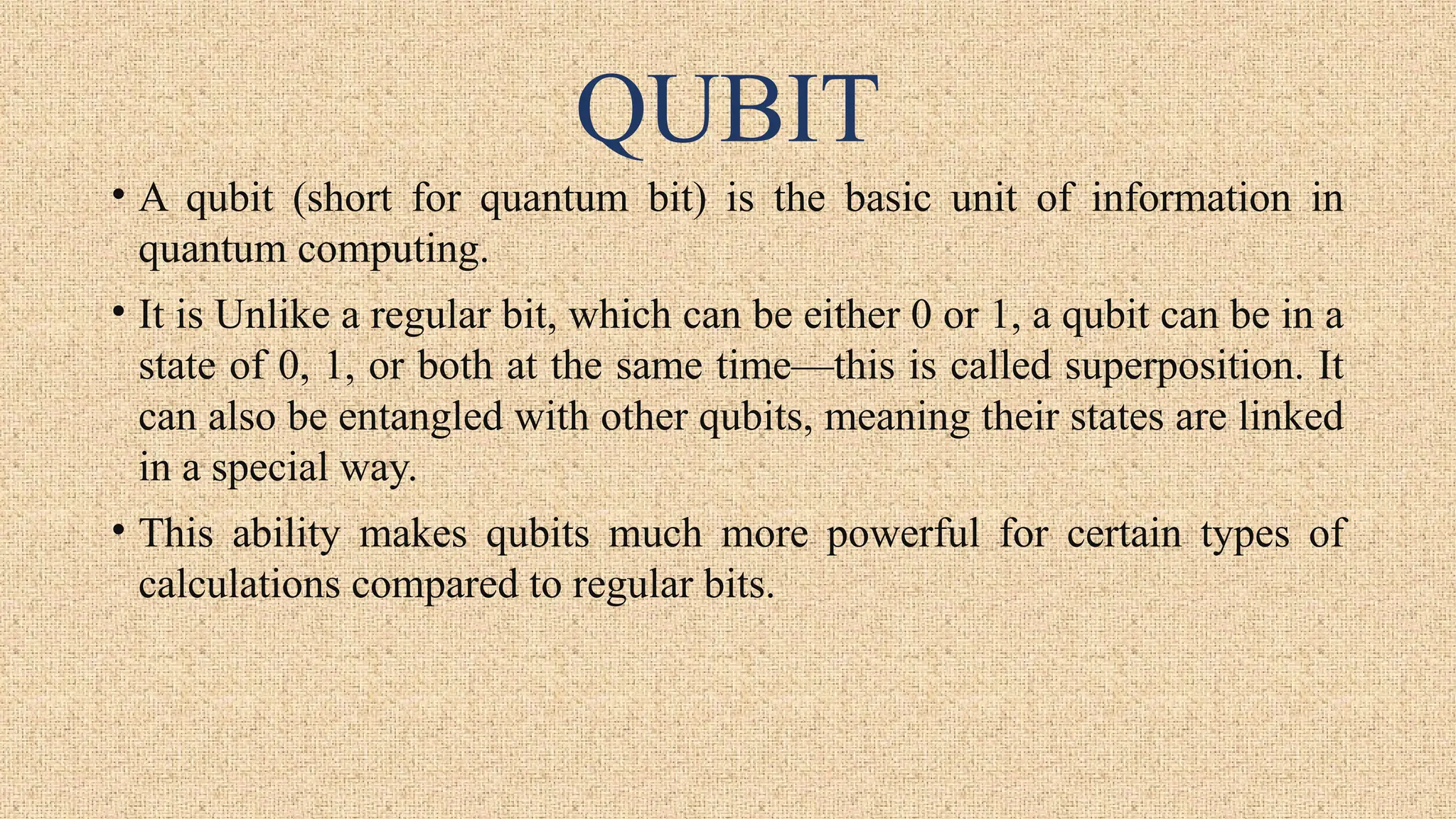
QUBIT
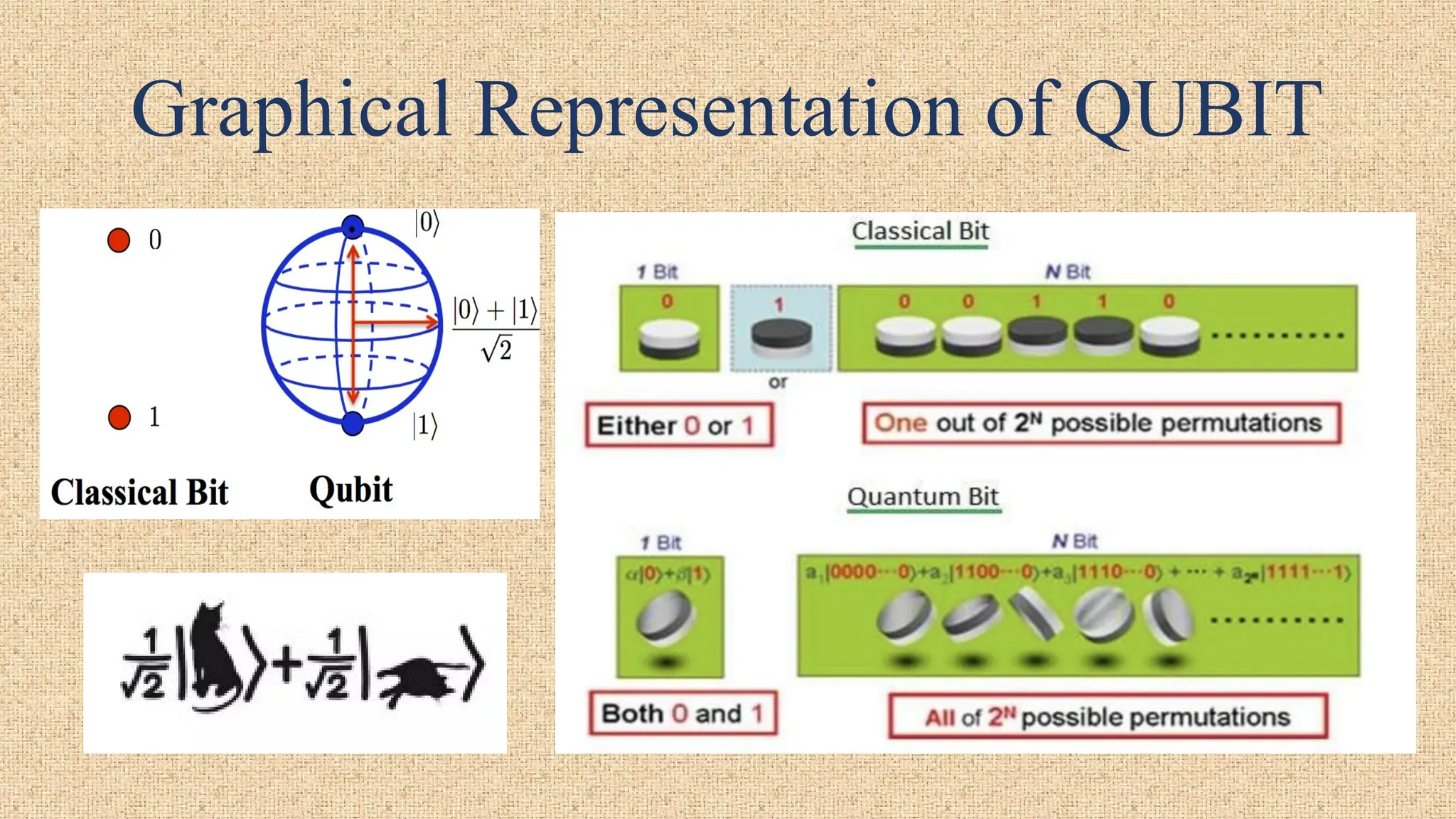
• A qubit(short for quantum bit) is the basic unit of information in
quantum computing.
• It is Unlike a regular bit, which can be either 0 or 1, a qubit can be in a
state of 0, 1, or both at the same time—this is called superposition. It
can also be entangled with other qubits, meaning their states are linked
in a special way.
• This ability makes qubits much more powerful for certain types of
calculations compared to regular bits.
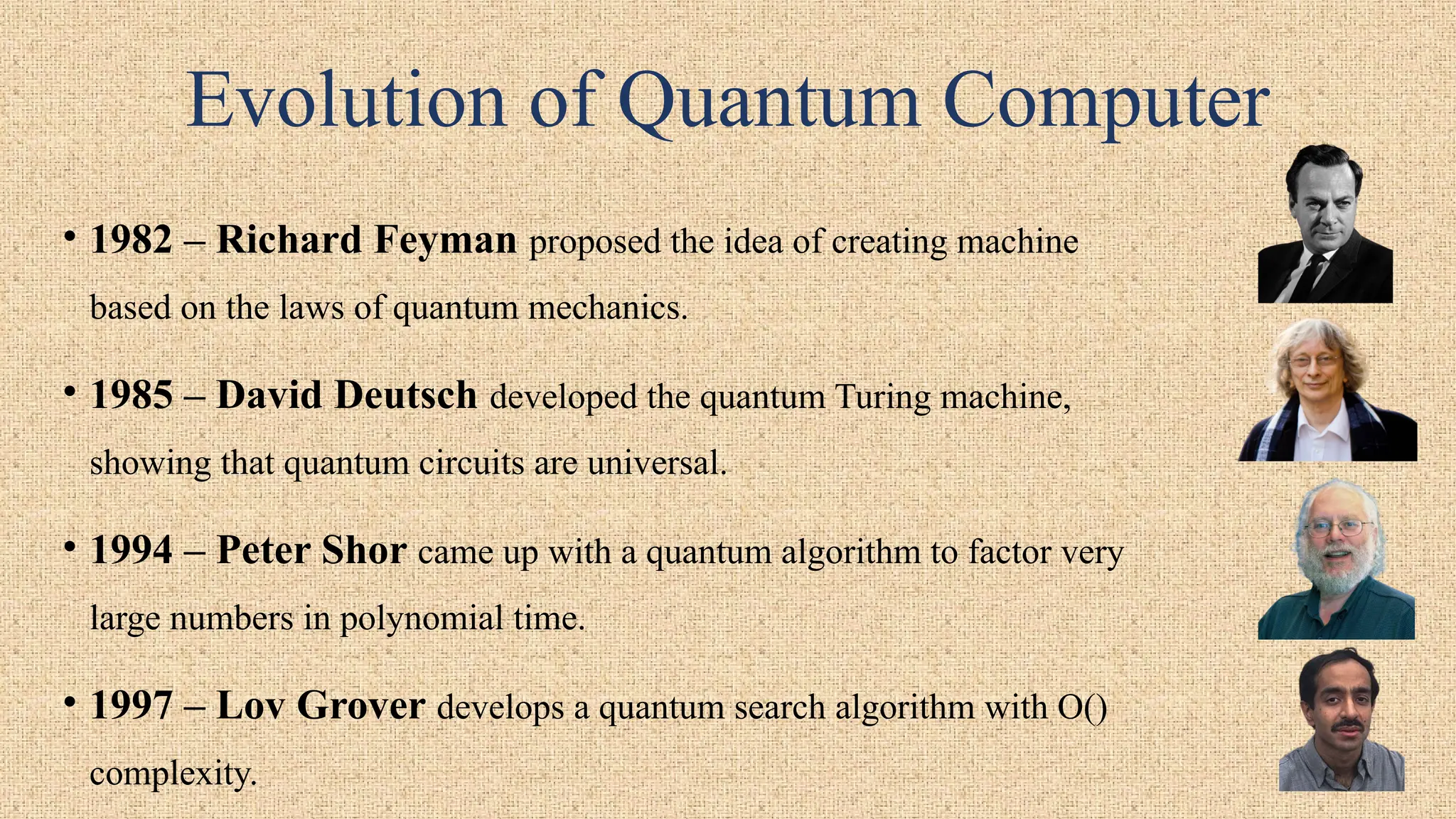
Evolution of QuantumComputer
• 1982 – Richard Feyman proposed the idea of creating machine
based on the laws of quantum mechanics.
• 1985 – David Deutsch developed the quantum Turing machine,
showing that quantum circuits are universal.
• 1994 – Peter Shor came up with a quantum algorithm to factor very
large numbers in polynomial time.
• 1997 – Lov Grover develops a quantum search algorithm with O()
complexity.
8.
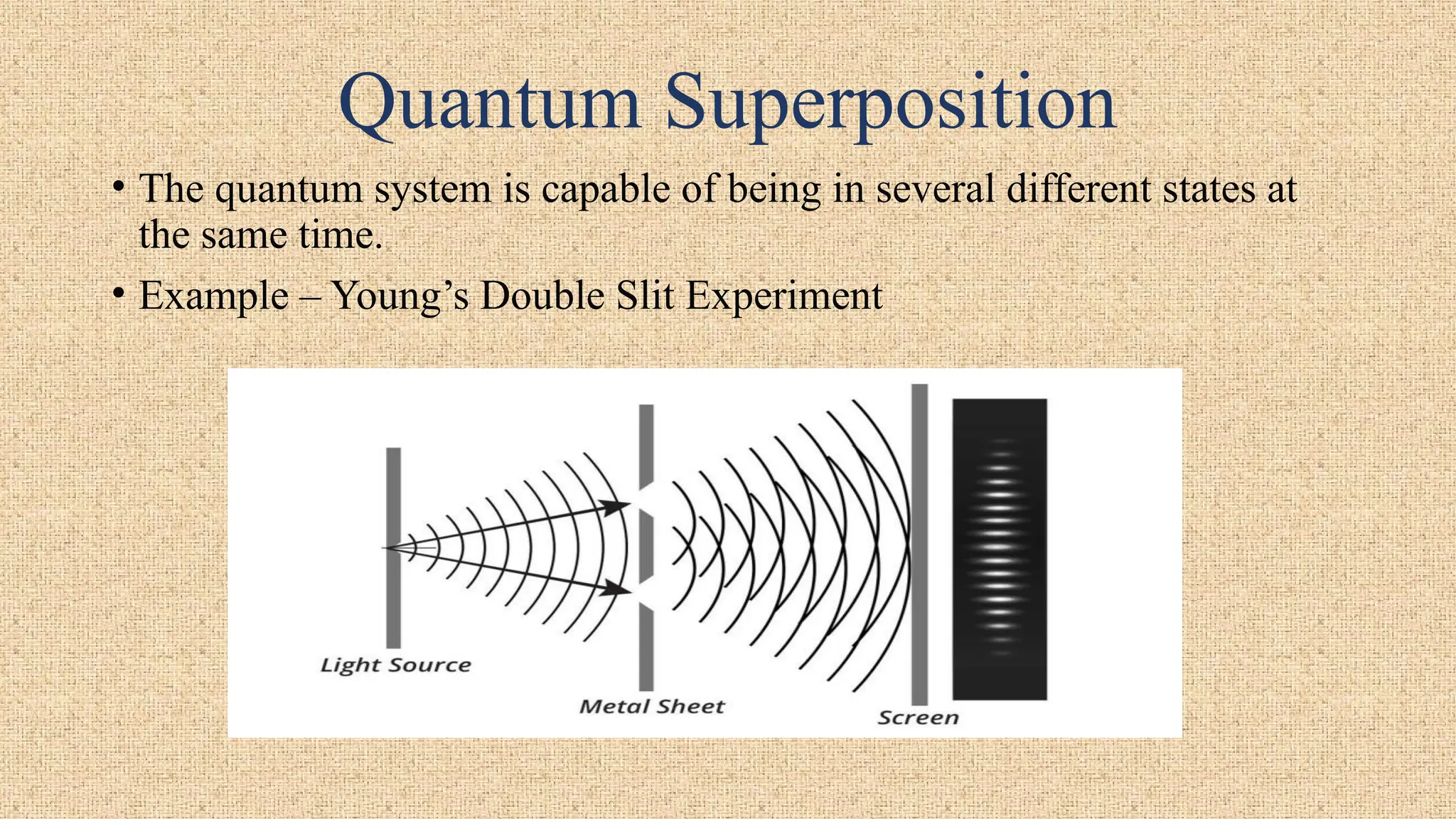
Quantum Superposition
• Thequantum system is capable of being in several different states at
the same time.
• Example – Young’s Double Slit Experiment
9.
Quantum Entanglement
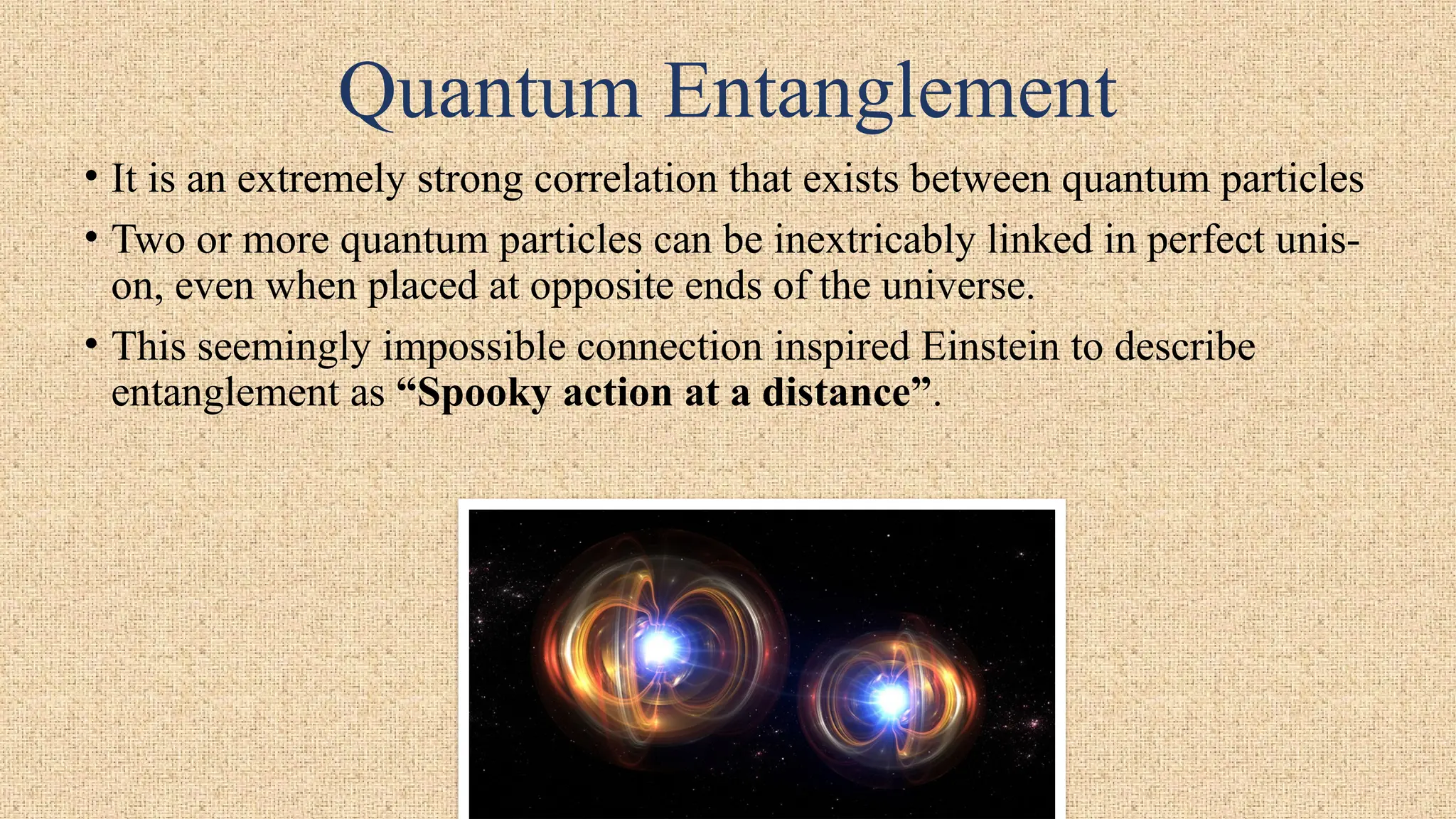
• Itis an extremely strong correlation that exists between quantum particles
• Two or more quantum particles can be inextricably linked in perfect unis-
on, even when placed at opposite ends of the universe.
• This seemingly impossible connection inspired Einstein to describe
entanglement as “Spooky action at a distance”.
10.
How a QuantumComputer works ?
Let’s say you invite five colleagues to your wedding, and you need to
plan their seating arrangements. The total number of ways to do so is 5! = 120.
Now, a conventional computing system tends to evaluate each of the 120
possibilities, compare them, and then decide on the final optimization.
However, a quantum computer undertakes the following steps for
optimizing seat allocation:
11.
How a QuantumComputer works ?
1.Considers qubits and creates quantum superposition for all possible quantum states.
2.The encoder applies phases to each quantum state and configures the qubits. For the
possible sitting ways that fall in phase, the amplitudes add up, while for the out-of-
phase ways, the amplitudes cancel out.
3.The quantum computer then uses interference to reinforce or amplify some answers
and cancel or diminish the others. As a result, a single solution for optimized seat
allocation is finally reached.
12.
Why Quantum Computing?
• Quantum computers take up a fraction of the space of classical computers.
• Level of power that can find solutions to problems out of the reach of today's
computers.
• By decreasing the size of transistors we are gradually approaching to the atom
stage, beyond which we can’t move down except applying the quantum mechanics
which in-turn give rise to quantum computing.
• "A quantum computer can create superposition with multiple probabilities that we
cannot achieve today, let alone examine the features of those probabilities. With
this type of application, the quantum computer will be much more efficient than a
classical computer,” asserts García Ripoll.
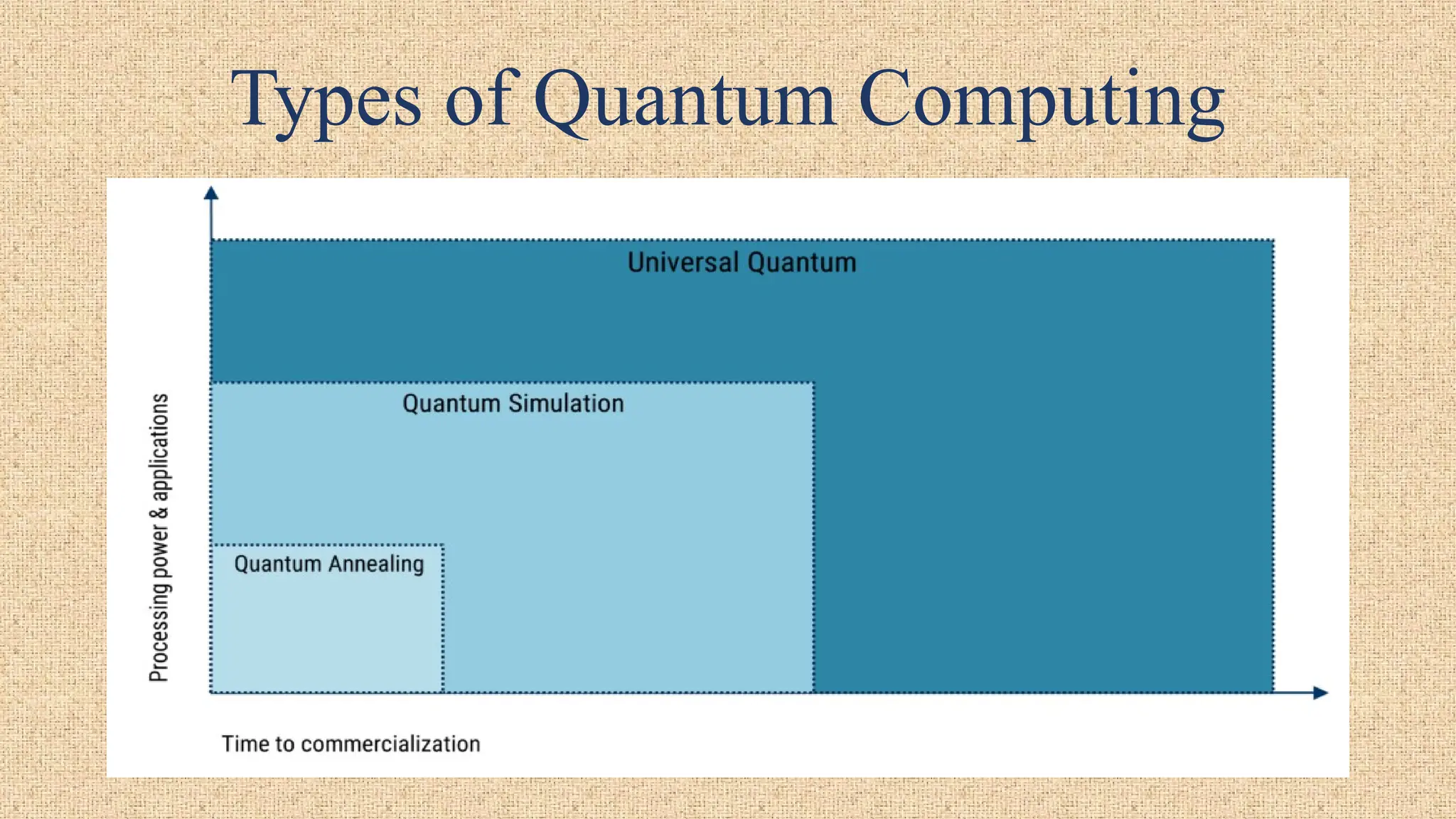
1. Quantum Annealing
•Quantum annealing is best for solving optimization problems.
• Quantum annealing is the least powerful and most narrowly applied form of quantum
computing.
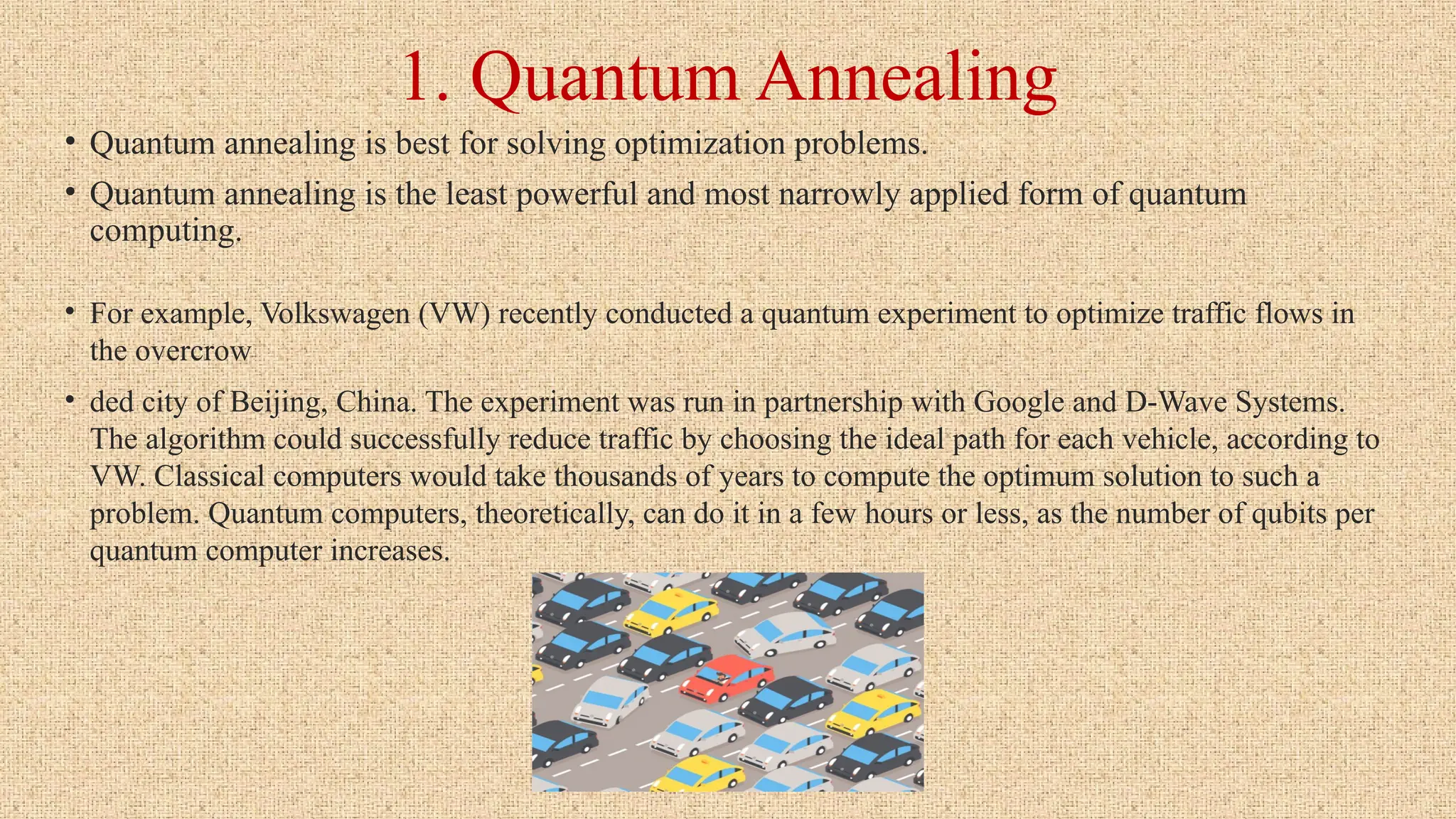
• For example, Volkswagen (VW) recently conducted a quantum experiment to optimize traffic flows in
the overcrow
• ded city of Beijing, China. The experiment was run in partnership with Google and D-Wave Systems.
The algorithm could successfully reduce traffic by choosing the ideal path for each vehicle, according to
VW. Classical computers would take thousands of years to compute the optimum solution to such a
problem. Quantum computers, theoretically, can do it in a few hours or less, as the number of qubits per
quantum computer increases.
15.
2. Quantum Simulation
•Quantum simulations explore specific problems in quantum physics that are
beyond the capacity of classical systems. Simulating complex quantum
phenomena could be one of the most important applications of quantum
computing.
• Quantum simulation promises to have applications in the study of many
problems in, e.g., condensed-matter physics, high-energy physics, atomic
physics, quantum chemistry and cosmology.
16.
2. Quantum Simulation
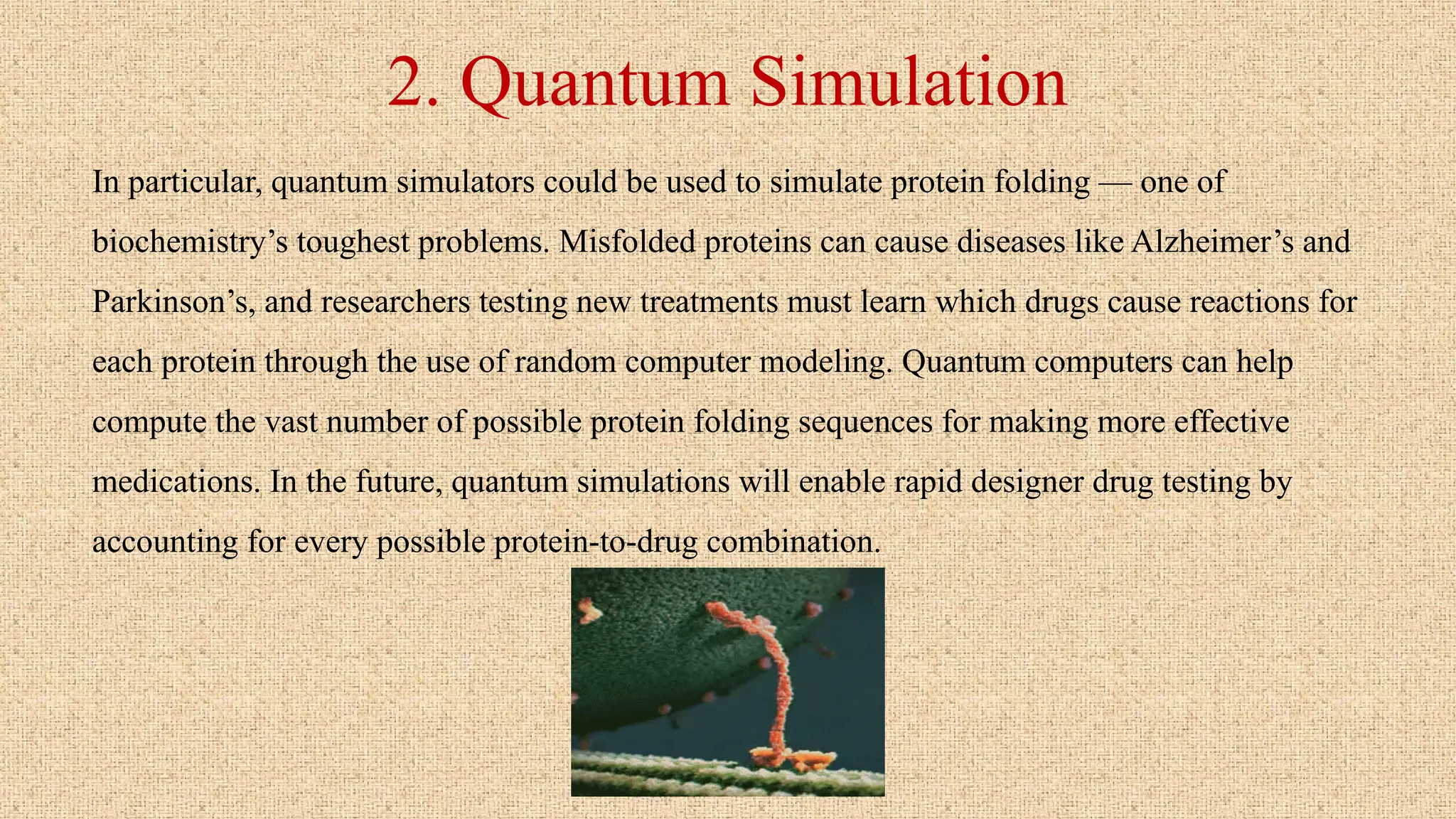
Inparticular, quantum simulators could be used to simulate protein folding — one of
biochemistry’s toughest problems. Misfolded proteins can cause diseases like Alzheimer’s and
Parkinson’s, and researchers testing new treatments must learn which drugs cause reactions for
each protein through the use of random computer modeling. Quantum computers can help
compute the vast number of possible protein folding sequences for making more effective
medications. In the future, quantum simulations will enable rapid designer drug testing by
accounting for every possible protein-to-drug combination.
17.
2. Universal Quantum
•Universal quantum computers are the most powerful and most generally applicable, but
also the hardest to build.
• A truly universal quantum computer would likely make use of over 100,000 qubits.
• The basic idea behind the universal quantum computer is that you could direct the
machine at any massively complex computation and get a quick solution.
• In the distant future, universal quantum computers could revolutionize the field of
artificial intelligence. Quantum AI could enable machine learning that is faster than that
of classical computers.
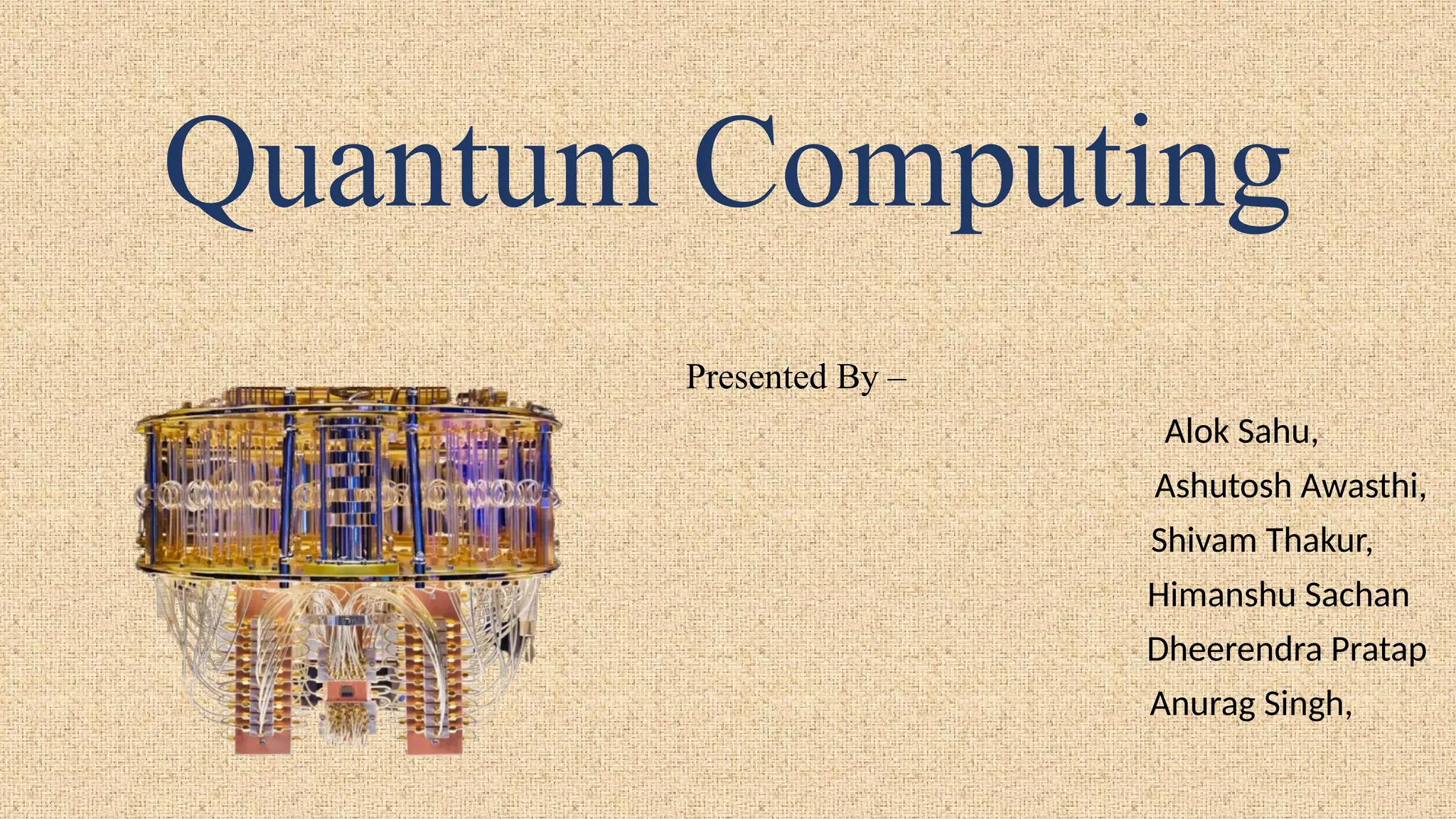
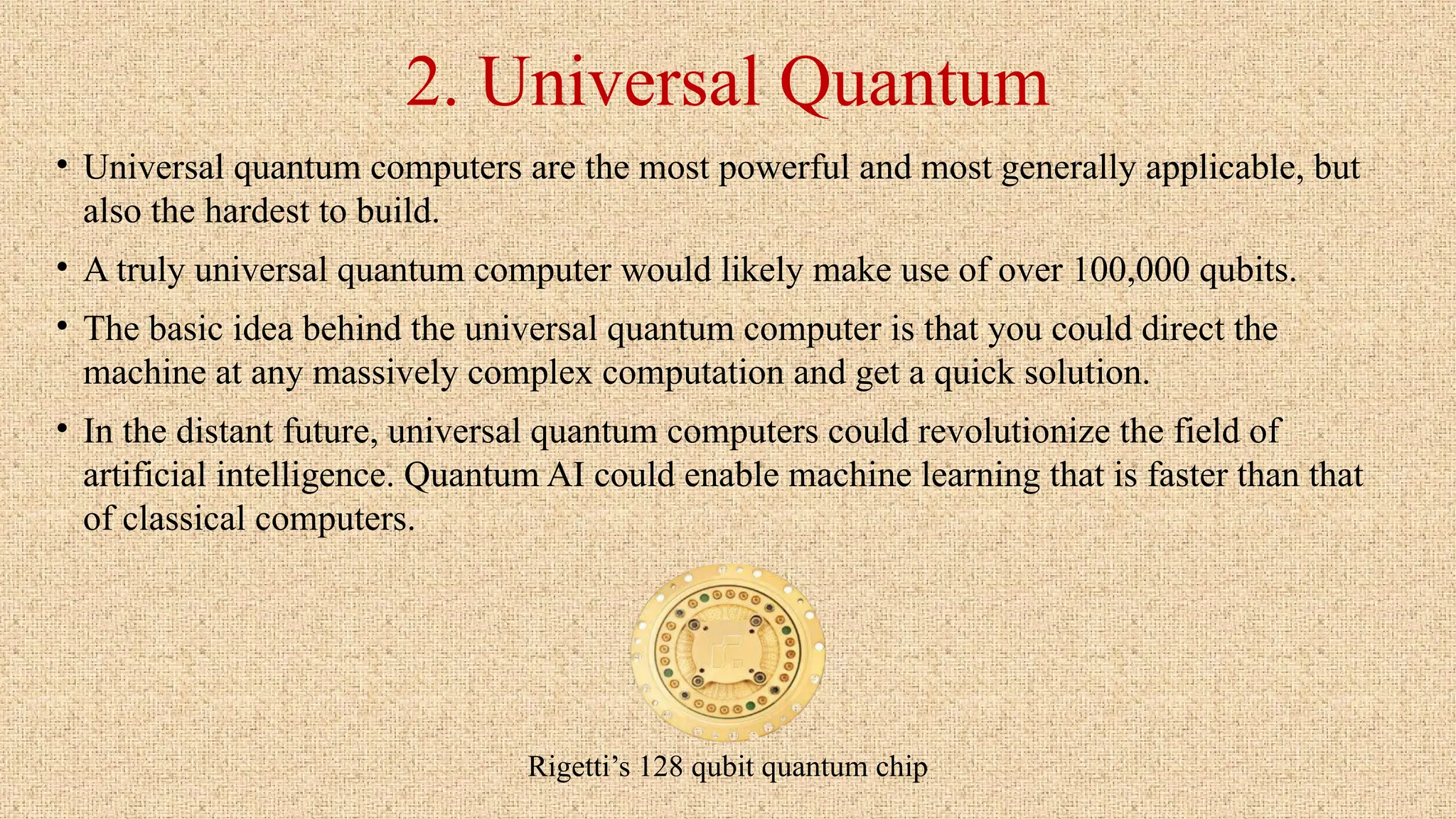
Rigetti’s 128 qubit quantum chip
18.
Advantages of quantumcomputing
• It can process massive amount of complex data.
• It has the ability to solve scientific and commercial problems.
• Its powerful processor can process data in a much faster speed.
• It has the capability to convey more accurate answers.
• Its feature of parallelism enables it to counter large number of
problems simultaneously.
19.
Application of QuantumComputing
• Optimization
• Radio therapy
• Protein folding
• Machine learning
• Labeling new stories
• Video compression
• Monte Carlo Simulation
20.
The future ofQuantum Computing
• Quantum computing technology will only continue to improve.
Quantum computers can also be used to efficiently simulate other
quantum systems. Perhaps someday quantum computers will be used
to design the next generation of classical computers.
• Recently, D-Wave Systems, announce that it broke the 1000 qubit
barrier, which (if true) would make it the most powerful computer on
the planet. Now IBM, Microsoft, HP and Google are trying to figure
out how to advance and commercialize the technology, in association
with D-wave.
21.
Conclusion
• Quantum computershave the potential to revolutionize computation
by making certain types of classically intractable problems solvable.
• While no quantum computer is yet sophisticated enough to carry out
calculations that a classical computer can't, great progress is under
way.
• Quantum simulators are making strides in fields varying from
molecular energetics to many-body physics.



![QUANTUM_COMPUTING_AND_ITS_POTENTIAL_APPLICATIONS[2].pptx](https://cdn.slidesharecdn.com/ss_thumbnails/quantumcomputinganditspotentialapplications2-250814011918-2632c4bc-thumbnail.jpg?width=640&height=640&fit=bounds)


