Quantum Computing
“I think I can safely say that nobody understands quantum
mechanics” - Feynman
Prepared By: Ajay Kumar
MCA IV Semester
(221029020011)
Overview
Introduction and History
Need forQuantum computers
Working Principle
Comparison withToday’sComputers
Advantages andApplications
Conclusion
What is a quantum computer?
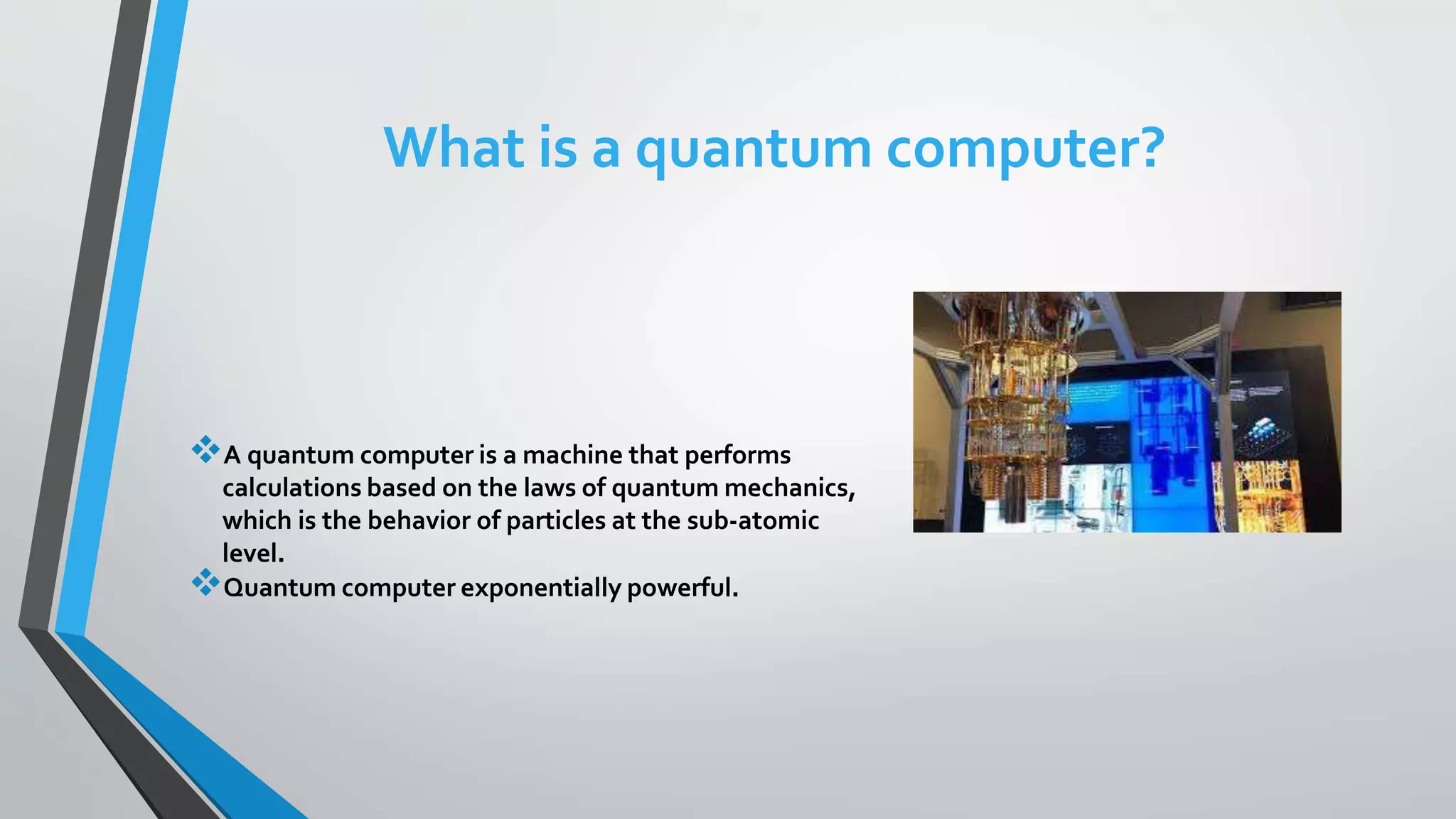
A quantum computer is a machine that performs
calculations based on the laws of quantum mechanics,
which is the behavior of particles at the sub-atomic
level.
Quantum computer exponentially powerful.
History
1982 - Feynman proposed the idea of creating machines based on the
laws of quantum mechanics instead of the laws of classical physics.
1985 - David Deutsch developed the QuantumTuring Machine, showing
that quantum circuits are universal.
1994 - Peter Shor came up with a quantum algorithm to factor very large
numbers in polynomial time.
1997 - LovGrover develops a quantum search algorithm withO(√N)
complexity
Need for Quantum computers
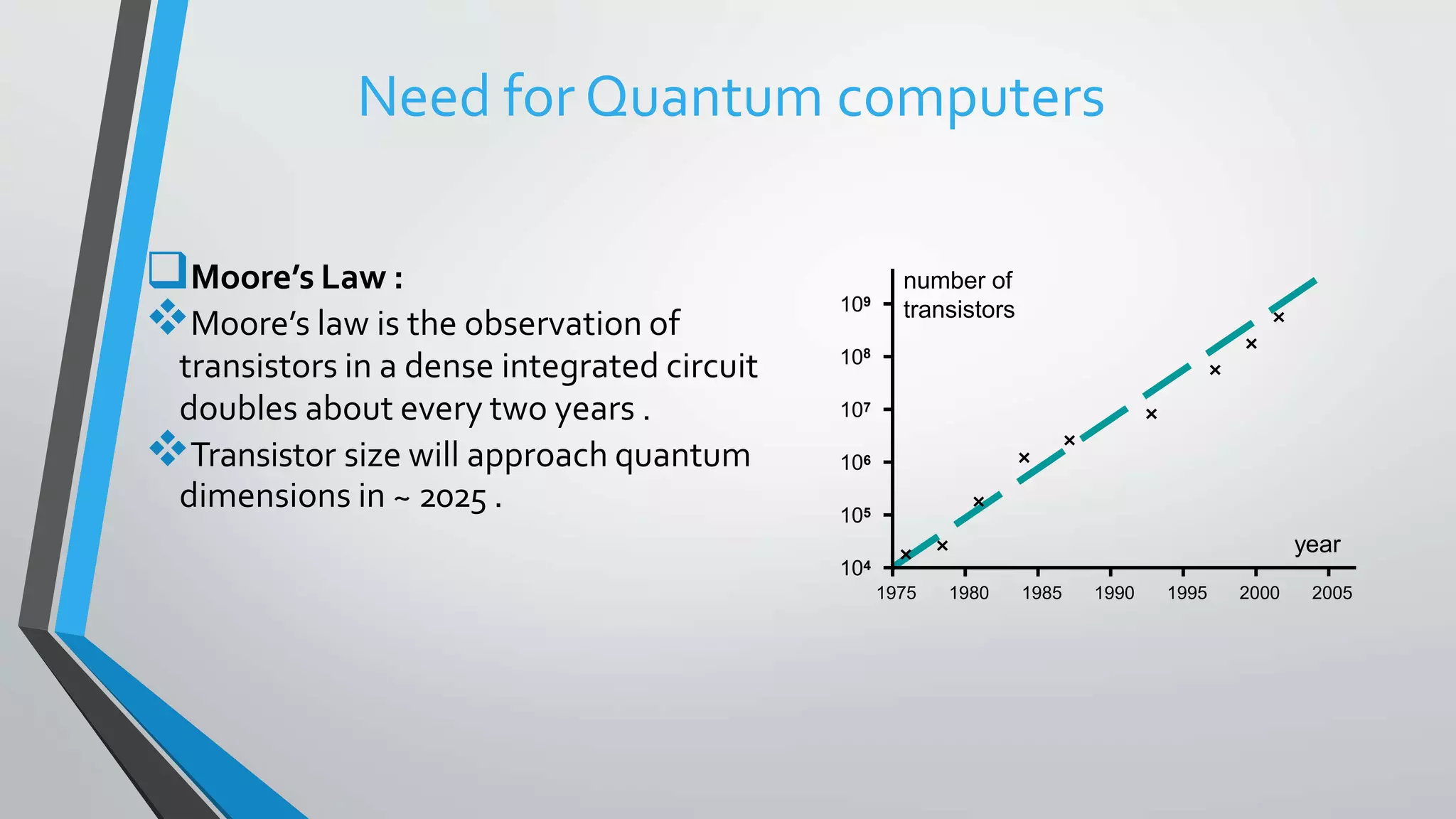
Moore’s Law :
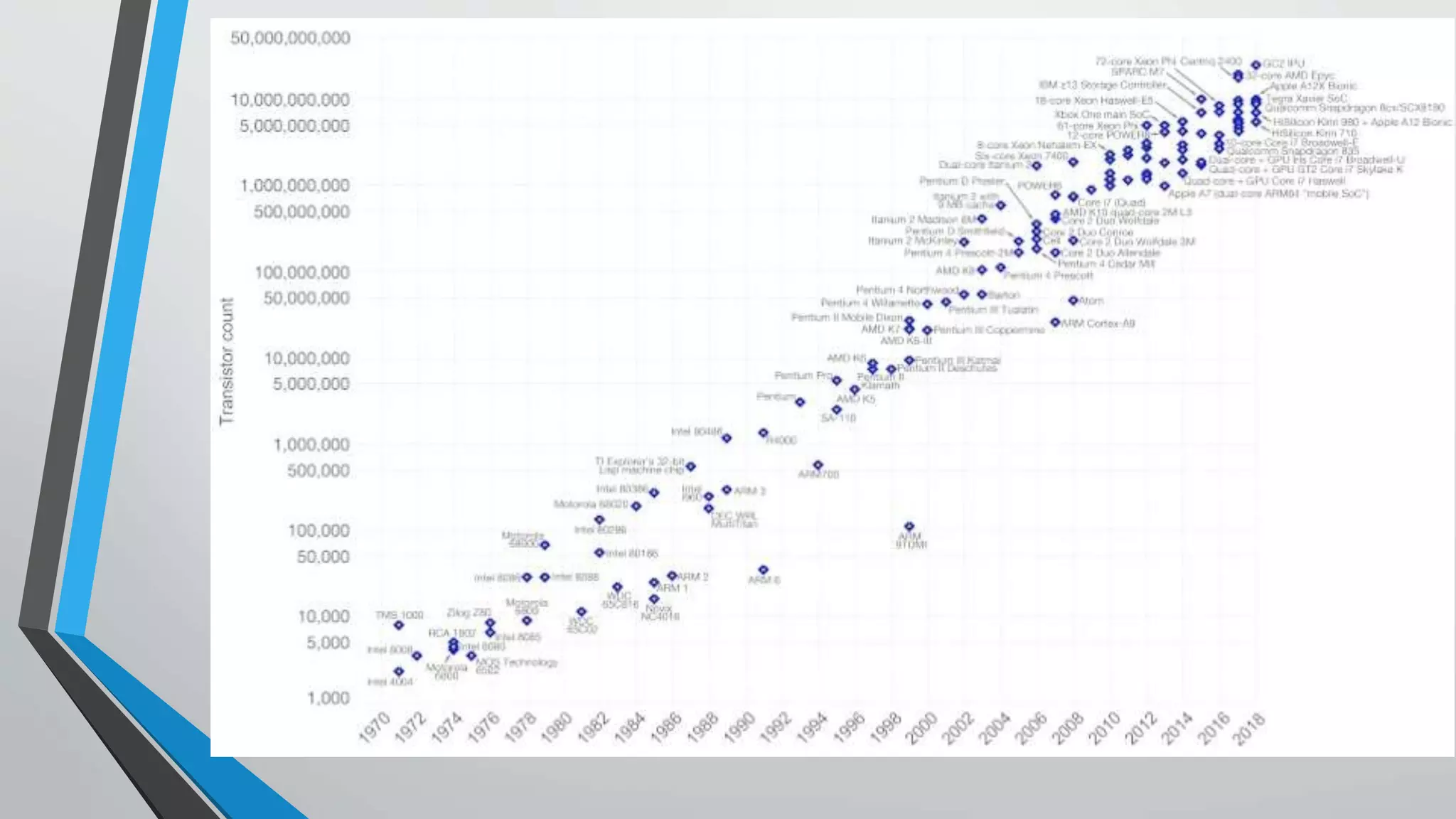
Moore’s law is the observation of
transistors in a dense integrated circuit
doubles about every two years .
Transistor size will approach quantum
dimensions in ~ 2025 .
1975 1980 1985 1990 1995 2000 2005
104
105
106
107
108
109
number of
transistors
year
Qubit
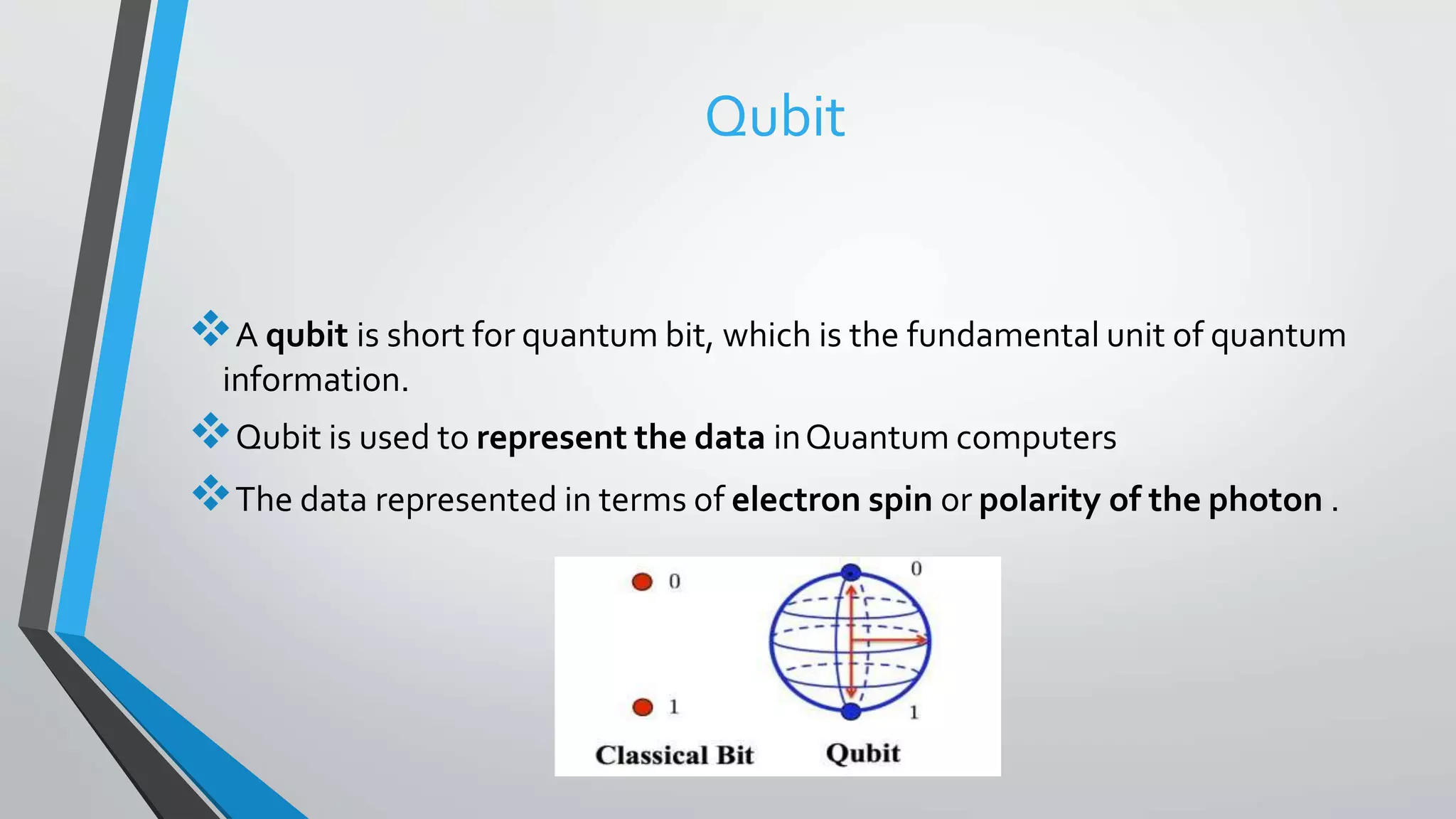
A qubit is short for quantum bit, which is the fundamental unit of quantum
information.
Qubit is used to represent the data inQuantum computers
The data represented in terms of electron spin or polarity of the photon .
How to Manipulate the Qubit data?
The Quantum gates are used to manipulate theQubit states.
TheQubit data can be read by measuring the Qubit’s Energy
level .
Generally computations starts with Initializing and ends with
Measuring.
Quantum Superposition
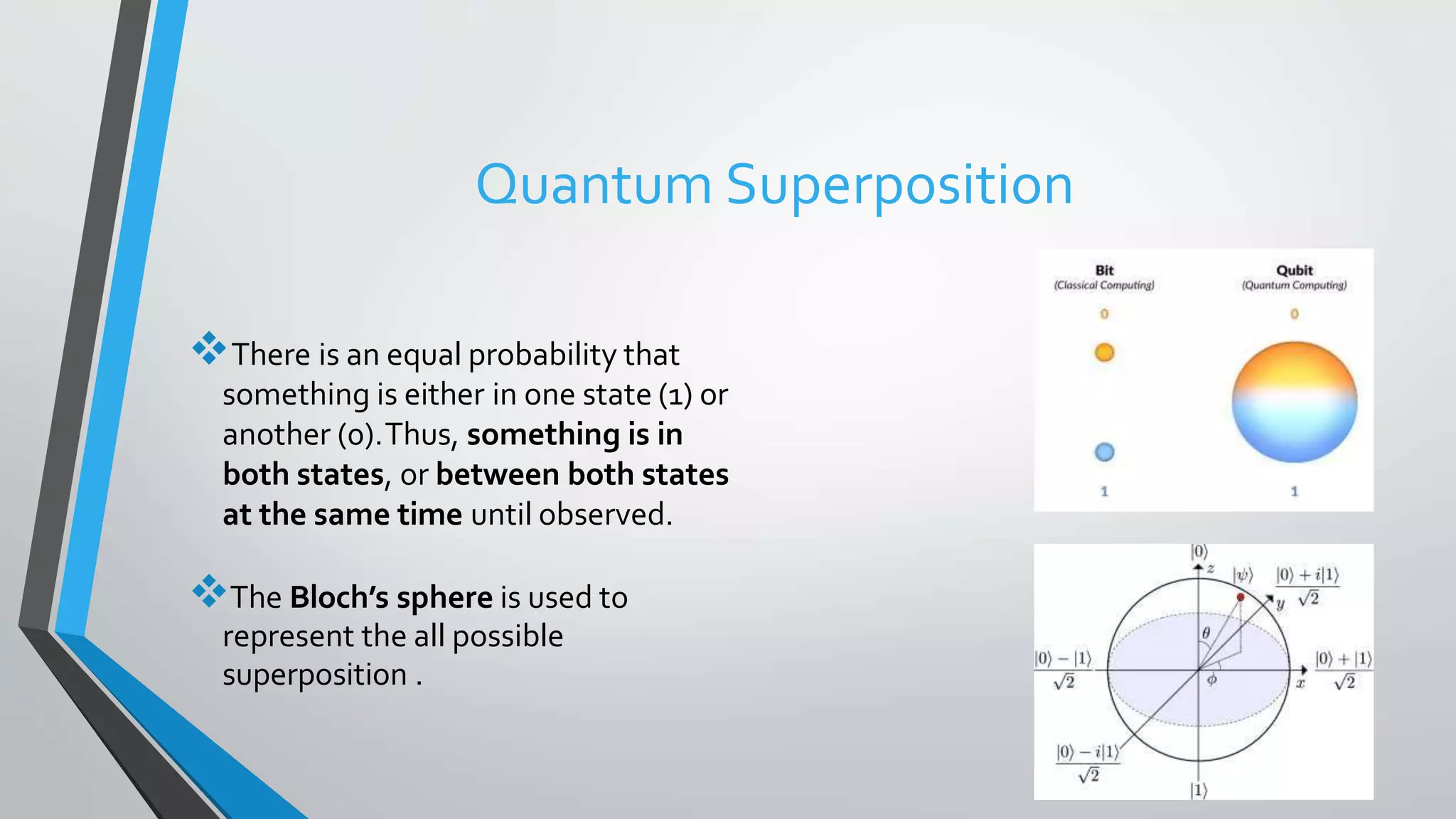
There is an equal probability that
something is either in one state (1) or
another (0).Thus, something is in
both states, or between both states
at the same time until observed.
The Bloch’s sphere is used to
represent the all possible
superposition .
Quantum Entanglement
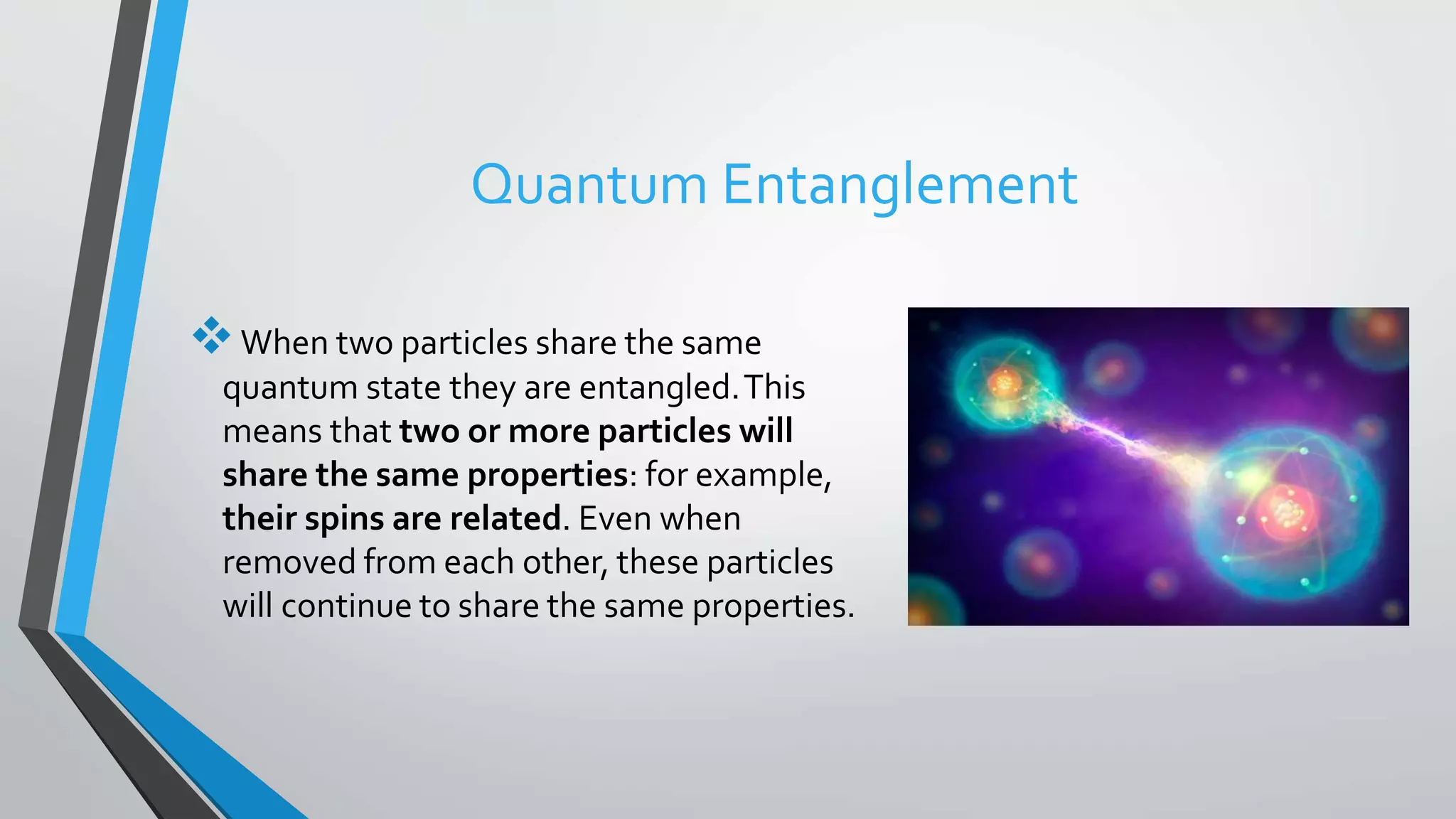
When two particles share the same
quantum state they are entangled.This
means that two or more particles will
share the same properties: for example,
their spins are related. Even when
removed from each other, these particles
will continue to share the same properties.
Comparison with Classical Computers
Today’sComputers
Today's computers work by manipulating bits
that exist in one of two states: a 0 or a 1.
1 and 0’s are carried and turned on by states of
electrical current
QuantumComputers
Quantum computers aren't limited to two
states like today’s computers.They encode
information as quantum bits, or qubits, which
can exist in superposition.
Superposition- quantum computers can
represent both 0 and 1 as well as everything in
between at the same time .
Advantages
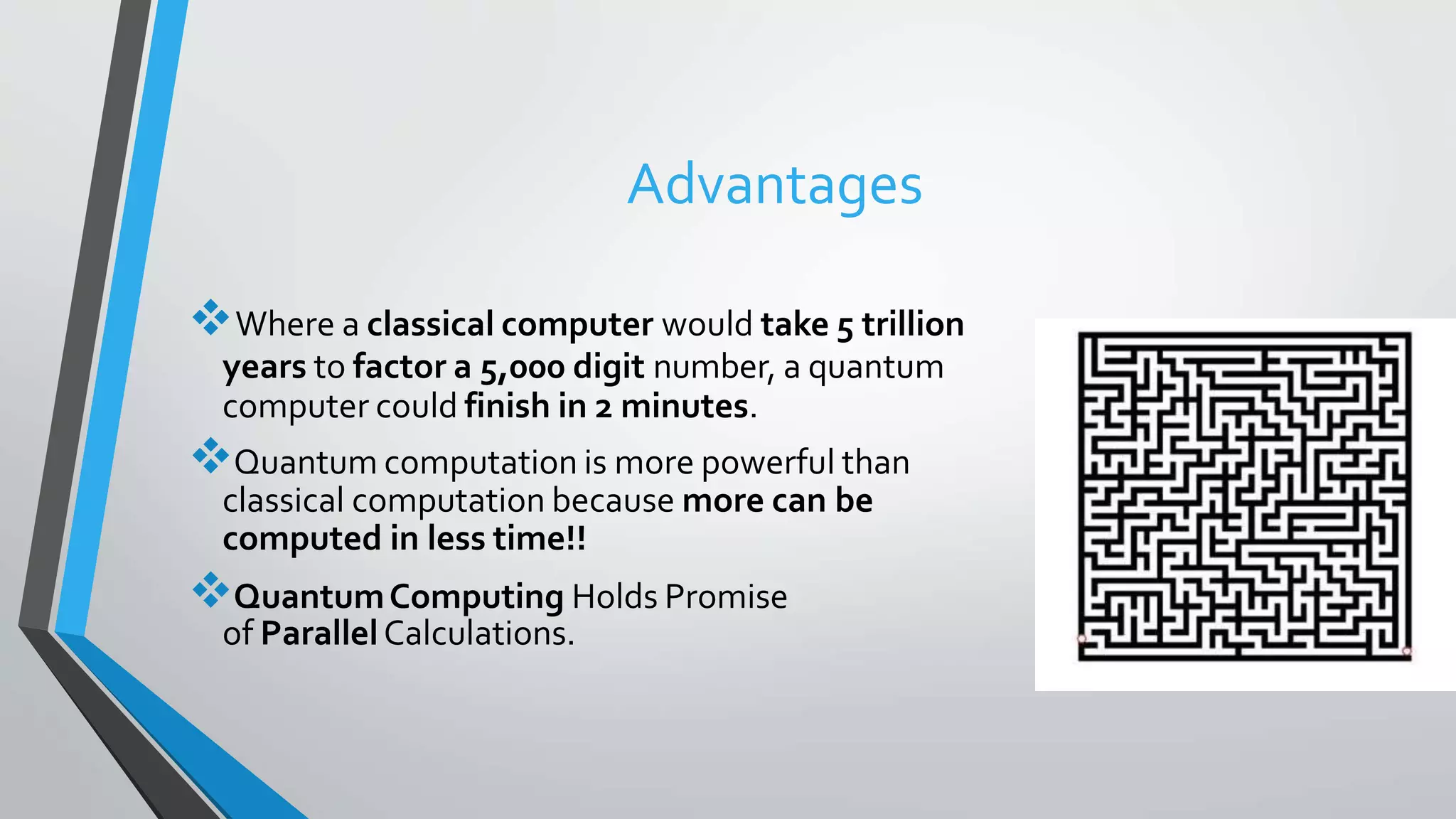
Where a classical computer would take 5 trillion
years to factor a 5,000 digit number, a quantum
computer could finish in 2 minutes.
Quantum computation is more powerful than
classical computation because more can be
computed in less time!!
QuantumComputing Holds Promise
of ParallelCalculations.
Applications
The quantum computers will revolutionize the drug discovery.
We could fire up some AI agents on those quantum computers and make
them create better instances of themselves
ImportantApplications ofQuantumComputing :
 Weather Forecasting
 Financial Modeling
 Molecular Modeling
 Cryptanalysis
 Particle Physics
IBM’s Quantum Computer
ResearchCompanies
D-Wave - Founded in 1999, D-Wave Systems is the world's first quantum
computing company and the leader in the development and delivery of quantum
computing systems and software
1QB Information Technologies, Inc. - is a quantum computing
software company, based in Vancouver, British Columbia.
Cambridge Quantum Computing - is an independent company
combining expertise in Quantum Information Processing,Artificial
Intelligence,Optimisation.
Summary and References
Classical computers reaching quantum scale - need alternative to
transistor technology
Quantum physics allows interesting but difficult alternative to computation
Reference :
https://en.wikipedia.org/wiki/Quantum_computing/
https://fossbytes.com/what-exactly-is-quantum-computing/
ThankYou !!!

Quantum computing ajay.pptx

  • 1.
    Quantum Computing “I thinkI can safely say that nobody understands quantum mechanics” - Feynman Prepared By: Ajay Kumar MCA IV Semester (221029020011)
  • 2.
    Overview Introduction and History NeedforQuantum computers Working Principle Comparison withToday’sComputers Advantages andApplications Conclusion
  • 3.
    What is aquantum computer? A quantum computer is a machine that performs calculations based on the laws of quantum mechanics, which is the behavior of particles at the sub-atomic level. Quantum computer exponentially powerful.
  • 4.
    History 1982 - Feynmanproposed the idea of creating machines based on the laws of quantum mechanics instead of the laws of classical physics. 1985 - David Deutsch developed the QuantumTuring Machine, showing that quantum circuits are universal. 1994 - Peter Shor came up with a quantum algorithm to factor very large numbers in polynomial time. 1997 - LovGrover develops a quantum search algorithm withO(√N) complexity
  • 5.
    Need for Quantumcomputers Moore’s Law : Moore’s law is the observation of transistors in a dense integrated circuit doubles about every two years . Transistor size will approach quantum dimensions in ~ 2025 . 1975 1980 1985 1990 1995 2000 2005 104 105 106 107 108 109 number of transistors year
  • 7.
    Qubit A qubit isshort for quantum bit, which is the fundamental unit of quantum information. Qubit is used to represent the data inQuantum computers The data represented in terms of electron spin or polarity of the photon .
  • 8.
    How to Manipulatethe Qubit data? The Quantum gates are used to manipulate theQubit states. TheQubit data can be read by measuring the Qubit’s Energy level . Generally computations starts with Initializing and ends with Measuring.
  • 9.
    Quantum Superposition There isan equal probability that something is either in one state (1) or another (0).Thus, something is in both states, or between both states at the same time until observed. The Bloch’s sphere is used to represent the all possible superposition .
  • 10.
    Quantum Entanglement When twoparticles share the same quantum state they are entangled.This means that two or more particles will share the same properties: for example, their spins are related. Even when removed from each other, these particles will continue to share the same properties.
  • 11.
    Comparison with ClassicalComputers Today’sComputers Today's computers work by manipulating bits that exist in one of two states: a 0 or a 1. 1 and 0’s are carried and turned on by states of electrical current QuantumComputers Quantum computers aren't limited to two states like today’s computers.They encode information as quantum bits, or qubits, which can exist in superposition. Superposition- quantum computers can represent both 0 and 1 as well as everything in between at the same time .
  • 12.
    Advantages Where a classicalcomputer would take 5 trillion years to factor a 5,000 digit number, a quantum computer could finish in 2 minutes. Quantum computation is more powerful than classical computation because more can be computed in less time!! QuantumComputing Holds Promise of ParallelCalculations.
  • 13.
    Applications The quantum computerswill revolutionize the drug discovery. We could fire up some AI agents on those quantum computers and make them create better instances of themselves ImportantApplications ofQuantumComputing :  Weather Forecasting  Financial Modeling  Molecular Modeling  Cryptanalysis  Particle Physics
  • 14.
  • 15.
    ResearchCompanies D-Wave - Foundedin 1999, D-Wave Systems is the world's first quantum computing company and the leader in the development and delivery of quantum computing systems and software 1QB Information Technologies, Inc. - is a quantum computing software company, based in Vancouver, British Columbia. Cambridge Quantum Computing - is an independent company combining expertise in Quantum Information Processing,Artificial Intelligence,Optimisation.
  • 16.
    Summary and References Classicalcomputers reaching quantum scale - need alternative to transistor technology Quantum physics allows interesting but difficult alternative to computation Reference : https://en.wikipedia.org/wiki/Quantum_computing/ https://fossbytes.com/what-exactly-is-quantum-computing/
  • 17.