Quantum Computer
A FUTURE APPROACH IN COMPUTING
“Not only is the
Universe stranger than
we think, it is stranger
than we can think.”
Werner Heisenberg
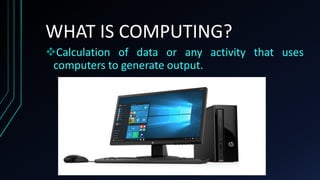
WHAT IS COMPUTING?
Calculation of data or any activity that uses
computers to generate output.
WHY DO WE NEED
QUANTUM COMPUTERS
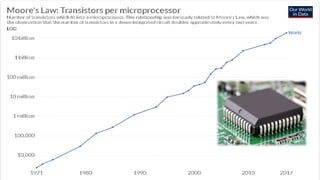
Moore’s Law
“The number of transistors in a
dense integrated circuit doubles
every 18 months and will continue
for at least a decade.”
Gordon Moore , 1997
It’s expected that the Moore’s
law will end by 2025.
“The world is running out of computing
capacity. Moore’s law is kinda running
out of steam … [we need quantum
computing to] create all of these rich
experiences we talk about, all of this
artificial intelligence.”
Satya Nadella , Microsoft CEO
What is a quantum computer?
“Quantum computer is a device which makes
the use of the quantum states of subatomic
particles to store information.”
Performs calculations based on the probability
of an object's state before it is measured.
History of Quantum
computers
How quantum computers
are different from
Classical computers?
CLASSICAL
COMPUTERS
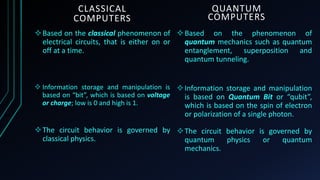
Based on the classical phenomenon of
electrical circuits, that is either on or
off at a time.
QUANTUM
COMPUTERS
Based on the phenomenon of
quantum mechanics such as quantum
entanglement, superposition and
quantum tunneling.
The circuit behavior is governed by
classical physics.
 Information storage and manipulation is
based on “bit”, which is based on voltage
or charge; low is 0 and high is 1.
Information storage and manipulation
is based on Quantum Bit or “qubit”,
which is based on the spin of electron
or polarization of a single photon.
The circuit behavior is governed by
quantum physics or quantum
mechanics.
“A classical computation is like a solo voice—
one line of pure tones succeeding each other.
A quantum computation is like a symphony—
many lines of tones interfering with one
another.”
Seth Lloyd
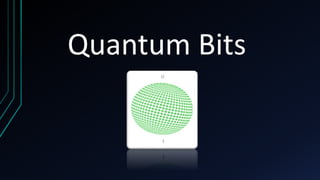
Quantum Bits
Typically subatomic particles such as electrons, protons or
photons.
Qu-bit = 2^q bits.
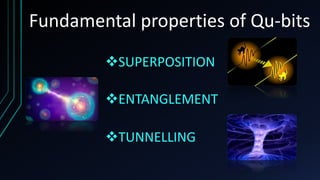
Fundamental properties of Qu-bits
SUPERPOSITION
ENTANGLEMENT
TUNNELLING
BASIC PHENOMENON OF
QUANTUM MECHANICS
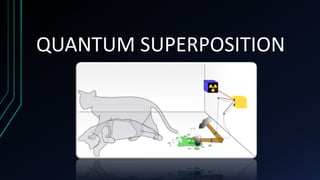
QUANTUM SUPERPOSITION
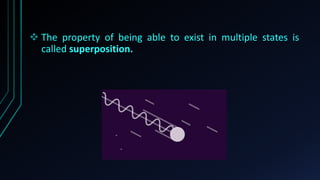
 The property of being able to exist in multiple states is
called superposition.
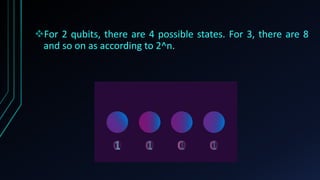
For 2 qubits, there are 4 possible states. For 3, there are 8
and so on as according to 2^n.
BUT, what is the result when a qubit is
observed?
QUANTUM ENTANGLEMENT
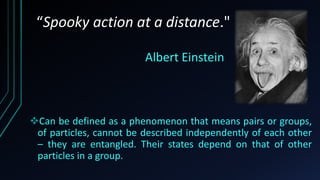
Can be defined as a phenomenon that means pairs or groups,
of particles, cannot be described independently of each other
– they are entangled. Their states depend on that of other
particles in a group.
“Spooky action at a distance."
Albert Einstein
Thanks to entanglement, qu-bits can hold up to two bits of data
and transmit data between qu-bits up to 1200 km apart.
QUANTUM TUNNELLING
Quantum tunnelling is the quantum-mechanical
effect of transitioning through a classically-
forbidden energy state.
 Quantum Tunnelling is what gives the quantum
computers the potential to perform tasks a classical
computer simply could not do.
Scope of Quantum computers
Shor’s algorithm.
Breaking cryptographic systems
Artificial Intelligence
 Calculating the probabilities for many possible choices.
finding the most suitable solution
FINANCIAL MODELING WEATHER FORECAST
DIFFICULTIES IN
BUILDING A
QUANTUM
COMPUTER/EXTREME
CONDITIONS
NO EXTERNAL NOISE/INTERFERENCE
Extremely sensitive, any external change can
collapse super position.
Also defined as DECOHERENCE.
EXTREMELY LOW TEMPERATURE
To achieve superconductivity, theoretically minimum
possible temperature is required.
D-wave system works on the temperature of 0.015
Kelvin above absolute zero.
EXTREMELY LOW PRESSURE
Very low pressure is required so that qubits can
function without any disturbance.
D-Wave system, the first practical quantum computer
has 10 billion times less pressure than the atmosphere.
EXTREMELY WEAK MAGNETIC FIELD
Protection against magnetic field is required to protect
qubits from external magnetic interference.
D-Wave system is shielded to 50000x less than Earth’s
magnetic field.
SOME INTERESTING FACTS
ABOUT QUANTUM COMPUTERS
MINDBLOWING COMPUTING POWER
A quantum computer containing more than 50 qubits can beat any
super computer in terms of computation power.
Recently GOOGLE claimed that its quantum computer containing only
53 qubits has completed a task only in 200 seconds that ordinary
computers require 10000 years to do!
CALCULATING PROBABILITY
IBM’s Deep Blue defeated Garry Kasparov, chess
grandmaster because it could calculate 22 million
moves per second. With a quantum computer,
these calculations would be 1 TRILLION per second
ANOTHER THING TO KEEP IN MIND
 Quantum computers will not replace Classical computers
“Nature is not classical , dammit, and if you want
to make a simulation of nature you’d better
make it quantum mechanical, and by golly, it’s a
wonderful problem because it does not look
easy.”
Richard Feynman, 1981
Resources
 Wikipedia
 Quantum computing 101(uwaterloo)
 https://www.sciencealert.com/
 https://www.ibm.com/
 https://medium.com/
 https://superposition.com/
 https://www.sciencedaily.com/
 https://www.weforum.org/
 https://computer.howstuffworks.com/
 https://www.dwavesys.com/
 https://www.technologyreview.com/
 https://www.researchgate.net/
 https://www.linkedin.com/pulse/physics-behind-quantum-computers-entanglement
COMPOSED
BY
HUZAIFAH IBRAHIM
ANY QUERY

Quantum Computer-a future approach in computing

  • 1.
    Quantum Computer A FUTUREAPPROACH IN COMPUTING
  • 2.
    “Not only isthe Universe stranger than we think, it is stranger than we can think.” Werner Heisenberg
  • 3.
    WHAT IS COMPUTING? Calculationof data or any activity that uses computers to generate output.
  • 4.
    WHY DO WENEED QUANTUM COMPUTERS
  • 5.
    Moore’s Law “The numberof transistors in a dense integrated circuit doubles every 18 months and will continue for at least a decade.” Gordon Moore , 1997 It’s expected that the Moore’s law will end by 2025.
  • 7.
    “The world isrunning out of computing capacity. Moore’s law is kinda running out of steam … [we need quantum computing to] create all of these rich experiences we talk about, all of this artificial intelligence.” Satya Nadella , Microsoft CEO
  • 8.
    What is aquantum computer? “Quantum computer is a device which makes the use of the quantum states of subatomic particles to store information.”
  • 9.
    Performs calculations basedon the probability of an object's state before it is measured.
  • 10.
  • 12.
    How quantum computers aredifferent from Classical computers?
  • 13.
    CLASSICAL COMPUTERS Based on theclassical phenomenon of electrical circuits, that is either on or off at a time. QUANTUM COMPUTERS Based on the phenomenon of quantum mechanics such as quantum entanglement, superposition and quantum tunneling. The circuit behavior is governed by classical physics.  Information storage and manipulation is based on “bit”, which is based on voltage or charge; low is 0 and high is 1. Information storage and manipulation is based on Quantum Bit or “qubit”, which is based on the spin of electron or polarization of a single photon. The circuit behavior is governed by quantum physics or quantum mechanics.
  • 14.
    “A classical computationis like a solo voice— one line of pure tones succeeding each other. A quantum computation is like a symphony— many lines of tones interfering with one another.” Seth Lloyd
  • 15.
  • 16.
    Typically subatomic particlessuch as electrons, protons or photons. Qu-bit = 2^q bits.
  • 17.
    Fundamental properties ofQu-bits SUPERPOSITION ENTANGLEMENT TUNNELLING
  • 19.
  • 20.
  • 21.
     The propertyof being able to exist in multiple states is called superposition.
  • 22.
    For 2 qubits,there are 4 possible states. For 3, there are 8 and so on as according to 2^n.
  • 23.
    BUT, what isthe result when a qubit is observed?
  • 24.
  • 25.
    Can be definedas a phenomenon that means pairs or groups, of particles, cannot be described independently of each other – they are entangled. Their states depend on that of other particles in a group. “Spooky action at a distance." Albert Einstein
  • 26.
    Thanks to entanglement,qu-bits can hold up to two bits of data and transmit data between qu-bits up to 1200 km apart.
  • 27.
  • 28.
    Quantum tunnelling isthe quantum-mechanical effect of transitioning through a classically- forbidden energy state.
  • 29.
     Quantum Tunnellingis what gives the quantum computers the potential to perform tasks a classical computer simply could not do.
  • 30.
  • 31.
  • 32.
    Artificial Intelligence  Calculatingthe probabilities for many possible choices. finding the most suitable solution
  • 33.
  • 34.
  • 35.
    NO EXTERNAL NOISE/INTERFERENCE Extremelysensitive, any external change can collapse super position. Also defined as DECOHERENCE.
  • 36.
    EXTREMELY LOW TEMPERATURE Toachieve superconductivity, theoretically minimum possible temperature is required. D-wave system works on the temperature of 0.015 Kelvin above absolute zero.
  • 37.
    EXTREMELY LOW PRESSURE Verylow pressure is required so that qubits can function without any disturbance. D-Wave system, the first practical quantum computer has 10 billion times less pressure than the atmosphere.
  • 38.
    EXTREMELY WEAK MAGNETICFIELD Protection against magnetic field is required to protect qubits from external magnetic interference. D-Wave system is shielded to 50000x less than Earth’s magnetic field.
  • 39.
  • 40.
    MINDBLOWING COMPUTING POWER Aquantum computer containing more than 50 qubits can beat any super computer in terms of computation power. Recently GOOGLE claimed that its quantum computer containing only 53 qubits has completed a task only in 200 seconds that ordinary computers require 10000 years to do!
  • 41.
    CALCULATING PROBABILITY IBM’s DeepBlue defeated Garry Kasparov, chess grandmaster because it could calculate 22 million moves per second. With a quantum computer, these calculations would be 1 TRILLION per second
  • 42.
    ANOTHER THING TOKEEP IN MIND  Quantum computers will not replace Classical computers
  • 43.
    “Nature is notclassical , dammit, and if you want to make a simulation of nature you’d better make it quantum mechanical, and by golly, it’s a wonderful problem because it does not look easy.” Richard Feynman, 1981
  • 44.
    Resources  Wikipedia  Quantumcomputing 101(uwaterloo)  https://www.sciencealert.com/  https://www.ibm.com/  https://medium.com/  https://superposition.com/  https://www.sciencedaily.com/  https://www.weforum.org/  https://computer.howstuffworks.com/  https://www.dwavesys.com/  https://www.technologyreview.com/  https://www.researchgate.net/  https://www.linkedin.com/pulse/physics-behind-quantum-computers-entanglement
  • 45.
  • 47.