Adding Quantitative Risk Analysis
                        to your
                   “Swiss Army knife”
                                John C. Goodpasture
                                 Managing Principal
                          Square Peg Consulting


©Square Peg Consulting, 2010, all rights reserved
Schedule: Your “Swiss Army
       Knife”
             Calendar
             Deliverables
             Tasks
             Work Breakdown of scope
             Project Logic
             Resource plan
             Margin of Risk [slack]


©Square Peg Consulting, 2010, all rights reserved
What’s missing?

             Not much
             Quantitative risk analysis


©Square Peg Consulting, 2010, all rights reserved
Project Context

             Projects are the result of business
            investment decisions
                   Investors seek returns
                   commensurate with risk and
                   resources committed
                   Public sector, private sector, non-
                   profits
                   Monetary or mission-success returns

©Square Peg Consulting, 2010, all rights reserved
Project Manager’s mission: “Deliver the
          scope, taking measured risks to do so”

©Square Peg Consulting, 2010, all rights reserved
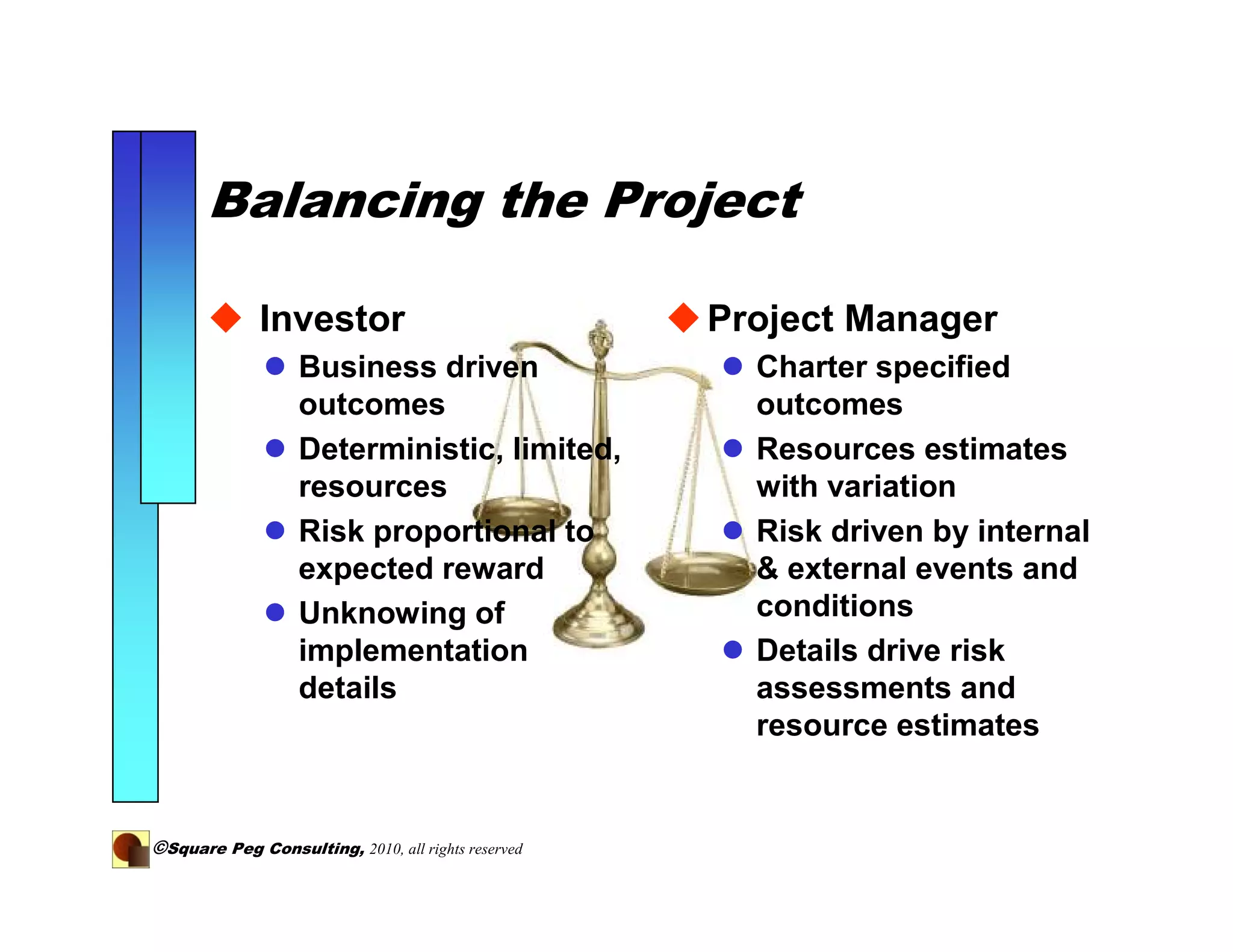
Balancing the Project

              Investor                              Project Manager
                   Business driven                    Charter specified
                   outcomes                           outcomes
                   Deterministic, limited,            Resources estimates
                   resources                          with variation
                   Risk proportional to               Risk driven by internal
                   expected reward                    & external events and
                   Unknowing of                       conditions
                   implementation                     Details drive risk
                   details                            assessments and
                                                      resource estimates


©Square Peg Consulting, 2010, all rights reserved
Project Equation:
        Resources committed =
        Resources Estimated + Project Risks
©Square Peg Consulting, 2010, all rights reserved
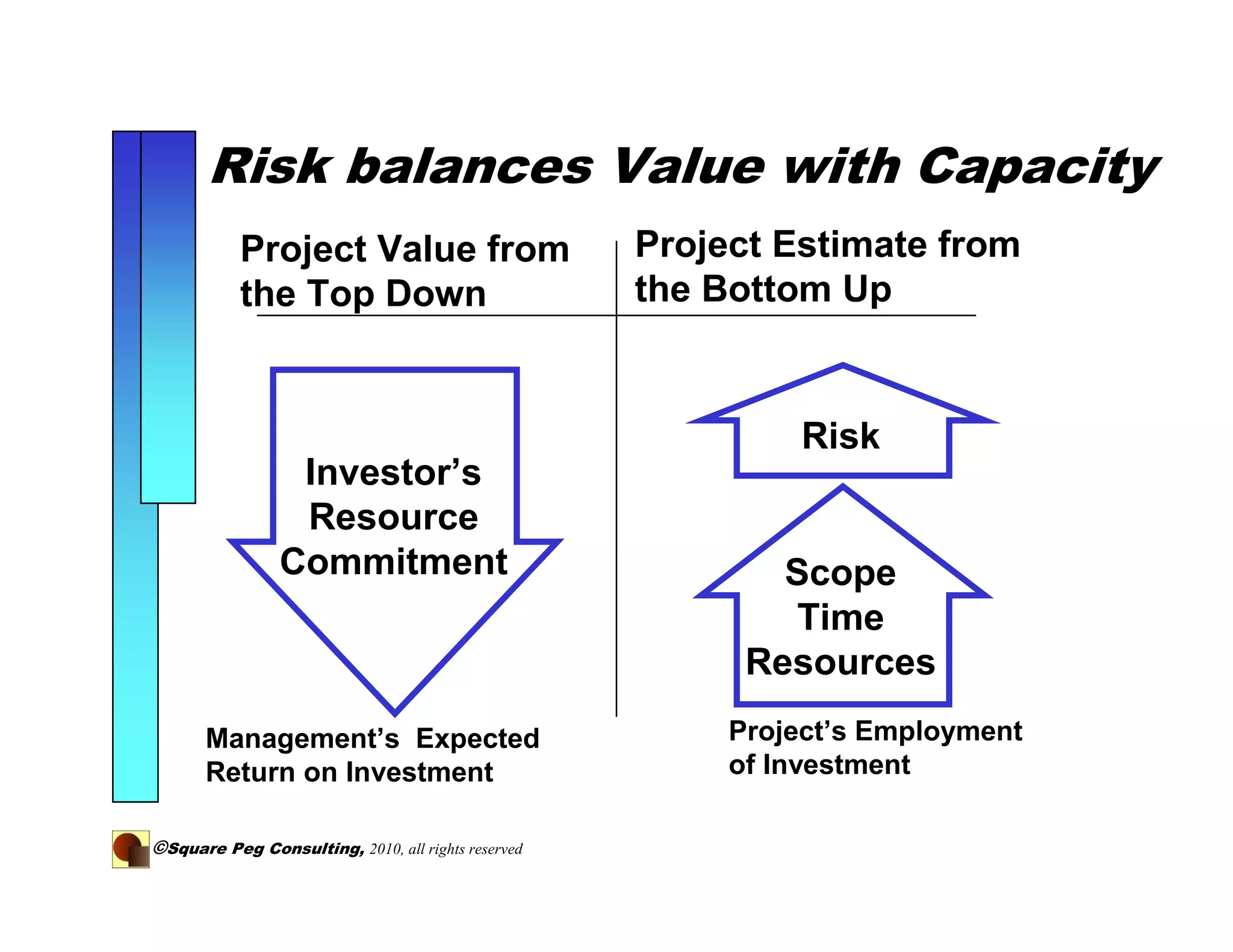
Risk balances Value with Capacity
           Project Value from                       Project Estimate from
           the Top Down                             the Bottom Up


                                                             Risk
                 Investor’s
                 Resource
                Commitment                                  Scope
                                                             Time
                                                          Resources
       Management’s Expected                             Project’s Employment
       Return on Investment                              of Investment

©Square Peg Consulting, 2010, all rights reserved
Managing risk

             All plans have uncertainties, and
            thus outcomes are at risk
             Probabilities and statistics are
            important data to understand and
            deal with uncertainties
             Information provides insight for
            problem avoidance

©Square Peg Consulting, 2010, all rights reserved
Why apply risk analysis to
       schedules?
            Determine the likelihood of overrunning
            the schedule
            Find architectural weakness in the
            schedule
            Estimate risk needed to balance
            investor commitment


©Square Peg Consulting, 2010, all rights reserved
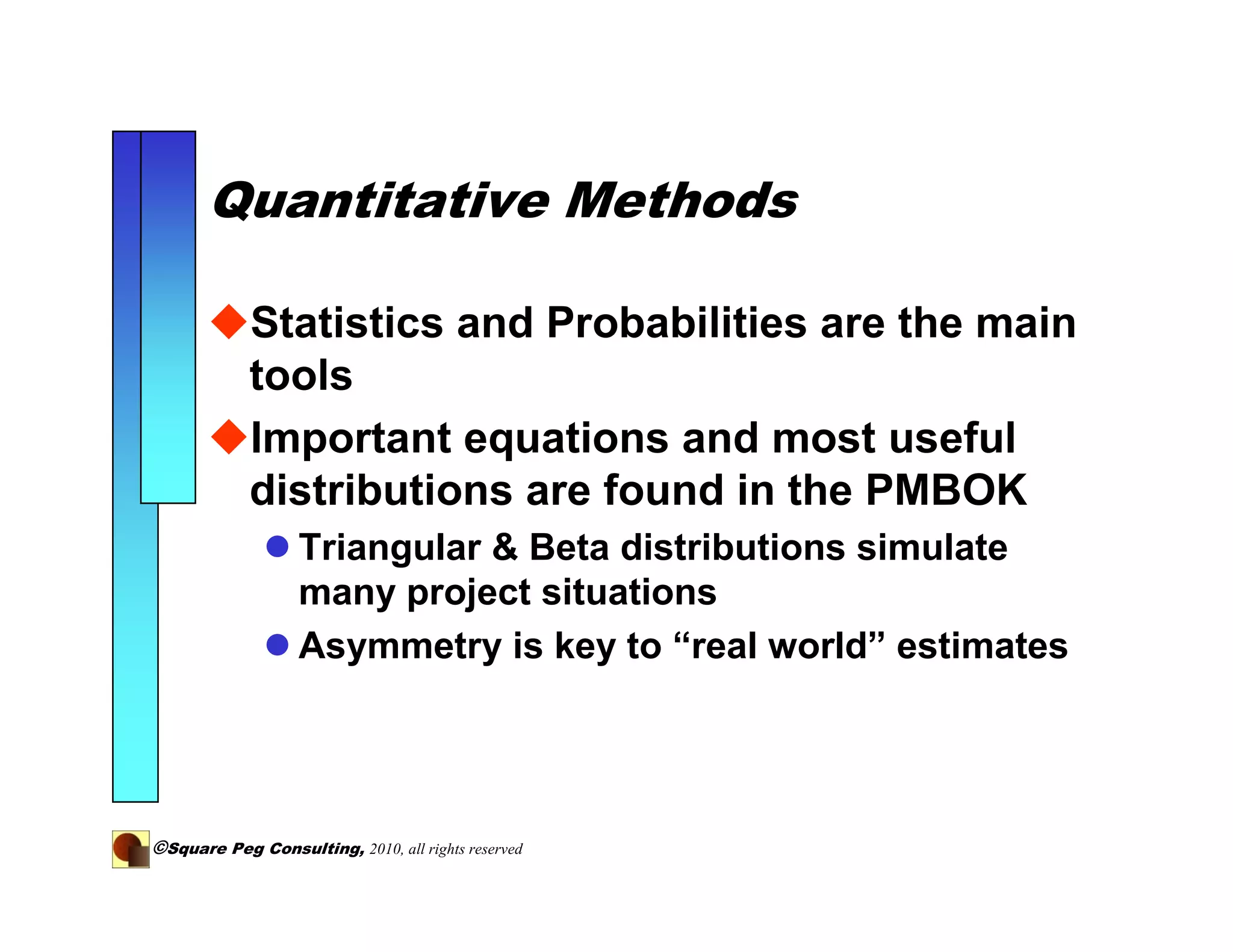
Quantitative Methods

            Statistics and Probabilities are the main
            tools
            Important equations and most useful
            distributions are found in the PMBOK
                   Triangular & Beta distributions simulate
                   many project situations
                   Asymmetry is key to “real world” estimates


©Square Peg Consulting, 2010, all rights reserved
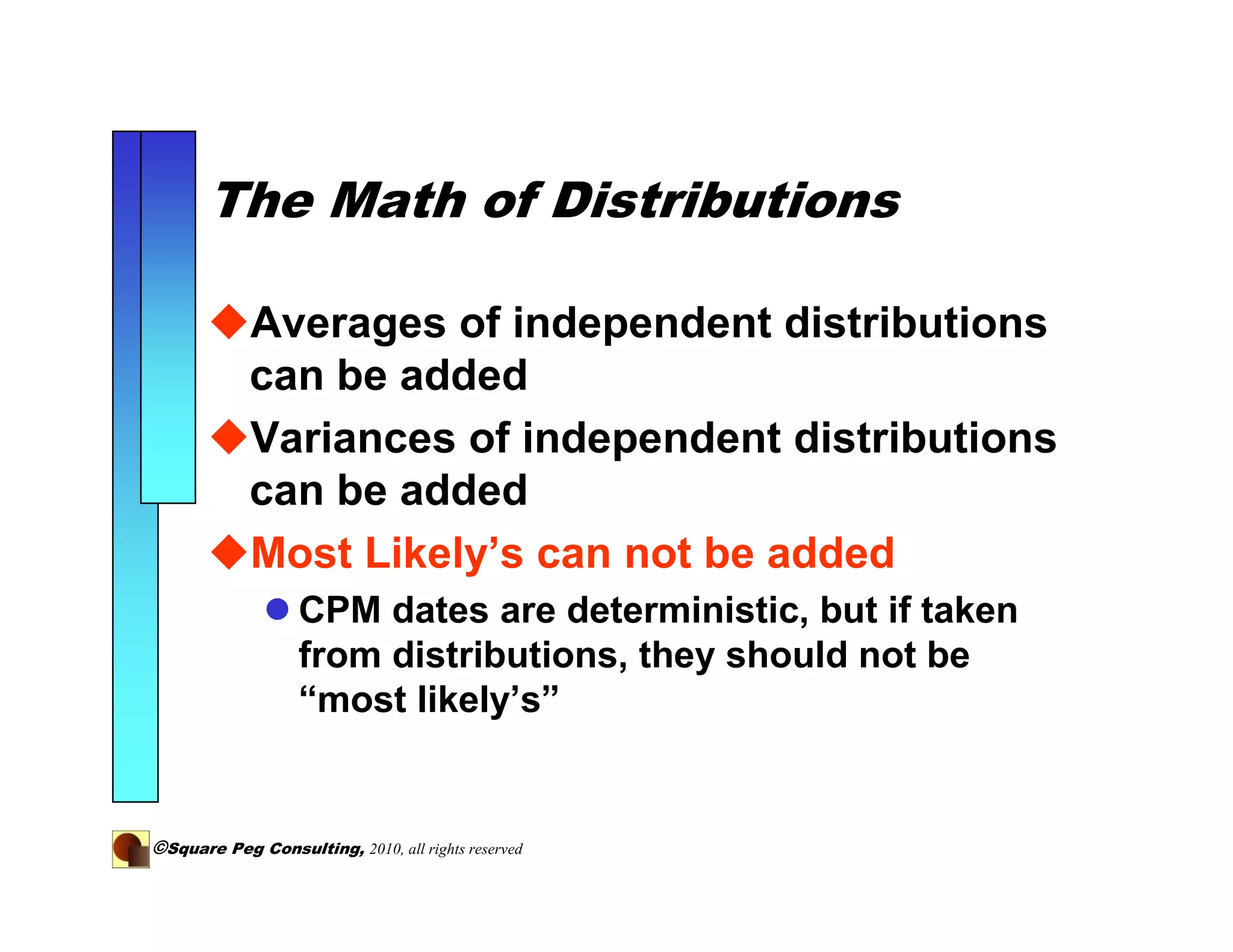
The Math of Distributions

            Averages of independent distributions
            can be added
            Variances of independent distributions
            can be added
            Most Likely’s can not be added
                   CPM dates are deterministic, but if taken
                   from distributions, they should not be
                   “most likely’s”


©Square Peg Consulting, 2010, all rights reserved
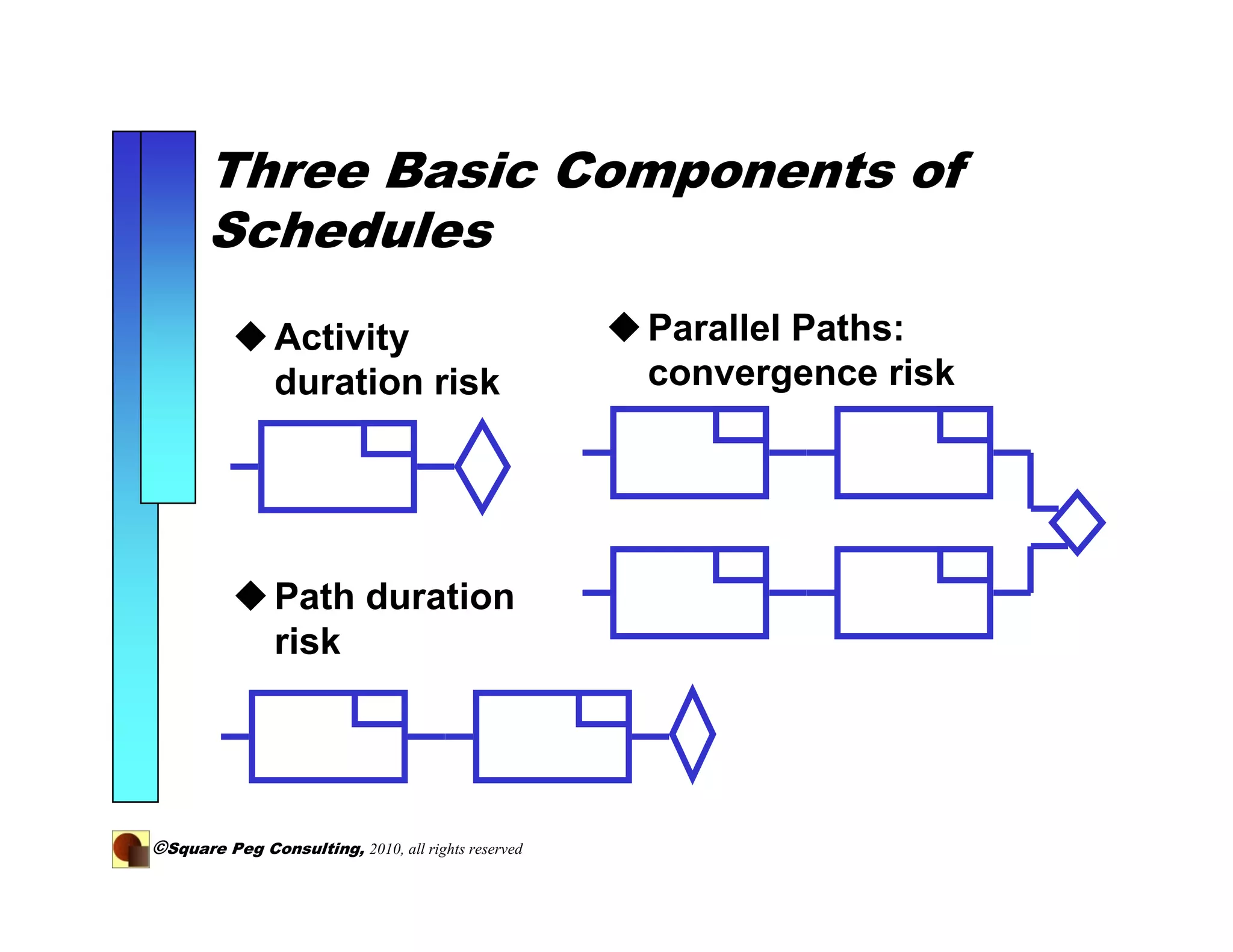
Three Basic Components of
       Schedules
                Activity                            Parallel Paths:
                duration risk                       convergence risk


                Path duration
                risk


©Square Peg Consulting, 2010, all rights reserved
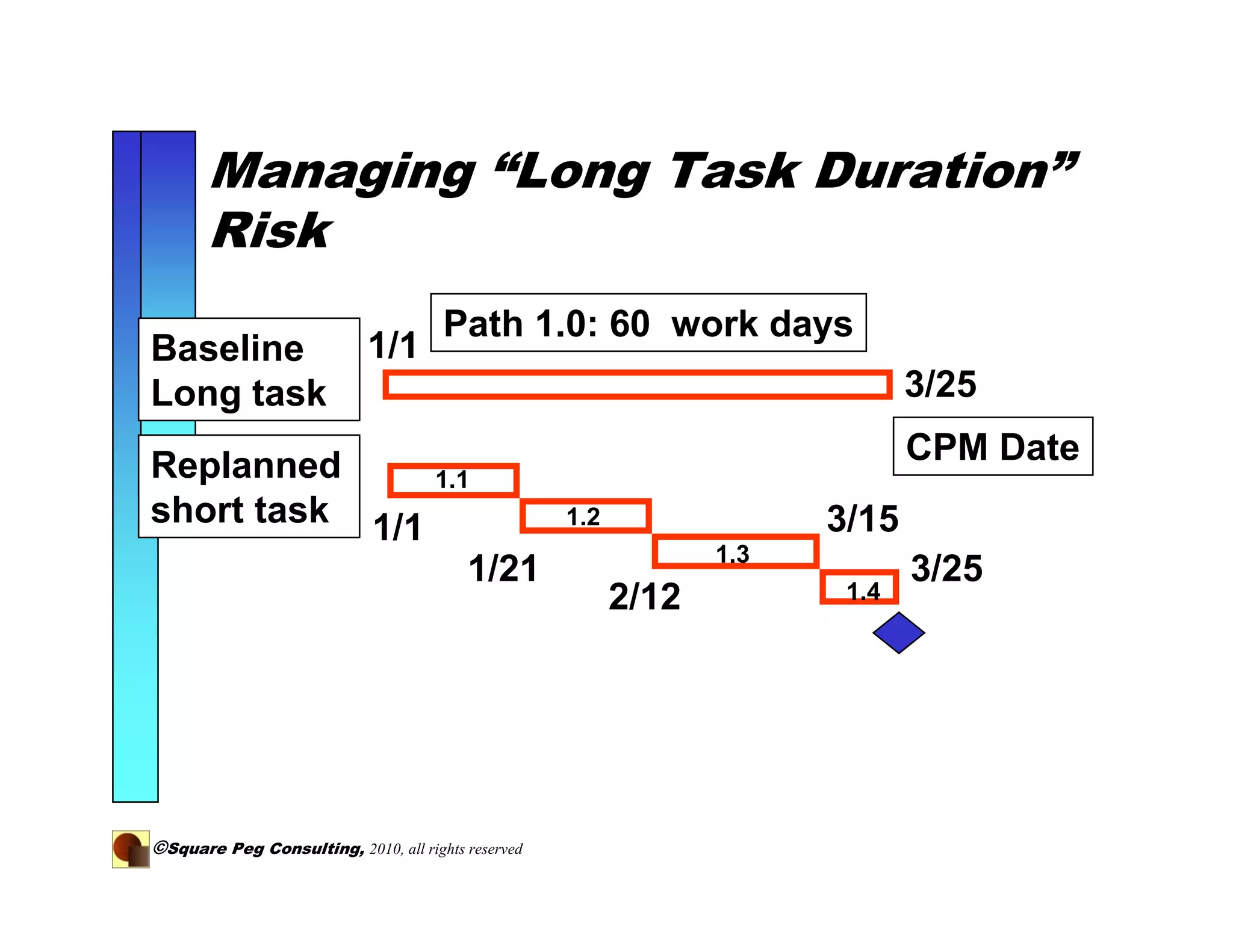
Managing “Long Task Duration”
       Risk
                                      Path 1.0: 60 work days
Baseline                    1/1
Long task                                                                     3/25

Replanned                                                                     CPM Date
               1.1
short task 1/1                                      1.2                3/15
                                                                 1.3
                  1/21                                                        3/25
                                                          2/12          1.4


©Square Peg Consulting, 2010, all rights reserved
Variance improved by 1/N
                                                     Managing D uration Risk

                 Work Breakdow n
                                       Triangle Probability Distribution of Duration
                 Structure of                                                                Variance Standard
                 Scheduled          Minimum Most Maximum                                      (Days-  Deviation
                 Activities in Days  [-10% ]      Likely       [+30% ] Average               squared)  (D ays)
                 WBS Activity 1.0
                 (Baseline)             54          60             78          64.00            26.00     5.10
                                     Baseline restructured into four subtasks and a summ ary task

                 WBS    Activity   1.1       13.5          15         19.5        16.00         1.63      1.27
                 WBS    Activity   1.2       13.5          15         19.5        16.00         1.63      1.27
                 WBS    Activity   1.3        18           20          26         21.33         2.89      1.70
                 WBS    Activity   1.4         9           10          13         10.67         0.72      0.85

                 WBS Activity 1.0
                 Summary (New                       Distribution Unknown
                 B aseline)                                                       64.00         6.86      2.62
                       Average = [min + m ax + most likely]/3                   No           74%        49%
                       Variance = [[max-m in][max-min] +                        change       improved   improved
                       [most likely - min][most likely - max]]/18               from         from       from
                       Standard Deviation = sq root [Variance]                  Baseline     Baseline   Baseline


©Square Peg Consulting, 2010, all rights reserved
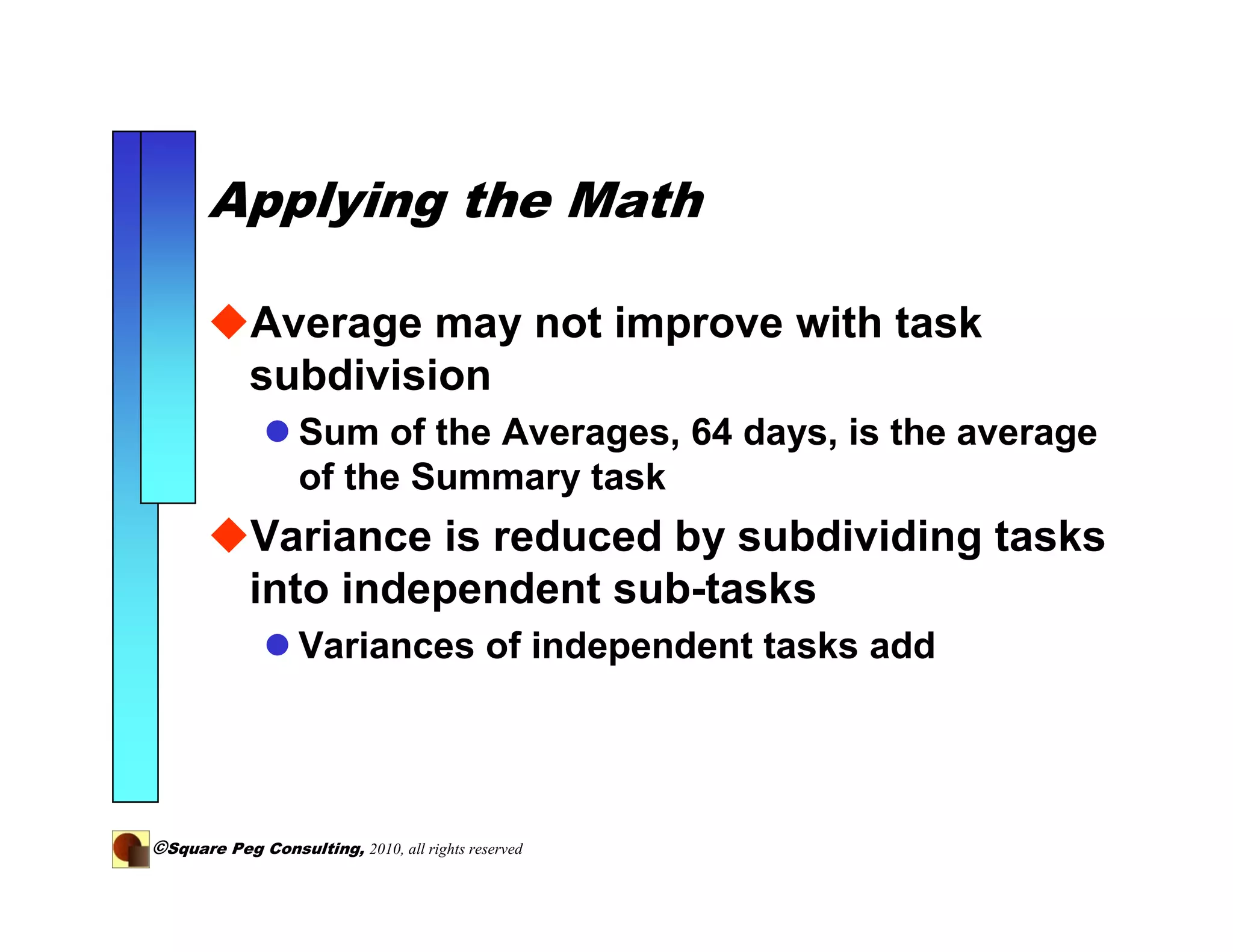
Applying the Math

            Average may not improve with task
            subdivision
                   Sum of the Averages, 64 days, is the average
                   of the Summary task
            Variance is reduced by subdividing tasks
            into independent sub-tasks
                   Variances of independent tasks add


©Square Peg Consulting, 2010, all rights reserved
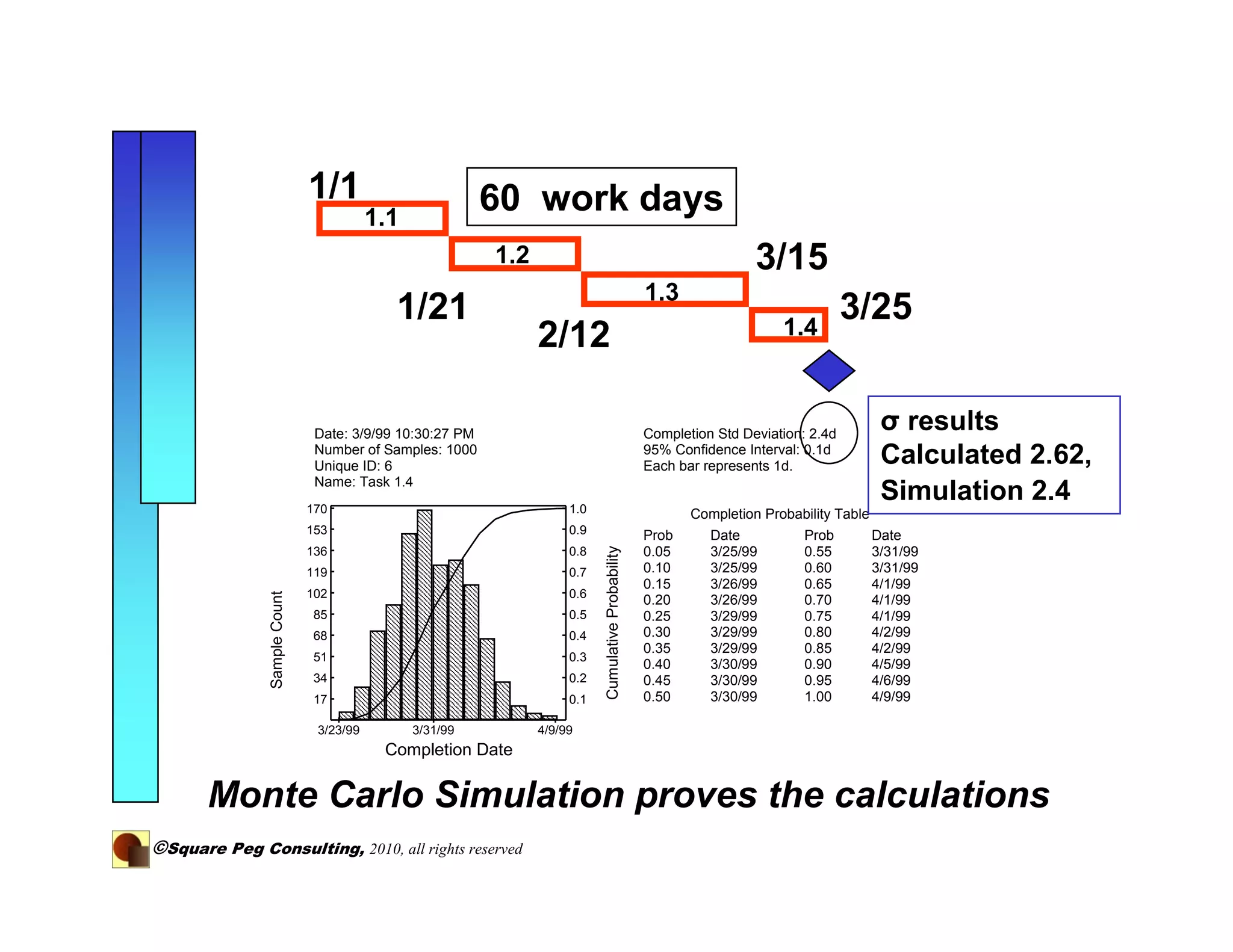
Monte Carlo Simulation

            Automates the tedium of calculations
            “Runs” the project schedule many
            times, independently
                   Each “run” uses the probability distribution
                   to determine a duration for each task, run-
                   by-run
             Result is a distribution of outcomes


©Square Peg Consulting, 2010, all rights reserved
1/1                         60 work days
                                         1.1
                                                          1.2                                                        3/15
                                                                                                    1.3
                                           1/21                                                                          1.4
                                                                                                                                     3/25
                                                                2/12

                               Date: 3/9/99 10:30:27 PM                                             Completion Std Deviation: 2.4d
                                                                                                                                           σ results
                               Number of Samples: 1000
                               Unique ID: 6
                                                                                                    95% Confidence Interval: 0.1d
                                                                                                    Each bar represents 1d.                Calculated 2.62,
                               Name: Task 1.4
                              170                                    1.0
                                                                                                                                           Simulation 2.4
                                                                                                           Completion Probability Table
                              153                                    0.9                            Prob      Date           Prob         Date


                                                                           Cumulative Probability
                              136                                    0.8                            0.05      3/25/99        0.55         3/31/99
                              119                                    0.7                            0.10      3/25/99        0.60         3/31/99
                                                                                                    0.15      3/26/99        0.65         4/1/99
                              102                                    0.6
               Sample Count


                                                                                                    0.20      3/26/99        0.70         4/1/99
                              85                                     0.5                            0.25      3/29/99        0.75         4/1/99
                              68                                     0.4                            0.30      3/29/99        0.80         4/2/99
                                                                                                    0.35      3/29/99        0.85         4/2/99
                              51                                     0.3
                                                                                                    0.40      3/30/99        0.90         4/5/99
                              34                                     0.2                            0.45      3/30/99        0.95         4/6/99
                              17                                     0.1                            0.50      3/30/99        1.00         4/9/99

                               3/23/99         3/31/99          4/9/99
                                          Completion Date


       Monte Carlo Simulation proves the calculations
©Square Peg Consulting, 2010, all rights reserved
1/1                         60 work days
                                         1.1
                                                          1.2                                                        3/15
                                                                                                    1.3
                                           1/21                                                                          1.4
                                                                                                                                     3/25
                                                                2/12

                               Date: 3/9/99 10:30:27 PM                                             Completion Std Deviation: 2.4d
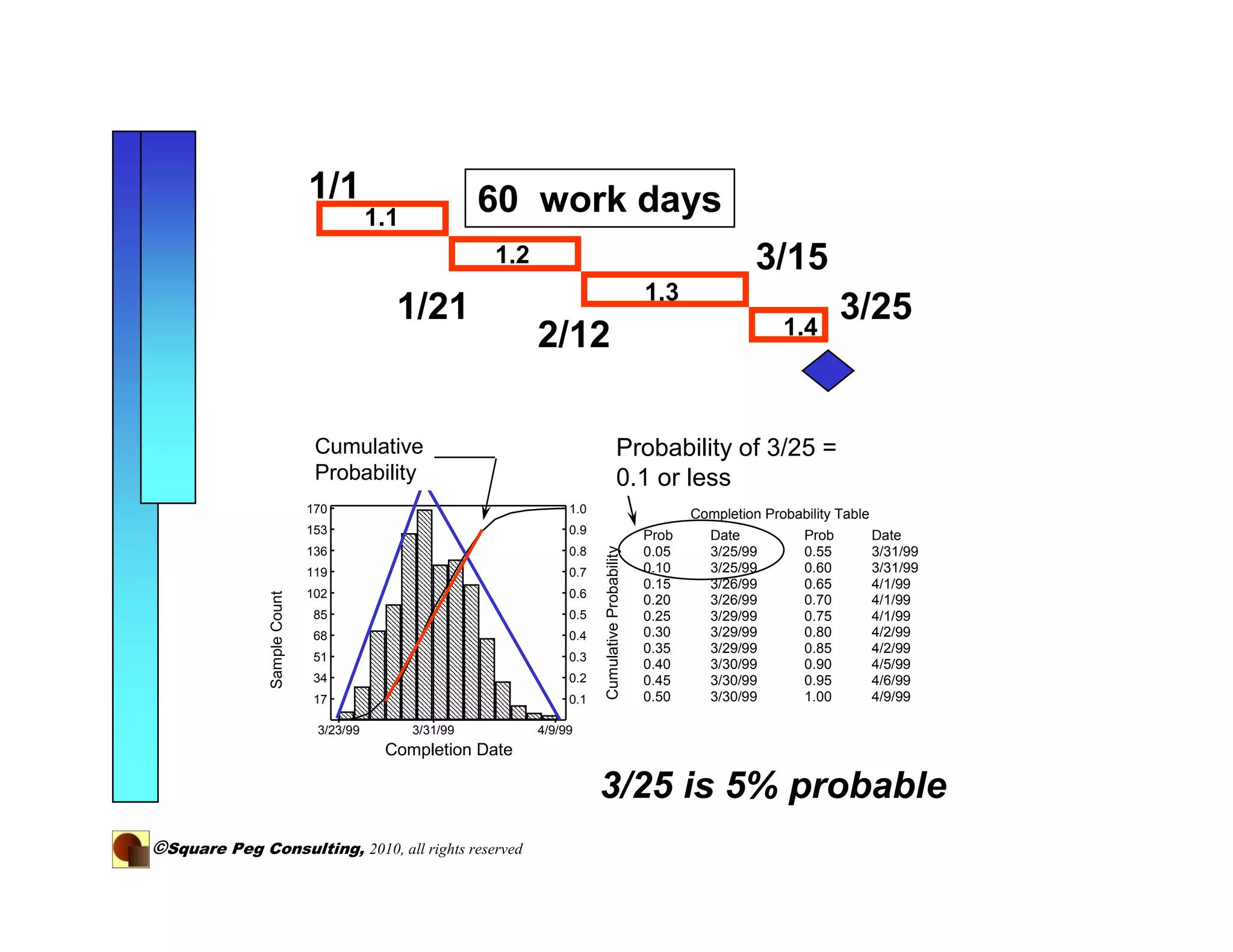
                               Cumulative
                               Number of Samples: 1000                                   Probability of 3/25 =
                                                                                           95% Confidence Interval: 0.1d
                               Unique ID: 6                                                Each bar represents 1d.
                               Probability
                               Name: Task 1.4                                            0.1 or less
                              170                                    1.0                                   Completion Probability Table
                              153                                    0.9                            Prob      Date           Prob         Date


                                                                           Cumulative Probability
                              136                                    0.8                            0.05      3/25/99        0.55         3/31/99
                              119                                    0.7                            0.10      3/25/99        0.60         3/31/99
                                                                                                    0.15      3/26/99        0.65         4/1/99
                              102                                    0.6
               Sample Count


                                                                                                    0.20      3/26/99        0.70         4/1/99
                              85                                     0.5                            0.25      3/29/99        0.75         4/1/99
                              68                                     0.4                            0.30      3/29/99        0.80         4/2/99
                                                                                                    0.35      3/29/99        0.85         4/2/99
                              51                                     0.3
                                                                                                    0.40      3/30/99        0.90         4/5/99
                              34                                     0.2                            0.45      3/30/99        0.95         4/6/99
                              17                                     0.1                            0.50      3/30/99        1.00         4/9/99

                               3/23/99         3/31/99          4/9/99
                                          Completion Date

                                                                           3/25 is 5% probable
©Square Peg Consulting, 2010, all rights reserved
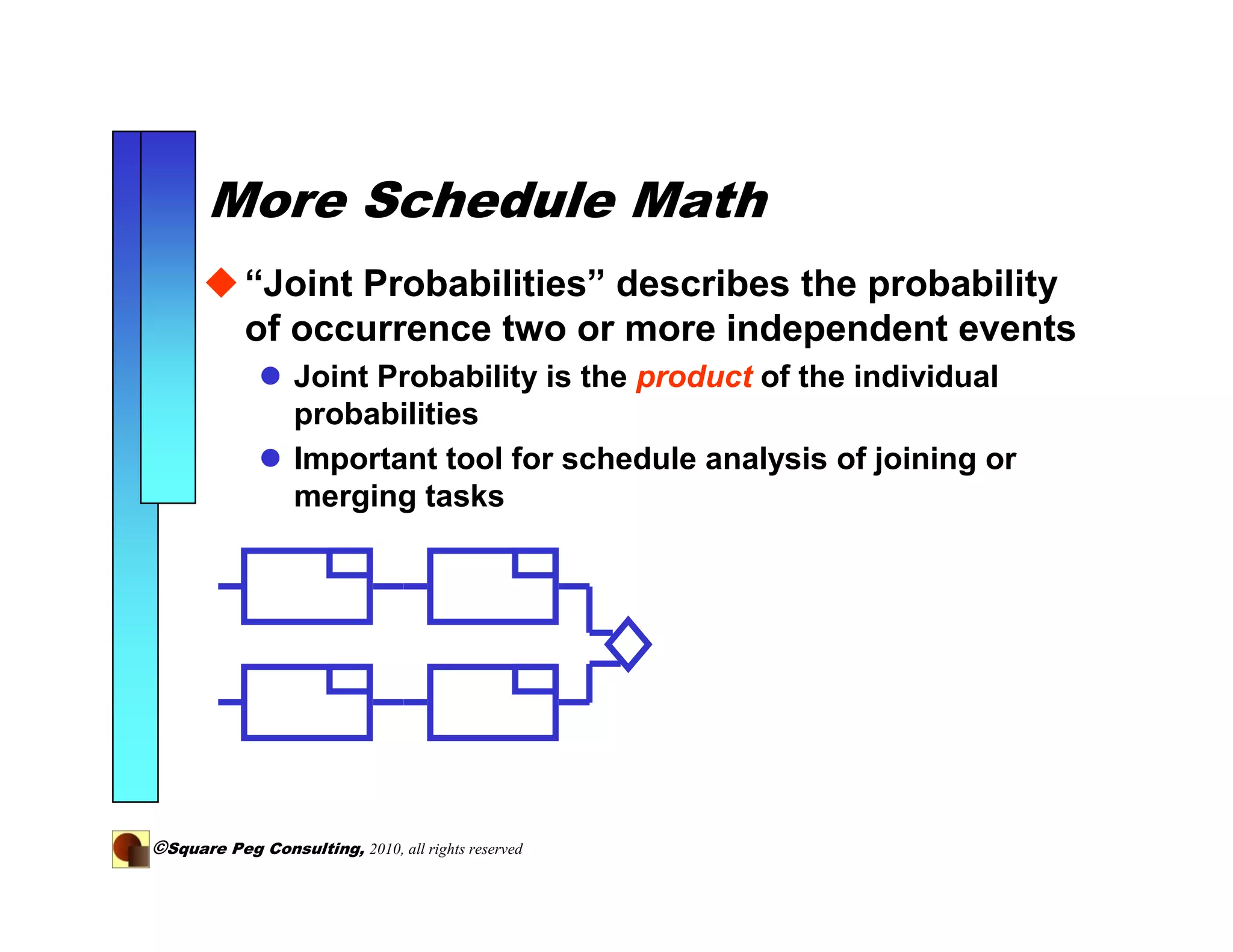
More Schedule Math
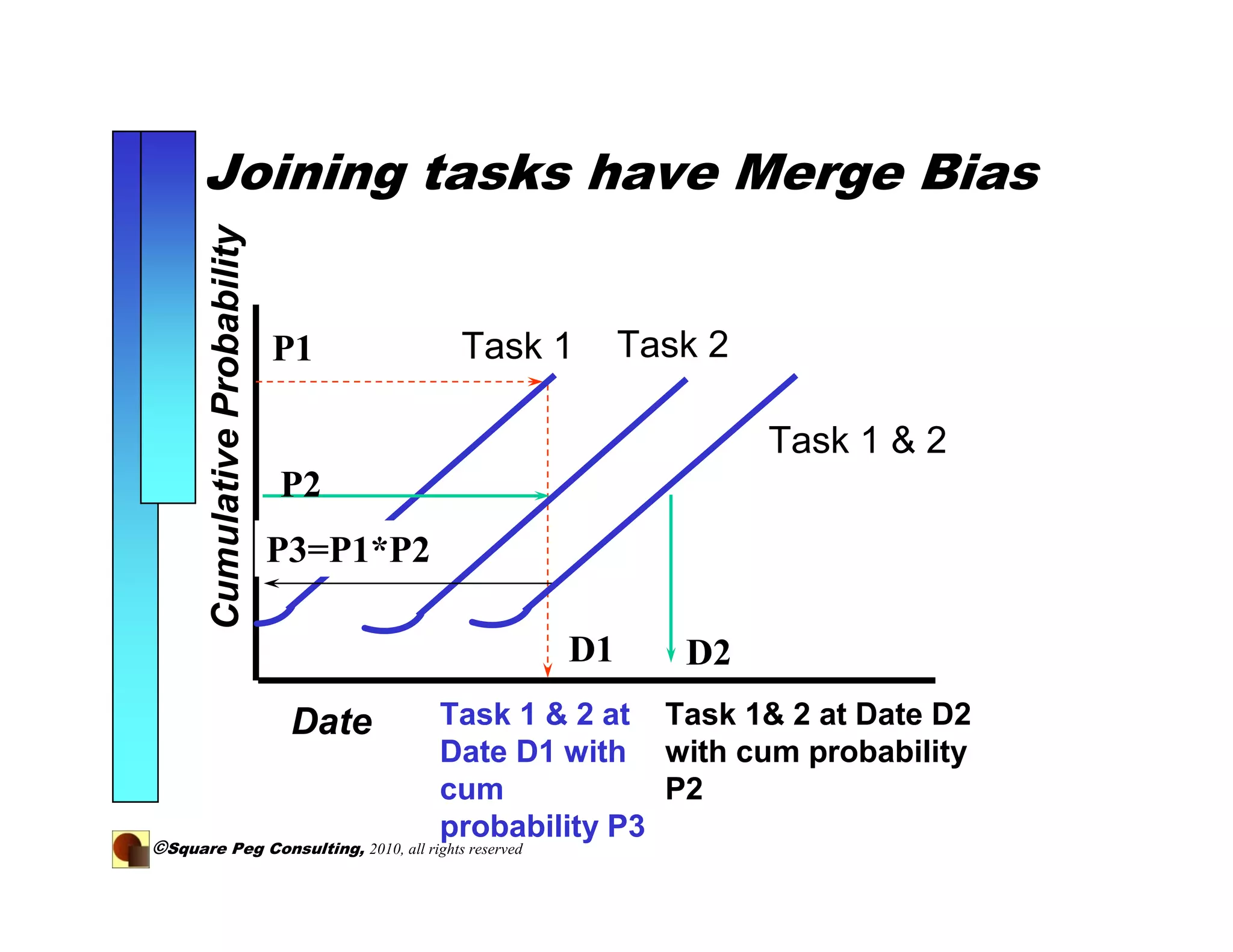
            “Joint Probabilities” describes the probability
            of occurrence two or more independent events
                  Joint Probability is the product of the individual
                  probabilities
                  Important tool for schedule analysis of joining or
                  merging tasks


©Square Peg Consulting, 2010, all rights reserved
Joining tasks have Merge Bias
       Cumulative Probability


                                P1          Task 1       Task 2

                                                                  Task 1 & 2
                                P2
                                P3=P1*P2

                                                    D1      D2
                                 Date      Task 1 & 2 at Task 1& 2 at Date D2
                                           Date D1 with with cum probability
                                           cum            P2
                                           probability P3
©Square Peg Consulting, 2010, all rights reserved
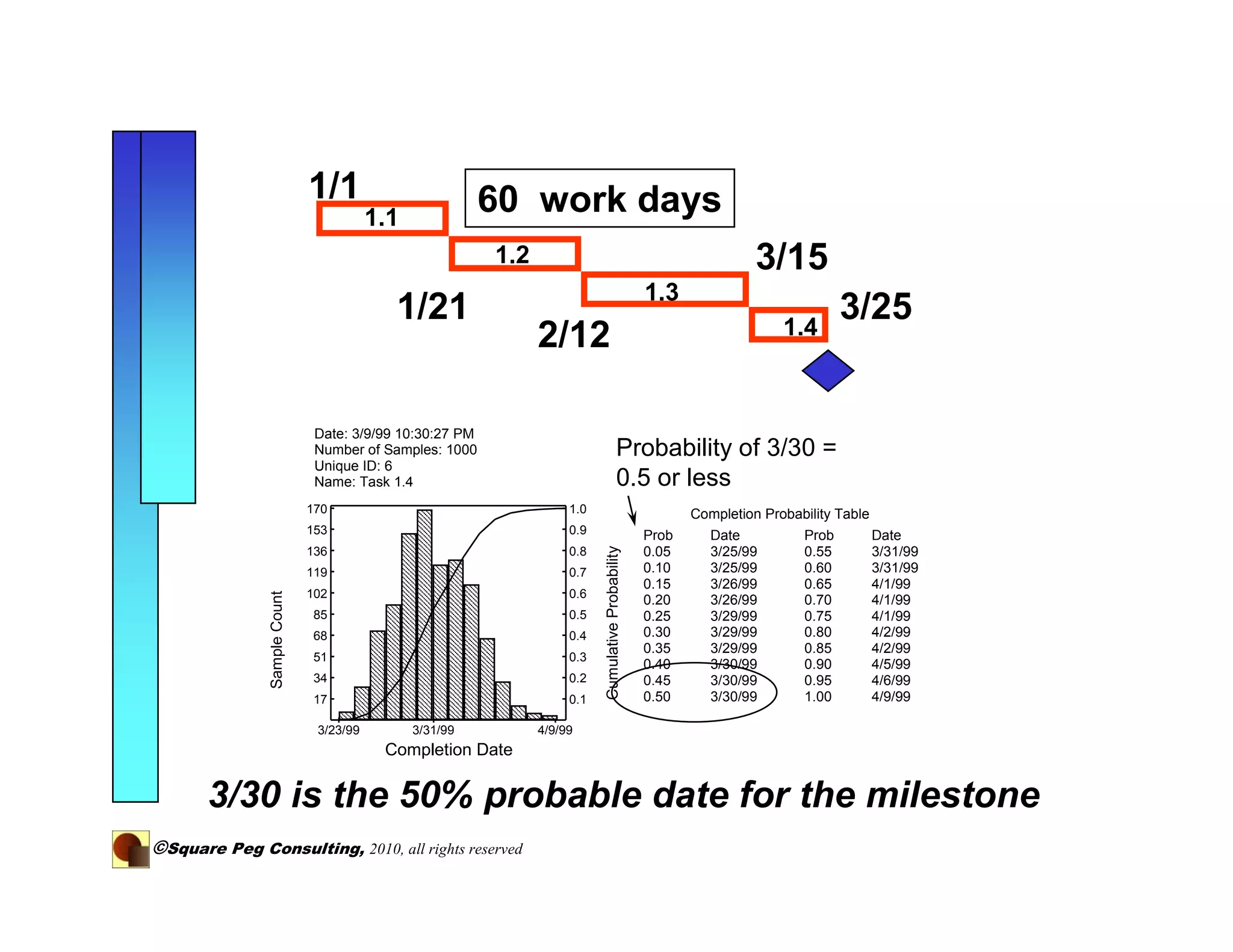
1/1                         60 work days
                                         1.1
                                                          1.2                                                        3/15
                                                                                                    1.3
                                           1/21                                                                          1.4
                                                                                                                                     3/25
                                                                2/12

                               Date: 3/9/99 10:30:27 PM                                             Completion Std Deviation: 2.4d
                               Number of Samples: 1000                                   Probability of 3/30 =
                                                                                           95% Confidence Interval: 0.1d
                               Unique ID: 6                                                Each bar represents 1d.
                               Name: Task 1.4                                            0.5 or less
                              170                                    1.0                                   Completion Probability Table
                              153                                    0.9                            Prob      Date           Prob         Date


                                                                           Cumulative Probability
                              136                                    0.8                            0.05      3/25/99        0.55         3/31/99
                              119                                    0.7                            0.10      3/25/99        0.60         3/31/99
                                                                                                    0.15      3/26/99        0.65         4/1/99
                              102                                    0.6
               Sample Count


                                                                                                    0.20      3/26/99        0.70         4/1/99
                              85                                     0.5                            0.25      3/29/99        0.75         4/1/99
                              68                                     0.4                            0.30      3/29/99        0.80         4/2/99
                                                                                                    0.35      3/29/99        0.85         4/2/99
                              51                                     0.3
                                                                                                    0.40      3/30/99        0.90         4/5/99
                              34                                     0.2                            0.45      3/30/99        0.95         4/6/99
                              17                                     0.1                            0.50      3/30/99        1.00         4/9/99

                               3/23/99         3/31/99          4/9/99
                                          Completion Date


       3/30 is the 50% probable date for the milestone
©Square Peg Consulting, 2010, all rights reserved
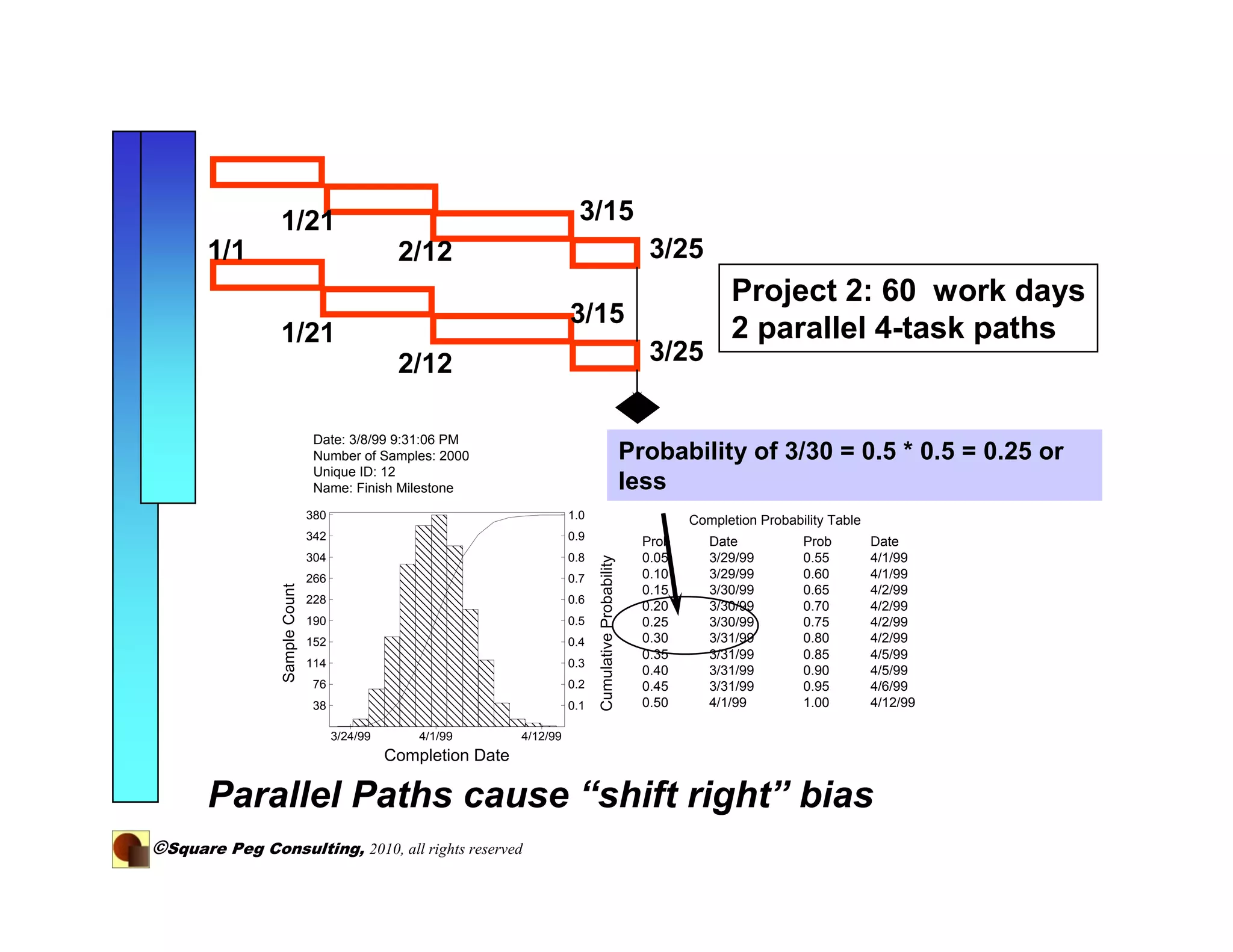
1/21                                                         3/15
       1/1                                       2/12                                                         3/25
                                                                                                                           Project 2: 60 work days
                                                                            3/15
                 1/21                                                                                                      2 parallel 4-task paths
                                                 2/12                                                         3/25

                                 Date: 3/8/99 9:31:06 PM                                                     Completion Std Deviation: 2.0d
                                 Number of Samples: 2000                                                   ProbabilityInterval: 0.1d = 0.5 * 0.5 = 0.25 or
                                                                                                             95% Confidence of 3/30
                                 Unique ID: 12                                                               Each bar represents 1d.
                                 Name: Finish Milestone                                                    less
                                380                                         1.0                                     Completion Probability Table
                                342                                         0.9                              Prob      Date            Prob        Date
                                304                                         0.8                              0.05      3/29/99         0.55        4/1/99


                                                                                  Cumulative Probability
                                266                                         0.7                              0.10      3/29/99         0.60        4/1/99
                 Sample Count


                                                                                                             0.15      3/30/99         0.65        4/2/99
                                228                                         0.6
                                                                                                             0.20      3/30/99         0.70        4/2/99
                                190                                         0.5                              0.25      3/30/99         0.75        4/2/99
                                152                                         0.4                              0.30      3/31/99         0.80        4/2/99
                                                                                                             0.35      3/31/99         0.85        4/5/99
                                114                                         0.3
                                                                                                             0.40      3/31/99         0.90        4/5/99
                                 76                                         0.2                              0.45      3/31/99         0.95        4/6/99
                                 38                                         0.1                              0.50      4/1/99          1.00        4/12/99

                                      3/24/99       4/1/99        4/12/99
                                                Completion Date

       Parallel Paths cause “shift right” bias
©Square Peg Consulting, 2010, all rights reserved
What’s been learned?

            Quantitative analysis can determine the
            likelihood of overrunning the schedule
            Architectural weaknesses in the schedule are
            revealed and quantified
            Risks needed to balance investor commitment
            can be estimated


©Square Peg Consulting, 2010, all rights reserved
Questions?

                          John Goodpasture
                          Square Peg Consulting


                          info@sqpegconsulting.com


©Square Peg Consulting, 2010, all rights reserved

Adding quantitative risk analysis your Swiss Army Knife

  • 1.
    Adding Quantitative RiskAnalysis to your “Swiss Army knife” John C. Goodpasture Managing Principal Square Peg Consulting ©Square Peg Consulting, 2010, all rights reserved
  • 2.
    Schedule: Your “SwissArmy Knife” Calendar Deliverables Tasks Work Breakdown of scope Project Logic Resource plan Margin of Risk [slack] ©Square Peg Consulting, 2010, all rights reserved
  • 3.
    What’s missing? Not much Quantitative risk analysis ©Square Peg Consulting, 2010, all rights reserved
  • 4.
    Project Context Projects are the result of business investment decisions Investors seek returns commensurate with risk and resources committed Public sector, private sector, non- profits Monetary or mission-success returns ©Square Peg Consulting, 2010, all rights reserved
  • 5.
    Project Manager’s mission:“Deliver the scope, taking measured risks to do so” ©Square Peg Consulting, 2010, all rights reserved
  • 6.
    Balancing the Project Investor Project Manager Business driven Charter specified outcomes outcomes Deterministic, limited, Resources estimates resources with variation Risk proportional to Risk driven by internal expected reward & external events and Unknowing of conditions implementation Details drive risk details assessments and resource estimates ©Square Peg Consulting, 2010, all rights reserved
  • 7.
    Project Equation: Resources committed = Resources Estimated + Project Risks ©Square Peg Consulting, 2010, all rights reserved
  • 8.
    Risk balances Valuewith Capacity Project Value from Project Estimate from the Top Down the Bottom Up Risk Investor’s Resource Commitment Scope Time Resources Management’s Expected Project’s Employment Return on Investment of Investment ©Square Peg Consulting, 2010, all rights reserved
  • 9.
    Managing risk All plans have uncertainties, and thus outcomes are at risk Probabilities and statistics are important data to understand and deal with uncertainties Information provides insight for problem avoidance ©Square Peg Consulting, 2010, all rights reserved
  • 10.
    Why apply riskanalysis to schedules? Determine the likelihood of overrunning the schedule Find architectural weakness in the schedule Estimate risk needed to balance investor commitment ©Square Peg Consulting, 2010, all rights reserved
  • 11.
    Quantitative Methods Statistics and Probabilities are the main tools Important equations and most useful distributions are found in the PMBOK Triangular & Beta distributions simulate many project situations Asymmetry is key to “real world” estimates ©Square Peg Consulting, 2010, all rights reserved
  • 12.
    The Math ofDistributions Averages of independent distributions can be added Variances of independent distributions can be added Most Likely’s can not be added CPM dates are deterministic, but if taken from distributions, they should not be “most likely’s” ©Square Peg Consulting, 2010, all rights reserved
  • 13.
    Three Basic Componentsof Schedules Activity Parallel Paths: duration risk convergence risk Path duration risk ©Square Peg Consulting, 2010, all rights reserved
  • 14.
    Managing “Long TaskDuration” Risk Path 1.0: 60 work days Baseline 1/1 Long task 3/25 Replanned CPM Date 1.1 short task 1/1 1.2 3/15 1.3 1/21 3/25 2/12 1.4 ©Square Peg Consulting, 2010, all rights reserved
  • 15.
    Variance improved by1/N Managing D uration Risk Work Breakdow n Triangle Probability Distribution of Duration Structure of Variance Standard Scheduled Minimum Most Maximum (Days- Deviation Activities in Days [-10% ] Likely [+30% ] Average squared) (D ays) WBS Activity 1.0 (Baseline) 54 60 78 64.00 26.00 5.10 Baseline restructured into four subtasks and a summ ary task WBS Activity 1.1 13.5 15 19.5 16.00 1.63 1.27 WBS Activity 1.2 13.5 15 19.5 16.00 1.63 1.27 WBS Activity 1.3 18 20 26 21.33 2.89 1.70 WBS Activity 1.4 9 10 13 10.67 0.72 0.85 WBS Activity 1.0 Summary (New Distribution Unknown B aseline) 64.00 6.86 2.62 Average = [min + m ax + most likely]/3 No 74% 49% Variance = [[max-m in][max-min] + change improved improved [most likely - min][most likely - max]]/18 from from from Standard Deviation = sq root [Variance] Baseline Baseline Baseline ©Square Peg Consulting, 2010, all rights reserved
  • 16.
    Applying the Math Average may not improve with task subdivision Sum of the Averages, 64 days, is the average of the Summary task Variance is reduced by subdividing tasks into independent sub-tasks Variances of independent tasks add ©Square Peg Consulting, 2010, all rights reserved
  • 17.
    Monte Carlo Simulation Automates the tedium of calculations “Runs” the project schedule many times, independently Each “run” uses the probability distribution to determine a duration for each task, run- by-run Result is a distribution of outcomes ©Square Peg Consulting, 2010, all rights reserved
  • 18.
    1/1 60 work days 1.1 1.2 3/15 1.3 1/21 1.4 3/25 2/12 Date: 3/9/99 10:30:27 PM Completion Std Deviation: 2.4d σ results Number of Samples: 1000 Unique ID: 6 95% Confidence Interval: 0.1d Each bar represents 1d. Calculated 2.62, Name: Task 1.4 170 1.0 Simulation 2.4 Completion Probability Table 153 0.9 Prob Date Prob Date Cumulative Probability 136 0.8 0.05 3/25/99 0.55 3/31/99 119 0.7 0.10 3/25/99 0.60 3/31/99 0.15 3/26/99 0.65 4/1/99 102 0.6 Sample Count 0.20 3/26/99 0.70 4/1/99 85 0.5 0.25 3/29/99 0.75 4/1/99 68 0.4 0.30 3/29/99 0.80 4/2/99 0.35 3/29/99 0.85 4/2/99 51 0.3 0.40 3/30/99 0.90 4/5/99 34 0.2 0.45 3/30/99 0.95 4/6/99 17 0.1 0.50 3/30/99 1.00 4/9/99 3/23/99 3/31/99 4/9/99 Completion Date Monte Carlo Simulation proves the calculations ©Square Peg Consulting, 2010, all rights reserved
  • 19.
    1/1 60 work days 1.1 1.2 3/15 1.3 1/21 1.4 3/25 2/12 Date: 3/9/99 10:30:27 PM Completion Std Deviation: 2.4d Cumulative Number of Samples: 1000 Probability of 3/25 = 95% Confidence Interval: 0.1d Unique ID: 6 Each bar represents 1d. Probability Name: Task 1.4 0.1 or less 170 1.0 Completion Probability Table 153 0.9 Prob Date Prob Date Cumulative Probability 136 0.8 0.05 3/25/99 0.55 3/31/99 119 0.7 0.10 3/25/99 0.60 3/31/99 0.15 3/26/99 0.65 4/1/99 102 0.6 Sample Count 0.20 3/26/99 0.70 4/1/99 85 0.5 0.25 3/29/99 0.75 4/1/99 68 0.4 0.30 3/29/99 0.80 4/2/99 0.35 3/29/99 0.85 4/2/99 51 0.3 0.40 3/30/99 0.90 4/5/99 34 0.2 0.45 3/30/99 0.95 4/6/99 17 0.1 0.50 3/30/99 1.00 4/9/99 3/23/99 3/31/99 4/9/99 Completion Date 3/25 is 5% probable ©Square Peg Consulting, 2010, all rights reserved
  • 20.
    More Schedule Math “Joint Probabilities” describes the probability of occurrence two or more independent events Joint Probability is the product of the individual probabilities Important tool for schedule analysis of joining or merging tasks ©Square Peg Consulting, 2010, all rights reserved
  • 21.
    Joining tasks haveMerge Bias Cumulative Probability P1 Task 1 Task 2 Task 1 & 2 P2 P3=P1*P2 D1 D2 Date Task 1 & 2 at Task 1& 2 at Date D2 Date D1 with with cum probability cum P2 probability P3 ©Square Peg Consulting, 2010, all rights reserved
  • 22.
    1/1 60 work days 1.1 1.2 3/15 1.3 1/21 1.4 3/25 2/12 Date: 3/9/99 10:30:27 PM Completion Std Deviation: 2.4d Number of Samples: 1000 Probability of 3/30 = 95% Confidence Interval: 0.1d Unique ID: 6 Each bar represents 1d. Name: Task 1.4 0.5 or less 170 1.0 Completion Probability Table 153 0.9 Prob Date Prob Date Cumulative Probability 136 0.8 0.05 3/25/99 0.55 3/31/99 119 0.7 0.10 3/25/99 0.60 3/31/99 0.15 3/26/99 0.65 4/1/99 102 0.6 Sample Count 0.20 3/26/99 0.70 4/1/99 85 0.5 0.25 3/29/99 0.75 4/1/99 68 0.4 0.30 3/29/99 0.80 4/2/99 0.35 3/29/99 0.85 4/2/99 51 0.3 0.40 3/30/99 0.90 4/5/99 34 0.2 0.45 3/30/99 0.95 4/6/99 17 0.1 0.50 3/30/99 1.00 4/9/99 3/23/99 3/31/99 4/9/99 Completion Date 3/30 is the 50% probable date for the milestone ©Square Peg Consulting, 2010, all rights reserved
  • 23.
    1/21 3/15 1/1 2/12 3/25 Project 2: 60 work days 3/15 1/21 2 parallel 4-task paths 2/12 3/25 Date: 3/8/99 9:31:06 PM Completion Std Deviation: 2.0d Number of Samples: 2000 ProbabilityInterval: 0.1d = 0.5 * 0.5 = 0.25 or 95% Confidence of 3/30 Unique ID: 12 Each bar represents 1d. Name: Finish Milestone less 380 1.0 Completion Probability Table 342 0.9 Prob Date Prob Date 304 0.8 0.05 3/29/99 0.55 4/1/99 Cumulative Probability 266 0.7 0.10 3/29/99 0.60 4/1/99 Sample Count 0.15 3/30/99 0.65 4/2/99 228 0.6 0.20 3/30/99 0.70 4/2/99 190 0.5 0.25 3/30/99 0.75 4/2/99 152 0.4 0.30 3/31/99 0.80 4/2/99 0.35 3/31/99 0.85 4/5/99 114 0.3 0.40 3/31/99 0.90 4/5/99 76 0.2 0.45 3/31/99 0.95 4/6/99 38 0.1 0.50 4/1/99 1.00 4/12/99 3/24/99 4/1/99 4/12/99 Completion Date Parallel Paths cause “shift right” bias ©Square Peg Consulting, 2010, all rights reserved
  • 24.
    What’s been learned? Quantitative analysis can determine the likelihood of overrunning the schedule Architectural weaknesses in the schedule are revealed and quantified Risks needed to balance investor commitment can be estimated ©Square Peg Consulting, 2010, all rights reserved
  • 25.
    Questions? John Goodpasture Square Peg Consulting info@sqpegconsulting.com ©Square Peg Consulting, 2010, all rights reserved