





A DEVELOMENT INSTITUTION’s
PERSPECTIVE
Project Risk Management
05/27/15Shehzad Akram2
05/27/15Shehzad Akram3
Risk-Defined
05/27/15Shehzad Akram4
A situation involving exposure to danger;
“The combination of the probability of
an event and its consequences”
 “Effect of uncertainty on objectives”
(ISO 31000(2009) /ISO Guide 73:2002)
Uncertainties include events (which may or not happen);
Uncertainties caused by ambiguity or a lack of information; and
Also includes both negative and positive impacts on objectives.
(developed by an international committee representing over 30 countries and is
based on the input of several thousand subject matter experts.)
PROJECT and PROJECT
MANAGEMENT
05/27/15Shehzad Akram5
Project: An individual or collaborative enterprise
planned and designed to achieve an aim.
A project is a temporary endeavor with a defined
beginning and end (usually time-constrained, and
often constrained by funding or deliverables),
undertaken to meet unique goals and objectives,
typically to bring about beneficial change or added
value
Project Management
05/27/15Shehzad Akram6
is the discipline of
Planning;
Organizing;
Securing; and
Managing resources to achieve specific goals.
PROJECT RISK
MANAGEMENT (PRM)
05/27/15Shehzad Akram7
From above definitions PRM:
 Art and science of planning, organizing, securing
and managing resources (Management) to
harness/control/manage the effects of uncertainties on
objectives (Risk)of a temporary endeavor (project).
One of the nine knowledge areas defined in PMBOK
(Project Management Body of Knowledge)
Risk Management
05/27/15Shehzad Akram8
Is a Comprehensive System that includes:
Creating an appropriate risk management environment
Maintaining an efficient Risk Measurement
Mitigating and Monitoring Process
Establishing an Adequate Internal Control Arrangement
Core of the Strategic Management of the Company
It is the process whereby organizations methodically
address the risks attaching to their activities with the goal
of achieving sustained benefit within each activity and
across the portfolio of all activities.
05/27/15Shehzad Akram9
OR
Risk Management is the;
Identification;
Assessment; and
prioritization of risks
Monitoring
followed by coordinated and economical application of
resources to minimize, monitor, and control the probability
and/or impact of unfortunate events or to maximize the
realization of opportunities.
Why Risk Management:
05/27/15Shehzad Akram10
Its objective is to add maximum sustainable value to all the
activities of the organization.
It marshals the understanding of the potential upside and downside
of all those factors which can affect the organization.
It increases the probability of success, and reduces both
the probability of failure and the uncertainty of achieving the
organization's overall objectives.
Healthy Stress?? Vs the bad stress (Zaib)
ROOTS OF UNCERTAINTY
05/27/15Shehzad Akram11
 Stakeholders
 Objectives
 Variety of Resources, (human, capital, material..)
 Project Organizations
 Scope of work
 Cost
 Time
 Delivery of Quantified and Qualitative objectives
 Technologies
 Environment
 Regulators
05/27/15Shehzad Akram12
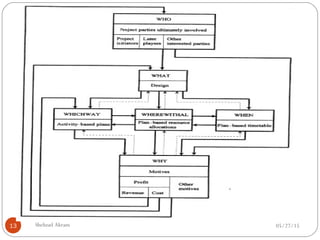
Roots of Uncertainty are associated with
who Who are the parties ultimately involved
(Executing Agencies, partners, etc..)
Why What do they want (motives, objectives..)
What What is it the parties interested in (design)
Whichway How is to be done (activities)
Wherewithal What resources are required (resources)
When when does it have to be done (Schedule, timetable)
05/27/15Shehzad Akram13
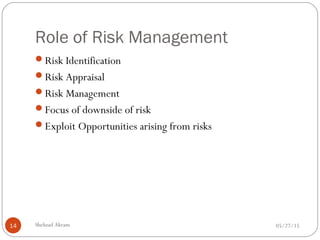
Role of Risk Management
05/27/15Shehzad Akram14
Risk Identification
Risk Appraisal
Risk Management
Focus of downside of risk
Exploit Opportunities arising from risks
05/27/15Shehzad Akram15
Types of Risks
05/27/15Shehzad Akram16
05/27/15Shehzad Akram17
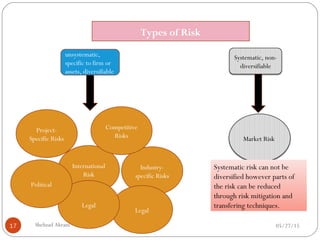
Project-
Specific Risks
International
Risk
Industry-
specific Risks
Competitive
Risks Market Risk
Types of Risk
unsystematic,
specific to firm or
assets, diversifiable
Systematic, non-
diversifiable
Systematic risk can not be
diversified however parts of
the risk can be reduced
through risk mitigation and
transfering techniques.
Legal
Legal
Political
05/27/15Shehzad Akram18
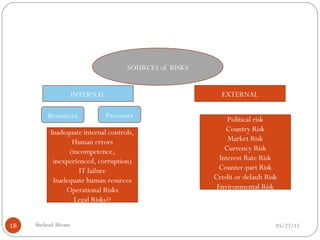
INTERNAL EXTERNAL
Resources Processes
SOURCES of RISKS
Political risk
Country Risk
Market Risk
Currency Risk
Interest Rate Risk
Counter-part Risk
Credit or default Risk
Environmental Risk
Inadequate internal controls,
Human errors
(incompetence,
inexperienced, corruption)
IT failure
Inadequate human resurces
Operational Risks
Legal Risks??
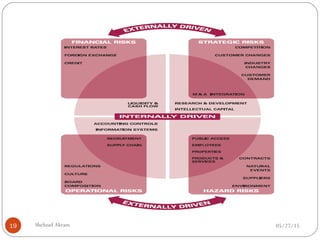
05/27/15Shehzad Akram19
05/27/15Shehzad Akram20
Business Risk vs Financial
Risk
Business risk arises from the nature of firms business;
Strategic risk, compliance risks, financial and operational risk
Financial risks arises from possible losses in financial markets
due to movements in financial variables, usually associated
with leverage with the risk that obligations and liabilities
can not be met with present assets
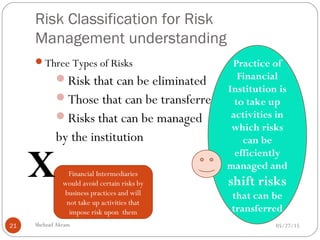
Risk Classification for Risk
Management understanding
05/27/15Shehzad Akram21
Three Types of Risks
Risk that can be eliminated
Those that can be transferred
Risks that can be managed
by the institution
Financial Intermediaries
would avoid certain risks by
business practices and will
not take up activities that
impose risk upon them
Practice of
Financial
Institution is
to take up
activities in
which risks
can be
efficiently
managed and
shift risks
that can be
transferred
X
05/27/15Shehzad Akram22
It must be integrated into the culture of
the organisation with an effective policy
and a programme led by the most senior
management. It must translate the
strategy into tactical and operational
objectives, assigning responsibility
throughout the organisation with each
manager and employee responsible for the
management of risk as part of their job
description. It supports accountability,
performance measurement and reward,
thus promoting operational efficiency at
all levels.
05/27/15Shehzad Akram23
RISK MANAGEMENT PROCESS
Risk Management Process
05/27/15Shehzad Akram24
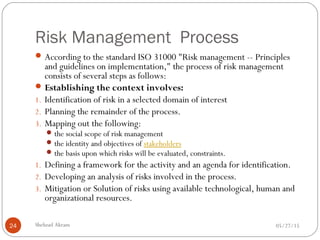
According to the standard ISO 31000 "Risk management -- Principles
and guidelines on implementation," the process of risk management
consists of several steps as follows:
Establishing the context involves:
1. Identification of risk in a selected domain of interest
2. Planning the remainder of the process.
3. Mapping out the following:
the social scope of risk management
the identity and objectives of stakeholders
the basis upon which risks will be evaluated, constraints.
1. Defining a framework for the activity and an agenda for identification.
2. Developing an analysis of risks involved in the process.
3. Mitigation or Solution of risks using available technological, human and
organizational resources.
Risk Management Principals
05/27/15Shehzad Akram25
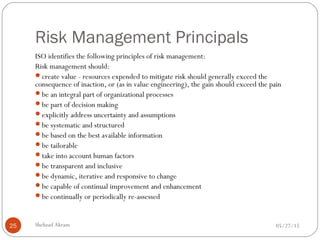
ISO identifies the following principles of risk management:
Risk management should:
create value - resources expended to mitigate risk should generally exceed the
consequence of inaction, or (as in value engineering), the gain should exceed the pain
be an integral part of organizational processes
be part of decision making
explicitly address uncertainty and assumptions
be systematic and structured
be based on the best available information
be tailorable
take into account human factors
be transparent and inclusive
be dynamic, iterative and responsive to change
be capable of continual improvement and enhancement
be continually or periodically re-assessed
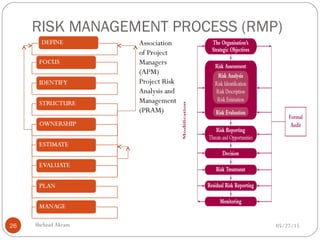
RISK MANAGEMENT PROCESS (RMP)
05/27/15Shehzad Akram26
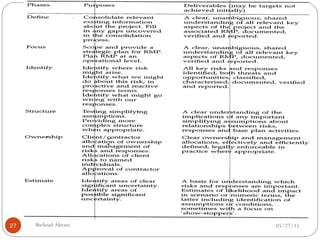
Association
of Project
Managers
(APM)
Project Risk
Analysis and
Management
(PRAM)
05/27/15Shehzad Akram27
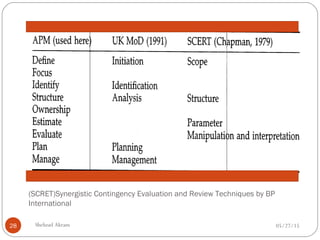
(SCRET)Synergistic Contingency Evaluation and Review Techniques by BP
International
05/27/15Shehzad Akram28
RPM
05/27/15Shehzad Akram29
Define phase: Define the Project for Risk
Management Purpose
1. Consolidate info about project, eg.,
 Project Objectives clearly stated, Project scope, Project
Strategy
Activity Plan (at higher level: Simple), Associated Timing,
Resource usage implication specified, Underlying issues like design
described, Stake holders interest defined
2. Uncover any gap in consolidation phase (gaps shall not exist but
in reality needs to be checked)
Define
Focus
Identify
Structure
Ownership
Estimate
Evaluate
Plan
Manage
05/27/15Shehzad Akram30
RPM
 Define
 Focus
 Identify
 Structure
 Ownership
 Estimate
 Evaluate
 Plan
 Manage
Focus The Risk Management Process:
Define RMP scope and strategy
Eg., testing viability of a project, a qualitative approach may
be appropriate; RMP used for budgets, costs, bid prices, a
quantitative approach may be required.
Scope covers issues like who is analyst, why is the formal
RMP required, what is the scope of the relevant risk
Plan the Process- what time frame? What resources,
what models (techniques) to be applied, what
software etc..
Culminate – in a tactical plan for risk management
process
Document, verify, assess and report
05/27/15Shehzad Akram31
RPM
 Define
 Focus
 Identify
 Structure
 Ownership
 Estimate
 Evaluate
 Plan
 Manage
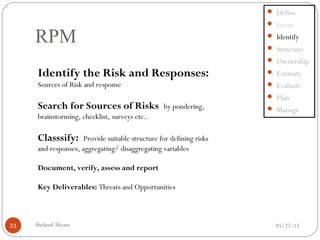
Identify the Risk and Responses:
Sources of Risk and response
Search for Sources of Risks by pondering,
brainstorming, checklist, surveys etc..
Classsify: Provide suitable structure for defining risks
and responses, aggregating/ disaggregating variables
Document, verify, assess and report
Key Deliverables: Threats and Opportunities
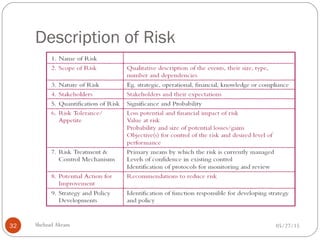
Description of Risk
05/27/15Shehzad Akram32
05/27/15Shehzad Akram33
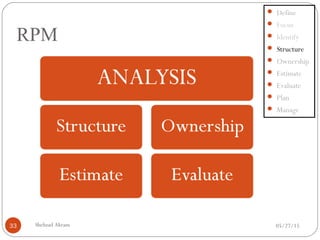
RPM
 Define
 Focus
 Identify
 Structure
 Ownership
 Estimate
 Evaluate
 Plan
 Manage
05/27/15Shehzad Akram34
RPM
 Define
 Focus
 Identify
 Structure
 Ownership
 Estimate
 Evaluate
 Plan
 Manage
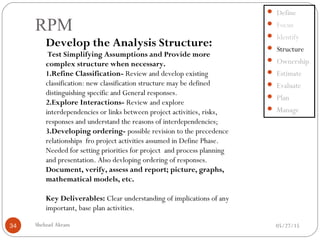
Develop the Analysis Structure:
Test Simplifying Assumptions and Provide more
complex structure when necessary.
1.Refine Classification- Review and develop existing
classification: new classification structure may be defined
distinguishing specific and General responses.
2.Explore Interactions- Review and explore
interdependencies or links between project activities, risks,
responses and understand the reasons of interdependencies;
3.Developing ordering- possible revision to the precedence
relationships fro project activities assumed in Define Phase.
Needed for setting priorities for project and process planning
and presentation. Also devloping ordering of responses.
Document, verify, assess and report; picture, graphs,
mathematical models, etc.
Key Deliverables: Clear understanding of implications of any
important, base plan activities.
05/27/15Shehzad Akram35
RPM
 Define
 Focus
 Identify
 Structure
 Ownership
 Estimate
 Evaluate
 Plan
 Manage
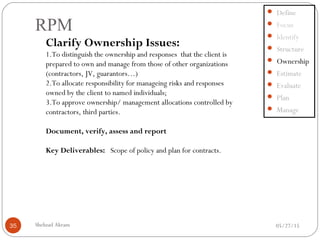
Clarify Ownership Issues:
1.To distinguish the ownership and responses that the client is
prepared to own and manage from those of other organizations
(contractors, JV, guarantors…)
2.To allocate responsibility for manageing risks and responses
owned by the client to named individuals;
3.To approve ownership/ management allocations controlled by
contractors, third parties.
Document, verify, assess and report
Key Deliverables: Scope of policy and plan for contracts.
05/27/15Shehzad Akram36
RPM
 Define
 Focus
 Identify
 Structure
 Ownership
 Estimate
 Evaluate
 Plan
 Manage
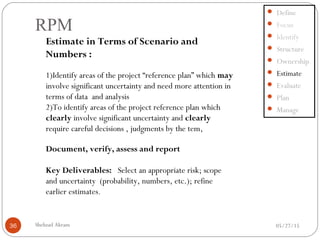
Estimate in Terms of Scenario and
Numbers :
1)Identify areas of the project “reference plan” which may
involve significant uncertainty and need more attention in
terms of data and analysis
2)To identify areas of the project reference plan which
clearly involve significant uncertainty and clearly
require careful decisions , judgments by the tem,
Document, verify, assess and report
Key Deliverables: Select an appropriate risk; scope
and uncertainty (probability, numbers, etc.); refine
earlier estimates.
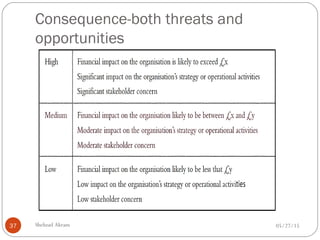
Consequence-both threats and
opportunities
05/27/15Shehzad Akram37
05/27/15Shehzad Akram38
RPM
 Define
 Focus
 Identify
 Structure
 Ownership
 Estimate
 Evaluate
 Plan
 Manage
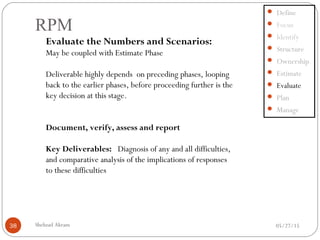
Evaluate the Numbers and Scenarios:
May be coupled with Estimate Phase
Deliverable highly depends on preceding phases, looping
back to the earlier phases, before proceeding further is the
key decision at this stage.
Document, verify, assess and report
Key Deliverables: Diagnosis of any and all difficulties,
and comparative analysis of the implications of responses
to these difficulties
05/27/15Shehzad Akram39
RPM
 Define
 Focus
 Identify
 Structure
 Ownership
 Estimate
 Evaluate
 Plan
 Manage
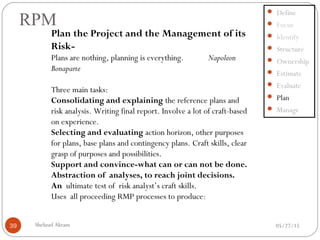
Plan the Project and the Management of its
Risk-
Plans are nothing, planning is everything. Napoleon
Bonaparte
Three main tasks:
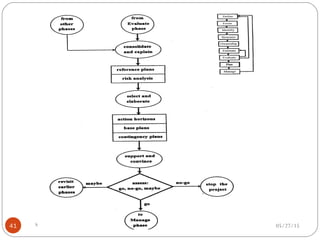
Consolidating and explaining the reference plans and
risk analysis. Writing final report. Involve a lot of craft-based
on experience.
Selecting and evaluating action horizon, other purposes
for plans, base plans and contingency plans. Craft skills, clear
grasp of purposes and possibilities.
Support and convince-what can or can not be done.
Abstraction of analyses, to reach joint decisions.
An ultimate test of risk analyst’s craft skills.
Uses all proceeding RMP processes to produce:
RPM
05/27/15Shehzad Akram40
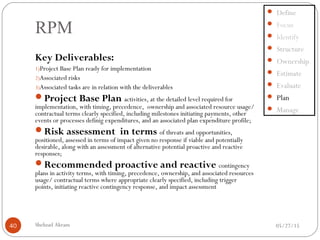
Key Deliverables:
1)Project Base Plan ready for implementation
2)Associated risks
3)Associated tasks are in relation with the deliverables
Project Base Plan activities, at the detailed level required for
implementation, with timing, precedence, ownership and associated resource usage/
contractual terms clearly specified, including milestones initiating payments, other
events or processes definig expenditures, and an associated plan expenditure profile;
Risk assessment in terms of threats and opportunities,
positioned, assessed in terms of impact given no response if viable and potentially
desirable, along with an assessment of alternative potential proactive and reactive
responses;
Recommended proactive and reactive contingency
plans in activity terms, with timing, precedence, ownership, and associated resources
usage/ contractual terms where appropriate clearly specified, including trigger
points, initiating reactive contingency response, and impact assessment
 Define
 Focus
 Identify
 Structure
 Ownership
 Estimate
 Evaluate
 Plan
 Manage
05/27/15Shehzad Akram41
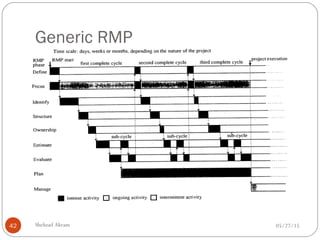
Generic RMP
05/27/15Shehzad Akram42
Table 4.1 Generic RMP Chris page 50-51
05/27/15Shehzad Akram43
RPM
 Define
 Focus
 Identify
 Structure
 Ownership
 Estimate
 Evaluate
 Plan
 Manage
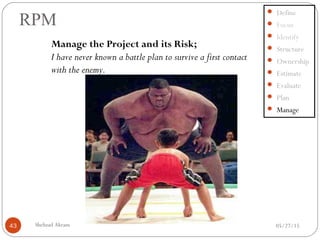
Manage the Project and its Risk;
I have never known a battle plan to survive a first contact
with the enemy.
05/27/15Shehzad Akram44
Four main tasks:
1. Manage planned actions; action phase, implement
planned project activities, basis of project
management, translating plans into actions seldom
straightforward. Routine project planning
meetings .
2. Monitor; Formal and informal monitoring at
different levels and change control process at
various levels. End-of project reviews involve
higher level monitoing
3. Manage Crisis
4. Roll action plans forward
 Define
 Focus
 Identify
 Structure
 Ownership
 Estimate
 Evaluate
 Plan
 Manage
05/27/15Shehzad Akram45
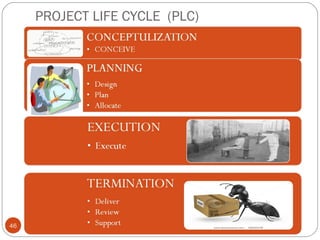
PROJECT LIFE CYCLE (PLC)
05/27/15Shehzad Akram46
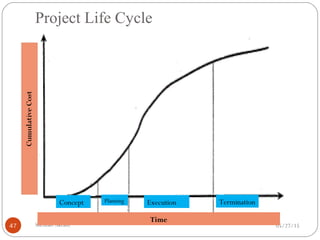
Project Life Cycle
05/27/15Shehzad Akram47
Concept Planning Execution Termination
Time
PLC
05/27/15Shehzad Akram48
KEY
Other
Projects
Start
Conceive
Design
Plan
Allocate
Execute
Deliver
Review
Support
Abort
Primary Progression flow
Primary feedback loops
Secondary feedback loops
Tertiary feedback loops
PLC
05/27/15Shehzad Akram49
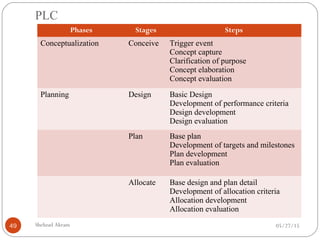
Phases Stages Steps
Conceptualization Conceive Trigger event
Concept capture
Clarification of purpose
Concept elaboration
Concept evaluation
Planning Design Basic Design
Development of performance criteria
Design development
Design evaluation
Plan Base plan
Development of targets and milestones
Plan development
Plan evaluation
Allocate Base design and plan detail
Development of allocation criteria
Allocation development
Allocation evaluation
PLC
05/27/15Shehzad Akram50
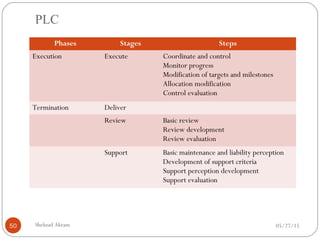
Phases Stages Steps
Execution Execute Coordinate and control
Monitor progress
Modification of targets and milestones
Allocation modification
Control evaluation
Termination Deliver
Review Basic review
Review development
Review evaluation
Support Basic maintenance and liability perception
Development of support criteria
Support perception development
Support evaluation
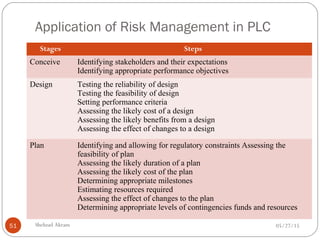
Application of Risk Management in PLC
05/27/15Shehzad Akram51
Stages Steps
Conceive Identifying stakeholders and their expectations
Identifying appropriate performance objectives
Design Testing the reliability of design
Testing the feasibility of design
Setting performance criteria
Assessing the likely cost of a design
Assessing the likely benefits from a design
Assessing the effect of changes to a design
Plan Identifying and allowing for regulatory constraints Assessing the
feasibility of plan
Assessing the likely duration of a plan
Assessing the likely cost of the plan
Determining appropriate milestones
Estimating resources required
Assessing the effect of changes to the plan
Determining appropriate levels of contingencies funds and resources
05/27/15Shehzad Akram52
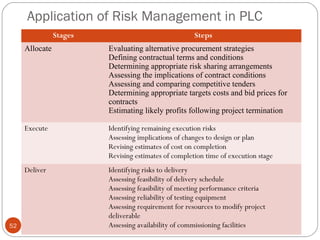
Stages Steps
Allocate Evaluating alternative procurement strategies
Defining contractual terms and conditions
Determining appropriate risk sharing arrangements
Assessing the implications of contract conditions
Assessing and comparing competitive tenders
Determining appropriate targets costs and bid prices for
contracts
Estimating likely profits following project termination
Execute Identifying remaining execution risks
Assessing implications of changes to design or plan
Revising estimates of cost on completion
Revising estimates of completion time of execution stage
Deliver Identifying risks to delivery
Assessing feasibility of delivery schedule
Assessing feasibility of meeting performance criteria
Assessing reliability of testing equipment
Assessing requirement for resources to modify project
deliverable
Assessing availability of commissioning facilities
Application of Risk Management in PLC
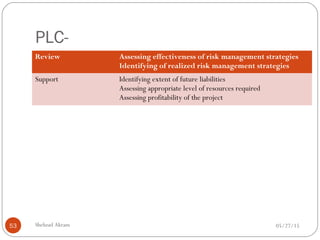
PLC-
05/27/15Shehzad Akram53
Review Assessing effectiveness of risk management strategies
Identifying of realized risk management strategies
Support Identifying extent of future liabilities
Assessing appropriate level of resources required
Assessing profitability of the project
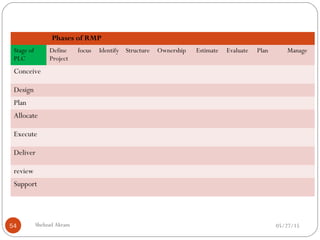
05/27/15Shehzad Akram54
Phases of RMP
Stage of
PLC
Define
Project
focus Identify Structure Ownership Estimate Evaluate Plan Manage
Conceive
Design
Plan
Allocate
Execute
Deliver
review
Support
05/27/15Shehzad Akram55
05/27/15Shehzad Akram56
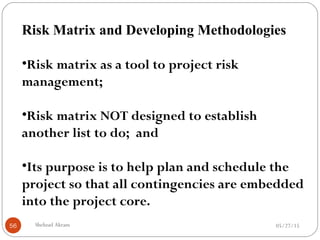
Risk Matrix and Developing Methodologies
•Risk matrix as a tool to project risk
management;
•Risk matrix NOT designed to establish
another list to do; and
•Its purpose is to help plan and schedule the
project so that all contingencies are embedded
into the project core.
05/27/15Shehzad Akram57
05/27/15Shehzad Akram58
05/27/15Shehzad Akram59
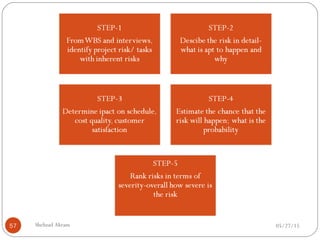
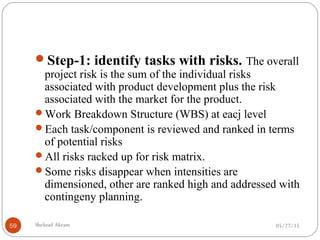
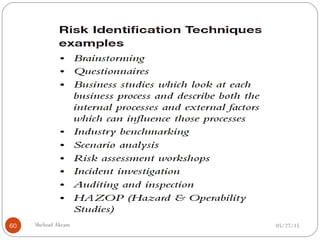
Step-1: identify tasks with risks. The overall
project risk is the sum of the individual risks
associated with product development plus the risk
associated with the market for the product.
Work Breakdown Structure (WBS) at eacj level
Each task/component is reviewed and ranked in terms
of potential risks
All risks racked up for risk matrix.
Some risks disappear when intensities are
dimensioned, other are ranked high and addressed with
contingeny planning.
05/27/15Shehzad Akram60
05/27/15Shehzad Akram61
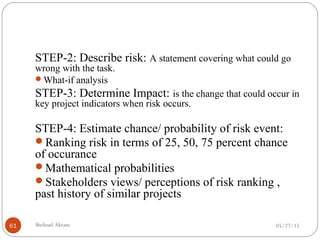
STEP-2: Describe risk: A statement covering what could go
wrong with the task.
What-if analysis
STEP-3: Determine Impact: is the change that could occur in
key project indicators when risk occurs.
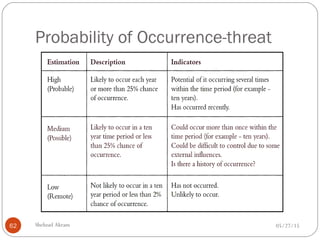
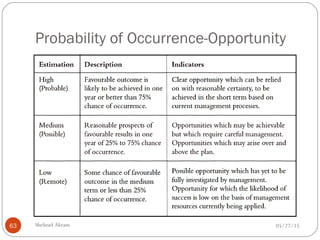
STEP-4: Estimate chance/ probability of risk event:
Ranking risk in terms of 25, 50, 75 percent chance
of occurance
Mathematical probabilities
Stakeholders views/ perceptions of risk ranking ,
past history of similar projects
Probability of Occurrence-threat
05/27/15Shehzad Akram62
Probability of Occurrence-Opportunity
05/27/15Shehzad Akram63
05/27/15Shehzad Akram64
05/27/15Shehzad Akram65
STEP-5: Rank Risk by Severity:
Risk may be high in probability but with minimal
severity, thus cost of contingency is low.
Low-probability risk may have high severity, eg., a
key supplier go out of business
STEP-6: Identify root-cause:
Analytic exercise that can eventually help manage risk
Identifying rot causes in schedules and task
definitions.
STEP-7: Prepare contingency plan:
A schedulable task addresses the likelyhood that a
linked task will not work.
Designed to correct an event or action that delays the
schedule or impacts the quality of work.
05/27/15Shehzad Akram66
05/27/15Shehzad Akram67
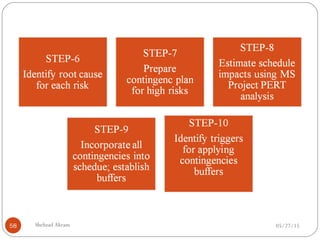
STEP-8: Estimate schedule impacts using MS Project
software:
•Apply theory of constraints
•When a predictable source or bottleneck is identified in the
planning process, creating a risk, the scenario planning is
done (worst case-pessimistic; optimistic; expected), PERT
analysis establishing a buffer schedule for that contingency.
STEP-9: Incorporate risk in schedules and establish buffers:
• New pessimistic risk-based schedule is not base-lined into
project but buffertime equal to difference between the
expected and pessimistic durations is withheld for later use.
05/27/15Shehzad Akram68
STEP-10: Identify triggers for applying buffers:
Identify events or indicators that will trigger a buffer action
based on risk.
Symptoms and trigger action
Risk may trigger a buffer
How decisions will be made to help avoid last minute “crisis
management.
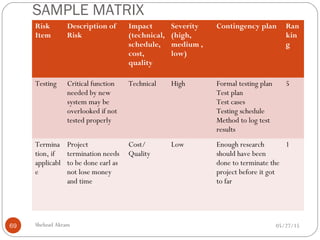
SAMPLE MATRIX
05/27/15Shehzad Akram69
Risk
Item
Description of
Risk
Impact
(technical,
schedule,
cost,
quality
Severity
(high,
medium ,
low)
Contingency plan Ran
kin
g
Testing Critical function
needed by new
system may be
overlooked if not
tested properly
Technical High Formal testing plan
Test plan
Test cases
Testing schedule
Method to log test
results
5
Termina
tion, if
applicabl
e
Project
termination needs
to be done earl as
not lose money
and time
Cost/
Quality
Low Enough research
should have been
done to terminate the
project before it got
to far
1
05/27/15Shehzad Akram70
Prepare the organization
Risk: the Oragnizational Culture Issue
A cultur of risk management competncies
Link corporate and project plannng
Traning and Development in Risk
Project Experience
Learning Organization
Strong Functional managers Addresse Quality
Building the Culture
Addressing Risk with scenarios
Performance incentives
The Risk of “Blinders”
Personal, Project and Organization Risk
Building a Risk Management Culture
Culture-Internal risk to projects
05/27/15Shehzad Akram71
Building culture is a process of developing:
People in Organization who thinks and plan projects
effectively
Support by company systems
Encourage people to think and plan effectively
Culture of what-if approach
Inculcating a culture of theoretical (could happen) and
practical risks (likely to happen)
Preparing the Organization
05/27/15Shehzad Akram72
Culture is the way f doing work
Risk management is likely to fail if organization does not
address risk the way work is done;
Risk management/ risk matrix is part of planning process in
organizations.
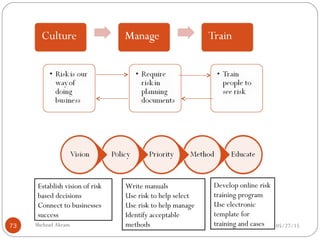
05/27/15Shehzad Akram73
Establish vision of risk
based decisions
Connect to businesses
success
Write manuals
Use risk to help select
Use risk to help manage
Identify acceptable
methods
Develop online risk
training program
Use electronic
template for
training and cases

project risk management

  • 1.
  • 2.
  • 3.
  • 4.
    Risk-Defined 05/27/15Shehzad Akram4 A situationinvolving exposure to danger; “The combination of the probability of an event and its consequences”  “Effect of uncertainty on objectives” (ISO 31000(2009) /ISO Guide 73:2002) Uncertainties include events (which may or not happen); Uncertainties caused by ambiguity or a lack of information; and Also includes both negative and positive impacts on objectives. (developed by an international committee representing over 30 countries and is based on the input of several thousand subject matter experts.)
  • 5.
    PROJECT and PROJECT MANAGEMENT 05/27/15ShehzadAkram5 Project: An individual or collaborative enterprise planned and designed to achieve an aim. A project is a temporary endeavor with a defined beginning and end (usually time-constrained, and often constrained by funding or deliverables), undertaken to meet unique goals and objectives, typically to bring about beneficial change or added value
  • 6.
    Project Management 05/27/15Shehzad Akram6 isthe discipline of Planning; Organizing; Securing; and Managing resources to achieve specific goals.
  • 7.
    PROJECT RISK MANAGEMENT (PRM) 05/27/15ShehzadAkram7 From above definitions PRM:  Art and science of planning, organizing, securing and managing resources (Management) to harness/control/manage the effects of uncertainties on objectives (Risk)of a temporary endeavor (project). One of the nine knowledge areas defined in PMBOK (Project Management Body of Knowledge)
  • 8.
    Risk Management 05/27/15Shehzad Akram8 Isa Comprehensive System that includes: Creating an appropriate risk management environment Maintaining an efficient Risk Measurement Mitigating and Monitoring Process Establishing an Adequate Internal Control Arrangement Core of the Strategic Management of the Company It is the process whereby organizations methodically address the risks attaching to their activities with the goal of achieving sustained benefit within each activity and across the portfolio of all activities.
  • 9.
    05/27/15Shehzad Akram9 OR Risk Managementis the; Identification; Assessment; and prioritization of risks Monitoring followed by coordinated and economical application of resources to minimize, monitor, and control the probability and/or impact of unfortunate events or to maximize the realization of opportunities.
  • 10.
    Why Risk Management: 05/27/15ShehzadAkram10 Its objective is to add maximum sustainable value to all the activities of the organization. It marshals the understanding of the potential upside and downside of all those factors which can affect the organization. It increases the probability of success, and reduces both the probability of failure and the uncertainty of achieving the organization's overall objectives. Healthy Stress?? Vs the bad stress (Zaib)
  • 11.
    ROOTS OF UNCERTAINTY 05/27/15ShehzadAkram11  Stakeholders  Objectives  Variety of Resources, (human, capital, material..)  Project Organizations  Scope of work  Cost  Time  Delivery of Quantified and Qualitative objectives  Technologies  Environment  Regulators
  • 12.
    05/27/15Shehzad Akram12 Roots ofUncertainty are associated with who Who are the parties ultimately involved (Executing Agencies, partners, etc..) Why What do they want (motives, objectives..) What What is it the parties interested in (design) Whichway How is to be done (activities) Wherewithal What resources are required (resources) When when does it have to be done (Schedule, timetable)
  • 13.
  • 14.
    Role of RiskManagement 05/27/15Shehzad Akram14 Risk Identification Risk Appraisal Risk Management Focus of downside of risk Exploit Opportunities arising from risks
  • 15.
  • 16.
  • 17.
    05/27/15Shehzad Akram17 Project- Specific Risks International Risk Industry- specificRisks Competitive Risks Market Risk Types of Risk unsystematic, specific to firm or assets, diversifiable Systematic, non- diversifiable Systematic risk can not be diversified however parts of the risk can be reduced through risk mitigation and transfering techniques. Legal Legal Political
  • 18.
    05/27/15Shehzad Akram18 INTERNAL EXTERNAL ResourcesProcesses SOURCES of RISKS Political risk Country Risk Market Risk Currency Risk Interest Rate Risk Counter-part Risk Credit or default Risk Environmental Risk Inadequate internal controls, Human errors (incompetence, inexperienced, corruption) IT failure Inadequate human resurces Operational Risks Legal Risks??
  • 19.
  • 20.
    05/27/15Shehzad Akram20 Business Riskvs Financial Risk Business risk arises from the nature of firms business; Strategic risk, compliance risks, financial and operational risk Financial risks arises from possible losses in financial markets due to movements in financial variables, usually associated with leverage with the risk that obligations and liabilities can not be met with present assets
  • 21.
    Risk Classification forRisk Management understanding 05/27/15Shehzad Akram21 Three Types of Risks Risk that can be eliminated Those that can be transferred Risks that can be managed by the institution Financial Intermediaries would avoid certain risks by business practices and will not take up activities that impose risk upon them Practice of Financial Institution is to take up activities in which risks can be efficiently managed and shift risks that can be transferred X
  • 22.
    05/27/15Shehzad Akram22 It mustbe integrated into the culture of the organisation with an effective policy and a programme led by the most senior management. It must translate the strategy into tactical and operational objectives, assigning responsibility throughout the organisation with each manager and employee responsible for the management of risk as part of their job description. It supports accountability, performance measurement and reward, thus promoting operational efficiency at all levels.
  • 23.
  • 24.
    Risk Management Process 05/27/15ShehzadAkram24 According to the standard ISO 31000 "Risk management -- Principles and guidelines on implementation," the process of risk management consists of several steps as follows: Establishing the context involves: 1. Identification of risk in a selected domain of interest 2. Planning the remainder of the process. 3. Mapping out the following: the social scope of risk management the identity and objectives of stakeholders the basis upon which risks will be evaluated, constraints. 1. Defining a framework for the activity and an agenda for identification. 2. Developing an analysis of risks involved in the process. 3. Mitigation or Solution of risks using available technological, human and organizational resources.
  • 25.
    Risk Management Principals 05/27/15ShehzadAkram25 ISO identifies the following principles of risk management: Risk management should: create value - resources expended to mitigate risk should generally exceed the consequence of inaction, or (as in value engineering), the gain should exceed the pain be an integral part of organizational processes be part of decision making explicitly address uncertainty and assumptions be systematic and structured be based on the best available information be tailorable take into account human factors be transparent and inclusive be dynamic, iterative and responsive to change be capable of continual improvement and enhancement be continually or periodically re-assessed
  • 26.
    RISK MANAGEMENT PROCESS(RMP) 05/27/15Shehzad Akram26 Association of Project Managers (APM) Project Risk Analysis and Management (PRAM)
  • 27.
  • 28.
    (SCRET)Synergistic Contingency Evaluationand Review Techniques by BP International 05/27/15Shehzad Akram28
  • 29.
    RPM 05/27/15Shehzad Akram29 Define phase:Define the Project for Risk Management Purpose 1. Consolidate info about project, eg.,  Project Objectives clearly stated, Project scope, Project Strategy Activity Plan (at higher level: Simple), Associated Timing, Resource usage implication specified, Underlying issues like design described, Stake holders interest defined 2. Uncover any gap in consolidation phase (gaps shall not exist but in reality needs to be checked) Define Focus Identify Structure Ownership Estimate Evaluate Plan Manage
  • 30.
    05/27/15Shehzad Akram30 RPM  Define Focus  Identify  Structure  Ownership  Estimate  Evaluate  Plan  Manage Focus The Risk Management Process: Define RMP scope and strategy Eg., testing viability of a project, a qualitative approach may be appropriate; RMP used for budgets, costs, bid prices, a quantitative approach may be required. Scope covers issues like who is analyst, why is the formal RMP required, what is the scope of the relevant risk Plan the Process- what time frame? What resources, what models (techniques) to be applied, what software etc.. Culminate – in a tactical plan for risk management process Document, verify, assess and report
  • 31.
    05/27/15Shehzad Akram31 RPM  Define Focus  Identify  Structure  Ownership  Estimate  Evaluate  Plan  Manage Identify the Risk and Responses: Sources of Risk and response Search for Sources of Risks by pondering, brainstorming, checklist, surveys etc.. Classsify: Provide suitable structure for defining risks and responses, aggregating/ disaggregating variables Document, verify, assess and report Key Deliverables: Threats and Opportunities
  • 32.
  • 33.
    05/27/15Shehzad Akram33 RPM  Define Focus  Identify  Structure  Ownership  Estimate  Evaluate  Plan  Manage
  • 34.
    05/27/15Shehzad Akram34 RPM  Define Focus  Identify  Structure  Ownership  Estimate  Evaluate  Plan  Manage Develop the Analysis Structure: Test Simplifying Assumptions and Provide more complex structure when necessary. 1.Refine Classification- Review and develop existing classification: new classification structure may be defined distinguishing specific and General responses. 2.Explore Interactions- Review and explore interdependencies or links between project activities, risks, responses and understand the reasons of interdependencies; 3.Developing ordering- possible revision to the precedence relationships fro project activities assumed in Define Phase. Needed for setting priorities for project and process planning and presentation. Also devloping ordering of responses. Document, verify, assess and report; picture, graphs, mathematical models, etc. Key Deliverables: Clear understanding of implications of any important, base plan activities.
  • 35.
    05/27/15Shehzad Akram35 RPM  Define Focus  Identify  Structure  Ownership  Estimate  Evaluate  Plan  Manage Clarify Ownership Issues: 1.To distinguish the ownership and responses that the client is prepared to own and manage from those of other organizations (contractors, JV, guarantors…) 2.To allocate responsibility for manageing risks and responses owned by the client to named individuals; 3.To approve ownership/ management allocations controlled by contractors, third parties. Document, verify, assess and report Key Deliverables: Scope of policy and plan for contracts.
  • 36.
    05/27/15Shehzad Akram36 RPM  Define Focus  Identify  Structure  Ownership  Estimate  Evaluate  Plan  Manage Estimate in Terms of Scenario and Numbers : 1)Identify areas of the project “reference plan” which may involve significant uncertainty and need more attention in terms of data and analysis 2)To identify areas of the project reference plan which clearly involve significant uncertainty and clearly require careful decisions , judgments by the tem, Document, verify, assess and report Key Deliverables: Select an appropriate risk; scope and uncertainty (probability, numbers, etc.); refine earlier estimates.
  • 37.
  • 38.
    05/27/15Shehzad Akram38 RPM  Define Focus  Identify  Structure  Ownership  Estimate  Evaluate  Plan  Manage Evaluate the Numbers and Scenarios: May be coupled with Estimate Phase Deliverable highly depends on preceding phases, looping back to the earlier phases, before proceeding further is the key decision at this stage. Document, verify, assess and report Key Deliverables: Diagnosis of any and all difficulties, and comparative analysis of the implications of responses to these difficulties
  • 39.
    05/27/15Shehzad Akram39 RPM  Define Focus  Identify  Structure  Ownership  Estimate  Evaluate  Plan  Manage Plan the Project and the Management of its Risk- Plans are nothing, planning is everything. Napoleon Bonaparte Three main tasks: Consolidating and explaining the reference plans and risk analysis. Writing final report. Involve a lot of craft-based on experience. Selecting and evaluating action horizon, other purposes for plans, base plans and contingency plans. Craft skills, clear grasp of purposes and possibilities. Support and convince-what can or can not be done. Abstraction of analyses, to reach joint decisions. An ultimate test of risk analyst’s craft skills. Uses all proceeding RMP processes to produce:
  • 40.
    RPM 05/27/15Shehzad Akram40 Key Deliverables: 1)ProjectBase Plan ready for implementation 2)Associated risks 3)Associated tasks are in relation with the deliverables Project Base Plan activities, at the detailed level required for implementation, with timing, precedence, ownership and associated resource usage/ contractual terms clearly specified, including milestones initiating payments, other events or processes definig expenditures, and an associated plan expenditure profile; Risk assessment in terms of threats and opportunities, positioned, assessed in terms of impact given no response if viable and potentially desirable, along with an assessment of alternative potential proactive and reactive responses; Recommended proactive and reactive contingency plans in activity terms, with timing, precedence, ownership, and associated resources usage/ contractual terms where appropriate clearly specified, including trigger points, initiating reactive contingency response, and impact assessment  Define  Focus  Identify  Structure  Ownership  Estimate  Evaluate  Plan  Manage
  • 41.
  • 42.
    Generic RMP 05/27/15Shehzad Akram42 Table4.1 Generic RMP Chris page 50-51
  • 43.
    05/27/15Shehzad Akram43 RPM  Define Focus  Identify  Structure  Ownership  Estimate  Evaluate  Plan  Manage Manage the Project and its Risk; I have never known a battle plan to survive a first contact with the enemy.
  • 44.
    05/27/15Shehzad Akram44 Four maintasks: 1. Manage planned actions; action phase, implement planned project activities, basis of project management, translating plans into actions seldom straightforward. Routine project planning meetings . 2. Monitor; Formal and informal monitoring at different levels and change control process at various levels. End-of project reviews involve higher level monitoing 3. Manage Crisis 4. Roll action plans forward  Define  Focus  Identify  Structure  Ownership  Estimate  Evaluate  Plan  Manage
  • 45.
  • 46.
    PROJECT LIFE CYCLE(PLC) 05/27/15Shehzad Akram46
  • 47.
    Project Life Cycle 05/27/15ShehzadAkram47 Concept Planning Execution Termination Time
  • 48.
  • 49.
    PLC 05/27/15Shehzad Akram49 Phases StagesSteps Conceptualization Conceive Trigger event Concept capture Clarification of purpose Concept elaboration Concept evaluation Planning Design Basic Design Development of performance criteria Design development Design evaluation Plan Base plan Development of targets and milestones Plan development Plan evaluation Allocate Base design and plan detail Development of allocation criteria Allocation development Allocation evaluation
  • 50.
    PLC 05/27/15Shehzad Akram50 Phases StagesSteps Execution Execute Coordinate and control Monitor progress Modification of targets and milestones Allocation modification Control evaluation Termination Deliver Review Basic review Review development Review evaluation Support Basic maintenance and liability perception Development of support criteria Support perception development Support evaluation
  • 51.
    Application of RiskManagement in PLC 05/27/15Shehzad Akram51 Stages Steps Conceive Identifying stakeholders and their expectations Identifying appropriate performance objectives Design Testing the reliability of design Testing the feasibility of design Setting performance criteria Assessing the likely cost of a design Assessing the likely benefits from a design Assessing the effect of changes to a design Plan Identifying and allowing for regulatory constraints Assessing the feasibility of plan Assessing the likely duration of a plan Assessing the likely cost of the plan Determining appropriate milestones Estimating resources required Assessing the effect of changes to the plan Determining appropriate levels of contingencies funds and resources
  • 52.
    05/27/15Shehzad Akram52 Stages Steps AllocateEvaluating alternative procurement strategies Defining contractual terms and conditions Determining appropriate risk sharing arrangements Assessing the implications of contract conditions Assessing and comparing competitive tenders Determining appropriate targets costs and bid prices for contracts Estimating likely profits following project termination Execute Identifying remaining execution risks Assessing implications of changes to design or plan Revising estimates of cost on completion Revising estimates of completion time of execution stage Deliver Identifying risks to delivery Assessing feasibility of delivery schedule Assessing feasibility of meeting performance criteria Assessing reliability of testing equipment Assessing requirement for resources to modify project deliverable Assessing availability of commissioning facilities Application of Risk Management in PLC
  • 53.
    PLC- 05/27/15Shehzad Akram53 Review Assessingeffectiveness of risk management strategies Identifying of realized risk management strategies Support Identifying extent of future liabilities Assessing appropriate level of resources required Assessing profitability of the project
  • 54.
    05/27/15Shehzad Akram54 Phases ofRMP Stage of PLC Define Project focus Identify Structure Ownership Estimate Evaluate Plan Manage Conceive Design Plan Allocate Execute Deliver review Support
  • 55.
  • 56.
    05/27/15Shehzad Akram56 Risk Matrixand Developing Methodologies •Risk matrix as a tool to project risk management; •Risk matrix NOT designed to establish another list to do; and •Its purpose is to help plan and schedule the project so that all contingencies are embedded into the project core.
  • 57.
  • 58.
  • 59.
    05/27/15Shehzad Akram59 Step-1: identifytasks with risks. The overall project risk is the sum of the individual risks associated with product development plus the risk associated with the market for the product. Work Breakdown Structure (WBS) at eacj level Each task/component is reviewed and ranked in terms of potential risks All risks racked up for risk matrix. Some risks disappear when intensities are dimensioned, other are ranked high and addressed with contingeny planning.
  • 60.
  • 61.
    05/27/15Shehzad Akram61 STEP-2: Describerisk: A statement covering what could go wrong with the task. What-if analysis STEP-3: Determine Impact: is the change that could occur in key project indicators when risk occurs. STEP-4: Estimate chance/ probability of risk event: Ranking risk in terms of 25, 50, 75 percent chance of occurance Mathematical probabilities Stakeholders views/ perceptions of risk ranking , past history of similar projects
  • 62.
  • 63.
  • 64.
  • 65.
    05/27/15Shehzad Akram65 STEP-5: RankRisk by Severity: Risk may be high in probability but with minimal severity, thus cost of contingency is low. Low-probability risk may have high severity, eg., a key supplier go out of business STEP-6: Identify root-cause: Analytic exercise that can eventually help manage risk Identifying rot causes in schedules and task definitions. STEP-7: Prepare contingency plan: A schedulable task addresses the likelyhood that a linked task will not work. Designed to correct an event or action that delays the schedule or impacts the quality of work.
  • 66.
  • 67.
    05/27/15Shehzad Akram67 STEP-8: Estimateschedule impacts using MS Project software: •Apply theory of constraints •When a predictable source or bottleneck is identified in the planning process, creating a risk, the scenario planning is done (worst case-pessimistic; optimistic; expected), PERT analysis establishing a buffer schedule for that contingency. STEP-9: Incorporate risk in schedules and establish buffers: • New pessimistic risk-based schedule is not base-lined into project but buffertime equal to difference between the expected and pessimistic durations is withheld for later use.
  • 68.
    05/27/15Shehzad Akram68 STEP-10: Identifytriggers for applying buffers: Identify events or indicators that will trigger a buffer action based on risk. Symptoms and trigger action Risk may trigger a buffer How decisions will be made to help avoid last minute “crisis management.
  • 69.
    SAMPLE MATRIX 05/27/15Shehzad Akram69 Risk Item Descriptionof Risk Impact (technical, schedule, cost, quality Severity (high, medium , low) Contingency plan Ran kin g Testing Critical function needed by new system may be overlooked if not tested properly Technical High Formal testing plan Test plan Test cases Testing schedule Method to log test results 5 Termina tion, if applicabl e Project termination needs to be done earl as not lose money and time Cost/ Quality Low Enough research should have been done to terminate the project before it got to far 1
  • 70.
    05/27/15Shehzad Akram70 Prepare theorganization Risk: the Oragnizational Culture Issue A cultur of risk management competncies Link corporate and project plannng Traning and Development in Risk Project Experience Learning Organization Strong Functional managers Addresse Quality Building the Culture Addressing Risk with scenarios Performance incentives The Risk of “Blinders” Personal, Project and Organization Risk Building a Risk Management Culture
  • 71.
    Culture-Internal risk toprojects 05/27/15Shehzad Akram71 Building culture is a process of developing: People in Organization who thinks and plan projects effectively Support by company systems Encourage people to think and plan effectively Culture of what-if approach Inculcating a culture of theoretical (could happen) and practical risks (likely to happen)
  • 72.
    Preparing the Organization 05/27/15ShehzadAkram72 Culture is the way f doing work Risk management is likely to fail if organization does not address risk the way work is done; Risk management/ risk matrix is part of planning process in organizations.
  • 73.
    05/27/15Shehzad Akram73 Establish visionof risk based decisions Connect to businesses success Write manuals Use risk to help select Use risk to help manage Identify acceptable methods Develop online risk training program Use electronic template for training and cases