PRSENTED BY : -
MANISH TIWARI
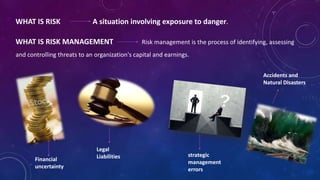
WHAT IS RISK A situation involving exposure to danger.
WHAT IS RISK MANAGEMENT Risk management is the process of identifying, assessing
and controlling threats to an organization's capital and earnings.
Financial
uncertainty
Legal
Liabilities strategic
management
errors
Accidents and
Natural Disasters
Risk management is important -
• Risk management is important in an organisation because without it, a firm cannot possibly define its
objectives for the future. If a company defines objectives without taking the risks into consideration,
chances are that they will lose direction once any of these risks hit home.
• The whole goal of risk management is to make sure that the company only takes the risks that will
help it achieve its primary objectives while keeping all other risks under control.
TYPES OF RISK
• Unsystematic Risk –
Unsystematic risk, also known as "specific risk," "diversifiable risk" or "residual risk," is the type of uncertainty
that comes with the company or industry you invest in. Unsystematic risk can be reduced through
diversification.
• Systematic Risk –
Systematic risk, also known as "market risk" or "un-diversifiable risk", is the uncertainty inherent to the entire
market or entire market segment.
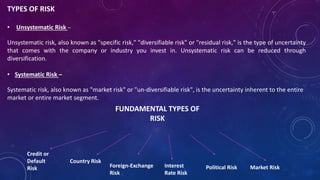
FUNDAMENTAL TYPES OF
RISK
Credit or
Default
Risk
Country Risk
Foreign-Exchange
Risk
Interest
Rate Risk
Political Risk Market Risk
RISK MANAGEMENT STANDARD
• The National Institute of Standards and Technology
• ISO (International Organization for Standardization)
Example : -
ISO 31000
• Provide frameworks for risk management process improvements that can be used by companies, regardless of the
organization's size or target sector
Recommendation
• create value for the organization
• systematic and structured
• best available information
• tailored to the project
• adaptable to change
• continuously monitored and improved upon
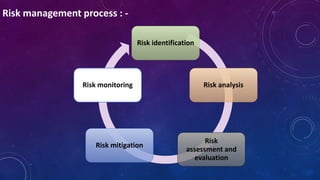
Risk identification
Risk analysis
Risk
assessment and
evaluation
Risk mitigation
Risk monitoring
Risk management process : -
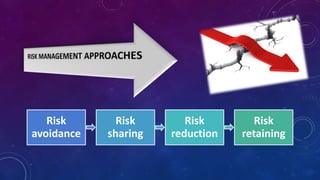
Risk
avoidance
Risk
sharing
Risk
reduction
Risk
retaining
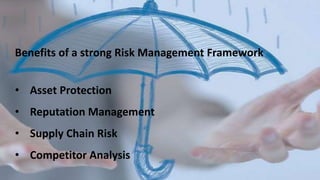
Benefits of a strong Risk Management Framework
• Asset Protection
• Reputation Management
• Supply Chain Risk
• Competitor Analysis

Risk management

  • 1.
    PRSENTED BY :- MANISH TIWARI
  • 2.
    WHAT IS RISKA situation involving exposure to danger. WHAT IS RISK MANAGEMENT Risk management is the process of identifying, assessing and controlling threats to an organization's capital and earnings. Financial uncertainty Legal Liabilities strategic management errors Accidents and Natural Disasters
  • 3.
    Risk management isimportant - • Risk management is important in an organisation because without it, a firm cannot possibly define its objectives for the future. If a company defines objectives without taking the risks into consideration, chances are that they will lose direction once any of these risks hit home. • The whole goal of risk management is to make sure that the company only takes the risks that will help it achieve its primary objectives while keeping all other risks under control.
  • 4.
    TYPES OF RISK •Unsystematic Risk – Unsystematic risk, also known as "specific risk," "diversifiable risk" or "residual risk," is the type of uncertainty that comes with the company or industry you invest in. Unsystematic risk can be reduced through diversification. • Systematic Risk – Systematic risk, also known as "market risk" or "un-diversifiable risk", is the uncertainty inherent to the entire market or entire market segment. FUNDAMENTAL TYPES OF RISK Credit or Default Risk Country Risk Foreign-Exchange Risk Interest Rate Risk Political Risk Market Risk
  • 5.
    RISK MANAGEMENT STANDARD •The National Institute of Standards and Technology • ISO (International Organization for Standardization) Example : - ISO 31000 • Provide frameworks for risk management process improvements that can be used by companies, regardless of the organization's size or target sector Recommendation • create value for the organization • systematic and structured • best available information • tailored to the project • adaptable to change • continuously monitored and improved upon
  • 6.
    Risk identification Risk analysis Risk assessmentand evaluation Risk mitigation Risk monitoring Risk management process : -
  • 7.
  • 8.
    Benefits of astrong Risk Management Framework • Asset Protection • Reputation Management • Supply Chain Risk • Competitor Analysis