Risk
Risk management - the art and science of
identifying, analyzing, and responding to risk
factors throughout the life of a project and in the
best interest of its objectives.

7-3

Copyright © 2010 Pearson Education, Inc.
Publishing as Prentice Hall
Definition of Risk
 Risk is a :
 Potential problem
 Future happenings
Change in mind, opinion, actions, places, etc
Choice and uncertainty that choice entails.

Characteristics of Risk
 Uncertainty
 Loss - risk becomes a reality and unwanted consequences
or losses occur
4
 Risk Category - #1
 Project Risks

 Technical Risks
 Business Risks

Market risk – building an excellent product or system that no
one really wants
Strategic risk – building a product that no longer fits into the
overall business strategy for the company
Sales risk – building a product that the sales force doesn't
understand how to sell
Management risk – losing the support of senior management
due to a change in focus or a change in people
Budget risk – losing budgetary or personnel commitment
5
Risk Category - #2
 Known risks
 Those risks that can be uncovered after careful evaluation
of the project plan, the business and technical
environment in which the project is being developed, and
other reliable information sources (e.g., unrealistic delivery
date)
 Predictable risks
 Those risks that are extrapolated from past project
experience (e.g., past turnover)
 Unpredictable risks
 Those risks that can and do occur, but are extremely difficult to
identify in advance
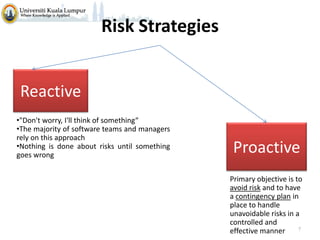
Risk Strategies
Reactive
•"Don't worry, I'll think of something“
•The majority of software teams and managers
rely on this approach
•Nothing is done about risks until something
goes wrong

Proactive
Primary objective is to
avoid risk and to have
a contingency plan in
place to handle
unavoidable risks in a
controlled and
7
effective manner
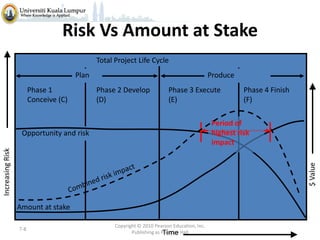
Risk Vs Amount at Stake
Total Project Life Cycle
Plan
Phase 1
Conceive (C)

Produce
Phase 2 Develop
(D)

Phase 3 Execute
(E)

Phase 4 Finish
(F)

Period of
highest risk
impact
$ Value

Increasing Risk

Opportunity and risk

Amount at stake
7-8

Copyright © 2010 Pearson Education, Inc.
Publishing as Prentice Hall
Time
Process of Risk Management

• What is likely to happen?
• What can be done?
• What are the warning signs?
• What are the likely outcomes?
Project Risk = (Probability of Event)(Consequences of Event)

7-9

Copyright © 2010 Pearson Education, Inc.
Publishing as Prentice Hall
Four Stages of Risk Management
1. Risk identification
2. Analysis of probability and consequences
3. Risk mitigation strategies

4. Control and documentation
7-10

Copyright © 2010 Pearson Education, Inc.
Publishing as Prentice Hall
RISK IDENTIFICATION
Systematic attempt to specify threats to the
project plan
Avoid them when possible and controlling
them when necessary
Risk identification approaches:
1. Generic Risks
2. Product –Specific-Risks
11
Risk Identification Method
Risk Item Checklist
• Used as one way to identify risks
• Focuses on known and predictable risks in specific
subcategories (see next slide)
• Can be organized in several ways
– A list of characteristics relevant to each risk
subcategory
– Questionnaire that leads to an estimate on the
impact of each risk
– A list containing a set of risk component and
drivers and their probability of occurrence
12
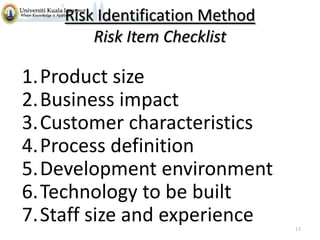
Risk Identification Method
Risk Item Checklist

1.Product size
2.Business impact
3.Customer characteristics
4.Process definition
5.Development environment
6.Technology to be built
7.Staff size and experience
13
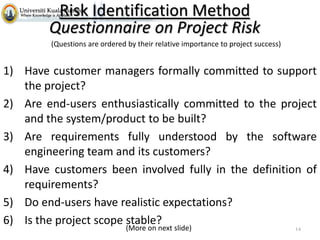
Risk Identification Method
Questionnaire on Project Risk
(Questions are ordered by their relative importance to project success)

1) Have customer managers formally committed to support
the project?
2) Are end-users enthusiastically committed to the project
and the system/product to be built?
3) Are requirements fully understood by the software
engineering team and its customers?
4) Have customers been involved fully in the definition of
requirements?
5) Do end-users have realistic expectations?
6) Is the project scope stable?
(More on next slide)

14
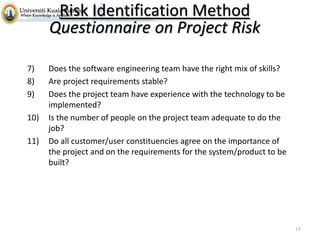
Risk Identification Method
Questionnaire on Project Risk
7)
8)
9)
10)
11)

Does the software engineering team have the right mix of skills?
Are project requirements stable?
Does the project team have experience with the technology to be
implemented?
Is the number of people on the project team adequate to do the
job?
Do all customer/user constituencies agree on the importance of
the project and on the requirements for the system/product to be
built?

15
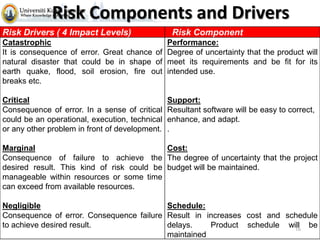
Risk Components and Drivers
Risk Drivers ( 4 Impact Levels)

Risk Component

Catastrophic
It is consequence of error. Great chance of
natural disaster that could be in shape of
earth quake, flood, soil erosion, fire out
breaks etc.

Performance:
Degree of uncertainty that the product will
meet its requirements and be fit for its
intended use.

Critical
Consequence of error. In a sense of critical
could be an operational, execution, technical
or any other problem in front of development.

Support:
Resultant software will be easy to correct,
enhance, and adapt.
.

Marginal
Cost:
Consequence of failure to achieve the The degree of uncertainty that the project
desired result. This kind of risk could be budget will be maintained.
manageable within resources or some time
can exceed from available resources.
Negligible
Schedule:
Consequence of error. Consequence failure Result in increases cost and schedule
to achieve desired result.
delays.
Product schedule will be
16
maintained
Risk Projection (Estimation)
Background
• Risk projection (or estimation) attempts to rate each
risk in two ways
– The probability that the risk is real
– The consequence of the problems associated with
the risk, should it occur
• The project planner, managers, and technical staff
perform four risk projection steps (see next slide)
• The intent of these steps is to consider risks in a
manner that leads to prioritization
• Be prioritizing risks, the software team can allocate
limited resources where they will have the most impact
18
Risk Projection/Estimation Steps
1) Establish a scale that reflects the perceived
likelihood of a risk (e.g., 1-low, 10-high)
2) Delineate the consequences of the risk
3) Estimate the impact of the risk on the
project and product
4) Note the overall accuracy of the risk
projection so that there will be no
misunderstandings
19
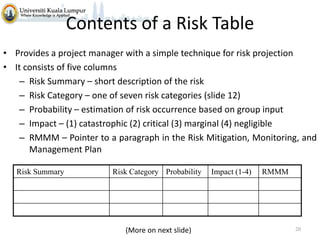
Contents of a Risk Table
• Provides a project manager with a simple technique for risk projection
• It consists of five columns
– Risk Summary – short description of the risk
– Risk Category – one of seven risk categories (slide 12)
– Probability – estimation of risk occurrence based on group input
– Impact – (1) catastrophic (2) critical (3) marginal (4) negligible
– RMMM – Pointer to a paragraph in the Risk Mitigation, Monitoring, and
Management Plan
Risk Summary

Risk Category Probability

(More on next slide)

Impact (1-4)

RMMM

20
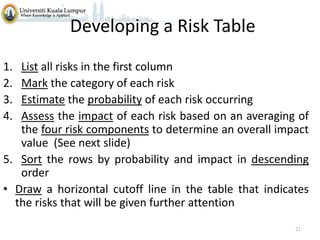
Developing a Risk Table
1.
2.
3.
4.

List all risks in the first column
Mark the category of each risk
Estimate the probability of each risk occurring
Assess the impact of each risk based on an averaging of
the four risk components to determine an overall impact
value (See next slide)
5. Sort the rows by probability and impact in descending
order
• Draw a horizontal cutoff line in the table that indicates
the risks that will be given further attention
21
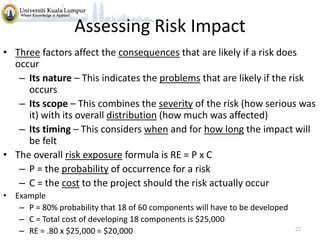
Assessing Risk Impact
• Three factors affect the consequences that are likely if a risk does
occur
– Its nature – This indicates the problems that are likely if the risk
occurs
– Its scope – This combines the severity of the risk (how serious was
it) with its overall distribution (how much was affected)
– Its timing – This considers when and for how long the impact will
be felt
• The overall risk exposure formula is RE = P x C
– P = the probability of occurrence for a risk
– C = the cost to the project should the risk actually occur
• Example
– P = 80% probability that 18 of 60 components will have to be developed
– C = Total cost of developing 18 components is $25,000
– RE = .80 x $25,000 = $20,000

22
Risk Mitigation, Monitoring, and
Management
Background
(Risk Mitigation)
• An effective strategy for dealing with risk must consider three
issues
– Risk mitigation (i.e., avoidance)
– Risk monitoring
– Risk management and contingency planning
• Risk mitigation (avoidance) is the primary strategy and is
achieved through a plan
– Example: Risk of high staff turnover (see next slide)

(More on next slide)

24
Background
(Risk Mitigation)
Strategy for Reducing Staff Turnover
 Meet with current staff to determine causes for turnover (e.g., poor
working conditions, low pay, competitive job market)
 Mitigate those causes that are under our control before the project
starts
 Once the project commences, assume turnover will occur and develop
techniques to ensure continuity when people leave
 Organize project teams so that information about each development
activity is widely dispersed
 Define documentation standards and establish mechanisms to ensure
that documents are developed in a timely manner
 Conduct peer reviews of all work (so that more than one person is "up to
speed")
 Assign a backup staff member for every critical technologist
25
Background
(Risk Monitoring)
• During risk monitoring, the project manager monitors
factors that may provide an indication of whether a risk is
becoming more or less likely
• Risk management and contingency planning assume that
mitigation efforts have failed and that the risk has
become a reality
• RMMM steps incur additional project cost
– Large projects may have identified 30 – 40 risks
• Risk is not limited to the project component itself
– Risks can occur after the project has been delivered to
26
the user
The RMMM Plan
• The RMMM plan may be a part of the project development plan or
may be a separate document.
• Once RMMM has been documented and the project has begun, the
risk mitigation, and monitoring steps begin
– Risk mitigation is a problem avoidance activity
– Risk monitoring is a project tracking activity
• Risk monitoring has three objectives
– To assess whether predicted risks do, in fact, occur
– To ensure that risk aversion steps defined for the risk are being
properly applied
– To collect information that can be used for future risk analysis
• The findings from risk monitoring may allow the project manager to
ascertain what risks caused which problems throughout the project
27
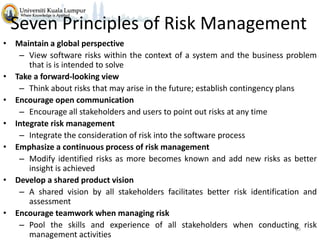
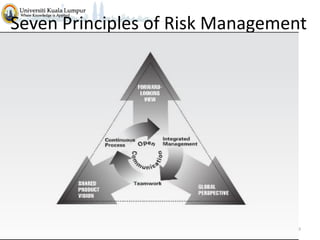
Seven Principles of Risk Management
• Maintain a global perspective
– View software risks within the context of a system and the business problem
that is is intended to solve
• Take a forward-looking view
– Think about risks that may arise in the future; establish contingency plans
• Encourage open communication
– Encourage all stakeholders and users to point out risks at any time
• Integrate risk management
– Integrate the consideration of risk into the software process
• Emphasize a continuous process of risk management
– Modify identified risks as more becomes known and add new risks as better
insight is achieved
• Develop a shared product vision
– A shared vision by all stakeholders facilitates better risk identification and
assessment
• Encourage teamwork when managing risk
– Pool the skills and experience of all stakeholders when conducting risk
28
management activities
Seven Principles of Risk Management

29
Summary
• Whenever much is riding on a project, common sense dictates risk
analysis
– Yet, most project managers do it informally and superficially, if at
all
• However, the time spent in risk management results in
– Less upheaval during the project
– A greater ability to track and control a project
– The confidence that comes with planning for problems before
they occur
• Risk management can absorb a significant amount of the project
planning effort…but the effort is worth it
30


Risk Factor Identification
Brainstorming meetings
Expert opinion
Past history

Multiple (or team based) assessments
7-31

Copyright © 2010 Pearson Education, Inc.
Publishing as Prentice Hall
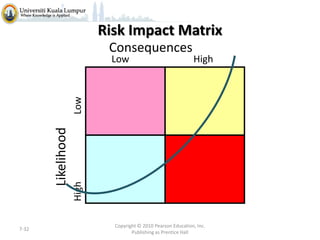
Risk Impact Matrix
Consequences

High

7-32

High

Likelihood

Low

Low

Copyright © 2010 Pearson Education, Inc.
Publishing as Prentice Hall
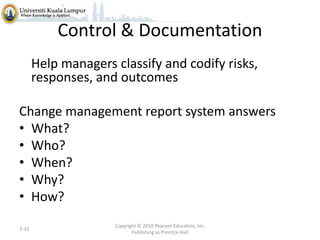
Control & Documentation
Help managers classify and codify risks,
responses, and outcomes
Change management report system answers
• What?
• Who?
• When?
• Why?
• How?
7-33

Copyright © 2010 Pearson Education, Inc.
Publishing as Prentice Hall
Summary
• Whenever riding much on a project, common sense
dictates risk analysis
– Yet, most project managers do it informally and
superficially, if at all
• However, the time spent in risk management results in
– Less upheaval during the project
– A greater ability to track and control a project
– The confidence that comes with planning for problems
before they occur
• Risk management can absorb a significant amount of the
34
project planning effort…but the effort is worth it

7-35

Copyright © 2010 Pearson Education, Inc.
Publishing as Prentice Hall

Project Management C7 -risk_management

  • 3.
    Risk Risk management -the art and science of identifying, analyzing, and responding to risk factors throughout the life of a project and in the best interest of its objectives. 7-3 Copyright © 2010 Pearson Education, Inc. Publishing as Prentice Hall
  • 4.
    Definition of Risk Risk is a :  Potential problem  Future happenings Change in mind, opinion, actions, places, etc Choice and uncertainty that choice entails. Characteristics of Risk  Uncertainty  Loss - risk becomes a reality and unwanted consequences or losses occur 4
  • 5.
     Risk Category- #1  Project Risks  Technical Risks  Business Risks Market risk – building an excellent product or system that no one really wants Strategic risk – building a product that no longer fits into the overall business strategy for the company Sales risk – building a product that the sales force doesn't understand how to sell Management risk – losing the support of senior management due to a change in focus or a change in people Budget risk – losing budgetary or personnel commitment 5
  • 6.
    Risk Category -#2  Known risks  Those risks that can be uncovered after careful evaluation of the project plan, the business and technical environment in which the project is being developed, and other reliable information sources (e.g., unrealistic delivery date)  Predictable risks  Those risks that are extrapolated from past project experience (e.g., past turnover)  Unpredictable risks  Those risks that can and do occur, but are extremely difficult to identify in advance
  • 7.
    Risk Strategies Reactive •"Don't worry,I'll think of something“ •The majority of software teams and managers rely on this approach •Nothing is done about risks until something goes wrong Proactive Primary objective is to avoid risk and to have a contingency plan in place to handle unavoidable risks in a controlled and 7 effective manner
  • 8.
    Risk Vs Amountat Stake Total Project Life Cycle Plan Phase 1 Conceive (C) Produce Phase 2 Develop (D) Phase 3 Execute (E) Phase 4 Finish (F) Period of highest risk impact $ Value Increasing Risk Opportunity and risk Amount at stake 7-8 Copyright © 2010 Pearson Education, Inc. Publishing as Prentice Hall Time
  • 9.
    Process of RiskManagement • What is likely to happen? • What can be done? • What are the warning signs? • What are the likely outcomes? Project Risk = (Probability of Event)(Consequences of Event) 7-9 Copyright © 2010 Pearson Education, Inc. Publishing as Prentice Hall
  • 10.
    Four Stages ofRisk Management 1. Risk identification 2. Analysis of probability and consequences 3. Risk mitigation strategies 4. Control and documentation 7-10 Copyright © 2010 Pearson Education, Inc. Publishing as Prentice Hall
  • 11.
    RISK IDENTIFICATION Systematic attemptto specify threats to the project plan Avoid them when possible and controlling them when necessary Risk identification approaches: 1. Generic Risks 2. Product –Specific-Risks 11
  • 12.
    Risk Identification Method RiskItem Checklist • Used as one way to identify risks • Focuses on known and predictable risks in specific subcategories (see next slide) • Can be organized in several ways – A list of characteristics relevant to each risk subcategory – Questionnaire that leads to an estimate on the impact of each risk – A list containing a set of risk component and drivers and their probability of occurrence 12
  • 13.
    Risk Identification Method RiskItem Checklist 1.Product size 2.Business impact 3.Customer characteristics 4.Process definition 5.Development environment 6.Technology to be built 7.Staff size and experience 13
  • 14.
    Risk Identification Method Questionnaireon Project Risk (Questions are ordered by their relative importance to project success) 1) Have customer managers formally committed to support the project? 2) Are end-users enthusiastically committed to the project and the system/product to be built? 3) Are requirements fully understood by the software engineering team and its customers? 4) Have customers been involved fully in the definition of requirements? 5) Do end-users have realistic expectations? 6) Is the project scope stable? (More on next slide) 14
  • 15.
    Risk Identification Method Questionnaireon Project Risk 7) 8) 9) 10) 11) Does the software engineering team have the right mix of skills? Are project requirements stable? Does the project team have experience with the technology to be implemented? Is the number of people on the project team adequate to do the job? Do all customer/user constituencies agree on the importance of the project and on the requirements for the system/product to be built? 15
  • 16.
    Risk Components andDrivers Risk Drivers ( 4 Impact Levels) Risk Component Catastrophic It is consequence of error. Great chance of natural disaster that could be in shape of earth quake, flood, soil erosion, fire out breaks etc. Performance: Degree of uncertainty that the product will meet its requirements and be fit for its intended use. Critical Consequence of error. In a sense of critical could be an operational, execution, technical or any other problem in front of development. Support: Resultant software will be easy to correct, enhance, and adapt. . Marginal Cost: Consequence of failure to achieve the The degree of uncertainty that the project desired result. This kind of risk could be budget will be maintained. manageable within resources or some time can exceed from available resources. Negligible Schedule: Consequence of error. Consequence failure Result in increases cost and schedule to achieve desired result. delays. Product schedule will be 16 maintained
  • 17.
  • 18.
    Background • Risk projection(or estimation) attempts to rate each risk in two ways – The probability that the risk is real – The consequence of the problems associated with the risk, should it occur • The project planner, managers, and technical staff perform four risk projection steps (see next slide) • The intent of these steps is to consider risks in a manner that leads to prioritization • Be prioritizing risks, the software team can allocate limited resources where they will have the most impact 18
  • 19.
    Risk Projection/Estimation Steps 1)Establish a scale that reflects the perceived likelihood of a risk (e.g., 1-low, 10-high) 2) Delineate the consequences of the risk 3) Estimate the impact of the risk on the project and product 4) Note the overall accuracy of the risk projection so that there will be no misunderstandings 19
  • 20.
    Contents of aRisk Table • Provides a project manager with a simple technique for risk projection • It consists of five columns – Risk Summary – short description of the risk – Risk Category – one of seven risk categories (slide 12) – Probability – estimation of risk occurrence based on group input – Impact – (1) catastrophic (2) critical (3) marginal (4) negligible – RMMM – Pointer to a paragraph in the Risk Mitigation, Monitoring, and Management Plan Risk Summary Risk Category Probability (More on next slide) Impact (1-4) RMMM 20
  • 21.
    Developing a RiskTable 1. 2. 3. 4. List all risks in the first column Mark the category of each risk Estimate the probability of each risk occurring Assess the impact of each risk based on an averaging of the four risk components to determine an overall impact value (See next slide) 5. Sort the rows by probability and impact in descending order • Draw a horizontal cutoff line in the table that indicates the risks that will be given further attention 21
  • 22.
    Assessing Risk Impact •Three factors affect the consequences that are likely if a risk does occur – Its nature – This indicates the problems that are likely if the risk occurs – Its scope – This combines the severity of the risk (how serious was it) with its overall distribution (how much was affected) – Its timing – This considers when and for how long the impact will be felt • The overall risk exposure formula is RE = P x C – P = the probability of occurrence for a risk – C = the cost to the project should the risk actually occur • Example – P = 80% probability that 18 of 60 components will have to be developed – C = Total cost of developing 18 components is $25,000 – RE = .80 x $25,000 = $20,000 22
  • 23.
  • 24.
    Background (Risk Mitigation) • Aneffective strategy for dealing with risk must consider three issues – Risk mitigation (i.e., avoidance) – Risk monitoring – Risk management and contingency planning • Risk mitigation (avoidance) is the primary strategy and is achieved through a plan – Example: Risk of high staff turnover (see next slide) (More on next slide) 24
  • 25.
    Background (Risk Mitigation) Strategy forReducing Staff Turnover  Meet with current staff to determine causes for turnover (e.g., poor working conditions, low pay, competitive job market)  Mitigate those causes that are under our control before the project starts  Once the project commences, assume turnover will occur and develop techniques to ensure continuity when people leave  Organize project teams so that information about each development activity is widely dispersed  Define documentation standards and establish mechanisms to ensure that documents are developed in a timely manner  Conduct peer reviews of all work (so that more than one person is "up to speed")  Assign a backup staff member for every critical technologist 25
  • 26.
    Background (Risk Monitoring) • Duringrisk monitoring, the project manager monitors factors that may provide an indication of whether a risk is becoming more or less likely • Risk management and contingency planning assume that mitigation efforts have failed and that the risk has become a reality • RMMM steps incur additional project cost – Large projects may have identified 30 – 40 risks • Risk is not limited to the project component itself – Risks can occur after the project has been delivered to 26 the user
  • 27.
    The RMMM Plan •The RMMM plan may be a part of the project development plan or may be a separate document. • Once RMMM has been documented and the project has begun, the risk mitigation, and monitoring steps begin – Risk mitigation is a problem avoidance activity – Risk monitoring is a project tracking activity • Risk monitoring has three objectives – To assess whether predicted risks do, in fact, occur – To ensure that risk aversion steps defined for the risk are being properly applied – To collect information that can be used for future risk analysis • The findings from risk monitoring may allow the project manager to ascertain what risks caused which problems throughout the project 27
  • 28.
    Seven Principles ofRisk Management • Maintain a global perspective – View software risks within the context of a system and the business problem that is is intended to solve • Take a forward-looking view – Think about risks that may arise in the future; establish contingency plans • Encourage open communication – Encourage all stakeholders and users to point out risks at any time • Integrate risk management – Integrate the consideration of risk into the software process • Emphasize a continuous process of risk management – Modify identified risks as more becomes known and add new risks as better insight is achieved • Develop a shared product vision – A shared vision by all stakeholders facilitates better risk identification and assessment • Encourage teamwork when managing risk – Pool the skills and experience of all stakeholders when conducting risk 28 management activities
  • 29.
    Seven Principles ofRisk Management 29
  • 30.
    Summary • Whenever muchis riding on a project, common sense dictates risk analysis – Yet, most project managers do it informally and superficially, if at all • However, the time spent in risk management results in – Less upheaval during the project – A greater ability to track and control a project – The confidence that comes with planning for problems before they occur • Risk management can absorb a significant amount of the project planning effort…but the effort is worth it 30 
  • 31.
    Risk Factor Identification Brainstormingmeetings Expert opinion Past history Multiple (or team based) assessments 7-31 Copyright © 2010 Pearson Education, Inc. Publishing as Prentice Hall
  • 32.
    Risk Impact Matrix Consequences High 7-32 High Likelihood Low Low Copyright© 2010 Pearson Education, Inc. Publishing as Prentice Hall
  • 33.
    Control & Documentation Helpmanagers classify and codify risks, responses, and outcomes Change management report system answers • What? • Who? • When? • Why? • How? 7-33 Copyright © 2010 Pearson Education, Inc. Publishing as Prentice Hall
  • 34.
    Summary • Whenever ridingmuch on a project, common sense dictates risk analysis – Yet, most project managers do it informally and superficially, if at all • However, the time spent in risk management results in – Less upheaval during the project – A greater ability to track and control a project – The confidence that comes with planning for problems before they occur • Risk management can absorb a significant amount of the 34 project planning effort…but the effort is worth it 
  • 35.
    7-35 Copyright © 2010Pearson Education, Inc. Publishing as Prentice Hall