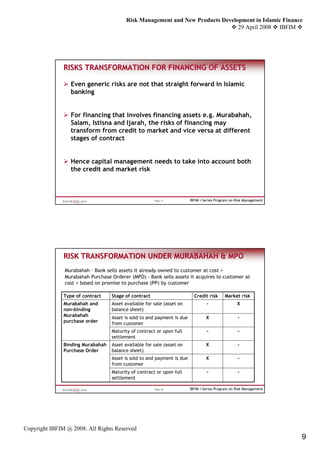
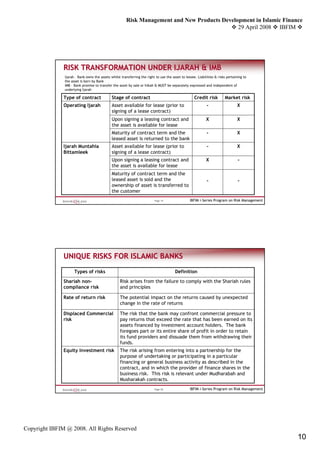
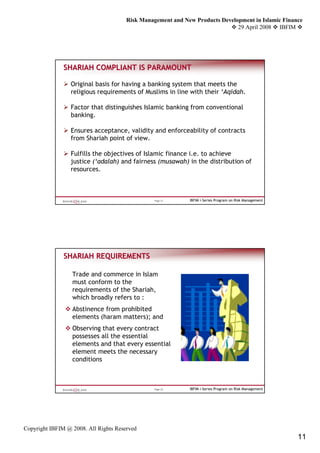
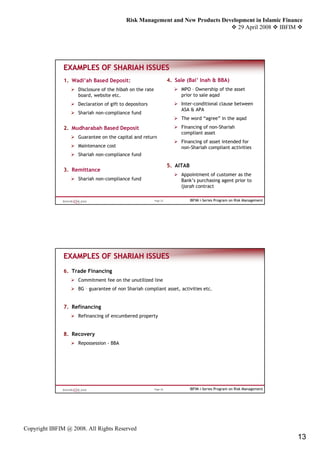
Risk Management and New Products Development in Islamic Finance
                                                                                                                          29 April 2008 IBFIM


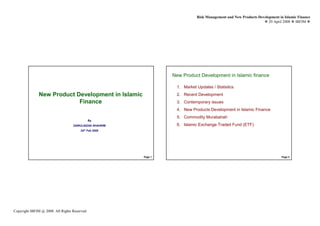
                          Introduction                                  New Product Development in Islamic finance
                                                                                 Introduction


                                                                         1. Market Updates / Statistics
              New Product Development in Islamic                         2. Recent Development
                           Finance                                       3. Contemporary issues
                                                                         4. New Products Development in Islamic Finance
                                                                         5. Commodity Murabahah
                                                  By
                                         ZAIRULNIZAD SHAHRIM             6. Islamic Exchange Traded Fund (ETF)
                                             24th Feb 2009


                                                               Page 1                                                             Page 2


Copyright IBFIM @ 2008. All Rights Reserved
Risk Management and New Products Development in Islamic Finance
                                                                                                                                                                                                          29 April 2008 IBFIM


           Market Updates & Statistics                                                                                                  Market Updates & Statistics
                     Introduction                                                                                                                              Introduction

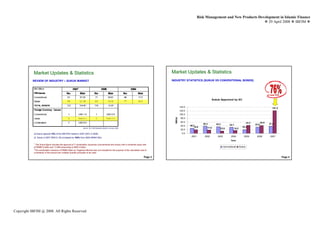
           REVIEW OF INDUSTRY – SUKUK MARKET                                                                                            INDUSTRY STATISTICS (SUKUK VS CONVENTIONAL BONDS)


                                                                                                                                                                                                                                      of total PDS

                                                                                                                                                                              Sukuk Approved by SC

                                                                                                                                                   140.0
                                                                                                                                                                                                                                          121.3
                                                                                                                                                   120.0
                                                                                                                                                   100.0


                                                                                                                                          RM'bil
                                                                                                                                                    80.0
                                                                                                                                                    60.0                                                         43.3          42.0
                                                                                                                                                                      38.4       35.3         32.7                      33.8           37.5
                                                                                                                                                    40.0   26.7
                                                                                                                                                              19.0        17.6                             19.3
                                                              Source: SC’s ICM Quarterly Bulletin- January 2008                                                                     12.0          15.2
                                                                                                                                                    20.0
             Sukuk captured 76% of the RM-PDS market in 2007 (55% in 2006)                                                                           0.0
                                                                                                                                                            2001       2002       2003         2004          2005        2006            2007
              Sukuk in 2007 (RM121.3b) increased by 189% from 2006 (RM42.02b)
                                                                                                                                                                                               Year
           1
             The Sukuk figure includes the approval of 7 combination issuances (conventional and sukuk) with a combined issue size
           of RM89.5 billion and 2 ABS amounting to RM3.4 billion                                                                                                                       Conventional     Sukuk
           2
            The combination issuance of RM60 billion by Cagamas Berhad was not included for the purpose of this calculation due to
           uncertainty of the amount per multiple Syariah principles to be used.

                                                                                                                               Page 3                                                                                                                Page 4


Copyright IBFIM @ 2008. All Rights Reserved
Risk Management and New Products Development in Islamic Finance
                                                                                                                                                                    29 April 2008 IBFIM


                                                                                                        Market Updates & Statistics
            Market Updates & Statistics
                     Introduction                                                                                           Introduction
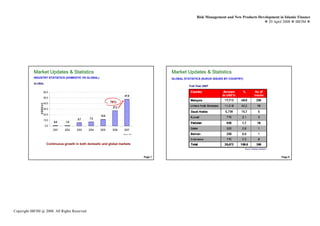
                                                                                                        INDUSTRY STATISTICS (DOMESTIC VS GLOBAL)
           INDUSTRY STATISTICS (SUKUK VS CONVENTIONAL BONDS)
                                                                                                        DOMESTIC


                                                                                                                    140.0
                                                                                                                                                                                          121.3
                                                                                                                    120.0

                                                                                                                    100.0

                                                                                                                     80.0
                                                                                                                                                             189%


                                                                                                           R 'bil
                                                                                                            M
                                                                                                                     60.0
                                                                                                                                                          43.3           42.0
                                                                                                                     40.0
                                                                                                                            19.0
                                                                                                                                     17.6
                                                                                                                     20.0                          15.2
                                                                                                                                            12.0

                                                                                                                      0.0
                                                               Source: Securities Commission
                                                                                                                            2001     2002   2003   2004   2005           2006             2007

                                                                                                                                                          Source: Securities Commission


                                                                                               Page 5                                                                                             Page 6


Copyright IBFIM @ 2008. All Rights Reserved
Risk Management and New Products Development in Islamic Finance
                                                                                                                                                                    29 April 2008 IBFIM


           Market Updates & Statistics                                                                        Market Updates & Statistics
                                          Introduction                                                                      Introduction
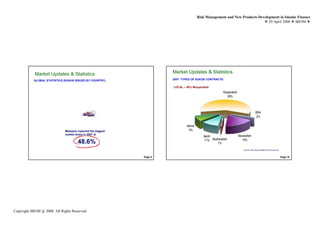
           INDUSTRY STATISTICS (DOMESTIC VS GLOBAL)                                                           GLOBAL STATISTICS (SUKUK ISSUED BY COUNTRY)
           GLOBAL
                                                                                                                        Full-Year 2007

                          60.0
                                                                                        47.8
                          50.0

                          40.0                                                76%
                U SD $'b il


                                                                               27.2
                          30.0
                          20.0                                         12.0
                                                         5.7    7.2
                          10.0
                                    0.8          1.0
                              0.0
                                    2001        2002     2003   2004   2005    2006    2007
                                                                                      Source: IFIS


                               Continuous growth in both domestic and global markets
                                                                                                                                                            Source: Dealogic Database


                                                                                                     Page 7                                                                             Page 8


Copyright IBFIM @ 2008. All Rights Reserved
Risk Management and New Products Development in Islamic Finance
                                                                                                                                                                                29 April 2008 IBFIM


            Market Updates & Statistics                                                                              Market Updates & Statistics
                     Introduction                                                                                                       Introduction

           GLOBAL STATISTICS (SUKUK ISSUED BY COUNTRY)                                                               2007- TYPES OF SUKUK CONTRACTS

                                                                                                                     LOCAL – 58% Musyarakah
                                                                                                                                                            Musyarakah
                                                                                                                                                               58%


                                                                               Pakistan
                                                                      Kuwait            Qatar
                                                                                1.7% 0.8%


                                                                                                                                                                                         BBA
                                                       Saudi Arabia    2.1%                     Bahrain
                                                         15.7%                                   0.5%
                                                                                                Indonesia
                                                                                                   0.3%

                                         United Arab
                                          Em irates
                                           30.2%
                                                                                        Malaysia
                                                                                         48.6%
                                                                                                                                                                                         2%

                                                                                                                             Istisna'
                              Malaysia captured the biggest                                                                    9%
                              market share in 2007 at
                                                                                                                                                Ijarah                   Murabahah
                                                                                                                                                 11% Mudharabah            19%
                                       48.6%                                                                                                            1%
                                                                                                                                                                            Source: Raw data compiled from IFIS and SC


                                                                                                            Page 9                                                                                                       Page 10


Copyright IBFIM @ 2008. All Rights Reserved
Risk Management and New Products Development in Islamic Finance
                                                                                                                                                                       29 April 2008 IBFIM


            Market Updates & Statistics                                                                       Market Updates & Statistics
                          Introduction                                                                                         Introduction
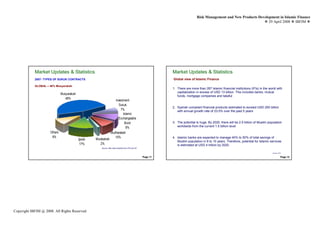
            2007- TYPES OF SUKUK CONTRACTS                                                                    Global view of Islamic Finance

            GLOBAL – 46% Musyarakah
                                                                                                              1. There are more than 267 Islamic financial institutions (IFIs) in the world with
                                                                                                                 capitalization in excess of USD 13 billion. This includes banks, mutual
                              Musyarakah
                                                                                                                 funds, mortgage companies and takaful
                                 46%
                                                                    Investment
                                                                       Sukuk
                                                                                                              2. Syariah compliant financial products estimated to exceed USD 250 billion
                                                                        7%                                       with annual growth rate of 23.5% over the past 5 years
                                                                          Islamic
                                                                      Exchangeable
                                                                           Bond                               3. The potential is huge. By 2020, there will be 2.5 billion of Muslim population
                                                                            9%                                   worldwide from the current 1.5 billion level
                     Others                                      Mudharabah
                      9%                                            10%                                       4. Islamic banks are expected to manage 40% to 50% of total savings of
                                           Ijarah   Murabahah
                                                                                                                 Muslim population in 8 to 10 years. Therefore, potential for Islamic services
                                            17%        2%                                                        is estimated at USD 4 trillion by 2020.
                                                       Source: Raw data compiled from IFIS and SC

                                                                                                                                                                                        Source: IFIS

                                                                                                    Page 11                                                                                        Page 12


Copyright IBFIM @ 2008. All Rights Reserved
Risk Management and New Products Development in Islamic Finance
                                                                                                                                                                                                                 29 April 2008 IBFIM


            Market Updates & Statistics                                                                                                                          Recent Development
                                    Introduction                                                                                                                         Introduction
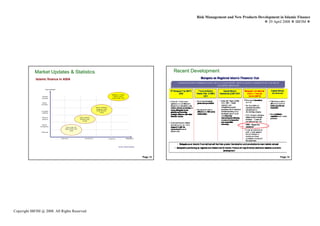
             Islamic finance in ASIA


                       Commitment

                                                                                                                 Malaysia, S. Arabia,
                  Business                                                                                        Bahrain, Dubai,
                 innovation                                                                                      Kuwait, Qatar, UAE


                   Market
                 innovation
                                                                                        Brunei, Indonesia,
                                                                                        Singapore, South
                 Competitor                                                              Africa, Morocco,
                  matching                                                                    Turkey


                  Minimum                                         Syiria, Lebanon,
                  presence                                        Germany, USA,
                                                                       Europe

                  Monitor
                development
                                             China, India, HK,
                                            Japan, Korea, Indo-
                                                  China
                 Wait & see


                                       Exploratory                        Development                        Expansion                  Research


                                                                                                                           Source: Internal research


                                                                                                                                                       Page 13                                                          Page 14


Copyright IBFIM @ 2008. All Rights Reserved
Risk Management and New Products Development in Islamic Finance
                                                                                                                                                                29 April 2008 IBFIM


             Recent Development                                                                         Recent Development
                             Introduction                                                                               Introduction
             Malaysia International Islamic Financial Centre (MIFC)                                     Malaysia International Islamic Financial Centre (MIFC)

             1. 14 August 2006 marked the launch of a nationwide initiative to promote
                                                                                                        3. It comprises a diversified range of financial institutions operating from
                Malaysia as an International Islamic Financial Centre - MIFC. The MIFC
                                                                                                           anywhere in Malaysia that offer Islamic financial products and services in any
                initiative is aimed at fortifying Malaysia’s position as a vibrant, innovative and
                                                                                                           currency to non-residents and residents. The objective of the MIFC is to
                competitive Islamic financial hub, with significant roles in:
                                                                                                           promote Malaysia as the centre for :
                       Facilitating relationships between the international Islamic financial
                                                                                                                Origination, distribution as well as trading of Islamic treasury and capital
                       markets; and
                                                                                                                market instruments
                       Bridging and expanding investment and trade relations between the
                                                                                                                Islamic fund and wealth management services
                       Middle Eastern, West Asian and North African regions with East Asia
                                                                                                                International currency Islamic financial services (including deposits and
                                                                                                                financing)
             2. The MIFC initiative is specifically undertaken by the collective efforts of the                 Takaful and retakaful
                country's financial and market regulators, together with the participation of                   Islamic finance education, training, consultancy and research
                the industry representing the Islamic banking, takaful and capital market in
                Malaysia


                                                                                              Page 15                                                                                  Page 16


Copyright IBFIM @ 2008. All Rights Reserved
Risk Management and New Products Development in Islamic Finance
                                                                                                                                                          29 April 2008 IBFIM


             Recent Development
                            Introduction                                                          Contemporary Issues
                                                                                                          Introduction
             International Currency Business Unit (ICBU)
                                                                                                  Infrastructural support

             1. An International Currency Business Unit (ICBU) of a licensed institution,         1. Syariah
                namely Islamic bank, commercial bank and investment bank, is permitted to
                conduct a wide range of Islamic banking business under the Islamic Banking            •   Lack of standardisation in financial contracts and can be a source of
                Act 1983 (IBA) or Islamic banking business under Section 124 of the Banking               ambiguity, dispute and higher cost
                and Financial Institutions Act 1989 (BAFIA) in international currencies other         •   Different Syariah interpretation
                than Malaysian ringgit

             2. The income arising from the transactions of the ICBU is eligible for full tax     2. Legal
                exemption accorded under the Income Tax Act 1967 for ten years from the               •   International acceptance of Islamic financial contract requires them to
                year of assessment 2007                                                                   be acceptable to the Syariah as well as enforceable under Common
                                                                                                          Law and Civil Law


                                                                                        Page 17                                                                                   Page 18


Copyright IBFIM @ 2008. All Rights Reserved
Risk Management and New Products Development in Islamic Finance
                                                                                                                                                         29 April 2008 IBFIM


            Contemporary Issues
                    Introduction                                                                  Contemporary Issues
                                                                                                          Introduction

            Infrastructural support                                                               Image of Islamic products and services

             3. Human talent                                                                      1. The credibility and sustainability of Islamic products as compared to
                                                                                                     conventional
                 •   Syariah experts that have adequate knowledge of banking and finance
                                                                                                      •   Resemblance to the products and services offered by conventional
                 •   Finance specialist to have adequate knowledge of the applicable rules
                                                                                                          players
                     and principles
                                                                                                      •   Whether we can integrate standard and codes of good practice
                                                                                                          developed at national level into global practices
                                                                                                      •   Acceptance of standard used in Sukuk issuance, rating decision and
                                                                                                          equity and project screening at international level


                                                                                        Page 19                                                                                Page 20


Copyright IBFIM @ 2008. All Rights Reserved
Risk Management and New Products Development in Islamic Finance
                                                                                                                                                           29 April 2008 IBFIM


            Contemporary Issues
                    Introduction                                                                  Contemporary Issues
                                                                                                          Introduction

            Market liquidity                                                                      Rating and statistical reporting

             1. Market                                                                            1. Rating is done using conventional methodology

                 •   Short term liquidity management and asset liability management                    •   Many Sukuk appear to have assets at their core, detailed analyzes of
                                                                                                           their commercial terms and legal structures shows that performance,
                 •   Financial risk management and hedging for issuer as well as investor                  for some is not governed by their assets, indeed, the credit risk is
                                                                                                           really that of the sponsor or originator - Moody’s

             2. Products and services                                                                  •   No substantial distinction from traditional rating criteria – Fitch

                 •   There is a gaps between Syariah compliant products and conventional               •   No significant difference in the methods to rate conventional and
                                                                                                           Islamic debt securities. Has own Syariah board and will validate
                 •   Lack of hedging and derivatives products to be used as risk                           Syariah compliance structure – MARC
                     management tools
                                                                                                       •   No significant difference in methodology – Standard and Poor’s
                 •   Money market instruments to manage market liquidity and set
                     benchmark rate of return                                                          •   No significant difference in methodology - RAM


                                                                                                  2. Different contractual relationships require different type of reporting

                                                                                        Page 21                                                                                  Page 22


Copyright IBFIM @ 2008. All Rights Reserved
Risk Management and New Products Development in Islamic Finance
                                                                                                                                                             29 April 2008 IBFIM


            New Product Development in Islamic finance                                               New Product Development in Islamic finance
                            Introduction                                                                             Introduction
            Preamble
                                                                                                     Issues
            1. Width (increasing issuance of new products) and depth (introducing more
               derivatives) of product range is one of the essential components of an efficient      1. Too few products in the market
               market

                                                                                                     2. Products are not competitive enough
            2. Sell what the market want, and not what can be produced

                                                                                                     3. Products are not compatible with the present infrastructure
            3. Essential product characteristics:
                a. Risk tolerance (high, medium and low risk)
                                                                                                     4. Products are not flexible enough
                b. Meeting the return expectation
                c. Meeting the liquidity expectation
                                                                                                     5. Most currently available products are based on Uqud al-Muawadah (contract
                d. Meeting the unique needs (Syariah compliance and other needs)                        of exchange) rather than Uqud al-Isthirak (contract of participation)


            4. Efficient market structure

                                                                                           Page 23                                                                            Page 24


Copyright IBFIM @ 2008. All Rights Reserved
Risk Management and New Products Development in Islamic Finance
                                                                                                                                                            29 April 2008 IBFIM


            New Product Development in Islamic finance                                             New Product Development in Islamic finance
                             Introduction                                                                           Introduction

            Issues                                                                                 Product Development Process

            6. All Islamic capital market products need to have endorsement from Syariah           1. It’s a dynamic management processes
               adviser – Attract additional cost and time consuming

                                                                                                   2. Market research – Identify the market needs
            7. Pricing mechanism – How do we price Islamic capital market products?

                                                                                                   3. Analysis and product design
            8. Products are not well understood

                                                                                                   4. Pricing and profitability consideration
            9. Islamic capital market products are not/less liquid – difficult to exit

                                                                                                   5. Promotion – selling aspect of the product development


                                                                                         Page 25                                                                   Page 26


Copyright IBFIM @ 2008. All Rights Reserved
Risk Management and New Products Development in Islamic Finance
                                                                                                                                                                                       29 April 2008 IBFIM


            New Product Development in Islamic finance                                                                         New Product Development in Islamic finance
                            Introduction                                                                                                       Introduction
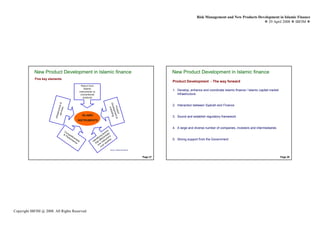
            Five key elements
                                                                                                                               Product Development - The way forward
                                                         Return from
                                                           Islamic
                                                       instruments vs
                                                                                                                               1. Develop, enhance and coordinate Islamic finance / Islamic capital market
                                                        conventional                                                              infrastructure
                                                          products
                            serv ture &


                                                                                   Dev rketing
                                                                                                                               2. Interaction between Syariah and Finance

                                                                                     Prod ent &
                                                                                      ma
                                  ices


                                                                                      elop
                               struc


                                                                                          uct
                                                                                          m
                         Infra


                                                         ISLAMIC                                                               3. Sound and establish regulatory framework
                                                  INSTRUMENTS

                                                                                                                               4. A large and diverse number of companies, investors and intermediaries
                                                                                      s
                                       Co                                          tor
                                      & mpe                                     fac te
                                        Pe tit                                g ntia nt
                                                                            in e
                                          rfo ive
                                             rm ne                      tify fer me
                                               an ss                 en if ru er                                               5. Strong support from the Government
                                                 ce                Id at d inst oth
                                                                      th ne r an
                                                                          o ve
                                                                              o
                                                                                     Source: Failaka International


                                                                                                                     Page 27                                                                                 Page 28


Copyright IBFIM @ 2008. All Rights Reserved
Risk Management and New Products Development in Islamic Finance
                                                                                                                                                           29 April 2008 IBFIM


            Commodity Murabahah & Tawarruq
                    Introduction                                                                   Commodity Murabahah & Tawarruq
                                                                                                           Introduction


             1. What is Tawarruq?
                                                                                                   3. Is it permissible? 3 opinions:
                 •   Comes from the word al-wariq, meaning silver, because the one who
                     buys the product is only buying for the sake of Dirham’s (originally,
                     silver and coins)                                                                 Opinion 1
                                                                                                       •   Majority of scholars say YES! Because Allah says (interpretation -”
                                                                                                           whereas Allah has permitted trading and prohibited riba”)
             2. Tawarruq – In practice
                 •   Buying a commodity from a supplier on deferred payment basis, then
                     the purchaser sells such commodity to a third party in cash                       •   The purchaser is buying the commodity either to benefit from the
                                                                                                           commodity itself or to benefit from its price
                 •   This transaction involves three parties:
                      a. The Trader (owner of the commodity)
                                                                                                       •   Meets the needs of people for cash as compared to Qard Hassan.
                      b. The purchaser (or the Mustawriq – the person who s engaging in
                         this transaction of tawarruq to obtain cash)
                      c. The second Purchaser ( who buys the said commodity from the
                         Mustawriq)


                                                                                         Page 29                                                                                 Page 30


Copyright IBFIM @ 2008. All Rights Reserved
Risk Management and New Products Development in Islamic Finance
                                                                                                                                                           29 April 2008 IBFIM


            Commodity Murabahah & Tawarruq
                    Introduction                                                                      Commodity Murabahah & Tawarruq
                                                                                                              Introduction


                Opinion 2                                                                               Opinion 3
                •   Not permissible because:                                                            •   Permissible subject to certain conditions:
                    i.   The aim is to take money for money and the commodity comes                         i.   That the person be in need of money
                         in between as a means of making the transaction permissible
                         (hilah)
                                                                                                            ii. That he should not be able to obtain money in any other
                                                                                                                permissible manner
                    ii. It leads to creation of huge debts in the Muslim society which is
                        undesirable by Syariah and which cause instability in the
                        economy                                                                             iii. That he does not sell the purchased commodity to the same
                                                                                                                 seller whom he bought it from for less price


                                                                                                            iv. There should not be any pre-arrangement or fictional device
                                                                                                                (hilah) in this transaction that might lead to riba


                                                                                            Page 31                                                                           Page 32


Copyright IBFIM @ 2008. All Rights Reserved
Risk Management and New Products Development in Islamic Finance
                                                                                                                                                             29 April 2008 IBFIM


            Commodity Murabahah & Tawarruq
                    Introduction                                                                    Commodity Murabahah & Tawarruq
                                                                                                            Introduction

           Tawarruq via the Banks                                                                   Tawarruq via the Banks
                                                                                                     4. It involves an additional party (the Bank) so we have four parties:
             1. Is the mode through which some Banks are facilitating the supply of cash to
                their clients                                                                            i.   The Trader (the original owner of the commodity and the first seller)
                                                                                                         ii. The Bank (the first Purchaser of the commodity and the second Seller
                                                                                                             of the said commodity)
             2. It involves buying a commodity by the Bank (upon the request of the client)
                from a supplier, then selling the said commodity to the client on deferred               iii. The Mustawriq, who is in need of cash (the second Purchaser of the
                payment basis, then the client resells such as commodity to a third party in                  Commodity and the third Seller)
                cash
                                                                                                         iv. The Third Purchaser (who buys the said commodity from the
                                                                                                             Mustawriq)
             3. Is different than the original Tawarruq known to earlier scholars
                                                                                                     5. It might involves authorizing the Bank to sell the commodity on behalf of the
                                                                                                        customer


                                                                                                     6. It involves the Banks in a new business without full practice

                                                                                          Page 33                                                                                     Page 34


Copyright IBFIM @ 2008. All Rights Reserved
Risk Management and New Products Development in Islamic Finance
                                                                                                                                                           29 April 2008 IBFIM


            Commodity Murabahah & Tawarruq
                    Introduction                                                                    Commodity Murabahah & Tawarruq
                                                                                                            Introduction

           Tawarruq via the Banks
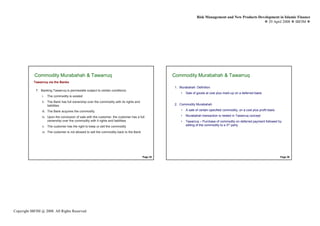
                                                                                                    1. Murabahah: Definition
             7. Banking Tawarruq is permissible subject to certain conditions:
                                                                                                        •   Sale of goods at cost plus mark-up on a deferred basis
                 i.   The commodity is existed
                 ii. The Bank has full ownership over the commodity with its rights and
                     liabilities                                                                    2. Commodity Murabahah

                 iii. The Bank acquires the commodity                                                   •   A sale of certain specified commodity, on a cost plus profit basis

                 iv. Upon the conclusion of sale with the customer, the customer has a full             •   Murabahah transaction is nested in Tawarruq concept
                     ownership over the commodity with it rights and liabilities                        •   Tawarruq – Purchase of commodity on deferred payment followed by
                 v. The customer has the right to keep or sell the commodity                                selling of the commodity to a 3rd party

                 vi. The customer is not allowed to sell the commodity back to the Bank


                                                                                          Page 35                                                                                Page 36


Copyright IBFIM @ 2008. All Rights Reserved
Risk Management and New Products Development in Islamic Finance
                                                                                                                                                              29 April 2008 IBFIM


            Commodity Murabahah & Tawarruq
                    Introduction                                                                       Commodity Introduction liquidity management
                                                                                                        Islamic tools for
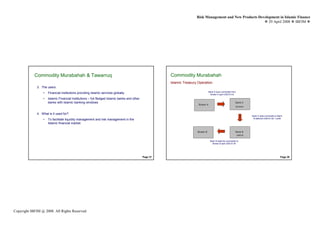
                                                                                                                  Murabahah
                                                                                                       Islamic Treasury Operation
             3. The users
                                                                                                                                   Bank A buys commodity from
                 •   Financial institutions providing Islamic services globally                                                      Broker A spot USD10 mil

                 •   Islamic Financial Institutions – full fledged Islamic banks and other
                     banks with Islamic banking windows                                                                                                       Bank A
                                                                                                                        Broker A
                                                                                                                                                              (excess)


             4. What is it used for?
                                                                                                                                                                            Bank A sells commodity to Bank
                                                                                                                                                                             B deferred USD10 mil + profit
                 •   To facilitate liquidity management and risk management in the
                     Islamic financial market

                                                                                                                       Broker B                               Bank B
                                                                                                                                                                (deficit)

                                                                                                                                    Bank B sells the commodity to
                                                                                                                                      Broker B spot USD10 mil


                                                                                             Page 37                                                                                                    Page 38


Copyright IBFIM @ 2008. All Rights Reserved
Risk Management and New Products Development in Islamic Finance
                                                                                                                                                                                     29 April 2008 IBFIM


           Commodity Murabahah
            Islamic tools for liquidity management
                      Introduction                                                                                   The way forward: Commodity Murabahah House
                                                                                                                      Islamic tools for liquidity management
                                                                                                                                Introduction

           Interbank Placement                                                                                       (CMH)
                          Commodity                                Commodity                                                                                                  Broker A
                           Broker A                                 Broker B                                                                                                                            1

                                                                                                                                                                                                              CPO Producer A
                      1      Bank A                                                  Bank A sells the                        Islamic Bank A
                                                                                5
                           purchases                                                 commodities on
                          commodities                                                 behalf of BNM                                                                                                           CPO Producer B
                          from Broker                                                                                                                                     2

                                                  Bank A                                                                                  3
                                                                                                                                                                                                              CPO Producer C
                                                                                                                                                       Broker B
                                                                                                                                                                                CMH
                                                       3
                             2                                     4                                                                                                          (Trading &                      Commodity
                                  Bank A sells       BNM pays to          BNM           6      Bank A                        Islamic Bank B/                                   Clearing)
                                 commodities to       Bank A on         appoints             credits the                          Client                                                                      Payment
                                  BNM (at cost         deferred        Bank A as
                                                                                            proceeds to                                                                                                       (spot)
                                                                                                                                                           4
                                     plus)             basis (at       an Agent to              BNM                                                                                                           Payment
                                                       mark up           sell the           (placement)                                                                                                       (deferred)
                                                        price)         commodity
                                                                        (net off)
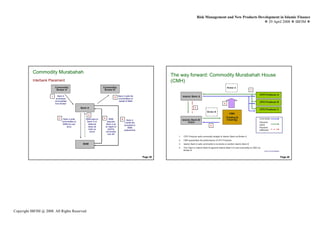
                                                                                                                        1.    CPO Producer sells commodity straight to Islamic Bank via Broker A
                                                                                                                        2.    CMH guarantees the performance of CPO Producer
                                                   BNM                                                                  3.    Islamic Bank A sells commodity to its clients or another Islamic Bank B
                                                                                                                        4.    The Client or Islamic Bank B appoints Islamic Bank A to sell commodity to CMH via
                                                                                                                              Broker B                                                                             Source: Bursa Malaysia


                                                                                                           Page 39                                                                                                                          Page 40


Copyright IBFIM @ 2008. All Rights Reserved
Risk Management and New Products Development in Islamic Finance
                                                                                                                                                                 29 April 2008 IBFIM


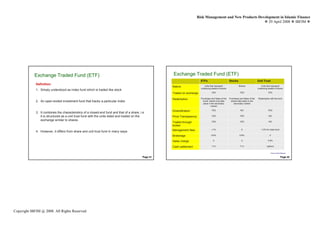
            Exchange Traded Fund (ETF)
                     Introduction
                                                                                                     Exchange Introduction Fund (ETF)
                                                                                                               Traded
                                                                                                                            ETFs                          Stocks                       Unit Trust
             Definition:
                                                                                                     Nature                    Units that represent                Shares                 Units that represent
                                                                                                                            underlying basket of stocks                                underlying basket of stocks
             1. Simply understood as index fund which is traded like stock
                                                                                                     Traded on exchange                YES                          YES                           YES


                                                                                                     Redemption             Purchases and Sales of the    Purchases and Sales of the   Redemption with the fund
             2. An open-ended investment fund that tracks a particular index                                                  funds’ shares only take      shares take place in the
                                                                                                                              place in the secondary          secondary market
                                                                                                                                      market

                                                                                                     Diversification                   YES                           NO                           YES
             3. It combines the characteristics of a closed-end fund and that of a share, i.e
                it is structured as a unit trust fund with the units listed and traded on the        Price Transparency                YES                          YES                           NO

                exchange similar to shares                                                                                             YES                          YES                           NO
                                                                                                     Traded through
                                                                                                     broker
                                                                                                     Management fees                   <1%                            0                   1-2% for index fund
             4. However, it differs from share and unit trust fund in many ways
                                                                                                     Brokerage                        0.6%                          0.6%                           0

                                                                                                     Sales charge                       0                             0                          3-5%


                                                                                                     Cash settlement                   T+3                           T+3                        Upfront


                                                                                                                                                                                                    Source: Bursa Malaysia

                                                                                           Page 41                                                                                                                Page 42


Copyright IBFIM @ 2008. All Rights Reserved
Risk Management and New Products Development in Islamic Finance
                                                                                                                                         29 April 2008 IBFIM


            Exchange Traded Fund (ETF)
                     Introduction                                                Exchange Traded Fund (ETF)
                                                                                          Introduction


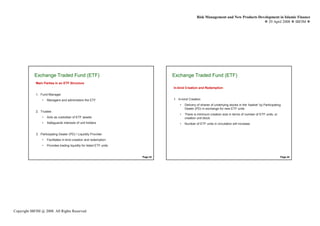
             Main Parties in an ETF Structure
                                                                                 In-kind Creation and Redemption

             1. Fund Manager
                 •   Managers and administers the ETF                            1. In-kind Creation
                                                                                     •   Delivery of shares of underlying stocks in the ‘basket’ by Participating
                                                                                         Dealer (PD) in exchange for new ETF units
             2. Trustee
                                                                                     •   There is minimum creation size in terms of number of ETF units, or
                 •   Acts as custodian of ETF assets                                     creation unit block
                 •   Safeguards interests of unit holders                            •   Number of ETF units in circulation will increase


             3. Participating Dealer (PD) / Liquidity Provider
                 •   Facilitates in-kind creation and redemption
                 •   Provides trading liquidity for listed ETF units


                                                                       Page 43                                                                                  Page 44


Copyright IBFIM @ 2008. All Rights Reserved
Risk Management and New Products Development in Islamic Finance
                                                                                                                                                             29 April 2008 IBFIM


            Exchange Traded Fund (ETF)
                     Introduction                                                                   Exchange Traded Fund (ETF)
                                                                                                             Introduction


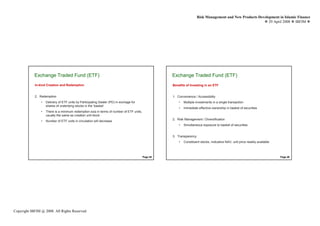
            In-kind Creation and Redemption                                                         Benefits of Investing in an ETF


            2. Redemption                                                                           1. Convenience / Accessibility
                •   Delivery of ETF units by Participating Dealer (PD) in exchage for                   •   Multiple investments in a single transaction
                    shares of underlying stocks in the ‘basket’
                                                                                                        •   Immediate effective ownership in basket of securities
                •   There is a minimum redemption siza in terms of number of ETF units,
                    usually the same as creation unit block
                                                                                                    2. Risk Management / Diversification
                •   Number of ETF units in circulation will decrease
                                                                                                        •   Simultaneous exposure to basket of securities


                                                                                                    3. Transparency
                                                                                                        •   Constituent stocks, indicative NAV, unit price readily available


                                                                                          Page 45                                                                              Page 46


Copyright IBFIM @ 2008. All Rights Reserved
Risk Management and New Products Development in Islamic Finance
                                                                                                                                                 29 April 2008 IBFIM


            Exchange Traded Fund (ETF)
                     Introduction                                                        Exchange Traded Fund (ETF)
                                                                                                  Introduction


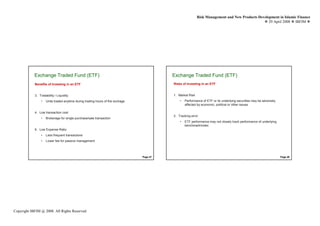
            Benefits of Investing in an ETF                                              Risks of Investing in an ETF


            3. Tradability / Liquidity                                                   1. Market Risk
                •   Units traded anytime during trading hours of the exchage                 •   Performance of ETF or its underlying securities may be adversely
                                                                                                 affected by economic, political or other issues

            4. Low transaction cost
                                                                                         2. Tracking error
                •   Brokerage for single purchase/sale transaction
                                                                                             •   ETF performance may not closely track performance of underlying
                                                                                                 benchmark/index
            6. Low Expense Ratio
                •   Less frequent transactions
                •   Lower fee for passive management


                                                                               Page 47                                                                              Page 48


Copyright IBFIM @ 2008. All Rights Reserved
Risk Management and New Products Development in Islamic Finance
                                                                                                                                                             29 April 2008 IBFIM


            Exchange Traded Fund (ETF)
                     Introduction                                                                    Exchange Traded Fund (ETF)
                                                                                                              Introduction


             Risks of Investing in an ETF                                                            ETFs in Malaysia


             3. Discount or Premium                                                                  1. 3 ETFs currently listed on Bursa Malaysia Securities
                 •   ETF unit price on the exchange may be at discount or premium to its                 •   2 Equity ETFs, 1 Bond ETF
                     NAV
                                                                                                         •   Most recent launch is MyETF Dow Jones Islamic Market Malaysia
                                                                                                             Titans 25 – 1st Syariah ETF listed in Asia & currently largest Syariah
                                                                                                             ETF in the world
             4. Manager skills
                 •   Manager may not manage in line with ETF objectives
                                                                                                     2. Challenges
                                                                                                         •   Investors’ understanding of products
                                                                                                         •   Performance expectations
                                                                                                         •   Competition from unit trust funds


                                                                                           Page 49                                                                                    Page 50


Copyright IBFIM @ 2008. All Rights Reserved
Risk Management and New Products Development in Islamic Finance
                                                                                                                                                 29 April 2008 IBFIM


            Exchange Traded Fund (ETF)
                     Introduction
                                                                                   Exchange Introduction Fund (ETF)
                                                                                             Traded
             ETFs in Malaysia                                                      Global ETF Industry

                                                                                                         Number               Share               AUM (USD bn)                  Share
             3. Moving forward                                                     US                    601                  51.3%               580.7                         72.9%
                 •   Continuous investor education                                 Europe                423                  36.1%               128.4                         16.1%
                                                                                   Others                147                  12.6%               87.5                          11.0%
                 •   Additional participants (i.e. PDs, market makers)
                                                                                   Total                 1,171                100.0%              796.6                         100%
                                                                                   Growth rate           64%                                      41%

                                                                                                                                                          Source: Morgan Stanley Investment Strategies, Bloomberg


                                                                                   1.   Global average daily trading volume +143% in 2007 to USD 59.8 billion
                                                                                           •   S&P 500, the largest ETF at USD 99.2 billion, accounts for about 40% of average daily
                                                                                               volume
                                                                                   2.   ETF assets under management (AUM) forecast to exceed USD 2 trillion in 2011, implying CAGR
                                                                                        of almost 26% over next 4 years


                                                                         Page 51                                                                                                                         Page 52


Copyright IBFIM @ 2008. All Rights Reserved
Risk Management and New Products Development in Islamic Finance
                                                                                                                                                         29 April 2008 IBFIM


                       Introduction                                                                          Introduction
             Islamic Exchange Traded Fund (ETF)                                                    Islamic Exchange Traded Fund (ETF)

             1. The first Islamic ETF may be that of Saudi NCB and Deutsche Bank                     iii. ETF securities can be traded if the assets they represent are tradable.
                launched in 2001 called Islamic Equity Builder                                            The fact that the market value of an ETF may be higher or lower than
                                                                                                          the NAV of the underlying asset creates no Syariah problem

             2. The ETF would be Syariah compatible if:
                 i.   The underlying asset is Syariah permissible. In the case of company            iv. ETF’s can be bought at cash or on deferred payment basis, except for
                      sharesthey have to be based on an Islamically acceptable index. The                gold and silver ETF’s where a deferred price sale will not be
                      purpose is to screen the sharesso as to select only the ones that                  acceptable
                      satisfy the Islamic equity criteria
                                                                                                     v. For this kind of ETF’s (gold and silver) it is further required that
                 ii. These shares must be held in a portfolio which is legally owned by the             redemption must be affected in kind if so demanded by the investor
                     investors


                                                                                         Page 53                                                                                Page 54


Copyright IBFIM @ 2008. All Rights Reserved
Risk Management and New Products Development in Islamic Finance
                                                                                                                                                                 29 April 2008 IBFIM


                       Introduction                                                                              Introduction
             Islamic Exchange Traded Fund (ETF)                                                        Islamic Exchange Traded Fund (ETF)
             Treatment of dividend                                                                     Issuer
                                                                                                       •   The Issuer is merely a manager or rather as an agent receiving fees

             1. One difference between ETF’s and mutual funds is the fact that dividend
                received from constituent companies is not reinvested as this deviate                  •   It is difficult for issuer to be Mudarib since definition of profit is not clear
                ETF’s from tracking the index.

                                                                                                       •   Issuer must not guarantee the performance of ETF’s, but may occasionally
             2. It remains nevertheless, that dividend is the entitlement of the investors. It             provide liquidity facility to smooth the periodically payments, redemption or
                should not be confiscated by the manager even as a management fees                         purchase of new assets


             3. In Islamic ETF’s dividend should periodically be distributed to ETF                    •   Fees can be fixed or based on formula based. In all cases must be known
                securities holders. Only actual dividend received should be distributed. If                or knowable.
                there is any interest earning in the dividend account it must be disposed off


                                                                                             Page 55                                                                                          Page 56


Copyright IBFIM @ 2008. All Rights Reserved
Risk Management and New Products Development in Islamic Finance
                                                                                                                                                                  29 April 2008 IBFIM


                       Introduction
                                                                                                          Key Takeaways…
                                                                                                                  Introduction
             Islamic Exchange Traded Fund (ETF)
                                                                                                          1. Investment climate has evolved from a very simple structure to a more
             Purification                                                                                    complex and problematic


             •   The Islamic equity investment criteria require purification of the portfolio             2. From Islamic perspective any investment can be Syariah compliant if all the
                 from impure income earned by constituent companies in the underlying                        requirements of Syariah are fulfilled
                 index

                                                                                                          3. Malaysia is distinct:
             •   It always recommended that such purification is done by the manager.
                                                                                                              •   Clear national strategy
                 However, this makes it difficult for the ETF’s to track the index. Many
                 Syariah boards have permitted that manager only inform investors of the                      •   Clear integrated regulatory and Syariah framework – Syariah
                 amount they need to dispose off to purify their investment.                                      harmonisation is reality
                                                                                                              •   Mandate for legal clarity – common law provides supportive legal
                                                                                                                  environment
                                                                                                              •   Deepening support infrastructure
                                                                                                              •   Defined means for global outreach

                                                                                                Page 57                                                                               Page 58


Copyright IBFIM @ 2008. All Rights Reserved
Risk Management and New Products Development in Islamic Finance
                                                                                                                                            29 April 2008 IBFIM


             Key Takeaways…
                     Introduction


             4. Scholars and bankers require more interactive dialogue on a deeper level


             5. “ Do not permit an error of opinion to be come a tradition for the community”


                                                                                                        Thank you


                                                                                           Page 59


Copyright IBFIM @ 2008. All Rights Reserved
Risk Management and New Products Development in Islamic Finance
                                                                                                                         29 April 2008 IBFIM


                            Introduction                                  DerivativesIntroduction overview
                                                                                        - An

                                                                          What is derivatives?

               Hedging Mechanism for Islamic Capital                      1. A derivative security is a financial asset whose value is
                                                                             dependent on the value of underlying asset.
                    Market Products & service
                                                                          2. The underlying asset could be a basic financial asset
                                                                             such as commodity, currency, common stocks, bonds,
                                                                             index or the combination of such assets.
                                                    By
                                           ZAIRULNIZAD SHAHRIM            3. Common forms – Forwards, Futures, Options, Swaps
                                              29th April 2008                and also some exotics such as Swaptions
                                                                          4. Derivatives enable the avoidance of unnecessary risks


                                                                 Page 1                                                                  Page 2


Copyright IBFIM @ 2008. All Rights Reserved
                                                                                                                                                    1
Risk Management and New Products Development in Islamic Finance
                                                                                                                                 29 April 2008 IBFIM


               DefinitionsIntroduction                                            DefinitionsIntroduction

               1.   Hedging – Reducing a firm’s exposure to price or              4.   Futures contract – A forward contract with the
                    rate fluctuations. Also known as immunization                      feature that gains and losses are realised each day
                                                                                       rather than only on the settlement date
               2.   Derivative – A financial asset that represents a claim
                    to another financial asset
                                                                                  5.   Option contract – A contract that gives the
                                                                                       buyer/owner the right to buy/sell some asset at a
               3.   Forward contract – A legally binding agreement
                                                                                       fixed price on or before a given date
                    between two parties calling for the sale of an
                    asset/product in the future at a price agreed upon
                    today


                                                                         Page 3                                                               Page 4


Copyright IBFIM @ 2008. All Rights Reserved
                                                                                                                                                            2
Risk Management and New Products Development in Islamic Finance
                                                                                                                                   29 April 2008 IBFIM


               DefinitionsIntroduction                                               Benefits of Introduction
                                                                                                  derivatives
               6.   Strike price – The fixed price specified in an option            1. Hedging purposes
                    contract at which the holder/owner can buy/sell the                 • Risk management tool
                    underlying asset. Also known as the exercise price
                                                                                     2. Profit from both bull and bear markets
                                                                                     3. Leverage / Gearing
               7.   Swaps – Agreement to exchange two
                    securities/currencies/commodities Agreement to                      • The use of leverage will magnify the effect of a given
                    exchange two securities/currencies/commodities                        price change
                                                                                        • Small investment (premium) to own the right to purchase
                                                                                          stocks.
                                                                                        • The potential loss is capped at premium paid
                                                                                     4. Transaction cost savings e.g SSF


                                                                            Page 5                                                                  Page 6


Copyright IBFIM @ 2008. All Rights Reserved
                                                                                                                                                              3
Risk Management and New Products Development in Islamic Finance
                                                                                                                                29 April 2008 IBFIM


              Risk management for Islamic instruments
                       Introduction                                               Risk management for Islamic instruments
                                                                                           Introduction


               1. Risk management is more critical in Islamic finance             Some of Islamic risk management tools are as follows:
                  simply because:                                                    1. Option in equities
                    • The nature of contracts                                            •   Generally acceptable based on ‘urbun’ however
                    • Real economic transaction                                              the trading part is still questionable by some
                                                                                             Shariah scholars
               2. It is important to ensure the risk management tools also
                  must be equally Shariah compliant                                  2. Profit rate swap

               3. Types of risk                                                          •   Permissible using murabahah transaction for both
                    • Market risk             • Rate of return risk                          fixed and floating mark-up
                    • Operational risk        • Equity investment risk               3. Forward sale
                                                                                         •   Permissible under the principle of salam.

                                                                         Page 7                                                              Page 8


Copyright IBFIM @ 2008. All Rights Reserved
                                                                                                                                                           4
Risk Management and New Products Development in Islamic Finance
                                                                                                                                    29 April 2008 IBFIM


              Risk management for Islamic instruments
                       Introduction
                                                                                      Hedging Products
                                                                                               Introduction


               4. Short-sale                                                          Syariah Compliant Hedging Instruments:
                   • Using salam contract is permissible, however the
                     usage of salam to replicate short-sale function in an            1.   Futures contracts
                     Islamic hedge fund using both long and short sale is
                     disputable
                                                                                      2.   Forward contracts

               5. Futures contract                                                    3.   Swap Agreements
                   • Uncertainty is removed through standard contract
                     and clearing house to ensure delivery                            4.   Structured Products


                                                                             Page 9                                                              Page 10


Copyright IBFIM @ 2008. All Rights Reserved
                                                                                                                                                               5
Risk Management and New Products Development in Islamic Finance
                                                                                                                              29 April 2008 IBFIM


               Hedging Products
                        Introduction
                                                                                Hedging Products
                                                                                         Introduction


                  Futures:
                                                                                Example of Futures contract transaction:
                  Approved by the Securities Commission of Malaysia
                  provided:
                                                                                1 Aug: Investor buys 1 CPO contract @ 1,400
                     1. Underlying is Syariah compliant
                                                                                1 Aug: End of day settles @ 1,420. Investor makes MYR
                     2. Performance of contract is certain                      MYR500 (i.e. 1,420 – 1,400 * MYR25.00)
                                                                                2 Aug: End of day settles at 1,395. Investor loses MYR625
                  Futures contracts deemed Syariah compliant:                   (i.e. 1,420 – 1,395 * MYR25.00)
                     1. Crude Palm Oil futures contract                         3 Aug: Investor sells @ 1,440. Investor gains MYR1,125.00
                     2. Crude Palm Kernel Oil futures contracts                 (i.e. 1,440 – 1,395 * 25.00)
                     3. Single Stock futures contracts
                                                                                Irregardless of market price at closing, investor gets to buy
                                                                                CPO @ 1,400


                                                                      Page 11                                                               Page 12


Copyright IBFIM @ 2008. All Rights Reserved
                                                                                                                                                         6
Risk Management and New Products Development in Islamic Finance
                                                                                                                                29 April 2008 IBFIM


               Hedging Products
                        Introduction
                                                                                  Hedging Products
                                                                                           Introduction


               Forward contracts                                                  Example of Forward Contract:

               Financial institutions undertake many forms of forward               On 1 Aug Bank A enters into forward contract with bank
               contracts for hedging purposes:                                      B to buy USD10,000,000 against MYR for value 13 Aug
                   1. Currency forwards e.g. USD/MYR forward                        @ 3.4750.
                   2. Commodity forwards e.g. Crude Palm Oil
                                                                                    On 13 Aug, Bank A will pay Bank B MYR MYR34,
                                                                                    475,000 and receive from Bank B USD10,000,000.

                                                                                  Prevailing market rate at time of exchange is ignored


                                                                        Page 13                                                              Page 14


Copyright IBFIM @ 2008. All Rights Reserved
                                                                                                                                                           7
Risk Management and New Products Development in Islamic Finance
                                                                                                                                  29 April 2008 IBFIM


               Hedging Products                                                     Hedging Products
                        Introduction                                                            Introduction


               Swap Agreements:                                                     Structured Products
                                                                                       1. A new trend among the Islamic financial institutions
                    “Agreement to exchange two securities or currencies                2. Syariah complaint issues
                    or commodities”                                                    3. Using an existing asset to create a new product

               Types:                                                               Example of structured products:
                                                                                      1. Commodity Murabahah
                  1. Currency swap: USD vs. MYR
                                                                                      2. Islamic Cross Currency Swaps
                  2. Profit rate swap: Floating vs. Fixed
                  3. Commodity: Crude Palm Oil vs. Soy Oil


                                                                          Page 15                                                                Page 16


Copyright IBFIM @ 2008. All Rights Reserved
                                                                                                                                                             8
Risk Management and New Products Development in Islamic Finance
                                                                                                                                 29 April 2008 IBFIM


               Syariah Issues in Hedging
                         Introduction
                                                                                    Syariah Issues in Hedging
                                                                                              Introduction


               Freedom to Contract                                                  Freedom from Riba’
                  1. Islam provides the basic freedom to enter into
                     transactions. The holy Qur’an says: “Allah has made               1. All types of contracts and transactions must be free
                     trade lawful”                                                        from riba’


                   2. A contract is invalid/unlawful if it involves the                2. Implies that there is no reward for time preference
                                                                                          and under conditions of zero risk.
                      element of coercion by either of the parties. The holy
                      Qur’an also says: “Let there be among you traffic
                      and trade by mutual goodwill”                                    3. The question of riba has been addressed in many
                                                                                          studies and there is a consensus about the meaning
                                                                                          and implications of riba.
                   3. But this norm does not suggest unrestricted freedom
                      to contract

                                                                          Page 17                                                               Page 18


Copyright IBFIM @ 2008. All Rights Reserved
                                                                                                                                                            9
Risk Management and New Products Development in Islamic Finance
                                                                                                                                29 April 2008 IBFIM


                            Introduction
                                                                                   Syariah Issues in Hedging
                                                                                             Introduction

                   4. Excess or surplus over and above the loan
                      capital. However, riba can be in different forms             Freedom from Gharar/Excessive Uncertainty
                      and is prohibited in all its forms.
                                                                                   1. All contracts and transactions must be free from
                                                                                      excessive gharar.
                   5. In the context of derivatives, there are some
                      opinion saying that riba can also occur when one
                                                                                   2. Implies that contracting under conditions of
                      gets a positive return without taking any risk
                                                                                      excessive uncertainty is not permissible.

                                                                                   3. Intentionally induced uncertainty.


                                                                         Page 19                                                             Page 20


Copyright IBFIM @ 2008. All Rights Reserved
                                                                                                                                                           10
Risk Management and New Products Development in Islamic Finance
                                                                                                                                    29 April 2008 IBFIM


               Syariah Issues in Hedging
                 Syariah Issues in Hedging
                          Introduction
                                                                                     Syariah Issues in Hedging
                                                                                                Introduction


                  Freedom from Gharar/Excessive Uncertainty                          Freedom from Gharar/Excessive Uncertainty

                  4. If the person know exactly the state of the contract, he        7. Normally relates to contracts of exchange (mu’awadat) i.e
                     probably will not entered into the contract.                       sale and lease but not to contract of partnership/equity


                  5. However, due to lack of knowledge with respect to               8. For instance:
                     contract specification, he had entered into this contract           • Pricing: Fixed or depends on certain index
                                                                                         • Delivery: Actual delivery or cash settlement or a third
                  6. To avoid a case whereby one party suffer from the                     party delivery (futures market)
                     consequences of his contract of which in normal                     • Mode of payment: Actual direct payment or through set-
                     circumstances, reasonable person would try to avoid                   off or other payment which is specific on certain
                                                                                           products i.e Profit Rate Swap whereby payment
                                                                                           between two Murabahah transactions, fixed and floating
                                                                           Page 21                                                               Page 22


Copyright IBFIM @ 2008. All Rights Reserved
                                                                                                                                                               11
Risk Management and New Products Development in Islamic Finance
                                                                                                                                  29 April 2008 IBFIM


               Syariah Issues in Hedging
                         Introduction
                                                                                    Syariah Issues in Hedging
                                                                                              Introduction


                                                                                    Freedom from Qimar (gambling) and Maysir (Unearned
               Freedom from Qimar (gambling) and Maysir (Unearned                   Income)
               Income)
                                                                                     3. If the process is backed by collection, analysis and
                1. Contracting under excessive uncertainty or gharar is                 interpretation of relevant information it is very much in
                   akin to gambling (Qimar).                                            conformity with Islamic teachings.

                2. The Qur’an and the sunnah of holy prophet prohibit                4. Islam allows the assumption of risk taking after making
                   gains made from games of chance which involve                        proper assessments of risk with the help of information.
                   unearned income (Maysir).


                                                                          Page 23                                                               Page 24


Copyright IBFIM @ 2008. All Rights Reserved
                                                                                                                                                             12
Risk Management and New Products Development in Islamic Finance
                                                                                                                              29 April 2008 IBFIM


               Syariah Issues in Hedging
                         Introduction                                                       Introduction
                                                                                 4. Urbun (down payment)
                 Freedom from Qimar (gambling) and Maysir (Unearned
                 Income)                                                             a. Deposit/down payment given by the buyer to the
                                                                                        seller in buying and selling contract
                  5. From financial perspective would be one where the               b. If the sale proceeds, the deposit will be part of the
                     outcome is purely dependent on chance alone                        price of the goods, otherwise it will be considered as
                                                                                        hibah (gift) from buyer to seller
                                                                                     c. If the buyer decide to terminate the contract, the
                  6. Some might look at it as a zero-sum game whereby it                money paid (deposit) will be forfeited to compensate
                     involves a definite loser and winner                               the seller
                                                                                     d. This principle can be used in Option in both equity
                  7. From derivatives perspective, margin payment is                    and commodity market
                     deemed as akin to gambling

                                                                       Page 25                                                                Page 26


Copyright IBFIM @ 2008. All Rights Reserved
                                                                                                                                                         13
Risk Management and New Products Development in Islamic Finance
                                                                                                                                  29 April 2008 IBFIM


                          Introduction                                                          Introduction
             5. Forward sale
                  a. If it involves a commodity (normal forward sale), is             d. Forward sale on equities:
                     permissible.
                                                                                          • Non permissible (AAOIFI Shariah standard)
                                                                                          • Permissible by some Shariah boards/scholars
                  b. Known as salam sale i.e advance payment against
                     future delivery such as wheat, metal
                                                                                      e. Forward sale on currency – not acceptable as currency
                                                                                         exchange requires spot and simultaneous exchange of
                  c. Also applicable to assets other than commodity such as              two different currencies to avoid riba.
                     Shares and currency


                                                                            Page 27                                                            Page 28


Copyright IBFIM @ 2008. All Rights Reserved
                                                                                                                                                             14
Risk Management and New Products Development in Islamic Finance
                                                                                                                                      29 April 2008 IBFIM


             6. Qabadh (possession)
                         Introduction
                                                                                       7. Arbitrage   Introduction


                  a. Not allowed to sell what you do not own/possess                      • Taking advantage on price discrepancies between
                  b. Not allowed to sell before you take delivery of it                     markets, products and assets

                  c. Require possession by the seller before the buyer can                • Monitor price of the same products in different market –
                     sell to another buyer                                                  looking at price divergence

                  d. This prohibition is confined to food items only – The                • Arbitrage between different product markets
                     Maliki School of Law                                                 • So far, no Shariah objection as long as the underlying
                  e. Hanafi, Shafi’e and Hanbali – Only concern on the issue                assets and contracts are Shariah compliant
                     of gharar when sale of an object before Qabadh


                                                                             Page 29                                                               Page 30


Copyright IBFIM @ 2008. All Rights Reserved
                                                                                                                                                                 15
Risk Management and New Products Development in Islamic Finance
                                                                                                                                     29 April 2008 IBFIM


            8. Short SalesIntroduction                                                9. Option     Introduction


                 a. A sale of security not owned (by the Seller) in                       a. Gives the right but not the obligation to purchase or sell an
                    anticipation of making a profit by purchasing the                        asset during a specified period at an agreed–upon price
                    security later (at the market) at a lower price
                                                                                          b. Islamic contract for Option i.e Urbun (down payment) and
                                                                                             Khiyar (contractual stipulation)
                 b. Typically, seller would borrow the security from broker               c. Generally, no objection with the mechanics of Option. It is
                    to be repaid later                                                       the trading of these promises and the charging of
                                                                                             premiums that objections are raised.
                                                                                          d. SAC of SC – So far, no formal opinion on stock or index
                 c. Generally, short sale in this definition is not permissible.             option. However, the SAC has allowed other option-like
                    Having said that, some Shariah scholars have allowed                     instruments i.e Call Warrants/TSR as long as shares
                    it under Salam contract                                                  involved are Shariah approved.


                                                                            Page 31                                                                  Page 32


Copyright IBFIM @ 2008. All Rights Reserved
                                                                                                                                                                16
Risk Management and New Products Development in Islamic Finance
                                                                                                                                29 April 2008 IBFIM


               Syariah Issues in Hedging
                         Introduction
                                                                                  Syariah Issues in Hedging
                                                                                            Introduction


               Freedom from Price Control and Manipulation                        Entitlement to Transact at Fair Prices

                   1. Islam envisages a free market where prices are                 1. Prices that are an outcome of free play of demand
                      determined by demand and supply. There shall be                   and supply without any intervention or manipulation
                      no interference in the price determination process                are believed to be fair.
                      even by the regulators except for cases where the
                      intervention is intended to counter cases of market            2. However, in some instances, pricing is based on a
                      anomalies caused by impairing the conditions of free              valuation exercise.
                      competition.
                                                                                     3. In such cases the difference between the price at
                   2. It is a requirement that the demand and supply                    which a transaction is executed and the fair price
                      should be genuine and free from any artificial                    (as per the opinion of valuation experts) is termed
                      element.                                                          as ghubn. The presence of ghubn makes a
                                                                                        transaction unethical.

                                                                        Page 33                                                               Page 34


Copyright IBFIM @ 2008. All Rights Reserved
                                                                                                                                                           17
Risk Management and New Products Development in Islamic Finance
                                                                                                                                   29 April 2008 IBFIM


               Syariah Issues in Hedging
                         Introduction
                                                                                     Syariah Issues in Hedging
                                                                                               Introduction


               Entitlement to Equal, Adequate and Accurate Information                1. Informational and pricing efficiency are clearly in
                                                                                         conformity with the Islamic and ethical notions relating
                 1. Islam emphasises on the role of information in the                   to adequacy and accuracy of information and fair
                    market. Provision of inaccurate information is                       pricing
                    forbidden.

                 2. Concealment of vital information (ghish) violates                 2.    As regards full-insurance efficiency or operational
                    Islamic ethics and according to the sunnah of the                      efficiency, these can be justified in the Islamic ethical
                    holy prophet, the party disadvantaged at the time of                   framework in terms of their maslahah for the people at
                    contracting may to annul the contract.                                 large.

                 3. Transactions must also be free from jahalah or                    3. Risk management products allow the market
                    misrepresentation                                                    participants at a micro-level to avoid undesirable
                                                                                         risks.


                                                                           Page 35                                                               Page 36


Copyright IBFIM @ 2008. All Rights Reserved
                                                                                                                                                              18
Risk Management and New Products Development in Islamic Finance
                                                                                                                                     29 April 2008 IBFIM


               Syariah Issues in Hedging
                         Introduction
                                                                                       Syariah Issues in Hedging
                                                                                                 Introduction


               The Case of Futures/Forward Contracts                                     1.   However, on grounds of public necessity some
                                                                                              degree of flexibility in the matter of gharar in
                  1. Futures/forward contract is settled at a future date.                    settlement of contracts is provided

                  2. As the buyer and seller enter into an obligation to                 2.   Scholars have permitted salam sale, i.e. sale of what
                     deliver the price and object of exchange on a future                     one does not have, but what one is reasonably sure
                     date, such transaction (bay) is forbidden                                of bringing into existence.

                  3. A futures contract also violates the Shariah                        3.   Scholars have insisted that one part of the contract
                     prohibition of sale of a non-existent underlying on                      must be settled on the spot, i.e., the buyer must give
                     grounds of gharar.                                                       delivery of the underlying instrument or price at the
                                                                                              time of contracting to the seller. It is the seller’s
                                                                                              obligation that is deferred to a future date.


                                                                             Page 37                                                              Page 38


Copyright IBFIM @ 2008. All Rights Reserved
                                                                                                                                                                19
Risk Management and New Products Development in Islamic Finance
                                                                                                                                    29 April 2008 IBFIM


               Syariah Issues in Hedging
                         Introduction                                                 Types of Shariah-compliant derivatives in Malaysia
                                                                                                Introduction


               The Case of Options
                 1. Shariah scholars is of the opinion that option is a               1. Currently, there are three (out of nine) products traded
                    promise to buy or sell an underlying asset at a specific             were approved instruments by SAC of SC
                    price within a stipulated time and such a promise
                    cannot be the subject matter of a sale or purchase                      a. Crude Palm Oil Futures (FCPO)
                                                                                            b. Crude Palm Kernel Oil Futures (FPKO)
                  2. Scholars have attempted to justify permissibility to
                                                                                            c. Single Stock Futures (SSF)
                     options by drawing a parallel with bai al-urbun.

                  3. Urbun refers to a sale in which the buyer deposits               2. In addition, the SAC also approved the mechanics of
                     money with the seller as a part payment of the price in             stock index futures contracts as long as the component is
                     advance but agrees that if he fails to ratify the contract
                     he will forfeit the deposit money which the seller can              made up of Shariah approved securities
                     keep

                                                                            Page 39                                                              Page 40


Copyright IBFIM @ 2008. All Rights Reserved
                                                                                                                                                               20
Risk Management and New Products Development in Islamic Finance
                                                                                                                                    29 April 2008 IBFIM


              Shariah-compliant commodity futures
                        Introduction                                                  Shariah arguments on FCPO/FPKO
                                                                                                Introduction


              1. Crude Palm Oil Futures (FCPO)                                        Gambling

              2. Crude Palm Kernel Oil Futures (FPKO)                                 There were issues regarding the requirement to place a
                                                                                      deposit as a margin of payment before begin trading. It is
                                                                                      considered akin to prohibited bet.
                   Exchange-traded agreement to buy and sell a
                   commodity in a actual market (cash market) in a                     i. Does not constitute gambling because the fluctuation of
                   standard quantity, at a future date and at a determined                the value occurs due to change of demand in CPO
                   place of delivery.                                                     futures market.
                   It is a financial product innovation for those involved in          ii. Common phenomenon in the trading world
                   crude palm oil/palm kernel oil trading to manage risks
                                                                                       iii. Gambling is actually depend solely on luck and is not
                   more efficiently and effectively, especially the risk of
                                                                                            related to demand and offer
                   price fluctuation

                                                                            Page 41                                                                 Page 42


Copyright IBFIM @ 2008. All Rights Reserved
                                                                                                                                                               21
Risk Management and New Products Development in Islamic Finance
                                                                                                                                        29 April 2008 IBFIM


              Shariah arguments on FCPO/FPKO
                        Introduction                                                     Shariah arguments on FCPO/FPKO
                                                                                                   Introduction


              Gharar                                                                     Bai’ Ma’dum
              Uncertainty in obtaining goods that have been bought and in                Which means buying something that does not exist. It exist
              receiving potential profits.                                               in futures contract because there is an element of
                                                                                         uncertainty to hand over the goods sold
               i. Profit and loss in business is a common factor, although
                  traders are actually aspire to earn profits                            i. However, bai’ma’dum that occurs in something that exists
                                                                                            and seller can obtain it or in the form that can be made
               ii. Trader should take steps to minimise loss
                                                                                            tangible is considered permissible i.e Salam and Istisna.
               iii. Specification such as quantity, type, price and delivery             ii. In futures market, contract can be settled in cash before the
                    date are made known to the market players.                               due date or settlement by delivery on the due date
               iv. In addition, surveillance and regulation are provided to              iii. In addition, the clearing house ensures the delivery and
                   ensure there is no cheating                                                settlement of a transaction

                                                                               Page 43                                                                   Page 44


Copyright IBFIM @ 2008. All Rights Reserved
                                                                                                                                                                   22
Risk Management and New Products Development in Islamic Finance
                                                                                                                                       29 April 2008 IBFIM


              Shariah arguments on FCPO/FPKO
                        Introduction                                                   Shariah arguments on FCPO/FPKO
                                                                                                 Introduction


              Speculation                                                              Exchange of goods (‘Iwadh)
              Another issue that has trigger doubts on FCPO and FPKO                   In FCPO/FPKO, there is no purchase of goods in the actual
              according to Shariah. It refers to making profits out of the             sense has occurred. Thus, there is no increase in value in
              price movements of goods.                                                economic activities.
             i. With regards to FCPO/FPKO, the SAC resolved that                       i. In actual fact, futures contract trading gives an increase in
                speculation is permissible under Islamic jurisprudence                    value to market players
             ii. It exists in many form of businesses and is not limited to            ii. When CPO producers hedges, the intention is to manage risk
                 futures market. It represent a blessing and an opportunity for            and cut costs. Indirectly, it improve company profits and make
                 traders                                                                   their products more competitive.
             iii. Need to avoid fraud and manipulation. Therefore, these
                  practices have to be monitored and supervised to ensure
                  fairness for market players
                                                                             Page 45                                                                      Page 46


Copyright IBFIM @ 2008. All Rights Reserved
                                                                                                                                                                    23
Risk Management and New Products Development in Islamic Finance
                                                                                                                                  29 April 2008 IBFIM


              CompositeIntroduction Futures contract
                         Index                                                      Composite Index Futures contract
                                                                                            Introduction


              1. The SAC endorsed the concept of stock index futures,                      Leverage                 Receivables                Cash
                 however the KLCI futures is based on non-halal stocks, so         Dow     Total Debt to Trailing   Account Receivables to     Cash + Interest Bearing
                                                                                   Jones   12-month Moving          Total Asset ration < 45%   Securities to Trailing 120-
                 it is not approved                                                        Average Market                                      months Moving Average
                                                                                           Capitalization < 33%                                Market Capitalization
              2. The mechanism for stock index futures contracts does not                                                                      <33%
                 contradict Shariah principles as long as the index                FTSE    Total Debt to Total      Account Receivables to     Cash + Interest Bearing
                                                                                           Asset < 33%              Total Asset ratio < 45%    Securities to Total Asset <
                 component is made up of Shariah approved securities                                                                           33%
                                                                                   S&P     Total Debt to Market     Account Receivables to     Cash + Interest Bearing
              3. Shariah approved securities                                               Value of Equity (12-     Market Value of Equity     Securities to Market Value
                                                                                           months Average) <        (12-months Average) <      of Equity (12-months
                   • There are some variations on stock selection criteria i.e             33%                      49%                        Average) < 33%
                     Dow Jones vs FTSE vs S&P vs KLSI
                                                                                   KLSI    NA                       NA                         NA


                                                                         Page 47                                                                                      Page 48


Copyright IBFIM @ 2008. All Rights Reserved
                                                                                                                                                                                24
Risk Management and New Products Development in Islamic Finance
                                                                                                                                  29 April 2008 IBFIM


              CompositeIntroduction Futures contract
                         Index                                                      CompositeIntroduction Futures contract
                                                                                               Index
               Gambling                                                             Mal
               1. No similarity with gambling. In gambling player loses all his     1. The Mal concept – very important to determine whether
                  money if his guess is wrong.                                         something can be traded
               2. Not happen in index trading because the total index point         2. Mal is something that has value that can be bought and
                  has its own value                                                    sold and can be compensated for its damage.
               Gharar                                                               3. In index futures contracts, it has a value within specific
                                                                                       period and is traded in its own market.
               1. No element of gharar as it is traded in a clear quantity and
                  pricing based on demand and supply.


                                                                          Page 49                                                               Page 50


Copyright IBFIM @ 2008. All Rights Reserved
                                                                                                                                                             25
Risk Management and New Products Development in Islamic Finance
                                                                                                                                 29 April 2008 IBFIM


              CompositeIntroduction Futures contract
                         Index                                                     CompositeIntroduction Futures contract
                                                                                              Index

                                                                                   Delivery
              1. It has value until the maturity date, after which the
                 contract cannot be traded.                                        1. In index futures contract – no physical delivery on the due
                                                                                      date, only cash settlement
              2. Nevertheless, the holder of the contract still can gain from
                 the differences in the buying and selling price upon
                 maturity.                                                         2. Generally, Islamic jurisprudence allows physical delivery
                                                                                      to be substituted for cash value


                                                                                   3. Cash settlements are carried out when physical delivery
                                                                                      cannot be done.


                                                                         Page 51                                                              Page 52


Copyright IBFIM @ 2008. All Rights Reserved
                                                                                                                                                            26
Risk Management and New Products Development in Islamic Finance
                                                                                                                                    29 April 2008 IBFIM


              CompositeIntroduction Futures contract
                         Index                                                       Single Stock Futures (SSF)
                                                                                               Introduction


              1. There is a potential to explore on the establishment of             1. SSFs gives a solution to hedge share exposure risk and
                 Shariah index futures contract i.e FTSE Bursa Malaysia                 speculate on share price movements
                 Hijrah Shariah Index
                                                                                     2. Considered as geared products and are cheaper to trade
              2. Comprises of 30 largest companies in the FBM EMAS                      than direct share investment
                 Index that meets triple screening process
                                                                                     Features:
                     i. FTSE’s global standards of free float, liquidity and
                                                                                        i.   Standardised contract
                        investibility
                                                                                        ii. Exchange traded
                     ii. Yasaar’s international Shariah screening
                         methodology                                                    iii. Standard quantity of a specific underlying asset
                     iii. SAC’s screening methodology                                   iv. Expiry on a predetermined future date


                                                                           Page 53                                                               Page 54


Copyright IBFIM @ 2008. All Rights Reserved
                                                                                                                                                               27
Risk Management and New Products Development in Islamic Finance
                                                                                                                               29 April 2008 IBFIM


              Single Stock Futures (SSF)
                        Introduction                                             Single Stock Futures (SSF)
                                                                                           Introduction


              1. SAC of SC approved SSF as a Shariah-compliant                   Based on the SAC’s list of Shariah compliant securities as at
                 instrument with condition.                                      25th May 2007, five of the ten SSFs currently trading on Bursa
                                                                                 are Shariah-compliant
              2. The underlying stocks of the SSF must be a Shariah-
                 compliant                                                            • Air Asia Bhd              • Scomi Group Bhd
                                                                                      • IOI Corporation Bhd       • Telekom Malaysia Bhd
              3. Provides another Shariah-compliant tool to manage risks in
                 relation to Shariah-compliant stocks                                 • Maxis Communication Bhd

              4. In line with CMP to introduce more competitive and
                 innovative Islamic financial services and products


                                                                       Page 55                                                              Page 56


Copyright IBFIM @ 2008. All Rights Reserved
                                                                                                                                                          28
Risk Management and New Products Development in Islamic Finance
                                                                                                                            29 April 2008 IBFIM


              Single Stock Futures (SSF)
                        Introduction                                          Single Stock Futures (SSF)
                                                                                        Introduction


              SSFs were approved by the SAC on the basis that the              Jahalah (Ignorance)
              instruments are free from prohibited elements:
                                                                                 1. From a financial transaction view point, it would be
                                                                                    unacceptable if one party to the transaction gains
                       Muqamarah (Gambling)                                         because of other party’s ignorance
                       Bai’ Ma’dum (Buying and selling something                 2. Not happen in SSFs simply because the instrument is
                       which does not exist                                         traded in clear quantities ( contract specification) and
                       Gharar (Uncertainty)                                         pricing is based on market demand and supply

                       Jahalah (Ignorance)


                                                                    Page 57                                                                Page 58


Copyright IBFIM @ 2008. All Rights Reserved
                                                                                                                                                       29
Risk Management and New Products Development in Islamic Finance
                                                                                                                                    29 April 2008 IBFIM


              Key takeaways…
                       Introduction                                                  Key takeaways…
                                                                                              Introduction


              1. Risk management is more critical in Islamic finance due to          4. There are three out of nine products traded were approved
                 the nature of contracts and it involves a real economic                instruments by SAC of SC
                 transaction                                                            i. Crude Palm Oil Futures (FCPO)

              2. Riba, Gharar, Maysir, Urbun, Forward sale, Qabadh,                     ii. Crude Palm Kernel Oil Futures (FPKO)
                 Arbitrage, Short sale and Option are some of the arguments             iii. Single Stock Futures (SSF)
                 that always come out when discuss about Islamic
                                                                                     5. SAC also approved the mechanics of stock index futures
                 derivatives
                                                                                        contracts as long as the component is made up of Shariah
              3. The Hanbalis hold that stipulations that remove a hardship,            approved securities
                 fulfils a legitimate need, provide a benefit or convenience or
                                                                                     6. Islamic says we should only be rewarded if we take or share
                 facilitate the smooth flow of commercial transactions are
                                                                                        some degree of risk in a venture. It does not prohibit us from
                 generally valid as a matter of principle
                                                                                        managing this risk. As such derivatives products developed
                                                                                        to managed risk is allowable.
                                                                           Page 59                                                               Page 60


Copyright IBFIM @ 2008. All Rights Reserved
                                                                                                                                                               30
Risk Management and New Products Development in Islamic Finance
                                                                                     29 April 2008 IBFIM


                                 Thank you


Copyright IBFIM @ 2008. All Rights Reserved
                                                                                                                31
Risk Management and New Products Development in Islamic Finance
                                                                                                    29 April 2008 IBFIM


                                             RISK MANAGEMENT IN
                                               ISLAMIC BANKING
                                                                    IBFIM i-Series
                                                          NOR SHAHRIZAN SULAIMAN
                                                              RISK MANAGEMENT DIVISION
                                                             BANK ISLAM MALAYSIA BERHAD
                                                                    29 APRIL 2008


              Bank Islam reserves all propriety rights to the contents of this Presentation. No part of this Presentation may be used or reproduced in any form
                                                                                                                                         reproduced
                                                                without Bank Islam’s prior written permission.
                                                                               Islam’

              This Presentation is provided for information purposes only. Neither Bank Islam nor the Presenter makes any warranty, expressed or implied, nor
                                                                              Neither
                         assumes any legal liability or responsibility for the accuracy, completeness or currency of the contents of this Presentation.


                                                                STRICTLY PRIVATE & CONFIDENTIAL


Copyright IBFIM @ 2008. All Rights Reserved
                                                                                                                                                                  1
Risk Management and New Products Development in Islamic Finance
                                                                                                     29 April 2008 IBFIM


                                                    RISK MANAGEMENT IN
                                                      ISLAMIC BANKING
                                                                           IBFIM i-Series
                                                                                 i-
                                                                 NOR SHAHRIZAN SULAIMAN
                                                                     RISK MANAGEMENT DIVISION
                                                                    BANK ISLAM MALAYSIA BERHAD
                                                                           29 APRIL 2008


                     Bank Islam reserves all propriety rights to the contents of this Presentation. No part of this Presentation may be used or reproduced in any form
                                                                                                                                                reproduced
                                                                       without Bank Islam’s prior written permission.
                                                                                      Islam’

                     This Presentation is provided for information purposes only. Neither Bank Islam nor the Presenter makes any warranty, expressed or implied, nor
                                                                                    Neither
                                assumes any legal liability or responsibility for the accuracy, completeness or currency of the contents of this Presentation.


                                                                       STRICTLY PRIVATE & CONFIDENTIAL


                       Allah S.W.T. says …


                     “And verily, this is My Straight Path, so follow it. And do not follow
                     (other) paths, for they will separate you away from His (Allah) path.
                     This is what He has ordained for you; so that you may become al-
                     Muttaqin (the pious and righteous person who fear Allah much and
                     abstain from all kinds of sins and evil deeds which He has
                     forbidden.)”
                                                                                                                     (Surah al-An’am: 153)


                                                                                        Page 2                          IBFIM i-Series Program on Risk Management


Copyright IBFIM @ 2008. All Rights Reserved
                                                                                                                                                                         1
Risk Management and New Products Development in Islamic Finance
                                                                                29 April 2008 IBFIM


                      Khalifah ‘Umar bin al-Khattab RA said to the traders in the Madinah
                      al-Munawwarah’s market:


                      “O traders! Do not trade in our market for those who not possess
                      knowledge (of Islamic commercial laws); because he may consume riba
                      willingly or unwillingly (because of the lack of knowledge).”


                                                      Page 3          IBFIM i-Series Program on Risk Management


                                   o Introduction to Risk Management

                                   o Risk Management for Islamic Banks

                                   o Guiding Principles of Risk Management

                                   o Risk Management in Bank Islam Malaysia Berhad


                                                      Page 4          IBFIM i-Series Program on Risk Management


Copyright IBFIM @ 2008. All Rights Reserved
                                                                                                                  2
Risk Management and New Products Development in Islamic Finance
                                                                                 29 April 2008 IBFIM


                         INTRODUCTION TO RISK MANAGEMENT

                                    Concept of risk management
                                    Definition of risk
                                    Risk management process
                                    Impact of poor risk management


                                                       Page 5         IBFIM i-Series Program on Risk Management


               CONCEPT OF RISK MANAGEMENT IN ISLAM

                 Text in Al-Quran

                     “O my children, do not enter the capital of Egypt by one gate but go into it by
                     different gates. However, know it well that I cannot ward off you Allah’s will
                     for none other than He has nay authority whatsoever. In Him I have put my
                     trust and all who want to rely upon anyone should put their trust in Him alone.”
                                                                              (Surah Yusuf: Verse 67)


                 Hadith from Prophet Muhammad s.a.w

                     Prophet (peace be upon him) once asked a Bedouin who had left his camel
                     untied, “Why do you not tie your camel?” The Bedouin answered, “I put my
                     trust in God.” The Prophet PBUH then said, “tie up your camel first then put
                     your trust in God.”


                                                       Page 6         IBFIM i-Series Program on Risk Management


Copyright IBFIM @ 2008. All Rights Reserved
                                                                                                                  3
Risk Management and New Products Development in Islamic Finance
                                                                               29 April 2008 IBFIM


              WHAT IS RISK?

                        Risks are uncertain future events which could influence the
                           achievement of the Bank’s objectives, including strategic,
                                operational, financial and compliance objectives.


                    Uncertain future events could be:
                    • Failure of a borrower to repay a financing
                    • Fluctuation of foreign exchange rates
                    • Fraud, incomplete security documentations, etc
                    • Non-compliance with shariah law and principles
                    • Other events that may result in a loss to the Bank


                                                    Page 7         IBFIM i-Series Program on Risk Management


              WHAT IS RISK MANAGEMENT?


                  Risk management is the process by which various risk
                  exposures are

                         (1) identified,

                         (2) measured/assessed,

                         (3) mitigated and controlled,

                         (4) reported and monitored.


                                                    Page 8         IBFIM i-Series Program on Risk Management


Copyright IBFIM @ 2008. All Rights Reserved
                                                                                                               4
Risk Management and New Products Development in Islamic Finance
                                                                              29 April 2008 IBFIM


                EXAMPLES OF RISK MANAGEMENT FAILURES

               1. Barings / Nick Leeson (1995)
                     Barings Singapore reported SIMEX trade losses of GBP
                     850 million
                     Brought down the whole bank…
               2. National Australia Bank (2004)
                     FX derivative losses of AUD 360 million…
               3. Allied Irish Bank / John Rusnak (2001)
                     US subsidiary Allfirst reported FX Options trading losses of
                     USD 750 million


                                                 Page 9      IBFIM i-Series Program on Risk Management


                EXAMPLES OF RISK MANAGEMENT FAILURES

               4. LTCM, Hedge Fund (1998)
                      Bond Market losses wiping out capital of USD3.9 billion
                      Fed and consortium of US Banks bailout
               5. Sumitomo / Yasuo Hamanaka (1996)
                      Commodity (copper) trading losses of USD1.8 billion…
               6. Orange County, CA, USA (1994)
                      Equity losses of USD2 billion
                      Reverse repos / over-leveraged
               7. Societe Generale, France (2008)
                      Jerome Kerviel traded Euro stock index futures and
                      concealed losses up to almost EUR 5.0 bio


                                                 Page 10     IBFIM i-Series Program on Risk Management


Copyright IBFIM @ 2008. All Rights Reserved
                                                                                                         5
Risk Management and New Products Development in Islamic Finance
                                                                              29 April 2008 IBFIM


                                  o Introduction to Risk Management

                                  o Risk Management for Islamic Banks

                                  o Guiding Principles of Risk Management

                                  o Risk Management in Bank Islam Malaysia Berhad


                                                  Page 11        IBFIM i-Series Program on Risk Management


                       RISK MANAGEMENT FOR ISLAMIC BANKS

                              Islamic banking business activities
                              Risks inherent in Islamic banking business
                              Uniqueness of Islamic banking
                              Risk issues for Islamic banks
                                 Shariah non-compliance risk
                                 Rate of return risk/ benchmark rate risk
                                 Displaced commercial risk
                                 Equity Investment risk
                                 Inventory risk/ completion risk
                              Risk transformation at different stages of a
                              contract


                                                  Page 12        IBFIM i-Series Program on Risk Management


Copyright IBFIM @ 2008. All Rights Reserved
                                                                                                             6
Risk Management and New Products Development in Islamic Finance
                                                                                   29 April 2008 IBFIM


               ISLAMIC BANKING BUSINESS ACTIVITIES


                                                          Page 13          IBFIM i-Series Program on Risk Management


               BALANCE SHEET OF ISLAMIC BANK
                                                     Profit & Loss

                                       Revenue                          Dividend/Hibah
                      Customer                       Islamic bank                          Depositors
                                       Financing                          Deposit

                                                    Balance Sheet

                                  Assets                                    Liabilities
                  Asset-backed transactions                   Demand deposits
                  Murabahah/Ijarah/Istisna/Salam              Wadiah/Mudharabah
                  Profit sharing transactions                 Investment accounts
                  Mudharabah/Musharakah                       Mudharabah
                  Fee based services                          Special investment accounts
                                                              Mudharabah/Musharakah
                                                              Equity

                                                   Off Balance Sheet

                  Restricted investments                      Direct investors

                                                          Page 14          IBFIM i-Series Program on Risk Management


Copyright IBFIM @ 2008. All Rights Reserved
                                                                                                                       7
Risk Management and New Products Development in Islamic Finance
                                                                                           29 April 2008 IBFIM


               RISK PROFILE OF ISLAMIC BANK

                                                            Shariah                      Displaced
                                                        non-compliance                  Commercial
                     Unique


                                                              risk                          risk


                                                                                                                Equity
                                  Rate of return risk                                                         Investment
                                                                                                                  risk

                                                                         Islamic bank


                                        Credit                                                                Operational
                     Generic


                                         Risk                                                                    risk


                                                            Market
                                                                                        Liquidity risk
                                                             risk


              Strategic        Legal    Fiduciary       Reputation             Transparency              Regulatory compliance


                                                                     Page 15                IBFIM i-Series Program on Risk Management


               GENERIC RISKS FOR BANKS
               Types of risks                    Definition

               Credit risk                       The potential that a counterparty fails to meet its
                                                 obligations in accordance with agreed terms and conditions
                                                 of credit-related contract

               Market risk                       The potential impact of adverse price movements such as
                                                 benchmark rates, foreign exchange rates, equity prices on
                                                 the economic value of an asset

               Liquidity risk                    The potential loss arising from the Bank’s inability either to
                                                 meet its obligations or to fund increases in assets as they
                                                 fall due without incurring unacceptable costs or losses

               Operational risk                  The potential loss resulting from inadequate or failed
                                                 internal processes, people and system or external events


                                                                     Page 16                IBFIM i-Series Program on Risk Management


Copyright IBFIM @ 2008. All Rights Reserved
                                                                                                                                        8
Risk Management and New Products Development in Islamic Finance
                                                                                29 April 2008 IBFIM


               RISKS TRANSFORMATION FOR FINANCING OF ASSETS

                  Even generic risks are not that straight forward in Islamic
                  banking


                  For financing that involves financing assets e.g. Murabahah,
                  Salam, Istisna and Ijarah, the risks of financing may
                  transform from credit to market and vice versa at different
                  stages of contract


                  Hence capital management needs to take into account both
                  the credit and market risk


                                                       Page 17           IBFIM i-Series Program on Risk Management


               RISK TRANSFORMATION UNDER MURABAHAH & MPO
               Murabahah – Bank sells assets it already owned to customer at cost +
               Murabahah Purchase Orderer (MPO) – Bank sells assets it acquires to customer at
               cost + based on promise to purchase (PP) by customer

               Type of contract    Stage of contract                       Credit risk      Market risk
               Murabahah and       Asset available for sale (asset on             -                X
               non-binding         balance sheet)
               Murabahah           Asset is sold to and payment is due            X                -
               purchase order      from customer
                                   Maturity of contract or upon full              -                -
                                   settlement
               Binding Murabahah   Asset available for sale (asset on             X                -
               Purchase Order      balance sheet)
                                   Asset is sold to and payment is due            X                -
                                   from customer
                                   Maturity of contract or upon full              -                -
                                   settlement

                                                       Page 18           IBFIM i-Series Program on Risk Management


Copyright IBFIM @ 2008. All Rights Reserved
                                                                                                                     9
Risk Management and New Products Development in Islamic Finance
                                                                                              29 April 2008 IBFIM


               RISK TRANSFORMATION UNDER IJARAH & IMB
               Ijarah – Bank owns the assets whilst transferring the right to use the asset to lessee. Liabilities & risks pertaining to
               the asset is born by Bank
               IMB – Bank promise to transfer the asset by sale or hibah & MUST be separately expressed and independent of
               underlying Ijarah

               Type of contract               Stage of contract                                      Credit risk         Market risk
               Operating Ijarah               Asset available for lease (prior to                            -                   X
                                              signing of a lease contract)
                                              Upon signing a leasing contract and                            X                   X
                                              the asset is available for lease
                                              Maturity of contract term and the                              -                   X
                                              leased asset is returned to the bank
               Ijarah Muntahia                Asset available for lease (prior to                            -                   X
               Bittamleek                     signing of a lease contract)
                                              Upon signing a leasing contract and                            X                    -
                                              the asset is available for lease
                                              Maturity of contract term and the
                                              leased asset is sold and the                                   -                    -
                                              ownership of asset is transferred to
                                              the customer
                                                                          Page 19                 IBFIM i-Series Program on Risk Management


               UNIQUE RISKS FOR ISLAMIC BANKS
                     Types of risks                                                     Definition
               Shariah non-                        Risk arises from the failure to comply with the Shariah rules
               compliance risk                     and principles

               Rate of return risk                 The potential impact on the returns caused by unexpected
                                                   change in the rate of returns

               Displaced Commercial                The risk that the bank may confront commercial pressure to
               risk                                pay returns that exceed the rate that has been earned on its
                                                   assets financed by investment account holders. The bank
                                                   foregoes part or its entire share of profit in order to retain
                                                   its fund providers and dissuade them from withdrawing their
                                                   funds.
               Equity Investment risk              The risk arising from entering into a partnership for the
                                                   purpose of undertaking or participating in a particular
                                                   financing or general business activity as described in the
                                                   contract, and in which the provider of finance shares in the
                                                   business risk. This risk is relevant under Mudharabah and
                                                   Musharakah contracts.
                                                                          Page 20                 IBFIM i-Series Program on Risk Management


Copyright IBFIM @ 2008. All Rights Reserved
                                                                                                                                              10
Risk Management and New Products Development in Islamic Finance
                                                                              29 April 2008 IBFIM


               SHARIAH COMPLIANT IS PARAMOUNT

                 Original basis for having a banking system that meets the
                 religious requirements of Muslims in line with their ‘Aqidah.

                 Factor that distinguishes Islamic banking from conventional
                 banking.

                 Ensures acceptance, validity and enforceability of contracts
                 from Shariah point of view.

                 Fulfills the objectives of Islamic finance i.e. to achieve
                 justice (‘adalah) and fairness (musawah) in the distribution of
                 resources.


                                                 Page 21     IBFIM i-Series Program on Risk Management


               SHARIAH REQUIREMENTS

                  Trade and commerce in Islam
                  must conform to the
                  requirements of the Shariah,
                  which broadly refers to :
                  Abstinence from prohibited
                  elements (haram matters); and
                  Observing that every contract
                  possesses all the essential
                  elements and that every essential
                  element meets the necessary
                  conditions


                                                 Page 22     IBFIM i-Series Program on Risk Management


Copyright IBFIM @ 2008. All Rights Reserved
                                                                                                         11
Risk Management and New Products Development in Islamic Finance
                                                                                     29 April 2008 IBFIM


               SALIENT FEATURES OF ISLAMIC BANKING
               Prima-facie free from prohibitive list as prescribed clearly by Shariah.

                              FEATURE                                             WHY?
               1. Interest (riba)-free                    Money is just a medium of exchange.
                                                          It cannot earn more money by itself. Must be
                                                          ‘churned’ via productive economic activities.
               2. Uncertainty or lack of                  Avoid any dispute due to unfairness in dealings
               knowledge (gharar)-free                    caused by the lack of knowledge.
               3. Gambling (maysir)-free                  Not ‘productive’ i.e. does not create new wealth
                                                          or economic activities (zero-sum game) –
                                                          different from speculation
               4. Not in direct conflict with             To ensure every contract behaves in its proper
               “established” Shariah principles           context.
               in mu’amalah.                              This does not negate freedom of contract
                                                          (hurriyah al-ta’aqud)


                                                             Page 23            IBFIM i-Series Program on Risk Management


               EXAMPLES OF SHARIAH ISSUES
                  Completeness of aqad (contract) risk
                      RUKUN                                            SHARAT
                   1. Seller             Capable of accepting responsibilities – ‘aqil (of sound mind), baligh (of
                                         age of puberty), rasyid (of age of majority), not prohibited from
                   2. Buyer              entering into contract (bankrupt or prodigal) and no coercion is
                                         exerted on either of them
                   3. Subject            Must exist at the time of sale
                      matter of          Must be pure (halal) according to Shariah
                      sale               Must have use or usufruct according to Shariah.
                                         Must be in the ownership of the seller at the time of sale.
                                         Must be capable of being delivered i.e. free from any encumbrances
                                         Must be known and specific by address, specification or description
                   4. Price              Must be in known currency and absolute amount.
                   5. Contract:          Must be absolute and in definite and decisive language.
                      Ijab &                  Must be unconditional.
                      Qabul                   Must be in present or past tense.
                                         Acceptance must agree with the offer.
                                         Executed in one and same meeting (majlis ‘aqd)

                                                             Page 24            IBFIM i-Series Program on Risk Management


Copyright IBFIM @ 2008. All Rights Reserved
                                                                                                                            12
Risk Management and New Products Development in Islamic Finance
                                                                                 29 April 2008 IBFIM


               EXAMPLES OF SHARIAH ISSUES
               1. Wadi’ah Based Deposit:                            4. Sale (Bai’ Inah & BBA)
                    Disclosure of the hibah on the rate                  MPO – Ownership of the asset
                    board, website etc.                                  prior to sale aqad
                    Declaration of gift to depositors                    Inter-conditional clause between
                                                                         ASA & APA
                    Shariah non-compliance fund
                                                                         The word “agree” in the aqad

               2. Mudharabah Based Deposit                               Financing of non-Shariah
                                                                         compliant asset
                    Guarantee on the capital and return
                                                                         Financing of asset intended for
                    Maintenance cost                                     non-Shariah compliant activities
                    Shariah non-compliance fund

                                                                    5. AITAB
               3. Remittance
                                                                         Appointment of customer as the
                    Shariah non-compliance fund                          Bank’s purchasing agent prior to
                                                                         Ijarah contract

                                                          Page 25              IBFIM i-Series Program on Risk Management


               EXAMPLES OF SHARIAH ISSUES
               6. Trade Financing
                    Commitment fee on the unutilized line
                    BG – guarantee of non Shariah compliant asset, activities etc.


               7. Refinancing
                    Refinancing of encumbered property


               8. Recovery
                    Repossession - BBA


                                                          Page 26              IBFIM i-Series Program on Risk Management


Copyright IBFIM @ 2008. All Rights Reserved
                                                                                                                           13
Risk Management and New Products Development in Islamic Finance
                                                                              29 April 2008 IBFIM


               IMPLICATIONS OF SHARIAH NON-COMPLIANCE
                                       NON-


               Non Financial Impacts                           Financial Impacts

                 Against the commands of Allah.                 Invalidation of contract (‘aqad)
                 Impediment from Allah’s blessing               Non-halal income
                 or barakah
                                                                Capital adequacy ratio (CAR)
                 Contravention of the provision of              Impact
                 Islamic Banking Act 1983 (Section
                 3(5)(a) & Section 4)
                 Jeopardize the Bank’s reputation
                 as an Islamic bank


                                                     Page 27            IBFIM i-Series Program on Risk Management


               RATE OF RETURN RISK


                “ Refers to the potential impact on an Islamic
                  Financial Institution’s (IFI) net income / net
                  income margin or market value of equity arising
                  from changes in the market rate of returns ”

                      Gap/Mismatch Risk or

                      Re-pricing Risk or

                      Benchmark Rate Risk


                                                     Page 28            IBFIM i-Series Program on Risk Management


Copyright IBFIM @ 2008. All Rights Reserved
                                                                                                                    14
Risk Management and New Products Development in Islamic Finance
                                                                              29 April 2008 IBFIM


               RATE OF RETURN RISK

                 Associated with the management of assets and liabilities
                 Fixed rate long term assets funded by variable rate short-
                 term liabilities
                 Movement in benchmark rates may result in fund providers
                 having expectations of a higher rate of return
                 Subsequently, it may result in displaced commercial risk
                 where due to market pressure, an Islamic bank needs to pay a
                 return that exceeds the rate that has been earned on its
                 assets.
                 If Islamic bank does not yield to market pressure, they may
                 lose their fund providers which could consequently lead to
                 liquidity risk

                                                  Page 29       IBFIM i-Series Program on Risk Management


               RATE OF RETURN RISK


                   Function of IFI’s income generated from the investment of
                   depositors/ investors’ funds

                   Optimal asset allocation – optimal returns

                   BNM Rate of Return Framework – computes IFIs’ gross “R”
                      Based on the return-on-assets (ROA) approach


                                                  Page 30       IBFIM i-Series Program on Risk Management


Copyright IBFIM @ 2008. All Rights Reserved
                                                                                                            15
Risk Management and New Products Development in Islamic Finance
                                                                                         29 April 2008 IBFIM


               RATE OF RETURN RISK
                   Objectives of Rate of Return Framework
                      Set minimum standards
                      Provide level playing field
                      Provide BNM with better means for assessing IFIs

                   Shariah contract applicable – Mudharabah
                      Profit sharing but loss solely borne by depositors unless there is evidence
                      of negligence on the part of the Mudarib (IFI)

                   Profit Sharing Ratio (PSR) – refers to the portion of profit
                   distributable to depositors and the bank

                   Profit Equalization Reserve (PER) – refers to the amounts
                   appropriated out of total income to maintain an acceptable
                   level of return to the depositors. Consists of an IAH portion and
                   a shareholder’s portion
                                                            Page 31             IBFIM i-Series Program on Risk Management


               RATE OF RETURN RISK


                        MUDHARIB                          CAPITAL                            RABB AL-MAL
                      (Manager – Bank)                                                     (Capital provider
                                                                                              - depositor)


                                         Profit                                   Losses

                    Shared between mudharib + rabb                    Borned solely by rabb al-mal.
                    al-mal.
                                                                      Mudharib will only be
                    Profit sharing according to a                     personally liable if the loss is
                    contractually agreed ratio.
                                                                      caused by negligence.
                    Profit sharing cannot be a fixed
                    amount/ a fixed percentage of
                    capital contribution.
                                                            Page 32             IBFIM i-Series Program on Risk Management


Copyright IBFIM @ 2008. All Rights Reserved
                                                                                                                            16
Risk Management and New Products Development in Islamic Finance
                                                                                           29 April 2008 IBFIM


               PROFIT DISTRIBUTION

                                                       Income from                    Income from                   Income from
                                                        investment                      financing                   IMM investing


                                                                                     Gross Income
                 Less:
                 Net trading income and other income
                 Financing and investment loss provision
                 Profit equalization reserve
                 Direct expenses

                                                                                Net Distributable Income


                                                                                             Profit Sharing Ratio

                                       Investment Risk Reserve

                                                                     Depositor                             Islamic bank


                                                                      Page 33                IBFIM i-Series Program on Risk Management


               DISPLACED COMMERCIAL RISK

                “ Refers to the risk arising from assets managed by the IFI
                  on behalf of investment account holders (IAHs) which is
                  effectively transferred to the IFI’s own capital because the
                  IFI follows the practice of foregoing part or all of its
                  Mudarib share of profit on such fund ”…IFSB

                    IAH = Capital Provider (“Rabb al Mal”)
                    IFI = Entrepreneur (“Mudharib”)


                    RoR Risk                                    DCR                                 Liquidity Risk


                                                                      Page 34                IBFIM i-Series Program on Risk Management


Copyright IBFIM @ 2008. All Rights Reserved
                                                                                                                                         17
Risk Management and New Products Development in Islamic Finance
                                                                               29 April 2008 IBFIM


               DISPLACED COMMERCIAL RISK - Mitigants

                   PER & IRR
                      Reserves for the purpose of income smoothening

                   Alternative deposit instruments
                      Islamic Negotiable Instrument of Deposits (INIDs)
                      Commodity Murabahah

                   However, probably not in the spirit of Islamic Finance which
                   encourages entrepreneurship…

                   Best to focus on optimizing income / revenues from sources of funds
                   i.e. Mudharabah Depositors / investors

                   Efficient Management of funds…ISLAMIC BANKING IS ESSENTIALLY
                   ABOUT FUND AND ASSET MANAGEMENT


                                                    Page 35       IBFIM i-Series Program on Risk Management


               EQUITY INVESTMENT RISK

               “ Refers to the risk of a decline in the fair value of equity positions held
                 by the IFI in its trading and banking books ”

                  BNM classifies the following as equity positions:
                    Ordinary shares; voting or nonvoting (common or preferred)
                    Convertible Securities
                    Commitments to buy or sell equity securities
                    Equity Derivatives
                    Off-balance sheet items i.e. swaps and options
                    Underwriting of equities

                  Equity-type Shariah Contracts:
                     Mudharabah
                     Musharakah
                     Musharakah Mutanaqissah (Diminishing Musharakah)


                                                    Page 36       IBFIM i-Series Program on Risk Management


Copyright IBFIM @ 2008. All Rights Reserved
                                                                                                              18
Risk Management and New Products Development in Islamic Finance
                                                                                                  29 April 2008 IBFIM


               EQUITY INVESTMENT RISK - Mudharabah

               1.    Bank contributes capital to an enterprise where                        Risk Weight              Credit Risk          Market Risk
                     profit is shared but loss is borne by the Bank.
                                                                                         PCE – trading in                               Depend on
               2.    Mudharib can’t guarantee against losses                             FX, share or                    NA             asset under
               3.    Can be applied to placement of excess funds in                      commodity                                      market risk
                     the inter- bank market                                                                                             requirement


                                                                                         PCE – business          Up to a max of
                                                                                         venture                 150% under BNM               NA
                                                                                                                 CAF
                                           Bank contribute $ (1)
                         Mudarib            Bank Receive $ (2)                                                   Project Finance
                                                                                         Prior to                  If PP is paid to
                                                                                         certification (fund     `project a/c’ with
                                                                                         advanced to             the Bank – based
                                                                                         Mudharib)               on rating of
                               Project Finance -                                                                 Mudharib.
                               Construction Contract                                                                                          NA
                                                                                                                    amount held in
                                                                                                                 `project a/c’ – 0%.
                                                                                                                    remaining
                                                                                                                 amount is based on
                                                                                                                 PCE bus. venture.
                      Ultimate
                                         Progress payment (PP) $
                      Customer
                                         (2a)
                                                                                         After certification     Based on rating of
                                                                                         (receivables are PP     ultimate customer.           NA
                                                                                         due to Mudarib
                                                                                         from ultimate
                                                                                         customer)


                                                                               Page 37                   IBFIM i-Series Program on Risk Management


              EQUITY INVESTMENT RISK – Musharaka’ and Musharaka’
                                       Musharaka’     Musharaka’
              Mutanaqissah
               Musharaka’
               • contribute capital in partnership which shares profit & loss
               • capital is redeemable by liquidation of musyarakah asset at the end of contract which has a fixed tenure or upon divestment of
               partnership.
               Musharaka’ Mutanaqissah (Diminishing Musharaka’)
               • Bank’s share in partnership is reduced gradually until fully sold to the partner.
               • It is an alternative to avoid conventional Term Loan repayable by installment.

                                                                                           Risk Weight            Credit Risk           Market Risk
                                             Bank contribute $ (1)                           PCE –                                      Depend on
                                                    Musharakah                             trading in                 NA               asset under
                          Partner                                                         FX, share or                                  market risk
                                               Bank Receive $ (2)                         commodity                                    requirement
                                             Bank sell its share (2a)
                                           Diminishing Musharakah
                                              Bank receives SP(3)
                                   Sub-contract                                               PCE –             Up to a max of              NA
                                   -Ijarah or                                               business           150% under BNM
                           $       -Murabahah                                                venture                 CAF


                                                                                              Joint                                    Refer to MR
                       Third party                                                        ownership of            Based on            charge for sub-
                                                                                          real estate &        partner’s rating          contract,
                                                                                            movable                                      Ijarah or
                                            PCE – Private Commercial Enterprise             property                                    Murabahah


                                                                               Page 38                   IBFIM i-Series Program on Risk Management


Copyright IBFIM @ 2008. All Rights Reserved
                                                                                                                                                        19
Risk Management and New Products Development in Islamic Finance
                                                                              29 April 2008 IBFIM


               INVENTORY RISK


                “ risk arising from holding items in inventory either
                  for resale under a Murabaha’ contract, or with a
                  view to leasing under the ijarah contract “


                       Items held under Non-binding Murabaha’ for Purchase
                       Order (MPO)

                       Items purchased under Istisna’ contract (‘unbilled work-
                       in-progress’)


                                                    Page 39             IBFIM i-Series Program on Risk Management


               INVENTORY RISK BY SHARIAH CONTRACT

                     Islamic      Applicable Stage            Market Risk        Proposed Capital
                    Contract      of the Contract                                    Charge


                 Murabaha’ and     Asset Held for                Yes                     15 %
                  Non-binding           Sale
                     MPO

                  Binding MPO        All stages                  None


                     Istisna’       Unbilled WIP                 Yes                  1.6 % (on
                                                                                      unbilled
                                                                                     inventory)


                                                    Page 40             IBFIM i-Series Program on Risk Management


Copyright IBFIM @ 2008. All Rights Reserved
                                                                                                                    20
Risk Management and New Products Development in Islamic Finance
                                                                                29 April 2008 IBFIM


               INVENTORY RISK BY SHARIAH CONTRACT

                       Islamic        Applicable Stage             Market Risk         Proposed Capital
                      Contract        of the Contract                                      Charge

                                       Asset available                Yes                      15%
                                          for lease

                                      Upon consigning a               Yes                     8%
                     Operating         lease contract                                     (Based on
                      Ijarah                                                            residual value)

                                        Maturity of                   Yes                     15%
                                       contract term                                    (of the carrying
                                                                                             value)

                   Ijarah Muntahia     Asset available                Yes                      15%
                      Bittamleek          for lease
                         (IMB)
                                      Upon consigning                 None
                                      a lease contract

                                                         Page 41             IBFIM i-Series Program on Risk Management


                                     o Introduction to Risk Management

                                     o Risk Management for Islamic Banks

                                     o Guiding Principles of Risk Management

                                     o Risk Management in Bank Islam Malaysia Berhad


                                                         Page 42             IBFIM i-Series Program on Risk Management


Copyright IBFIM @ 2008. All Rights Reserved
                                                                                                                         21
Risk Management and New Products Development in Islamic Finance
                                                                                  29 April 2008 IBFIM


                     GUIDING PRINCIPLES OF RISK MANAGEMENT

                                  BASEL Committee on Banking Supervision
                                  Islamic Financial Services Board (IFSB)
                                  Bank Negara Malaysia


                                                         Page 43        IBFIM i-Series Program on Risk Management


               BASEL
                 1988 Capital Accord (Basel I)
                     Regulatory based
                     Set out requirements to calculate capital charge ie the amount of capital to be
                     set aside to absorb potential loss across banks and across countries
                     One size fits all

                 1996 Basel I (Amendments)
                     Market Risk was incorporated into Basel I

                 2004 International Convergence of Capital Measurement and Capital
                 Standards (Basel II)
                     Aims to make capital requirements more risk sensitive
                     Includes Operational Risk
                     Bank shall be subject to 3 mutually reinforcing pillars
                        Pillar 1: Minimum Capital requirements
                        Pillar 2: Supervisory Review Process
                        Pillar 3: Market Discipline


                                                         Page 44        IBFIM i-Series Program on Risk Management


Copyright IBFIM @ 2008. All Rights Reserved
                                                                                                                    22
Risk Management and New Products Development in Islamic Finance
                                                                              29 April 2008 IBFIM


               IFSB STANDARDS

                 2005 Guiding Principles of Risk Management
                 2005 Capital Adequacy Standard
                 2006 Corporate Governance
                 2007 Supervisory Review Process
                 2007 Transparency and Market Discipline


                                                   Page 45    IBFIM i-Series Program on Risk Management


               IFSB GUIDING PRINCIPLES OF RISK MANAGEMENT

               15 guiding principles which cover

                 General requirement for an effective risk management process (1)
                 Credit risk (4)
                 Equity Investment Risk (3)
                 Market Risk (1)
                 Liquidity Risk (2)
                 Rate of Return Risk (2)
                 Operational risk (2)


                                                   Page 46    IBFIM i-Series Program on Risk Management


Copyright IBFIM @ 2008. All Rights Reserved
                                                                                                          23
Risk Management and New Products Development in Islamic Finance
                                                                                 29 April 2008 IBFIM


               IFSB GUIDING PRINCIPLES OF RISK MANAGEMENT

               General requirements

                 Principle 1.0 – IIFS shall have in place a comprehensive risk management
                 and reporting process, including:

                     Appropriate Board and Senior Management oversight
                     Identify, measure, monitor, report and control relevant categories of risks
                     Held adequate capital against risk
                     Comply with Shariah rules and principles
                     Adequate risk reporting to the supervisory authority


                                                       Page 47          IBFIM i-Series Program on Risk Management


               IFSB GUIDING PRINCIPLES OF RISK MANAGEMENT

               Rate of return risk

                 Principle 6.1 – IIFS shall establish a comprehensive risk management
                 framework and reporting process to assess the potential impacts of market
                 factors affecting rates of return on assets in comparison with the expected
                 rates of return for investment account holders

                 Principle 6.2 – IIFS shall have in place an appropriate framework for
                 managing displaced commercial risk, where applicable


                                                       Page 48          IBFIM i-Series Program on Risk Management


Copyright IBFIM @ 2008. All Rights Reserved
                                                                                                                    24
Risk Management and New Products Development in Islamic Finance
                                                                                 29 April 2008 IBFIM


               IFSB GUIDING PRINCIPLES OF RISK MANAGEMENT

               Shariah non-compliance

                 Principle 7.1 – IIFS shall have in place adequate systems and controls,
                 including Shariah Board/Advisor, to ensure compliance with Shariah rules
                 and principles

                 Requirements:
                     IIFS shall ensure that they comply at all times with the Shariah rules and
                     principles
                     IIFS shall ensure that their contract documentation complies with Shariah rules
                     and principles
                     IIFS shall undertake a Shariah compliance review at least annually
                     IIFS shall keep track of income not recognised arising out of Shariah non-
                     compliance and assess the probability of similar cases arising in the future


                                                       Page 49         IBFIM i-Series Program on Risk Management


               IFSB CAPITAL ADEQUACY STANDARD
               The need for RWCR framework
                  To ensure that Islamic banks can absorb a reasonable level of losses before
                  becoming insolvent.
                  To provide protection to depositors and/ or PSIA – the higher the CAR, the
                  higher the level of protection.
                  To promote stability and efficiency of the financial system by reducing the
                  likelihood of Islamic banks becoming insolvent.
                  To ensure that the Islamic banks’ capital position commensurate with its
                  overall risk profile and strategy.


                                                       Page 50         IBFIM i-Series Program on Risk Management


Copyright IBFIM @ 2008. All Rights Reserved
                                                                                                                   25
Risk Management and New Products Development in Islamic Finance
                                                                                   29 April 2008 IBFIM


               IFSB CAPITAL ADEQUACY STANDARD

                IFSB RWCR - Standard Formula


                                            Eligible Capital                     > 8.00%

                   Total RWA (Credit + Market Risks) + Operational Risk                               PSIA is
                                                                                                       Profit
                                                      Less                                            Sharing
                          RWA funded by PSIA (Credit + Market Risks)                                Investment
                                                                                                      Account


                                                           Page 51            IBFIM i-Series Program on Risk Management


               IFSB CAPITAL ADEQUACY STANDARD

                   IFSB RWCR - Supervisory Discretion Formula


                                                           Eligible Capital

                                      Total RWA (Credit + Market Risks) + Operational Risk
                                                               Less
                                      RWA funded by Restricted PSIA (Credit + Market Risks)
                                                                 Less
                             (1 – α)[RWA funded by Unrestricted PSIA (Credit + Market Risks)]
                                                                 Less
                      α [RWA funded by Profit Equalisation Reserve (PER) and Investment Risk Reverse (IRR)
                      of Unrestricted PSIA (Credit + Market Risks)]


                                                           Page 52            IBFIM i-Series Program on Risk Management


Copyright IBFIM @ 2008. All Rights Reserved
                                                                                                                          26
Risk Management and New Products Development in Islamic Finance
                                                                              29 April 2008 IBFIM


                          RISK MANAGEMENT IN BANK ISLAM

                                   Risk Management Framework
                                   Organizational Structure
                                   Policy and Guidelines
                                   Enablers


                                                 Page 53     IBFIM i-Series Program on Risk Management


               RISK MANAGEMENT FRAMEWORK (RMF)

                 Providing an architecture that governs the overall risk
                 management philosophy and strategy

                 Acting as a foundation to allow management of risks to be
                 conducted most effectively in line with the industry’s best
                 practices

                 Setting a tone for the philosophical and practical approaches
                 in managing risk


                                                 Page 54     IBFIM i-Series Program on Risk Management


Copyright IBFIM @ 2008. All Rights Reserved
                                                                                                         27
Risk Management and New Products Development in Islamic Finance
                                                                                                           29 April 2008 IBFIM


               CONCEPT & METHODOLOGY

                 SOLAH – THE PILLAR OF                                               PHILOSOPHY OF                                   BANK ISLAM’S RMF
                        ISLAM                                                         SOLAH IN LIFE

                                  NIYYAH                                            MISSION STATEMENT
                                                                                                                                      MISSION & OBJECTIVES
                Pronouncement/ Statement of Solah


                                 JAMA’AH                                                   STRUCTURE                               FUNCTIONAL STRUCTURE
                  Implementation Structure of Solah


                                  SYARAT                                                 RULE OF LAW                                POLICIES & GUIDELINES
                      Necessary Elements of Solah


                                      RUKUN                                               PROCEDURE                                            PROCESSES
                       Essential Activities of Solah


                                 QAEDAH                                                                                                        ENABLERS
                                                                                                  TOOLS
                      Facilities Required for Solah


                                                                                          Page 55                  IBFIM i-Series Program on Risk Management


               FUNCTIONAL STRUCTURE

                                                                                                                   Other Board                 Constitution
                                                                                                                   Committees                  As per BNM guidelines
                Shariah Supervisory                                             BOARD OF
                   Council (SSC)                                                                                                               Function
                                                                                DIRECTORS
                                                  Board Financing                                                  Board Risk                  Risk Mgmt Oversight and Over-
                                                 Review Committee                                                Committee (BRC)               riding authority for Risk Mgmt
                                                      (BFRC)                                                                                   Approval of RMD Submissions
                SHAREHOLDER


                MANAGEMENT
                                                                              Managing Director
                     Internal Audit
                                                                                                                                  Functional
                      Department
                                                                                                                       Administrative


                                Business Units             Other Management            Financing          Management Risk
                                                              Committees              Committees          Control Committee
                                                                                    (FCA, FCB, RFC)            (MRCC)
                                                                                                                                            Risk Management
                               Business Support
                                                                                                                                             Division (RMD)
                                    Units
                                                                                                            Asset Liability
                                                                                                          Committee (ALCO)
                               Other Corporate
                                Support Units                                                                                 Credit Risk                Market Risk


                                                                                                                       Credit Administration            Credit Analysis


                                                                                                                                                      Shariah Compliance
                                                                                                                      Business Risk Control
                                                                                                                                                             Risk
                                                                                                                         & Compliance

                                                                                                                                                       Operational Risk


                                                                                          Page 56                  IBFIM i-Series Program on Risk Management


Copyright IBFIM @ 2008. All Rights Reserved
                                                                                                                                                                                28
Risk Management and New Products Development in Islamic Finance
                                                                                    29 April 2008 IBFIM


               POLICIES & GUIDELINES

                  Policies for principle risk areas are in place covering areas of credit,
                  market, operational and Shariah compliance
                  Policies are supported by Guidelines and further supported by operational
                  manuals to ensure policies are implemented properly and effectively
                  Approving authority
                      RMF – Board
                      Policy – Board
                      Guideline – MRCC
                      Manual - Stakeholders
                  The RMF and all policies are reviewed at a minimum once in 2 years
                  All Guidelines and Manuals are reviewed annually (at a minimum)


                                                         Page 57             IBFIM i-Series Program on Risk Management


               CREDIT RISK
                                    Policy                                         Guidelines
               Credit Risk Policy - The policy addresses the       1. Pricing Matrix Guidelines
               broad credit management framework that              2. Acceptance Letter Offer Guideline
               covers the objective, strategy, structure and       3. Negative List Guideline
               credit processes in order to establish the best     4. Collaterals Guideline
               practices in the management of credit risk
                                                                   5. Valuation Guideline
               that are in line with the regulatory
                                                                   6. Discretionary Power Guideline
               requirements.
                                                                   7. Sovereign Risk Guideline
                                                                   8. Consumer Grading Guideline
                                                                   9. Sectoral Guideline
                                                                   10. Business Relationship Etiquette
                                                                       Guideline
                                                                   11. Watchlist Guideline
                                                                   12. Financing Process Guideline
                                                                   13. Credit Recovery Guideline
                                                                   14. Guidelines on Risk Adjusted Pricing for
                                                                       Corporate & Commercial


                                                         Page 58             IBFIM i-Series Program on Risk Management


Copyright IBFIM @ 2008. All Rights Reserved
                                                                                                                         29
Risk Management and New Products Development in Islamic Finance
                                                                                     29 April 2008 IBFIM


              MARKET RISK

                                    Policy                                             Guidelines
                  Market Risk Policy – Describes the Risk              1. Market Risk Limits Guideline
                  Policy and Analytics, Asset and Liability            2. Hedging Guideline
                  Management (ALM) and Middle Office                   3. Mark-to-Market Guideline
                  functions of the Market Risk Department              4. Rate Reasonability Check Guideline
                                                                       5. Value-at-Risk (VaR) Guideline
                  Trading Book Policy - Addresses market               6. Asset and Liability Management
                  risk factors which include but not limited              Guideline
                  to profit rate or rate of return, foreign            7. Market Risk Manual & Procedures
                  exchange, equity and commodity risks
                  inherent in the Bank’s trading and
                  banking books


                                                             Page 59              IBFIM i-Series Program on Risk Management


              OPERATIONAL RISK
                                    Policy                                              Guidelines

               Operational Risk Policy – The policy provides the       1. Operational Risk Management Guideline
               effective and efficient operational risk                2. Management Awareness and Self-
               management through out the Bank through its
                                                                       3. Assessment (MASA) Reporting Guideline
               strategies in terms of organization structure,
               process, risk tolerance, risk measurement and           4. Fraud Handling and Reporting Guideline
               analytic model management information system            5. Takaful/Insurance Guideline
                                                                       6. Key Risk Indicators (KRIs) Guideline
                                                                       7. Outsourcing Guideline
                                                                       8. Operational Risk Management Process for
                                                                          Information Security Management System
                                                                       9. Customer Complaint Guideline


                                                             Page 60              IBFIM i-Series Program on Risk Management


Copyright IBFIM @ 2008. All Rights Reserved
                                                                                                                              30
Risk Management and New Products Development in Islamic Finance
                                                                                    29 April 2008 IBFIM


               SHARIAH COMPLIANCE RISK
                                 Policy                                       Guidelines
               Shariah Compliance Risk Management            1. Wadiah Contract Guideline.
               Policy – The policy provides the Shariah
                                                             2. Ijarah and Ijarah Muntahiah Bit Tamlik
               requirements applicable throughout the Bank
                                                                 Guideline
               in its activities, products and services in
               compliance with the Shariah principles,       3. Murabahah and MPO Contract Guideline
               provisions of the Islamic Banking Act 1983    4. Mudharabah (financing) Contract Guideline
               and Bank Negara Malaysia’s rules and          5. Musharakah (financing) Contract Guideline
               regulations.                                  6. Handling and Reporting of Shariah Non
                                                                 Compliances Guideline
                                                             7. Mudharabah (Deposit) Contract Guideline
                                                             8. Musharakah Mutanaqisah Contract Guideline
                                                             9. Musharakah (Investment) Contract Guideline
                                                             10. Kafalah Contract Guideline
                                                             11. Wakalah Contract Guideline
                                                             12. Tawarruq Contract Guideline


                                                             Page 61        IBFIM i-Series Program on Risk Management


               RISK MANAGEMENT PROCESS

                  Awareness & Identification
                       Knowing what the risks/risk areas are


                  Assessment & Measurement
                       Analytical ability to assess & measure risks


                  Mitigation & Control
                       Identifying & applying appropriate mitigations & controls of identified
                       risks/risk areas


                  Monitoring & Reporting
                       Continuous monitoring & appropriately reporting identified risks/risk areas


                                                             Page 62        IBFIM i-Series Program on Risk Management


Copyright IBFIM @ 2008. All Rights Reserved
                                                                                                                        31
Risk Management and New Products Development in Islamic Finance
                                                                                                  29 April 2008 IBFIM


               ENABLERS

                      Tools to assess and monitor risk issues include:
                                       Key Risk Indicator (KRI)
                                       Management Awareness and Self Assessment (MASA)
                                       Risk Profiling
                                       Portfolio / Exposure tracking
                                       Customer Ratings
                                       Value at Risk (VaR)


                      Systems to manage risk issues
                                        Core Banking and Middle-wares
                                       Financing Origination & Collection Systems
                                       Treasury Middle Office systems - QRisk, Quantum
                                       Operational Risk Management System
                                       Administrative systems


                                                                         Page 63         IBFIM i-Series Program on Risk Management


               MANAGING SHARIAH NON-COMPLIANCE RISK
                                NON-
               Functional structure
                                                               Shariah Supervisory
                                                                     Council


                                                              Shariah Department
                                                                                                  Shariah Audit Unit of
                 External Audit/ BNM


                                                                                                                          Audit Examination
                                                                                                                             Committee
                                                                                                          IAD
                        Audit


                                                              Shariah Compliance
                                                                   Risk Mgmt

                                                             Shariah Compliance
                                                              Risk Working Group

                                                                   Board Risk
                                                                   Committee


                                                                         Page 64         IBFIM i-Series Program on Risk Management


Copyright IBFIM @ 2008. All Rights Reserved
                                                                                                                                              32
Risk Management and New Products Development in Islamic Finance
                                                                                    29 April 2008 IBFIM


               MANAGING SHARIAH NON-COMPLIANCE RISK
                                NON-
               Functional structure
                 Function                         Key Roles and Responsibilities/ Remarks
               Shariah           Structurally reports to Board, but functionally is independent of the Board and
               Supervisory       management of the Bank.
               Council           Governed by BNM GPS1
               Shariah        Support the SSC’s function on day-to-day basis
               Department        Providing Shariah advice based on the decisions of Shariah councils
                                 Conducting training on Shariah related matters.
               SCRM           Third layer of control mechanism after SSC and SD.
               Department        Facilitating the process of managing SCR in the Bank.
                                 Formulating SCRM policy and guidelines
                                 Performing independent evaluation on products, manual & guidelines
                                 Monitoring SNC and keeping track of income arising from SNC
                                 Identifying internal control weakness and recommending mechanism to address
                                 the SNC.
               Shariah           Sub-committee of Management Risk Control Committee – established to be
               Compliance        responsible for developing the SCRM capability of the Bank.
               Risk Working      Chairman: GM CABD, Deputy Chairman: CRO, Secretary: Head of SCRMD and
               Group             members: Senior officers from Business and Support Units.

                                                            Page 65            IBFIM i-Series Program on Risk Management


               MANAGING SHARIAH NON-COMPLIANCE RISK
                                NON-
                  Awareness & Identification
                      Conduct Shariah awareness program to all staff
                      Incorporate Shariah requirement in operational manuals
                      Newsletter on quarterly basis
                      Risk portal

                  Assessment & Measurement
                      Develop Shariah compliance risk scorecard
                      Shariah assessment on new products, initiatives, manuals

                  Mitigation & Control
                      Issue policy and guidelines
                      Establish Shariah Compliance Risk Working Group
                      Shariah representative in all committees
                      Require sign off

                  Monitoring & Reporting
                      Shariah non-compliances tracking report
                      Key Risk Indicators
                      Monthly reporting to MRCC and BRC


                                                            Page 66            IBFIM i-Series Program on Risk Management


Copyright IBFIM @ 2008. All Rights Reserved
                                                                                                                           33
Risk Management and New Products Development in Islamic Finance
                                                                                 29 April 2008 IBFIM


               KEY RISK INDICATORS REPORT
                 SNC is one of the Bank’s Key Risk Indicator (KRI) parameters.
                 Objectives of the parameter:
                   To promote better understanding of Shariah compliance.
                   To provide a benchmark in determining the level of SNC.

              Shariah non-compliance is “ZERO TOLERANCE”

                RATING      DEFINITION                         DESCRIPTION
                   1     Very Satisfactory    No potential SNC case being reported to
                                              SCRMU.
                   2     Satisfactory         Detection of ≤ 5 cases of PSNC.
                   3     Fair                 Detection of 6 - ≤ 10 cases of PSNC.
                   4     Unsatisfactory       Detection of > 10 cases of PSNC.
                   5     Very                 Confirmation of at least 1 SNC by SSC.
                         Unsatisfactory

                                                    Page 67        IBFIM i-Series Program on Risk Management


                                              Q & A…


                                                    Page 68        IBFIM i-Series Program on Risk Management


Copyright IBFIM @ 2008. All Rights Reserved
                                                                                                               34
Risk Management and New Products Development in Islamic Finance
                                                                              29 April 2008 IBFIM


                                              ً ِْ َ         ‫ُ ْ ًا‬
                                                  Thank You


                                                 ‫َا ْ َ َم‬
                                                         ‫و‬
                                                   Wassalam


                                                   Page 69            IBFIM i-Series Program on Risk Management


Copyright IBFIM @ 2008. All Rights Reserved
                                                                                                                  35

Full Risk management and new products developme

  • 4.
    Risk Management andNew Products Development in Islamic Finance 29 April 2008 IBFIM Introduction New Product Development in Islamic finance Introduction 1. Market Updates / Statistics New Product Development in Islamic 2. Recent Development Finance 3. Contemporary issues 4. New Products Development in Islamic Finance 5. Commodity Murabahah By ZAIRULNIZAD SHAHRIM 6. Islamic Exchange Traded Fund (ETF) 24th Feb 2009 Page 1 Page 2 Copyright IBFIM @ 2008. All Rights Reserved
  • 5.
    Risk Management andNew Products Development in Islamic Finance 29 April 2008 IBFIM Market Updates & Statistics Market Updates & Statistics Introduction Introduction REVIEW OF INDUSTRY – SUKUK MARKET INDUSTRY STATISTICS (SUKUK VS CONVENTIONAL BONDS) of total PDS Sukuk Approved by SC 140.0 121.3 120.0 100.0 RM'bil 80.0 60.0 43.3 42.0 38.4 35.3 32.7 33.8 37.5 40.0 26.7 19.0 17.6 19.3 Source: SC’s ICM Quarterly Bulletin- January 2008 12.0 15.2 20.0 Sukuk captured 76% of the RM-PDS market in 2007 (55% in 2006) 0.0 2001 2002 2003 2004 2005 2006 2007 Sukuk in 2007 (RM121.3b) increased by 189% from 2006 (RM42.02b) Year 1 The Sukuk figure includes the approval of 7 combination issuances (conventional and sukuk) with a combined issue size of RM89.5 billion and 2 ABS amounting to RM3.4 billion Conventional Sukuk 2 The combination issuance of RM60 billion by Cagamas Berhad was not included for the purpose of this calculation due to uncertainty of the amount per multiple Syariah principles to be used. Page 3 Page 4 Copyright IBFIM @ 2008. All Rights Reserved
  • 6.
    Risk Management andNew Products Development in Islamic Finance 29 April 2008 IBFIM Market Updates & Statistics Market Updates & Statistics Introduction Introduction INDUSTRY STATISTICS (DOMESTIC VS GLOBAL) INDUSTRY STATISTICS (SUKUK VS CONVENTIONAL BONDS) DOMESTIC 140.0 121.3 120.0 100.0 80.0 189% R 'bil M 60.0 43.3 42.0 40.0 19.0 17.6 20.0 15.2 12.0 0.0 Source: Securities Commission 2001 2002 2003 2004 2005 2006 2007 Source: Securities Commission Page 5 Page 6 Copyright IBFIM @ 2008. All Rights Reserved
  • 7.
    Risk Management andNew Products Development in Islamic Finance 29 April 2008 IBFIM Market Updates & Statistics Market Updates & Statistics Introduction Introduction INDUSTRY STATISTICS (DOMESTIC VS GLOBAL) GLOBAL STATISTICS (SUKUK ISSUED BY COUNTRY) GLOBAL Full-Year 2007 60.0 47.8 50.0 40.0 76% U SD $'b il 27.2 30.0 20.0 12.0 5.7 7.2 10.0 0.8 1.0 0.0 2001 2002 2003 2004 2005 2006 2007 Source: IFIS Continuous growth in both domestic and global markets Source: Dealogic Database Page 7 Page 8 Copyright IBFIM @ 2008. All Rights Reserved
  • 8.
    Risk Management andNew Products Development in Islamic Finance 29 April 2008 IBFIM Market Updates & Statistics Market Updates & Statistics Introduction Introduction GLOBAL STATISTICS (SUKUK ISSUED BY COUNTRY) 2007- TYPES OF SUKUK CONTRACTS LOCAL – 58% Musyarakah Musyarakah 58% Pakistan Kuwait Qatar 1.7% 0.8% BBA Saudi Arabia 2.1% Bahrain 15.7% 0.5% Indonesia 0.3% United Arab Em irates 30.2% Malaysia 48.6% 2% Istisna' Malaysia captured the biggest 9% market share in 2007 at Ijarah Murabahah 11% Mudharabah 19% 48.6% 1% Source: Raw data compiled from IFIS and SC Page 9 Page 10 Copyright IBFIM @ 2008. All Rights Reserved
  • 9.
    Risk Management andNew Products Development in Islamic Finance 29 April 2008 IBFIM Market Updates & Statistics Market Updates & Statistics Introduction Introduction 2007- TYPES OF SUKUK CONTRACTS Global view of Islamic Finance GLOBAL – 46% Musyarakah 1. There are more than 267 Islamic financial institutions (IFIs) in the world with capitalization in excess of USD 13 billion. This includes banks, mutual Musyarakah funds, mortgage companies and takaful 46% Investment Sukuk 2. Syariah compliant financial products estimated to exceed USD 250 billion 7% with annual growth rate of 23.5% over the past 5 years Islamic Exchangeable Bond 3. The potential is huge. By 2020, there will be 2.5 billion of Muslim population 9% worldwide from the current 1.5 billion level Others Mudharabah 9% 10% 4. Islamic banks are expected to manage 40% to 50% of total savings of Ijarah Murabahah Muslim population in 8 to 10 years. Therefore, potential for Islamic services 17% 2% is estimated at USD 4 trillion by 2020. Source: Raw data compiled from IFIS and SC Source: IFIS Page 11 Page 12 Copyright IBFIM @ 2008. All Rights Reserved
  • 10.
    Risk Management andNew Products Development in Islamic Finance 29 April 2008 IBFIM Market Updates & Statistics Recent Development Introduction Introduction Islamic finance in ASIA Commitment Malaysia, S. Arabia, Business Bahrain, Dubai, innovation Kuwait, Qatar, UAE Market innovation Brunei, Indonesia, Singapore, South Competitor Africa, Morocco, matching Turkey Minimum Syiria, Lebanon, presence Germany, USA, Europe Monitor development China, India, HK, Japan, Korea, Indo- China Wait & see Exploratory Development Expansion Research Source: Internal research Page 13 Page 14 Copyright IBFIM @ 2008. All Rights Reserved
  • 11.
    Risk Management andNew Products Development in Islamic Finance 29 April 2008 IBFIM Recent Development Recent Development Introduction Introduction Malaysia International Islamic Financial Centre (MIFC) Malaysia International Islamic Financial Centre (MIFC) 1. 14 August 2006 marked the launch of a nationwide initiative to promote 3. It comprises a diversified range of financial institutions operating from Malaysia as an International Islamic Financial Centre - MIFC. The MIFC anywhere in Malaysia that offer Islamic financial products and services in any initiative is aimed at fortifying Malaysia’s position as a vibrant, innovative and currency to non-residents and residents. The objective of the MIFC is to competitive Islamic financial hub, with significant roles in: promote Malaysia as the centre for : Facilitating relationships between the international Islamic financial Origination, distribution as well as trading of Islamic treasury and capital markets; and market instruments Bridging and expanding investment and trade relations between the Islamic fund and wealth management services Middle Eastern, West Asian and North African regions with East Asia International currency Islamic financial services (including deposits and financing) 2. The MIFC initiative is specifically undertaken by the collective efforts of the Takaful and retakaful country's financial and market regulators, together with the participation of Islamic finance education, training, consultancy and research the industry representing the Islamic banking, takaful and capital market in Malaysia Page 15 Page 16 Copyright IBFIM @ 2008. All Rights Reserved
  • 12.
    Risk Management andNew Products Development in Islamic Finance 29 April 2008 IBFIM Recent Development Introduction Contemporary Issues Introduction International Currency Business Unit (ICBU) Infrastructural support 1. An International Currency Business Unit (ICBU) of a licensed institution, 1. Syariah namely Islamic bank, commercial bank and investment bank, is permitted to conduct a wide range of Islamic banking business under the Islamic Banking • Lack of standardisation in financial contracts and can be a source of Act 1983 (IBA) or Islamic banking business under Section 124 of the Banking ambiguity, dispute and higher cost and Financial Institutions Act 1989 (BAFIA) in international currencies other • Different Syariah interpretation than Malaysian ringgit 2. The income arising from the transactions of the ICBU is eligible for full tax 2. Legal exemption accorded under the Income Tax Act 1967 for ten years from the • International acceptance of Islamic financial contract requires them to year of assessment 2007 be acceptable to the Syariah as well as enforceable under Common Law and Civil Law Page 17 Page 18 Copyright IBFIM @ 2008. All Rights Reserved
  • 13.
    Risk Management andNew Products Development in Islamic Finance 29 April 2008 IBFIM Contemporary Issues Introduction Contemporary Issues Introduction Infrastructural support Image of Islamic products and services 3. Human talent 1. The credibility and sustainability of Islamic products as compared to conventional • Syariah experts that have adequate knowledge of banking and finance • Resemblance to the products and services offered by conventional • Finance specialist to have adequate knowledge of the applicable rules players and principles • Whether we can integrate standard and codes of good practice developed at national level into global practices • Acceptance of standard used in Sukuk issuance, rating decision and equity and project screening at international level Page 19 Page 20 Copyright IBFIM @ 2008. All Rights Reserved
  • 14.
    Risk Management andNew Products Development in Islamic Finance 29 April 2008 IBFIM Contemporary Issues Introduction Contemporary Issues Introduction Market liquidity Rating and statistical reporting 1. Market 1. Rating is done using conventional methodology • Short term liquidity management and asset liability management • Many Sukuk appear to have assets at their core, detailed analyzes of their commercial terms and legal structures shows that performance, • Financial risk management and hedging for issuer as well as investor for some is not governed by their assets, indeed, the credit risk is really that of the sponsor or originator - Moody’s 2. Products and services • No substantial distinction from traditional rating criteria – Fitch • There is a gaps between Syariah compliant products and conventional • No significant difference in the methods to rate conventional and Islamic debt securities. Has own Syariah board and will validate • Lack of hedging and derivatives products to be used as risk Syariah compliance structure – MARC management tools • No significant difference in methodology – Standard and Poor’s • Money market instruments to manage market liquidity and set benchmark rate of return • No significant difference in methodology - RAM 2. Different contractual relationships require different type of reporting Page 21 Page 22 Copyright IBFIM @ 2008. All Rights Reserved
  • 15.
    Risk Management andNew Products Development in Islamic Finance 29 April 2008 IBFIM New Product Development in Islamic finance New Product Development in Islamic finance Introduction Introduction Preamble Issues 1. Width (increasing issuance of new products) and depth (introducing more derivatives) of product range is one of the essential components of an efficient 1. Too few products in the market market 2. Products are not competitive enough 2. Sell what the market want, and not what can be produced 3. Products are not compatible with the present infrastructure 3. Essential product characteristics: a. Risk tolerance (high, medium and low risk) 4. Products are not flexible enough b. Meeting the return expectation c. Meeting the liquidity expectation 5. Most currently available products are based on Uqud al-Muawadah (contract d. Meeting the unique needs (Syariah compliance and other needs) of exchange) rather than Uqud al-Isthirak (contract of participation) 4. Efficient market structure Page 23 Page 24 Copyright IBFIM @ 2008. All Rights Reserved
  • 16.
    Risk Management andNew Products Development in Islamic Finance 29 April 2008 IBFIM New Product Development in Islamic finance New Product Development in Islamic finance Introduction Introduction Issues Product Development Process 6. All Islamic capital market products need to have endorsement from Syariah 1. It’s a dynamic management processes adviser – Attract additional cost and time consuming 2. Market research – Identify the market needs 7. Pricing mechanism – How do we price Islamic capital market products? 3. Analysis and product design 8. Products are not well understood 4. Pricing and profitability consideration 9. Islamic capital market products are not/less liquid – difficult to exit 5. Promotion – selling aspect of the product development Page 25 Page 26 Copyright IBFIM @ 2008. All Rights Reserved
  • 17.
    Risk Management andNew Products Development in Islamic Finance 29 April 2008 IBFIM New Product Development in Islamic finance New Product Development in Islamic finance Introduction Introduction Five key elements Product Development - The way forward Return from Islamic instruments vs 1. Develop, enhance and coordinate Islamic finance / Islamic capital market conventional infrastructure products serv ture & Dev rketing 2. Interaction between Syariah and Finance Prod ent & ma ices elop struc uct m Infra ISLAMIC 3. Sound and establish regulatory framework INSTRUMENTS 4. A large and diverse number of companies, investors and intermediaries s Co tor & mpe fac te Pe tit g ntia nt in e rfo ive rm ne tify fer me an ss en if ru er 5. Strong support from the Government ce Id at d inst oth th ne r an o ve o Source: Failaka International Page 27 Page 28 Copyright IBFIM @ 2008. All Rights Reserved
  • 18.
    Risk Management andNew Products Development in Islamic Finance 29 April 2008 IBFIM Commodity Murabahah & Tawarruq Introduction Commodity Murabahah & Tawarruq Introduction 1. What is Tawarruq? 3. Is it permissible? 3 opinions: • Comes from the word al-wariq, meaning silver, because the one who buys the product is only buying for the sake of Dirham’s (originally, silver and coins) Opinion 1 • Majority of scholars say YES! Because Allah says (interpretation -” whereas Allah has permitted trading and prohibited riba”) 2. Tawarruq – In practice • Buying a commodity from a supplier on deferred payment basis, then the purchaser sells such commodity to a third party in cash • The purchaser is buying the commodity either to benefit from the commodity itself or to benefit from its price • This transaction involves three parties: a. The Trader (owner of the commodity) • Meets the needs of people for cash as compared to Qard Hassan. b. The purchaser (or the Mustawriq – the person who s engaging in this transaction of tawarruq to obtain cash) c. The second Purchaser ( who buys the said commodity from the Mustawriq) Page 29 Page 30 Copyright IBFIM @ 2008. All Rights Reserved
  • 19.
    Risk Management andNew Products Development in Islamic Finance 29 April 2008 IBFIM Commodity Murabahah & Tawarruq Introduction Commodity Murabahah & Tawarruq Introduction Opinion 2 Opinion 3 • Not permissible because: • Permissible subject to certain conditions: i. The aim is to take money for money and the commodity comes i. That the person be in need of money in between as a means of making the transaction permissible (hilah) ii. That he should not be able to obtain money in any other permissible manner ii. It leads to creation of huge debts in the Muslim society which is undesirable by Syariah and which cause instability in the economy iii. That he does not sell the purchased commodity to the same seller whom he bought it from for less price iv. There should not be any pre-arrangement or fictional device (hilah) in this transaction that might lead to riba Page 31 Page 32 Copyright IBFIM @ 2008. All Rights Reserved
  • 20.
    Risk Management andNew Products Development in Islamic Finance 29 April 2008 IBFIM Commodity Murabahah & Tawarruq Introduction Commodity Murabahah & Tawarruq Introduction Tawarruq via the Banks Tawarruq via the Banks 4. It involves an additional party (the Bank) so we have four parties: 1. Is the mode through which some Banks are facilitating the supply of cash to their clients i. The Trader (the original owner of the commodity and the first seller) ii. The Bank (the first Purchaser of the commodity and the second Seller of the said commodity) 2. It involves buying a commodity by the Bank (upon the request of the client) from a supplier, then selling the said commodity to the client on deferred iii. The Mustawriq, who is in need of cash (the second Purchaser of the payment basis, then the client resells such as commodity to a third party in Commodity and the third Seller) cash iv. The Third Purchaser (who buys the said commodity from the Mustawriq) 3. Is different than the original Tawarruq known to earlier scholars 5. It might involves authorizing the Bank to sell the commodity on behalf of the customer 6. It involves the Banks in a new business without full practice Page 33 Page 34 Copyright IBFIM @ 2008. All Rights Reserved
  • 21.
    Risk Management andNew Products Development in Islamic Finance 29 April 2008 IBFIM Commodity Murabahah & Tawarruq Introduction Commodity Murabahah & Tawarruq Introduction Tawarruq via the Banks 1. Murabahah: Definition 7. Banking Tawarruq is permissible subject to certain conditions: • Sale of goods at cost plus mark-up on a deferred basis i. The commodity is existed ii. The Bank has full ownership over the commodity with its rights and liabilities 2. Commodity Murabahah iii. The Bank acquires the commodity • A sale of certain specified commodity, on a cost plus profit basis iv. Upon the conclusion of sale with the customer, the customer has a full • Murabahah transaction is nested in Tawarruq concept ownership over the commodity with it rights and liabilities • Tawarruq – Purchase of commodity on deferred payment followed by v. The customer has the right to keep or sell the commodity selling of the commodity to a 3rd party vi. The customer is not allowed to sell the commodity back to the Bank Page 35 Page 36 Copyright IBFIM @ 2008. All Rights Reserved
  • 22.
    Risk Management andNew Products Development in Islamic Finance 29 April 2008 IBFIM Commodity Murabahah & Tawarruq Introduction Commodity Introduction liquidity management Islamic tools for Murabahah Islamic Treasury Operation 3. The users Bank A buys commodity from • Financial institutions providing Islamic services globally Broker A spot USD10 mil • Islamic Financial Institutions – full fledged Islamic banks and other banks with Islamic banking windows Bank A Broker A (excess) 4. What is it used for? Bank A sells commodity to Bank B deferred USD10 mil + profit • To facilitate liquidity management and risk management in the Islamic financial market Broker B Bank B (deficit) Bank B sells the commodity to Broker B spot USD10 mil Page 37 Page 38 Copyright IBFIM @ 2008. All Rights Reserved
  • 23.
    Risk Management andNew Products Development in Islamic Finance 29 April 2008 IBFIM Commodity Murabahah Islamic tools for liquidity management Introduction The way forward: Commodity Murabahah House Islamic tools for liquidity management Introduction Interbank Placement (CMH) Commodity Commodity Broker A Broker A Broker B 1 CPO Producer A 1 Bank A Bank A sells the Islamic Bank A 5 purchases commodities on commodities behalf of BNM CPO Producer B from Broker 2 Bank A 3 CPO Producer C Broker B CMH 3 2 4 (Trading & Commodity Bank A sells BNM pays to BNM 6 Bank A Islamic Bank B/ Clearing) commodities to Bank A on appoints credits the Client Payment BNM (at cost deferred Bank A as proceeds to (spot) 4 plus) basis (at an Agent to BNM Payment mark up sell the (placement) (deferred) price) commodity (net off) 1. CPO Producer sells commodity straight to Islamic Bank via Broker A 2. CMH guarantees the performance of CPO Producer BNM 3. Islamic Bank A sells commodity to its clients or another Islamic Bank B 4. The Client or Islamic Bank B appoints Islamic Bank A to sell commodity to CMH via Broker B Source: Bursa Malaysia Page 39 Page 40 Copyright IBFIM @ 2008. All Rights Reserved
  • 24.
    Risk Management andNew Products Development in Islamic Finance 29 April 2008 IBFIM Exchange Traded Fund (ETF) Introduction Exchange Introduction Fund (ETF) Traded ETFs Stocks Unit Trust Definition: Nature Units that represent Shares Units that represent underlying basket of stocks underlying basket of stocks 1. Simply understood as index fund which is traded like stock Traded on exchange YES YES YES Redemption Purchases and Sales of the Purchases and Sales of the Redemption with the fund 2. An open-ended investment fund that tracks a particular index funds’ shares only take shares take place in the place in the secondary secondary market market Diversification YES NO YES 3. It combines the characteristics of a closed-end fund and that of a share, i.e it is structured as a unit trust fund with the units listed and traded on the Price Transparency YES YES NO exchange similar to shares YES YES NO Traded through broker Management fees <1% 0 1-2% for index fund 4. However, it differs from share and unit trust fund in many ways Brokerage 0.6% 0.6% 0 Sales charge 0 0 3-5% Cash settlement T+3 T+3 Upfront Source: Bursa Malaysia Page 41 Page 42 Copyright IBFIM @ 2008. All Rights Reserved
  • 25.
    Risk Management andNew Products Development in Islamic Finance 29 April 2008 IBFIM Exchange Traded Fund (ETF) Introduction Exchange Traded Fund (ETF) Introduction Main Parties in an ETF Structure In-kind Creation and Redemption 1. Fund Manager • Managers and administers the ETF 1. In-kind Creation • Delivery of shares of underlying stocks in the ‘basket’ by Participating Dealer (PD) in exchange for new ETF units 2. Trustee • There is minimum creation size in terms of number of ETF units, or • Acts as custodian of ETF assets creation unit block • Safeguards interests of unit holders • Number of ETF units in circulation will increase 3. Participating Dealer (PD) / Liquidity Provider • Facilitates in-kind creation and redemption • Provides trading liquidity for listed ETF units Page 43 Page 44 Copyright IBFIM @ 2008. All Rights Reserved
  • 26.
    Risk Management andNew Products Development in Islamic Finance 29 April 2008 IBFIM Exchange Traded Fund (ETF) Introduction Exchange Traded Fund (ETF) Introduction In-kind Creation and Redemption Benefits of Investing in an ETF 2. Redemption 1. Convenience / Accessibility • Delivery of ETF units by Participating Dealer (PD) in exchage for • Multiple investments in a single transaction shares of underlying stocks in the ‘basket’ • Immediate effective ownership in basket of securities • There is a minimum redemption siza in terms of number of ETF units, usually the same as creation unit block 2. Risk Management / Diversification • Number of ETF units in circulation will decrease • Simultaneous exposure to basket of securities 3. Transparency • Constituent stocks, indicative NAV, unit price readily available Page 45 Page 46 Copyright IBFIM @ 2008. All Rights Reserved
  • 27.
    Risk Management andNew Products Development in Islamic Finance 29 April 2008 IBFIM Exchange Traded Fund (ETF) Introduction Exchange Traded Fund (ETF) Introduction Benefits of Investing in an ETF Risks of Investing in an ETF 3. Tradability / Liquidity 1. Market Risk • Units traded anytime during trading hours of the exchage • Performance of ETF or its underlying securities may be adversely affected by economic, political or other issues 4. Low transaction cost 2. Tracking error • Brokerage for single purchase/sale transaction • ETF performance may not closely track performance of underlying benchmark/index 6. Low Expense Ratio • Less frequent transactions • Lower fee for passive management Page 47 Page 48 Copyright IBFIM @ 2008. All Rights Reserved
  • 28.
    Risk Management andNew Products Development in Islamic Finance 29 April 2008 IBFIM Exchange Traded Fund (ETF) Introduction Exchange Traded Fund (ETF) Introduction Risks of Investing in an ETF ETFs in Malaysia 3. Discount or Premium 1. 3 ETFs currently listed on Bursa Malaysia Securities • ETF unit price on the exchange may be at discount or premium to its • 2 Equity ETFs, 1 Bond ETF NAV • Most recent launch is MyETF Dow Jones Islamic Market Malaysia Titans 25 – 1st Syariah ETF listed in Asia & currently largest Syariah ETF in the world 4. Manager skills • Manager may not manage in line with ETF objectives 2. Challenges • Investors’ understanding of products • Performance expectations • Competition from unit trust funds Page 49 Page 50 Copyright IBFIM @ 2008. All Rights Reserved
  • 29.
    Risk Management andNew Products Development in Islamic Finance 29 April 2008 IBFIM Exchange Traded Fund (ETF) Introduction Exchange Introduction Fund (ETF) Traded ETFs in Malaysia Global ETF Industry Number Share AUM (USD bn) Share 3. Moving forward US 601 51.3% 580.7 72.9% • Continuous investor education Europe 423 36.1% 128.4 16.1% Others 147 12.6% 87.5 11.0% • Additional participants (i.e. PDs, market makers) Total 1,171 100.0% 796.6 100% Growth rate 64% 41% Source: Morgan Stanley Investment Strategies, Bloomberg 1. Global average daily trading volume +143% in 2007 to USD 59.8 billion • S&P 500, the largest ETF at USD 99.2 billion, accounts for about 40% of average daily volume 2. ETF assets under management (AUM) forecast to exceed USD 2 trillion in 2011, implying CAGR of almost 26% over next 4 years Page 51 Page 52 Copyright IBFIM @ 2008. All Rights Reserved
  • 30.
    Risk Management andNew Products Development in Islamic Finance 29 April 2008 IBFIM Introduction Introduction Islamic Exchange Traded Fund (ETF) Islamic Exchange Traded Fund (ETF) 1. The first Islamic ETF may be that of Saudi NCB and Deutsche Bank iii. ETF securities can be traded if the assets they represent are tradable. launched in 2001 called Islamic Equity Builder The fact that the market value of an ETF may be higher or lower than the NAV of the underlying asset creates no Syariah problem 2. The ETF would be Syariah compatible if: i. The underlying asset is Syariah permissible. In the case of company iv. ETF’s can be bought at cash or on deferred payment basis, except for sharesthey have to be based on an Islamically acceptable index. The gold and silver ETF’s where a deferred price sale will not be purpose is to screen the sharesso as to select only the ones that acceptable satisfy the Islamic equity criteria v. For this kind of ETF’s (gold and silver) it is further required that ii. These shares must be held in a portfolio which is legally owned by the redemption must be affected in kind if so demanded by the investor investors Page 53 Page 54 Copyright IBFIM @ 2008. All Rights Reserved
  • 31.
    Risk Management andNew Products Development in Islamic Finance 29 April 2008 IBFIM Introduction Introduction Islamic Exchange Traded Fund (ETF) Islamic Exchange Traded Fund (ETF) Treatment of dividend Issuer • The Issuer is merely a manager or rather as an agent receiving fees 1. One difference between ETF’s and mutual funds is the fact that dividend received from constituent companies is not reinvested as this deviate • It is difficult for issuer to be Mudarib since definition of profit is not clear ETF’s from tracking the index. • Issuer must not guarantee the performance of ETF’s, but may occasionally 2. It remains nevertheless, that dividend is the entitlement of the investors. It provide liquidity facility to smooth the periodically payments, redemption or should not be confiscated by the manager even as a management fees purchase of new assets 3. In Islamic ETF’s dividend should periodically be distributed to ETF • Fees can be fixed or based on formula based. In all cases must be known securities holders. Only actual dividend received should be distributed. If or knowable. there is any interest earning in the dividend account it must be disposed off Page 55 Page 56 Copyright IBFIM @ 2008. All Rights Reserved
  • 32.
    Risk Management andNew Products Development in Islamic Finance 29 April 2008 IBFIM Introduction Key Takeaways… Introduction Islamic Exchange Traded Fund (ETF) 1. Investment climate has evolved from a very simple structure to a more Purification complex and problematic • The Islamic equity investment criteria require purification of the portfolio 2. From Islamic perspective any investment can be Syariah compliant if all the from impure income earned by constituent companies in the underlying requirements of Syariah are fulfilled index 3. Malaysia is distinct: • It always recommended that such purification is done by the manager. • Clear national strategy However, this makes it difficult for the ETF’s to track the index. Many Syariah boards have permitted that manager only inform investors of the • Clear integrated regulatory and Syariah framework – Syariah amount they need to dispose off to purify their investment. harmonisation is reality • Mandate for legal clarity – common law provides supportive legal environment • Deepening support infrastructure • Defined means for global outreach Page 57 Page 58 Copyright IBFIM @ 2008. All Rights Reserved
  • 33.
    Risk Management andNew Products Development in Islamic Finance 29 April 2008 IBFIM Key Takeaways… Introduction 4. Scholars and bankers require more interactive dialogue on a deeper level 5. “ Do not permit an error of opinion to be come a tradition for the community” Thank you Page 59 Copyright IBFIM @ 2008. All Rights Reserved
  • 34.
    Risk Management andNew Products Development in Islamic Finance 29 April 2008 IBFIM Introduction DerivativesIntroduction overview - An What is derivatives? Hedging Mechanism for Islamic Capital 1. A derivative security is a financial asset whose value is dependent on the value of underlying asset. Market Products & service 2. The underlying asset could be a basic financial asset such as commodity, currency, common stocks, bonds, index or the combination of such assets. By ZAIRULNIZAD SHAHRIM 3. Common forms – Forwards, Futures, Options, Swaps 29th April 2008 and also some exotics such as Swaptions 4. Derivatives enable the avoidance of unnecessary risks Page 1 Page 2 Copyright IBFIM @ 2008. All Rights Reserved 1
  • 35.
    Risk Management andNew Products Development in Islamic Finance 29 April 2008 IBFIM DefinitionsIntroduction DefinitionsIntroduction 1. Hedging – Reducing a firm’s exposure to price or 4. Futures contract – A forward contract with the rate fluctuations. Also known as immunization feature that gains and losses are realised each day rather than only on the settlement date 2. Derivative – A financial asset that represents a claim to another financial asset 5. Option contract – A contract that gives the buyer/owner the right to buy/sell some asset at a 3. Forward contract – A legally binding agreement fixed price on or before a given date between two parties calling for the sale of an asset/product in the future at a price agreed upon today Page 3 Page 4 Copyright IBFIM @ 2008. All Rights Reserved 2
  • 36.
    Risk Management andNew Products Development in Islamic Finance 29 April 2008 IBFIM DefinitionsIntroduction Benefits of Introduction derivatives 6. Strike price – The fixed price specified in an option 1. Hedging purposes contract at which the holder/owner can buy/sell the • Risk management tool underlying asset. Also known as the exercise price 2. Profit from both bull and bear markets 3. Leverage / Gearing 7. Swaps – Agreement to exchange two securities/currencies/commodities Agreement to • The use of leverage will magnify the effect of a given exchange two securities/currencies/commodities price change • Small investment (premium) to own the right to purchase stocks. • The potential loss is capped at premium paid 4. Transaction cost savings e.g SSF Page 5 Page 6 Copyright IBFIM @ 2008. All Rights Reserved 3
  • 37.
    Risk Management andNew Products Development in Islamic Finance 29 April 2008 IBFIM Risk management for Islamic instruments Introduction Risk management for Islamic instruments Introduction 1. Risk management is more critical in Islamic finance Some of Islamic risk management tools are as follows: simply because: 1. Option in equities • The nature of contracts • Generally acceptable based on ‘urbun’ however • Real economic transaction the trading part is still questionable by some Shariah scholars 2. It is important to ensure the risk management tools also must be equally Shariah compliant 2. Profit rate swap 3. Types of risk • Permissible using murabahah transaction for both • Market risk • Rate of return risk fixed and floating mark-up • Operational risk • Equity investment risk 3. Forward sale • Permissible under the principle of salam. Page 7 Page 8 Copyright IBFIM @ 2008. All Rights Reserved 4
  • 38.
    Risk Management andNew Products Development in Islamic Finance 29 April 2008 IBFIM Risk management for Islamic instruments Introduction Hedging Products Introduction 4. Short-sale Syariah Compliant Hedging Instruments: • Using salam contract is permissible, however the usage of salam to replicate short-sale function in an 1. Futures contracts Islamic hedge fund using both long and short sale is disputable 2. Forward contracts 5. Futures contract 3. Swap Agreements • Uncertainty is removed through standard contract and clearing house to ensure delivery 4. Structured Products Page 9 Page 10 Copyright IBFIM @ 2008. All Rights Reserved 5
  • 39.
    Risk Management andNew Products Development in Islamic Finance 29 April 2008 IBFIM Hedging Products Introduction Hedging Products Introduction Futures: Example of Futures contract transaction: Approved by the Securities Commission of Malaysia provided: 1 Aug: Investor buys 1 CPO contract @ 1,400 1. Underlying is Syariah compliant 1 Aug: End of day settles @ 1,420. Investor makes MYR 2. Performance of contract is certain MYR500 (i.e. 1,420 – 1,400 * MYR25.00) 2 Aug: End of day settles at 1,395. Investor loses MYR625 Futures contracts deemed Syariah compliant: (i.e. 1,420 – 1,395 * MYR25.00) 1. Crude Palm Oil futures contract 3 Aug: Investor sells @ 1,440. Investor gains MYR1,125.00 2. Crude Palm Kernel Oil futures contracts (i.e. 1,440 – 1,395 * 25.00) 3. Single Stock futures contracts Irregardless of market price at closing, investor gets to buy CPO @ 1,400 Page 11 Page 12 Copyright IBFIM @ 2008. All Rights Reserved 6
  • 40.
    Risk Management andNew Products Development in Islamic Finance 29 April 2008 IBFIM Hedging Products Introduction Hedging Products Introduction Forward contracts Example of Forward Contract: Financial institutions undertake many forms of forward On 1 Aug Bank A enters into forward contract with bank contracts for hedging purposes: B to buy USD10,000,000 against MYR for value 13 Aug 1. Currency forwards e.g. USD/MYR forward @ 3.4750. 2. Commodity forwards e.g. Crude Palm Oil On 13 Aug, Bank A will pay Bank B MYR MYR34, 475,000 and receive from Bank B USD10,000,000. Prevailing market rate at time of exchange is ignored Page 13 Page 14 Copyright IBFIM @ 2008. All Rights Reserved 7
  • 41.
    Risk Management andNew Products Development in Islamic Finance 29 April 2008 IBFIM Hedging Products Hedging Products Introduction Introduction Swap Agreements: Structured Products 1. A new trend among the Islamic financial institutions “Agreement to exchange two securities or currencies 2. Syariah complaint issues or commodities” 3. Using an existing asset to create a new product Types: Example of structured products: 1. Commodity Murabahah 1. Currency swap: USD vs. MYR 2. Islamic Cross Currency Swaps 2. Profit rate swap: Floating vs. Fixed 3. Commodity: Crude Palm Oil vs. Soy Oil Page 15 Page 16 Copyright IBFIM @ 2008. All Rights Reserved 8
  • 42.
    Risk Management andNew Products Development in Islamic Finance 29 April 2008 IBFIM Syariah Issues in Hedging Introduction Syariah Issues in Hedging Introduction Freedom to Contract Freedom from Riba’ 1. Islam provides the basic freedom to enter into transactions. The holy Qur’an says: “Allah has made 1. All types of contracts and transactions must be free trade lawful” from riba’ 2. A contract is invalid/unlawful if it involves the 2. Implies that there is no reward for time preference and under conditions of zero risk. element of coercion by either of the parties. The holy Qur’an also says: “Let there be among you traffic and trade by mutual goodwill” 3. The question of riba has been addressed in many studies and there is a consensus about the meaning and implications of riba. 3. But this norm does not suggest unrestricted freedom to contract Page 17 Page 18 Copyright IBFIM @ 2008. All Rights Reserved 9
  • 43.
    Risk Management andNew Products Development in Islamic Finance 29 April 2008 IBFIM Introduction Syariah Issues in Hedging Introduction 4. Excess or surplus over and above the loan capital. However, riba can be in different forms Freedom from Gharar/Excessive Uncertainty and is prohibited in all its forms. 1. All contracts and transactions must be free from excessive gharar. 5. In the context of derivatives, there are some opinion saying that riba can also occur when one 2. Implies that contracting under conditions of gets a positive return without taking any risk excessive uncertainty is not permissible. 3. Intentionally induced uncertainty. Page 19 Page 20 Copyright IBFIM @ 2008. All Rights Reserved 10
  • 44.
    Risk Management andNew Products Development in Islamic Finance 29 April 2008 IBFIM Syariah Issues in Hedging Syariah Issues in Hedging Introduction Syariah Issues in Hedging Introduction Freedom from Gharar/Excessive Uncertainty Freedom from Gharar/Excessive Uncertainty 4. If the person know exactly the state of the contract, he 7. Normally relates to contracts of exchange (mu’awadat) i.e probably will not entered into the contract. sale and lease but not to contract of partnership/equity 5. However, due to lack of knowledge with respect to 8. For instance: contract specification, he had entered into this contract • Pricing: Fixed or depends on certain index • Delivery: Actual delivery or cash settlement or a third 6. To avoid a case whereby one party suffer from the party delivery (futures market) consequences of his contract of which in normal • Mode of payment: Actual direct payment or through set- circumstances, reasonable person would try to avoid off or other payment which is specific on certain products i.e Profit Rate Swap whereby payment between two Murabahah transactions, fixed and floating Page 21 Page 22 Copyright IBFIM @ 2008. All Rights Reserved 11
  • 45.
    Risk Management andNew Products Development in Islamic Finance 29 April 2008 IBFIM Syariah Issues in Hedging Introduction Syariah Issues in Hedging Introduction Freedom from Qimar (gambling) and Maysir (Unearned Freedom from Qimar (gambling) and Maysir (Unearned Income) Income) 3. If the process is backed by collection, analysis and 1. Contracting under excessive uncertainty or gharar is interpretation of relevant information it is very much in akin to gambling (Qimar). conformity with Islamic teachings. 2. The Qur’an and the sunnah of holy prophet prohibit 4. Islam allows the assumption of risk taking after making gains made from games of chance which involve proper assessments of risk with the help of information. unearned income (Maysir). Page 23 Page 24 Copyright IBFIM @ 2008. All Rights Reserved 12
  • 46.
    Risk Management andNew Products Development in Islamic Finance 29 April 2008 IBFIM Syariah Issues in Hedging Introduction Introduction 4. Urbun (down payment) Freedom from Qimar (gambling) and Maysir (Unearned Income) a. Deposit/down payment given by the buyer to the seller in buying and selling contract 5. From financial perspective would be one where the b. If the sale proceeds, the deposit will be part of the outcome is purely dependent on chance alone price of the goods, otherwise it will be considered as hibah (gift) from buyer to seller c. If the buyer decide to terminate the contract, the 6. Some might look at it as a zero-sum game whereby it money paid (deposit) will be forfeited to compensate involves a definite loser and winner the seller d. This principle can be used in Option in both equity 7. From derivatives perspective, margin payment is and commodity market deemed as akin to gambling Page 25 Page 26 Copyright IBFIM @ 2008. All Rights Reserved 13
  • 47.
    Risk Management andNew Products Development in Islamic Finance 29 April 2008 IBFIM Introduction Introduction 5. Forward sale a. If it involves a commodity (normal forward sale), is d. Forward sale on equities: permissible. • Non permissible (AAOIFI Shariah standard) • Permissible by some Shariah boards/scholars b. Known as salam sale i.e advance payment against future delivery such as wheat, metal e. Forward sale on currency – not acceptable as currency exchange requires spot and simultaneous exchange of c. Also applicable to assets other than commodity such as two different currencies to avoid riba. Shares and currency Page 27 Page 28 Copyright IBFIM @ 2008. All Rights Reserved 14
  • 48.
    Risk Management andNew Products Development in Islamic Finance 29 April 2008 IBFIM 6. Qabadh (possession) Introduction 7. Arbitrage Introduction a. Not allowed to sell what you do not own/possess • Taking advantage on price discrepancies between b. Not allowed to sell before you take delivery of it markets, products and assets c. Require possession by the seller before the buyer can • Monitor price of the same products in different market – sell to another buyer looking at price divergence d. This prohibition is confined to food items only – The • Arbitrage between different product markets Maliki School of Law • So far, no Shariah objection as long as the underlying e. Hanafi, Shafi’e and Hanbali – Only concern on the issue assets and contracts are Shariah compliant of gharar when sale of an object before Qabadh Page 29 Page 30 Copyright IBFIM @ 2008. All Rights Reserved 15
  • 49.
    Risk Management andNew Products Development in Islamic Finance 29 April 2008 IBFIM 8. Short SalesIntroduction 9. Option Introduction a. A sale of security not owned (by the Seller) in a. Gives the right but not the obligation to purchase or sell an anticipation of making a profit by purchasing the asset during a specified period at an agreed–upon price security later (at the market) at a lower price b. Islamic contract for Option i.e Urbun (down payment) and Khiyar (contractual stipulation) b. Typically, seller would borrow the security from broker c. Generally, no objection with the mechanics of Option. It is to be repaid later the trading of these promises and the charging of premiums that objections are raised. d. SAC of SC – So far, no formal opinion on stock or index c. Generally, short sale in this definition is not permissible. option. However, the SAC has allowed other option-like Having said that, some Shariah scholars have allowed instruments i.e Call Warrants/TSR as long as shares it under Salam contract involved are Shariah approved. Page 31 Page 32 Copyright IBFIM @ 2008. All Rights Reserved 16
  • 50.
    Risk Management andNew Products Development in Islamic Finance 29 April 2008 IBFIM Syariah Issues in Hedging Introduction Syariah Issues in Hedging Introduction Freedom from Price Control and Manipulation Entitlement to Transact at Fair Prices 1. Islam envisages a free market where prices are 1. Prices that are an outcome of free play of demand determined by demand and supply. There shall be and supply without any intervention or manipulation no interference in the price determination process are believed to be fair. even by the regulators except for cases where the intervention is intended to counter cases of market 2. However, in some instances, pricing is based on a anomalies caused by impairing the conditions of free valuation exercise. competition. 3. In such cases the difference between the price at 2. It is a requirement that the demand and supply which a transaction is executed and the fair price should be genuine and free from any artificial (as per the opinion of valuation experts) is termed element. as ghubn. The presence of ghubn makes a transaction unethical. Page 33 Page 34 Copyright IBFIM @ 2008. All Rights Reserved 17
  • 51.
    Risk Management andNew Products Development in Islamic Finance 29 April 2008 IBFIM Syariah Issues in Hedging Introduction Syariah Issues in Hedging Introduction Entitlement to Equal, Adequate and Accurate Information 1. Informational and pricing efficiency are clearly in conformity with the Islamic and ethical notions relating 1. Islam emphasises on the role of information in the to adequacy and accuracy of information and fair market. Provision of inaccurate information is pricing forbidden. 2. Concealment of vital information (ghish) violates 2. As regards full-insurance efficiency or operational Islamic ethics and according to the sunnah of the efficiency, these can be justified in the Islamic ethical holy prophet, the party disadvantaged at the time of framework in terms of their maslahah for the people at contracting may to annul the contract. large. 3. Transactions must also be free from jahalah or 3. Risk management products allow the market misrepresentation participants at a micro-level to avoid undesirable risks. Page 35 Page 36 Copyright IBFIM @ 2008. All Rights Reserved 18
  • 52.
    Risk Management andNew Products Development in Islamic Finance 29 April 2008 IBFIM Syariah Issues in Hedging Introduction Syariah Issues in Hedging Introduction The Case of Futures/Forward Contracts 1. However, on grounds of public necessity some degree of flexibility in the matter of gharar in 1. Futures/forward contract is settled at a future date. settlement of contracts is provided 2. As the buyer and seller enter into an obligation to 2. Scholars have permitted salam sale, i.e. sale of what deliver the price and object of exchange on a future one does not have, but what one is reasonably sure date, such transaction (bay) is forbidden of bringing into existence. 3. A futures contract also violates the Shariah 3. Scholars have insisted that one part of the contract prohibition of sale of a non-existent underlying on must be settled on the spot, i.e., the buyer must give grounds of gharar. delivery of the underlying instrument or price at the time of contracting to the seller. It is the seller’s obligation that is deferred to a future date. Page 37 Page 38 Copyright IBFIM @ 2008. All Rights Reserved 19
  • 53.
    Risk Management andNew Products Development in Islamic Finance 29 April 2008 IBFIM Syariah Issues in Hedging Introduction Types of Shariah-compliant derivatives in Malaysia Introduction The Case of Options 1. Shariah scholars is of the opinion that option is a 1. Currently, there are three (out of nine) products traded promise to buy or sell an underlying asset at a specific were approved instruments by SAC of SC price within a stipulated time and such a promise cannot be the subject matter of a sale or purchase a. Crude Palm Oil Futures (FCPO) b. Crude Palm Kernel Oil Futures (FPKO) 2. Scholars have attempted to justify permissibility to c. Single Stock Futures (SSF) options by drawing a parallel with bai al-urbun. 3. Urbun refers to a sale in which the buyer deposits 2. In addition, the SAC also approved the mechanics of money with the seller as a part payment of the price in stock index futures contracts as long as the component is advance but agrees that if he fails to ratify the contract he will forfeit the deposit money which the seller can made up of Shariah approved securities keep Page 39 Page 40 Copyright IBFIM @ 2008. All Rights Reserved 20
  • 54.
    Risk Management andNew Products Development in Islamic Finance 29 April 2008 IBFIM Shariah-compliant commodity futures Introduction Shariah arguments on FCPO/FPKO Introduction 1. Crude Palm Oil Futures (FCPO) Gambling 2. Crude Palm Kernel Oil Futures (FPKO) There were issues regarding the requirement to place a deposit as a margin of payment before begin trading. It is considered akin to prohibited bet. Exchange-traded agreement to buy and sell a commodity in a actual market (cash market) in a i. Does not constitute gambling because the fluctuation of standard quantity, at a future date and at a determined the value occurs due to change of demand in CPO place of delivery. futures market. It is a financial product innovation for those involved in ii. Common phenomenon in the trading world crude palm oil/palm kernel oil trading to manage risks iii. Gambling is actually depend solely on luck and is not more efficiently and effectively, especially the risk of related to demand and offer price fluctuation Page 41 Page 42 Copyright IBFIM @ 2008. All Rights Reserved 21
  • 55.
    Risk Management andNew Products Development in Islamic Finance 29 April 2008 IBFIM Shariah arguments on FCPO/FPKO Introduction Shariah arguments on FCPO/FPKO Introduction Gharar Bai’ Ma’dum Uncertainty in obtaining goods that have been bought and in Which means buying something that does not exist. It exist receiving potential profits. in futures contract because there is an element of uncertainty to hand over the goods sold i. Profit and loss in business is a common factor, although traders are actually aspire to earn profits i. However, bai’ma’dum that occurs in something that exists and seller can obtain it or in the form that can be made ii. Trader should take steps to minimise loss tangible is considered permissible i.e Salam and Istisna. iii. Specification such as quantity, type, price and delivery ii. In futures market, contract can be settled in cash before the date are made known to the market players. due date or settlement by delivery on the due date iv. In addition, surveillance and regulation are provided to iii. In addition, the clearing house ensures the delivery and ensure there is no cheating settlement of a transaction Page 43 Page 44 Copyright IBFIM @ 2008. All Rights Reserved 22
  • 56.
    Risk Management andNew Products Development in Islamic Finance 29 April 2008 IBFIM Shariah arguments on FCPO/FPKO Introduction Shariah arguments on FCPO/FPKO Introduction Speculation Exchange of goods (‘Iwadh) Another issue that has trigger doubts on FCPO and FPKO In FCPO/FPKO, there is no purchase of goods in the actual according to Shariah. It refers to making profits out of the sense has occurred. Thus, there is no increase in value in price movements of goods. economic activities. i. With regards to FCPO/FPKO, the SAC resolved that i. In actual fact, futures contract trading gives an increase in speculation is permissible under Islamic jurisprudence value to market players ii. It exists in many form of businesses and is not limited to ii. When CPO producers hedges, the intention is to manage risk futures market. It represent a blessing and an opportunity for and cut costs. Indirectly, it improve company profits and make traders their products more competitive. iii. Need to avoid fraud and manipulation. Therefore, these practices have to be monitored and supervised to ensure fairness for market players Page 45 Page 46 Copyright IBFIM @ 2008. All Rights Reserved 23
  • 57.
    Risk Management andNew Products Development in Islamic Finance 29 April 2008 IBFIM CompositeIntroduction Futures contract Index Composite Index Futures contract Introduction 1. The SAC endorsed the concept of stock index futures, Leverage Receivables Cash however the KLCI futures is based on non-halal stocks, so Dow Total Debt to Trailing Account Receivables to Cash + Interest Bearing Jones 12-month Moving Total Asset ration < 45% Securities to Trailing 120- it is not approved Average Market months Moving Average Capitalization < 33% Market Capitalization 2. The mechanism for stock index futures contracts does not <33% contradict Shariah principles as long as the index FTSE Total Debt to Total Account Receivables to Cash + Interest Bearing Asset < 33% Total Asset ratio < 45% Securities to Total Asset < component is made up of Shariah approved securities 33% S&P Total Debt to Market Account Receivables to Cash + Interest Bearing 3. Shariah approved securities Value of Equity (12- Market Value of Equity Securities to Market Value months Average) < (12-months Average) < of Equity (12-months • There are some variations on stock selection criteria i.e 33% 49% Average) < 33% Dow Jones vs FTSE vs S&P vs KLSI KLSI NA NA NA Page 47 Page 48 Copyright IBFIM @ 2008. All Rights Reserved 24
  • 58.
    Risk Management andNew Products Development in Islamic Finance 29 April 2008 IBFIM CompositeIntroduction Futures contract Index CompositeIntroduction Futures contract Index Gambling Mal 1. No similarity with gambling. In gambling player loses all his 1. The Mal concept – very important to determine whether money if his guess is wrong. something can be traded 2. Not happen in index trading because the total index point 2. Mal is something that has value that can be bought and has its own value sold and can be compensated for its damage. Gharar 3. In index futures contracts, it has a value within specific period and is traded in its own market. 1. No element of gharar as it is traded in a clear quantity and pricing based on demand and supply. Page 49 Page 50 Copyright IBFIM @ 2008. All Rights Reserved 25
  • 59.
    Risk Management andNew Products Development in Islamic Finance 29 April 2008 IBFIM CompositeIntroduction Futures contract Index CompositeIntroduction Futures contract Index Delivery 1. It has value until the maturity date, after which the contract cannot be traded. 1. In index futures contract – no physical delivery on the due date, only cash settlement 2. Nevertheless, the holder of the contract still can gain from the differences in the buying and selling price upon maturity. 2. Generally, Islamic jurisprudence allows physical delivery to be substituted for cash value 3. Cash settlements are carried out when physical delivery cannot be done. Page 51 Page 52 Copyright IBFIM @ 2008. All Rights Reserved 26
  • 60.
    Risk Management andNew Products Development in Islamic Finance 29 April 2008 IBFIM CompositeIntroduction Futures contract Index Single Stock Futures (SSF) Introduction 1. There is a potential to explore on the establishment of 1. SSFs gives a solution to hedge share exposure risk and Shariah index futures contract i.e FTSE Bursa Malaysia speculate on share price movements Hijrah Shariah Index 2. Considered as geared products and are cheaper to trade 2. Comprises of 30 largest companies in the FBM EMAS than direct share investment Index that meets triple screening process Features: i. FTSE’s global standards of free float, liquidity and i. Standardised contract investibility ii. Exchange traded ii. Yasaar’s international Shariah screening methodology iii. Standard quantity of a specific underlying asset iii. SAC’s screening methodology iv. Expiry on a predetermined future date Page 53 Page 54 Copyright IBFIM @ 2008. All Rights Reserved 27
  • 61.
    Risk Management andNew Products Development in Islamic Finance 29 April 2008 IBFIM Single Stock Futures (SSF) Introduction Single Stock Futures (SSF) Introduction 1. SAC of SC approved SSF as a Shariah-compliant Based on the SAC’s list of Shariah compliant securities as at instrument with condition. 25th May 2007, five of the ten SSFs currently trading on Bursa are Shariah-compliant 2. The underlying stocks of the SSF must be a Shariah- compliant • Air Asia Bhd • Scomi Group Bhd • IOI Corporation Bhd • Telekom Malaysia Bhd 3. Provides another Shariah-compliant tool to manage risks in relation to Shariah-compliant stocks • Maxis Communication Bhd 4. In line with CMP to introduce more competitive and innovative Islamic financial services and products Page 55 Page 56 Copyright IBFIM @ 2008. All Rights Reserved 28
  • 62.
    Risk Management andNew Products Development in Islamic Finance 29 April 2008 IBFIM Single Stock Futures (SSF) Introduction Single Stock Futures (SSF) Introduction SSFs were approved by the SAC on the basis that the Jahalah (Ignorance) instruments are free from prohibited elements: 1. From a financial transaction view point, it would be unacceptable if one party to the transaction gains Muqamarah (Gambling) because of other party’s ignorance Bai’ Ma’dum (Buying and selling something 2. Not happen in SSFs simply because the instrument is which does not exist traded in clear quantities ( contract specification) and Gharar (Uncertainty) pricing is based on market demand and supply Jahalah (Ignorance) Page 57 Page 58 Copyright IBFIM @ 2008. All Rights Reserved 29
  • 63.
    Risk Management andNew Products Development in Islamic Finance 29 April 2008 IBFIM Key takeaways… Introduction Key takeaways… Introduction 1. Risk management is more critical in Islamic finance due to 4. There are three out of nine products traded were approved the nature of contracts and it involves a real economic instruments by SAC of SC transaction i. Crude Palm Oil Futures (FCPO) 2. Riba, Gharar, Maysir, Urbun, Forward sale, Qabadh, ii. Crude Palm Kernel Oil Futures (FPKO) Arbitrage, Short sale and Option are some of the arguments iii. Single Stock Futures (SSF) that always come out when discuss about Islamic 5. SAC also approved the mechanics of stock index futures derivatives contracts as long as the component is made up of Shariah 3. The Hanbalis hold that stipulations that remove a hardship, approved securities fulfils a legitimate need, provide a benefit or convenience or 6. Islamic says we should only be rewarded if we take or share facilitate the smooth flow of commercial transactions are some degree of risk in a venture. It does not prohibit us from generally valid as a matter of principle managing this risk. As such derivatives products developed to managed risk is allowable. Page 59 Page 60 Copyright IBFIM @ 2008. All Rights Reserved 30
  • 64.
    Risk Management andNew Products Development in Islamic Finance 29 April 2008 IBFIM Thank you Copyright IBFIM @ 2008. All Rights Reserved 31
  • 65.
    Risk Management andNew Products Development in Islamic Finance 29 April 2008 IBFIM RISK MANAGEMENT IN ISLAMIC BANKING IBFIM i-Series NOR SHAHRIZAN SULAIMAN RISK MANAGEMENT DIVISION BANK ISLAM MALAYSIA BERHAD 29 APRIL 2008 Bank Islam reserves all propriety rights to the contents of this Presentation. No part of this Presentation may be used or reproduced in any form reproduced without Bank Islam’s prior written permission. Islam’ This Presentation is provided for information purposes only. Neither Bank Islam nor the Presenter makes any warranty, expressed or implied, nor Neither assumes any legal liability or responsibility for the accuracy, completeness or currency of the contents of this Presentation. STRICTLY PRIVATE & CONFIDENTIAL Copyright IBFIM @ 2008. All Rights Reserved 1
  • 66.
    Risk Management andNew Products Development in Islamic Finance 29 April 2008 IBFIM RISK MANAGEMENT IN ISLAMIC BANKING IBFIM i-Series i- NOR SHAHRIZAN SULAIMAN RISK MANAGEMENT DIVISION BANK ISLAM MALAYSIA BERHAD 29 APRIL 2008 Bank Islam reserves all propriety rights to the contents of this Presentation. No part of this Presentation may be used or reproduced in any form reproduced without Bank Islam’s prior written permission. Islam’ This Presentation is provided for information purposes only. Neither Bank Islam nor the Presenter makes any warranty, expressed or implied, nor Neither assumes any legal liability or responsibility for the accuracy, completeness or currency of the contents of this Presentation. STRICTLY PRIVATE & CONFIDENTIAL Allah S.W.T. says … “And verily, this is My Straight Path, so follow it. And do not follow (other) paths, for they will separate you away from His (Allah) path. This is what He has ordained for you; so that you may become al- Muttaqin (the pious and righteous person who fear Allah much and abstain from all kinds of sins and evil deeds which He has forbidden.)” (Surah al-An’am: 153) Page 2 IBFIM i-Series Program on Risk Management Copyright IBFIM @ 2008. All Rights Reserved 1
  • 67.
    Risk Management andNew Products Development in Islamic Finance 29 April 2008 IBFIM Khalifah ‘Umar bin al-Khattab RA said to the traders in the Madinah al-Munawwarah’s market: “O traders! Do not trade in our market for those who not possess knowledge (of Islamic commercial laws); because he may consume riba willingly or unwillingly (because of the lack of knowledge).” Page 3 IBFIM i-Series Program on Risk Management o Introduction to Risk Management o Risk Management for Islamic Banks o Guiding Principles of Risk Management o Risk Management in Bank Islam Malaysia Berhad Page 4 IBFIM i-Series Program on Risk Management Copyright IBFIM @ 2008. All Rights Reserved 2
  • 68.
    Risk Management andNew Products Development in Islamic Finance 29 April 2008 IBFIM INTRODUCTION TO RISK MANAGEMENT Concept of risk management Definition of risk Risk management process Impact of poor risk management Page 5 IBFIM i-Series Program on Risk Management CONCEPT OF RISK MANAGEMENT IN ISLAM Text in Al-Quran “O my children, do not enter the capital of Egypt by one gate but go into it by different gates. However, know it well that I cannot ward off you Allah’s will for none other than He has nay authority whatsoever. In Him I have put my trust and all who want to rely upon anyone should put their trust in Him alone.” (Surah Yusuf: Verse 67) Hadith from Prophet Muhammad s.a.w Prophet (peace be upon him) once asked a Bedouin who had left his camel untied, “Why do you not tie your camel?” The Bedouin answered, “I put my trust in God.” The Prophet PBUH then said, “tie up your camel first then put your trust in God.” Page 6 IBFIM i-Series Program on Risk Management Copyright IBFIM @ 2008. All Rights Reserved 3
  • 69.
    Risk Management andNew Products Development in Islamic Finance 29 April 2008 IBFIM WHAT IS RISK? Risks are uncertain future events which could influence the achievement of the Bank’s objectives, including strategic, operational, financial and compliance objectives. Uncertain future events could be: • Failure of a borrower to repay a financing • Fluctuation of foreign exchange rates • Fraud, incomplete security documentations, etc • Non-compliance with shariah law and principles • Other events that may result in a loss to the Bank Page 7 IBFIM i-Series Program on Risk Management WHAT IS RISK MANAGEMENT? Risk management is the process by which various risk exposures are (1) identified, (2) measured/assessed, (3) mitigated and controlled, (4) reported and monitored. Page 8 IBFIM i-Series Program on Risk Management Copyright IBFIM @ 2008. All Rights Reserved 4
  • 70.
    Risk Management andNew Products Development in Islamic Finance 29 April 2008 IBFIM EXAMPLES OF RISK MANAGEMENT FAILURES 1. Barings / Nick Leeson (1995) Barings Singapore reported SIMEX trade losses of GBP 850 million Brought down the whole bank… 2. National Australia Bank (2004) FX derivative losses of AUD 360 million… 3. Allied Irish Bank / John Rusnak (2001) US subsidiary Allfirst reported FX Options trading losses of USD 750 million Page 9 IBFIM i-Series Program on Risk Management EXAMPLES OF RISK MANAGEMENT FAILURES 4. LTCM, Hedge Fund (1998) Bond Market losses wiping out capital of USD3.9 billion Fed and consortium of US Banks bailout 5. Sumitomo / Yasuo Hamanaka (1996) Commodity (copper) trading losses of USD1.8 billion… 6. Orange County, CA, USA (1994) Equity losses of USD2 billion Reverse repos / over-leveraged 7. Societe Generale, France (2008) Jerome Kerviel traded Euro stock index futures and concealed losses up to almost EUR 5.0 bio Page 10 IBFIM i-Series Program on Risk Management Copyright IBFIM @ 2008. All Rights Reserved 5
  • 71.
    Risk Management andNew Products Development in Islamic Finance 29 April 2008 IBFIM o Introduction to Risk Management o Risk Management for Islamic Banks o Guiding Principles of Risk Management o Risk Management in Bank Islam Malaysia Berhad Page 11 IBFIM i-Series Program on Risk Management RISK MANAGEMENT FOR ISLAMIC BANKS Islamic banking business activities Risks inherent in Islamic banking business Uniqueness of Islamic banking Risk issues for Islamic banks Shariah non-compliance risk Rate of return risk/ benchmark rate risk Displaced commercial risk Equity Investment risk Inventory risk/ completion risk Risk transformation at different stages of a contract Page 12 IBFIM i-Series Program on Risk Management Copyright IBFIM @ 2008. All Rights Reserved 6
  • 72.
    Risk Management andNew Products Development in Islamic Finance 29 April 2008 IBFIM ISLAMIC BANKING BUSINESS ACTIVITIES Page 13 IBFIM i-Series Program on Risk Management BALANCE SHEET OF ISLAMIC BANK Profit & Loss Revenue Dividend/Hibah Customer Islamic bank Depositors Financing Deposit Balance Sheet Assets Liabilities Asset-backed transactions Demand deposits Murabahah/Ijarah/Istisna/Salam Wadiah/Mudharabah Profit sharing transactions Investment accounts Mudharabah/Musharakah Mudharabah Fee based services Special investment accounts Mudharabah/Musharakah Equity Off Balance Sheet Restricted investments Direct investors Page 14 IBFIM i-Series Program on Risk Management Copyright IBFIM @ 2008. All Rights Reserved 7
  • 73.
    Risk Management andNew Products Development in Islamic Finance 29 April 2008 IBFIM RISK PROFILE OF ISLAMIC BANK Shariah Displaced non-compliance Commercial Unique risk risk Equity Rate of return risk Investment risk Islamic bank Credit Operational Generic Risk risk Market Liquidity risk risk Strategic Legal Fiduciary Reputation Transparency Regulatory compliance Page 15 IBFIM i-Series Program on Risk Management GENERIC RISKS FOR BANKS Types of risks Definition Credit risk The potential that a counterparty fails to meet its obligations in accordance with agreed terms and conditions of credit-related contract Market risk The potential impact of adverse price movements such as benchmark rates, foreign exchange rates, equity prices on the economic value of an asset Liquidity risk The potential loss arising from the Bank’s inability either to meet its obligations or to fund increases in assets as they fall due without incurring unacceptable costs or losses Operational risk The potential loss resulting from inadequate or failed internal processes, people and system or external events Page 16 IBFIM i-Series Program on Risk Management Copyright IBFIM @ 2008. All Rights Reserved 8
  • 74.
    Risk Management andNew Products Development in Islamic Finance 29 April 2008 IBFIM RISKS TRANSFORMATION FOR FINANCING OF ASSETS Even generic risks are not that straight forward in Islamic banking For financing that involves financing assets e.g. Murabahah, Salam, Istisna and Ijarah, the risks of financing may transform from credit to market and vice versa at different stages of contract Hence capital management needs to take into account both the credit and market risk Page 17 IBFIM i-Series Program on Risk Management RISK TRANSFORMATION UNDER MURABAHAH & MPO Murabahah – Bank sells assets it already owned to customer at cost + Murabahah Purchase Orderer (MPO) – Bank sells assets it acquires to customer at cost + based on promise to purchase (PP) by customer Type of contract Stage of contract Credit risk Market risk Murabahah and Asset available for sale (asset on - X non-binding balance sheet) Murabahah Asset is sold to and payment is due X - purchase order from customer Maturity of contract or upon full - - settlement Binding Murabahah Asset available for sale (asset on X - Purchase Order balance sheet) Asset is sold to and payment is due X - from customer Maturity of contract or upon full - - settlement Page 18 IBFIM i-Series Program on Risk Management Copyright IBFIM @ 2008. All Rights Reserved 9
  • 75.
    Risk Management andNew Products Development in Islamic Finance 29 April 2008 IBFIM RISK TRANSFORMATION UNDER IJARAH & IMB Ijarah – Bank owns the assets whilst transferring the right to use the asset to lessee. Liabilities & risks pertaining to the asset is born by Bank IMB – Bank promise to transfer the asset by sale or hibah & MUST be separately expressed and independent of underlying Ijarah Type of contract Stage of contract Credit risk Market risk Operating Ijarah Asset available for lease (prior to - X signing of a lease contract) Upon signing a leasing contract and X X the asset is available for lease Maturity of contract term and the - X leased asset is returned to the bank Ijarah Muntahia Asset available for lease (prior to - X Bittamleek signing of a lease contract) Upon signing a leasing contract and X - the asset is available for lease Maturity of contract term and the leased asset is sold and the - - ownership of asset is transferred to the customer Page 19 IBFIM i-Series Program on Risk Management UNIQUE RISKS FOR ISLAMIC BANKS Types of risks Definition Shariah non- Risk arises from the failure to comply with the Shariah rules compliance risk and principles Rate of return risk The potential impact on the returns caused by unexpected change in the rate of returns Displaced Commercial The risk that the bank may confront commercial pressure to risk pay returns that exceed the rate that has been earned on its assets financed by investment account holders. The bank foregoes part or its entire share of profit in order to retain its fund providers and dissuade them from withdrawing their funds. Equity Investment risk The risk arising from entering into a partnership for the purpose of undertaking or participating in a particular financing or general business activity as described in the contract, and in which the provider of finance shares in the business risk. This risk is relevant under Mudharabah and Musharakah contracts. Page 20 IBFIM i-Series Program on Risk Management Copyright IBFIM @ 2008. All Rights Reserved 10
  • 76.
    Risk Management andNew Products Development in Islamic Finance 29 April 2008 IBFIM SHARIAH COMPLIANT IS PARAMOUNT Original basis for having a banking system that meets the religious requirements of Muslims in line with their ‘Aqidah. Factor that distinguishes Islamic banking from conventional banking. Ensures acceptance, validity and enforceability of contracts from Shariah point of view. Fulfills the objectives of Islamic finance i.e. to achieve justice (‘adalah) and fairness (musawah) in the distribution of resources. Page 21 IBFIM i-Series Program on Risk Management SHARIAH REQUIREMENTS Trade and commerce in Islam must conform to the requirements of the Shariah, which broadly refers to : Abstinence from prohibited elements (haram matters); and Observing that every contract possesses all the essential elements and that every essential element meets the necessary conditions Page 22 IBFIM i-Series Program on Risk Management Copyright IBFIM @ 2008. All Rights Reserved 11
  • 77.
    Risk Management andNew Products Development in Islamic Finance 29 April 2008 IBFIM SALIENT FEATURES OF ISLAMIC BANKING Prima-facie free from prohibitive list as prescribed clearly by Shariah. FEATURE WHY? 1. Interest (riba)-free Money is just a medium of exchange. It cannot earn more money by itself. Must be ‘churned’ via productive economic activities. 2. Uncertainty or lack of Avoid any dispute due to unfairness in dealings knowledge (gharar)-free caused by the lack of knowledge. 3. Gambling (maysir)-free Not ‘productive’ i.e. does not create new wealth or economic activities (zero-sum game) – different from speculation 4. Not in direct conflict with To ensure every contract behaves in its proper “established” Shariah principles context. in mu’amalah. This does not negate freedom of contract (hurriyah al-ta’aqud) Page 23 IBFIM i-Series Program on Risk Management EXAMPLES OF SHARIAH ISSUES Completeness of aqad (contract) risk RUKUN SHARAT 1. Seller Capable of accepting responsibilities – ‘aqil (of sound mind), baligh (of age of puberty), rasyid (of age of majority), not prohibited from 2. Buyer entering into contract (bankrupt or prodigal) and no coercion is exerted on either of them 3. Subject Must exist at the time of sale matter of Must be pure (halal) according to Shariah sale Must have use or usufruct according to Shariah. Must be in the ownership of the seller at the time of sale. Must be capable of being delivered i.e. free from any encumbrances Must be known and specific by address, specification or description 4. Price Must be in known currency and absolute amount. 5. Contract: Must be absolute and in definite and decisive language. Ijab & Must be unconditional. Qabul Must be in present or past tense. Acceptance must agree with the offer. Executed in one and same meeting (majlis ‘aqd) Page 24 IBFIM i-Series Program on Risk Management Copyright IBFIM @ 2008. All Rights Reserved 12
  • 78.
    Risk Management andNew Products Development in Islamic Finance 29 April 2008 IBFIM EXAMPLES OF SHARIAH ISSUES 1. Wadi’ah Based Deposit: 4. Sale (Bai’ Inah & BBA) Disclosure of the hibah on the rate MPO – Ownership of the asset board, website etc. prior to sale aqad Declaration of gift to depositors Inter-conditional clause between ASA & APA Shariah non-compliance fund The word “agree” in the aqad 2. Mudharabah Based Deposit Financing of non-Shariah compliant asset Guarantee on the capital and return Financing of asset intended for Maintenance cost non-Shariah compliant activities Shariah non-compliance fund 5. AITAB 3. Remittance Appointment of customer as the Shariah non-compliance fund Bank’s purchasing agent prior to Ijarah contract Page 25 IBFIM i-Series Program on Risk Management EXAMPLES OF SHARIAH ISSUES 6. Trade Financing Commitment fee on the unutilized line BG – guarantee of non Shariah compliant asset, activities etc. 7. Refinancing Refinancing of encumbered property 8. Recovery Repossession - BBA Page 26 IBFIM i-Series Program on Risk Management Copyright IBFIM @ 2008. All Rights Reserved 13
  • 79.
    Risk Management andNew Products Development in Islamic Finance 29 April 2008 IBFIM IMPLICATIONS OF SHARIAH NON-COMPLIANCE NON- Non Financial Impacts Financial Impacts Against the commands of Allah. Invalidation of contract (‘aqad) Impediment from Allah’s blessing Non-halal income or barakah Capital adequacy ratio (CAR) Contravention of the provision of Impact Islamic Banking Act 1983 (Section 3(5)(a) & Section 4) Jeopardize the Bank’s reputation as an Islamic bank Page 27 IBFIM i-Series Program on Risk Management RATE OF RETURN RISK “ Refers to the potential impact on an Islamic Financial Institution’s (IFI) net income / net income margin or market value of equity arising from changes in the market rate of returns ” Gap/Mismatch Risk or Re-pricing Risk or Benchmark Rate Risk Page 28 IBFIM i-Series Program on Risk Management Copyright IBFIM @ 2008. All Rights Reserved 14
  • 80.
    Risk Management andNew Products Development in Islamic Finance 29 April 2008 IBFIM RATE OF RETURN RISK Associated with the management of assets and liabilities Fixed rate long term assets funded by variable rate short- term liabilities Movement in benchmark rates may result in fund providers having expectations of a higher rate of return Subsequently, it may result in displaced commercial risk where due to market pressure, an Islamic bank needs to pay a return that exceeds the rate that has been earned on its assets. If Islamic bank does not yield to market pressure, they may lose their fund providers which could consequently lead to liquidity risk Page 29 IBFIM i-Series Program on Risk Management RATE OF RETURN RISK Function of IFI’s income generated from the investment of depositors/ investors’ funds Optimal asset allocation – optimal returns BNM Rate of Return Framework – computes IFIs’ gross “R” Based on the return-on-assets (ROA) approach Page 30 IBFIM i-Series Program on Risk Management Copyright IBFIM @ 2008. All Rights Reserved 15
  • 81.
    Risk Management andNew Products Development in Islamic Finance 29 April 2008 IBFIM RATE OF RETURN RISK Objectives of Rate of Return Framework Set minimum standards Provide level playing field Provide BNM with better means for assessing IFIs Shariah contract applicable – Mudharabah Profit sharing but loss solely borne by depositors unless there is evidence of negligence on the part of the Mudarib (IFI) Profit Sharing Ratio (PSR) – refers to the portion of profit distributable to depositors and the bank Profit Equalization Reserve (PER) – refers to the amounts appropriated out of total income to maintain an acceptable level of return to the depositors. Consists of an IAH portion and a shareholder’s portion Page 31 IBFIM i-Series Program on Risk Management RATE OF RETURN RISK MUDHARIB CAPITAL RABB AL-MAL (Manager – Bank) (Capital provider - depositor) Profit Losses Shared between mudharib + rabb Borned solely by rabb al-mal. al-mal. Mudharib will only be Profit sharing according to a personally liable if the loss is contractually agreed ratio. caused by negligence. Profit sharing cannot be a fixed amount/ a fixed percentage of capital contribution. Page 32 IBFIM i-Series Program on Risk Management Copyright IBFIM @ 2008. All Rights Reserved 16
  • 82.
    Risk Management andNew Products Development in Islamic Finance 29 April 2008 IBFIM PROFIT DISTRIBUTION Income from Income from Income from investment financing IMM investing Gross Income Less: Net trading income and other income Financing and investment loss provision Profit equalization reserve Direct expenses Net Distributable Income Profit Sharing Ratio Investment Risk Reserve Depositor Islamic bank Page 33 IBFIM i-Series Program on Risk Management DISPLACED COMMERCIAL RISK “ Refers to the risk arising from assets managed by the IFI on behalf of investment account holders (IAHs) which is effectively transferred to the IFI’s own capital because the IFI follows the practice of foregoing part or all of its Mudarib share of profit on such fund ”…IFSB IAH = Capital Provider (“Rabb al Mal”) IFI = Entrepreneur (“Mudharib”) RoR Risk DCR Liquidity Risk Page 34 IBFIM i-Series Program on Risk Management Copyright IBFIM @ 2008. All Rights Reserved 17
  • 83.
    Risk Management andNew Products Development in Islamic Finance 29 April 2008 IBFIM DISPLACED COMMERCIAL RISK - Mitigants PER & IRR Reserves for the purpose of income smoothening Alternative deposit instruments Islamic Negotiable Instrument of Deposits (INIDs) Commodity Murabahah However, probably not in the spirit of Islamic Finance which encourages entrepreneurship… Best to focus on optimizing income / revenues from sources of funds i.e. Mudharabah Depositors / investors Efficient Management of funds…ISLAMIC BANKING IS ESSENTIALLY ABOUT FUND AND ASSET MANAGEMENT Page 35 IBFIM i-Series Program on Risk Management EQUITY INVESTMENT RISK “ Refers to the risk of a decline in the fair value of equity positions held by the IFI in its trading and banking books ” BNM classifies the following as equity positions: Ordinary shares; voting or nonvoting (common or preferred) Convertible Securities Commitments to buy or sell equity securities Equity Derivatives Off-balance sheet items i.e. swaps and options Underwriting of equities Equity-type Shariah Contracts: Mudharabah Musharakah Musharakah Mutanaqissah (Diminishing Musharakah) Page 36 IBFIM i-Series Program on Risk Management Copyright IBFIM @ 2008. All Rights Reserved 18
  • 84.
    Risk Management andNew Products Development in Islamic Finance 29 April 2008 IBFIM EQUITY INVESTMENT RISK - Mudharabah 1. Bank contributes capital to an enterprise where Risk Weight Credit Risk Market Risk profit is shared but loss is borne by the Bank. PCE – trading in Depend on 2. Mudharib can’t guarantee against losses FX, share or NA asset under 3. Can be applied to placement of excess funds in commodity market risk the inter- bank market requirement PCE – business Up to a max of venture 150% under BNM NA CAF Bank contribute $ (1) Mudarib Bank Receive $ (2) Project Finance Prior to If PP is paid to certification (fund `project a/c’ with advanced to the Bank – based Mudharib) on rating of Project Finance - Mudharib. Construction Contract NA amount held in `project a/c’ – 0%. remaining amount is based on PCE bus. venture. Ultimate Progress payment (PP) $ Customer (2a) After certification Based on rating of (receivables are PP ultimate customer. NA due to Mudarib from ultimate customer) Page 37 IBFIM i-Series Program on Risk Management EQUITY INVESTMENT RISK – Musharaka’ and Musharaka’ Musharaka’ Musharaka’ Mutanaqissah Musharaka’ • contribute capital in partnership which shares profit & loss • capital is redeemable by liquidation of musyarakah asset at the end of contract which has a fixed tenure or upon divestment of partnership. Musharaka’ Mutanaqissah (Diminishing Musharaka’) • Bank’s share in partnership is reduced gradually until fully sold to the partner. • It is an alternative to avoid conventional Term Loan repayable by installment. Risk Weight Credit Risk Market Risk Bank contribute $ (1) PCE – Depend on Musharakah trading in NA asset under Partner FX, share or market risk Bank Receive $ (2) commodity requirement Bank sell its share (2a) Diminishing Musharakah Bank receives SP(3) Sub-contract PCE – Up to a max of NA -Ijarah or business 150% under BNM $ -Murabahah venture CAF Joint Refer to MR Third party ownership of Based on charge for sub- real estate & partner’s rating contract, movable Ijarah or PCE – Private Commercial Enterprise property Murabahah Page 38 IBFIM i-Series Program on Risk Management Copyright IBFIM @ 2008. All Rights Reserved 19
  • 85.
    Risk Management andNew Products Development in Islamic Finance 29 April 2008 IBFIM INVENTORY RISK “ risk arising from holding items in inventory either for resale under a Murabaha’ contract, or with a view to leasing under the ijarah contract “ Items held under Non-binding Murabaha’ for Purchase Order (MPO) Items purchased under Istisna’ contract (‘unbilled work- in-progress’) Page 39 IBFIM i-Series Program on Risk Management INVENTORY RISK BY SHARIAH CONTRACT Islamic Applicable Stage Market Risk Proposed Capital Contract of the Contract Charge Murabaha’ and Asset Held for Yes 15 % Non-binding Sale MPO Binding MPO All stages None Istisna’ Unbilled WIP Yes 1.6 % (on unbilled inventory) Page 40 IBFIM i-Series Program on Risk Management Copyright IBFIM @ 2008. All Rights Reserved 20
  • 86.
    Risk Management andNew Products Development in Islamic Finance 29 April 2008 IBFIM INVENTORY RISK BY SHARIAH CONTRACT Islamic Applicable Stage Market Risk Proposed Capital Contract of the Contract Charge Asset available Yes 15% for lease Upon consigning a Yes 8% Operating lease contract (Based on Ijarah residual value) Maturity of Yes 15% contract term (of the carrying value) Ijarah Muntahia Asset available Yes 15% Bittamleek for lease (IMB) Upon consigning None a lease contract Page 41 IBFIM i-Series Program on Risk Management o Introduction to Risk Management o Risk Management for Islamic Banks o Guiding Principles of Risk Management o Risk Management in Bank Islam Malaysia Berhad Page 42 IBFIM i-Series Program on Risk Management Copyright IBFIM @ 2008. All Rights Reserved 21
  • 87.
    Risk Management andNew Products Development in Islamic Finance 29 April 2008 IBFIM GUIDING PRINCIPLES OF RISK MANAGEMENT BASEL Committee on Banking Supervision Islamic Financial Services Board (IFSB) Bank Negara Malaysia Page 43 IBFIM i-Series Program on Risk Management BASEL 1988 Capital Accord (Basel I) Regulatory based Set out requirements to calculate capital charge ie the amount of capital to be set aside to absorb potential loss across banks and across countries One size fits all 1996 Basel I (Amendments) Market Risk was incorporated into Basel I 2004 International Convergence of Capital Measurement and Capital Standards (Basel II) Aims to make capital requirements more risk sensitive Includes Operational Risk Bank shall be subject to 3 mutually reinforcing pillars Pillar 1: Minimum Capital requirements Pillar 2: Supervisory Review Process Pillar 3: Market Discipline Page 44 IBFIM i-Series Program on Risk Management Copyright IBFIM @ 2008. All Rights Reserved 22
  • 88.
    Risk Management andNew Products Development in Islamic Finance 29 April 2008 IBFIM IFSB STANDARDS 2005 Guiding Principles of Risk Management 2005 Capital Adequacy Standard 2006 Corporate Governance 2007 Supervisory Review Process 2007 Transparency and Market Discipline Page 45 IBFIM i-Series Program on Risk Management IFSB GUIDING PRINCIPLES OF RISK MANAGEMENT 15 guiding principles which cover General requirement for an effective risk management process (1) Credit risk (4) Equity Investment Risk (3) Market Risk (1) Liquidity Risk (2) Rate of Return Risk (2) Operational risk (2) Page 46 IBFIM i-Series Program on Risk Management Copyright IBFIM @ 2008. All Rights Reserved 23
  • 89.
    Risk Management andNew Products Development in Islamic Finance 29 April 2008 IBFIM IFSB GUIDING PRINCIPLES OF RISK MANAGEMENT General requirements Principle 1.0 – IIFS shall have in place a comprehensive risk management and reporting process, including: Appropriate Board and Senior Management oversight Identify, measure, monitor, report and control relevant categories of risks Held adequate capital against risk Comply with Shariah rules and principles Adequate risk reporting to the supervisory authority Page 47 IBFIM i-Series Program on Risk Management IFSB GUIDING PRINCIPLES OF RISK MANAGEMENT Rate of return risk Principle 6.1 – IIFS shall establish a comprehensive risk management framework and reporting process to assess the potential impacts of market factors affecting rates of return on assets in comparison with the expected rates of return for investment account holders Principle 6.2 – IIFS shall have in place an appropriate framework for managing displaced commercial risk, where applicable Page 48 IBFIM i-Series Program on Risk Management Copyright IBFIM @ 2008. All Rights Reserved 24
  • 90.
    Risk Management andNew Products Development in Islamic Finance 29 April 2008 IBFIM IFSB GUIDING PRINCIPLES OF RISK MANAGEMENT Shariah non-compliance Principle 7.1 – IIFS shall have in place adequate systems and controls, including Shariah Board/Advisor, to ensure compliance with Shariah rules and principles Requirements: IIFS shall ensure that they comply at all times with the Shariah rules and principles IIFS shall ensure that their contract documentation complies with Shariah rules and principles IIFS shall undertake a Shariah compliance review at least annually IIFS shall keep track of income not recognised arising out of Shariah non- compliance and assess the probability of similar cases arising in the future Page 49 IBFIM i-Series Program on Risk Management IFSB CAPITAL ADEQUACY STANDARD The need for RWCR framework To ensure that Islamic banks can absorb a reasonable level of losses before becoming insolvent. To provide protection to depositors and/ or PSIA – the higher the CAR, the higher the level of protection. To promote stability and efficiency of the financial system by reducing the likelihood of Islamic banks becoming insolvent. To ensure that the Islamic banks’ capital position commensurate with its overall risk profile and strategy. Page 50 IBFIM i-Series Program on Risk Management Copyright IBFIM @ 2008. All Rights Reserved 25
  • 91.
    Risk Management andNew Products Development in Islamic Finance 29 April 2008 IBFIM IFSB CAPITAL ADEQUACY STANDARD IFSB RWCR - Standard Formula Eligible Capital > 8.00% Total RWA (Credit + Market Risks) + Operational Risk PSIA is Profit Less Sharing RWA funded by PSIA (Credit + Market Risks) Investment Account Page 51 IBFIM i-Series Program on Risk Management IFSB CAPITAL ADEQUACY STANDARD IFSB RWCR - Supervisory Discretion Formula Eligible Capital Total RWA (Credit + Market Risks) + Operational Risk Less RWA funded by Restricted PSIA (Credit + Market Risks) Less (1 – α)[RWA funded by Unrestricted PSIA (Credit + Market Risks)] Less α [RWA funded by Profit Equalisation Reserve (PER) and Investment Risk Reverse (IRR) of Unrestricted PSIA (Credit + Market Risks)] Page 52 IBFIM i-Series Program on Risk Management Copyright IBFIM @ 2008. All Rights Reserved 26
  • 92.
    Risk Management andNew Products Development in Islamic Finance 29 April 2008 IBFIM RISK MANAGEMENT IN BANK ISLAM Risk Management Framework Organizational Structure Policy and Guidelines Enablers Page 53 IBFIM i-Series Program on Risk Management RISK MANAGEMENT FRAMEWORK (RMF) Providing an architecture that governs the overall risk management philosophy and strategy Acting as a foundation to allow management of risks to be conducted most effectively in line with the industry’s best practices Setting a tone for the philosophical and practical approaches in managing risk Page 54 IBFIM i-Series Program on Risk Management Copyright IBFIM @ 2008. All Rights Reserved 27
  • 93.
    Risk Management andNew Products Development in Islamic Finance 29 April 2008 IBFIM CONCEPT & METHODOLOGY SOLAH – THE PILLAR OF PHILOSOPHY OF BANK ISLAM’S RMF ISLAM SOLAH IN LIFE NIYYAH MISSION STATEMENT MISSION & OBJECTIVES Pronouncement/ Statement of Solah JAMA’AH STRUCTURE FUNCTIONAL STRUCTURE Implementation Structure of Solah SYARAT RULE OF LAW POLICIES & GUIDELINES Necessary Elements of Solah RUKUN PROCEDURE PROCESSES Essential Activities of Solah QAEDAH ENABLERS TOOLS Facilities Required for Solah Page 55 IBFIM i-Series Program on Risk Management FUNCTIONAL STRUCTURE Other Board Constitution Committees As per BNM guidelines Shariah Supervisory BOARD OF Council (SSC) Function DIRECTORS Board Financing Board Risk Risk Mgmt Oversight and Over- Review Committee Committee (BRC) riding authority for Risk Mgmt (BFRC) Approval of RMD Submissions SHAREHOLDER MANAGEMENT Managing Director Internal Audit Functional Department Administrative Business Units Other Management Financing Management Risk Committees Committees Control Committee (FCA, FCB, RFC) (MRCC) Risk Management Business Support Division (RMD) Units Asset Liability Committee (ALCO) Other Corporate Support Units Credit Risk Market Risk Credit Administration Credit Analysis Shariah Compliance Business Risk Control Risk & Compliance Operational Risk Page 56 IBFIM i-Series Program on Risk Management Copyright IBFIM @ 2008. All Rights Reserved 28
  • 94.
    Risk Management andNew Products Development in Islamic Finance 29 April 2008 IBFIM POLICIES & GUIDELINES Policies for principle risk areas are in place covering areas of credit, market, operational and Shariah compliance Policies are supported by Guidelines and further supported by operational manuals to ensure policies are implemented properly and effectively Approving authority RMF – Board Policy – Board Guideline – MRCC Manual - Stakeholders The RMF and all policies are reviewed at a minimum once in 2 years All Guidelines and Manuals are reviewed annually (at a minimum) Page 57 IBFIM i-Series Program on Risk Management CREDIT RISK Policy Guidelines Credit Risk Policy - The policy addresses the 1. Pricing Matrix Guidelines broad credit management framework that 2. Acceptance Letter Offer Guideline covers the objective, strategy, structure and 3. Negative List Guideline credit processes in order to establish the best 4. Collaterals Guideline practices in the management of credit risk 5. Valuation Guideline that are in line with the regulatory 6. Discretionary Power Guideline requirements. 7. Sovereign Risk Guideline 8. Consumer Grading Guideline 9. Sectoral Guideline 10. Business Relationship Etiquette Guideline 11. Watchlist Guideline 12. Financing Process Guideline 13. Credit Recovery Guideline 14. Guidelines on Risk Adjusted Pricing for Corporate & Commercial Page 58 IBFIM i-Series Program on Risk Management Copyright IBFIM @ 2008. All Rights Reserved 29
  • 95.
    Risk Management andNew Products Development in Islamic Finance 29 April 2008 IBFIM MARKET RISK Policy Guidelines Market Risk Policy – Describes the Risk 1. Market Risk Limits Guideline Policy and Analytics, Asset and Liability 2. Hedging Guideline Management (ALM) and Middle Office 3. Mark-to-Market Guideline functions of the Market Risk Department 4. Rate Reasonability Check Guideline 5. Value-at-Risk (VaR) Guideline Trading Book Policy - Addresses market 6. Asset and Liability Management risk factors which include but not limited Guideline to profit rate or rate of return, foreign 7. Market Risk Manual & Procedures exchange, equity and commodity risks inherent in the Bank’s trading and banking books Page 59 IBFIM i-Series Program on Risk Management OPERATIONAL RISK Policy Guidelines Operational Risk Policy – The policy provides the 1. Operational Risk Management Guideline effective and efficient operational risk 2. Management Awareness and Self- management through out the Bank through its 3. Assessment (MASA) Reporting Guideline strategies in terms of organization structure, process, risk tolerance, risk measurement and 4. Fraud Handling and Reporting Guideline analytic model management information system 5. Takaful/Insurance Guideline 6. Key Risk Indicators (KRIs) Guideline 7. Outsourcing Guideline 8. Operational Risk Management Process for Information Security Management System 9. Customer Complaint Guideline Page 60 IBFIM i-Series Program on Risk Management Copyright IBFIM @ 2008. All Rights Reserved 30
  • 96.
    Risk Management andNew Products Development in Islamic Finance 29 April 2008 IBFIM SHARIAH COMPLIANCE RISK Policy Guidelines Shariah Compliance Risk Management 1. Wadiah Contract Guideline. Policy – The policy provides the Shariah 2. Ijarah and Ijarah Muntahiah Bit Tamlik requirements applicable throughout the Bank Guideline in its activities, products and services in compliance with the Shariah principles, 3. Murabahah and MPO Contract Guideline provisions of the Islamic Banking Act 1983 4. Mudharabah (financing) Contract Guideline and Bank Negara Malaysia’s rules and 5. Musharakah (financing) Contract Guideline regulations. 6. Handling and Reporting of Shariah Non Compliances Guideline 7. Mudharabah (Deposit) Contract Guideline 8. Musharakah Mutanaqisah Contract Guideline 9. Musharakah (Investment) Contract Guideline 10. Kafalah Contract Guideline 11. Wakalah Contract Guideline 12. Tawarruq Contract Guideline Page 61 IBFIM i-Series Program on Risk Management RISK MANAGEMENT PROCESS Awareness & Identification Knowing what the risks/risk areas are Assessment & Measurement Analytical ability to assess & measure risks Mitigation & Control Identifying & applying appropriate mitigations & controls of identified risks/risk areas Monitoring & Reporting Continuous monitoring & appropriately reporting identified risks/risk areas Page 62 IBFIM i-Series Program on Risk Management Copyright IBFIM @ 2008. All Rights Reserved 31
  • 97.
    Risk Management andNew Products Development in Islamic Finance 29 April 2008 IBFIM ENABLERS Tools to assess and monitor risk issues include: Key Risk Indicator (KRI) Management Awareness and Self Assessment (MASA) Risk Profiling Portfolio / Exposure tracking Customer Ratings Value at Risk (VaR) Systems to manage risk issues Core Banking and Middle-wares Financing Origination & Collection Systems Treasury Middle Office systems - QRisk, Quantum Operational Risk Management System Administrative systems Page 63 IBFIM i-Series Program on Risk Management MANAGING SHARIAH NON-COMPLIANCE RISK NON- Functional structure Shariah Supervisory Council Shariah Department Shariah Audit Unit of External Audit/ BNM Audit Examination Committee IAD Audit Shariah Compliance Risk Mgmt Shariah Compliance Risk Working Group Board Risk Committee Page 64 IBFIM i-Series Program on Risk Management Copyright IBFIM @ 2008. All Rights Reserved 32
  • 98.
    Risk Management andNew Products Development in Islamic Finance 29 April 2008 IBFIM MANAGING SHARIAH NON-COMPLIANCE RISK NON- Functional structure Function Key Roles and Responsibilities/ Remarks Shariah Structurally reports to Board, but functionally is independent of the Board and Supervisory management of the Bank. Council Governed by BNM GPS1 Shariah Support the SSC’s function on day-to-day basis Department Providing Shariah advice based on the decisions of Shariah councils Conducting training on Shariah related matters. SCRM Third layer of control mechanism after SSC and SD. Department Facilitating the process of managing SCR in the Bank. Formulating SCRM policy and guidelines Performing independent evaluation on products, manual & guidelines Monitoring SNC and keeping track of income arising from SNC Identifying internal control weakness and recommending mechanism to address the SNC. Shariah Sub-committee of Management Risk Control Committee – established to be Compliance responsible for developing the SCRM capability of the Bank. Risk Working Chairman: GM CABD, Deputy Chairman: CRO, Secretary: Head of SCRMD and Group members: Senior officers from Business and Support Units. Page 65 IBFIM i-Series Program on Risk Management MANAGING SHARIAH NON-COMPLIANCE RISK NON- Awareness & Identification Conduct Shariah awareness program to all staff Incorporate Shariah requirement in operational manuals Newsletter on quarterly basis Risk portal Assessment & Measurement Develop Shariah compliance risk scorecard Shariah assessment on new products, initiatives, manuals Mitigation & Control Issue policy and guidelines Establish Shariah Compliance Risk Working Group Shariah representative in all committees Require sign off Monitoring & Reporting Shariah non-compliances tracking report Key Risk Indicators Monthly reporting to MRCC and BRC Page 66 IBFIM i-Series Program on Risk Management Copyright IBFIM @ 2008. All Rights Reserved 33
  • 99.
    Risk Management andNew Products Development in Islamic Finance 29 April 2008 IBFIM KEY RISK INDICATORS REPORT SNC is one of the Bank’s Key Risk Indicator (KRI) parameters. Objectives of the parameter: To promote better understanding of Shariah compliance. To provide a benchmark in determining the level of SNC. Shariah non-compliance is “ZERO TOLERANCE” RATING DEFINITION DESCRIPTION 1 Very Satisfactory No potential SNC case being reported to SCRMU. 2 Satisfactory Detection of ≤ 5 cases of PSNC. 3 Fair Detection of 6 - ≤ 10 cases of PSNC. 4 Unsatisfactory Detection of > 10 cases of PSNC. 5 Very Confirmation of at least 1 SNC by SSC. Unsatisfactory Page 67 IBFIM i-Series Program on Risk Management Q & A… Page 68 IBFIM i-Series Program on Risk Management Copyright IBFIM @ 2008. All Rights Reserved 34
  • 100.
    Risk Management andNew Products Development in Islamic Finance 29 April 2008 IBFIM ً ِْ َ ‫ُ ْ ًا‬ Thank You ‫َا ْ َ َم‬ ‫و‬ Wassalam Page 69 IBFIM i-Series Program on Risk Management Copyright IBFIM @ 2008. All Rights Reserved 35