Project Risk Management
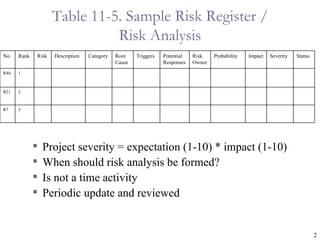
Table 11-5. Sample Risk Register /
                              Risk Analysis
No.   Rank   Risk   Description   Category   Root    Triggers   Potential   Risk    Probability   Impact   Severity   Status
                                             Cause              Responses   Owner
R44   1


R21   2


R7    3


                Project severity = expectation (1-10) * impact (1-10)
                When should risk analysis be formed?
                Is not a time activity
                Periodic update and reviewed


                                                                                                                               2
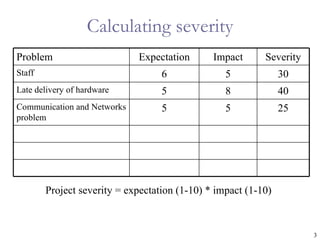
Calculating severity
Problem                      Expectation       Impact      Severity
Staff                              6              5             30
Late delivery of hardware          5              8             40
Communication and Networks         5              5             25
problem


        Project severity = expectation (1-10) * impact (1-10)


                                                                      3
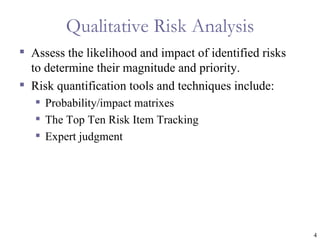
Qualitative Risk Analysis
 Assess the likelihood and impact of identified risks
  to determine their magnitude and priority.
 Risk quantification tools and techniques include:
    Probability/impact matrixes
    The Top Ten Risk Item Tracking
    Expert judgment


                                                         4
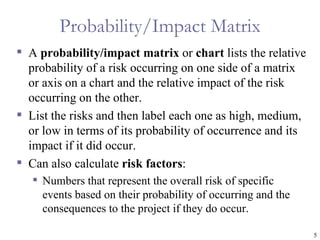
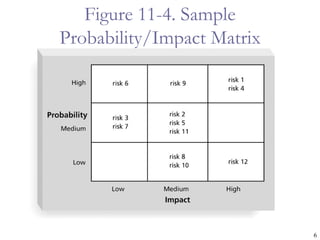
Probability/Impact Matrix
 A probability/impact matrix or chart lists the relative
  probability of a risk occurring on one side of a matrix
  or axis on a chart and the relative impact of the risk
  occurring on the other.
 List the risks and then label each one as high, medium,
  or low in terms of its probability of occurrence and its
  impact if it did occur.
 Can also calculate risk factors:
    Numbers that represent the overall risk of specific
     events based on their probability of occurring and the
     consequences to the project if they do occur.

                                                              5
Figure 11-4. Sample
Probability/Impact Matrix


                            6
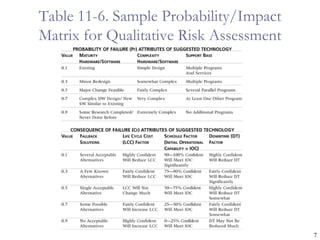
Table 11-6. Sample Probability/Impact
Matrix for Qualitative Risk Assessment


                                         7
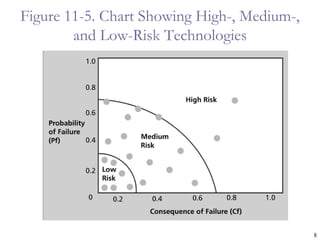
Figure 11-5. Chart Showing High-, Medium-,
        and Low-Risk Technologies


                                             8
Top Ten Risk Item Tracking
 Top Ten Risk Item Tracking is a qualitative risk
  analysis tool that helps to identify risks and maintain
  an awareness of risks throughout the life of a project.
 Establish a periodic review of the top ten project risk
  items.
 List the current ranking, previous ranking, number of
  times the risk appears on the list over a period of
  time, and a summary of progress made in resolving
  the risk item.


                                                            9
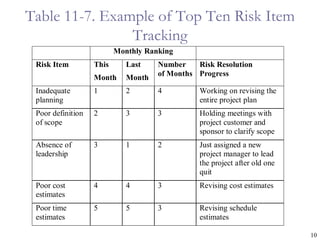
Table 11-7. Example of Top Ten Risk Item
                Tracking
                          Monthly Ranking
 Risk Item         This      Last    Number    Risk Resolution
                                     of Months Progress
                   Month     Month
 Inadequate        1         2       4          Working on revising the
 planning                                       entire project plan
 Poor definition   2         3       3          Holding meetings with
 of scope                                       project customer and
                                                sponsor to clarify scope
 Absence of        3         1       2          Just assigned a new
 leadership                                     project manager to lead
                                                the project after old one
                                                quit
 Poor cost         4         4       3          Revising cost estimates
 estimates
 Poor time         5         5       3          Revising schedule
 estimates                                      estimates

                                                                            10
Expert Judgment
 Many organizations rely on the intuitive feelings and
  past experience of experts to help identify potential
  project risks.
 Experts can categorize risks as high, medium, or low
  with or without more sophisticated techniques.
 Can also help create and monitor a watch list, a list of
  risks that are low priority, but are still identified as
  potential risks.


                                                             11
Quantitative Risk Analysis
 Often follows qualitative risk analysis, but both can be
  done together.
 Large, complex projects involving leading edge
  technologies often require extensive quantitative risk
  analysis.
 Main techniques include:
    Decision tree analysis
    Simulation
    Sensitivity analysis


                                                             12
Decision Trees and Expected
        Monetary Value (EMV)
 A decision tree is a diagramming analysis technique
  used to help select the best course of action in
  situations in which future outcomes are uncertain.
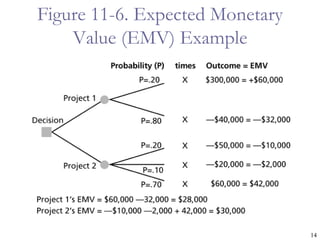
 Estimated monetary value (EMV) is the product of a
  risk event probability and the risk event’s monetary
  value.
 You can draw a decision tree to help find the EMV.


                                                         13
Figure 11-6. Expected Monetary
    Value (EMV) Example


                                 14
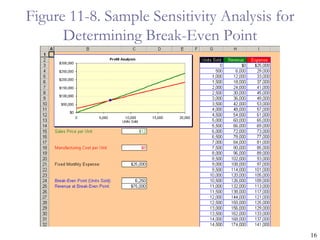
Sensitivity Analysis
 Sensitivity analysis is a technique used to show the
  effects of changing one or more variables on an
  outcome.
 For example, many people use it to determine what the
  monthly payments for a loan will be given different
  interest rates or periods of the loan, or for determining
  break-even points based on different assumptions.
 Spreadsheet software, such as Excel, is a common tool
  for performing sensitivity analysis.


                                                              15
Figure 11-8. Sample Sensitivity Analysis for
      Determining Break-Even Point


                                               16
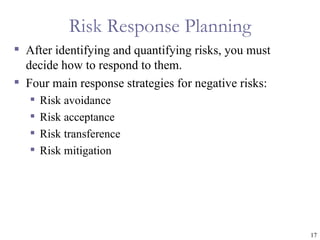
Risk Response Planning
 After identifying and quantifying risks, you must
  decide how to respond to them.
 Four main response strategies for negative risks:
      Risk avoidance
      Risk acceptance
      Risk transference
      Risk mitigation


                                                      17
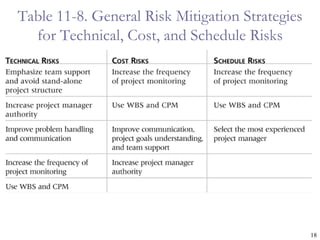
Table 11-8. General Risk Mitigation Strategies
  for Technical, Cost, and Schedule Risks


                                                 18
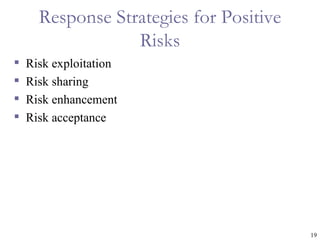
Response Strategies for Positive
                  Risks
   Risk exploitation
   Risk sharing
   Risk enhancement
   Risk acceptance


                                         19
Residual and Secondary Risks
 It’s also important to identify residual and secondary
  risks.
 Residual risks are risks that remain after all of the
  response strategies have been implemented.
 Secondary risks are a direct result of implementing a
  risk response.


                                                           20
Media Snapshot
 A highly publicized example of a risk response to
  corporate financial scandals, such as those affecting
  Enron, Arthur Andersen, and WorldCom, was legal
  action.
 The Sarbanes-Oxley Act of 2002 is considered the
  most significant change to federal securities laws in the
  United States since the New Deal.
 This Act has caused many organizations to initiate
  projects and other actions to avoid litigation.*

*Iosub, John C., “What the Sarbanes-Oxley Act Means for IT Managers,” TechRepublic,
(March 19, 2003) (http://techrepublic.com.com/5100-6313-5034345.html).

                                                                                      21
Risk Monitoring and Control
 Involves executing the risk management process to
  respond to risk events.
 Workarounds are unplanned responses to risk events
  that must be done when there are no contingency plans.
 Main outputs of risk monitoring and control are:
    Requested changes.
    Recommended corrective and preventive actions.
    Updates to the risk register, project management plan,
     and organizational process assets.


                                                              22
Using Software to Assist in Project
          Risk Management
 Risk registers can be created in a simple Word or Excel
  file or as part of a database.
 More sophisticated risk management software, such as
  Monte Carlo simulation tools, help in analyzing project
  risks.
 The PMI Risk Specific Interest Group’s Web site at
  www.risksig.com has a detailed list of software
  products to assist in risk management.


                                                            23
Results of Good Project Risk
               Management
 Unlike crisis management, good project risk
  management often goes unnoticed.
 Well-run projects appear to be almost effortless, but a
  lot of work goes into running a project well.
 Project managers should strive to make their jobs look
  easy to reflect the results of well-run projects.


                                                            24
Chapter Summary
 Project risk management is the art and science of
  identifying, analyzing, and responding to risk
  throughout the life of a project and in the best interests
  of meeting project objectives.
 Main processes include:
      Risk management planning
      Risk identification
      Qualitative risk analysis
      Quantitative risk analysis
      Risk response planning
      Risk monitoring and control

                                                               25
Table 11-2. Topics Addressed in a
       Risk Management Plan
 Methodology

 Roles and responsibilities

 Budget and schedule

 Risk categories

 Risk probability and impact

 Risk documentation
                                      26

Project risk management

  • 1.
  • 2.
    Table 11-5. SampleRisk Register / Risk Analysis No. Rank Risk Description Category Root Triggers Potential Risk Probability Impact Severity Status Cause Responses Owner R44 1 R21 2 R7 3  Project severity = expectation (1-10) * impact (1-10)  When should risk analysis be formed?  Is not a time activity  Periodic update and reviewed 2
  • 3.
    Calculating severity Problem Expectation Impact Severity Staff 6 5 30 Late delivery of hardware 5 8 40 Communication and Networks 5 5 25 problem Project severity = expectation (1-10) * impact (1-10) 3
  • 4.
    Qualitative Risk Analysis Assess the likelihood and impact of identified risks to determine their magnitude and priority.  Risk quantification tools and techniques include:  Probability/impact matrixes  The Top Ten Risk Item Tracking  Expert judgment 4
  • 5.
    Probability/Impact Matrix  Aprobability/impact matrix or chart lists the relative probability of a risk occurring on one side of a matrix or axis on a chart and the relative impact of the risk occurring on the other.  List the risks and then label each one as high, medium, or low in terms of its probability of occurrence and its impact if it did occur.  Can also calculate risk factors:  Numbers that represent the overall risk of specific events based on their probability of occurring and the consequences to the project if they do occur. 5
  • 6.
  • 7.
    Table 11-6. SampleProbability/Impact Matrix for Qualitative Risk Assessment 7
  • 8.
    Figure 11-5. ChartShowing High-, Medium-, and Low-Risk Technologies 8
  • 9.
    Top Ten RiskItem Tracking  Top Ten Risk Item Tracking is a qualitative risk analysis tool that helps to identify risks and maintain an awareness of risks throughout the life of a project.  Establish a periodic review of the top ten project risk items.  List the current ranking, previous ranking, number of times the risk appears on the list over a period of time, and a summary of progress made in resolving the risk item. 9
  • 10.
    Table 11-7. Exampleof Top Ten Risk Item Tracking Monthly Ranking Risk Item This Last Number Risk Resolution of Months Progress Month Month Inadequate 1 2 4 Working on revising the planning entire project plan Poor definition 2 3 3 Holding meetings with of scope project customer and sponsor to clarify scope Absence of 3 1 2 Just assigned a new leadership project manager to lead the project after old one quit Poor cost 4 4 3 Revising cost estimates estimates Poor time 5 5 3 Revising schedule estimates estimates 10
  • 11.
    Expert Judgment  Manyorganizations rely on the intuitive feelings and past experience of experts to help identify potential project risks.  Experts can categorize risks as high, medium, or low with or without more sophisticated techniques.  Can also help create and monitor a watch list, a list of risks that are low priority, but are still identified as potential risks. 11
  • 12.
    Quantitative Risk Analysis Often follows qualitative risk analysis, but both can be done together.  Large, complex projects involving leading edge technologies often require extensive quantitative risk analysis.  Main techniques include:  Decision tree analysis  Simulation  Sensitivity analysis 12
  • 13.
    Decision Trees andExpected Monetary Value (EMV)  A decision tree is a diagramming analysis technique used to help select the best course of action in situations in which future outcomes are uncertain.  Estimated monetary value (EMV) is the product of a risk event probability and the risk event’s monetary value.  You can draw a decision tree to help find the EMV. 13
  • 14.
    Figure 11-6. ExpectedMonetary Value (EMV) Example 14
  • 15.
    Sensitivity Analysis  Sensitivityanalysis is a technique used to show the effects of changing one or more variables on an outcome.  For example, many people use it to determine what the monthly payments for a loan will be given different interest rates or periods of the loan, or for determining break-even points based on different assumptions.  Spreadsheet software, such as Excel, is a common tool for performing sensitivity analysis. 15
  • 16.
    Figure 11-8. SampleSensitivity Analysis for Determining Break-Even Point 16
  • 17.
    Risk Response Planning After identifying and quantifying risks, you must decide how to respond to them.  Four main response strategies for negative risks:  Risk avoidance  Risk acceptance  Risk transference  Risk mitigation 17
  • 18.
    Table 11-8. GeneralRisk Mitigation Strategies for Technical, Cost, and Schedule Risks 18
  • 19.
    Response Strategies forPositive Risks  Risk exploitation  Risk sharing  Risk enhancement  Risk acceptance 19
  • 20.
    Residual and SecondaryRisks  It’s also important to identify residual and secondary risks.  Residual risks are risks that remain after all of the response strategies have been implemented.  Secondary risks are a direct result of implementing a risk response. 20
  • 21.
    Media Snapshot  Ahighly publicized example of a risk response to corporate financial scandals, such as those affecting Enron, Arthur Andersen, and WorldCom, was legal action.  The Sarbanes-Oxley Act of 2002 is considered the most significant change to federal securities laws in the United States since the New Deal.  This Act has caused many organizations to initiate projects and other actions to avoid litigation.* *Iosub, John C., “What the Sarbanes-Oxley Act Means for IT Managers,” TechRepublic, (March 19, 2003) (http://techrepublic.com.com/5100-6313-5034345.html). 21
  • 22.
    Risk Monitoring andControl  Involves executing the risk management process to respond to risk events.  Workarounds are unplanned responses to risk events that must be done when there are no contingency plans.  Main outputs of risk monitoring and control are:  Requested changes.  Recommended corrective and preventive actions.  Updates to the risk register, project management plan, and organizational process assets. 22
  • 23.
    Using Software toAssist in Project Risk Management  Risk registers can be created in a simple Word or Excel file or as part of a database.  More sophisticated risk management software, such as Monte Carlo simulation tools, help in analyzing project risks.  The PMI Risk Specific Interest Group’s Web site at www.risksig.com has a detailed list of software products to assist in risk management. 23
  • 24.
    Results of GoodProject Risk Management  Unlike crisis management, good project risk management often goes unnoticed.  Well-run projects appear to be almost effortless, but a lot of work goes into running a project well.  Project managers should strive to make their jobs look easy to reflect the results of well-run projects. 24
  • 25.
    Chapter Summary  Projectrisk management is the art and science of identifying, analyzing, and responding to risk throughout the life of a project and in the best interests of meeting project objectives.  Main processes include:  Risk management planning  Risk identification  Qualitative risk analysis  Quantitative risk analysis  Risk response planning  Risk monitoring and control 25
  • 26.
    Table 11-2. TopicsAddressed in a Risk Management Plan  Methodology  Roles and responsibilities  Budget and schedule  Risk categories  Risk probability and impact  Risk documentation 26