IRL6050-C:
PROJECT MANAGEMENT IN
INTERNATIONAL RELATIONS
Determining Project
Stakeholders & Risks
Stakeholder
“A person or group of people who have a vested
interest in the success of an organization or
project and the environment in which the
organization/ project operates”
Write down three typical project stakeholders
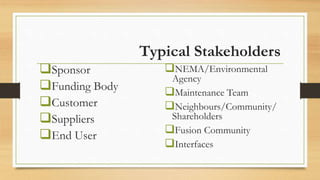
Typical Stakeholders
Sponsor
Funding Body
Customer
Suppliers
End User
NEMA/Environmental
Agency
Maintenance Team
Neighbours/Community/
Shareholders
Fusion Community
Interfaces
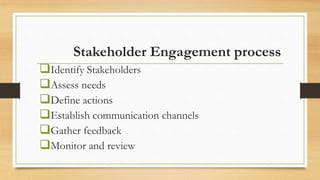
Stakeholder Engagement process
Identify Stakeholders
Assess needs
Define actions
Establish communication channels
Gather feedback
Monitor and review
Project Risk Management
Project Risk – Definition
“Project risk is an uncertain event or
condition that, if it occurs, has a positive
or negative effect on a project objective”
Risk is an uncertain event that may
have a positive or negative impact on
the project.
Residual and Secondary Risks
It’s also important to identify residual and secondary
risks.
Residual risks are risks that remain after all of
the response strategies have been implemented.
Secondary risks are a direct result of
implementing a risk response.
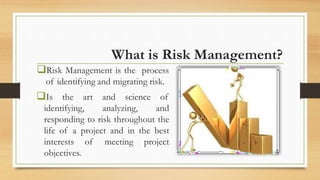
What is Risk Management?
Risk Management is the process
of identifying and migrating risk.
Is the art and science of
identifying, analyzing, and
responding to risk throughout the
life of a project and in the best
interests of meeting project
objectives.
What is the Risk Management process?
The Risk Management Process
consists of a series of steps that,
when undertaken in sequence,
enable continual improvement in
decision-making.
Why is it important?
 Risk affects all aspects of your
project – your budget, your
schedule, your scope, the agreed
level of quality, and so on
 Increase probability of positive
event.
 Reduce the occurrence of negative
event.
What does it include?
 Risk Management Planning
 Risk Identification
 Qualitative RiskAnalysis
 Quantitative RiskAnalysis
 Risk Response Planning
 Risk Monitoring and Control
How is it done in project?
 Make Risk Management Part of Your
Project
 Identify Risks Early in Your Project
 Communicate About Risks
 Consider Both Threats and
Opportunities
 Clarify Ownership Issues
How is it done in project?
• Prioritise Risks
• Analyse Risks
• Plan and Implement Risk Responses
• Register Project Risks
• Track Risks andAssociated Tasks
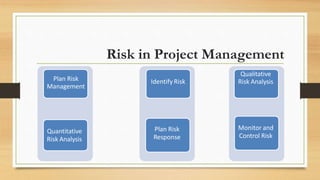
Risk in Project Management
Plan Risk
Management
Quantitative
Risk Analysis
Identify Risk
Plan Risk
Response
Qualitative
Risk Analysis
Monitor and
Control Risk
Plan Risk Management
Analysis and decision making to
implement risk management.
Appropriate to size and
complexity of the project.
Stakeholders will be involved in
planning risk management.
Risk Management Plan
Schedule Risk
Cost Risk
Quality Risk
Scope Risk
Resource Risk
Customer Satisfaction Risk
Identify Risk
 Which risk has more probability
of affecting the project?
 SWOTAnalysis
 Information gathering
 Check-listAnalysis
 AssumptionAnalysis
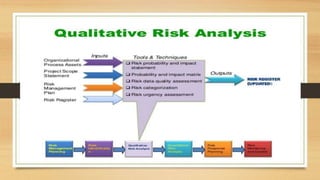
Qualitative Risk Analysis
 Assess impact and likelihood
of the identified risk.
 Probability and Impact
Matrix.
 Risk categorization.
 Risk urgency assessment.
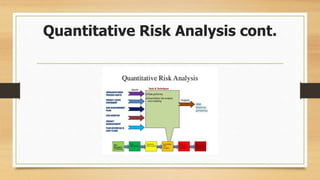
Quantitative Risk Analysis
 Data gathering
 Direct
 Diagrammatic
 Delphi
 Probability distribution
 Modeling Techniques
 Decision tree Analysis
 SensitivityAnalysis
 Expert Judgment
Plan Risk Response
Eliminate threats before they
happen.
Decrease impact of threat.
Contingency plan ( Do
something if risk happens)
Fallback plan ( Do something if
contingency plans are not effective)
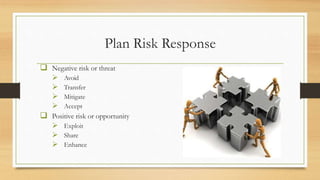
Plan Risk Response
 Negative risk or threat
 Avoid
 Transfer
 Mitigate
 Accept
 Positive risk or opportunity
 Exploit
 Share
 Enhance
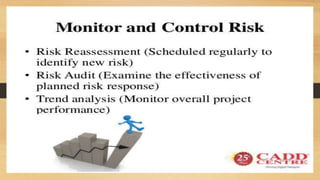
Monitor and Control Risk
• Risk Reassessment (Scheduled regularly to
identify new risk)
• RiskAudit (Examine the effectiveness
of planned risk response)
• Trend analysis (Monitor overall
project performance)
What are the benefits?
• Effective use of resources
• Promoting continuous
improvement
• Fewer shocks and failures
• Strategic business planning
• Raised awareness of significant
risks.
What are the benefits?
• Quick grasp of new opportunities
• Enhancing communication
• Reassuring stakeholders
• Focus on internal audit
programme
• Recognition of responsibility
and accountability.
How does Primavera help?
 Keep track of issues.
 Maintain threshold
 Health of project
 Track overall project progress to identify any
deviation
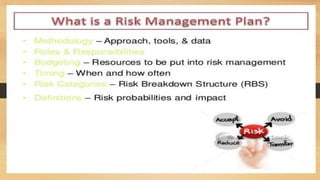
Topics Addressed in
a Risk Management Plan
Methodology
Roles and responsibilities
Budget and schedule
Risk categories
Risk probability and impact
Risk documentation
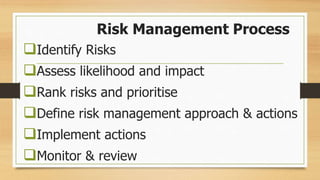
Risk Management Process
Identify Risks
Assess likelihood and impact
Rank risks and prioritise
Define risk management approach & actions
Implement actions
Monitor & review
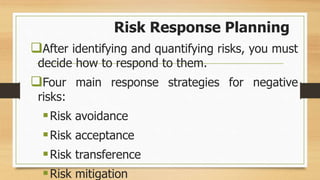
Risk Response Planning
After identifying and quantifying risks, you must
decide how to respond to them.
Four main response strategies for negative
risks:
Risk avoidance
Risk acceptance
Risk transference
Risk mitigation
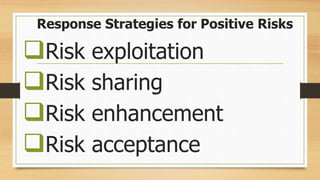
Response Strategies for Positive Risks
Risk exploitation
Risk sharing
Risk enhancement
Risk acceptance
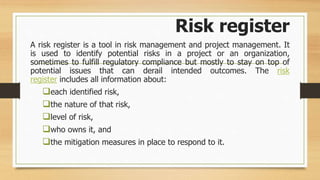
Risk register
A risk register is a tool in risk management and project management. It
is used to identify potential risks in a project or an organization,
sometimes to fulfill regulatory compliance but mostly to stay on top of
potential issues that can derail intended outcomes. The risk
register includes all information about:
each identified risk,
the nature of that risk,
level of risk,
who owns it, and
the mitigation measures in place to respond to it.
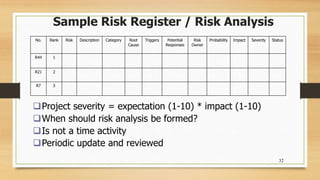
Sample Risk Register / Risk Analysis
No. Rank Risk Description Category Root
Cause
Triggers Potential
Responses
Risk
Owner
Probability Impact Severity Status
R44 1
R21 2
R7 3
32
Project severity = expectation (1-10) * impact (1-10)
When should risk analysis be formed?
Is not a time activity
Periodic update and reviewed
Qualitative Risk Analysis
Assess the likelihood and impact of identified
risks to determine their magnitude and priority.
Risk quantification tools and techniques
include:
Probability/impact matrixes
The Top Ten Risk Item Tracking
Expert judgment
33
Quantitative Risk Analysis
Often follows qualitative risk analysis, but both can
be done together.
Large, complex projects involving leading edge
technologies often require extensive quantitative risk
analysis.
Main techniques include:
 Decision tree analysis
 Simulation
 Sensitivity analysis
35
Quantitative Risk Analysis cont.
Sensitivity analysis.
This involves analysing the
project to determine how
sensitive is to particular risks by
analysing the impact and
severity of each risk.
Expected monetary value analysis.
In broad terms, determining the expected
monetary value is to multiply the likelihood by
the cost impact to obtain an expected value
for each risk, these are then added up to
obtain the expected military value for the
project.
A typical way of calculating EMV is using
decision trees;
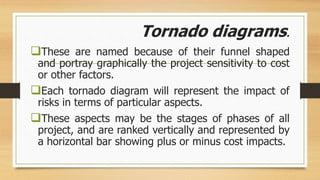
Tornado diagrams.
These are named because of their funnel shaped
and portray graphically the project sensitivity to cost
or other factors.
Each tornado diagram will represent the impact of
risks in terms of particular aspects.
These aspects may be the stages of phases of all
project, and are ranked vertically and represented by
a horizontal bar showing plus or minus cost impacts.
Modeling and simulation
The most common form of this is Monte
Carlo analysis which is normally calculated
by computer by analysing many scenarios
for the project schedule and calculating the
impact of particular the risk events and is
helpful in identifying risks and the effect
they have on the project schedule.
Expert Judgment
Many organizations rely on the intuitive feelings and
past experience of experts to help identify potential
project risks.
Experts can categorize risks as high, medium, or low
with or without more sophisticated techniques.
Can also help create and monitor a watch list, a
list of risks that are low priority, but are still
identified as potential risks.
41
Decision tree analysis.
These are in the form of a flow diagram where each
node, represented by a rectangle, contains a
description of the risk aspect and its cost.
These rectangles are linked together via arrows
each arrow leading to another box representing the
percentage probability.
These totals are calculated by multiplying the risk
costs by the probability and adding that value to the
initial cost.
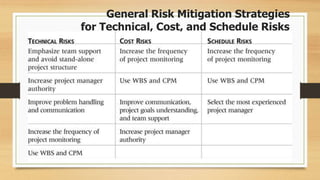
General Risk Mitigation Strategies
for Technical, Cost, and Schedule Risks
Risk Monitoring and Control
Involves executing the risk management process to respond
to risk events.
Workarounds are unplanned responses to risk events that
must be done when there are no contingency plans.
Main outputs of risk monitoring and control are:
 Requested changes.
 Recommended corrective and preventive actions.
 Updates to the risk register, project management plan,
and organizational process assets.
44
Using Software to Assist
in Project Risk Management
Risk registers can be created in a simple Word or
Excel file or as part of a database.
More sophisticated risk management software, such
as Monte Carlo simulation tools, help in analyzing
project risks.
The PMI Risk Specific Interest Group’s Web site at
www.risksig.com has a detailed list of software
products to assist in risk management.
Results of Good
Project Risk Management
Unlike crisis management, good project risk
management often goes unnoticed.
Well-run projects appear to be almost
effortless, but a lot of work goes into running a
project well.
Project managers should strive to make their
jobs look easy to reflect the results of well-run
projects. 49
Results of Good
Project Risk Management
Unlike crisis management, good project risk
management often goes unnoticed.
Well-run projects appear to be almost
effortless, but a lot of work goes into running a
project well.
Project managers should strive to make their
jobs look easy to reflect the results of well-run
projects.
50

Final Class Presentation on Determining Project Stakeholders & Risks.pptx

  • 1.
    IRL6050-C: PROJECT MANAGEMENT IN INTERNATIONALRELATIONS Determining Project Stakeholders & Risks
  • 2.
    Stakeholder “A person orgroup of people who have a vested interest in the success of an organization or project and the environment in which the organization/ project operates” Write down three typical project stakeholders
  • 3.
    Typical Stakeholders Sponsor Funding Body Customer Suppliers EndUser NEMA/Environmental Agency Maintenance Team Neighbours/Community/ Shareholders Fusion Community Interfaces
  • 4.
    Stakeholder Engagement process IdentifyStakeholders Assess needs Define actions Establish communication channels Gather feedback Monitor and review
  • 5.
  • 6.
    Project Risk –Definition “Project risk is an uncertain event or condition that, if it occurs, has a positive or negative effect on a project objective” Risk is an uncertain event that may have a positive or negative impact on the project.
  • 7.
    Residual and SecondaryRisks It’s also important to identify residual and secondary risks. Residual risks are risks that remain after all of the response strategies have been implemented. Secondary risks are a direct result of implementing a risk response.
  • 8.
    What is RiskManagement? Risk Management is the process of identifying and migrating risk. Is the art and science of identifying, analyzing, and responding to risk throughout the life of a project and in the best interests of meeting project objectives.
  • 9.
    What is theRisk Management process? The Risk Management Process consists of a series of steps that, when undertaken in sequence, enable continual improvement in decision-making.
  • 10.
    Why is itimportant?  Risk affects all aspects of your project – your budget, your schedule, your scope, the agreed level of quality, and so on  Increase probability of positive event.  Reduce the occurrence of negative event.
  • 11.
    What does itinclude?  Risk Management Planning  Risk Identification  Qualitative RiskAnalysis  Quantitative RiskAnalysis  Risk Response Planning  Risk Monitoring and Control
  • 12.
    How is itdone in project?  Make Risk Management Part of Your Project  Identify Risks Early in Your Project  Communicate About Risks  Consider Both Threats and Opportunities  Clarify Ownership Issues
  • 13.
    How is itdone in project? • Prioritise Risks • Analyse Risks • Plan and Implement Risk Responses • Register Project Risks • Track Risks andAssociated Tasks
  • 14.
    Risk in ProjectManagement Plan Risk Management Quantitative Risk Analysis Identify Risk Plan Risk Response Qualitative Risk Analysis Monitor and Control Risk
  • 15.
    Plan Risk Management Analysisand decision making to implement risk management. Appropriate to size and complexity of the project. Stakeholders will be involved in planning risk management.
  • 16.
    Risk Management Plan ScheduleRisk Cost Risk Quality Risk Scope Risk Resource Risk Customer Satisfaction Risk
  • 17.
    Identify Risk  Whichrisk has more probability of affecting the project?  SWOTAnalysis  Information gathering  Check-listAnalysis  AssumptionAnalysis
  • 18.
    Qualitative Risk Analysis Assess impact and likelihood of the identified risk.  Probability and Impact Matrix.  Risk categorization.  Risk urgency assessment.
  • 19.
    Quantitative Risk Analysis Data gathering  Direct  Diagrammatic  Delphi  Probability distribution  Modeling Techniques  Decision tree Analysis  SensitivityAnalysis  Expert Judgment
  • 20.
    Plan Risk Response Eliminatethreats before they happen. Decrease impact of threat. Contingency plan ( Do something if risk happens) Fallback plan ( Do something if contingency plans are not effective)
  • 21.
    Plan Risk Response Negative risk or threat  Avoid  Transfer  Mitigate  Accept  Positive risk or opportunity  Exploit  Share  Enhance
  • 22.
    Monitor and ControlRisk • Risk Reassessment (Scheduled regularly to identify new risk) • RiskAudit (Examine the effectiveness of planned risk response) • Trend analysis (Monitor overall project performance)
  • 23.
    What are thebenefits? • Effective use of resources • Promoting continuous improvement • Fewer shocks and failures • Strategic business planning • Raised awareness of significant risks.
  • 24.
    What are thebenefits? • Quick grasp of new opportunities • Enhancing communication • Reassuring stakeholders • Focus on internal audit programme • Recognition of responsibility and accountability.
  • 25.
    How does Primaverahelp?  Keep track of issues.  Maintain threshold  Health of project  Track overall project progress to identify any deviation
  • 27.
    Topics Addressed in aRisk Management Plan Methodology Roles and responsibilities Budget and schedule Risk categories Risk probability and impact Risk documentation
  • 28.
    Risk Management Process IdentifyRisks Assess likelihood and impact Rank risks and prioritise Define risk management approach & actions Implement actions Monitor & review
  • 29.
    Risk Response Planning Afteridentifying and quantifying risks, you must decide how to respond to them. Four main response strategies for negative risks: Risk avoidance Risk acceptance Risk transference Risk mitigation
  • 30.
    Response Strategies forPositive Risks Risk exploitation Risk sharing Risk enhancement Risk acceptance
  • 31.
    Risk register A riskregister is a tool in risk management and project management. It is used to identify potential risks in a project or an organization, sometimes to fulfill regulatory compliance but mostly to stay on top of potential issues that can derail intended outcomes. The risk register includes all information about: each identified risk, the nature of that risk, level of risk, who owns it, and the mitigation measures in place to respond to it.
  • 32.
    Sample Risk Register/ Risk Analysis No. Rank Risk Description Category Root Cause Triggers Potential Responses Risk Owner Probability Impact Severity Status R44 1 R21 2 R7 3 32 Project severity = expectation (1-10) * impact (1-10) When should risk analysis be formed? Is not a time activity Periodic update and reviewed
  • 33.
    Qualitative Risk Analysis Assessthe likelihood and impact of identified risks to determine their magnitude and priority. Risk quantification tools and techniques include: Probability/impact matrixes The Top Ten Risk Item Tracking Expert judgment 33
  • 35.
    Quantitative Risk Analysis Oftenfollows qualitative risk analysis, but both can be done together. Large, complex projects involving leading edge technologies often require extensive quantitative risk analysis. Main techniques include:  Decision tree analysis  Simulation  Sensitivity analysis 35
  • 36.
  • 37.
    Sensitivity analysis. This involvesanalysing the project to determine how sensitive is to particular risks by analysing the impact and severity of each risk.
  • 38.
    Expected monetary valueanalysis. In broad terms, determining the expected monetary value is to multiply the likelihood by the cost impact to obtain an expected value for each risk, these are then added up to obtain the expected military value for the project. A typical way of calculating EMV is using decision trees;
  • 39.
    Tornado diagrams. These arenamed because of their funnel shaped and portray graphically the project sensitivity to cost or other factors. Each tornado diagram will represent the impact of risks in terms of particular aspects. These aspects may be the stages of phases of all project, and are ranked vertically and represented by a horizontal bar showing plus or minus cost impacts.
  • 40.
    Modeling and simulation Themost common form of this is Monte Carlo analysis which is normally calculated by computer by analysing many scenarios for the project schedule and calculating the impact of particular the risk events and is helpful in identifying risks and the effect they have on the project schedule.
  • 41.
    Expert Judgment Many organizationsrely on the intuitive feelings and past experience of experts to help identify potential project risks. Experts can categorize risks as high, medium, or low with or without more sophisticated techniques. Can also help create and monitor a watch list, a list of risks that are low priority, but are still identified as potential risks. 41
  • 42.
    Decision tree analysis. Theseare in the form of a flow diagram where each node, represented by a rectangle, contains a description of the risk aspect and its cost. These rectangles are linked together via arrows each arrow leading to another box representing the percentage probability. These totals are calculated by multiplying the risk costs by the probability and adding that value to the initial cost.
  • 43.
    General Risk MitigationStrategies for Technical, Cost, and Schedule Risks
  • 44.
    Risk Monitoring andControl Involves executing the risk management process to respond to risk events. Workarounds are unplanned responses to risk events that must be done when there are no contingency plans. Main outputs of risk monitoring and control are:  Requested changes.  Recommended corrective and preventive actions.  Updates to the risk register, project management plan, and organizational process assets. 44
  • 48.
    Using Software toAssist in Project Risk Management Risk registers can be created in a simple Word or Excel file or as part of a database. More sophisticated risk management software, such as Monte Carlo simulation tools, help in analyzing project risks. The PMI Risk Specific Interest Group’s Web site at www.risksig.com has a detailed list of software products to assist in risk management.
  • 49.
    Results of Good ProjectRisk Management Unlike crisis management, good project risk management often goes unnoticed. Well-run projects appear to be almost effortless, but a lot of work goes into running a project well. Project managers should strive to make their jobs look easy to reflect the results of well-run projects. 49
  • 50.
    Results of Good ProjectRisk Management Unlike crisis management, good project risk management often goes unnoticed. Well-run projects appear to be almost effortless, but a lot of work goes into running a project well. Project managers should strive to make their jobs look easy to reflect the results of well-run projects. 50