BUILDING A RISK
TOLERANT IMS
Informing the Program Performance with Risk to Increase
the Probability of Program Success (PoPS)
1
Niwot Ridge, LLC
Safran Risk
Roadshow
McClean, VA
June 23, 2015
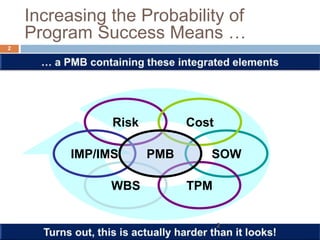
Increasing the Probability of Program
Success Means …
Risk
SOW
Cost
WBS
IMP/IMS
TPM
PMB
2
2
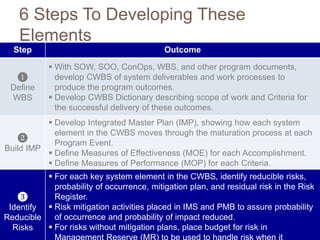
6 Steps To Developing These Elements
Step Outcome
❶
Define
WBS
§ With SOW, SOO, ConOps, WBS, and other program documents, develop
CWBS of system deliverables and work processes to produce the program
outcomes.
§ Develop CWBS Dictionary describing scope of work and Criteria for the
successful delivery of these outcomes.
❷
Build IMP
§ Develop Integrated Master Plan (IMP), showing how each system element in
the CWBS moves through the maturation process at each Program Event.
§ Define Measures of Effectiveness (MOE) for each Accomplishment.
§ Define Measures of Performance (MOP) for each Criteria.
❸
Identify
Reducible
Risks
§ For each key system element in the CWBS, identify reducible risks, probability
of occurrence, mitigation plan, and residual risk in the Risk Register.
§ Risk mitigation activities placed in IMS and PMB to assure probability of
occurrence and probability of impact reduced.
§ For risks without mitigation plans, place budget for risk in Management
Reserve (MR) to be used to handle risk when it becomes an Issue.
C
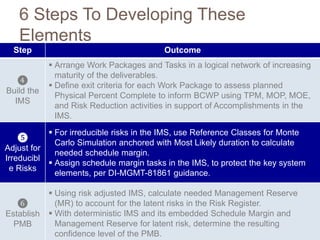
Step Outcome
❹
Build the
IMS
§ Arrange Work Packages and Tasks in a logical network of increasing maturity
of the deliverables.
§ Define exit criteria for each Work Package to assess planned Physical Percent
Complete to inform BCWP using TPM, MOP, MOE, and Risk Reduction
activities in support of Accomplishments in the IMS.
❺
Adjust for
Irreducible
Risks
§ For irreducible risks in the IMS, use Reference Classes for Monte Carlo
Simulation anchored with Most Likely duration to calculate needed schedule
margin.
§ Assign schedule margin tasks in the IMS, to protect the key system elements,
per DI-MGMT-81861 guidance.
❻
Establish
PMB
§ Using risk adjusted IMS, calculate needed Management Reserve (MR) to
account for the latent risks in the Risk Register.
§ With deterministic IMS and its embedded Schedule Margin and Management
Reserve for latent risk, determine the resulting confidence level of the PMB.
6 Steps To Developing These Elements
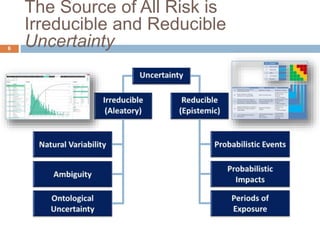
The Source of All Risk is
Irreducible and Reducible Uncertainty
5
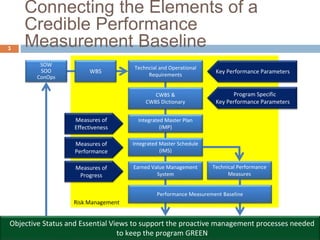
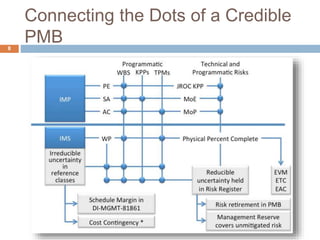
Connecting the Dots of a Credible PMB
6
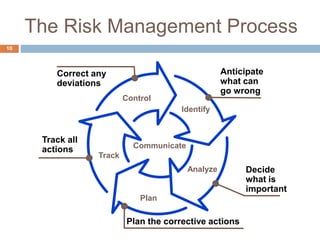
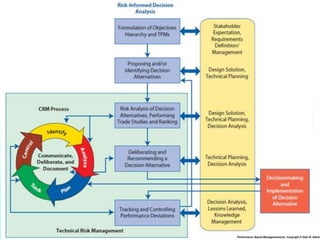
The Risk Management Process
Anticipate
what can
go wrong
Communicate
Identify
Plan
Track
Control
Decide
what is
important
Plan the corrective actions
Correct any
deviations
Track all
actions
Analyze
7
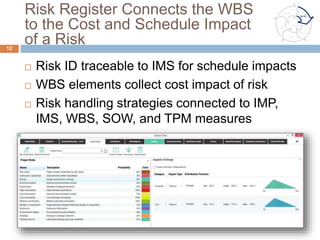
Risk Register Connects the WBS to the
Cost and Schedule Impact of a Risk
¨  Risk ID traceable to IMS for schedule impacts
¨  WBS elements collect cost impact of risk
¨  Risk handling strategies connected to IMP, IMS,
WBS, SOW, and TPM measures
Communicate
Identify
Plan
Track
Control
Analyze
8
Programmatic and Technical
Compliance Measures of Risk
9
¨  Key Performance Parameters (KPPs) – represent a critical subset of
the performance parameters so significant that failure to meet the
threshold value of performance can be cause for the concept or
system selected to be reevaluated or the project to be reassessed or
terminated.
¨  Measures of Effectiveness (MOEs) – operational measures of
success closely related to the achievements of the mission or
operational objectives evaluated in the intended operational
environment, under a specific set of conditions (i.e., how well the
solution achieves the intended purpose).
¨  Measures of Performance (MOPs) – characterize physical or
functional attributes relating to the system operation, measured or
estimated under specified testing and/or operational environment
conditions.
¨  Technical Performance Measures (TPMs) – measure attributes that
determine how well a system or system element is satisfying or
expected to satisfy a technical requirement or goal.
Communicate
Identify
Plan
Track
Control
Analyze
Analyze Reducible and
Irreducible Risks
¨  Risk analysis answers the question “How big is the
risk?” by:
¤  Considering the likelihood of the root cause occurrence;
¤  Identifying the possible consequences in terms of
performance, schedule, and cost; and
¤  Identifying the risk level using the “Risk Reporting
Matrix”
10
Communicate
Identify
Plan
Track
Control
Analyze
Planning Reducible and Irreducible
Risk Response
¨  Risk mitigation planning answers the question “What
is the program’s approach for addressing this
potential unfavorable consequence?”
¨  One or more of these mitigation options may apply:
¤  Avoiding risk by eliminating the root cause and/or the
consequence,
¤  Controlling the cause or consequence,
¤  Transferring the risk,
¤  Assuming the level of risk and continuing on the current
program plan.
¤  Provide margin to cover the impact of the risk.
11
Communicate
Identify
Plan
Track
Control
Analyze
Implementing the Risk Plan
¨  Risk mitigation (plan) execution ensures successful risk
mitigation occurs.
¨  It answers the question – How can the planned risk
mitigation be implemented?
¤  Determining what planning, budget, and requirements and
contractual changes are needed,
¤  Providing a coordination vehicle for management and other
stakeholders,
¤  Directing the teams to execute the defined and approved
risk mitigation plans,
¤  Outlining the risk reporting requirements for on-going
monitoring, and
¤  Documenting the change history.
12
Communicate
Identify
Plan
Track
Control
Analyze
Tracking the Risk
¨  Risk tracking ensures successful risk mitigation. It
answers the question “How are things going?” by:
¤  Communicating risks to all affected stakeholders,
¤  Monitoring risk mitigation plans
¤  Reviewing regular status updates
¤  Displaying risk management dynamics by tracking risk
status within the Risk Reporting Matrix
¤  Alerting management as to when risk mitigation plans
should be implemented or adjusted.
13
Communicate
Identify
Plan
Track
Control
Analyze
Risk Control Processes
14
¨  The Risk Control function takes tracking status
reports for the watched and mitigated program risk
and decides what to do with them based on the
reported data. The general process of controlling
risks includes:
¤  Analyzing the status reports
¤  Deciding how to proceed
¤  Executing the decisions
Communicate
Identify
Plan
Track
Control
Analyze
15 Performance Based Management(sm), Copyright ® Glen B. Alleman, 2012
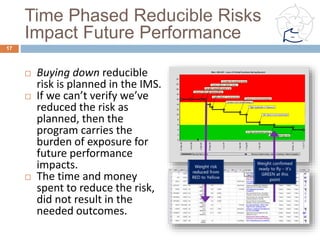
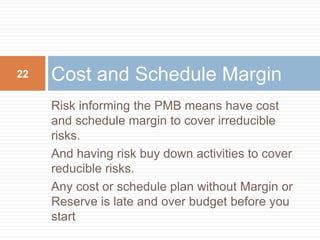
Risk informing the PMB means have cost and
schedule margin to cover irreducible risks.
And having risk buy down activities to cover
reducible risks.
Any cost or schedule plan without Margin or
Reserve is late and over budget before you start
Cost and Schedule Margin16
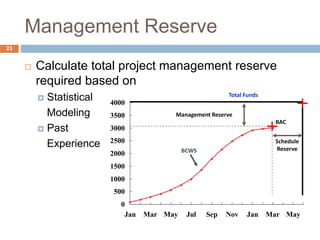
Management Reserve
¨  Calculate total project management reserve required
based on
¤  Statistical
Modeling
¤  Past
Experience
0
500
1000
1500
2000
2500
3000
3500
4000
Jan Mar May Jul Sep Nov Jan Mar May
BCWS	
  
Management	
  Reserve	
  
Schedule	
  
Reserve	
  
BAC	
  
Total	
  Funds	
  
17
Management Reserve Calculation
Principles
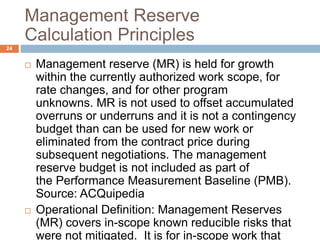
¨  Management reserve (MR) is held for growth within the
currently authorized work scope, for rate changes, and
for other program unknowns. MR is not used to offset
accumulated overruns or underruns and it is not a
contingency budget than can be used for new work or
eliminated from the contract price during subsequent
negotiations. The management reserve budget
is not included as part of the Performance Measurement
Baseline (PMB). Source: ACQuipedia
¨  Operational Definition: Management Reserves (MR)
covers in-scope known reducible risks that were not
mitigated. It is for in-scope work that may or may not
materialize.
18
Monte Carlo Simulation of Unmitigated
Reducible Risk for MR
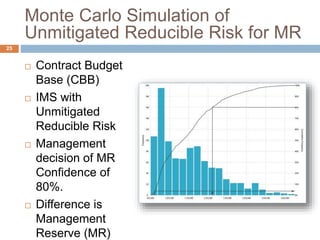
19
¨  Contract Budget
Base (CBB)
¨  IMS with
Unmitigated
Reducible Risk
¨  Management
decision of MR
Confidence of 80%.
¨  Difference is
Management
Reserve (MR)
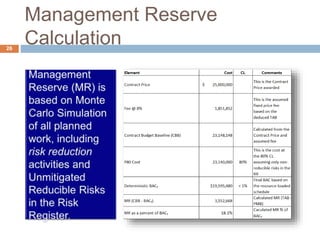
Management Reserve Calculation
20
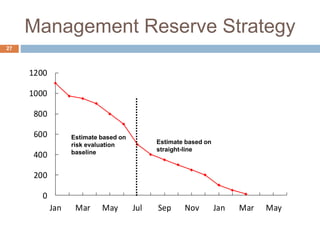
Management Reserve Strategy
0
200
400
600
800
1000
1200
Jan Mar May Jul Sep Nov Jan Mar May
Estimate based on
risk evaluation
baseline
Estimate based on
straight-line
21
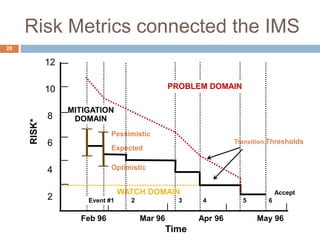
Risk Metrics connected the IMS
WATCH DOMAIN
RISK*
Transition Thresholds
PROBLEM DOMAIN
Feb 96 Mar 96 Apr 96
Time
Pessimistic
Expected
Optimistic
MITIGATION
DOMAIN
Accept
12
10
8
6
4
2
May 96
Event #1 2 3 4 65
22
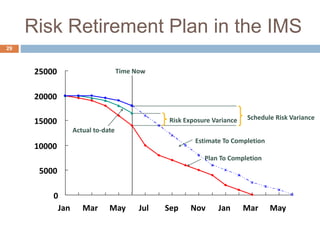
Risk Retirement Plan in the IMS
Time	
  Now	
  
Es>mate	
  To	
  Comple>on	
  
Risk	
  Exposure	
  Variance	
   Schedule	
  Risk	
  Variance	
  
Plan	
  To	
  Comple>on	
  
Actual	
  to-­‐date	
  
0	
  
5000	
  
10000	
  
15000	
  
20000	
  
25000	
  
Jan	
   Mar	
   May	
   Jul	
   Sep	
   Nov	
   Jan	
   Mar	
   May	
  
23
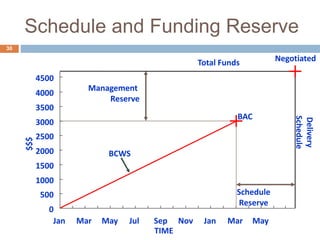
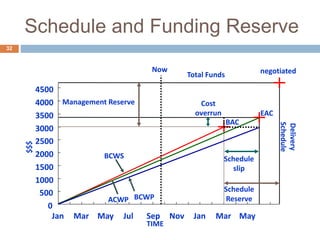
Schedule and Funding Reserve
0	
  
500	
  
1000	
  
1500	
  
2000	
  
2500	
  
3000	
  
3500	
  
4000	
  
Jan	
   Mar	
   May	
   Jul	
   Sep	
   Nov	
   Jan	
   Mar	
   May	
  
BCWS	
  
Management	
  	
  
Reserve	
  
Schedule	
  
Reserve	
  
BAC	
  
Total	
  Funds	
  
Delivery	
  
Schedule	
  
TIME	
  
$$$	
  
4500	
  
Nego>ated	
  
24
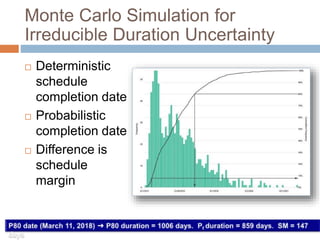
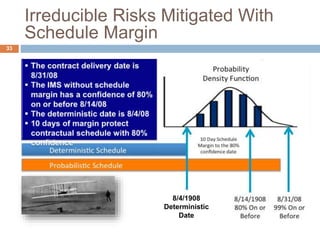
Monte Carlo Simulation for Irreducible
Duration Uncertainty
¨  Deterministic
schedule
completion date
¨  Probabilistic
completion date
¨  Difference is
schedule margin
8/4/1908
Deterministic
Date
GA/RP
Irreducible Risks Mitigated With
Schedule Margin
26
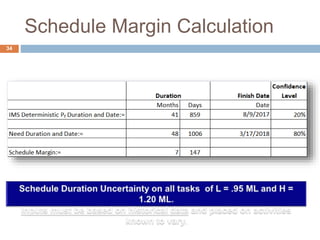
Schedule Margin Calculation
27
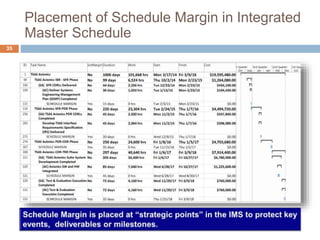
Placement of Schedule Margin in Integrated
Master Schedule
28
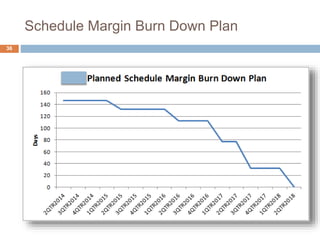
Schedule Margin Burn Down Plan
29
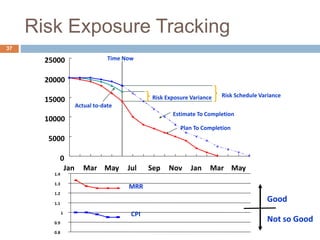
Risk Exposure Tracking
Time	
  Now	
  
Es>mate	
  To	
  Comple>on	
  
Risk	
  Exposure	
  Variance	
   Risk	
  Schedule	
  Variance	
  
Plan	
  To	
  Comple>on	
  
Actual	
  to-­‐date	
  
MRR	
  
CPI	
  
Good	
  
Not	
  so	
  Good	
  
0.8	
  
0.9	
  
1	
  
1.1	
  
1.2	
  
1.3	
  
1.4	
  
0	
  
5000	
  
10000	
  
15000	
  
20000	
  
25000	
  
Jan	
   Mar	
   May	
   Jul	
   Sep	
   Nov	
   Jan	
   Mar	
   May	
  
30
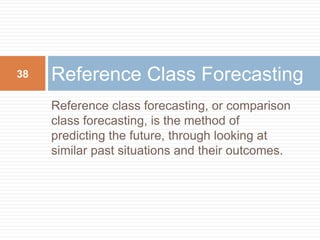
Reference class forecasting, or comparison class
forecasting, is the method of predicting the
future, through looking at similar past situations
and their outcomes.
Reference Class Forecasting31
32
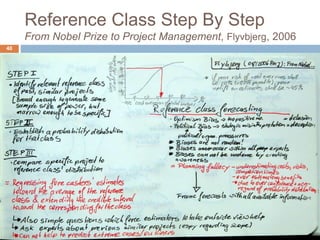
Reference Class Step By Step
From Nobel Prize to Project Management, Flyvbjerg, 2006
33
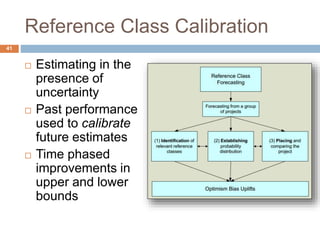
Reference Class Calibration
34
¨  Estimating in the
presence of
uncertainty
¨  Past performance
used to calibrate
future estimates
¨  Time phased
improvements in
upper and lower
bounds
Integrating the Cost, Schedule and Technical Risk
Cost, Schedule, Technical Model†
WBS
Task 100
Task 101
Task 102
Task 103
Task 104
Task 105
Task 106
Probability
Density
Function
§  Research the Project
§  Find Analogies
§  Ask Endless Questions
§  Analyze the Results
§  What can go wrong?
§  How likely is it to go wrong?
§  What is the cause?
§  What is the consequence?
Monte Carlo Simulation
Tool is Mandatory
1.0
.8
.6
.4
.2
0
Days, Facilities, Parts, People
Cumulative Distribution Function
35
With the Risk Adjusted PMB, we now need to
inform program performance (Earned Value)
comes next.
With reducible risk, the planned reduction of
risk, on the planned date, informs program
performance.
With irreducible risk, the schedule margin
reduction as planned informs program
performance
Connecting Risk and EV36
EV	
  Data	
  
EV	
  Data	
   EV	
  Data	
  
Putting this framework together with EV
Program	
  
Manager	
  
Func>onal	
  
Managers	
  
Work	
  Package	
  
Managers	
  
Individuals/	
  
Team	
  Members	
  
	
  Iden>fy	
  
Analyze	
  
§ Review	
  
§ Priori*ze	
  
§ Evaluate	
  
§ Classify	
  
Track	
  
Plan	
  
•  Approve	
  plans	
  
•  Recommend	
  
ac*ons	
  
•  Develop	
  plans	
  
risks	
  
Top	
  N	
  
risks	
  
Top	
  N	
  
risks	
   decisions	
  
assign	
  responsibility	
  
trends	
  
risk	
  
status	
  
Control	
  
•  Integrate	
  	
  
•  Repriori*ze	
  
•  Authorize	
  	
  
•  Func*onal	
  area	
  
resources	
  
1	
  
3	
  
2	
  assign	
  non-­‐top	
  N	
  
37
Connecting EV and Risk Management
38
¨  EV data is assigned to Tasks and Work Packages,
managed by CAMs and WP managers.
¤  They can review, prioritize, evaluate, classify the risks
they know well at the lowest level in the IMS.
¨  In the planning stages of the IMS (or BoE), risks are
revealed during the normal course of work
¤  Identifying and analyzing these risks, again falls on the
CAM and WP Managers.
¨  During the Tracking activities, risks are including the
in standard EVM performance assessment
¤  ETC, EAC, BCWR, and other going forward estimiates
1	
  
2	
  
3	
  
With the Reducible and Irreducible risks
identified, analyzed, planned, tracked, and
controlled, we can now construct the picture
needed by the Program Manager to increase the
Probability of Success by producing the …
The Final Picture We Are Looking For39
Communicate
Identify
Plan
Track
Control
Analyze
This	
  chart	
  was	
  first	
  published	
  in	
  2004,	
  Dr.	
  David	
  Hillson,	
  “Combining	
  Earned	
  Value	
  
Management	
  and	
  Risk	
  Management	
  to	
  Create	
  Synergy”,	
  www.risk-­‐doctor.com	
  
… Forecast of the EAC and ECD of IMS with
Reducible and Irreducible Risk.
Expected Cost
40
41
§  IMP/IMS Development and Execution
§  Earned Value Management Systems
§  Programmatic and Technical Risk Management
§  Proposal Management
§  DFARS Six Business Systems Integration
§  DCMA/DCAA Validation and Surveillance
glen.alleman@niwotridge.com
+1 303 241 9633

Earning value from risk (v4 full charts)

  • 1.
    BUILDING A RISK TOLERANTIMS Informing the Program Performance with Risk to Increase the Probability of Program Success (PoPS) 1 Niwot Ridge, LLC Safran Risk Roadshow McClean, VA June 23, 2015
  • 2.
    Increasing the Probabilityof Program Success Means … Risk SOW Cost WBS IMP/IMS TPM PMB 2 2
  • 3.
    6 Steps ToDeveloping These Elements Step Outcome ❶ Define WBS § With SOW, SOO, ConOps, WBS, and other program documents, develop CWBS of system deliverables and work processes to produce the program outcomes. § Develop CWBS Dictionary describing scope of work and Criteria for the successful delivery of these outcomes. ❷ Build IMP § Develop Integrated Master Plan (IMP), showing how each system element in the CWBS moves through the maturation process at each Program Event. § Define Measures of Effectiveness (MOE) for each Accomplishment. § Define Measures of Performance (MOP) for each Criteria. ❸ Identify Reducible Risks § For each key system element in the CWBS, identify reducible risks, probability of occurrence, mitigation plan, and residual risk in the Risk Register. § Risk mitigation activities placed in IMS and PMB to assure probability of occurrence and probability of impact reduced. § For risks without mitigation plans, place budget for risk in Management Reserve (MR) to be used to handle risk when it becomes an Issue. C
  • 4.
    Step Outcome ❹ Build the IMS § ArrangeWork Packages and Tasks in a logical network of increasing maturity of the deliverables. § Define exit criteria for each Work Package to assess planned Physical Percent Complete to inform BCWP using TPM, MOP, MOE, and Risk Reduction activities in support of Accomplishments in the IMS. ❺ Adjust for Irreducible Risks § For irreducible risks in the IMS, use Reference Classes for Monte Carlo Simulation anchored with Most Likely duration to calculate needed schedule margin. § Assign schedule margin tasks in the IMS, to protect the key system elements, per DI-MGMT-81861 guidance. ❻ Establish PMB § Using risk adjusted IMS, calculate needed Management Reserve (MR) to account for the latent risks in the Risk Register. § With deterministic IMS and its embedded Schedule Margin and Management Reserve for latent risk, determine the resulting confidence level of the PMB. 6 Steps To Developing These Elements
  • 5.
    The Source ofAll Risk is Irreducible and Reducible Uncertainty 5
  • 6.
    Connecting the Dotsof a Credible PMB 6
  • 7.
    The Risk ManagementProcess Anticipate what can go wrong Communicate Identify Plan Track Control Decide what is important Plan the corrective actions Correct any deviations Track all actions Analyze 7
  • 8.
    Risk Register Connectsthe WBS to the Cost and Schedule Impact of a Risk ¨  Risk ID traceable to IMS for schedule impacts ¨  WBS elements collect cost impact of risk ¨  Risk handling strategies connected to IMP, IMS, WBS, SOW, and TPM measures Communicate Identify Plan Track Control Analyze 8
  • 9.
    Programmatic and Technical ComplianceMeasures of Risk 9 ¨  Key Performance Parameters (KPPs) – represent a critical subset of the performance parameters so significant that failure to meet the threshold value of performance can be cause for the concept or system selected to be reevaluated or the project to be reassessed or terminated. ¨  Measures of Effectiveness (MOEs) – operational measures of success closely related to the achievements of the mission or operational objectives evaluated in the intended operational environment, under a specific set of conditions (i.e., how well the solution achieves the intended purpose). ¨  Measures of Performance (MOPs) – characterize physical or functional attributes relating to the system operation, measured or estimated under specified testing and/or operational environment conditions. ¨  Technical Performance Measures (TPMs) – measure attributes that determine how well a system or system element is satisfying or expected to satisfy a technical requirement or goal. Communicate Identify Plan Track Control Analyze
  • 10.
    Analyze Reducible and IrreducibleRisks ¨  Risk analysis answers the question “How big is the risk?” by: ¤  Considering the likelihood of the root cause occurrence; ¤  Identifying the possible consequences in terms of performance, schedule, and cost; and ¤  Identifying the risk level using the “Risk Reporting Matrix” 10 Communicate Identify Plan Track Control Analyze
  • 11.
    Planning Reducible andIrreducible Risk Response ¨  Risk mitigation planning answers the question “What is the program’s approach for addressing this potential unfavorable consequence?” ¨  One or more of these mitigation options may apply: ¤  Avoiding risk by eliminating the root cause and/or the consequence, ¤  Controlling the cause or consequence, ¤  Transferring the risk, ¤  Assuming the level of risk and continuing on the current program plan. ¤  Provide margin to cover the impact of the risk. 11 Communicate Identify Plan Track Control Analyze
  • 12.
    Implementing the RiskPlan ¨  Risk mitigation (plan) execution ensures successful risk mitigation occurs. ¨  It answers the question – How can the planned risk mitigation be implemented? ¤  Determining what planning, budget, and requirements and contractual changes are needed, ¤  Providing a coordination vehicle for management and other stakeholders, ¤  Directing the teams to execute the defined and approved risk mitigation plans, ¤  Outlining the risk reporting requirements for on-going monitoring, and ¤  Documenting the change history. 12 Communicate Identify Plan Track Control Analyze
  • 13.
    Tracking the Risk ¨ Risk tracking ensures successful risk mitigation. It answers the question “How are things going?” by: ¤  Communicating risks to all affected stakeholders, ¤  Monitoring risk mitigation plans ¤  Reviewing regular status updates ¤  Displaying risk management dynamics by tracking risk status within the Risk Reporting Matrix ¤  Alerting management as to when risk mitigation plans should be implemented or adjusted. 13 Communicate Identify Plan Track Control Analyze
  • 14.
    Risk Control Processes 14 ¨ The Risk Control function takes tracking status reports for the watched and mitigated program risk and decides what to do with them based on the reported data. The general process of controlling risks includes: ¤  Analyzing the status reports ¤  Deciding how to proceed ¤  Executing the decisions Communicate Identify Plan Track Control Analyze
  • 15.
    15 Performance BasedManagement(sm), Copyright ® Glen B. Alleman, 2012
  • 16.
    Risk informing thePMB means have cost and schedule margin to cover irreducible risks. And having risk buy down activities to cover reducible risks. Any cost or schedule plan without Margin or Reserve is late and over budget before you start Cost and Schedule Margin16
  • 17.
    Management Reserve ¨  Calculatetotal project management reserve required based on ¤  Statistical Modeling ¤  Past Experience 0 500 1000 1500 2000 2500 3000 3500 4000 Jan Mar May Jul Sep Nov Jan Mar May BCWS   Management  Reserve   Schedule   Reserve   BAC   Total  Funds   17
  • 18.
    Management Reserve Calculation Principles ¨ Management reserve (MR) is held for growth within the currently authorized work scope, for rate changes, and for other program unknowns. MR is not used to offset accumulated overruns or underruns and it is not a contingency budget than can be used for new work or eliminated from the contract price during subsequent negotiations. The management reserve budget is not included as part of the Performance Measurement Baseline (PMB). Source: ACQuipedia ¨  Operational Definition: Management Reserves (MR) covers in-scope known reducible risks that were not mitigated. It is for in-scope work that may or may not materialize. 18
  • 19.
    Monte Carlo Simulationof Unmitigated Reducible Risk for MR 19 ¨  Contract Budget Base (CBB) ¨  IMS with Unmitigated Reducible Risk ¨  Management decision of MR Confidence of 80%. ¨  Difference is Management Reserve (MR)
  • 20.
  • 21.
    Management Reserve Strategy 0 200 400 600 800 1000 1200 JanMar May Jul Sep Nov Jan Mar May Estimate based on risk evaluation baseline Estimate based on straight-line 21
  • 22.
    Risk Metrics connectedthe IMS WATCH DOMAIN RISK* Transition Thresholds PROBLEM DOMAIN Feb 96 Mar 96 Apr 96 Time Pessimistic Expected Optimistic MITIGATION DOMAIN Accept 12 10 8 6 4 2 May 96 Event #1 2 3 4 65 22
  • 23.
    Risk Retirement Planin the IMS Time  Now   Es>mate  To  Comple>on   Risk  Exposure  Variance   Schedule  Risk  Variance   Plan  To  Comple>on   Actual  to-­‐date   0   5000   10000   15000   20000   25000   Jan   Mar   May   Jul   Sep   Nov   Jan   Mar   May   23
  • 24.
    Schedule and FundingReserve 0   500   1000   1500   2000   2500   3000   3500   4000   Jan   Mar   May   Jul   Sep   Nov   Jan   Mar   May   BCWS   Management     Reserve   Schedule   Reserve   BAC   Total  Funds   Delivery   Schedule   TIME   $$$   4500   Nego>ated   24
  • 25.
    Monte Carlo Simulationfor Irreducible Duration Uncertainty ¨  Deterministic schedule completion date ¨  Probabilistic completion date ¨  Difference is schedule margin
  • 26.
  • 27.
  • 28.
    Placement of ScheduleMargin in Integrated Master Schedule 28
  • 29.
  • 30.
    Risk Exposure Tracking Time  Now   Es>mate  To  Comple>on   Risk  Exposure  Variance   Risk  Schedule  Variance   Plan  To  Comple>on   Actual  to-­‐date   MRR   CPI   Good   Not  so  Good   0.8   0.9   1   1.1   1.2   1.3   1.4   0   5000   10000   15000   20000   25000   Jan   Mar   May   Jul   Sep   Nov   Jan   Mar   May   30
  • 31.
    Reference class forecasting,or comparison class forecasting, is the method of predicting the future, through looking at similar past situations and their outcomes. Reference Class Forecasting31
  • 32.
  • 33.
    Reference Class StepBy Step From Nobel Prize to Project Management, Flyvbjerg, 2006 33
  • 34.
    Reference Class Calibration 34 ¨ Estimating in the presence of uncertainty ¨  Past performance used to calibrate future estimates ¨  Time phased improvements in upper and lower bounds
  • 35.
    Integrating the Cost,Schedule and Technical Risk Cost, Schedule, Technical Model† WBS Task 100 Task 101 Task 102 Task 103 Task 104 Task 105 Task 106 Probability Density Function §  Research the Project §  Find Analogies §  Ask Endless Questions §  Analyze the Results §  What can go wrong? §  How likely is it to go wrong? §  What is the cause? §  What is the consequence? Monte Carlo Simulation Tool is Mandatory 1.0 .8 .6 .4 .2 0 Days, Facilities, Parts, People Cumulative Distribution Function 35
  • 36.
    With the RiskAdjusted PMB, we now need to inform program performance (Earned Value) comes next. With reducible risk, the planned reduction of risk, on the planned date, informs program performance. With irreducible risk, the schedule margin reduction as planned informs program performance Connecting Risk and EV36
  • 37.
    EV  Data   EV  Data   EV  Data   Putting this framework together with EV Program   Manager   Func>onal   Managers   Work  Package   Managers   Individuals/   Team  Members    Iden>fy   Analyze   § Review   § Priori*ze   § Evaluate   § Classify   Track   Plan   •  Approve  plans   •  Recommend   ac*ons   •  Develop  plans   risks   Top  N   risks   Top  N   risks   decisions   assign  responsibility   trends   risk   status   Control   •  Integrate     •  Repriori*ze   •  Authorize     •  Func*onal  area   resources   1   3   2  assign  non-­‐top  N   37
  • 38.
    Connecting EV andRisk Management 38 ¨  EV data is assigned to Tasks and Work Packages, managed by CAMs and WP managers. ¤  They can review, prioritize, evaluate, classify the risks they know well at the lowest level in the IMS. ¨  In the planning stages of the IMS (or BoE), risks are revealed during the normal course of work ¤  Identifying and analyzing these risks, again falls on the CAM and WP Managers. ¨  During the Tracking activities, risks are including the in standard EVM performance assessment ¤  ETC, EAC, BCWR, and other going forward estimiates 1   2   3  
  • 39.
    With the Reducibleand Irreducible risks identified, analyzed, planned, tracked, and controlled, we can now construct the picture needed by the Program Manager to increase the Probability of Success by producing the … The Final Picture We Are Looking For39 Communicate Identify Plan Track Control Analyze
  • 40.
    This  chart  was  first  published  in  2004,  Dr.  David  Hillson,  “Combining  Earned  Value   Management  and  Risk  Management  to  Create  Synergy”,  www.risk-­‐doctor.com   … Forecast of the EAC and ECD of IMS with Reducible and Irreducible Risk. Expected Cost 40
  • 41.
    41 §  IMP/IMS Developmentand Execution §  Earned Value Management Systems §  Programmatic and Technical Risk Management §  Proposal Management §  DFARS Six Business Systems Integration §  DCMA/DCAA Validation and Surveillance glen.alleman@niwotridge.com +1 303 241 9633