Risk Management
What is risk?
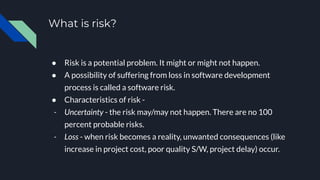
● Risk is a potential problem. It might or might not happen.
● A possibility of suffering from loss in software development
process is called a software risk.
● Characteristics of risk -
- Uncertainty - the risk may/may not happen. There are no 100
percent probable risks.
- Loss - when risk becomes a reality, unwanted consequences (like
increase in project cost, poor quality S/W, project delay) occur.
What is risk management?
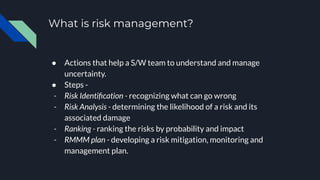
● Actions that help a S/W team to understand and manage
uncertainty.
● Steps -
- Risk Identification - recognizing what can go wrong
- Risk Analysis - determining the likelihood of a risk and its
associated damage
- Ranking - ranking the risks by probability and impact
- RMMM plan - developing a risk mitigation, monitoring and
management plan.
Reactive vs Proactive Risk Strategies
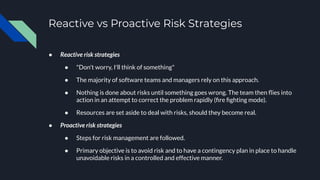
● Reactive risk strategies
● "Don't worry, I'll think of something"
● The majority of software teams and managers rely on this approach.
● Nothing is done about risks until something goes wrong. The team then flies into
action in an attempt to correct the problem rapidly (fire fighting mode).
● Resources are set aside to deal with risks, should they become real.
● Proactive risk strategies
● Steps for risk management are followed.
● Primary objective is to avoid risk and to have a contingency plan in place to handle
unavoidable risks in a controlled and effective manner.
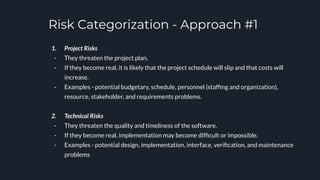
Risk Categorization - Approach #1
1. Project Risks
- They threaten the project plan.
- If they become real, it is likely that the project schedule will slip and that costs will
increase.
- Examples - potential budgetary, schedule, personnel (staffing and organization),
resource, stakeholder, and requirements problems.
2. Technical Risks
- They threaten the quality and timeliness of the software.
- If they become real, implementation may become difficult or impossible.
- Examples - potential design, implementation, interface, verification, and maintenance
problems
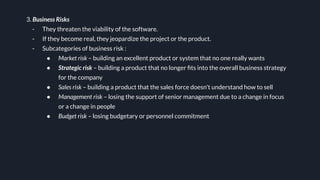
3. Business Risks
- They threaten the viability of the software.
- If they become real, they jeopardize the project or the product.
- Subcategories of business risk :
● Market risk – building an excellent product or system that no one really wants
● Strategic risk – building a product that no longer fits into the overall business strategy
for the company
● Sales risk – building a product that the sales force doesn't understand how to sell
● Management risk – losing the support of senior management due to a change in focus
or a change in people
● Budget risk – losing budgetary or personnel commitment
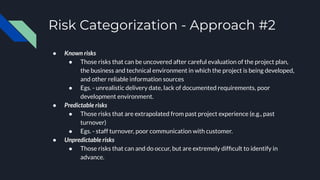
Risk Categorization - Approach #2
● Known risks
● Those risks that can be uncovered after careful evaluation of the project plan,
the business and technical environment in which the project is being developed,
and other reliable information sources
● Egs. - unrealistic delivery date, lack of documented requirements, poor
development environment.
● Predictable risks
● Those risks that are extrapolated from past project experience (e.g., past
turnover)
● Egs. - staff turnover, poor communication with customer.
● Unpredictable risks
● Those risks that can and do occur, but are extremely difficult to identify in
advance.
Risk Identification
Background
● Risk identification is a systematic attempt to specify threats to the project plan.
● By identifying known and predictable risks, the project manager takes a first step
towards avoiding them when possible and controlling them when necessary.
● Generic risks
● Risks that are a potential threat to every software project
● Product-specific risks
● Risks that can be identified only by those a with a clear understanding of the
technology, the people, and the environment that is specific to the software
that is to be built.
● This requires examination of the project plan and the statement of scope.
● "What special characteristics of this product may threaten our project plan?"
Risk Item Checklist
● Used as a way for risk identification.
● Focuses on known and predictable risks in specific subcategories. (next slide)
● Can be organized in several ways -
- Questions relevant to each of the subcategories can be answered for each S/W
project. Answers to these questions allow you to estimate risk impact.
- List characteristics that are relevant to each subcategory.
- A set of “risk components and drivers” are listed along with their probability of
occurrence.
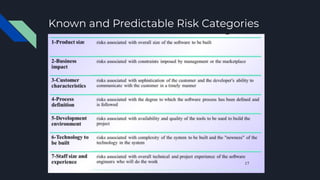
Known and Predictable Risk Categories
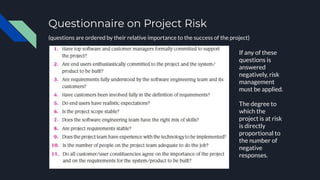
Questionnaire on Project Risk
(questions are ordered by their relative importance to the success of the project)
If any of these
questions is
answered
negatively, risk
management
must be applied.
The degree to
which the
project is at risk
is directly
proportional to
the number of
negative
responses.
Risk Components and Drivers
● The project manager identifies the risk drivers that affect the following risk
components -
● Performance risk - the degree of uncertainty that the product will meet its
requirements and be fit for its intended use
● Cost risk - the degree of uncertainty that the project budget will be maintained
● Support risk - the degree of uncertainty that the resultant software will be easy to
correct, adapt, and enhance
● Schedule risk - the degree of uncertainty that the project schedule will be
maintained and that the product will be delivered on time
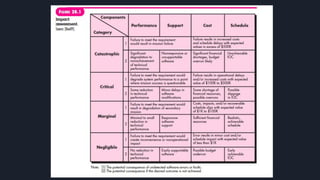
● The impact of each risk driver on the risk component is divided into one of the 4 impact
levels
● Negligible, marginal, critical, and catastrophic
● Risk drivers can be assessed as impossible, improbable, probable, and frequent.
Risk Projection/ Estimation
Background
● Risk projection (or estimation) attempts to rate each risk in two ways -
● The probability that the risk is real
● The consequences of the problems associated with the risk, should it occur
● The project planner, managers, and technical staff perform four risk projection
steps (see next slide)
● The intent of these steps is to consider risks in a manner that leads to prioritization
● By prioritizing risks, the software team can allocate limited resources where they
will have the most impact
Risk Projection Steps
1. Establish a scale that reflects the perceived likelihood of a risk (e.g., 1-low, 10-high).
2. Delineate the consequences of the risk.
3. Estimate the impact of the risk on the project and product.
4. Note the overall accuracy of the risk projection so that there will be no
misunderstandings.
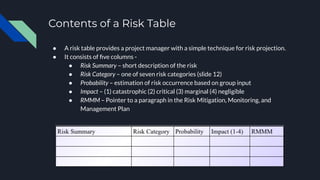
Contents of a Risk Table
● A risk table provides a project manager with a simple technique for risk projection.
● It consists of five columns -
● Risk Summary – short description of the risk
● Risk Category – one of seven risk categories (slide 12)
● Probability – estimation of risk occurrence based on group input
● Impact – (1) catastrophic (2) critical (3) marginal (4) negligible
● RMMM – Pointer to a paragraph in the Risk Mitigation, Monitoring, and
Management Plan
Developing a Risk Table
● List all risks in the first column
● Mark the category of each risk
● Estimate the probability of each risk occurring
● Assess the impact of each risk based on an averaging of the four risk components to
determine an overall impact value (See next slide)
● Sort the rows by probability and impact in descending order
● Draw a horizontal cutoff line in the table that indicates the risks that will be given
further attention
Assessing Risk Impact
● Three factors affect the consequences that are likely if a risk does occur -
● Its nature – This indicates the problems that are likely if the risk occurs
● Its scope – This combines the severity of the risk (how serious was it) with its
overall distribution (how much was affected)
● Its timing – This considers when and for how long the impact will be felt
● The overall risk exposure formula is RE = P x C
● P = the probability of occurrence for a risk
● C = the cost to the project should the risk actually occur
● Example
● P = 80% probability that 18 of 60 software components will have to be
developed
● C = Total cost of developing 18 components is $25,000
● RE = .80 x $25,000 = $20,000
Risk Refinement
● Topic 28.5 (to be covered from the book)
Risk Mitigation, Monitoring
and Management (RMMM)
Background
● An effective strategy for dealing with risk must consider three issues -
○ Risk mitigation (i.e., avoidance)
○ Risk monitoring
○ Risk management and contingency planning
● Consider high staff turnover (staff leaving the company) as a project risk. Based on past
history and management intuition, the likelihood of high turnover is estimated to
be 0.70 (70 percent, rather high) and the impact is projected as critical. That is, high
turnover will have a critical impact on project cost and schedule.
● Risk mitigation - If a software team adopts a proactive approach to risk, avoidance is always the
best strategy. This is achieved by developing a plan for risk mitigation
● Risk Monitoring - The project manager monitors factors that may provide an indication of
whether the risk is becoming more or less likely.
● In case of high staff turnover, the following may be monitored -
- the general attitude of team members based on project pressures
- the degree to which the team has jelled, interpersonal relationships among team
members
- potential problems with compensation and benefits
- availability of jobs within the company and outside it
● A project manager should also monitor the effectiveness of risk mitigation steps.
● Risk management and contingency planning - This assumes that mitigation efforts have
failed and that the risk has become a reality.
● In case of high staff turnover, if the mitigation strategy has been followed, backup is available,
information is documented, and knowledge has been dispersed across the team.
● In addition, resources can be refocused (and project schedule can be readjusted) to those
functions that are fully staffed, enabling newcomers who must be added to the team to get up to
speed.
● Those individuals who are leaving are asked to stop all work and spend their last weeks in
“knowledge transfer mode”.
● RMMM steps incur additional project cost. For example, spending the time to back up every
critical technologist costs money.
● Part of risk management, therefore, is to evaluate when the benefits accrued by the RMMM
steps are outweighed by the costs associated with implementing them.
● Perform a cost-benefit analysis.
● For a large project, 30 or 40 risks may be identified. If between three and seven risk
management steps are identified for each, risk management may become a project in itself.
● Adapt the Pareto 80–20 rule to software risk.
● 80 percent of the overall project risk (i.e., 80 percent of the potential for project failure) can
be accounted for by only 20 percent of the identified risks.
● Risk analysis steps will help to determine which of the risks reside in that 20 percent.
● Thus, some of the risks may not make it into the RMMM plan.
RMMM Plan
● The RMMM plan may be a part of the software project plan or may be a separate
document
● Once RMMM has been documented and the project has begun, the risk mitigation,
and monitoring steps begin
○ Risk mitigation is a problem avoidance activity
○ Risk monitoring is a project tracking activity
● Risk monitoring has three objectives
○ To assess whether predicted risks do, in fact, occur
○ To ensure that risk aversion steps defined for the risk are being properly applied
○ To collect information that can be used for future risk analysis
● The findings from risk monitoring may allow the project manager to ascertain what
risks caused which problems throughout the project

Risk Management.pdf for college studentds

  • 1.
  • 2.
    What is risk? ●Risk is a potential problem. It might or might not happen. ● A possibility of suffering from loss in software development process is called a software risk. ● Characteristics of risk - - Uncertainty - the risk may/may not happen. There are no 100 percent probable risks. - Loss - when risk becomes a reality, unwanted consequences (like increase in project cost, poor quality S/W, project delay) occur.
  • 3.
    What is riskmanagement? ● Actions that help a S/W team to understand and manage uncertainty. ● Steps - - Risk Identification - recognizing what can go wrong - Risk Analysis - determining the likelihood of a risk and its associated damage - Ranking - ranking the risks by probability and impact - RMMM plan - developing a risk mitigation, monitoring and management plan.
  • 4.
    Reactive vs ProactiveRisk Strategies ● Reactive risk strategies ● "Don't worry, I'll think of something" ● The majority of software teams and managers rely on this approach. ● Nothing is done about risks until something goes wrong. The team then flies into action in an attempt to correct the problem rapidly (fire fighting mode). ● Resources are set aside to deal with risks, should they become real. ● Proactive risk strategies ● Steps for risk management are followed. ● Primary objective is to avoid risk and to have a contingency plan in place to handle unavoidable risks in a controlled and effective manner.
  • 5.
    Risk Categorization -Approach #1 1. Project Risks - They threaten the project plan. - If they become real, it is likely that the project schedule will slip and that costs will increase. - Examples - potential budgetary, schedule, personnel (staffing and organization), resource, stakeholder, and requirements problems. 2. Technical Risks - They threaten the quality and timeliness of the software. - If they become real, implementation may become difficult or impossible. - Examples - potential design, implementation, interface, verification, and maintenance problems
  • 6.
    3. Business Risks -They threaten the viability of the software. - If they become real, they jeopardize the project or the product. - Subcategories of business risk : ● Market risk – building an excellent product or system that no one really wants ● Strategic risk – building a product that no longer fits into the overall business strategy for the company ● Sales risk – building a product that the sales force doesn't understand how to sell ● Management risk – losing the support of senior management due to a change in focus or a change in people ● Budget risk – losing budgetary or personnel commitment
  • 7.
    Risk Categorization -Approach #2 ● Known risks ● Those risks that can be uncovered after careful evaluation of the project plan, the business and technical environment in which the project is being developed, and other reliable information sources ● Egs. - unrealistic delivery date, lack of documented requirements, poor development environment. ● Predictable risks ● Those risks that are extrapolated from past project experience (e.g., past turnover) ● Egs. - staff turnover, poor communication with customer. ● Unpredictable risks ● Those risks that can and do occur, but are extremely difficult to identify in advance.
  • 8.
  • 9.
    Background ● Risk identificationis a systematic attempt to specify threats to the project plan. ● By identifying known and predictable risks, the project manager takes a first step towards avoiding them when possible and controlling them when necessary. ● Generic risks ● Risks that are a potential threat to every software project ● Product-specific risks ● Risks that can be identified only by those a with a clear understanding of the technology, the people, and the environment that is specific to the software that is to be built. ● This requires examination of the project plan and the statement of scope. ● "What special characteristics of this product may threaten our project plan?"
  • 10.
    Risk Item Checklist ●Used as a way for risk identification. ● Focuses on known and predictable risks in specific subcategories. (next slide) ● Can be organized in several ways - - Questions relevant to each of the subcategories can be answered for each S/W project. Answers to these questions allow you to estimate risk impact. - List characteristics that are relevant to each subcategory. - A set of “risk components and drivers” are listed along with their probability of occurrence.
  • 11.
    Known and PredictableRisk Categories
  • 12.
    Questionnaire on ProjectRisk (questions are ordered by their relative importance to the success of the project) If any of these questions is answered negatively, risk management must be applied. The degree to which the project is at risk is directly proportional to the number of negative responses.
  • 13.
    Risk Components andDrivers ● The project manager identifies the risk drivers that affect the following risk components - ● Performance risk - the degree of uncertainty that the product will meet its requirements and be fit for its intended use ● Cost risk - the degree of uncertainty that the project budget will be maintained ● Support risk - the degree of uncertainty that the resultant software will be easy to correct, adapt, and enhance ● Schedule risk - the degree of uncertainty that the project schedule will be maintained and that the product will be delivered on time ● The impact of each risk driver on the risk component is divided into one of the 4 impact levels ● Negligible, marginal, critical, and catastrophic ● Risk drivers can be assessed as impossible, improbable, probable, and frequent.
  • 15.
  • 16.
    Background ● Risk projection(or estimation) attempts to rate each risk in two ways - ● The probability that the risk is real ● The consequences of the problems associated with the risk, should it occur ● The project planner, managers, and technical staff perform four risk projection steps (see next slide) ● The intent of these steps is to consider risks in a manner that leads to prioritization ● By prioritizing risks, the software team can allocate limited resources where they will have the most impact
  • 17.
    Risk Projection Steps 1.Establish a scale that reflects the perceived likelihood of a risk (e.g., 1-low, 10-high). 2. Delineate the consequences of the risk. 3. Estimate the impact of the risk on the project and product. 4. Note the overall accuracy of the risk projection so that there will be no misunderstandings.
  • 18.
    Contents of aRisk Table ● A risk table provides a project manager with a simple technique for risk projection. ● It consists of five columns - ● Risk Summary – short description of the risk ● Risk Category – one of seven risk categories (slide 12) ● Probability – estimation of risk occurrence based on group input ● Impact – (1) catastrophic (2) critical (3) marginal (4) negligible ● RMMM – Pointer to a paragraph in the Risk Mitigation, Monitoring, and Management Plan
  • 19.
    Developing a RiskTable ● List all risks in the first column ● Mark the category of each risk ● Estimate the probability of each risk occurring ● Assess the impact of each risk based on an averaging of the four risk components to determine an overall impact value (See next slide) ● Sort the rows by probability and impact in descending order ● Draw a horizontal cutoff line in the table that indicates the risks that will be given further attention
  • 20.
    Assessing Risk Impact ●Three factors affect the consequences that are likely if a risk does occur - ● Its nature – This indicates the problems that are likely if the risk occurs ● Its scope – This combines the severity of the risk (how serious was it) with its overall distribution (how much was affected) ● Its timing – This considers when and for how long the impact will be felt ● The overall risk exposure formula is RE = P x C ● P = the probability of occurrence for a risk ● C = the cost to the project should the risk actually occur ● Example ● P = 80% probability that 18 of 60 software components will have to be developed ● C = Total cost of developing 18 components is $25,000 ● RE = .80 x $25,000 = $20,000
  • 21.
    Risk Refinement ● Topic28.5 (to be covered from the book)
  • 22.
  • 23.
    Background ● An effectivestrategy for dealing with risk must consider three issues - ○ Risk mitigation (i.e., avoidance) ○ Risk monitoring ○ Risk management and contingency planning ● Consider high staff turnover (staff leaving the company) as a project risk. Based on past history and management intuition, the likelihood of high turnover is estimated to be 0.70 (70 percent, rather high) and the impact is projected as critical. That is, high turnover will have a critical impact on project cost and schedule.
  • 24.
    ● Risk mitigation- If a software team adopts a proactive approach to risk, avoidance is always the best strategy. This is achieved by developing a plan for risk mitigation
  • 25.
    ● Risk Monitoring- The project manager monitors factors that may provide an indication of whether the risk is becoming more or less likely. ● In case of high staff turnover, the following may be monitored - - the general attitude of team members based on project pressures - the degree to which the team has jelled, interpersonal relationships among team members - potential problems with compensation and benefits - availability of jobs within the company and outside it ● A project manager should also monitor the effectiveness of risk mitigation steps.
  • 26.
    ● Risk managementand contingency planning - This assumes that mitigation efforts have failed and that the risk has become a reality. ● In case of high staff turnover, if the mitigation strategy has been followed, backup is available, information is documented, and knowledge has been dispersed across the team. ● In addition, resources can be refocused (and project schedule can be readjusted) to those functions that are fully staffed, enabling newcomers who must be added to the team to get up to speed. ● Those individuals who are leaving are asked to stop all work and spend their last weeks in “knowledge transfer mode”.
  • 27.
    ● RMMM stepsincur additional project cost. For example, spending the time to back up every critical technologist costs money. ● Part of risk management, therefore, is to evaluate when the benefits accrued by the RMMM steps are outweighed by the costs associated with implementing them. ● Perform a cost-benefit analysis. ● For a large project, 30 or 40 risks may be identified. If between three and seven risk management steps are identified for each, risk management may become a project in itself. ● Adapt the Pareto 80–20 rule to software risk. ● 80 percent of the overall project risk (i.e., 80 percent of the potential for project failure) can be accounted for by only 20 percent of the identified risks. ● Risk analysis steps will help to determine which of the risks reside in that 20 percent. ● Thus, some of the risks may not make it into the RMMM plan.
  • 28.
    RMMM Plan ● TheRMMM plan may be a part of the software project plan or may be a separate document ● Once RMMM has been documented and the project has begun, the risk mitigation, and monitoring steps begin ○ Risk mitigation is a problem avoidance activity ○ Risk monitoring is a project tracking activity ● Risk monitoring has three objectives ○ To assess whether predicted risks do, in fact, occur ○ To ensure that risk aversion steps defined for the risk are being properly applied ○ To collect information that can be used for future risk analysis ● The findings from risk monitoring may allow the project manager to ascertain what risks caused which problems throughout the project