1
Quality Measurement Tools
2
Objectives
 Present an overview of Seven Quality Tools
 Address purpose and applications
 Highlight benefits
 Why Do This "Quality"?
The Deming Chain
 Improve Quality
 Decrease Costs
 Improve Productivity
 Decrease Price
 Increase Market
 Provide More Jobs
 Return on Investment
3
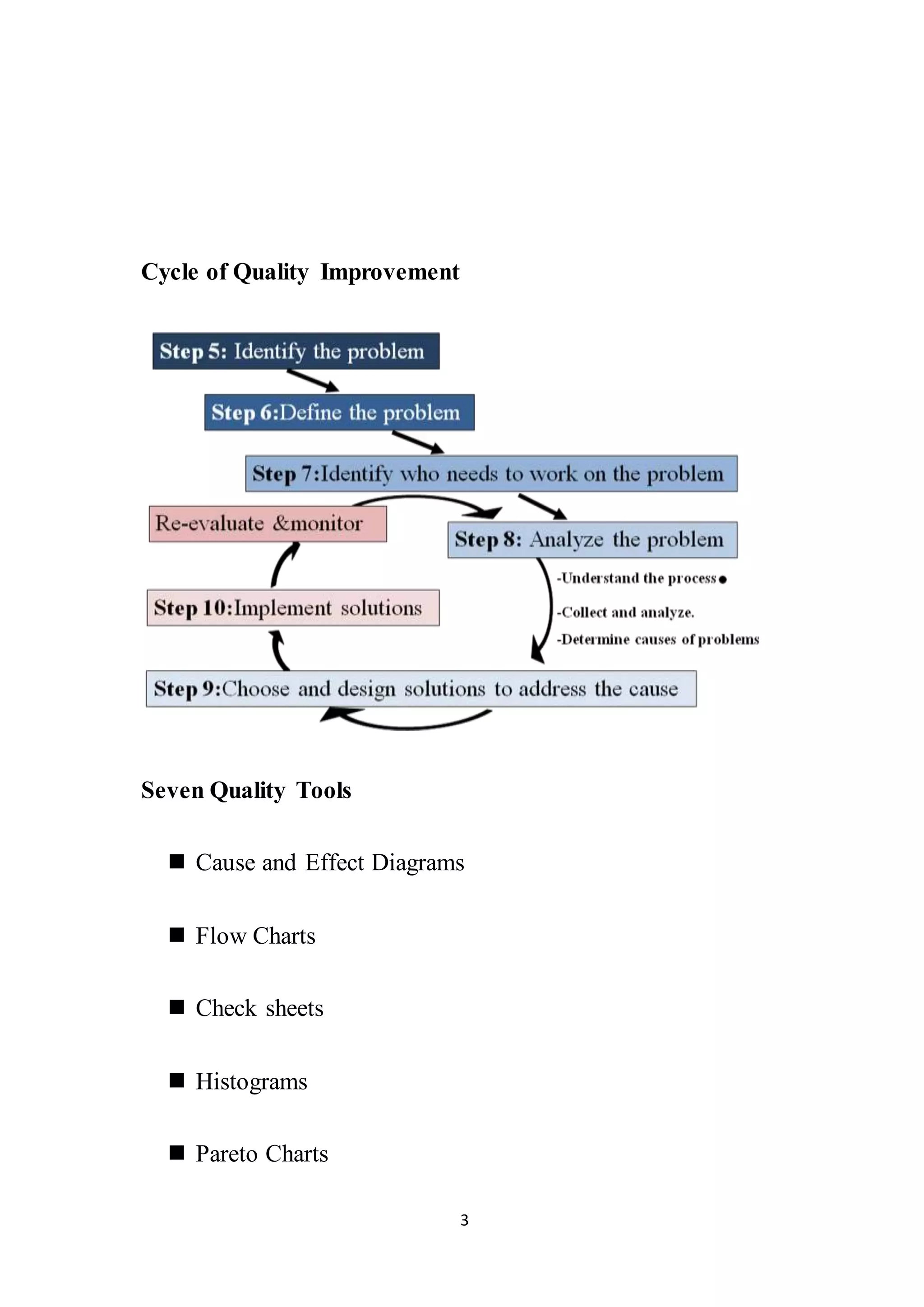
Cycle of Quality Improvement
Seven Quality Tools
 Cause and Effect Diagrams
 Flow Charts
 Check sheets
 Histograms
 Pareto Charts
4
 Control Charts
 Scatter Diagrams
Brainstorming Quality tool
 Brainstorming is a procedure that allows a group to express
problem areas, ideas, solutions, or needs.
 It allows each participant to state their opinion in a non-threatening
environment.
 Brainstorming helps a group create many ideas in as short a time as
possible.
Rules
• Best in a diverse group
• Go around room and get input from all – one idea per turn
• Continue until ideas are exhausted
• All ideas are valid
• No criticism
• Discuss ideas
5
• Look for answers
Cause and Effect (Fishbone Diagram) Quality Tool
Purpose:
 A Cause & Effect Diagram is a graphic representation used when
you need to identify, explore, and display the possible causes of a
specific problem or condition.
 “Fishboning” represents a sophisticated form of brainstorming.
Benefits:
 Breaks problems down into bite-size pieces to find root cause
 Fosters team work
 Common understanding of factors causing the problem
 Road map to verify picture of the process
 Follows brainstorming relationship.
6
Flow Charts Quality Tool
Purpose:
Visual illustration of the sequence of operations required to complete a
task
 Schematic drawing of the process to measure or
improve.
 Starting point for process improvement.
 Potential weakness in the process are made visual.
 Picture of process as it should be.
Benefits:
 Identify process improvements
 Understand the process
 Shows duplicated effort and other non-value-added
steps
7
 Clarify working relationships between people and
organizations
 Target specific steps in the process forimprovement.
Checksheets (Quality Tool)
Purpose:
 Tool for collecting and organizing measured or counted data
 Data collected can be used as input data for other quality
tools
Benefits:
 Collect data in a systematic and organized manner
 To determine source of problem
 To facilitate classification of data (stratification)
Histograms (Quality Control Tool)
 A graphic summary of variation in a set of data.
 The pictorial nature of the histogram lets people see patterns that
are difficult to detect in a simple table of number.
 A histogram is a picture of the statistical variation in your process.
8
Purpose:
 To determine the spread or variation of a set of data points in a
graphical form.
Benefits:
• Understand the variation that exists in a process
• Tell you to unseen causes of variation.
• Help to identify otherwise hidden sources of variation
• Used to determine the capability of a process
• Starting point for the improvement process
Pareto Charts (Quality Control Tool)
Purpose:
 Prioritize problems.
How is it done?
 Create a preliminary list of problem classifications.
 Tally the occurrences in each problem classification.
 Arrange each classification in order from highest to lowest
9
 Construct the bar chart
Benefits:
 Pareto analysis helps graphically display results so the significant
few problems emerge from the general background
 It tells you what to work on first
Control Charts (Quality Control Tool)
Purpose:
 The primary purpose of a control chart is to predict expected
product outcome.
Benefits:
 Predict process out of control and out of specification limits
 Distinguish between specific, identifiable causes of variation
 Can be used for statistical process control
Common Causes
 Are inherently part of the process.
10
 Minute, partially unknown.
 Difficult to control.
 Normal or natural process.
SpecialCauses (Assignable)
 Are not part of the process.
 A large, special, easier to pinpoint.
 Need to be identified quickly to stabilize process.
 Specific problems.
Control Charts Quality Control Tool
 Strategy for eliminating assignable-cause variation.
 Strategy for reducing common-cause variation.
Scatter Diagrams Quality Control Tool
Purpose:
 A scatter diagram shows the correlation between two variables in a
process.
 Dots representing data points are scattered on the diagram.
11
 The extent to which the dots cluster together in a line across the
diagram shows the strength with which the two factors are related.

Quality measurement tools

  • 1.
  • 2.
    2 Objectives  Present anoverview of Seven Quality Tools  Address purpose and applications  Highlight benefits  Why Do This "Quality"? The Deming Chain  Improve Quality  Decrease Costs  Improve Productivity  Decrease Price  Increase Market  Provide More Jobs  Return on Investment
  • 3.
    3 Cycle of QualityImprovement Seven Quality Tools  Cause and Effect Diagrams  Flow Charts  Check sheets  Histograms  Pareto Charts
  • 4.
    4  Control Charts Scatter Diagrams Brainstorming Quality tool  Brainstorming is a procedure that allows a group to express problem areas, ideas, solutions, or needs.  It allows each participant to state their opinion in a non-threatening environment.  Brainstorming helps a group create many ideas in as short a time as possible. Rules • Best in a diverse group • Go around room and get input from all – one idea per turn • Continue until ideas are exhausted • All ideas are valid • No criticism • Discuss ideas
  • 5.
    5 • Look foranswers Cause and Effect (Fishbone Diagram) Quality Tool Purpose:  A Cause & Effect Diagram is a graphic representation used when you need to identify, explore, and display the possible causes of a specific problem or condition.  “Fishboning” represents a sophisticated form of brainstorming. Benefits:  Breaks problems down into bite-size pieces to find root cause  Fosters team work  Common understanding of factors causing the problem  Road map to verify picture of the process  Follows brainstorming relationship.
  • 6.
    6 Flow Charts QualityTool Purpose: Visual illustration of the sequence of operations required to complete a task  Schematic drawing of the process to measure or improve.  Starting point for process improvement.  Potential weakness in the process are made visual.  Picture of process as it should be. Benefits:  Identify process improvements  Understand the process  Shows duplicated effort and other non-value-added steps
  • 7.
    7  Clarify workingrelationships between people and organizations  Target specific steps in the process forimprovement. Checksheets (Quality Tool) Purpose:  Tool for collecting and organizing measured or counted data  Data collected can be used as input data for other quality tools Benefits:  Collect data in a systematic and organized manner  To determine source of problem  To facilitate classification of data (stratification) Histograms (Quality Control Tool)  A graphic summary of variation in a set of data.  The pictorial nature of the histogram lets people see patterns that are difficult to detect in a simple table of number.  A histogram is a picture of the statistical variation in your process.
  • 8.
    8 Purpose:  To determinethe spread or variation of a set of data points in a graphical form. Benefits: • Understand the variation that exists in a process • Tell you to unseen causes of variation. • Help to identify otherwise hidden sources of variation • Used to determine the capability of a process • Starting point for the improvement process Pareto Charts (Quality Control Tool) Purpose:  Prioritize problems. How is it done?  Create a preliminary list of problem classifications.  Tally the occurrences in each problem classification.  Arrange each classification in order from highest to lowest
  • 9.
    9  Construct thebar chart Benefits:  Pareto analysis helps graphically display results so the significant few problems emerge from the general background  It tells you what to work on first Control Charts (Quality Control Tool) Purpose:  The primary purpose of a control chart is to predict expected product outcome. Benefits:  Predict process out of control and out of specification limits  Distinguish between specific, identifiable causes of variation  Can be used for statistical process control Common Causes  Are inherently part of the process.
  • 10.
    10  Minute, partiallyunknown.  Difficult to control.  Normal or natural process. SpecialCauses (Assignable)  Are not part of the process.  A large, special, easier to pinpoint.  Need to be identified quickly to stabilize process.  Specific problems. Control Charts Quality Control Tool  Strategy for eliminating assignable-cause variation.  Strategy for reducing common-cause variation. Scatter Diagrams Quality Control Tool Purpose:  A scatter diagram shows the correlation between two variables in a process.  Dots representing data points are scattered on the diagram.
  • 11.
    11  The extentto which the dots cluster together in a line across the diagram shows the strength with which the two factors are related.