By / Mahmoud Shaqria
‫شقريه‬‫محمد‬ ‫محمود‬
Out lines
OIntroduction
Oshared governance
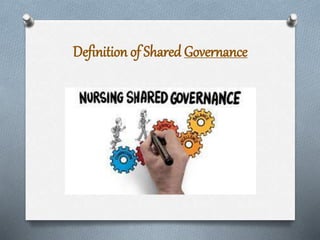
ODefinition of Shared Governance
OPrinciples of Shared governance
O Benefit From Shared Governance
O Shared governance models
O Three Developmental Phases of Shared
Governance in Nursing
O Barriers to implementation of Shared
Governance
Governing boards:
O What is a Governing Body
O Governing Board Responsibilities
O The functions of hospital governing board
O Health center board …( Federal Requirements)
Out lines
O First introduced by Christman in1976
O Asserted the idea that nurses should have decision
making power within their scope of practice equal to
that of physicians within theirs.
O that was developed as an alternative to the
traditional bureaucratic organizational structure
O In shared governance, the organization's
governance is shared among board members,
nurses, physicians, and management
Introduction
Shared governance
OShare:
O participate, partake, implies having or taking part in
an undertaking or activity
O Governance:
O having the authority to determine basic policy
O The action or manner of governing
Definition of Shared Governance
O It is a partnership between staff and management
working together to promote shared decision making
and accountability to provide an improved work
environment
O It is working together to make decisions that affect
nursing practice and patient care.
O It is working with other disciplines for the good of the
patient.
Definition of Shared Governance
principles of shared
governance
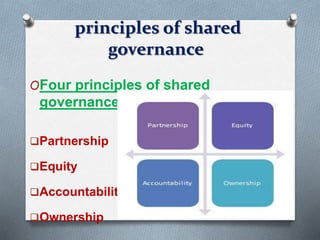
OFour principles of shared
governance
Partnership
Equity
Accountability
Ownership
Partnership
 Developing collaboration and healthy partnerships among the
healthcare team is essential to teambuilding, relationship
development, and strengthening professional practice.
 Each team member’s role is important in helping the organization
to meet its overall goals.
 This importance is further demonstrated when staff are included
in practice decisions and process changes.
O Partnerships development can occur both internally and externally in
an organization
principles of shared governance
O Equity
 Equity within a shared governance structure focuses on all members of the
team having an equal stake in the outcomes of the care and quality that they
provide
 No one role is more important than the other in providing safe and efficient
care.
 Each member has specific knowledge and skills that, when combined with
those of the entire healthcare team, deliver quality to patients in the most
efficient way.
 Collaboration and team effort are essential for healthcare members to
achieve optimal outcomes.
 Equity is achieved when team members come prepared to work within their
scope of practice and role within the organization to achieve an overall goal
principles of shared governance
Accountability
when all staff members achieve a clear
understanding of their role and expectations, and
take responsibility for their actions and decisions;
this is the core of shared governance.
In order to operationalize professional
accountability there must be autonomy, authority,
and control of practice.
principles of shared
governance
O Ownership
O Ownership is based on the fact that success of an
organization depends on how well each member of the
healthcare team performs their jobs.
O Ownership is being responsible for the end product or
outcome, whether good or bad.
O In ownership, the individual goals become team goals,
because the goal of the team cannot be achieved
without each person skillfully performing his roles and
integrating his efforts .
principles of shared governance
Benefit From Shared Governance
O Possibility to make changes
O Promotes healthy and Happier work environment
O Improves employee satisfaction and patient
outcomes
O Nurses are empowered
O They have a voice
O Autonomy is valued
O Nurse satisfaction improves
O Nurses turnover decreases
O Quality of care improves
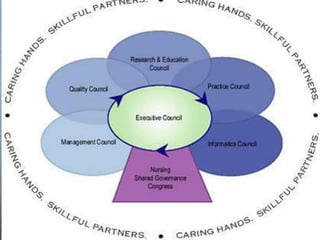
Shared governance models
O A congressional model,
O which is structured similarly to that of the federal government, all
nursing departments belong to the nursing congress.
O Members are elected into the cabinet or committees that represent the
areas of nursing accountability, which typically include: practice, quality,
professional development and education, research, and management.
In this model, work is submitted to the committees for action.
O The various committees of the congress are delegated decision making
power in their area of accountability and report back to the cabinet or
senate their activities
O The councilor model
O uses councils that act on behalf of staff to make
decisions.
O Councils are given authority and accountability to
make decisions in their area of oversight
O Like the congressional model, the councilor model
divides nursing accountability into five key areas:
practice, quality, education, research, and resource
management
Shared governance models
O The accountability is dispersed between staff and
management.
O Typically there is a central council that coordinates the
activities of the different councils.
O Nurse accountability is divided in the same categories as
in the congressional and councilor models.
O The main difference is that this model has two separate
tracks, one for clinical practice and one for management
O The structure allows for work to be completed by
committees and then reported to the responsible
committees for accountability
Shared governance models
The unit-based model
O Is the last model discussed in the literature and is rarely
used.
O Accountability is defined by the unit and decisions made
on the unit typically do not affect the organization outside
of the unit.
O In a unit based model, each unit can establish its own
individual system; the downfall is that there may be
different models within an organization.
O Unit-based councils are not recommended by literature
because they do not integrate with the organization or the
nursing executive level ‫للتمريض‬ ‫التنفيذي‬ ‫المستوى‬ .
Shared governance models
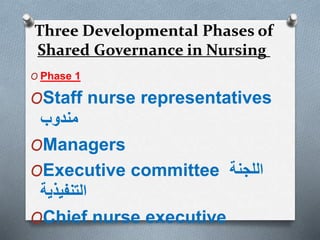
O Phase 1
OStaff nurse representatives
‫مندوب‬
OManagers
OExecutive committee ‫اللجنة‬
‫التنفيذية‬
OChief nurse executive
Three Developmental Phases of
Shared Governance in Nursing
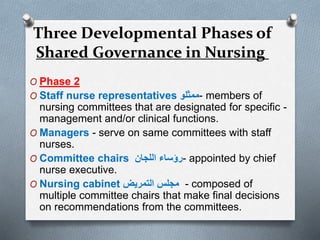
O Phase 2
O Staff nurse representatives ‫-ممثلو‬ members of
nursing committees that are designated for specific -
management and/or clinical functions.
O Managers - serve on same committees with staff
nurses.
O Committee chairs ‫اللجان‬ ‫-رؤساء‬ appointed by chief
nurse executive.
O Nursing cabinet ‫التمريض‬ ‫مجلس‬ - composed of
multiple committee chairs that make final decisions
on recommendations from the committees.
Three Developmental Phases of
Shared Governance in Nursing
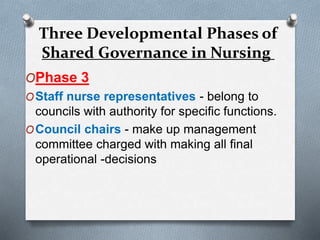
OPhase 3
OStaff nurse representatives - belong to
councils with authority for specific functions.
OCouncil chairs - make up management
committee charged with making all final
operational -decisions
Three Developmental Phases of
Shared Governance in Nursing
Barriers to implementation of
Shared Governance
O The resistance of nurse managers to change their
roles from autocratic decision makers to consultants,
O Not all nurses want to share decisions and
accountability
O Poor communication
O Lack of interest
O Lack of concern
O Poor planning
Governing boards ‫اإلدارة‬ ‫مجالس‬ :
OThe organization using authority to direct and
control provided by the owners and the legal
act of formation.
OThey set initial direction and have the full
authority to act in the owners’ best interests.
OGoverning boards function at arm’s length
from ‫عن‬ ‫بعيدا‬ the operational organization.
OThey focus on the big picture, future-oriented
and act as a single entity ‫واحد‬ ‫كيان‬
What is a Governing Body
OIs the highest governing authority
within the organizational and
governance structures of the
institution
Governing Board Responsibilities
• Assess and Monitor Needs of Target
Population
• Approve Health Center Program Grant
Application
• Approve and Monitor Annual Budget .
• Establish a Quality Assurance/Quality
Improvement (QA/QI) Program
• Select Services provided and Hours of
Operation.
• Engage in Long-Term Strategic Planning
The functions of hospital
governing board:
(1) It ensures the quality of care provided by the
individuals who have been granted privileges at the
hospital.
(2)To fulfill that responsibility, the board oversees the
quality of the credentialing, privileging, and peer
review processes
(3) The board hires a CEO who forms an administrative
team that is capable of making smart strategic and
financial decisions.
Required knowledge and skills
of individual board members:
O Understanding of the concept and operation of a
health center
O Ability to read and understand standard financial
statements
O Ability to work with others on the board and in a
community setting
O Training and/or experience in one or more of the
following areas is desirable: (management - health care
delivery marketing/public relations - employee relations-
Community affairs - financial management - personnel
management - law)
Health center board …( Federal
Requirements)
1 .The board must have at least 9, but no more than 25 members.
2 .At least 51 percent of the board‘s members must be users of
the health center.
3 .Half of the remaining members of the board cannot earn more
than 10 percent of their income from the health care industry.
Health center board …( Federal
Requirements)
4.The remaining members of the board must represent the
area served by the center and have expertise in
community affairs; Federal, State, and local government;
accounting; health administration; health professions;
business; finance; banking; legal affairs; trade unions;
insurance; and personnel management as well as social
services such as religion, education, and welfare.
5. Employees of the center and their spouses, children,
parents, or brothers or sisters (blood or marriage) cannot
be members of the board.
Shared governance

Shared governance

  • 1.
    By / MahmoudShaqria ‫شقريه‬‫محمد‬ ‫محمود‬
  • 2.
    Out lines OIntroduction Oshared governance ODefinitionof Shared Governance OPrinciples of Shared governance
  • 3.
    O Benefit FromShared Governance O Shared governance models O Three Developmental Phases of Shared Governance in Nursing O Barriers to implementation of Shared Governance Governing boards: O What is a Governing Body O Governing Board Responsibilities O The functions of hospital governing board O Health center board …( Federal Requirements) Out lines
  • 4.
    O First introducedby Christman in1976 O Asserted the idea that nurses should have decision making power within their scope of practice equal to that of physicians within theirs. O that was developed as an alternative to the traditional bureaucratic organizational structure O In shared governance, the organization's governance is shared among board members, nurses, physicians, and management Introduction
  • 5.
    Shared governance OShare: O participate,partake, implies having or taking part in an undertaking or activity O Governance: O having the authority to determine basic policy O The action or manner of governing
  • 6.
  • 7.
    O It isa partnership between staff and management working together to promote shared decision making and accountability to provide an improved work environment O It is working together to make decisions that affect nursing practice and patient care. O It is working with other disciplines for the good of the patient. Definition of Shared Governance
  • 8.
    principles of shared governance OFourprinciples of shared governance Partnership Equity Accountability Ownership
  • 9.
    Partnership  Developing collaborationand healthy partnerships among the healthcare team is essential to teambuilding, relationship development, and strengthening professional practice.  Each team member’s role is important in helping the organization to meet its overall goals.  This importance is further demonstrated when staff are included in practice decisions and process changes. O Partnerships development can occur both internally and externally in an organization principles of shared governance
  • 10.
    O Equity  Equitywithin a shared governance structure focuses on all members of the team having an equal stake in the outcomes of the care and quality that they provide  No one role is more important than the other in providing safe and efficient care.  Each member has specific knowledge and skills that, when combined with those of the entire healthcare team, deliver quality to patients in the most efficient way.  Collaboration and team effort are essential for healthcare members to achieve optimal outcomes.  Equity is achieved when team members come prepared to work within their scope of practice and role within the organization to achieve an overall goal principles of shared governance
  • 11.
    Accountability when all staffmembers achieve a clear understanding of their role and expectations, and take responsibility for their actions and decisions; this is the core of shared governance. In order to operationalize professional accountability there must be autonomy, authority, and control of practice. principles of shared governance
  • 12.
    O Ownership O Ownershipis based on the fact that success of an organization depends on how well each member of the healthcare team performs their jobs. O Ownership is being responsible for the end product or outcome, whether good or bad. O In ownership, the individual goals become team goals, because the goal of the team cannot be achieved without each person skillfully performing his roles and integrating his efforts . principles of shared governance
  • 13.
    Benefit From SharedGovernance O Possibility to make changes O Promotes healthy and Happier work environment O Improves employee satisfaction and patient outcomes O Nurses are empowered O They have a voice O Autonomy is valued O Nurse satisfaction improves O Nurses turnover decreases O Quality of care improves
  • 14.
    Shared governance models OA congressional model, O which is structured similarly to that of the federal government, all nursing departments belong to the nursing congress. O Members are elected into the cabinet or committees that represent the areas of nursing accountability, which typically include: practice, quality, professional development and education, research, and management. In this model, work is submitted to the committees for action. O The various committees of the congress are delegated decision making power in their area of accountability and report back to the cabinet or senate their activities
  • 15.
    O The councilormodel O uses councils that act on behalf of staff to make decisions. O Councils are given authority and accountability to make decisions in their area of oversight O Like the congressional model, the councilor model divides nursing accountability into five key areas: practice, quality, education, research, and resource management Shared governance models
  • 16.
    O The accountabilityis dispersed between staff and management. O Typically there is a central council that coordinates the activities of the different councils. O Nurse accountability is divided in the same categories as in the congressional and councilor models. O The main difference is that this model has two separate tracks, one for clinical practice and one for management O The structure allows for work to be completed by committees and then reported to the responsible committees for accountability Shared governance models
  • 17.
    The unit-based model OIs the last model discussed in the literature and is rarely used. O Accountability is defined by the unit and decisions made on the unit typically do not affect the organization outside of the unit. O In a unit based model, each unit can establish its own individual system; the downfall is that there may be different models within an organization. O Unit-based councils are not recommended by literature because they do not integrate with the organization or the nursing executive level ‫للتمريض‬ ‫التنفيذي‬ ‫المستوى‬ . Shared governance models
  • 19.
    O Phase 1 OStaffnurse representatives ‫مندوب‬ OManagers OExecutive committee ‫اللجنة‬ ‫التنفيذية‬ OChief nurse executive Three Developmental Phases of Shared Governance in Nursing
  • 20.
    O Phase 2 OStaff nurse representatives ‫-ممثلو‬ members of nursing committees that are designated for specific - management and/or clinical functions. O Managers - serve on same committees with staff nurses. O Committee chairs ‫اللجان‬ ‫-رؤساء‬ appointed by chief nurse executive. O Nursing cabinet ‫التمريض‬ ‫مجلس‬ - composed of multiple committee chairs that make final decisions on recommendations from the committees. Three Developmental Phases of Shared Governance in Nursing
  • 21.
    OPhase 3 OStaff nurserepresentatives - belong to councils with authority for specific functions. OCouncil chairs - make up management committee charged with making all final operational -decisions Three Developmental Phases of Shared Governance in Nursing
  • 22.
    Barriers to implementationof Shared Governance O The resistance of nurse managers to change their roles from autocratic decision makers to consultants, O Not all nurses want to share decisions and accountability O Poor communication O Lack of interest O Lack of concern O Poor planning
  • 23.
    Governing boards ‫اإلدارة‬‫مجالس‬ : OThe organization using authority to direct and control provided by the owners and the legal act of formation. OThey set initial direction and have the full authority to act in the owners’ best interests. OGoverning boards function at arm’s length from ‫عن‬ ‫بعيدا‬ the operational organization. OThey focus on the big picture, future-oriented and act as a single entity ‫واحد‬ ‫كيان‬
  • 24.
    What is aGoverning Body OIs the highest governing authority within the organizational and governance structures of the institution
  • 25.
    Governing Board Responsibilities •Assess and Monitor Needs of Target Population • Approve Health Center Program Grant Application • Approve and Monitor Annual Budget . • Establish a Quality Assurance/Quality Improvement (QA/QI) Program • Select Services provided and Hours of Operation. • Engage in Long-Term Strategic Planning
  • 26.
    The functions ofhospital governing board: (1) It ensures the quality of care provided by the individuals who have been granted privileges at the hospital. (2)To fulfill that responsibility, the board oversees the quality of the credentialing, privileging, and peer review processes (3) The board hires a CEO who forms an administrative team that is capable of making smart strategic and financial decisions.
  • 27.
    Required knowledge andskills of individual board members: O Understanding of the concept and operation of a health center O Ability to read and understand standard financial statements O Ability to work with others on the board and in a community setting O Training and/or experience in one or more of the following areas is desirable: (management - health care delivery marketing/public relations - employee relations- Community affairs - financial management - personnel management - law)
  • 28.
    Health center board…( Federal Requirements) 1 .The board must have at least 9, but no more than 25 members. 2 .At least 51 percent of the board‘s members must be users of the health center. 3 .Half of the remaining members of the board cannot earn more than 10 percent of their income from the health care industry.
  • 29.
    Health center board…( Federal Requirements) 4.The remaining members of the board must represent the area served by the center and have expertise in community affairs; Federal, State, and local government; accounting; health administration; health professions; business; finance; banking; legal affairs; trade unions; insurance; and personnel management as well as social services such as religion, education, and welfare. 5. Employees of the center and their spouses, children, parents, or brothers or sisters (blood or marriage) cannot be members of the board.

Editor's Notes

  • #27 CEO – Chief Executive Officer – This person is the highest ranking corporate officer.  They are the head of management for an organization.