By /
Mahmoud Shaqria
‫شقريه‬ ‫محمد‬‫محمود‬
1-DefinitionOF Benchmarking
2-Principlesof Benchmarking
3-Types of benchmarking
4-Benchmarking Process
5-Advantages & Disadvantages of the
benchmarking
 Definition
There are many definitions according to different
perceptions and applications of the technique and
philosophy.
 Benchmarking defined as a process for improving
performance of any organization by continuously
identifying, understanding & adopting outstanding
practices and processes inside or outside the organization.
1. Improves practices, services or products.
2. Involves learning about ‘best practices’ from
others.
3. Accelerates the rate of progress and
improvements.
4. Contributes to continuous quality
management;
5. Is an ongoing process.
6. Promotes fresh and innovative thinking
about problems.
7. Provides hard data on performance.
8. Focuses not only on what is achieved, but
on how it is achieved.
9. Involves the adaptation, not merely
adoption, of best practices.
10. Results in the setting of specific targets.
1-Internal benchmarking
2-External benchmarking
*The process of comparing an
organization’s current data on productivity
with its own past records to determine how
its current
performance compares with past
performance.
*Variations alert the manager to changes
*Patterns and trends guide staffing/work
processes
ADVANTAGES:
1-Easier to implement
2-Easier to access data
DISADVANTAGES:
-External ideas blocked
*External benchmarking requires a
comparison of work with external
organizations in order to discover new ideas,
methods, products and services.
*The objective is continuously to improve
one's own performance by measuring how it
performs,comparing it with that of others
and determining how the others achieve their
performance levels.
Advantages
1-Helps to measure one’s own performance
2-Helps to search for best practices
Disadvantages
1-Takes time
2-Requires support
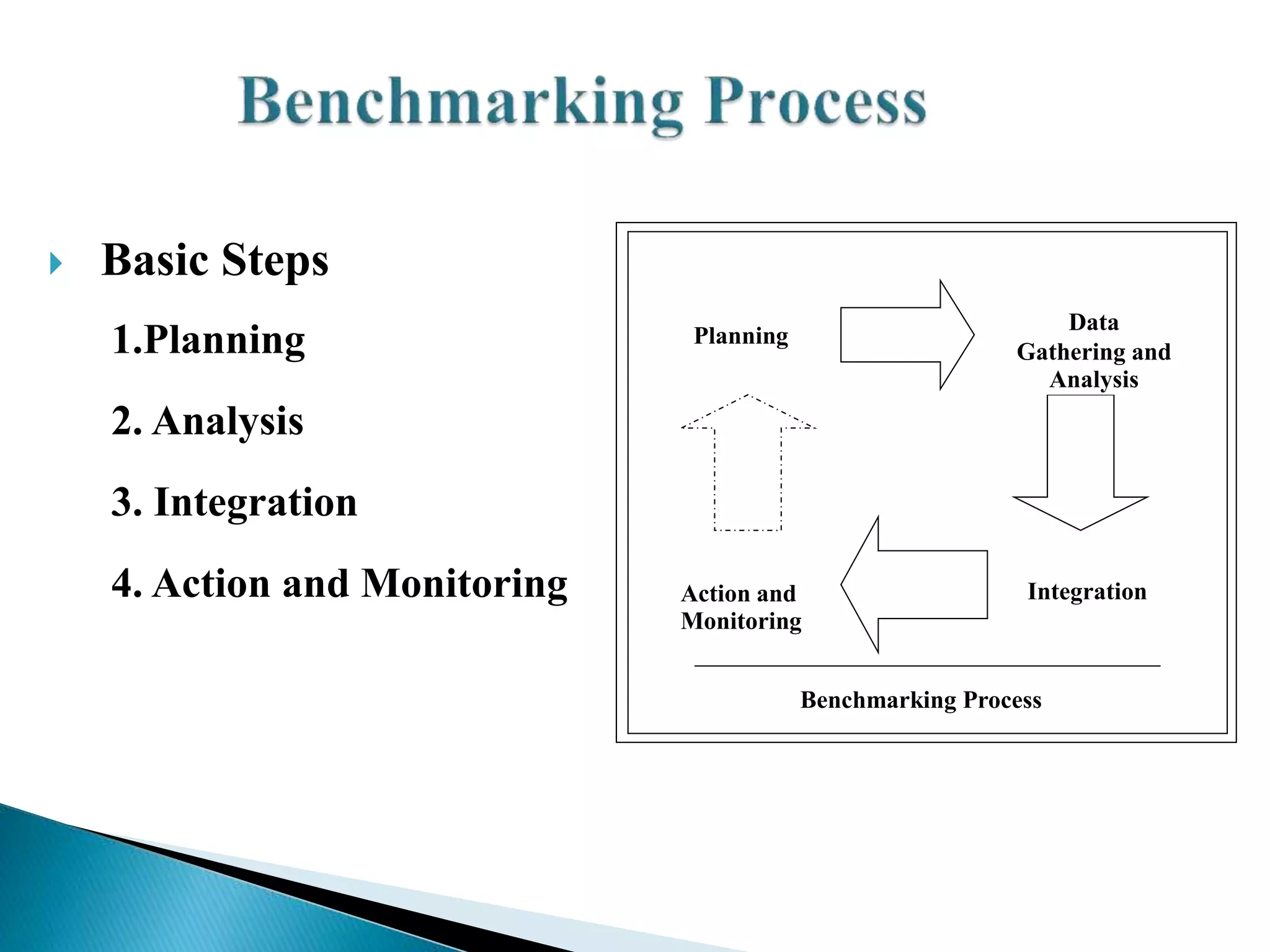
 Basic Steps
1.Planning
2. Analysis
3. Integration
4. Action and Monitoring
Planning
Data
Gathering and
Analysis
Action and
Monitoring
Integration
Benchmarking Process
◦ 1-Planning
 Establish benchmarking roles and
responsibilities.
 Decide what you wish to benchmark.
 Identify the process to benchmark.
 Decide against whom you need to benchmark
 Document the current process.
 Identify outputs required.
 Determine data collection methodologies .
2. Analysis
 Normalise the performance data.
 Construct a comparison matrix to compare
your current performance data with your
partners’ data.
 Identify outstanding practices.
 Analys the gaps .
 Analys factors that create the gaps.
 Isolate process enablers.
3. Integration
 Define Set stretching targets
 “Vision” an alternative process
 Consider the barriers to change
 Plan to implement the changes
4. Action and Monitoring
 Implementation planning
 Roll-out of new modus operandi (changes)
 Collecting data
 Evaluating progress
 Iterative change
 Advantages of the benchmarking :
1-Learn from others experience & practices.
2- It allows examination of present processes
3- Aids change & improvement.
4-It gives a chance for study & measurement of a
competitor for the purposes of process or product
quality improvement.
5-Benchmarking often proves particularly successful when
comparing processes.
6-Helps the organizations to stay in the business with high
performance.
7-Delight the customer of the organizations.
8-Continuous of Improvement and apply benchmarking
increased the opportunity to be world class leader.
9-Sharing the best practices between benchmarking partners.
10-It Iidentifies opportunities for improvement.
 Disadvantages of benchmarking :
1-Poorly defined benchmarks may lead to wasted
effort and meaningless results.
2-Incorrect comparisons will effect the result of
required improvement and what is best for someone
else may not suit to other.
3-Some organizations have reluctance to share the
information.
4-Benchmarking cannot change all required
improvement at once.
Thank you

Benchmarking

  • 1.
    By / Mahmoud Shaqria ‫شقريه‬‫محمد‬‫محمود‬
  • 2.
    1-DefinitionOF Benchmarking 2-Principlesof Benchmarking 3-Typesof benchmarking 4-Benchmarking Process 5-Advantages & Disadvantages of the benchmarking
  • 3.
     Definition There aremany definitions according to different perceptions and applications of the technique and philosophy.  Benchmarking defined as a process for improving performance of any organization by continuously identifying, understanding & adopting outstanding practices and processes inside or outside the organization.
  • 4.
    1. Improves practices,services or products. 2. Involves learning about ‘best practices’ from others. 3. Accelerates the rate of progress and improvements. 4. Contributes to continuous quality management; 5. Is an ongoing process.
  • 5.
    6. Promotes freshand innovative thinking about problems. 7. Provides hard data on performance. 8. Focuses not only on what is achieved, but on how it is achieved. 9. Involves the adaptation, not merely adoption, of best practices. 10. Results in the setting of specific targets.
  • 6.
  • 7.
    *The process ofcomparing an organization’s current data on productivity with its own past records to determine how its current performance compares with past performance. *Variations alert the manager to changes *Patterns and trends guide staffing/work processes
  • 8.
    ADVANTAGES: 1-Easier to implement 2-Easierto access data DISADVANTAGES: -External ideas blocked
  • 9.
    *External benchmarking requiresa comparison of work with external organizations in order to discover new ideas, methods, products and services. *The objective is continuously to improve one's own performance by measuring how it performs,comparing it with that of others and determining how the others achieve their performance levels.
  • 10.
    Advantages 1-Helps to measureone’s own performance 2-Helps to search for best practices Disadvantages 1-Takes time 2-Requires support
  • 11.
     Basic Steps 1.Planning 2.Analysis 3. Integration 4. Action and Monitoring Planning Data Gathering and Analysis Action and Monitoring Integration Benchmarking Process
  • 12.
    ◦ 1-Planning  Establishbenchmarking roles and responsibilities.  Decide what you wish to benchmark.  Identify the process to benchmark.  Decide against whom you need to benchmark  Document the current process.  Identify outputs required.  Determine data collection methodologies .
  • 13.
    2. Analysis  Normalisethe performance data.  Construct a comparison matrix to compare your current performance data with your partners’ data.  Identify outstanding practices.  Analys the gaps .  Analys factors that create the gaps.  Isolate process enablers.
  • 14.
    3. Integration  DefineSet stretching targets  “Vision” an alternative process  Consider the barriers to change  Plan to implement the changes 4. Action and Monitoring  Implementation planning  Roll-out of new modus operandi (changes)  Collecting data  Evaluating progress  Iterative change
  • 15.
     Advantages ofthe benchmarking : 1-Learn from others experience & practices. 2- It allows examination of present processes 3- Aids change & improvement. 4-It gives a chance for study & measurement of a competitor for the purposes of process or product quality improvement.
  • 16.
    5-Benchmarking often provesparticularly successful when comparing processes. 6-Helps the organizations to stay in the business with high performance. 7-Delight the customer of the organizations. 8-Continuous of Improvement and apply benchmarking increased the opportunity to be world class leader. 9-Sharing the best practices between benchmarking partners. 10-It Iidentifies opportunities for improvement.
  • 17.
     Disadvantages ofbenchmarking : 1-Poorly defined benchmarks may lead to wasted effort and meaningless results. 2-Incorrect comparisons will effect the result of required improvement and what is best for someone else may not suit to other. 3-Some organizations have reluctance to share the information. 4-Benchmarking cannot change all required improvement at once.
  • 18.