By/ MahmoudShaqria
‫شقريه‬ ‫محمد‬ ‫محمود‬
OUT LINES
-Introduction
- Definition Of Budget.
-Importance Of Budget
-Purposes Of Budget
-Characteristics Of Good Budget.
-Budget In Health Care Systems.
-Budgeting Process.
OUT LINES CONT,
-Types(classification )Of Budget
-Advantages And Disadvantages Of Budget
-Budgetary Control
-The role of nurse administrator in
budgeting
-References
Introduction
One of the most important factors contributing
to changes in health care and the role of the
nurse manager is the economic climate. It is
crucial that nurses be able to allocate
resources effectively, plan and develop
different types of budgets and monitor
expenditures.
-Attention to the budgeting process is the first
step to understanding how to use resources
most effectively
 Definition Of Budget
Budget is a financial plan to estimate the income and
expenditure for a certain period of time(usually one
year).
Budget is a plan that uses numerical data to predict
the activities of an organization over a period of
time.
Budgets detail how resources will be acquired and
used to support planned services within the defined
time period.
 Importance Of Budget
1. It sets a frame work for policy formulation
2. Budgeting is a means of policy implementation
3. A budget is a means of legal control
4. It is a tool of accountability
5. It is a tool of management
6. It is an instrument of economic policy
Purposes Of Budget
 To compare budgeted costs with actual costs at the same
level of activity
 To help in controlling costs
 To plan product levels
 To compare like with like
 Characteristics Of Good Budget
.
• Good budgeting should involve persons at different levels
while preparing the budgets.
• There should be proper fixation of authority and
responsibility.
.
• The target of budget should be realistic, if targets are
difficult to be achieved then they will not enthuse the
persons concerned
• A good accounting system is also essential to make the
budgeting successful.
.
• Budgeting system should have whole hearted support of
the top management.
• The employees should be imparted budgeting education.
-Budget In Health Care Systems
 Budgets are basic for finance, more than a forecast of income and
expenditure.
 The financial system consists of laws,policies,regulations,procedures
and proforma related to the collection and expenditure of government
money.
 It is designed to support health personnel as they carryout their
program and to protect government money from being misused or
wasted.
 In government setting, financial resources available to health services
are less or very limited.
 In which about 60% of the budget allocated is required to be spent on
salaries and wages and remaining percentage of budget spent on
stores and consumables include druges,equipment and other medical
supplies.
 Budgeting Process
Budgeting is a process of planning and controlling
future operation by comparing actual result with
planned expectations.
1- Determine the requirements of budget.
2- Develop a plan.
3- Implementation.
4- Evaluation.
1- Determine the requirements of budget:
Effective budget occur when all personnel using resources are
involved in the press.
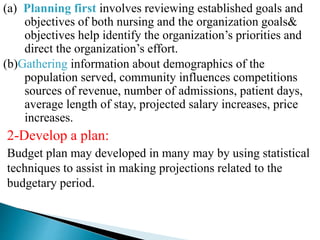
(a) Planning first involves reviewing established goals and
objectives of both nursing and the organization goals&
objectives help identify the organization’s priorities and
direct the organization’s effort.
(b)Gathering information about demographics of the
population served, community influences competitions
sources of revenue, number of admissions, patient days,
average length of stay, projected salary increases, price
increases.
2-Develop a plan:
Budget plan may developed in many may by using statistical
techniques to assist in making projections related to the
budgetary period.
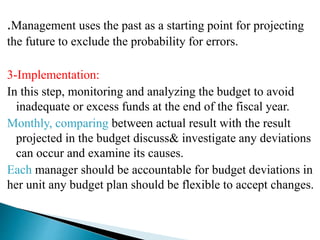
.Management uses the past as a starting point for projecting
the future to exclude the probability for errors.
3-Implementation:
In this step, monitoring and analyzing the budget to avoid
inadequate or excess funds at the end of the fiscal year.
Monthly, comparing between actual result with the result
projected in the budget discuss& investigate any deviations
can occur and examine its causes.
Each manager should be accountable for budget deviations in
her unit any budget plan should be flexible to accept changes.
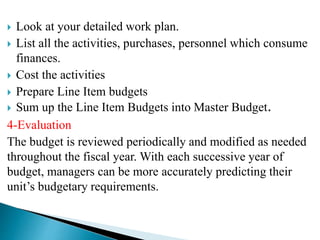
 Look at your detailed work plan.
 List all the activities, purchases, personnel which consume
finances.
 Cost the activities
 Prepare Line Item budgets
 Sum up the Line Item Budgets into Master Budget.
4-Evaluation
The budget is reviewed periodically and modified as needed
throughout the fiscal year. With each successive year of
budget, managers can be more accurately predicting their
unit’s budgetary requirements.
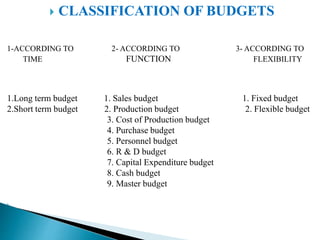
 CLASSIFICATION OF BUDGETS
1-ACCORDING TO 2- ACCORDING TO 3- ACCORDING TO
TIME FUNCTION FLEXIBILITY
1.Long term budget 1. Sales budget 1. Fixed budget
2.Short term budget 2. Production budget 2. Flexible budget
3. Cost of Production budget
4. Purchase budget
5. Personnel budget
6. R & D budget
7. Capital Expenditure budget
8. Cash budget
9. Master budget

1-According To Time:
 Long Term
 Short Term
1-Long term Budget
-Long-term budgets are prepared for those organizations,
which deal in regular product line.
-Here organizations are not supposed to change their
proceedings in short time periods.
2-Short term Budget
Short term budgets are prepared for short time periods which
work for seasonal product line.
2- According To Function:
1. SALES BUDGET:
 Sales budget is the most important budget based on which all the
other budgets are built up. This budget is a forecast of quantities and
values of sales to be achieved in a budget period.
2. PRODUCTION BUDGET:
 Production budget involves planning the level of production which
in turn involves the answer to the following questions:
a.What is to be produced?
b. When is it to be produced?
c. How is it to be produced?
d. Where is it to be produced?
3. COST OF PRODUCTION BUDGET
This budget is an estimate of cost of output planned
for a budget period and may be classified into :
• Material Cost Budget
• Labor Cost Budget
• Overhead Cost Budget
4. PURCHASE BUDGET:
This budget provides information about the materials to
be acquired from the market during the budget period.
5. PERSONNEL BUDGET:
This budget gives an estimate of the requirements of direct
labor essential to meet the production target.
This budget may be classified into –
a. Labor requirement budget
b. Labor recruitment budget
6. RESEARCH AND DEVELOPMENT BUDGET:
This budget provides an estimate of expenditure to be
incurred on R & D during the budget period.
A R&D budget is prepared taking into consideration the
research projects in hand and new R & D projects to be taken up.
7. CAPITAL EXPENDITURE BUDGET:
This is an important budget providing for acquisition of assets
necessitated by the following factors:
a. Replacement of existing assets.
b. Purchase of additional assets to meet increased production
c. Installation of improved type of machinery to reduce
costs.
8. CASH BUDGET:
This budget gives an estimate of the anticipated receipts and
payments of cash during the budget period.
Cash budget makes the provision for minimum cash
balance to be maintained at all times.
9. MASTER BUDGET:
CIMA defines this budget as “ The summary budget incorporating
its component functional budget and which is finally approved,
adopted and employed”.
Thus master budget is a summary of all functional budgets in
capsule form available in one report.
3- According To Flexibility:
1-FIXED BUDGET:
This is defined as a budget which is designed to remain
unchanged irrespective of the volume of output or turnover
attained.
This budget will, therefore, be useful only when the actual
level of activity corresponds to the budgeted level of activity.
2-FLEXIBLE BUDGET:
CIMA defines this budget as one “ which, by recognizing the
difference in behaviour between fixed and variable costs in
relation to fluctuations in output, turnover or other variable
factors such as number of employees, is designed to change
appropriately with such fluctuations”.
Advantages And Disadvantages Of Budget
Advantages of budget
1.Ensure the most effective use of financial and non financial
resources.
2.Establish a frame of reference for managerial decisions.
3.Motivate employees by bringing them together to achieve
common goals.
4.Facilitate work coordination across the entire organization
through communication by identifying who is responsible for
what.
5.Identify potential trouble spots so corrective action can be
taken.
6. Help employees learn from the experience.
7. Help organization in evaluating its progress.
Disadvantages of budget
1-Budgets convert all aspects of organizational performance
into monetary values for a single comparable unit of
measurement.
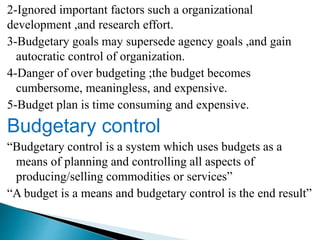
2-Ignored important factors such a organizational
development ,and research effort.
3-Budgetary goals may supersede agency goals ,and gain
autocratic control of organization.
4-Danger of over budgeting ;the budget becomes
cumbersome, meaningless, and expensive.
5-Budget plan is time consuming and expensive.
Budgetary control
“Budgetary control is a system which uses budgets as a
means of planning and controlling all aspects of
producing/selling commodities or services”
“A budget is a means and budgetary control is the end result”
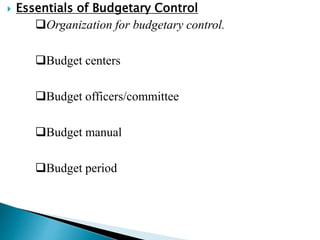
 Essentials of Budgetary Control
Organization for budgetary control.
Budget centers
Budget officers/committee
Budget manual
Budget period
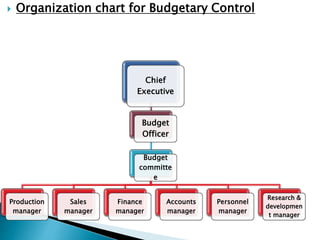
 Organization chart for Budgetary Control
Chief
Executive
Budget
Officer
Budget
committe
e
Production
manager
Sales
manager
Finance
manager
Accounts
manager
Personnel
manager
Research &
developmen
t manager
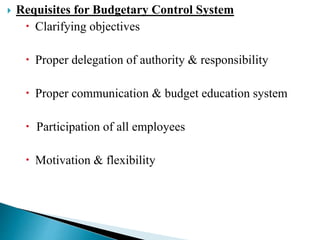
 Requisites for Budgetary Control System
 Clarifying objectives
 Proper delegation of authority & responsibility
 Proper communication & budget education system
 Participation of all employees
 Motivation & flexibility
 The role of nurse administrator in budgeting
-The nurse administrator is responsible for formulating
nursing service department budget . This budget states quality
, size of nursing personnel, amount and type of equipment,
physical facilities and other resources that should be available
for nursing practice and research , nursing service department
budget is derived from total budget of the organization.
-Should be participated in planning budget.
-Identifying short and long term unit needs, thus inspiring
proactive rather than reactive fiscal planning.
-Is knowledgeable about political, social and economic
factors that shape fiscal planning in health care today.
-Demonstrates flexibility in fiscal goals setting in arapidly
changing system.
-Anticipates ,recognizes and creatively problem solves
budgetary constraints.
-Influences and inspires group members to become active in
short and long range fiscal planning.
-Ensures that client safety is not jeopardized by cost
constraints.
-The administrator should support the budget when the
budget is allotted.
Staff canactually affect the organization’s finances .to avoid
negative effect:
1. Decrease misuse of sick time
2. Decrease excessive overtime or turnover,and wasteful use
of resources
3. The manger plays akey role in explaining the
organization’sfinancial goals and how each individual is
responsible for helping the organization meet these goals
4. Increasing employee awareness about to safe supplies
tominimizing costs
5-techniques to decrease absenteeism and turnover may
be instituted
6-displaying equipment costs on supply sticker or
requisitions
7-participation in quality improvement and action teams
also serves to inform staff of cost factor
THANK You

Managing costs and budget

  • 1.
  • 2.
    OUT LINES -Introduction - DefinitionOf Budget. -Importance Of Budget -Purposes Of Budget -Characteristics Of Good Budget. -Budget In Health Care Systems. -Budgeting Process.
  • 3.
    OUT LINES CONT, -Types(classification)Of Budget -Advantages And Disadvantages Of Budget -Budgetary Control -The role of nurse administrator in budgeting -References
  • 4.
    Introduction One of themost important factors contributing to changes in health care and the role of the nurse manager is the economic climate. It is crucial that nurses be able to allocate resources effectively, plan and develop different types of budgets and monitor expenditures. -Attention to the budgeting process is the first step to understanding how to use resources most effectively
  • 5.
     Definition OfBudget Budget is a financial plan to estimate the income and expenditure for a certain period of time(usually one year). Budget is a plan that uses numerical data to predict the activities of an organization over a period of time. Budgets detail how resources will be acquired and used to support planned services within the defined time period.
  • 6.
     Importance OfBudget 1. It sets a frame work for policy formulation 2. Budgeting is a means of policy implementation 3. A budget is a means of legal control 4. It is a tool of accountability 5. It is a tool of management 6. It is an instrument of economic policy Purposes Of Budget  To compare budgeted costs with actual costs at the same level of activity  To help in controlling costs  To plan product levels  To compare like with like
  • 7.
     Characteristics OfGood Budget . • Good budgeting should involve persons at different levels while preparing the budgets. • There should be proper fixation of authority and responsibility. . • The target of budget should be realistic, if targets are difficult to be achieved then they will not enthuse the persons concerned • A good accounting system is also essential to make the budgeting successful. . • Budgeting system should have whole hearted support of the top management. • The employees should be imparted budgeting education.
  • 8.
    -Budget In HealthCare Systems  Budgets are basic for finance, more than a forecast of income and expenditure.  The financial system consists of laws,policies,regulations,procedures and proforma related to the collection and expenditure of government money.  It is designed to support health personnel as they carryout their program and to protect government money from being misused or wasted.  In government setting, financial resources available to health services are less or very limited.  In which about 60% of the budget allocated is required to be spent on salaries and wages and remaining percentage of budget spent on stores and consumables include druges,equipment and other medical supplies.
  • 9.
     Budgeting Process Budgetingis a process of planning and controlling future operation by comparing actual result with planned expectations. 1- Determine the requirements of budget. 2- Develop a plan. 3- Implementation. 4- Evaluation. 1- Determine the requirements of budget: Effective budget occur when all personnel using resources are involved in the press.
  • 10.
    (a) Planning firstinvolves reviewing established goals and objectives of both nursing and the organization goals& objectives help identify the organization’s priorities and direct the organization’s effort. (b)Gathering information about demographics of the population served, community influences competitions sources of revenue, number of admissions, patient days, average length of stay, projected salary increases, price increases. 2-Develop a plan: Budget plan may developed in many may by using statistical techniques to assist in making projections related to the budgetary period.
  • 11.
    .Management uses thepast as a starting point for projecting the future to exclude the probability for errors. 3-Implementation: In this step, monitoring and analyzing the budget to avoid inadequate or excess funds at the end of the fiscal year. Monthly, comparing between actual result with the result projected in the budget discuss& investigate any deviations can occur and examine its causes. Each manager should be accountable for budget deviations in her unit any budget plan should be flexible to accept changes.
  • 12.
     Look atyour detailed work plan.  List all the activities, purchases, personnel which consume finances.  Cost the activities  Prepare Line Item budgets  Sum up the Line Item Budgets into Master Budget. 4-Evaluation The budget is reviewed periodically and modified as needed throughout the fiscal year. With each successive year of budget, managers can be more accurately predicting their unit’s budgetary requirements.
  • 13.
     CLASSIFICATION OFBUDGETS 1-ACCORDING TO 2- ACCORDING TO 3- ACCORDING TO TIME FUNCTION FLEXIBILITY 1.Long term budget 1. Sales budget 1. Fixed budget 2.Short term budget 2. Production budget 2. Flexible budget 3. Cost of Production budget 4. Purchase budget 5. Personnel budget 6. R & D budget 7. Capital Expenditure budget 8. Cash budget 9. Master budget 
  • 14.
    1-According To Time: Long Term  Short Term 1-Long term Budget -Long-term budgets are prepared for those organizations, which deal in regular product line. -Here organizations are not supposed to change their proceedings in short time periods. 2-Short term Budget Short term budgets are prepared for short time periods which work for seasonal product line.
  • 15.
    2- According ToFunction: 1. SALES BUDGET:  Sales budget is the most important budget based on which all the other budgets are built up. This budget is a forecast of quantities and values of sales to be achieved in a budget period. 2. PRODUCTION BUDGET:  Production budget involves planning the level of production which in turn involves the answer to the following questions: a.What is to be produced? b. When is it to be produced? c. How is it to be produced? d. Where is it to be produced?
  • 16.
    3. COST OFPRODUCTION BUDGET This budget is an estimate of cost of output planned for a budget period and may be classified into : • Material Cost Budget • Labor Cost Budget • Overhead Cost Budget 4. PURCHASE BUDGET: This budget provides information about the materials to be acquired from the market during the budget period.
  • 17.
    5. PERSONNEL BUDGET: Thisbudget gives an estimate of the requirements of direct labor essential to meet the production target. This budget may be classified into – a. Labor requirement budget b. Labor recruitment budget 6. RESEARCH AND DEVELOPMENT BUDGET: This budget provides an estimate of expenditure to be incurred on R & D during the budget period. A R&D budget is prepared taking into consideration the research projects in hand and new R & D projects to be taken up.
  • 18.
    7. CAPITAL EXPENDITUREBUDGET: This is an important budget providing for acquisition of assets necessitated by the following factors: a. Replacement of existing assets. b. Purchase of additional assets to meet increased production c. Installation of improved type of machinery to reduce costs. 8. CASH BUDGET: This budget gives an estimate of the anticipated receipts and payments of cash during the budget period. Cash budget makes the provision for minimum cash balance to be maintained at all times.
  • 19.
    9. MASTER BUDGET: CIMAdefines this budget as “ The summary budget incorporating its component functional budget and which is finally approved, adopted and employed”. Thus master budget is a summary of all functional budgets in capsule form available in one report. 3- According To Flexibility: 1-FIXED BUDGET: This is defined as a budget which is designed to remain unchanged irrespective of the volume of output or turnover attained. This budget will, therefore, be useful only when the actual level of activity corresponds to the budgeted level of activity.
  • 20.
    2-FLEXIBLE BUDGET: CIMA definesthis budget as one “ which, by recognizing the difference in behaviour between fixed and variable costs in relation to fluctuations in output, turnover or other variable factors such as number of employees, is designed to change appropriately with such fluctuations”. Advantages And Disadvantages Of Budget Advantages of budget 1.Ensure the most effective use of financial and non financial resources. 2.Establish a frame of reference for managerial decisions.
  • 21.
    3.Motivate employees bybringing them together to achieve common goals. 4.Facilitate work coordination across the entire organization through communication by identifying who is responsible for what. 5.Identify potential trouble spots so corrective action can be taken. 6. Help employees learn from the experience. 7. Help organization in evaluating its progress. Disadvantages of budget 1-Budgets convert all aspects of organizational performance into monetary values for a single comparable unit of measurement.
  • 22.
    2-Ignored important factorssuch a organizational development ,and research effort. 3-Budgetary goals may supersede agency goals ,and gain autocratic control of organization. 4-Danger of over budgeting ;the budget becomes cumbersome, meaningless, and expensive. 5-Budget plan is time consuming and expensive. Budgetary control “Budgetary control is a system which uses budgets as a means of planning and controlling all aspects of producing/selling commodities or services” “A budget is a means and budgetary control is the end result”
  • 23.
     Essentials ofBudgetary Control Organization for budgetary control. Budget centers Budget officers/committee Budget manual Budget period
  • 24.
     Organization chartfor Budgetary Control Chief Executive Budget Officer Budget committe e Production manager Sales manager Finance manager Accounts manager Personnel manager Research & developmen t manager
  • 25.
     Requisites forBudgetary Control System  Clarifying objectives  Proper delegation of authority & responsibility  Proper communication & budget education system  Participation of all employees  Motivation & flexibility
  • 26.
     The roleof nurse administrator in budgeting -The nurse administrator is responsible for formulating nursing service department budget . This budget states quality , size of nursing personnel, amount and type of equipment, physical facilities and other resources that should be available for nursing practice and research , nursing service department budget is derived from total budget of the organization. -Should be participated in planning budget. -Identifying short and long term unit needs, thus inspiring proactive rather than reactive fiscal planning. -Is knowledgeable about political, social and economic factors that shape fiscal planning in health care today.
  • 27.
    -Demonstrates flexibility infiscal goals setting in arapidly changing system. -Anticipates ,recognizes and creatively problem solves budgetary constraints. -Influences and inspires group members to become active in short and long range fiscal planning. -Ensures that client safety is not jeopardized by cost constraints. -The administrator should support the budget when the budget is allotted.
  • 28.
    Staff canactually affectthe organization’s finances .to avoid negative effect: 1. Decrease misuse of sick time 2. Decrease excessive overtime or turnover,and wasteful use of resources 3. The manger plays akey role in explaining the organization’sfinancial goals and how each individual is responsible for helping the organization meet these goals 4. Increasing employee awareness about to safe supplies tominimizing costs
  • 29.
    5-techniques to decreaseabsenteeism and turnover may be instituted 6-displaying equipment costs on supply sticker or requisitions 7-participation in quality improvement and action teams also serves to inform staff of cost factor
  • 30.